
































































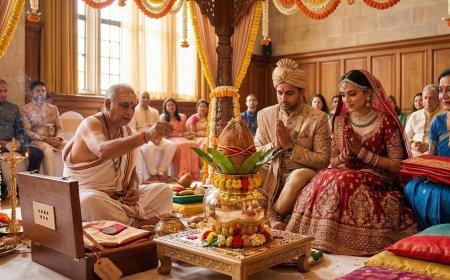






The First Steps She Takes as His Wife: How Indian Cultures Welcome the Bride Across the Threshold
A comprehensive editorial analysis of Griha Pravesh and related Indian bride entry rituals, examining their historical roots, regional variations, and emotional significance for NRI families. The article explores how communities across Punjab, Rajasthan, Tamil Nadu, Bengal, Maharashtra, and the Himalayan regions adapt threshold ceremonies abroad. It provides practical guidance for performing Griha Pravesh in major diaspora hubs including Toronto, London, Melbourne, Houston, and Dubai, offering culturally grounded insight for couples planning traditional Indian weddings outside India.

In Indian mythology, love is never stationary. From forests to kingdoms, from exile to homecoming, sacred love stories are built on journeys — physical, spiritual, cosmic. For NRIs planning weddings across continents, these ancient narratives feel uncannily familiar: love tested by distance, strengthened by separation, sanctified by return. This is a cultural map of how travel itself becomes the sacred thread that binds two souls.
You grew up hearing these stories in fragments.
A grandmother’s voice over crackling WhatsApp calls. A temple priest explaining a verse too quickly. A half-remembered Doordarshan rerun playing in the background while your parents packed suitcases for yet another move abroad.
Now you are in London or Toronto or Dubai, planning a wedding that will require guest lists across time zones and ceremonies in two countries. And suddenly, the old stories feel less like mythology and more like biography.
Because in Indian mythology, love always travels.
🌟 DID YOU KNOW?
• The epic Ramayana spans over 24,000 verses — much of it centered on exile, separation, and a 14-year journey before reunion.
• In Mahabharata, nearly every major relationship unfolds during travel — forest exile, pilgrimage, battlefield departure — reinforcing that transformation happens on the road.
• According to diaspora research by the Indian Ministry of External Affairs, over 32 million people of Indian origin now live outside India — making “love across distance” not just mythological, but a lived cultural inheritance.
WHAT IS THE SYMBOLISM OF TRAVEL IN INDIAN MYTHOLOGICAL LOVE STORIES?
Indian mythological love stories are rarely confined to palaces and wedding mandaps. They unfold across forests, rivers, mountains, and even worlds beyond earth. Travel is not a backdrop — it is the crucible in which love proves itself.
In the Ramayana, when Rama accepts वनवास (Vanvaas — forest exile), Sita chooses to accompany him. This is not passive devotion. It is an active crossing of thresholds — from palace comfort to wilderness uncertainty. The forest becomes their shared testing ground. Later, her abduction and his ocean-crossing to Lanka transform geography into emotional terrain. Distance here represents trial; the journey becomes proof.
In the Mahabharata, Arjuna and Draupadi endure exile together. Their relationship evolves not in royal halls but in forests and pilgrimages. The concept of तीर्थयात्रा (Tirtha Yatra — sacred pilgrimage) transforms physical travel into spiritual cleansing. Movement signifies growth.
Even divine love, like that of Krishna and Radha, is rooted in separation. Krishna leaves Vrindavan. The ache of that departure becomes the foundation of विरह (Viraha — sacred longing), a concept that Indian philosophy treats as spiritually elevating.
Step by step, these narratives move from union, to separation, to quest, to reunion — mirroring the emotional choreography of countless NRI couples today.
Travel in these stories is not escape. It is initiation.
COMMUNITY COMPARISON TABLE
| Community / State | Local Name of Journey Motif | Key Tradition | How NRIs Abroad Adapt It |
|---|---|---|---|
| Himachali | Dev Parikrama | Couple visits local deity shrines post-wedding | Temple visits in diaspora cities like Toronto or Birmingham |
| Garhwali | Tehri Bidai Journey | Bride symbolically crosses mountain threshold | Scenic outdoor vow exchanges in Vancouver |
| Kumaoni | Kul Devta Yatra | Newlyweds seek ancestral blessings | Virtual darshan via live-stream from Uttarakhand temples |
| Ladakhi | Goncha Blessing Visit | Couple travels to monastery for prayers | Buddhist ceremony additions in Melbourne |
| Kashmiri Pandit | Vyug & Temple Visit | Visit to family temple after marriage | Community hall rituals in New Jersey with priest flown in |
| Punjabi | Doli Departure | Bride’s physical departure to groom’s home | Emotional airport send-offs in Calgary |
| Marathi | Grihapravesh | Bride enters new home after travel | Symbolic apartment threshold rituals in Dubai Marina |
| Tamil | Kashi Yatra | Groom symbolically leaves for renunciation before returning | Playful reenactment in Sydney wedding halls |
| Bengali | Bidaay & Bou Bhaat | Bride’s departure and formal welcome | Reception hosted weeks later when couple returns to India |
| Rajasthani | Padharo Sa | Bride welcomed after journey | Destination palace weddings in Jaipur with global guests |
THE MEANING BEHIND THE JOURNEY
In the Indian worldview, life itself is संसार (Samsara — cyclical journey of existence). Marriage is not static companionship; it is shared movement through duty, desire, and destiny.
Travel symbolizes transition — from daughter to wife, from prince to protector, from individual to partnership. The ancient concept of धर्म (Dharma — righteous duty) often reveals itself only when comfort is stripped away. Forests and exile are metaphors for uncertainty. Crossing oceans represents courage. Returning home symbolizes integration.
For NRIs, this symbolism feels visceral. Leaving India for education or work was your own vanvaas. Falling in love abroad is your pilgrimage. Planning a wedding across cultures is your ocean crossing.
At its core, these stories teach that love is not proven by proximity but by perseverance.
And if you ever need to explain it to a non-Indian partner, you can say: In our stories, love is sacred because it survives the journey.
DOING THE JOURNEY SYMBOLISM ABROAD: THE PRACTICAL REALITY
When you are planning a wedding in Southall or Mississauga or Harris Park in Sydney, you are already living the metaphor.
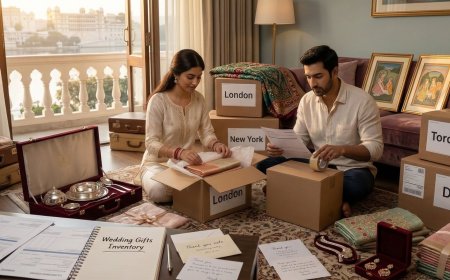
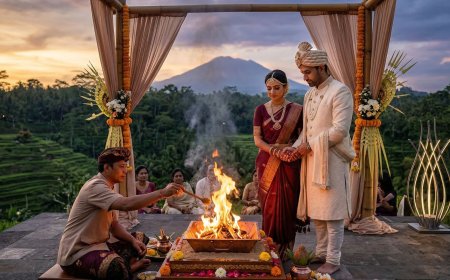
Many NRI couples consciously incorporate symbolic travel into their ceremonies. A Kashi Yatra reenactment works beautifully in UK venues — but remember that many historic halls restrict open flames. If your priest requires a small हवन (Havan — sacred fire ritual), confirm smoke detector policies in advance. In London, sourcing ritual items is simple along Southall Broadway. In Toronto, Gerrard Street East remains a lifeline for kumkum, coconuts, and brass diyas. In Sydney, Harris Park offers everything from mango leaves to silk dhotis. In Houston, Hillcroft Avenue is your cultural artery. In Dubai, Meena Bazaar never fails.
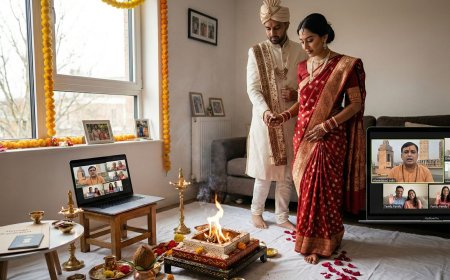
The bigger challenge is finding a region-specific priest. A Tamil Iyer priest for Kashi Yatra is different from a North Indian pandit interpreting exile symbolism. Start at least four months early. Ask community WhatsApp groups. Many priests now conduct hybrid ceremonies, coordinating via Zoom with elders in Chennai or Varanasi.
Time zones matter. If you want grandparents in India to witness a symbolic departure ritual, remember that 6 pm in Toronto is 4:30 am in Delhi. Schedule consciously.
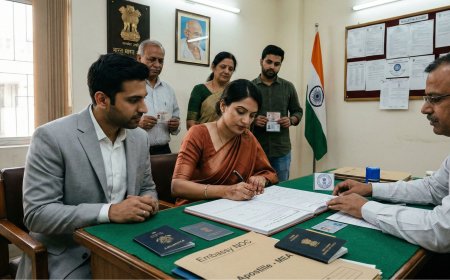
For couples marrying civilly first, consider placing the symbolic journey before the legal signing. It reframes paperwork as part of a sacred path.
You are not just recreating mythology. You are living it.
DOING THIS AS A DESTINATION WEDDING IN INDIA
Many NRIs choose to return to India precisely to reclaim this symbolism. Forest resorts in Uttarakhand echo the Ramayana’s wilderness motif. Palace weddings in Jaipur evoke royal departures. Temple towns like Rameswaram or Varanasi deepen pilgrimage themes.
Brief your local planner carefully. Explain that you want emphasis on journey symbolism, not just aesthetic ritual. Provide family customs in writing. Arrange printed ceremony cards explaining exile, pilgrimage, or Kashi Yatra for non-Indian guests.
When done thoughtfully, your destination wedding becomes more than spectacle. It becomes narrative closure.
WHAT YOU NEED: RITUAL CHECKLIST
Ritual Items
Coconut, rice grains, turmeric, kumkum, brass diya, symbolic walking stick for Kashi Yatra, small havan kund if permitted, printed explanation cards for guests.
People Required
Region-specific priest, two family elders to narrate story context, one coordinator managing live-stream to India.
Preparation Steps
Confirm venue fire rules. Source items locally two weeks prior. Rehearse symbolic walk so photographers capture the emotional arc. Coordinate India time zones.
For verified priests and culturally aligned planners abroad, NRI.Wedding maintains a curated global directory.
5 QUESTIONS NRI COUPLES ALWAYS ASK
Can we adapt these journey rituals in a hotel ballroom?
Yes. Symbolism matters more than geography. A few deliberate steps across the stage can carry the weight of an epic if narrated properly.
What if my partner isn’t Indian?
Explain the story beforehand. Provide printed translations. Invite them to participate actively. Mythology becomes inclusive when contextualized.
How do we find a priest who understands our regional nuance?
Community associations are key. Interview priests. Ask how they interpret Vanvaas or Kashi Yatra. Alignment matters.
Can grandparents in India participate live?
Absolutely. Assign a tech-savvy cousin. Test audio. Send them ceremony outlines in advance so they feel included, not confused.
Should we do this before or after our civil ceremony?
Most couples perform symbolic rituals before signing documents. It reframes legality as part of a sacred continuum.
THE EMOTIONAL ANGLE
You may not call it exile. But when you left India at eighteen, something shifted.
Your wedding planning now feels like stitching continents together. The priest chants in Sanskrit. Your partner’s family Googles translations. Your grandparents watch through a phone screen propped against a steel tumbler.
And when you take those symbolic steps — whether reenacting Kashi Yatra or honoring Vanvaas — you feel something ancient settle inside you.
Not homesickness.
Continuity.
Because love that survives airports and immigration lines understands what mythology has always known: distance refines devotion.
A MOMENT TO SMILE
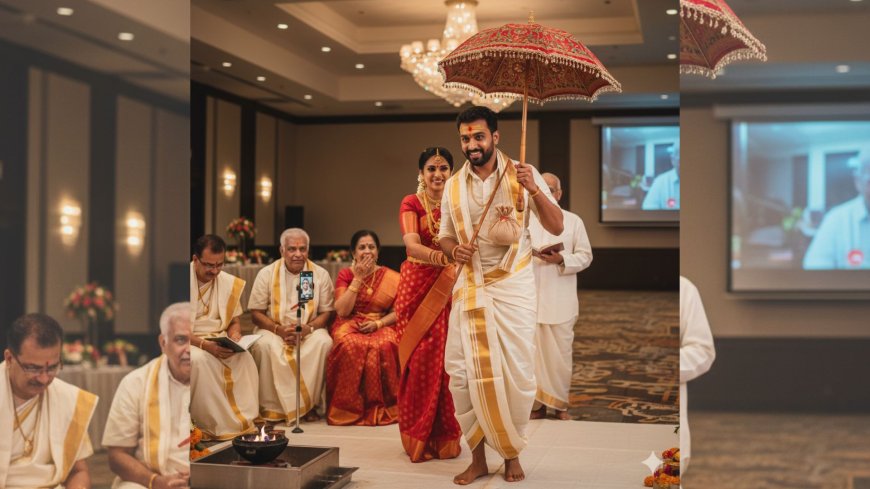
At a wedding in Mississauga, the groom dramatically began his Kashi Yatra walk — umbrella in hand, declaring renunciation. Halfway across the banquet hall, the fire alarm beeped because someone opened the kitchen door. Guests froze. The priest kept chanting. The bride’s grandmother shouted over FaceTime from Chennai, “Don’t you dare actually leave!”
Everyone burst into laughter. The groom turned around, right on cue, and the ritual resumed.
Years later, that false alarm is still the family’s favorite part of the story.
QUOTES FROM THE DIASPORA
“When we reenacted Vanvaas in Vancouver, it felt like we were honoring our own immigration story.” — Ananya R., Garhwali, Vancouver
“Watching my son symbolically return from Kashi Yatra in Houston made me feel we hadn’t lost anything by moving abroad.” — Meera S., Tamil, Houston
“I never understood Viraha until I planned a wedding across three time zones.” — Priyanka M., Bengali, London
Your Roots Travel With You
Indian mythology never promised easy love. It promised meaningful love — love tested by forests, oceans, exile, and return.
As an NRI couple, you are not diluting tradition by marrying abroad. You are expanding it. Every airport farewell, every hybrid ceremony, every symbolic step across a ballroom stage is proof that culture is portable.
NRI.Wedding connects you with region-specific priests, planners, photographers, and checklists who understand both epic symbolism and immigration paperwork. Because bridging worlds requires both poetry and precision.
Your love crossed oceans. Let your roots cross with it.
Indian mythological journey symbolism — from Ramayana exile to Kashi Yatra — continues to shape NRI weddings across London, Toronto, Sydney, Houston, and Dubai.
What's Your Reaction?
 Like
0
Like
0
 Dislike
0
Dislike
0
 Love
0
Love
0
 Funny
0
Funny
0
 Angry
0
Angry
0
 Sad
0
Sad
0
 Wow
0
Wow
0