
























































Groom's Accessories Guide — Turbans, Safa, Jewelry and More: The Complete NRI Groom's Handbook
The NRI groom's accessories — the turban or safa that frames his face in every ceremony photograph, the kalgi that pins it, the kadas and haar that appear in the ring exchange and hand photographs, the juttis that complete the traditional look, and the dupatta, pocket square, and ceremonial sword that define the regional tradition being celebrated — receive a fraction of the planning attention that the sherwani receives, yet are visible in every image from the baraat to the reception. This complete guide covers everything NRI grooms need to know about wedding accessories — the turban versus safa distinction, all major regional headwear styles, the full groom's jewelry vocabulary by regional tradition, the accessory coordination table, the India shopping guide by accessory category, lead times for custom and ready-made pieces, the wedding morning dressing sequence, remote sourcing logistics for NRI grooms planning from abroad, and the five common accessory mistakes that leave the groom's look incomplete on the most photographed day of his life.


Groom's Accessories Guide: Turbans, Safa, Jewelry and More
The Details That Complete the Look
There is a specific moment in the NRI groom's wedding preparation that arrives — usually late in the planning process, usually after the sherwani has been selected and the footwear has been decided — when someone asks about the turban.
Not hypothetically. Specifically. Which style. Which fabric. Which colour in relation to the sherwani. Who will tie it. How long the tying takes. Whether the groom has ever worn one before and what the experience of wearing it for six hours feels like.
Most NRI grooms have not thought about any of this.
The sherwani received months of attention — showrooms visited, fabrics assessed, embroidery evaluated, fitting appointments scheduled. The turban, which frames the groom's face in every photograph taken from the front and defines the visual silhouette of the groom's look from every angle, was assumed to be something that would be sorted out closer to the time.
This assumption is understandable. In the visual conversation about Indian weddings, the bride's look receives the overwhelming majority of the attention — her outfit, her jewelry, her hair, her makeup — and the groom's accessories are treated as supporting detail rather than as decisions of genuine aesthetic consequence.
They are not supporting detail.
The turban or safa that the groom wears at his wedding frames his face in every ceremony photograph, defines the height and proportion of his overall silhouette, signals the cultural tradition he is celebrating within, and requires — if it is to look correct and feel comfortable across a full wedding day — specific knowledge, specific planning, and specific professional skill to execute properly.
The jewelry that he wears — the kaleere interaction, the ring exchange, the bracelet or kada that appears in the hand photographs — is visible in images that will be looked at for decades. The brooch or kalgi that pins the turban is a specific accessory with its own aesthetic vocabulary and its own cultural significance. The footwear, the pocket square, the buttonhole, the dupatta draping — each element of the groom's complete look is a decision with visual and cultural consequences that deserve more thought than most NRI grooms give them.
This guide gives them that thought.
The Cultural Framework: What the Groom's Accessories Actually Mean
Regional Traditions and Their Accessories
The accessories that are appropriate for an NRI groom's wedding look are determined — in the first instance — by the cultural and regional tradition of the wedding ceremony. Different Indian regional traditions have different conventions for groom's dress and accessories, and understanding which tradition the wedding is celebrating within is the starting point for all accessory decisions.
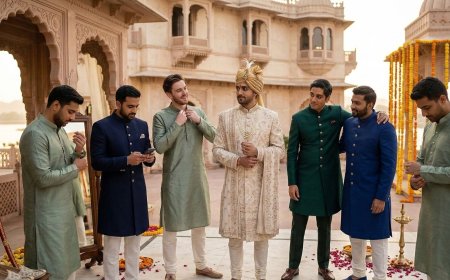
North Indian Hindu tradition — Punjabi, UP, Rajasthani, Gujarati: The North Indian groom's look is typically built around the sherwani and the turban or safa — the headwear that is the most visually distinctive element of the North Indian groom's appearance. The specific style of turban or safa varies by community and region — the Rajasthani pagri is different from the Punjabi dastar is different from the UP-style safa — and the specific style appropriate to the family's community is typically determined by family tradition rather than individual choice.
South Indian Hindu tradition — Tamil, Telugu, Kannada, Malayalam: The South Indian groom's traditional look typically involves a dhoti rather than a sherwani, and headwear — where present — takes the form of specific ceremonial pieces rather than the elaborate turban traditions of North India. Many South Indian grooms today wear contemporary sherwanis for the main ceremony, which creates a hybrid look that requires careful accessory integration.
Muslim tradition: The traditional Muslim groom's look — the sherwani with the sehra, the veil of flowers or tinsel that covers the groom's face during the baraat — is a specific cultural tradition with its own accessory vocabulary that includes the characteristic flower garland and the specific jewelry traditions of the community.
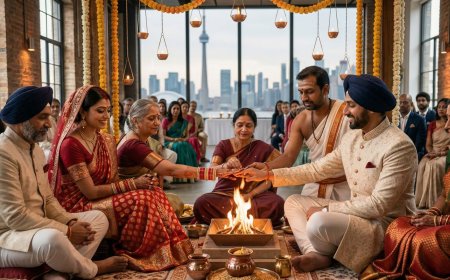
Sikh tradition: The Sikh groom's look is built around the dastar — the turban that is not merely a wedding accessory but a fundamental expression of Sikh identity — and the specific conventions of Sikh wedding dress that are rooted in religious tradition rather than regional fashion.
The honest starting point: Know which tradition the wedding is celebrating within, and understand the conventions of that tradition before making any accessory decision that departs from it. Departures from tradition are legitimate — but they should be conscious departures, made with full awareness of what the convention is and why the departure is being made.
The Turban and Safa: The Groom's Most Significant Accessory
The Turban vs. the Safa — Understanding the Difference
The terms turban and safa are often used interchangeably in NRI wedding planning conversations — which creates confusion because they are not the same thing, they are not worn the same way, and they do not create the same visual effect.
The turban — the pagri, dastar, or specific regional equivalent — is a structured headwear piece created by a specific wrapping technique applied to a length of fabric, typically several metres long, that produces a characteristic structural shape at the head. The North Indian wedding turban has specific regional styles — the Rajasthani pagri's fan-shaped front, the Punjabi dastar's tall structured form, the Marwari pagri's distinctive side drape — each produced by a different wrapping technique that requires a specialist.
The safa — also called a bandhani safa, a Rajasthani safa, or a wedding safa depending on the context — is a pre-tied or partially pre-tied headwear piece that creates a specific look without the full structural wrapping of the traditional turban. The safa is typically tied around the head with the fabric ends left to drape at one side, often decorated with a kalgi or brooch and sometimes with a trailing end of embroidered fabric.
The practical distinction: The traditional turban requires a specialist to tie it — on the wedding day, with the groom present, taking typically fifteen to thirty minutes depending on the style and length. The safa is more forgiving — some versions can be partially pre-tied and adjusted on the day, and the skill level required for a competent safa is lower than for a traditional turban. For NRI grooms who have no experience wearing either, the safa is typically the more accessible starting point.
The Major Turban and Safa Styles
The Rajasthani Pagri: The most visually dramatic of the North Indian wedding turban styles — the characteristic fan-shaped structure at the front, the elaborate draping at the sides, the often heavily embroidered or mirror-worked fabric. The Rajasthani pagri is among the most photographically compelling of the groom's headwear options — its scale and its visual complexity create a specific sense of occasion that simpler styles do not match.
For NRI grooms whose families have Rajasthani roots, the pagri is a natural cultural expression. For NRI grooms from other backgrounds who are drawn to the aesthetic, it is a legitimate choice — but the specific community conventions around pagri style and colour should be understood before departing from them.
The Punjabi Dastar: The Punjabi dastar — in its wedding context — is a structured turban with a specific height and symmetry that differs from the everyday Sikh dastar. The wedding dastar is typically in a fabric that coordinates with the sherwani, sometimes incorporating embellishment at the front, and is tied by a specialist in the specific Punjabi tying style. For Punjabi Sikh grooms, the dastar is not merely an accessory — it is a religious and cultural statement whose significance extends well beyond the aesthetic.
The Simple Safa: The basic wedding safa — a length of fabric wrapped around the head in a relatively simple pattern, with a trailing end and a kalgi or brooch — is the most accessible and most adaptable of the groom's headwear options. Its simplicity allows the sherwani's embroidery and the overall look to be the primary visual statement, with the safa providing the necessary cultural framing without competing for attention. For NRI grooms who are less comfortable with elaborate headwear, the simple safa is the dignified, culturally appropriate middle path.
The Jodhpuri Safa: The safa style associated with Jodhpur's wedding tradition — typically in the characteristic blue of the city, though wedding safas are made in any colour — with a specific draping style that creates a structured front panel and a trailing side drape. The Jodhpuri safa is among the most elegant of the wedding headwear options, with a visual refinement that works exceptionally well with contemporary and minimalist sherwani choices.
The Sehra — The Floral Veil: The sehra — the veil of flowers, strings of pearls, or tinsel strips that hangs over the groom's face during the baraat — is a specific accessory within certain North Indian and Muslim wedding traditions. The sehra is not merely decorative — it carries specific cultural significance within the traditions that use it, providing a symbolic separation between the groom's pre-wedding and wedding-day identity. For NRI grooms from traditions where the sehra is customary, it is a meaningful cultural element. For NRI grooms considering adopting it as an aesthetic choice from outside its traditional context, understanding its cultural significance is appropriate.
The Colour Coordination of the Turban
The colour relationship between the turban and the sherwani is one of the most frequently discussed and most frequently misunderstood elements of the groom's wedding look.
The general principle — that the turban should coordinate with the sherwani — is correct but incomplete. The specific nature of the coordination matters significantly. A turban in exactly the same fabric and colour as the sherwani creates a monochromatic look that can be sophisticated or overwhelming depending on the specific combination. A turban in a colour that appears elsewhere in the sherwani's embroidery — picking up an accent colour from the embroidery thread rather than the base fabric — creates a more subtle and more visually interesting coordination.
The turban colour also interacts with the bride's outfit colour. In many North Indian wedding traditions, the turban is intentionally coordinated with the bride's outfit — the groom's turban incorporating the red or pink of the bride's lehenga — creating a visual connection between the two looks in the ceremony photographs. This coordinated approach requires early communication between the groom's and bride's outfit teams.
Who Ties the Turban: The Specialist Question
The turban for an NRI groom's wedding must be tied by someone who knows what they are doing. This is not a task for a helpful family member who has seen it done before. It is a skill — a specific, practised, physically demanding skill — that produces either a correct result or an incorrect one, and the difference is visible in every photograph.
The options for the NRI groom:
Most large Indian wedding hotels and most destination wedding venues have access to specialists who tie wedding turbans as a dedicated service. The wedding planner should know the relevant specialist and should confirm their availability and their familiarity with the specific style required well in advance of the wedding day.
In cities with large Sikh or Rajasthani communities — Delhi, Jaipur, Amritsar, Mumbai — turban-tying specialists are accessible and the service is well-organised. In destination wedding locations that are further from the major centres, the specialist may need to travel to the venue — which requires advance booking and travel arrangements.
The turban tying session on the wedding morning should be allocated adequate time — a minimum of twenty to thirty minutes for most traditional styles, longer for elaborate Rajasthani pagri styles. It should happen after the groom's grooming routine is complete but before the sherwani is put on — the movement required to tie the turban can displace the sherwani's arrangement if the order is reversed.
The Jewelry: What NRI Grooms Actually Wear
The Cultural Vocabulary of Groom's Jewelry
Indian groom's jewelry has a specific vocabulary — different from Western groom's jewelry and different from Indian bride's jewelry — that is rooted in specific cultural traditions and carries specific ceremonial significance.
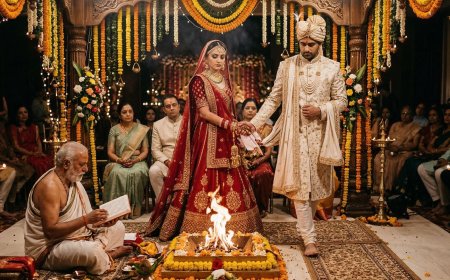
The Mala — The Floral Garland: The fresh flower garland that is placed around the groom's neck at specific moments in the ceremony — the jaimala exchange in North Indian Hindu weddings, where the bride and groom garland each other — is technically an accessory rather than jewelry, but its visual presence in the ceremony photographs makes it among the most significant elements of the groom's ceremonial appearance. The specific flowers used in the jaimala — typically white flowers with accents of orange and red — are chosen by the florist and the family, and the groom's role is to wear it gracefully rather than to select it.
The Haar — The Gold Chain or Necklace: The traditional groom's haar — a heavy gold chain or necklace worn with the sherwani — is part of the ceremonial groom's look in many North Indian traditions. Contemporary NRI grooms vary widely in their comfort with this piece — some wear it as a cultural statement, others find it visually incompatible with their sherwani's embroidery. The key assessment question is whether the haar adds to or competes with the sherwani's existing visual weight.
The Kadas and Bangles: The kada — a thick metal bracelet, typically gold or silver — is among the most commonly worn groom's jewelry pieces across regional traditions. The Sikh kada carries specific religious significance. The decorative gold or silver kada worn by non-Sikh grooms is a more purely aesthetic choice. The kada appears in the ring exchange photographs and in the ceremony hand photographs — making its condition and quality visible in the permanent record.
The Ring: The engagement ring and the wedding ring — if the couple is exchanging rings as part of the ceremony — are the groom's jewelry pieces that receive the closest photographic attention. The ring exchange is typically one of the most photographed moments of the entire wedding ceremony. The groom's rings should be clean, should fit correctly, and should have been assessed against the color of the sherwani fabric and the shade of the gold or jewelry being worn to ensure visual coherence.
The Brooch or Kalgi: The kalgi — the decorative brooch pinned to the front of the turban — is among the most visually prominent accessories of the traditional North Indian groom's look. The kalgi's form varies from the elaborate — a tall, feathered ornament in gold with precious stone settings — to the understated — a simple pin in precious metal. The kalgi is visible in every front-facing photograph of the groom and its scale and quality should be proportionate to the overall formality and investment level of the look.
The Groom's Jewelry by Regional Tradition
| Regional Tradition | Typical Jewelry Pieces | Key Accessory | What to Avoid |
|---|---|---|---|
| North Indian Hindu (Punjabi, UP) | Haar, kadas, ring, kalgi on turban | The kalgi — quality and scale matter | Over-layering jewelry with a heavily embroidered sherwani |
| Rajasthani | Elaborate haar, armbands, kadas, ear stud in some communities | The pagri with kalgi — the dominant visual statement | Under-investing in the turban accessories |
| South Indian Hindu | Minimal — ring, occasional gold chain | Dhoti accessories — the specific drape and its pins | Heavy North Indian jewelry with South Indian traditional dress |
| Gujarati | Kadas, ring, occasional haar | The safa and its coordination with the bride's bandhani | Over-formalising a traditionally more relaxed aesthetic |
| Punjabi Sikh | Kada (religious), ring | The dastar — the primary expression | Any jewelry that conflicts with the religious significance of the dastar |
| Muslim | Haar, kadas, ring | The sehra if worn — its quality and flower selection | Mixing incompatible aesthetic vocabularies |
| Bengali | Dhoti with specific accessories, occasional chain | The specific draping of the dhoti | Substituting sherwani without considering accessory compatibility |
The Complete Accessories Guide: Every Element
The Footwear — Juttis and Mojris
The traditional North Indian groom's footwear — the jutti or mojri, the hand-embroidered flat shoe of Punjabi and Rajasthani tradition — is one of the most charming and most culturally specific accessories of the Indian wedding look. The jutti appears in specific photographs — the feet photograph that many Indian wedding photographers take during the ceremony, the outdoor shots where the footwear is visible against the venue's surface — and its condition, its embroidery quality, and its colour coordination with the sherwani deserve the same attention given to any other visible accessory.
The specific considerations for NRI grooms selecting juttis: the sizing of traditional handmade juttis does not correspond to standard international shoe sizing — a fitting in person is strongly preferable to online purchase. The leather sole of a traditional jutti is not designed for the outdoor surfaces of many destination wedding venues — consider whether a rubber sole replacement is appropriate for the specific venue.
For South Indian grooms in traditional dress, the footwear is typically simple flat sandals in leather or a leather-look material that complements the dhoti's formal simplicity. For grooms wearing more contemporary wedding attire, formal shoes in an appropriate colour are a legitimate choice that does not conflict with the cultural register of the outfit.
The Dupatta or Stole
The groom's dupatta — worn across the shoulder or draped across both shoulders depending on the regional tradition — is a specific accessory within certain North Indian wedding traditions that is sometimes overlooked in groom's outfit planning.
The groom's dupatta is typically in a fabric that coordinates with the sherwani's lining or embroidery accent colour — or in the bride's outfit colour for the garland exchange photographs. Its draping position varies by community tradition, and the specific way it should be worn — which shoulder, how much of it should be visible, whether it is pinned — is a conversation worth having with the family before the wedding day.
The Pocket Square and Buttonhole
For NRI grooms whose wedding attire incorporates Western elements — the bandhgala jacket, the indo-western suit, or any sherwani design with a defined breast pocket — the pocket square is a small but visible detail that rewards attention.
The pocket square should coordinate with but not precisely match the sherwani fabric — a pocket square in an accent colour or pattern that references but does not replicate the embroidery creates a more sophisticated result than an exact match. The pocket square should be folded correctly — the flat fold is the most formal and most versatile, appropriate across the range of sherwani styles.
The buttonhole — a fresh flower worn in the lapel of a structured jacket — is a Western accessory that has been naturalised into the NRI groom's look over the past two decades. Its flower should be in a colour that coordinates with the wedding's floral palette and should be fresh enough to last the duration of the event for which it is worn.
The Ceremonial Sword — The Kirpan and Decorative Swords
In certain North Indian wedding traditions — particularly Rajasthani and some Punjabi communities — the groom carries or wears a ceremonial sword as part of the wedding procession. This is a specific cultural tradition with its own accessory requirements — the sword's scabbard, the belt or sash from which it hangs, and the specific carrying convention of the tradition.
For NRI grooms from traditions where the ceremonial sword is conventional, advance planning for the sword's procurement and the specific carrying arrangement is part of the accessories planning. For destination weddings in venue settings, confirming with the venue that the ceremonial sword is accommodated within their event policies is a practical step.
The Accessory Coordination Table
The relationship between the various groom's accessories and how they work together — or conflict — is the most complex dimension of the accessories planning.
| Element | Coordinates With | Potential Conflict | Resolution |
|---|---|---|---|
| Turban/Safa colour | Sherwani embroidery accent, bride's outfit | Clashing with sherwani base colour | Pick up embroidery accent rather than base fabric colour |
| Kalgi scale | Overall formality level of look | Elaborate kalgi on minimalist sherwani | Match kalgi scale to sherwani embellishment level |
| Haar weight | Sherwani neckline and collar design | Heavy haar with heavily embroidered sherwani neckline | Assess visual weight balance — one or the other dominant |
| Kada metal | Ring metal, sherwani hardware | Mixed metals without intention | Commit to gold or silver across all metal accessories |
| Jutti embroidery | Sherwani colour and embroidery | Competing embroidery pattern | Coordinate jutti colour with sherwani, simplify if sherwani is complex |
| Sehra length | Groom's height and baraat setting | Very long sehra impractical in wind or movement | Discuss length with supplier relative to baraat conditions |
| Dupatta colour | Bride's outfit, sherwani lining colour | Dupatta colour competing with both | Use neutral or accent colour that bridges bride and groom outfits |
| Pocket square | Jacket style and embroidery | Casual fold on formal bandhgala | Always flat fold for structured jacket styles |
The NRI Groom's Accessories Shopping Guide
Where to Buy in India
The accessories for an NRI groom's wedding look require specific shopping destinations — not the general clothing market but the specific markets and suppliers where the relevant craft traditions are concentrated.
Turbans and safas: Chandni Chowk in Delhi — the Kinari Bazaar section specifically — is the most comprehensive source for wedding turban and safa fabric in North India. The fabric is sold by the metre and the tying is a separate service. In Jaipur, the old city markets around Johari Bazaar carry the specific Rajasthani pagri fabrics and the city has a concentration of turban-tying specialists.
The kalgi: Jewellery markets in Jaipur — Johari Bazaar specifically — carry the widest range of kalgi options in India, from the most elaborate heritage pieces to contemporary minimal interpretations. Delhi's Dariba Kalan jewellery market is the equivalent source for the Delhi wedding market.
Juttis and mojris: Punjabi Bagh market in Delhi and the old city market in Jaipur are the primary sources for quality handmade juttis. Quality varies significantly — assess the embroidery technique, the sole construction, and the stitching quality before purchase rather than relying on appearance alone.
Kadas and groom's jewelry: The same jewelry markets that serve the bridal jewelry requirements serve groom's jewelry. The major organised jewelry chains — Tanishq, Malabar Gold — carry standardised groom's jewelry pieces. For more distinctive pieces, the artisan jewellers in Jaipur and Hyderabad's old city markets offer work of higher craft quality.
The Lead Time for Each Accessory
| Accessory | If Custom/Made to Order | If Ready-Made | When to Finalise |
|---|---|---|---|
| Turban/Safa fabric | 2–4 weeks for custom embroidery | Available immediately in markets | 2–3 months before — confirm colour after sherwani confirmed |
| Kalgi | 4–8 weeks for commissioned piece | Available immediately in markets | 2–3 months before |
| Groom's haar | 6–10 weeks if custom | Available in jewelry stores | 3–4 months before |
| Kadas | 4–6 weeks if custom | Available in jewelry stores | 2–3 months before |
| Juttis | 4–6 weeks if custom sized | 2–4 weeks if standard size available | 2 months before |
| Sehra | 1–2 weeks fresh flowers — on day | — | Day before or morning of — fresh flowers only |
| Dupatta/Stole | 2–4 weeks if fabric matched | Available in markets | After sherwani confirmed — 2 months before |
| Pocket square | 1–2 weeks if custom | Available immediately | After sherwani confirmed |
| Ceremonial sword | 4–8 weeks if custom scabbard | Available from specialist suppliers | 3 months before |
Managing the Accessories From Abroad: The NRI Logistics
The Remote Coordination Challenge
For NRI grooms who cannot make a dedicated India visit for accessories shopping — and whose India visit is compressed into the final weeks before the wedding — the accessories must be sourced through a combination of remote research, trusted intermediaries, and the wedding planner's local network.
The wedding planner's network is the most valuable resource for NRI grooms sourcing accessories remotely. A planner with experience of NRI weddings will have established relationships with turban fabric suppliers, kalgi jewellers, jutti makers, and the specific artisans whose work meets the quality standard that a wedding of significant investment requires.
The remote sourcing protocol:
Establish the sherwani's colour and embroidery vocabulary first — accessories cannot be sourced without this reference. Share detailed photographs of the sherwani with the wedding planner with specific notes on the accent colours, the metal work's tone — gold, silver, rose gold — and the overall formality level.
Ask the planner to source options for each accessory category and present them photographically with pricing and availability information. The photographs should include the accessory against a neutral background for accurate colour assessment and against a fabric sample that represents the sherwani.
Confirm selections with the planner's guidance and the input of a trusted family member who can assess the physical quality of the piece in person — the planner can facilitate a review visit to the supplier if required.
The Packing and Transport Considerations
Groom's accessories require specific packing consideration — particularly the turban fabric, the kalgi, and any delicate jewelry.
Turban fabric should be rolled rather than folded — fold lines in ceremonial fabric are visible when the turban is tied and difficult to remove. The fabric should be wrapped in tissue and placed in a protective tube or rolled in a soft fabric bag.
The kalgi is a fragile piece — the feather elements and the stone settings are both vulnerable to pressure and impact. It should be transported in a rigid case with appropriate padding rather than in soft luggage.
Juttis should be transported in their original box or in a shoe bag — the embroidery is vulnerable to scuffing against other items in luggage.
Gold and silver jewelry should be transported in individual protective pouches within a dedicated jewelry roll or case — and declared at customs according to the relevant regulations for the NRI's country of residence and India as the destination.
The Wedding Day Accessories Sequence
The sequence in which the groom's accessories are put on matters — both for the physical practicality of dressing and for the protection of each element during the dressing process.
The correct sequence is: undergarment and base layers first, then the sherwani, then the footwear, then the jewelry — kadas, ring, haar — then the dupatta or stole if being worn, and finally the turban or safa, which should be tied last because the physical process of turban tying requires the freedom of movement that is restricted once the full outfit is on.
The kalgi is pinned to the turban after the turban is tied — not before.
The sehra, if being worn, is attached to the front of the turban after the turban is tied and the kalgi is placed — typically by a family member rather than by the specialist, as the sehra's attachment is less technically demanding than the turban tying itself.
The pocket square is the last element — placed after all movement involved in dressing is complete.
The full dressing process should be allocated a minimum of ninety minutes — more if the turban style is elaborate — and should not be rushed. A groom who has dressed calmly, in the correct sequence, with adequate time for each element, arrives at the ceremony composed. A groom who has dressed in a rush, with the turban tying overlapping with the photography, with the jutti not located until the last moment, arrives at the ceremony with the specific stress that compressed last-minute logistics produce.
Common Mistakes NRI Grooms Make With Accessories
The first and most common mistake is leaving the accessories as an afterthought — attending to the sherwani with months of focus and attention and then attempting to source, coordinate, and arrange the turban, kalgi, jewelry, and footwear in the final two weeks before the wedding. The accessories require the same lead time and the same deliberate attention as the sherwani — particularly for custom pieces and particularly for the turban tying arrangement, which must be confirmed with a specific specialist well in advance.
The second mistake is not coordinating the turban colour with both the sherwani and the bride's outfit before finalising. The groom who selects his turban fabric without knowing the bride's outfit colours — or who does not check his turban selection against both outfits when the bride's final look is confirmed — arrives at the ceremony with a colour relationship in the joint photographs that was never assessed before it was permanent.
The third mistake is wearing accessories for the first time on the wedding day. The groom who has never worn a traditional jutti should wear it for several hours on a day before the wedding to allow the leather to begin breaking in. The groom who has never worn a heavy haar should wear it for a trial period to assess whether the weight is comfortable across the duration of the ceremony. Accessories that are worn for the first time on the wedding day may cause discomfort or practical problems that a trial wearing would have identified.
The fourth mistake is not allocating adequate time for turban tying in the wedding morning schedule. The groom who has forty-five minutes before the baraat departs and has not yet had his turban tied is in a time pressure that affects the quality of the tying, the quality of the photographs, and the quality of his composure at the ceremony's beginning.
The fifth mistake is not having the accessories photographed before the wedding day — as a reference record and as a quality confirmation. Photographing each piece in natural light, against the sherwani fabric, confirms the colour and quality coordination before the wedding day makes it unalterable.
The Complete Groom
The groom who arrives at his wedding ceremony with every accessory considered, coordinated, and correctly worn is not the groom who spent more time on his appearance than the occasion warranted.
He is the groom who understood that the occasion warranted the attention.
The turban that was tied by a specialist who knew the specific style. The kalgi that was chosen for its proportion to the sherwani's formality. The kadas that are the right metal to coordinate with the ring. The juttis that have been broken in enough to be comfortable across a full day. The dupatta draped in the specific way that the family tradition requires. The pocket square in the flat fold that the bandhgala jacket demands.
Each of these is a small decision. Together they are the complete look — the groom at the full expression of his cultural identity, his personal aesthetic, and the specific occasion that the wedding represents.
The bride's look receives the attention it deserves because it has always been understood that the bride deserves that attention. The groom's look deserves the same understanding — not because the groom should compete with the bride's visual statement but because the groom is in every photograph, present at every moment, and deserving of the preparation that makes his appearance on this specific day a genuine expression of who he is at his best.
The accessories complete that expression.
Plan them with the care they deserve. Source them with the lead time they require. Wear them with the composure that comes from knowing that every detail has been considered.
The complete groom is not the most elaborately accessorised groom. He is the groom for whom every element was chosen deliberately, coordinated thoughtfully, and worn with the confidence of a man who knew exactly what he was doing.
Published by NRIWedding.com — The Premium Global Platform for Non-Resident Indians Planning Indian Weddings From Abroad.
What's Your Reaction?
 Like
0
Like
0
 Dislike
0
Dislike
0
 Love
0
Love
0
 Funny
0
Funny
0
 Angry
0
Angry
0
 Sad
0
Sad
0
 Wow
0
Wow
0