












































































Jalandhar Banquet Halls with In-House Catering — Are They Worth It or Should You Go Outside?
The in-house catering tie-in in a Jalandhar banquet hall contract is one of the most consequential clauses an NRI family signs — and one of the least understood before the deposit is paid. This comprehensive editorial breaks down exactly what in-house catering at Jalandhar's premium halls delivers in 2025, when it is worth accepting, and when the external caterer option justifies the buyout fee or the search for a more flexible venue. From kitchen infrastructure assessment and structured tasting frameworks to service staff ratios, minimum guarantee negotiation, and the buyout fee arithmetic that determines whether external catering makes financial sense, every dimension of the decision is examined through the specific lens of the NRI family coordinating from abroad. Includes a full eight-factor decision comparison table and the five most costly catering mistakes NRI families make when booking Jalandhar wedding venues.

Jalandhar Banquet Halls with In-House Catering — Are They Worth It or Should You Go Outside?
The argument had started, as the most consequential arguments in Punjabi wedding planning tend to start, not with a disagreement about principles but with a specific dish.
The dish was dal makhani. Specifically, it was the dal makhani made by Surjit Singh of Surjit's Catering in Amritsar, whose recipe Mandeep's family had been consuming at every significant event in their lives for twenty-two years and whose specific quality — the overnight slow-cook, the particular proportion of cream that Surjit Singh described as a family secret and that Mandeep's mother described as the reason no other dal makhani was acceptable at any event she was associated with — had achieved, in the family's internal mythology, the status of a non-negotiable.
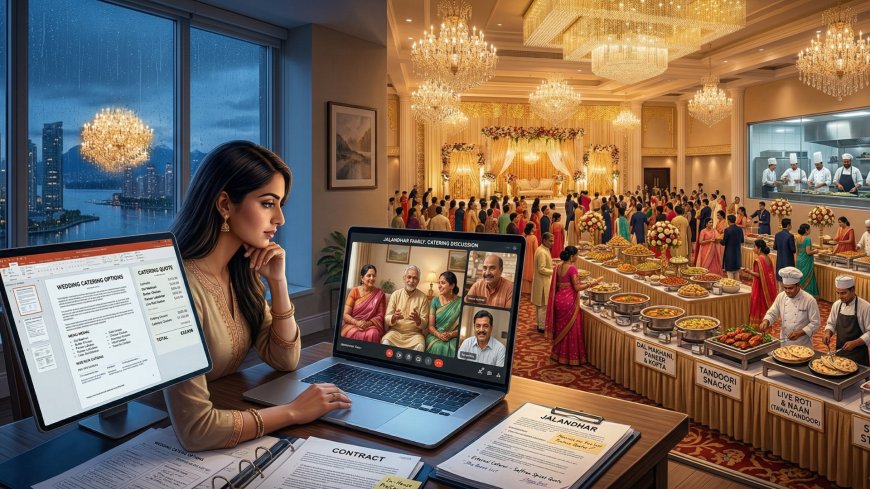
Mandeep was in Vancouver. Her parents were in Jalandhar. The wedding was in March. The hall they had selected — a premium standalone banquet hall in the Garha Road area whose capacity, aesthetic, and infrastructure had survived the family's three-month selection process — had an in-house catering operation that was, by all accounts the family had gathered, genuinely good. The hall's owner, a composed and confident man who had been running the facility for fourteen years, had described his catering team with the particular pride of someone who considers his kitchen a competitive advantage rather than a necessary inconvenience. The dal makhani, he had said, was excellent.
Mandeep's mother had received this information with the specific expression she reserved for claims that required verification before acceptance.
The contract the hall had sent contained, in clause seven, the provision that had initiated the argument: all food and beverage at events hosted in the facility must be prepared and served by the hall's in-house catering team. External caterers were not permitted on the premises. The clause was standard, the owner had said when Mandeep's father called to ask about it. All halls of this standard had the same policy. It was a quality control measure. It was also, Mandeep's father had observed, a commercial arrangement that ensured the hall received the catering revenue in addition to the rental revenue, but the owner had not addressed this observation directly.
Mandeep had spent a Sunday afternoon in Vancouver going through the NRI bride forums and the WhatsApp groups she had joined in the months since the engagement, trying to find a consensus answer to the question that the clause seven conversation had made urgent: was the hall's in-house catering actually good enough to accept the tie-in, or should the family be looking for a hall that permitted external caterers, even if that hall was less impressive in the other dimensions that had made the Garha Road hall their first choice?
The forum had not produced a consensus. It had produced forty-seven responses across three threads, which covered the full range from enthusiastic endorsement of in-house catering at specific halls to detailed cautionary accounts of in-house catering that had promised one thing at the tasting and delivered another at the event. What the forty-seven responses had collectively produced was not a simple answer but a framework — the specific questions, the specific assessments, the specific verifications — that turned the in-house versus external decision from a matter of family preference about dal makhani into a structured evaluation with a defensible conclusion.
This guide is that framework — the complete, honest account of what in-house catering at a Jalandhar banquet hall actually means in 2025, when it is worth accepting, when it is not, and how the NRI family managing this decision from Vancouver or Birmingham makes it correctly rather than emotionally.
Understanding the In-House Catering Model: What It Is and Why It Exists
The in-house catering tie-in that appears in the contracts of most Jalandhar premium banquet halls is not, despite how it sometimes feels to the family on the receiving end of clause seven, an arbitrary commercial imposition. It is a business model whose logic is coherent and whose implications for the family are both practical and financial in ways that the family needs to understand before it can assess whether those implications are acceptable.
The banquet hall that operates in-house catering is a business whose revenue model has two primary components: the hall rental and the catering margin. The catering margin on a six-hundred-cover Punjabi wedding at a per-head rate of fifteen hundred rupees is nine lakh rupees in gross catering revenue, from which the kitchen costs, the staff costs, and the food costs are deducted to produce the hall's catering profit. This catering profit is not a secondary income for most premium Jalandhar halls — it is a primary income whose contribution to the business's total revenue is comparable to or greater than the rental income.
The hall that permits external catering loses this revenue entirely. The buyout fee that some halls charge to permit external catering — a fee that compensates the hall for the catering revenue it would otherwise receive — is the mechanism by which the hall attempts to recover some of this loss while accommodating the family's preference for an external caterer. The buyout fee in the Jalandhar market in 2025 runs from one lakh fifty thousand to three lakh rupees, depending on the hall and the event scale, and its existence reflects the hall's honest acknowledgment that the catering revenue it foregoes has a specific commercial value.
Understanding this model changes the family's assessment of the in-house catering decision in a useful way. The question is not "why won't they let us bring our own caterer?" — a question whose answer is commercial and straightforward. The question is "given that the hall's catering operation exists to generate revenue rather than primarily to serve the family's food preferences, is the quality of that operation sufficient to produce an outcome I would choose if I were choosing freely?" That is a different question, and it has a different answer for different halls.
What In-House Catering at Jalandhar's Premium Halls Actually Delivers
The quality range of in-house catering across Jalandhar's banquet halls in 2025 is wide enough that the category description "in-house catering" is itself nearly meaningless as a quality indicator. The in-house catering at a hall that has invested seriously in its kitchen operation, trained its staff over years of event delivery, and built its menu around the specific requirements of the Punjabi wedding is a different product from the in-house catering at a hall whose kitchen is a profit centre managed to the minimum standard that prevents complaint.
The Kitchen Infrastructure Question
The first indicator of in-house catering quality is the kitchen infrastructure — the physical capacity of the kitchen to produce the volume and variety of food that a six-hundred-cover Punjabi wedding requires without the quality degradation that insufficient kitchen capacity produces. The Punjabi wedding's food requirements are demanding by any catering standard: multiple courses, live cooking stations, simultaneous service of multiple protein dishes, dessert live counters, and the specific expectation that every guest's plate is filled from food that was prepared recently rather than held for extended periods.
The kitchen that can deliver this at six hundred covers is a kitchen with specific infrastructure — the burner capacity, the holding equipment, the cold storage, the staff-to-cover ratio — whose specification is worth asking about before the tasting and worth verifying against the event delivery. The hall whose kitchen was designed for a maximum event of three hundred covers and that is now routinely booking events of five hundred and six hundred is the hall whose in-house catering quality degrades under event load in ways that the intimate tasting does not predict.
The Tasting as Quality Assessment
The tasting that most premium Jalandhar halls offer prospective clients as part of the booking process is the most useful quality assessment tool available to the NRI family, and its usefulness is directly related to how the family conducts it. The tasting that is conducted as a social occasion — the hall owner serving tea and presenting the family with a selection of dishes in a comfortable setting — produces a pleasant experience and limited useful information. The tasting that is conducted as a structured quality assessment produces the information the decision requires.
The structured tasting covers the specific dishes that will be on the wedding menu, prepared by the team that will cook at the event rather than by the head chef whose skills are not necessarily representative of the team's general standard. It tests the dishes at a volume approximating the event scale — a batch-cooked dal makhani tastes different from a small-pan dal makhani, and the difference is the difference between the tasting experience and the event experience. It assesses the consistency of the seasoning across multiple portions of the same dish, because inconsistency at the tasting predicts inconsistency at the event.
For the NRI family whose tasting must be conducted by a proxy — the family member or trusted local advisor who can attend the tasting in the family's absence — the tasting brief should be specific enough that the proxy's assessment is structured rather than impressionistic. The specific dishes to taste, the specific quality indicators to assess, the specific questions to ask the kitchen team — these are the brief that the proxy needs to conduct a tasting that produces useful information rather than a general impression.
The Service Staff Quality
The food quality and the service quality are distinct dimensions of the in-house catering outcome, and halls that excel at one do not always excel at the other. The service staff for a Punjabi wedding event — the team responsible for the timing of course service, the replenishment of the live stations, the attentiveness to the table service, and the management of the guest flow through the buffet — is a team whose quality directly affects the event experience in ways that are as visible as the food quality.
The service staff ratio — the number of service personnel per cover — is the quantifiable indicator of service quality that the NRI family should ask about specifically. The adequate ratio for a Punjabi wedding dinner service is one service staff member per twenty-five to thirty guests. The hall that deploys one staff member per forty guests is the hall whose service will show the strain at the peak of the dinner service, when the live stations are running simultaneously and the buffet replenishment and the table clearance are competing for the same staff resource.
The External Catering Option: When It Is the Right Choice
The external caterer option — either at a hall that permits it freely or at a hall whose buyout fee makes it commercially accessible — is the right choice in specific circumstances that are worth identifying precisely, because the external caterer decision is not automatically the right choice any more than the in-house catering acceptance is automatically the wrong one.
When the Family Has a Specific Caterer Whose Quality Is Verified
The family that has eaten Surjit Singh's dal makhani at twenty-two events over twenty-two years has a quality verification for that caterer that no tasting at a new hall can match. The accumulated experience of a specific caterer's specific dishes over years of events is a quality database that the in-house tasting cannot replicate, and when that caterer's quality is a genuine family priority rather than a sentimental attachment, the external caterer option has a clear rationale.
The qualification for this rationale is the distinction between verified quality and sentimental preference. The family whose attachment to their preferred caterer is primarily about the familiarity and the emotional association — the dal makhani that tastes like every previous event — should assess honestly whether that attachment is worth the buyout fee or the inconvenience of finding a hall that permits external catering. The family whose preferred caterer genuinely produces a quality outcome that the in-house market cannot match has a different calculation.
When the In-House Tasting Reveals Quality Concerns
The tasting that reveals specific quality concerns — inconsistent seasoning, inadequate batch cooking quality, service staff ratios that the kitchen manager confirms are the standard deployment — is the tasting that makes the external caterer option worth the additional cost and complexity. The family that identifies quality concerns at the tasting and proceeds with the in-house catering on the basis of the owner's assurances is the family that discovers at the event whether the concerns were justified, at the moment when the discovery is least useful.
When the Menu Requirements Exceed the Hall's Kitchen Capability
The Punjabi wedding whose menu requirements include regional specialities, international dishes for the diaspora guests, or specific cuisine categories that the hall's kitchen team has not been trained in is the wedding whose in-house catering tie-in is most likely to produce an outcome that does not meet the family's requirements. The hall kitchen that produces excellent standard Punjabi wedding food may not produce the specific Amritsari dishes, the South Indian additions for the groom's family, or the Continental dishes for the international guests that the family's menu planning requires. When the gap between the kitchen's capability and the menu requirement is significant, the external caterer option addresses it directly.
The Buyout Fee: When It Makes Financial Sense
The buyout fee — the payment that releases the family from the in-house catering tie-in and permits an external caterer — is a cost whose financial sense depends on the arithmetic of the specific event rather than on a general principle.
The buyout fee of two lakh rupees for a six-hundred-cover event represents three hundred and thirty rupees per head. If the external caterer the family prefers charges two hundred rupees per head more than the hall's in-house per-head rate, the buyout fee adds an additional three hundred and thirty rupees per head to that differential, making the external caterer option five hundred and thirty rupees per head more expensive than the in-house option for equivalent food. If the differential between the in-house per-head rate and the external caterer's rate is in the other direction — the external caterer is significantly less expensive than the in-house rate — the buyout fee may be partially or fully offset by the per-head saving.
The financial calculation should be done with the specific numbers from the specific hall and the specific external caterer rather than from general principles, because the numbers vary enough across the market that the general principle is not a reliable guide to the specific decision.
Halls That Permit External Catering: What the Jalandhar Market Offers
The Jalandhar banquet hall market's approach to external catering varies across a spectrum from the full tie-in that permits no external caterer under any circumstances to the fully open policy that imposes no restriction on the family's catering choices. Between these extremes are the buyout model, the preferred vendor panel model, and the hybrid model that permits external caterers for specific menu components while requiring in-house catering for others.
The fully open policy halls are less common at the premium end of the Jalandhar market than at the mid-range and community hall categories, because the premium hall's business model depends on the catering revenue in ways that the community hall's lower rental income does not. The NRI family that is committed to an external caterer and that is searching for a premium hall with a fully open catering policy will find the search more restricted than the search for a hall with a buyout option.
The preferred vendor panel model — the hall that maintains a list of approved external caterers from which the family must choose — is a middle position whose usefulness depends on whether the family's preferred caterer is on the panel. The panel's composition is the hall owner's commercial decision, and the caterers on it are typically caterers who have a relationship with the hall that may include a referral arrangement. The family whose preferred caterer is not on the panel should ask whether panel additions are possible and what the process for addition involves.
The Complete In-House vs External Catering Decision Framework
| Decision Factor | In-House Catering | External Caterer | Key Question |
|---|---|---|---|
| Food quality assurance | Depends on hall's kitchen investment | Verified through prior experience | Has the in-house tasting produced confidence? |
| Menu flexibility | Limited to hall kitchen's range | Full flexibility | Does the menu require capabilities the hall lacks? |
| Cost structure | Per-head rate plus minimum guarantee | Per-head plus buyout fee or open hall rental | Is the total cost differential justified by quality difference? |
| Logistical complexity | Single point of accountability | Multiple vendor coordination | Can the family manage external coordination from abroad? |
| Service staff quality | Hall's trained team | Caterer's own team | Which team's service record is stronger? |
| Family preference caterer | Not accommodated | Accommodated | Is the preference quality-based or sentimental? |
| Risk of quality variance | Event vs tasting variance risk | Known caterer reduces this risk | How much quality certainty does the family require? |
| Post-event accountability | Hall accountable for food and service | Caterer accountable for food, hall for venue | Is single accountability important to the family? |
The NRI-Specific Considerations
The NRI family's specific circumstances create considerations in the in-house versus external catering decision that the locally-based family does not face in the same form.
The coordination complexity of managing an external caterer from Vancouver or Birmingham is a practical consideration that the local family manages in person and that the NRI family manages through remote communication, proxy attendance, and the specific friction that distance introduces into vendor coordination. The external caterer whose brief requires multiple in-person tastings, detailed menu planning sessions, and on-site coordination meetings that the NRI family cannot attend directly is an additional coordination burden whose management requires either a trusted local proxy or a wedding coordinator whose scope includes catering management.
The single accountability advantage of the in-house catering tie-in has a specific value for the NRI family that it does not have in the same way for the local family. When the hall is responsible for both the venue and the catering, there is one point of contact, one contract, and one accountability relationship for the entire event's food and service outcome. When the external caterer is a separate engagement, the event's total food and service outcome is distributed across two separate vendor relationships, each of whose accountability for the other's contribution is limited. For the NRI family managing multiple vendor relationships from a time zone that makes real-time problem resolution difficult, the single accountability model has a practical value that the cost and quality calculation should include.
The tasting proxy issue is the most practically significant NRI-specific consideration. The tasting that is the primary quality assessment tool for the in-house catering decision is a tasting that the NRI family in Vancouver cannot conduct personally. The proxy whose brief is to conduct the tasting must be trusted enough that the family can make a significant quality decision on the basis of the proxy's report, and the brief must be specific enough that the proxy's assessment covers the dimensions the family needs assessed rather than the dimensions the proxy spontaneously notices. The family that sends a proxy whose brief is "tell me if the food is good" will receive a different quality of information than the family whose brief specifies the dishes to assess, the quality indicators to look for, and the questions to ask the kitchen team.
Common Mistakes NRI Families Make With the Catering Decision
The first mistake is making the in-house versus external decision on the basis of the booking conversation rather than the tasting. The hall owner's description of his kitchen's quality is not a quality assessment — it is a sales presentation. The tasting is the assessment. The family that commits to the in-house catering at the booking stage, before the tasting has occurred, is the family that has accepted the sales presentation as a substitute for the evidence.
The second mistake is conducting the tasting as a social occasion rather than a structured assessment. The tasting that is a pleasant afternoon at the hall, with the owner present and the food presented in its best light, produces a social experience and limited actionable information. The tasting whose brief specifies the dishes, the volume, the assessment criteria, and the questions produces a quality assessment. The NRI family whose proxy is conducting the tasting should provide the proxy with a specific brief rather than a general request to "see what the food is like."
The third mistake is not negotiating the minimum guarantee downward before accepting the in-house catering tie-in. The in-house catering tie-in and the minimum guarantee are separate provisions that are negotiated separately, and the family that accepts the tie-in without renegotiating the minimum guarantee has accepted two commercial conditions simultaneously when it had the leverage to negotiate both. The minimum guarantee negotiation is most productive at the contract stage, when the hall's desire to close the booking creates the maximum incentive to accommodate the family's requests.
The fourth mistake is not asking about the service staff deployment for the specific event scale before signing the contract. The per-head rate and the menu are the dimensions that the tasting covers and the contract specifies. The service staff ratio — the number of service personnel per cover — is frequently not specified in the contract and is frequently not raised at the tasting. The family that discovers on the wedding evening that the service team is insufficient for the event scale discovers this at the worst possible moment. The service staff deployment should be asked about specifically, the answer should be documented, and the acceptable minimum should be specified in the contract where the hall will agree to include it.
The fifth mistake is treating the external caterer option as automatically superior to the in-house option without assessing the specific in-house quality at the specific hall. The NRI family that has read cautionary accounts of in-house catering at Jalandhar halls and that approaches the tasting with the conclusion already formed is the family that may reject an in-house catering operation that is genuinely good, at a hall that is otherwise perfect for the event, on the basis of a general caution rather than a specific assessment. Every hall's in-house catering should be assessed on its own terms at its own tasting before the conclusion is reached.
What Mandeep's Family Decided
The proxy tasting had been conducted by Mandeep's maasi — a woman whose culinary standards were, within the family, considered second only to Mandeep's mother's and whose assessment of the dal makhani question the family considered authoritative. The brief Mandeep had sent from Vancouver had been specific: taste the dal makhani, the sarson da saag, the paneer makhani, and the mutton curry. Assess each for seasoning consistency across three portions. Ask the kitchen manager how many burners the dal makhani is cooked on for a six-hundred-cover event and for how long. Ask about the service staff ratio. Report back in detail.
The report had come back in two voice notes and a WhatsApp message with four photographs. The dal makhani, Mandeep's maasi had said, was genuinely good. Not Surjit Singh good — she had made this comparison explicitly and without diplomatic softening — but good enough that the family's objection to it was a preference rather than a quality concern. The sarson da saag was excellent. The service staff ratio the kitchen manager had confirmed was one staff member per twenty-eight covers, which was within the adequate range. The kitchen's dal makhani was produced in batches of the correct size for the event scale, not compromised by volume.
Mandeep had called her mother with the report. There had been a long pause. Her mother had said: the sarson da saag is excellent?
Mandeep had said: maasi said it was the best she had eaten outside our family's kitchen.
Her mother had said nothing for a moment. Then she had said: we can accept the in-house catering.
The dal makhani at the wedding had been good. Mandeep's mother had acknowledged this, after the fourth course, in the specific way she acknowledged things that had turned out better than her expectations — without excessive enthusiasm, but without reservation. She had said: it is not Surjit Singh's.
Mandeep had said: no, it is not.
Her mother had said: but it is acceptable.
For a Punjabi mother evaluating a dal makhani at her daughter's wedding, acceptable was the word that meant good.
Conduct the tasting before committing to the in-house option. Brief the proxy specifically, not generally. Negotiate the minimum guarantee separately from the tie-in acceptance. Ask about the service staff ratio and document the answer. Assess each hall's catering on its own terms rather than on the category's general reputation.
The in-house catering decision is not a principle. It is an assessment. Make the assessment with the evidence, not with the assumption.
Published by NRIWedding.com — The Premium Global Platform for Non-Resident Indians Planning Indian Weddings From Abroad.
What's Your Reaction?
 Like
0
Like
0
 Dislike
0
Dislike
0
 Love
0
Love
0
 Funny
0
Funny
0
 Angry
0
Angry
0
 Sad
0
Sad
0
 Wow
0
Wow
0