









































































Ready-to-Wear vs Custom Bridal in Jalandhar — Which Makes More Sense for a Two-Week Visit?
For NRI brides visiting Jalandhar with two weeks and a full wedding wardrobe to source, the choice between ready-to-wear and custom bridal wear is one of the most consequential decisions of the entire trip — and one that is rarely made with the right framework. This comprehensive guide by NRIWedding.com breaks down exactly how Jalandhar's bridal market works across the full spectrum from ready-to-wear through semi-custom to fully bespoke, category by category and day by day. Covering the timeline realities of genuine custom work, the pre-departure commission model that makes bespoke possible within a two-week window, the semi-custom middle ground that serves most NRI brides best, and a complete decision matrix across every garment category — from the bridal lehenga and mehndi outfit to family wear and Phulkari dupattas. Includes the five most costly mistakes NRI brides make on two-week Jalandhar shopping trips and a practical day-by-day itinerary framework for managing the full fortnight.

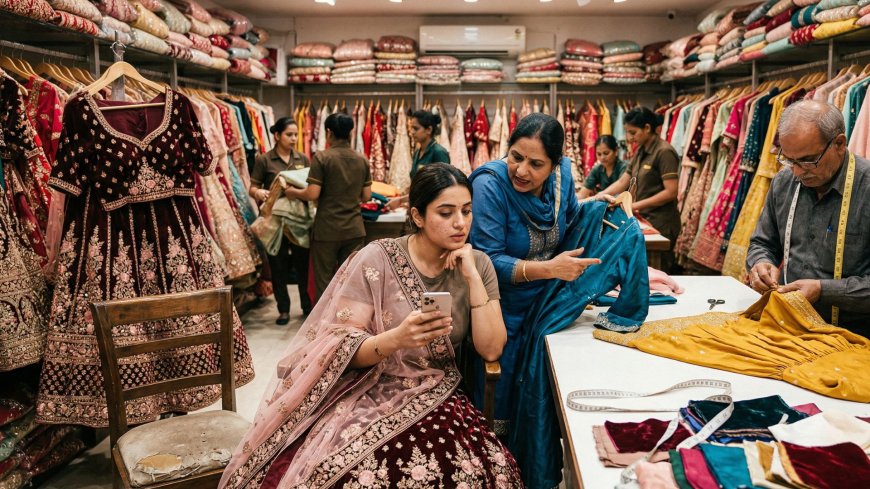
Ready-to-Wear vs Custom Bridal in Jalandhar — Which Makes More Sense for a Two-Week Visit?
The Appointment on a Wednesday in October
Harpreet had fourteen days.
She had counted them with the specific, slightly anxious precision of someone who has negotiated annual leave from a demanding employer and knows, with absolute clarity, that not a single one of the fourteen can be wasted. She was a secondary school deputy head in Coventry, and the fortnight she had carved out of the autumn term — negotiated in April, confirmed in June, guilt-managed through September — represented the outer limit of what the school, her conscience, and her sense of professional obligation would permit. Fourteen days in Jalandhar. Fourteen days to do what needed to be done for a wedding in the second week of March.
The list was not short. The bridal lehenga. The engagement party outfit. The mehndi outfit. The wedding reception dress — the one that would be worn at the UK celebration in April, which needed to be Indian enough for the family and contemporary enough for the Coventry friends who had never attended an Indian wedding before. The jewellery, which was its own conversation entirely. The outfits for her mother and her younger sister, both of whom had declined to take their own trips to India on the grounds that Harpreet was going anyway and could surely manage it. The gifts for the groom's family — the darji pieces, the embroidered items, the specific things that her future mother-in-law had communicated through a series of WhatsApp messages that were warm in tone and precise in implication.
She had done her research. She knew the difference between ready-to-wear and custom. She had read the forums, consulted the Facebook groups, watched the YouTube vlogs of the NRI brides who had done this before her. She had arrived at Jalandhar with a position: she would go custom for the bridal lehenga, because custom was the right choice for the main piece, and she would buy ready-to-wear for everything else, because ready-to-wear was faster and she did not have time for anything else.
By the end of the first Wednesday, her position had collapsed entirely.
The custom atelier she had booked for the bridal lehenga consultation told her, with complete professionalism and not a trace of apology, that their current lead time for a full bridal commission was six weeks minimum. She had fourteen days. The ready-to-wear boutique she visited in the afternoon had a lehenga in a colour that was not quite right but close, in a size that was not quite right but adjustable, in a quality that was genuinely impressive, and a tailor attached to the boutique who looked at her for forty-five seconds and told her he could have the alterations done in four days.
She sat in the car outside the boutique and called her mother.
The question she asked her mother — the question she had not properly asked herself before she boarded the flight — was the question this guide is built to answer: given two weeks, given a Jalandhar wedding market, given the specific, non-negotiable constraints of the NRI bride's timeline, which choice actually makes more sense?
This guide is for Harpreet, and for every NRI bride who arrives in Jalandhar with a position and discovers, on the first Wednesday, that the position needs interrogating.
Why This Decision Is More Consequential Than It First Appears
The ready-to-wear versus custom question is, on the surface, a straightforward logistical calculation. Custom takes longer and produces something specific to you. Ready-to-wear is faster and produces something that existed before you arrived. The NRI bride with two weeks assumes, reasonably, that the timeline constraint settles the question in favour of ready-to-wear for most categories and custom only where the timeline can somehow be made to work.
The reality is more layered than this framing suggests, and the layers matter because the consequences of the wrong choice — in either direction — are significant in a context where returning to correct a mistake is not a realistic option.
The custom versus ready-to-wear decision is not a single decision. It is a category-by-category decision, and the right answer for the bridal lehenga is not the right answer for the mehndi outfit, which is not the right answer for the reception dress, which is not the right answer for the family outfits. Each category has a different timeline profile, a different quality differential between the two options, a different risk profile, and a different relationship to the NRI bride's specific constraints. Treating it as a single, universal question produces a single, universal answer that is almost certainly wrong for at least some of what needs to be purchased.
The second layer is that ready-to-wear and custom are not, in Jalandhar's bridal market, cleanly separate categories. The market contains a spectrum that includes fully ready-to-wear with no alteration, ready-to-wear with standard alterations, ready-to-wear with significant customisation, semi-custom work using standard base pieces with custom embellishment, and fully custom work from fabric selection through to finished garment. Each point on this spectrum has a different timeline, a different price, a different quality profile, and a different risk profile. The NRI bride who thinks in binary terms — custom or ready-to-wear — is missing most of the spectrum that is actually available to her.
What Ready-to-Wear Actually Means in Jalandhar's Bridal Market
Ready-to-wear in the Jalandhar bridal context does not mean what it means in the retail contexts most NRI brides are familiar with from their lives abroad. It does not mean a finished, size-standardised garment that can be taken from a rail and worn without modification. It means a garment that has been made in advance — in a standard or semi-standard size, in a design that the boutique has produced before, using fabrics and embellishments that were selected by the boutique rather than the customer — and that will be altered to fit the individual customer before handover.
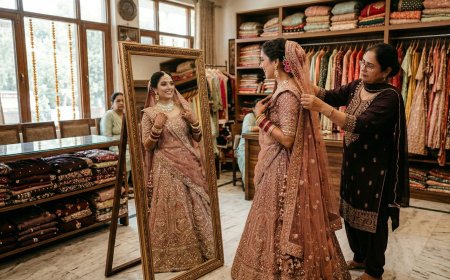
The alteration is not a minor adjustment. In Jalandhar's better bridal boutiques, the alteration process for a ready-to-wear bridal lehenga involves a measurement appointment, a fitting, adjustments to the waistband, the blouse, and the skirt length, and a final fitting before collection. This process, when done properly, takes between three and seven days depending on the complexity of the alterations required and the workload of the boutique's in-house tailor.
This means that ready-to-wear in Jalandhar is not the same as same-day retail. It is a shorter version of the custom process — a process that begins with a finished or near-finished garment rather than with fabric and a brief, but that still requires time, fitting appointments, and the kind of engaged, attentive alteration work that distinguishes Jalandhar's better boutiques from the purely transactional end of the market.
The Genuine Advantages of Ready-to-Wear
The timeline advantage is real and significant. A ready-to-wear bridal lehenga in Jalandhar, with standard alterations, can be ready for collection in four to seven days from the measurement appointment. For the NRI bride with fourteen days, this represents a manageable allocation — two days of exploration and selection, one measurement appointment, one fitting, collection on day seven or eight, leaving a week for everything else on the list.
The ability to assess the finished product before committing is a genuine and underappreciated advantage of ready-to-wear. With custom work, the customer is committing to a garment she has not yet seen — committing on the basis of a brief, a fabric swatch, a reference image, and trust in the atelier's ability to translate that brief into a finished piece. With ready-to-wear, she can see the garment, touch the fabric, assess the embroidery quality, evaluate the colour against her own skin tone in the boutique's lighting, and make an informed decision about whether this specific object is what she wants. The risk of the finished piece being significantly different from what she imagined — one of the most common sources of disappointment in custom bridal work — is substantially reduced.
The price advantage is also real, though less consistent than is sometimes suggested. Ready-to-wear lehengas in Jalandhar's better boutiques are not necessarily cheaper than custom work at equivalent quality levels. But they are more predictably priced — the price is visible at the point of selection, rather than being assembled from components that may increase between quote and invoice.
The Genuine Limitations of Ready-to-Wear
The fundamental limitation of ready-to-wear is that the garment was designed for a general customer, not for the specific person standing in the boutique. The colour was chosen by the boutique. The embellishment style was chosen by the boutique. The silhouette was developed to suit a range of figures rather than a specific one. The NRI bride who has a clear, specific bridal vision — who knows precisely the shade, the embellishment style, the silhouette, the fabric weight she wants — may find that ready-to-wear in Jalandhar's market brings her close to that vision but not to it. The distance between close and exact is the distance between a beautiful wedding outfit and the wedding outfit.
The second limitation is size range. Jalandhar's ready-to-wear bridal market, like most Indian bridal markets, produces in a size range that reflects the median of its primary customer base. The NRI bride whose measurements fall significantly outside this range — in any direction — may find that the alteration required to bring a ready-to-wear piece into fit is so extensive that the timeline advantage over custom work is partially or entirely lost, and that the extensive alteration has compromised the garment's drape and structure in ways that cannot be fully corrected.
What Custom Actually Means in Jalandhar — The Full Picture
Custom bridal work in Jalandhar, at its best, is the process of building a garment entirely to the customer's specification — from fabric selection and colour matching through embellishment design, construction, fitting, and finishing. The customer participates in decisions at every stage. The result is a garment that exists nowhere else, that was made for this specific person's measurements and vision, and that carries the specific, irreplaceable quality of something made with complete intentionality.
This is the ideal. The reality of custom bridal work in Jalandhar's market in 2025 is a spectrum of practice that ranges from this ideal down to what is effectively ready-to-wear with the customer's name written on the order book.
The Timeline Reality of Genuine Custom Work
Genuine custom bridal work — the kind that begins with fabric selection and ends with a finished garment built entirely to the customer's brief — requires a minimum of three to four weeks for a piece of moderate complexity. For a heavily embroidered bridal lehenga with any element of hand embroidery, the minimum is six weeks. For a piece that includes genuine Phulkari or other traditional hand embellishment, eight to twelve weeks is the realistic expectation.
These timelines are not the boutique protecting itself against the possibility of delay. They are the physical reality of what the work requires. Hand embroidery cannot be accelerated beyond the pace at which a skilled embroiderer can work. Fabric that has been ordered from a supplier has a delivery time that exists independently of the boutique's desire to serve its customers quickly. Construction, fitting, correction, and finishing are sequential processes, each of which requires the previous one to be complete before it can begin.
The NRI bride with two weeks cannot have genuinely custom bridal work completed in Jalandhar during her visit if she arrives without having initiated the process before departure. This is the statement that most NRI brides who are planning a Jalandhar custom commission need to hear clearly, without qualification.
The Pre-Departure Custom Model — The Correct Approach
The correct approach for the NRI bride who wants custom bridal work from a Jalandhar atelier is not to commission it during the visit. It is to commission it before the visit — through a remote consultation process that begins six to eight weeks before the trip — and to use the visit for fittings, adjustments, and collection.
The pre-departure custom model works as follows. The NRI bride identifies the atelier she wants to work with, makes contact through WhatsApp or video call, conducts an initial consultation remotely, selects fabric from swatches that can be photographed and shared digitally, agrees on an embellishment brief using reference images, provides precise measurements taken either by a local tailor in the UK or using a detailed self-measurement guide, and places the order with a confirmed deposit and delivery timeline. The atelier begins work immediately. By the time the NRI bride arrives in Jalandhar, the garment is in an advanced stage of construction and ready for a fitting within the first two or three days. Adjustments are made, the final piece is collected before departure.
This model works. It is used successfully by NRI brides working with Jalandhar's more experienced custom ateliers regularly. It requires organisation, trust, and the willingness to commit to a brief without the reassurance of a physical showroom visit at the point of commissioning. But it produces genuinely custom bridal work within the NRI bride's timeline constraints — and it produces it without the specific, dispiriting experience of arriving in Jalandhar with two weeks and discovering that everything genuine takes longer than two weeks.
The Semi-Custom Middle Ground
Between ready-to-wear and fully custom lies a semi-custom model that is, for many NRI brides with two-week visits, the most practically sensible option for the bridal lehenga. Semi-custom work begins with a base piece — a constructed lehenga in a standard size, with a standard embellishment format — and customises specific elements to the customer's specification. The colour may be specified. The embellishment may be upgraded or changed in the most visible areas. The silhouette may be adjusted beyond standard alteration parameters. The blouse may be made from scratch to the customer's measurements and design brief.
This approach compresses the timeline because the most labour-intensive elements of construction — the cutting, the basic assembly, the foundational embellishment — are already done. What remains is the customisation layer, which can often be completed within seven to ten days of the initial appointment. The result is a garment that is more specific to the customer than pure ready-to-wear but that can be delivered within the NRI bride's two-week window without the pre-departure commission process that fully custom work requires.
The semi-custom model is most effective in Jalandhar's boutiques that maintain a significant stock of well-made base pieces and that have skilled in-house tailors and embroiderers who can execute the customisation layer to a quality standard that matches the base construction. It is less effective — and can produce inconsistent results — in boutiques where the customisation work is subcontracted or rushed to meet a customer's timeline.
The Category-by-Category Decision Framework
The ready-to-wear versus custom question, answered category by category, produces a more nuanced and more practically useful framework than the binary choice suggests.
The Bridal Lehenga
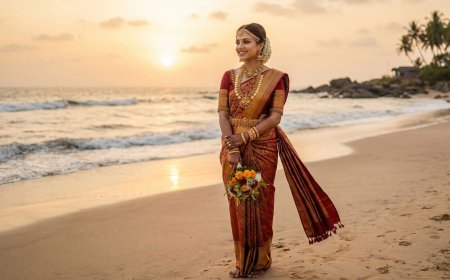
For the bridal lehenga specifically, the recommendation is: custom if commissioned before departure with a minimum six-week lead time, semi-custom if the budget and the boutique's stock permit it, and ready-to-wear with thorough alteration if neither of the first two options is available. Ready-to-wear only is not the last resort. It is a legitimate choice if the right piece exists in the market. The NRI bride should not allow the cultural mythology of custom bridal work to prevent her from buying a genuinely beautiful ready-to-wear lehenga that is more right for her than a rushed custom piece would have been.
The Mehndi and Sangeet Outfits
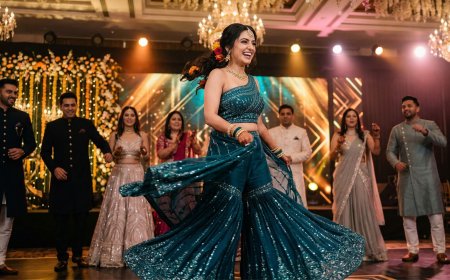
For the mehndi and sangeet outfits — the secondary function wear that needs to be beautiful but does not carry the same emotional and financial weight as the bridal lehenga — ready-to-wear is almost always the correct choice for the two-week visitor. Jalandhar's market has an excellent range of ready-to-wear in the categories typically worn for these functions: the sharara sets, the Anarkali suits, the lighter lehengas in contemporary colours that are the standard contemporary Punjabi mehndi aesthetic. The alteration requirement for these pieces is typically lighter than for the bridal lehenga, and the timeline from selection to collection is correspondingly shorter — often three to four days.
The Reception Outfit
The reception outfit for the UK celebration — the piece that needs to work across cultural contexts — is the category where semi-custom most consistently makes sense. The cultural and aesthetic brief for this piece is often more specific and more personal than the brief for any other garment in the wedding wardrobe, and the NRI bride's ability to articulate that brief to a Jalandhar atelier who understands both the Indian craft vocabulary and the diaspora aesthetic is the factor that determines whether semi-custom is the right model. Boutiques with documented experience serving NRI brides — whose owners understand what it means to want something that reads as Indian in Coventry as well as in Jalandhar — are the correct destination for this conversation.
Family and Bridesmaid Outfits
For the family and bridesmaid outfits — the category that often constitutes the largest volume of garments in the total purchase — ready-to-wear is the correct choice without qualification. The timeline, the budget, and the practical reality of fitting multiple people across a two-week visit make anything other than ready-to-wear with standard alterations impractical. Jalandhar's ready-to-wear market for family function wear is genuinely strong, and the boutiques that specialise in outfitting large wedding parties have the stock depth and the alteration capacity to serve this requirement well within the two-week window.
The Table: Ready-to-Wear vs Custom — Decision Matrix for the Two-Week NRI Bride in Jalandhar
| Garment Category | Recommended Approach | Timeline (RTW) | Timeline (Custom) | Pre-Departure Action Required | Key Risk | Price Differential |
|---|---|---|---|---|---|---|
| Bridal Lehenga | Custom (pre-commissioned) or Semi-Custom | 4–7 days with alterations | 6–10 weeks from commission | Commission 6–8 weeks before travel | RTW: vision compromise; Custom: timeline failure | Custom 20–40% higher |
| Mehndi / Sangeet Outfit | Ready-to-Wear | 3–4 days | 3–4 weeks | None required | Colour or fit compromise | RTW significantly lower |
| Reception Dress (UK event) | Semi-Custom | 5–7 days | 4–6 weeks | Brief preparation recommended | Cultural-aesthetic mismatch | Semi-custom 10–25% higher |
| Bridal Blouse (standalone) | Custom — always | 5–7 days for experienced tailor | N/A — blouse custom is fast | Measurements and brief | Fit failure with RTW blouse | Minimal differential |
| Family Outfits | Ready-to-Wear | 3–5 days | Not recommended | Approximate sizes from family | Volume alteration delays | RTW strongly advantaged |
| Bridesmaid Outfits | Ready-to-Wear | 3–4 days | Not recommended | Colour brief pre-departure | Consistency across group | RTW strongly advantaged |
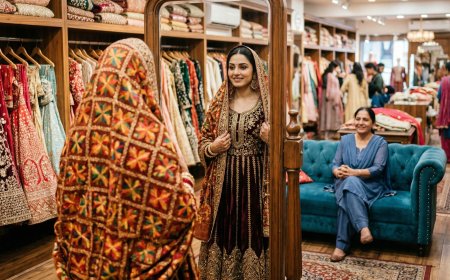
| Phulkari Dupatta | Custom (pre-commissioned) or RTW specialist | 1–2 days (RTW) | 6–10 weeks | Commission before travel if custom | Authenticity risk in RTW | Custom 30–50% higher |
| Jewellery | Ready-to-purchase always | Same day | N/A | Research vendor before travel | Quality and hallmark risk | N/A |
How to Use Two Weeks in Jalandhar — The Day-by-Day Logic
The two-week visit to Jalandhar for wedding shopping is most productively structured around a simple principle: complete the most time-sensitive and most complex purchases first, leaving the simpler and faster purchases for the second week when the pressure of the bridal lehenga question has been resolved.
Days one and two should be dedicated entirely to exploration and the bridal lehenga decision — visiting the boutiques identified in pre-departure research, assessing the semi-custom and ready-to-wear options available, and making the decision that the first two days' information makes possible. The bride who makes the bridal lehenga decision by the end of day two is the bride who has the rest of the two weeks organised around a resolved central question. The bride who defers this decision is the bride who spends the second week with an unresolved anxiety that colours every other purchase.
Days three through seven should cover the measurement appointment and first fitting for the bridal lehenga, the selection and measurement for the mehndi and sangeet outfits, the reception dress conversation, and the beginning of the family outfit selection. The structure of these days should be generous — two boutique appointments per day maximum, with transit time, meal time, and the specific rest that jet lag and decision fatigue require built in as non-negotiable.
Days eight through twelve are for the second fittings, collections, the jewellery purchasing, and the secondary categories — accessories, gifts, the miscellaneous items that every wedding shopping trip accumulates. The bride who has managed the first week well will find the second week more spacious than she expected. The bride who has not will find it more pressured than is comfortable.
Days thirteen and fourteen are the buffer. They are the days that absorb the appointment that ran over, the alteration that needed doing again, the gift that was not available until this week. They are the days that the bride who has planned carefully will spend eating good food and seeing family without the anxiety of an unfinished list. They are the days that the bride who has not planned carefully will spend in a state of compressed urgency that produces decisions she will later regret.
Common Mistakes NRI Brides Make on Two-Week Jalandhar Shopping Trips
The first mistake is arriving without having initiated the custom commission before departure. The NRI bride who wants custom bridal work and who does not begin the process until she lands in Jalandhar will spend her two weeks managing the disappointment of a timeline that does not accommodate her. The remote consultation and pre-departure commission model exists and works. The failure to use it is a planning error, not a market limitation.
The second mistake is allocating insufficient time for alterations on ready-to-wear purchases. Alterations in Jalandhar's better boutiques are not an afterthought — they are a skilled process that requires appointments, fitting sessions, and the time of experienced tailors who are also serving other clients. The NRI bride who selects a ready-to-wear lehenga on day ten of a fourteen-day trip and expects collection on day thirteen is operating against the realistic timeline of a proper alteration process. Select early, collect late.
The third mistake is booking too many boutique appointments in a single day. The NRI bride who schedules four or five boutique appointments on a Tuesday because she has limited time and wants to see as much as possible will make the worst decisions of her trip on that Tuesday. Boutique appointments for bridal wear require genuine attention, genuine comparison, and the specific cognitive clarity that becomes impossible after the third showroom in a single afternoon. Two appointments per day, with adequate time between them, produces better decisions than four appointments back to back.
The fourth mistake is not having the alteration conversation before committing to a ready-to-wear purchase. The ready-to-wear lehenga that requires extensive structural alteration — not just hemming and waist adjustment, but significant reconstruction of the blouse, recutting of the skirt, or replacement of embellishment elements — is not a ready-to-wear lehenga in any practical sense. It is a semi-custom project with a base piece that was made for someone else. Assess the alteration requirement honestly before committing, and ensure the boutique's tailor confirms the timeline for the specific alterations required, not a generic estimate.
The fifth mistake is treating the two-week timeline as a reason to accept less than what is wanted. The specific, focused urgency of the NRI bride with a finite window on the ground is one of the market's most effectively exploited dynamics — the vendor who presents the imperfect option as the best available within the timeline, who manufactures the urgency that turns a considered decision into an impulsive one. Two weeks in Jalandhar, managed properly, is sufficient time to find the right bridal lehenga. It is sufficient time to commission semi-custom work that reflects a genuine brief. It is sufficient time to clothe a wedding party. The timeline is a constraint, not a capitulation.
Harpreet's Wednesday, Revisited
She did not buy the lehenga that was almost right.
She sat in the car for twenty minutes after the phone call with her mother, looking at the photographs she had taken in the boutique, and concluded — with the specific clarity of someone who has just made herself ask the honest question — that almost right was not good enough for the one outfit of the fourteen-day trip that had no margin for compromise.
She went back to the custom atelier the following morning and asked a different question. Not whether they could complete a full commission in two weeks — she already knew the answer to that — but whether they had a base piece in their stock that was close enough to her brief to serve as a semi-custom starting point. They had one. The colour needed adjustment. The blouse needed to be made from scratch. The border embellishment needed to be changed.
The atelier's tailor looked at the base piece and looked at Harpreet's reference images and said nine days.
She collected the lehenga on day twelve of fourteen. It was not the lehenga she would have commissioned from scratch with six weeks and no flight home. But it was a lehenga that was genuinely hers — the colour she had described, the blouse that fitted the way a blouse should fit, the border that carried the reference she had brought from a photograph she had been keeping in a folder on her phone for eleven months.
She wore it in March. She was back in the classroom by the following Wednesday.
The fortnight, she told her mother afterwards, had been exactly enough.
Commission before you fly if custom is what you want. Use the semi-custom model if two weeks is all you have. Buy ready-to-wear without apology if the right piece exists in the market. Allocate your days with more generosity than feels necessary. Decide the bridal lehenga first.
And never mistake urgency for a reason to accept less than what you came for.
Published by NRIWedding.com — The Premium Global Platform for Non-Resident Indians Planning Indian Weddings From Abroad.
What's Your Reaction?
 Like
0
Like
0
 Dislike
0
Dislike
0
 Love
0
Love
0
 Funny
0
Funny
0
 Angry
0
Angry
0
 Sad
0
Sad
0
 Wow
0
Wow
0