














































Bridal Salwar Suits in Jalandhar — Why More NRI Brides Are Choosing This Over Lehengas
The lehenga's dominance in the NRI bridal market has created an assumption that deserves to be examined — and a growing number of NRI Punjabi brides are examining it. This in-depth guide from NRIWedding.com makes the complete case for the bridal salwar suit as a primary wedding ceremony garment, mapping Jalandhar's exceptional bridal suit market across every silhouette and every price point. It covers the five primary bridal suit silhouettes — the Anarkali, the sharara, the Patiala, the straight suit, and the lehenga suit — alongside the GT Road showrooms, the Model Town premium boutiques of Riwayat by Ritu and Aaina Couture, the Paragpur wholesale belt, and the master tailor infrastructure that produces Jalandhar's finest custom pieces. It addresses the embellishment vocabulary that makes a suit genuinely bridal, the price advantage over equivalent lehengas, the dupatta investment that completes the look, the fitting timeline that NRI brides consistently underestimate, and the five most consequential mistakes made when approaching this category without a complete brief.

Bridal Salwar Suits in Jalandhar — Why More NRI Brides Are Choosing This Over Lehengas
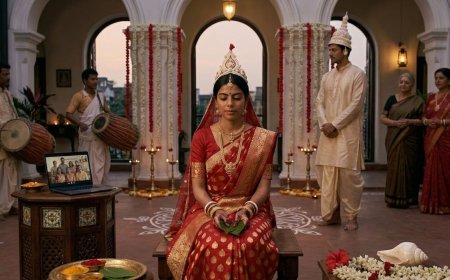
The decision came to Simrandeep on a Thursday morning in March, in the changing room of a bridal boutique on GT Road in Jalandhar, wearing a lehenga that cost more than her first month's salary in Edinburgh and that was, by every objective measure, beautiful. The embroidery was exceptional. The colour — a deep wine with antique gold work — was exactly what she had been looking for for seven months. The silhouette was correct. The dupatta fell in the way that dupattas in photographs fall, which is to say with the generous, unhurried grace of fabric that has been specifically constructed to photograph well.
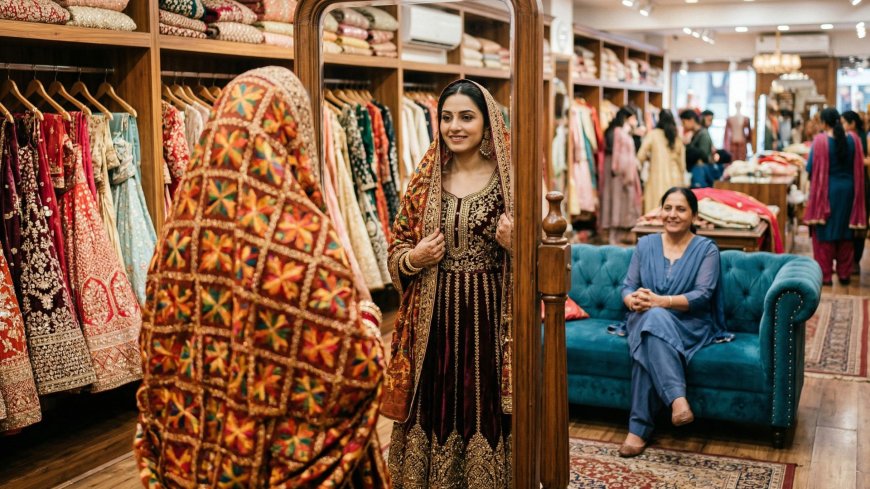
She stood in front of the mirror for a long moment. The boutique owner's assistant stood at a respectful distance. Her mother sat on the velvet settee with the expression of someone who has been waiting for this moment for a long time and who is trying not to show how much she wants the answer to be yes.
Simrandeep looked at herself in the mirror. She looked at the lehenga. She looked at herself in the lehenga. And then she said, quietly and with the certainty of someone who has arrived at a conclusion that has been forming for longer than she realised: I don't think this is right for me.
Her mother said: what?
Simrandeep said: I don't think a lehenga is right for me.
What followed was a conversation that lasted, in various forms and with various participants, for the next three weeks. Her mother, who had worn a lehenga at her own wedding and who had been imagining Simrandeep in a lehenga since approximately the day of the engagement, needed time to understand what Simrandeep was actually saying — not that she wanted something cheaper, not that she wanted something different in colour or embellishment, but that she wanted a different garment type entirely. Her future mother-in-law, when she heard, said: but every bride wears a lehenga. Simrandeep's best friend in Edinburgh, who had worn a lehenga at her own wedding two years earlier, said: are you sure? Her younger sister, who was twenty-one and had been looking forward to the lehenga shopping with a specific enthusiasm, said: but the lehenga photographs are so beautiful.
The photographs. This was the argument that came up most consistently in the three weeks of conversation. The lehenga photographs are so beautiful. And they are — the full skirt, the heavily embroidered hem, the sweep of the dupatta, the specific visual drama of the Indian bridal lehenga in a wedding photograph is genuinely extraordinary. Simrandeep knew this. She had spent seven months collecting those photographs on Instagram and Pinterest with the same focused enthusiasm as every other bride.
But she also knew something that the three weeks of conversation kept circling without quite landing on: that the photograph was not the wedding. That she would be wearing the outfit for eight to ten hours, not for the thirty seconds of a camera click. That she would be standing, sitting, bending, embracing, performing the ritual movements of the anand karaj, dancing at the reception, managing a full Punjabi wedding day in whatever she chose to wear. And that the lehenga she had tried on in the boutique on GT Road — as beautiful as it was, as correct as it was in every aesthetic dimension — felt, on her specific body, in the specific way she moved, like a garment she was wearing rather than a garment she was in.
She knew what she wanted. She had known it for longer than the GT Road changing room moment, though the changing room moment was when she acknowledged it. She wanted a bridal salwar suit.
Not a casual salwar suit. Not the salwar kameez she wore on ordinary days. A bridal salwar suit — embroidered, embellished, formal, made from fabric that belonged to a wedding — but in a silhouette that was her own, that she had worn in various forms her entire life, that her body understood and her hands knew how to manage and that she would not spend the anand karaj conscious of.
This guide is for Simrandeep, and for every NRI bride who has stood in a changing room in a beautiful lehenga and felt the specific discomfort of a garment that is right for the occasion but wrong for the person — and who needs to understand that the bridal salwar suit is not a compromise, that Jalandhar is one of the finest markets in India for exactly this choice, and that more NRI brides than the Instagram algorithm would suggest are arriving at exactly this conclusion.
The Shift That Is Actually Happening
The dominance of the lehenga in the Indian bridal market — and specifically in the NRI Indian bridal market, where the Instagram and Pinterest visual landscape is overwhelmingly lehenga-focused — has created an assumption that is worth examining: that the lehenga is the default Indian bridal choice, and that any other choice is a deviation from the norm that requires justification.
This assumption is historically inaccurate and currently becoming less accurate with each wedding season. The salwar suit — in its various forms, from the Patiala to the Anarkali to the heavily structured bridal suit with a flared or straight silhouette — has been the primary bridal garment of the Punjabi wedding tradition for generations. The lehenga's current dominance in the bridal market is a relatively recent development, driven in significant part by the Bollywood-influenced bridal fashion industry of the past two decades rather than by the deep traditions of the Punjabi wedding itself. The grandmother who wore a salwar suit to her wedding was not making a compromise. She was wearing what the tradition specified.
The contemporary return to the bridal salwar suit is therefore not a departure from tradition. For the Punjabi bride, it is in many ways a return to it — a reclamation of the garment that the tradition produced and that the fashion industry temporarily displaced.
Why NRI Brides Specifically Are Driving This Return
The NRI dimension of this shift is worth naming specifically, because the NRI bride has a particular relationship with comfort and practicality in formal clothing that the India-resident bride may not share in the same degree. The NRI bride, who wears western clothing for three hundred and fifty days of the year and Indian clothing for the remaining fifteen, does not have the practiced ease with a lehenga that comes from growing up wearing it to festivals and family occasions and other people's weddings. The India-resident bride who has worn lehengas to a dozen weddings before her own has a physical familiarity with the garment that the NRI bride who last wore one at a cousin's sangeet three years ago does not.
This is not a criticism of the NRI bride. It is a practical observation about embodied familiarity. The garment that your body knows — that you can manage without thinking, that your hands reach for correctly, that you can stand in and sit in and move in without a fraction of your attention being dedicated to managing it — is the garment that frees you to be present at your own wedding rather than managing your clothing at your own wedding.
For many NRI brides, the salwar suit is that garment. Not because it is simpler, but because it is known. And for the Punjabi NRI bride whose family is in Jalandhar, the market for bridal salwar suits — in the full range of fabrics, silhouettes, embellishments, and price points that a bridal brief requires — is one of the finest in India.
Understanding the Bridal Salwar Suit: The Silhouette Options
Before the market conversation, the garment conversation — because the category of bridal salwar suits in Jalandhar encompasses a range of silhouettes that are not all the same garment and that serve different aesthetic briefs differently.
The Anarkali: The Most Formal Expression
The Anarkali — the long, flared kurta that falls to the ankle or the floor, worn over a churidar or straight-cut trouser — is the most formal silhouette in the bridal salwar suit vocabulary and the one most frequently chosen as a direct alternative to the lehenga for the wedding ceremony itself. The Anarkali's floor-length flare gives it the visual drama and the photographic presence that the lehenga has, while maintaining the one-piece construction that the lehenga does not — the bride does not need to manage a separate skirt, a separate blouse, and a separate dupatta as three distinct pieces of clothing.
The bridal Anarkali in Jalandhar's market is available in the full range of embellishment levels — from the lightly embellished piece appropriate for a summer wedding to the fully zardozi-covered piece that matches the visual weight of the heaviest lehenga. The fabric range covers raw silk, georgette, net, velvet, and the various silk blends that the Punjabi bridal market has developed as its own vocabulary. The price range, for a bridal Anarkali of wedding ceremony quality, is ₹25,000 to ₹1,50,000 in the Jalandhar market — a range that is, for equivalent visual weight and embellishment quality, typically lower than the equivalent lehenga in the same market.
The Sharara: The Heritage Silhouette
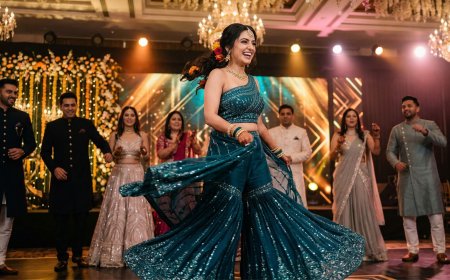
The sharara — the wide-legged, heavily flared trouser worn with a short or long kurta — is the oldest and most culturally specific silhouette in the Punjabi bridal suit vocabulary, with roots in the Mughal court tradition that make it among the most heritage-rich choices in the entire Indian bridal wardrobe. The sharara's wide flare at the hem creates the same visual volume as a lehenga skirt, but the garment is a trouser — the bride can step over the fire for the pheras without gathering fabric, can sit cross-legged for the anand karaj without managing a skirt, and can dance at the reception without the specific physical management that a full lehenga skirt requires.
The bridal sharara is having a significant moment in the NRI Punjabi bridal market, driven partly by the heritage revival that has made traditional craft and traditional silhouettes newly compelling to the diaspora bride who is looking for authenticity rather than the contemporary bridal aesthetic. A well-made sharara in a heritage fabric — a heavy Banarasi brocade, a Chanderi silk, a raw silk with zari work — is among the most beautiful garments in the Indian bridal wardrobe, and it is a garment that the Jalandhar market produces with a specific expertise that reflects the silhouette's deep roots in the Punjabi tradition.
The Patiala Suit: The Regional Statement
The Patiala suit — the voluminous, pleated salwar with the distinctive gathered hem, worn with a fitted kurta and a dupatta — is the most regionally specific choice in the Jalandhar bridal suit market. The Patiala silhouette is specific to the Punjab region, and choosing it for a wedding is a specific cultural statement — a declaration of regional identity and of the bride's rootedness in the Punjabi tradition.
For the NRI bride whose family connection to the Punjab is central to her identity and whose wedding is intended to be an expression of that identity, the bridal Patiala suit is the most authentic possible choice. It is not, in the conventional sense, the most versatile choice — the Patiala silhouette is specific enough that it reads as a clear regional statement rather than as a generalised Indian bridal look — but for the bride who wants to make that statement, the Jalandhar market produces the definitive version of it.
The Straight Suit: The Contemporary Minimalist
The straight-cut suit — a fitted kurta of various lengths, from hip-grazing to ankle, worn over straight-cut or slightly tapered trousers — is the most contemporary of the bridal suit silhouettes and the most aligned with the NRI bride's general wardrobe aesthetic. The straight suit's clean lines and structured silhouette make it the choice for the bride whose aesthetic is more minimalist, whose lehenga rejection is partly about visual weight as well as comfort, and who wants a bridal look that is elegant without the maximalist embellishment vocabulary of the traditional Punjabi bridal look.
The bridal straight suit in Jalandhar's market is the category that has seen the most design evolution in the past five years, as the designers and boutiques serving the NRI market have responded to the demand for a more contemporary interpretation of the bridal suit. The pieces available in this silhouette — in crepe, in silk, in structured georgette — carry embellishment that is more restrained and more precisely placed than the traditional heavily embroidered pieces, and they photograph with a graphic clarity that the heavily embellished pieces do not.
The Lehenga Suit: The Bridge
The lehenga suit — technically a hybrid silhouette that combines a structured kurta top with a lehenga skirt rather than trousers — is the choice for the bride who wants the visual drama of a lehenga with the upper-body freedom of a suit. It is a category unto itself rather than a compromise between the two, and it is available in Jalandhar's market in the full range of embellishment levels. For the bride whose specific discomfort with the lehenga is the weight and management of the skirt, the lehenga suit does not solve the problem. For the bride whose discomfort is with the blouse-and-skirt two-piece construction rather than the skirt itself, the lehenga suit — which replaces the blouse with a kurta — may be exactly the right resolution.
Jalandhar's Bridal Suit Market: The Geography
Jalandhar is one of the finest markets in India for bridal salwar suits, and this is not a concession to local pride but a statement of fact rooted in the city's specific position as the heartland of Punjabi textile and garment craft. The phulkari embroidery tradition, the chikankari workshops, the tailoring infrastructure that has been producing the Patiala suit for generations — all of these craft traditions are present in Jalandhar in a depth and an authenticity that most Indian cities, including Delhi, cannot match for the specifically Punjabi bridal vocabulary.
GT Road and the Main Market
The GT Road corridor — the primary commercial spine of Jalandhar's bridal shopping landscape — carries bridal suits across the full quality and price spectrum, from the mid-market showrooms that serve the local bridal market to the premium boutiques that have specifically developed their NRI offering over the past decade.
Bebe-di-Hatti on GT Road is among the most historically significant bridal suit shops in Jalandhar, with a heritage in the phulkari and traditional Punjabi embroidery traditions that gives it an authenticity in the bridal suit category that newer boutiques cannot replicate. The Anarkali and sharara pieces here are made with the specific embroidery vocabulary of the Punjabi tradition — the thread counts, the pattern density, the specific motifs — that distinguish a piece made within the tradition from a piece made in its image. For the NRI bride whose brief is authentically Punjabi, this is the first visit.
Studio by Shilpa on GT Road has built its reputation specifically on the NRI bridal client, offering bridal suits — primarily Anarkalis and straight suits — in a contemporary vocabulary that bridges the traditional Punjabi aesthetic and the more globally-influenced tastes of the diaspora bride. The pieces here are designed to photograph well, to manage comfortably through a full wedding day, and to carry the visual weight of a bridal garment without the physical weight that the heavily embellished traditional pieces impose. The NRI infrastructure — the remote consultation capability, the documentation for international transit, the alteration service calibrated to compressed timelines — is well-developed.
Patiala Shahi in the main market carries the definitive Patiala suit bridal collection in Jalandhar, sourcing from the Patiala craft clusters and maintaining the construction standards that the traditional silhouette requires. For the bride who has chosen the Patiala suit as her bridal garment, this is the most important destination in the city.
Model Town: The Premium Boutique District
Model Town, which is Jalandhar's premium residential and commercial area, carries the city's most design-forward and most premium bridal suit boutiques — the ones that have specifically positioned themselves for the NRI buyer who wants the quality of a Delhi or Mumbai boutique in the city where the wedding is happening.
Riwayat by Ritu in Model Town is the boutique most consistently mentioned by NRI brides who have shopped in Jalandhar for bridal suits. The aesthetic is contemporary heritage — pieces that draw on the Punjabi craft traditions of phulkari, chikankari, and zardozi but resolve into silhouettes and colour palettes that are current rather than conventional. The bridal Anarkali range here is particularly strong, with pieces in the ₹45,000 to ₹1,80,000 range that are specifically designed for the NRI bride's brief: beautiful enough for a wedding, comfortable enough for an eight-hour day, documented thoroughly enough for international customs and insurance.
Aaina Couture, also in the Model Town area, carries bridal suits in the heavily embellished traditional vocabulary alongside a contemporary minimalist range that has developed in direct response to the NRI bride's request for something that is formal without being maximalist. The sharara sets here are among the finest available in Jalandhar, made from fabrics sourced from the Chandni Chowk wholesale market and embellished in-house by craftsmen who have been working in the phulkari and zardozi traditions for decades.
House of Anmol in Model Town occupies the upper end of the Jalandhar bridal suit market, with pieces in the ₹80,000 to ₹3,00,000 range that are the city's closest equivalent to the premium boutique experience available in Delhi and Mumbai. The custom service here — where the bride selects the fabric, the silhouette, the embellishment, and the colour, and the boutique produces a piece to those specifications — is available with a six-to-eight week turnaround, which accommodates the NRI bride who plans the first India visit as a consultation visit and collects on the second.
Paragpur and the Wholesale Belt
The Paragpur wholesale market carries bridal suit fabrics and semi-finished pieces at prices that reflect the wholesale margin structure rather than the retail one — typically thirty to forty percent lower than the GT Road showrooms for equivalent fabric quality. For the NRI bride with a local contact who knows the Paragpur market, having a bridal suit made from Paragpur fabric by a Jalandhar tailor produces the best value proposition in the city: a piece of comparable quality to the mid-premium boutique at a significantly lower total cost.
The tailoring infrastructure in Jalandhar — the master tailors who have been cutting and constructing Punjabi suits for decades — is a specific and underappreciated resource that the NRI bride shopping in Jalandhar has access to in a way that the NRI bride shopping in Delhi does not. The Jalandhar tailor who has been cutting Patiala suits for thirty years produces a garment whose fit and construction is of a quality that the boutique's in-house tailoring frequently cannot match. Accessing this resource requires a local contact, a specific recommendation, and a timeline that allows multiple fittings — typically four to five weeks from the first measurement to the final collection.
The Embellishment Vocabulary: What Makes a Bridal Suit Bridal
The question that every bride who is considering a bridal salwar suit eventually confronts is the question of what makes it bridal — what distinguishes a very formal salwar suit from a bridal salwar suit, what gives it the visual weight and the ceremonial appropriateness that a wedding garment requires.
The answer is a combination of four elements that, in the right combination and the right proportion, elevate a salwar suit from formal to bridal.
The Fabric
Bridal-weight fabric is the foundation. The fabrics that carry the visual weight of a wedding — the heavy silks, the brocades, the velvet, the raw silk with its specific matt lustre — are available in Jalandhar's market across the GT Road showrooms and the Paragpur wholesale belt, and the selection of the fabric is the first and most consequential decision in the bridal suit brief. A well-chosen fabric in a bridal silk or a heavy chanderi carries a visual presence that lightweight fabrics do not achieve regardless of the embellishment applied to them.
The Embellishment
The embellishment on a bridal suit — the embroidery, the sequin work, the zardozi, the phulkari — is what distinguishes it visually from a formal occasion suit. Bridal embellishment covers significantly more of the fabric surface than formal occasion embellishment, is applied in a denser and more intricate pattern, and typically uses thread or materials — real zari, real sequins, cut-work embroidery — that are of a higher quality than the embellishment on occasion wear.
The Jalandhar market has a specific strength in the phulkari embroidery tradition — the hand-embroidered work in silk thread on cotton or silk fabric that is specific to the Punjab region and that is experiencing a significant revival in the NRI bridal market. A bridal Anarkali or sharara in hand-phulkari embroidery is among the most distinctive and most culturally specific choices available in the Indian bridal market, and it is a choice that specifically rewards shopping in Jalandhar rather than anywhere else.
The Silhouette Construction
Bridal-weight construction — the lining, the boning or structure in the bodice of an Anarkali, the precision of the flare in a sharara, the volume management in a Patiala — is what gives the garment its posture and its presence. A bridal suit in correct construction holds its shape through an eight-hour day and photographs with the same grace at the end of the evening as at the beginning. A suit in poor construction loses its shape within hours and shows the fatigue of the day in every late-evening photograph. The tailoring investment — in a master tailor rather than a volume production atelier — is the construction investment that produces the difference.
The Dupatta
The dupatta is the element of the bridal suit that most clearly signals the garment's wedding context. A heavily embellished dupatta — in hand-embroidery, in zardozi, in phulkari — draped in the specific way of the Punjabi bridal tradition, is the element that transforms a formal suit into a bridal one in the photograph and in the room. The Jalandhar market's dupatta selection — particularly the phulkari dupattas from the traditional craft clusters — is among the finest in India, and the bride who chooses a bridal suit should invest in the dupatta with the same attention she would give the garment itself.
Common Mistakes NRI Brides Make With Bridal Salwar Suit Shopping in Jalandhar
Buying a Suit That Is Formally Correct But Not Bridal in Weight
The most common mistake NRI brides make when choosing a bridal salwar suit is selecting a piece that is beautiful and formally appropriate but insufficiently bridal in its visual weight — a piece that reads as a very good occasion suit rather than as a wedding garment. The visual weight of a bridal garment comes from the combination of fabric weight, embellishment density, and silhouette construction described above, and all three must be present. A piece that has two of the three will feel like it is almost right but not quite — and the almost right feeling will be visible in the wedding photographs.
Not Accounting for the Dupatta in the Budget
The dupatta is frequently treated as an accessory to the main garment rather than as an integral element of the bridal look, and the budget is allocated accordingly — a significant investment in the suit and a residual budget for the dupatta. This allocation is incorrect for the bridal context. A heavy hand-phulkari dupatta or a zardozi-embellished dupatta of bridal quality is a significant investment in its own right — ₹15,000 to ₹60,000 in the Jalandhar market for a genuine handcrafted piece — and should be budgeted separately and with the same priority as the main garment.
Choosing the Silhouette Without Trying It
The NRI bride who has decided on a bridal suit and has shortlisted the Anarkali based on photographs without trying the silhouette on her specific body is making the same error that she was trying to avoid by not choosing a lehenga — the error of selecting a garment based on how it looks on someone else rather than on how it works on her. The Anarkali's flare falls differently on different bodies. The sharara's volume is managed differently by different heights. The Patiala's fullness reads differently on different proportions. Try every silhouette before committing to one, and try it on your own body in the specific way you will be wearing it — with the heels, with the dupatta draped, with the jewellery if possible.
Not Communicating the Bridal Context to the Tailor
The NRI bride who commissions a bridal suit from a Jalandhar tailor without explicitly communicating the wedding context — without specifying that this is the wedding ceremony garment, that it needs to hold its shape through an eight-hour day, that the construction must be to bridal rather than to occasion-wear standards — is leaving the construction brief incomplete. The tailor who understands the garment is the wedding garment will apply a different level of construction care than the tailor who has been given a measurement and a fabric without context. Communicate the context explicitly.
Underestimating the Fitting Timeline
A custom bridal suit in Jalandhar requires a minimum of four to five weeks from the first fitting to the final collection, and this timeline includes at least three fitting appointments: the initial measurement, the mid-construction assessment, and the final fitting. The NRI bride who arrives in Jalandhar with a ten-day window and expects to commission and collect a custom bridal suit within that window is expecting a production timeline that the quality of construction does not accommodate. The commission must happen on an earlier visit, or the bride must accept a ready-to-wear piece with alterations rather than a custom piece. Plan accordingly.
The Price Comparison: Bridal Suit vs Lehenga in Jalandhar
The price argument for the bridal salwar suit is one that most brides discover only after they have begun seriously exploring the category. A bridal salwar suit of equivalent visual weight and embellishment quality to a mid-market lehenga costs, in the Jalandhar market, between twenty and thirty-five percent less than the lehenga equivalent. The reasons are structural: the bridal suit requires less fabric than a full lehenga skirt, the construction of a suit is typically less labour-intensive than the construction of a lehenga with its multiple layers of underskirt and interfacing, and the market for bridal suits — being less fashion-driven than the lehenga market — has less of the premium applied to trending styles.
For the NRI bride whose budget is stretched by the total cost of the wedding, the price differential between a bridal suit and an equivalent lehenga is a material consideration that frees budget for other categories — the jewellery, the family outfits, the footwear — without compromising the bridal garment's quality or its visual impact.
The Resolution
Simrandeep found the suit at Riwayat by Ritu in Model Town, on the second day of what had been reframed, after the GT Road changing room conversation, as not a lehenga shopping trip but a bridal shopping trip — a distinction that turned out to matter.
It was an Anarkali. Deep wine and antique gold — the same palette she had been looking for in the lehenga, expressed differently. The embroidery was phulkari in silk thread, applied over a raw silk base fabric that had a lustre that moved differently from the zardozi-on-net that the lehenga had used. The silhouette fell to the floor in a single, clean sweep rather than the gathered layers of the lehenga skirt. The dupatta was hand-phulkari, a separate investment that Simrandeep made without hesitation because the boutique owner spread it across both arms and the embroidery caught the light in a way that answered every remaining question.
She tried it on. She stood in front of the mirror. She did not have the feeling of wearing a garment. She had the feeling of being dressed.
Her mother, sitting on the velvet settee in a different boutique from the one on GT Road but in the same attitude of hopeful waiting, said: well?
Simrandeep said: this is right.
Her mother looked at the Anarkali for a long moment. Then she said, with the specific grace of a woman who has revised an expectation without surrendering it: it is beautiful.
It was. It was also exactly what Simrandeep had needed — not a lehenga that was right for the occasion and wrong for the person, but a garment that was right for both. The photographs from the wedding, which arrived six weeks later and which Simrandeep and her husband looked at together on a Sunday morning in Edinburgh, contain a bride who is fully present in every frame.
The Anarkali holds its shape in the final photograph of the evening — taken at eleven-thirty, after the dancing, after the embracing, after eight hours of being a bride — exactly as it does in the first photograph of the morning.
That is what bridal construction does. That is what the right garment does.
Understand that the bridal salwar suit is not a departure from the Punjabi wedding tradition — it is a return to it.
Try every silhouette on your own body before committing — photographs are someone else's experience of the garment.
Invest in the dupatta with the same budget priority as the main garment — it is the element that makes the suit bridal.
Commission the custom piece on an earlier India visit — the construction timeline cannot be compressed into ten days.
Communicate the wedding ceremony context explicitly to the tailor — the construction standard follows from the brief.
The right bridal garment is the one that lets you be present at your own wedding — not the one that requires you to manage it. In Jalandhar, the market for that garment is waiting.
Published by NRIWedding.com — The Premium Global Platform for Non-Resident Indians Planning Indian Weddings From Abroad.
What's Your Reaction?
 Like
0
Like
0
 Dislike
0
Dislike
0
 Love
0
Love
0
 Funny
0
Funny
0
 Angry
0
Angry
0
 Sad
0
Sad
0
 Wow
0
Wow
0