

















































Bridal Dupatta Shopping in Jalandhar — Standalone Pieces That Elevate Any Outfit
For NRI brides planning a Punjabi wedding, the dupatta is not an accessory — it is the piece that defines the ceremony, anchors the visual memory of the day, and carries the deepest cultural weight of the entire bridal wardrobe. Yet it remains the most consistently underresearched and underbudgeted item in the NRI bridal shopping process. This definitive guide by NRIWedding.com covers Jalandhar's bridal dupatta market in full — from the hand-phulkari craftswomen of Basti Sheikh and the wholesale textile corridors of Paragpur to the premium standalone boutiques of Model Town. Every major dupatta tradition is explained in depth — phulkari, chikankari, zardozi, gota patti, and bandhani — with specific sourcing guidance, authenticity tests, draping considerations, and lead time requirements. Includes a complete dupatta type and sourcing reference table, the six most costly mistakes NRI brides make in the dupatta category, and the specific framework for commissioning the chope as the ritual garment it is.

Bridal Dupatta Shopping in Jalandhar — Standalone Pieces That Elevate Any Outfit
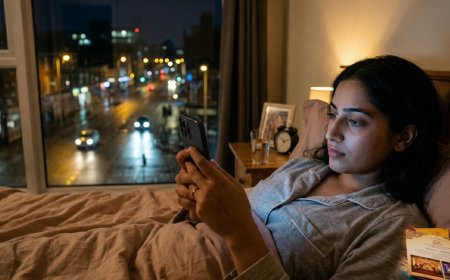
The realisation arrived late, as the most useful realisations in wedding planning tend to do. Parveen was in Birmingham, seven weeks before her wedding in Jalandhar, going through the final checklist on a Sunday evening when her fiancé was watching football and the flat was quiet enough for the kind of focused attention that the checklist required. She had the lehenga. She had the jewellery. She had the footwear — two pairs, one for the ceremony and one for the reception, both purchased on her October visit to Jalandhar with the specific efficiency of someone who had read the right guides before she went. She had the family sarees, the groom's sherwani, the children's outfits, the coordinated family palette agreed and mostly executed.
She did not have the dupatta.
Not the dupatta that came with the lehenga — that she had. A perfectly constructed piece in matching fabric, embellished to coordinate with the lehenga's embroidery, designed to be worn over the head for the ceremony photographs and then managed across the left shoulder for the rest of the day. That dupatta was fine. That dupatta was correct. That dupatta was, in the specific way of things that are correct without being right, entirely unmemorable.
What Parveen did not have was the dupatta that her mother had been mentioning since the engagement — not insistently, not with any particular urgency, but with the quiet consistency of someone who knows something important and is waiting for the right moment to be heard. Her mother had mentioned, on at least three separate occasions in the fourteen months of wedding planning, that the dupatta her own mother had worn at her wedding — a hand-phulkari piece in ivory and deep red, made in the Basti Sheikh area of Jalandhar, given to her mother by her maternal aunt who had spent six months embroidering it — was the single item from her bridal trousseau that she still had, still kept folded in tissue in the back of the cupboard, still took out occasionally to look at.
Parveen had heard this. She had not, until the Sunday evening with the checklist and the quiet flat and seven weeks remaining, understood what her mother was actually saying.
Her mother was saying: the dupatta is not an accessory. It is the piece that your wedding will be remembered by. It is the piece that will be in the cupboard forty years from now. It is the piece that, if you get it right, is the thing that everyone who attended your wedding will mention when they describe what you looked like.
Parveen called her mother. She said: tell me about the dupatta.
Her mother, who had been waiting for this call, told her.
What followed was three weeks of research into a category of bridal shopping that Parveen had not previously taken seriously and that turned out to be, in the Jalandhar market specifically, one of the richest and most varied and most culturally specific categories in the entire Indian bridal landscape. The bridal dupatta market in Jalandhar is not an adjunct to the garment market. It is, in many ways, the heart of it — the category where the craft traditions of the Punjab are most purely and most beautifully expressed, where the difference between a piece made within a living tradition and a piece made in its commercial image is most starkly visible, and where the investment of time and attention produces a return — in beauty, in cultural specificity, in the specific quality of being exactly right — that no other category of bridal purchase quite matches.
This guide is for Parveen, and for every NRI bride who has arrived at the dupatta conversation late and needs to understand the market — the traditions, the craft distinctions, the geographical landscape of Jalandhar's bridal dupatta world — with enough depth and specificity to make the right decision in the time that remains.
Why the Dupatta Deserves Its Own Conversation
The dupatta has been the most consistently undervalued item in the Indian bridal wardrobe for the past two decades, and the reasons for this undervaluation are structural. The Indian bridal fashion industry — the magazines, the Instagram accounts, the designer campaigns — presents the dupatta as a component of the bridal set rather than as an independent statement, which means that the attention and the budget given to the dupatta are typically residual: what remains after the lehenga, the jewellery, and the footwear have been addressed.
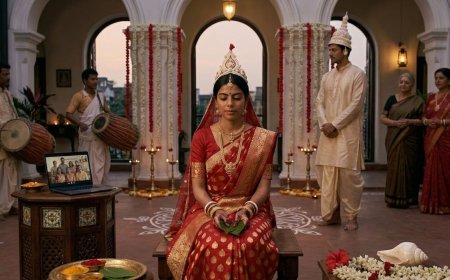
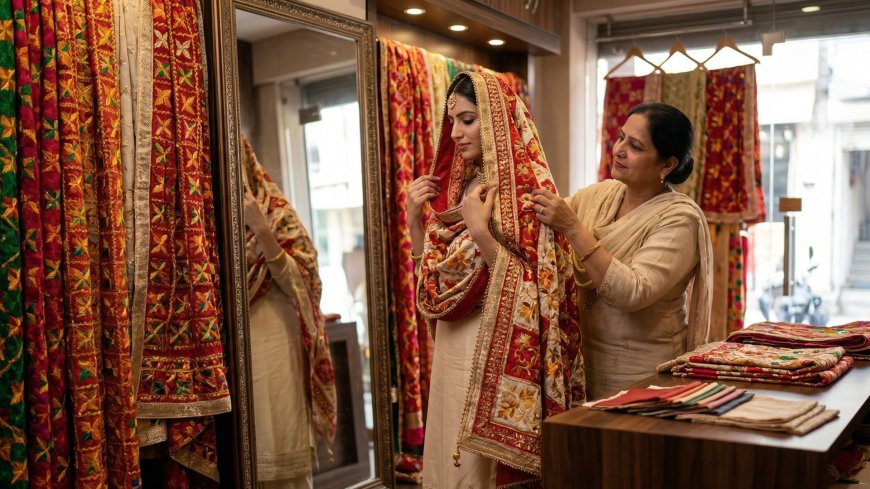
This framing is wrong for every bride and specifically wrong for the Punjabi bride, in whose tradition the dupatta has a ceremonial significance that the garment itself does not. The chope — the traditional phulkari dupatta placed over the bride's head by her maternal family during the wedding ceremony — is a ritual object before it is a piece of clothing. The dupatta draped over the bride's head at the anand karaj is the visual element that every family member and every photographer is attending to in that specific moment. The dupatta that falls across the bride's left shoulder for the reception photographs is the element that most consistently appears in the close shots that define the visual memory of the day.
The dupatta, in the Punjabi wedding context, is not an accessory. It is architecture. And Jalandhar — as the heartland of the phulkari tradition, as the city where the most skilled dupatta craftswomen work, as the market where the variety of bridal dupattas available in any single shopping day exceeds what most other Indian cities offer across multiple trips — is the correct place to take this architecture seriously.
The Standalone Dupatta: Why It Changes Everything
The standalone dupatta — a piece sourced independently of the primary garment, chosen for its own qualities rather than as a matching component of a set — is the decision that transforms the bridal look from a coordinated outfit into a considered aesthetic statement. The standalone dupatta introduces a second layer of decision-making into the bridal look: not only what does the garment say, but what does the dupatta say in response to it?
The responses available in the Jalandhar market are extraordinarily varied. A heavily embroidered lehenga paired with a hand-phulkari dupatta in a complementary but distinct colour palette creates a visual conversation between two craft traditions that photographs with a depth that a matching set cannot achieve. A contemporary minimalist Anarkali paired with a densely embroidered traditional bagh dupatta creates a contrast that is simultaneously fashion-forward and culturally rooted. A bridal suit in a muted, contemporary palette paired with a chope in the traditional red and white creates the specific visual statement of a bride who is simultaneously of the present and of the tradition.
These conversations are only available to the bride who has treated the dupatta as an independent choice. The bride who has bought the matching set has made one decision. The bride who has sourced the dupatta separately has made two, and the space between those two decisions is where the most interesting bridal aesthetics live.
The Dupatta Traditions: Understanding Before You Shop
Phulkari: The Tradition That Defines the Category
Phulkari — the hand-embroidery tradition of the Punjab, in which silk thread is worked onto cotton or silk fabric in the specific patterns that have been associated with the region for centuries — is the tradition that makes Jalandhar's bridal dupatta market internationally significant. The word phulkari means flower work, but the tradition encompasses a vocabulary of patterns that extends far beyond floral motifs: geometric, abstract, figurative, and narrative patterns that carry the specific visual language of the Punjab across generations of craftswomen who learned the work from their mothers and grandmothers.
The bridal phulkari dupatta is not simply a dupatta with embroidery. It is a specific garment type within the tradition, with its own naming conventions, its own pattern vocabulary, and its own ceremonial functions. The bagh — meaning garden — is the most densely embroidered phulkari, with the thread covering the entire fabric surface in geometric patterns of extraordinary complexity. The chope is the specific phulkari used in the wedding ceremony — traditionally in red and white, traditionally given by the maternal aunt, traditionally placed over the bride's head at the ceremony's most significant moment. The sainchi carries figurative motifs — birds, trees, figures — that tell stories specific to the Punjabi folk tradition.
Understanding which phulkari type is appropriate for which function within the wedding is the knowledge that transforms dupatta shopping from a visual exercise into a cultural one. The bagh, with its full-surface embroidery and its weight, is the statement piece — for the photography, for the reception, for the moments where the dupatta is the visual centrepiece. The chope is the ceremonial piece, not interchangeable with any other phulkari regardless of its beauty. The sainchi is the storytelling piece, the one that carries specific meaning in its patterns for those who know how to read them.
Chikankari: The Lucknow Tradition in Jalandhar's Market
Chikankari — the white-on-white embroidery tradition of Lucknow — is available in Jalandhar's dupatta market in a quality that reflects the city's position as a major textile trading centre. The chikankari dupatta, in the bridal context, is the choice for the bride whose aesthetic is more restrained — who wants the visual interest of embroidery without the colour saturation of phulkari, who is wearing a heavily coloured lehenga and wants the dupatta to provide contrast rather than additional colour.
The bridal chikankari dupatta in Jalandhar's market ranges from the simple shadow-work pieces appropriate for pre-wedding events to the heavily embroidered mukaish and badla-work pieces that carry sufficient visual weight for the wedding ceremony. The finest chikankari available in Jalandhar is sourced directly from the Lucknow craft clusters and is available from the specialist textile importers in the Paragpur area rather than from the garment boutiques on GT Road.
Zardozi: The Heavy Embellishment Tradition
Zardozi — the embroidery tradition using metallic thread, typically gold or silver, that produces the heaviest and most visually dramatic of the Indian embellishment vocabularies — is the tradition that the mainstream bridal dupatta market in Jalandhar is most comprehensively equipped to serve. The zardozi dupatta, in its bridal form, carries dense metallic embellishment across the border and pallu areas, with lighter work or plain fabric at the field — the centre of the dupatta that drapes over the head.
For the NRI bride whose primary garment is in the restrained contemporary vocabulary, a zardozi dupatta provides the visual weight and the ceremonial gravitas of the bridal context without requiring the primary garment to carry that weight. The conversation between a minimalist Anarkali and a heavily zardozi-embellished dupatta is one of the most photographically effective in the contemporary NRI Punjabi bridal market.
Gota Patti: The Rajasthani Tradition
Gota patti — the ribbon embellishment tradition of Rajasthan, using strips of metallic ribbon applied to fabric in floral and geometric patterns — has entered the Jalandhar dupatta market in the past decade as a response to the NRI bride's demand for the lighter, more contemporary embellishment vocabulary that gota patti produces. The gota patti dupatta is lighter than zardozi, more graphic in its pattern vocabulary, and more aligned with the contemporary fusion aesthetic that a significant proportion of the NRI Punjabi bridal market favours.
The gota patti dupattas available in Jalandhar's market range from the lightweight organza pieces appropriate for a sangeet to the heavier silk pieces with dense gota work that carry sufficient visual weight for the wedding ceremony. The variety available — in colour, in pattern density, in the combination of gota with other embellishment techniques — has expanded significantly in the past five years as the Jalandhar market has responded to NRI demand.
Bandhani and Tie-Dye: The Regional Textile Tradition
Bandhani — the tie-dye tradition of Gujarat and Rajasthan — is available in Jalandhar's dupatta market in pieces sourced directly from the traditional craft clusters of those regions, and it provides an option for the bride whose aesthetic is rooted in the broader North Indian textile tradition rather than specifically in the Punjabi vocabulary. The bandhani dupatta, in the bridal context, is most appropriate for pre-wedding events — the mehndi, the sangeet — where its festive colour vocabulary and its regional craft authenticity are more appropriate than the formal embellishment of the phulkari or zardozi traditions.
Where to Shop: Jalandhar's Bridal Dupatta Market
Basti Sheikh: The Phulkari Source
Basti Sheikh is the most important destination in Jalandhar — and arguably in all of India — for the genuine hand-phulkari dupatta. The embroidery tradition in this area of the city is not a commercial approximation of the phulkari tradition. It is the tradition itself, maintained by craftswomen whose families have been doing this work for generations and who have not substituted the hand-embroidery with machine production despite the economics that would justify the substitution.
The phulkari workshops in Basti Sheikh are not shops. They are homes and community spaces where the work is done, typically by groups of women working collectively on a single piece over weeks or months. Accessing these workshops requires a local introduction — the kind that comes through family networks or through the boutiques that have established relationships with the craftswomen, such as House of Phulkari, which was described in the previous guide.
What the Basti Sheikh phulkari offers that no commercial market can replicate is the specific quality of hand work that results from the craftswomen's relationship with the tradition. The thread tension in a hand-phulkari piece is variable in a way that produces depth and life in the embroidery — the slight variations in the stitch length, the specific way the silk thread catches the light at different angles, the density of the coverage that a human hand working with intention produces. These qualities are visible in person and photograph with an intimacy and an authenticity that machine embroidery and commercial production cannot approximate.
For the NRI bride who wants a chope specifically, Basti Sheikh is the only source in Jalandhar that produces the piece to the traditional standard — in the traditional red and white, with the traditional pattern vocabulary, made with the understanding of what the chope is and what it does in the ceremony. Commission this piece with a minimum of four months' lead time.
Paragpur: The Wholesale Textile Source
The Paragpur wholesale market, which serves primarily the garment manufacturing industry of Jalandhar and the surrounding region, carries a dupatta section that is among the most varied and most competitively priced in North India. The dupattas available here — in plain fabrics, in printed fabrics, in semi-embellished fabrics that are sold to boutiques for further embellishment — are the raw material from which the finished bridal dupattas of the Jalandhar market are made.
For the NRI bride who wants a dupatta made to her specific brief — a specific fabric, a specific base colour, a specific embellishment type applied to her specification — the Paragpur market is the starting point. The fabric is selected here, at wholesale prices that represent thirty to forty percent savings over the retail boutique equivalents, and the embellishment is then commissioned from the specialist embroidery workshops or the boutique ateliers that apply the work to the fabric.
The Paragpur dupatta market is best navigated with a local contact who knows the specific vendors within the market that carry the quality levels appropriate for a bridal brief. The market's density — hundreds of vendors across a physically large area — rewards the informed buyer and is overwhelming for the uninformed one.
GT Road and the Main Market: The Accessible Retail Destination
The GT Road corridor carries the most accessible retail destination for bridal dupattas in Jalandhar, with a concentration of shops that carry finished dupatta pieces across the full quality and price spectrum. The shops here range from the mass-market retailers carrying commercially produced phulkari-look dupattas at ₹2,000 to ₹8,000 to the mid-market boutiques carrying genuine hand-embroidered pieces in the ₹15,000 to ₹50,000 range.
Dupatta House on GT Road is the most well-known dedicated dupatta retailer in Jalandhar, carrying a selection that covers the full embellishment vocabulary — phulkari, chikankari, zardozi, gota patti, bandhani — in an organised retail environment that allows comparison shopping across traditions and price points. For the NRI bride who is developing her understanding of the category before making a purchase decision, Dupatta House is the most efficient orientation destination in the city.
Phulkari Palace on GT Road carries the most commercially significant phulkari dupatta range in the city's retail market — pieces that are produced in commercial workshops using a combination of hand and machine embroidery that produces a visual quality close to genuine hand-phulkari at a significantly lower price. For the NRI bride whose budget does not accommodate the full hand-phulkari investment but who wants the phulkari aesthetic, the Phulkari Palace range provides the most honest version of the commercial approximation.
Kiran Saree Centre, which has been operating on GT Road for over thirty years and whose primary business is sarees, carries a dupatta section that is specifically strong in the chikankari and heavy embellishment categories. The pieces here are sourced from across North India — the chikankari from Lucknow, the zardozi from the Delhi embroidery workshops, the bandhani from Rajasthan — and the selection reflects the owner's thirty years of textile buying experience.
Model Town: The Premium Dupatta Boutiques
The Model Town area carries the premium end of the Jalandhar dupatta market, with boutiques that carry standalone dupatta pieces of genuine craft quality in a retail environment that is appropriate to the investment.
Rang de Dupatta, described in the previous guide, is the most important destination in this area for the NRI bride specifically. The hand-phulkari pieces here are sourced from the Basti Sheikh craftswomen through a direct relationship that the boutique has maintained for seven years, and the quality — confirmed by the physical weight of the thread work, the density of the coverage, and the specific way the piece moves when handled — is of a standard that the commercial market does not reach.
The boutique's approach to the NRI customer is specifically developed: swatches dispatched to the bride's international address, video consultations conducted at times that accommodate international time zones, a ready-to-ship range for brides who cannot visit in person, and a custom commission service for the bride who knows exactly what she wants and needs the piece made to that specification. The price range — ₹8,000 to ₹80,000 for hand-phulkari pieces — reflects the genuine hand-work investment rather than the commercial production economics.
Tilla Threads in Model Town carries the most design-forward dupatta range in Jalandhar — pieces that take the traditional embellishment vocabularies and resolve them into contemporary design statements. The phulkari at Tilla Threads uses non-traditional colour combinations — dusty rose on ivory, sage green on champagne, midnight blue on gold — that place the traditional craft in a contemporary aesthetic context. The gota patti work uses contemporary geometric patterns rather than the traditional floral vocabulary. The overall aesthetic is specifically calibrated to the NRI bride who wants the cultural rootedness of the traditional craft without the conventional colour palette that the tradition has historically used.
Riwayat Textiles in Model Town is the boutique most specifically oriented toward the NRI bride who wants the dupatta as the primary bridal statement — who is planning a simpler primary garment and wants the dupatta to carry the visual weight of the bridal look. The pieces here are designed with this brief in mind: the embellishment is more concentrated, the fabric choices are more dramatic, and the construction — the weight and the drape of the finished piece — is calibrated to the requirements of a dupatta that is the centre of the look rather than the complement to it.
The Specialist Craft Clusters: Beyond the Market
Beyond the commercial market, Jalandhar's surrounding region contains craft clusters that produce bridal dupattas of a quality and a cultural specificity that the city's retail market cannot replicate. The phulkari craft villages in the Phagwara area, accessible from Jalandhar in under an hour, produce pieces that are genuinely within the living tradition — made by women who learned the work from their mothers, using patterns that have specific meanings in the community's cultural vocabulary, in the thread and fabric combinations that the tradition specifies.
Accessing these craft clusters requires a local contact — a family member who knows the area, a wedding planner with craft sourcing relationships, or the introduction of a boutique like House of Phulkari that maintains direct relationships with the craft community. The pieces available through this channel are not available in any retail market, and the experience of commissioning a dupatta directly from the craftswomen who make it — seeing the work in progress, understanding the time investment, carrying a piece whose provenance is specific and documented — is one that many NRI brides describe as among the most significant purchases of the entire wedding.
The Draping Question: How the Dupatta Is Worn Determines What to Buy
The most frequently overlooked dimension of dupatta selection is the draping style — how the dupatta will be worn at each ceremony, and how the draping style affects the choice of fabric, weight, and embellishment. A dupatta that drapes beautifully in one style may not work in another, and the NRI bride who buys a dupatta without considering how it will be worn is making the selection from incomplete information.
The head drape — the dupatta placed over the head for the ceremony photographs and for the anand karaj — requires a dupatta with enough weight and drape to fall naturally and stay in place without constant adjustment. A very lightweight dupatta will slip and require management. A very heavy dupatta will sit rigidly rather than falling with the natural grace that the photograph requires. The weight sweet spot for the head drape is a medium-weight fabric with sufficient body — a silk georgette, a heavy chiffon, a medium-weight raw silk — that falls with controlled grace rather than either stiffness or instability.
The left-shoulder drape — the standard reception and evening styling for the Punjabi bride — requires a dupatta with enough length to fall from the left shoulder to approximately the knee or floor, and with an embellishment distribution that reads well from the front when draped in this manner. The pallu embellishment — the heavily embellished border that frames the trailing end of the dupatta — is the element that is most visible in this drape, and it should be chosen with the left-shoulder drape in mind rather than with the head drape.
The pinned drape — the contemporary styling in which the dupatta is pinned to the shoulder of the blouse or the Anarkali and arranged to fall in a specific direction — requires a lighter dupatta that can be shaped and positioned rather than one that is heavy enough to fall on its own. The lightest embellishment options — the gota patti, the light chikankari, the printed silk — are most compatible with the pinned drape.
Common Mistakes NRI Brides Make With Bridal Dupatta Shopping in Jalandhar
Treating the Matching Dupatta as Sufficient
The most consequential mistake in the dupatta category is treating the dupatta that comes with the primary garment as sufficient without evaluating it against the wedding's specific requirements. The matching dupatta is designed to coordinate with the garment. It is not designed to be the visual statement of the ceremony, to serve as the chope, or to carry the specific craft and cultural significance that a standalone piece can carry. Evaluate the matching dupatta honestly and supplement or replace it if the evaluation finds it insufficient for the specific ceremonial function it must serve.
Choosing the Dupatta After the Jewellery Is Confirmed
The dupatta and the jewellery are the two elements of the bridal look that most directly affect each other — the maang tikka sits against the dupatta, the nath chain is anchored to the dupatta in some styling traditions, and the overall visual balance of the face and head area in the ceremony photographs is determined by how the dupatta and the jewellery read together. The dupatta should be confirmed at the same time as the jewellery, not after, so that the two decisions can be made in reference to each other rather than sequentially without the ability to adjust.
Buying Without Handling the Piece
The weight, the drape, and the texture of a dupatta are properties that cannot be assessed from a photograph or a video. The NRI bride who purchases a dupatta remotely — without a physical swatch, without handling the piece in person — is making the most significant sensory decision in the dupatta selection without the sensory information required to make it correctly. Insist on a fabric swatch for any remote purchase, and if the timeline allows a physical visit, handle the shortlisted pieces before confirming any purchase.
Not Commissioning the Chope Separately
The chope is not substitutable by any other dupatta, regardless of its beauty or its cultural authenticity in a different tradition. The NRI bride who plans to use the matching dupatta as the chope, or who plans to use a hand-phulkari bagh as the chope because it is beautiful, is misunderstanding the function of the chope in the ceremony. The chope is a specific ritual garment with a specific tradition of commissioning — from the maternal family, given to the bride at a specific moment in the wedding proceedings — and this specificity requires that it be sourced separately, from a maker who understands its function, and given to the appropriate family member before the ceremony so that the giving itself can be the ritual that it is supposed to be.
Underestimating the Lead Time for Hand Embroidery
A genuine hand-phulkari dupatta of bridal quality takes between six weeks and four months to produce, depending on the density of the embroidery and the workload of the craftswomen. The NRI bride who inquires about a hand-phulkari commission two months before the wedding may find that the piece cannot be completed to the standard required within the timeline available. Begin the hand-embroidery commission conversation at the same time as the primary garment commission — not after the garment is confirmed, but simultaneously, because the embroidery timeline is as uncompressible as the tailoring timeline.
Conflating Commercial Phulkari With Hand Phulkari
The Jalandhar market contains a large volume of commercially produced phulkari — machine-embroidered or partially machine-embroidered pieces that carry the visual vocabulary of the phulkari tradition without the hand work that gives genuine phulkari its quality and its cultural significance. The difference between hand and machine phulkari is visible when both are handled together — the thread tension, the back of the work, the weight of the silk — but is not always discernible in a photograph or in a retail environment where the commercial piece is displayed without a genuine hand piece for comparison. Ask explicitly whether the piece is hand-embroidered or machine-embroidered, and ask to see the back of the work. The back of a genuine hand-phulkari is as orderly as the front, because the craftswomen work from the back of the fabric. The back of a machine-embroidered piece is distinctively different.
The Complete Jalandhar Bridal Dupatta Guide
| Type | Tradition | Best Source | Lead Time | Price Range | Best For |
|---|---|---|---|---|---|
| Chope (traditional) | Phulkari | Basti Sheikh, House of Phulkari | 3–4 months | ₹35K–₹90K | Wedding ceremony ritual |
| Bagh (full coverage) | Phulkari | Basti Sheikh, Rang de Dupatta | 2–4 months | ₹25K–₹80K | Statement photography piece |
| Sainchi (figurative) | Phulkari | House of Phulkari | 3–5 months | ₹30K–₹1L | Cultural heritage statement |
| Commercial Phulkari | Phulkari-inspired | GT Road, Phulkari Palace | Immediate | ₹5K–₹25K | Pre-wedding events |
| Chikankari (heavy) | Lucknow tradition | Kiran Saree Centre, Paragpur | 4–6 weeks | ₹12K–₹45K | Ceremony, restrained palette |
| Zardozi (bridal) | Metallic embroidery | GT Road boutiques | 3–6 weeks | ₹15K–₹60K | Heavy embellishment look |
| Gota Patti | Rajasthani tradition | Tilla Threads, Model Town | 2–4 weeks | ₹8K–₹35K | Contemporary fusion |
| Bandhani | Tie-dye tradition | Paragpur, GT Road | Immediate | ₹3K–₹15K | Mehndi, sangeet |
| Custom design | Any tradition | Rang de Dupatta, Riwayat | 6–12 weeks | ₹20K–₹1.5L | Specific brief, standalone statement |
The Resolution
Parveen arrived in Jalandhar four weeks before the wedding. She had seven weeks when she called her mother and began the research, and she had used three of those weeks well — reading, asking, building the understanding of the category that the Birmingham flat on a Sunday evening had not provided.
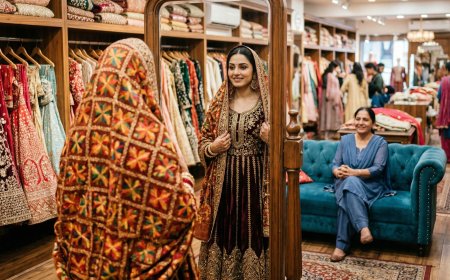
She spent her first day in Jalandhar entirely on dupattas. Not on the garment, not on the jewellery, not on any of the other categories that had already been addressed — just the dupatta. She went to Dupatta House on GT Road in the morning to develop her eye. She went to Rang de Dupatta in Model Town in the afternoon with the knowledge that the morning had given her. She went to House of Phulkari in Basti Sheikh on the second morning, with her mother and with the specific understanding of what she was looking for and why.
At House of Phulkari, Gurmail Singh showed her three pieces. The first was a bagh in deep red and gold — dense, magnificent, the kind of piece that announces itself in a room. The second was a sainchi in ivory with figurative motifs — birds, trees, the Punjabi landscape in silk thread on cotton. The third was a chope in the traditional red and white, commissioned by a family and uncollected — a piece that was technically available but that felt, when Parveen held it, like something that belonged to a different story.
She bought the sainchi. Not because it was the most conventionally beautiful of the three — the bagh was more immediately dramatic, the chope was more culturally specific. She bought it because when she held it and her mother looked at it and neither of them said anything for a full thirty seconds, she understood that the silence was the thing she had been looking for.
The chope she commissioned separately, to be ready for the wedding. She asked her mother's sister to pay for it, because that was what the tradition specified, and her mother's sister said yes without hesitation because she had been waiting to be asked.
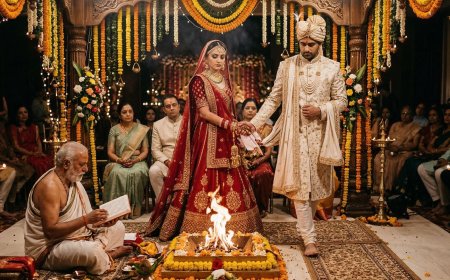
At the wedding, the sainchi fell across Parveen's left shoulder for the reception photographs in the specific way of a piece made with intention. The chope was placed over her head during the anand karaj by her mother's sister's hands. In the photographs — both the professional ones and the candid ones taken by guests — the dupatta is the element that every person who attended the wedding mentions when they describe what Parveen looked like.
Her mother, who has kept her own phulkari dupatta in tissue in the back of the cupboard for thirty years, looked at the sainchi the morning after the wedding and said: this will keep.
She was right. It will.
Commission the chope separately and from the correct source — it is a ritual garment, not an accessory.
Begin the hand-embroidery commission at the same time as the primary garment, not after it.
Handle every shortlisted piece in person before purchasing — weight, drape, and texture are not visible in photographs.
Choose the dupatta with the specific draping style in mind — the ceremony drape and the reception drape have different requirements.
Ask to see the back of every phulkari piece — genuine hand work is as orderly on the back as on the front.
The dupatta is the piece that your wedding will be remembered by. In Jalandhar, the market for that piece is not just available — it is among the finest in the world. Give it the time and the attention it has always deserved.
Published by NRIWedding.com — The Premium Global Platform for Non-Resident Indians Planning Indian Weddings From Abroad.
What's Your Reaction?
 Like
0
Like
0
 Dislike
0
Dislike
0
 Love
0
Love
0
 Funny
0
Funny
0
 Angry
0
Angry
0
 Sad
0
Sad
0
 Wow
0
Wow
0