


























































Two Thousand Years of Faith, One Sacred Thread: The Complete Guide to Syrian Christian Wedding Traditions in Kerala
Kerala's Syrian Christian community carries one of the oldest Christian traditions on earth — a faith that arrived on the Malabar Coast in 52 AD and wove itself so completely into Kerala's culture that its weddings are unlike anything else in Christendom. From the Koonamoodu kneeling to the Minnu tying, from the Manthrakodi draping to the banana leaf Sadya, a Syrian Christian wedding is two thousand years of faith, culture, and community in a single ceremony. For Syrian Christian NRIs across the US, UK, Canada, UAE, and Australia, this is your complete guide to every ritual, every denomination, and every detail.


Kerala's Syrian Christian community carries one of the oldest Christian traditions in the world — a faith that arrived on this coastline nearly two thousand years ago, long before Christianity reached most of Europe, and wove itself so completely into the fabric of Kerala's culture that its wedding ceremonies are unlike anything else in Christendom. Syrian Christian weddings are not simply Christian weddings in Kerala — they are Keralite weddings that are Christian, carrying the jasmine and the banana leaf and the gold alongside the cross and the liturgy and the ancient Syriac prayers. For Syrian Christian NRIs from Kottayam to Canada, from Thiruvalla to Texas, from Kollam to the United Kingdom, this wedding tradition is the most beautiful argument for why some things must be preserved exactly as they are.
You grew up knowing that your community's weddings were different — different from the Hindu weddings your neighbours had, different from the church weddings your friends from other Christian backgrounds described, different even from what most people imagined when they heard the word "Christian wedding." You grew up with the smell of incense and coconut oil lamps in the same breath. You grew up knowing the word Koonamoodu and Minnu before you fully understood either. You grew up watching brides in cream-and-gold Kasavu sarees receive the cross, and understanding without being told that this was not a contradiction — it was the whole point.
You are planning your own wedding now. You are in a house in Mississauga or a flat in Wembley or an apartment in Houston, and your mother is on the phone from Kottayam or Thiruvalla saying, "The Koonamoodu must be done by the right person, the Minnu must be from the right jeweller, the priest must know our rite — not just any Mar Thoma priest, not just any Catholic priest, our rite." She means every word. Because in a tradition that has survived two thousand years of history, colonisation, and diaspora, every word she says has been said before, by mothers who also knew that some things must not be lost.
This is the Syrian Christian wedding of Kerala. It is two thousand years old. It is yours. And it is extraordinary.
🌟 DID YOU KNOW?
- The Kerala Syrian Christian community traces its origin to the arrival of St. Thomas the Apostle on the Malabar Coast in 52 AD — making the Syrian Christian faith in Kerala older than most of the world's major Christian denominations, predating the establishment of the Roman Catholic Church and arriving in India while Jerusalem was still standing. This is not legend but a historical tradition accepted by scholars and central to Syrian Christian identity worldwide.
- The Minnu — the sacred Syrian Christian wedding pendant — is one of the most distinctive pieces of bridal jewellery in the world. It consists of a small gold cross pendant attached to a string of twenty-one black beads and tied around the bride's neck by the groom during the wedding ceremony. The number twenty-one is theologically significant: it represents the Holy Trinity multiplied by seven, the number of divine completeness in Christian mystical tradition.
- The Syrian Christian wedding liturgy in Kerala has historically been conducted in Syriac — a dialect of Aramaic, the language spoken by Jesus Christ himself — making the Kerala Syrian Christian wedding ceremony one of the very few Christian rituals in the world still conducted in the language of the original apostolic tradition. Many Syrian Christian denominations in Kerala continue to use Syriac alongside Malayalam in their wedding liturgy today.
What Is a Syrian Christian Wedding?
The Syrian Christian community of Kerala — also known as Saint Thomas Christians, Nasrani, or Marthoma Nazranis — comprises several distinct denominations that share a common apostolic origin but follow different rites and ecclesiastical traditions. The major denominational groups whose wedding traditions are covered in this guide are the Jacobite Syrian Orthodox, Malankara Orthodox, Mar Thoma Syrian, Syro-Malabar Catholic, Syro-Malankara Catholic, and Church of South India (CSI) communities. Each has its own specific liturgical tradition, but all share a common cultural heritage that distinguishes Syrian Christian weddings from any other Christian wedding in the world.
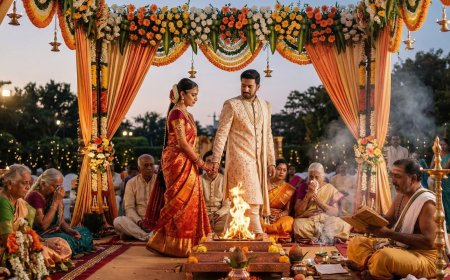
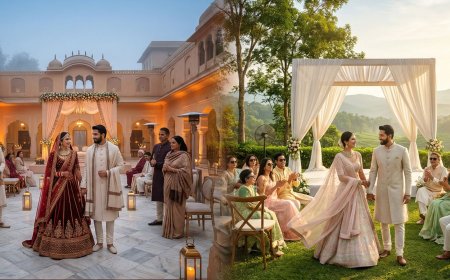
What makes a Syrian Christian wedding distinct is this: it is a liturgical Christian ceremony that has absorbed, over two thousand years of coexistence with Kerala's Hindu and later Muslim culture, a set of pre-wedding, wedding day, and post-wedding rituals that are entirely Keralite in character. The bride wears a Kasavu saree (the cream-and-gold Kerala saree) rather than a Western white dress in traditional ceremonies. The nilavilakku (Kerala oil lamp) burns at the threshold. The Sadya (banana leaf feast) is served at the wedding meal. The pudamuri (gifting of clothes by the groom's family) happens before the ceremony. Jasmine adorns the bride's hair. Coconut and banana are the auspicious fruits of the celebration.
And within this Keralite cultural framework, the specifically Christian elements — the church ceremony, the liturgy in Syriac and Malayalam, the priestly blessing, the exchange of rings, the tying of the Minnu — create something entirely singular. This is what two thousand years of a faith living inside a culture produces: not a compromise, but a synthesis. Not a dilution, but a deepening.
The wedding sequence typically unfolds across multiple days and multiple locations — the pre-wedding rituals at the family home, the church ceremony, and the reception feast — and each stage carries its own specific rituals, prayers, and cultural observances that this guide addresses in full.
The Pre-Wedding Rituals
Nirnayam (Engagement)
The formal engagement ceremony — Nirnayam (literally "the decision" or "the agreement") — is the first official ritual in the Syrian Christian wedding sequence. It takes place at the bride's home, typically weeks or months before the wedding, and involves both families gathering with a priest to formalise the betrothal. The priest leads prayers, the couple exchanges rings in the presence of family witnesses, and the groom's family presents gifts to the bride. In many families this is a relatively intimate gathering; in others it is a substantial celebration in its own right. The Nirnayam is the community's formal announcement that these two people are promised to each other, and it carries social and in some cases quasi-legal weight within the community.
Pudamuri
As described in its own full guide, Pudamuri — the ritual gifting of clothes by the groom's family to the bride — is observed in Syrian Christian families with the same significance as in Hindu families, though sometimes with Christian prayers added to the gifting ceremony. The Kasavu saree given during Pudamuri is the saree the bride wears for the wedding, connecting the pre-wedding gift directly to the wedding day in a way that is both practical and deeply symbolic.
Veli (the Threading Ceremony)
The Veli — the ceremony in which the groom's family threads a sacred string or garland in preparation for the wedding — is a pre-wedding ritual observed in some Syrian Christian families, particularly in the Jacobite and Orthodox denominations, that reflects the community's deep continuity with Kerala's broader wedding culture. It varies significantly by family and denomination.
Marrying Eve Prayers and Family Gathering
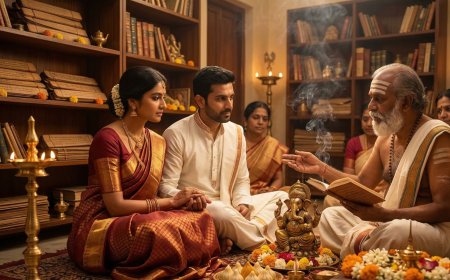
The evening before the wedding, most Syrian Christian families hold a prayer service at the family home — a gathering of extended family and close friends, led by a priest or lay elder, in which the couple is blessed and commended to God's protection for the day ahead. This is one of the most intimate moments of the entire wedding sequence, held in the family home rather than the church, in the Malayalam that everyone present has prayed in their whole lives.
The Church Ceremony: Step by Step
The Syrian Christian church ceremony is the absolute heart of the wedding — a liturgical service that, depending on the denomination, can last between one and three hours and moves through a precise sequence of prayers, scriptural readings, homily, sacramental rites, and community blessing. The following describes the general sequence, with denominational variations noted.
The Arrival and Seating
In most Syrian Christian denominations, the bride and groom arrive at the church separately and are seated apart until they are brought together by the ceremony. The church is decorated with flowers — white and gold predominant — and the nilavilakku burns at the entrance in many family traditions, a Kerala cultural element that sits entirely naturally within the Syrian Christian ceremonial space.
The Kartavyam (the Calling)
The formal beginning of the ceremony involves the priest calling the couple forward — the Kartavyam (duty or calling) — in which the couple is presented to the congregation and the wedding party takes its formal position before the altar. In Jacobite and Orthodox ceremonies, this is accompanied by liturgical chanting in Syriac that has been sung at Syrian Christian weddings for over a thousand years.
The Koonamoodu (the Kneeling)
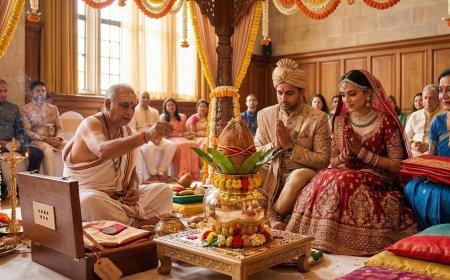
Koonamoodu — the ritual kneeling of the couple before the altar — is one of the most visually and spiritually distinctive elements of the Syrian Christian wedding. The bride and groom kneel together, side by side, before the priest and the altar, in an act of humility and submission before God that is simultaneously an act of equality — they kneel together, neither above the other. The priest places his stole over their bowed heads as a gesture of covering and blessing. The congregation observes in silence.
The Minnu Dharanam (the Tying of the Sacred Pendant)
Minnu Dharanam — the tying of the Minnu (the sacred gold cross pendant on twenty-one black beads) around the bride's neck by the groom — is the Syrian Christian equivalent of the Mangalsutra tying in Hindu ceremonies, and it is the moment the entire church has been building toward. The groom ties the Minnu with three knots — representing the Holy Trinity — while the priest chants the blessing. The church bells ring. The congregation murmurs its blessing. The bride's expression at this moment — the precise, private look that passes across a bride's face when the Minnu settles at her throat — is the photograph that every Syrian Christian family keeps above everything else.
The Minnu in different Syrian Christian denominations carries slightly different designs. The Jacobite and Orthodox Minnu is typically a plain gold cross on black beads. The Syro-Malabar Catholic Minnu may incorporate a specific cross design associated with the Thomas Cross (Nasrani Menorah). The Mar Thoma Minnu follows its own community-specific design. Confirming the correct Minnu design for your denomination with a Kerala jeweller is essential.
The Exchange of Rings
The exchange of wedding rings follows or accompanies the Minnu tying, with the priest blessing the rings and the couple placing them on each other's fingers. In some denominations the rings are blessed on the altar before the ceremony begins; in others the blessing happens at the moment of exchange.
The Manthrakodi (the Wedding Saree)
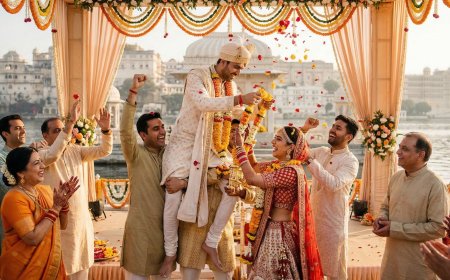
Manthrakodi — literally "the saree of the mantras" or "the blessed cloth" — is the white or cream silk saree that the groom drapes over the bride's head and shoulders during the church ceremony, typically after the exchange of rings. It is a gesture of covering, protection, and blessing — the groom literally enveloping his bride in cloth as a symbol of the care and shelter he is committing to provide. The Manthrakodi is distinct from the Pudamuri Kasavu saree — it is an additional ceremonial draping specific to the church ceremony itself, and it is one of the most photographed moments of any Syrian Christian wedding.
The Priestly Blessing and Homily
Following the sacramental rites, the priest delivers a homily and the couple receives the priestly blessing — hands laid upon their bowed heads, prayers spoken in Syriac and Malayalam, the congregation standing. In many denominations, the couple also receives Holy Communion as part of the wedding liturgy, making the ceremony a full sacramental service rather than simply a blessing ritual.
The Signing of the Register
The formal signing of the church register — witnessed by family representatives and the officiating priest — completes the ecclesiastical record of the marriage. In India, this church register has legal standing. For NRI couples, the church ceremony abroad may need to be preceded by or followed by separate civil registration depending on the country's legal requirements — discuss this with your priest well in advance.
Community Comparison Table
| Denomination / Community | Ceremony Name | Key Distinctive Ritual | Minnu Style | How NRIs Abroad Adapt |
|---|---|---|---|---|
| Jacobite Syrian Orthodox | Holy Qurbana & Wedding | Syriac liturgy; Koonamoodu; plain gold cross Minnu on black beads | Plain gold cross, 21 black beads | Jacobite priest sourced through diocese networks; Syriac liturgy maintained |
| Malankara Orthodox | Holy Qurbana & Wedding | Similar to Jacobite; specific Orthodox episcopal blessing | Plain gold cross variant; diocese-specific | Malankara Orthodox diocese in diaspora countries provides priest referrals |
| Mar Thoma Syrian | Mar Thoma Wedding Service | Reformed liturgy; Malayalam prominent; evangelical elements alongside Syrian rite | Mar Thoma cross design, black beads | Mar Thoma congregations in UK, US, Canada, Australia provide officiating priests |
| Syro-Malabar Catholic | Holy Qurbana (Chaldean Rite) | Latin-influenced but Eastern rite; Thomas Cross Minnu; priest in specific vestments | Thomas Cross (Nasrani Menorah) design | Syro-Malabar Catholic parishes in diaspora cities; priest must be of the rite |
| Syro-Malankara Catholic | Byzantine-influenced service | Eastern Catholic rite; Syriac and Malayalam; specific Minnu design | Eastern Catholic cross variant | Syro-Malankara Catholic bishop's office for diaspora priest referrals |
| Church of South India (CSI) | CSI Wedding Service | Protestant reformed service; Malayalam; less Syriac; ring exchange central | Simple gold cross or ring; less traditional Minnu | CSI congregations widely available in diaspora; most accessible for NRI weddings |
| Kerala Hindu (Nair) — for comparison | Hindu Wedding | Dhare Hereyuvudu; Saptapadi; Mangalsutra | Gold pendant, black beads | Hindu pandit sourced through temple networks |
| Kerala Muslim (Mappila) — for comparison | Nikah | Mahr presentation; Qazi officiates; Malayalam and Arabic | No Minnu equivalent | Qazi sourced through Islamic centre networks |
The Meaning Behind the Rituals
To understand why the Syrian Christian wedding carries such extraordinary emotional weight — why it moves people who have attended hundreds of church services and dozens of weddings and still find themselves undone at the Minnu tying — you need to understand what this community has survived in order to still be here, doing this, in exactly this way.
The Syrian Christians of Kerala have weathered Portuguese colonisation that tried to Latinise their ancient rite. They have survived schisms and denominational splits that divided families and communities for generations. They have sent their children to every corner of the world — to the Gulf, to the United Kingdom, to North America, to Australia — and watched those children build new lives in new countries while carrying the old prayers in their mouths and the Minnu in their luggage.
And they are still here. Still kneeling at the Koonamoodu. Still tying the Minnu with three knots for the Trinity. Still chanting in Syriac — the language of Jesus — at weddings in Houston and Toronto and Melbourne, in church halls that smell of candle wax and jasmine and the specific mixture of cultures that two thousand years of faithful preservation produces.
The Manthrakodi draping — the groom covering his bride with white silk in the church — is not a Hindu borrowing or a cultural compromise. It is the Syrian Christian community's own theological statement about marriage: that the covenant between husband and wife is a covenant of shelter, that love is not only feeling but protection, that a husband covers his wife not as a superior covers an inferior but as the divine covers the human — with care, with warmth, with the specific tenderness of choosing someone and staying.
For a non-Indian or non-Christian partner or family member seeking the simplest truth: this community has been doing this for two thousand years, and every gesture in this ceremony is the reason why.
Doing a Syrian Christian Wedding Abroad: The Practical Reality
The Syrian Christian NRI wedding abroad faces a set of logistical challenges that are distinct from Hindu NRI weddings — because the challenge is not just finding the right priest but finding the right priest of the right denomination who knows the right rite and has the ecclesiastical authority to officiate a valid marriage in your denomination's eyes.
The priest question is the first and most important decision. A Syrian Christian wedding cannot be officiated by any Christian minister — the rite specificity matters theologically and practically. A Jacobite wedding must be officiated by a Jacobite priest; a Syro-Malabar Catholic wedding requires a priest of the Chaldean rite who is in communion with Rome. For NRI couples in major diaspora cities, the route to finding the right priest runs through the diocesan office of your denomination in the country you are in. The Jacobite and Malankara Orthodox churches both have diocesan structures in the United States, United Kingdom, Canada, Australia, and the UAE. The Mar Thoma church has congregations in virtually every major diaspora city in the world — their website maintains a global congregation directory. The Syro-Malabar Catholic church has parishes in several major diaspora cities. Begin your priest search at least six months before the wedding by contacting the relevant diocesan office directly.
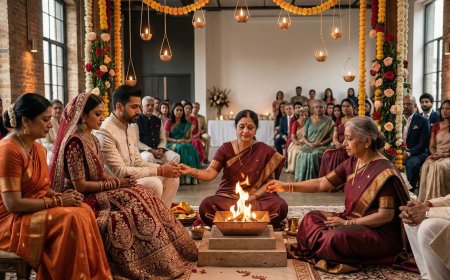
The church or venue for the ceremony is the second major decision. Most Syrian Christian NRI couples prefer to hold the wedding in a church — either a Kerala Syrian Christian church in their city, an ecumenical church that hosts Syrian Christian ceremonies, or a church of another denomination that is willing to host. In London, there are Jacobite, Mar Thoma, and Malankara Orthodox congregations with their own church spaces. In the San Francisco Bay Area, the Jacobite and Mar Thoma communities have established church buildings. In Toronto, the Mar Thoma congregation is well-established. In Melbourne and Sydney, all major Syrian Christian denominations have active congregations. If no suitable church is available, many priests will officiate in a hired venue — discuss this flexibility with your priest and your diocesan office.
The Minnu must be sourced specifically for your denomination, and this is not a detail to leave to the last minute. The wrong Minnu design — a CSI cross when your family is Jacobite, for instance — will be noticed immediately by every elder in the room and will matter to your family in ways that the couple may not fully anticipate. Order your Minnu from a Kerala jeweller who specialises in Syrian Christian jewellery — several jewellers in Kottayam, Thiruvalla, and Ernakulam specialise in denomination-specific Minnu designs and ship internationally. Order at least eight to ten weeks before the wedding to allow for shipping, customs, and any adjustments. NRI.Wedding's vendor directory includes Kerala jewellers who ship Syrian Christian Minnu internationally.
The Manthrakodi — the white or cream silk saree used for the ceremonial draping — must be pure silk and of sufficient length for the draping gesture. This is available from Kerala saree retailers who ship internationally, from South Indian saree shops in diaspora cities, or from the groom's family in Kerala who can source and carry it. Confirm the specific Manthrakodi requirements with your priest — some denominations have specific guidelines on the fabric and colour.
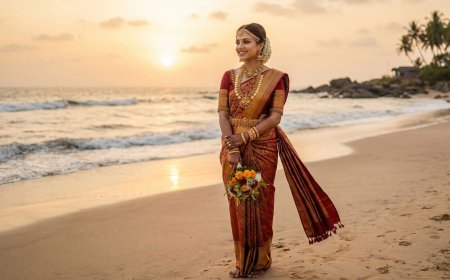
The Kasavu saree for the bride follows the same sourcing guidance as described in the Pudamuri article — authentic Kerala weavers, online Kerala saree retailers with international shipping, or diaspora city saree shops. For a Syrian Christian wedding, the cream-and-gold Kasavu saree is the traditional choice for the church ceremony, though some modern brides choose a white gown for the church and a Kasavu saree for the reception. If doing both, plan the outfit changes into your wedding day timeline with your photographer.
The Sadya follows the sourcing and planning guidance in the Sadya article — find a verified Malayali caterer in your city, confirm the dish count, source banana leaves in advance.
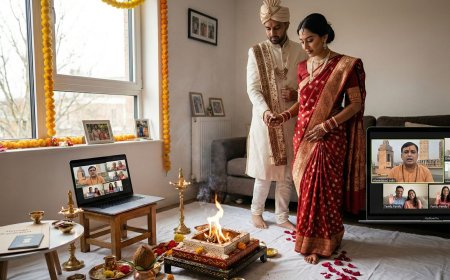
For coordinating with family in Kerala by video call, the Syrian Christian church ceremony streams particularly well because it is long, visually rich, and emotionally varied — your family in Kottayam will want to see the full liturgy, not just the Minnu tying. Set up a stable tablet on a tripod in the church well before guests arrive and assign one family member as the video call coordinator throughout. Begin the stream thirty minutes before the ceremony starts.
Doing a Syrian Christian Wedding as a Destination in Kerala
To get married in a Syrian Christian church in Kerala — in the centuries-old stone church in Kottayam, or in the Cheriapalli (the small church) of Thiruvalla, or in your family's ancestral parish church that has been registering Syrian Christian marriages since before anyone can remember — is to participate in something that transcends any individual wedding.
The most meaningful Syrian Christian destination wedding locations in Kerala are the historic churches of Kottayam (the heartland of Syrian Christian culture, home to some of the oldest functioning Syrian Christian churches in the world), Thiruvalla (the headquarters of the Mar Thoma church), Changanacherry (a centre of Syro-Malabar Catholic life), and the ancient churches of Palai and Pala in Kottayam district. For a wedding with both spiritual and visual grandeur, the Kottayam Cheriapalli (the 1550 Church) and the nearby Valiyapalli (the 1579 Church) are among the most architecturally extraordinary ancient Christian churches anywhere in Asia.
Brief your priest in Kerala well in advance — at least three to four months before the wedding — with a written note of your denomination, your family's specific rite tradition, and any elements you want emphasised or included. If your family has a hereditary connection to a specific church or priest lineage, honour it.
For non-Indian and non-Christian guests at a Kerala Syrian Christian destination wedding, a bilingual ceremony booklet in English and Malayalam explaining the liturgy, the Minnu, the Koonamoodu, and the Manthrakodi is one of the most thoughtful hospitality gestures possible. International guests who understand the two-thousand-year history of what they are witnessing bring a quality of attention to the ceremony that is its own form of blessing.
What You Need: The Complete Syrian Christian Wedding Checklist
Ritual and Ceremonial Items The Minnu (denomination-specific — order from Kerala jeweller at least eight to ten weeks before), the Manthrakodi (white or cream silk saree for ceremonial draping — source from Kerala retailer or diaspora saree shop), the Kasavu saree for the bride (source from Kerala retailer or diaspora saree shop), wedding rings (blessed before or during ceremony), nilavilakku (Kerala oil lamp for home and venue decoration), fresh jasmine flowers for the bride's hair, the Pudamuri complete gift set, church flower decorations (white and gold traditional), candles for the altar (confirm requirements with priest), and the church register for the officiating priest.
People Required The officiating priest of the correct denomination and rite (confirmed with diocesan office at least six months before), the bride and groom, both sets of parents, the best man and bridesmaids (whose roles vary by denomination — confirm with priest), the Manthrakodi draper (traditionally the groom, guided by the priest), church choir or music leader familiar with Syrian Christian liturgical music, a designated video call coordinator for the India family stream, and your wedding photographer and videographer briefed specifically on the Minnu tying and Manthrakodi moments as priority captures.
Preparation Steps Contact diocesan office for priest referral at least six months before. Order Minnu from Kerala jeweller at least eight to ten weeks before. Source Manthrakodi and Kasavu saree at least six weeks before. Confirm church or venue booking at least four months before. Book Sadya caterer at least four months before. Confirm Pudamuri ceremony timing and set with both families at least one month before. Brief photographer on ceremony sequence at least one week before. Set up and test India video call connection the day before. Arrange civil registration requirements for your country well in advance of the wedding.
NRI.Wedding connects Syrian Christian couples abroad with denomination-specific priests, Kerala Minnu jewellers, Kasavu saree suppliers, Sadya caterers, and wedding photographers experienced in the full Syrian Christian wedding sequence. Begin planning at NRI.Wedding.
5 Questions NRI Couples Always Ask
We are from different Syrian Christian denominations — one Jacobite, one Mar Thoma. Can we have a joint ceremony?
This is more common in the NRI diaspora than in Kerala itself, and it has been navigated successfully by many couples. The first step is an honest conversation with priests from both denominations — some are more open to co-officiating or to hosting each other's rites than others, and this varies by individual priest, diocese, and country. The second step is deciding which denomination's rite will be primary and how elements of the other will be incorporated. Some couples hold two separate blessings — one in each church — while others hold a single ceremony that incorporates prayers from both traditions with two priests co-officiating. The NRI context often makes priests more flexible than they might be in Kerala, because diaspora communities are accustomed to ecumenical cooperation. Begin these conversations at least six months before the wedding and approach both priests with openness, humility, and a clear sense of what matters most to both families.
My partner is not Christian. How do we honour both traditions in the wedding?
This is one of the most sensitive and personal questions in any interfaith wedding, and it deserves a thoughtful, honest answer rather than a generic one. The Syrian Christian church ceremony, as a sacramental Christian rite, has theological boundaries that some denominations hold firmly — particularly around the Minnu tying and the priestly blessing, which are understood as specifically Christian sacramental acts. Discuss with your priest what is and is not possible within your denomination's guidelines. Many couples in this situation hold two separate ceremonies — a Syrian Christian church ceremony for the Christian community and a civil or Hindu ceremony for the broader family — with a joint reception that honours both. Some priests are willing to include a blessing for the non-Christian partner and family within the service. The key is to begin the conversation with your priest early, to be specific about what you want, and to trust the priest's guidance on what is theologically possible within your tradition.
How do we find a Jacobite Syrian Orthodox priest in Canada who can perform a valid wedding?
The Jacobite Syrian Orthodox Church has a North American diocese with its headquarters in the United States, and the diocesan office maintains a list of priests serving in Canada and the US. Contact the diocese directly — their contact information is available through the Malankara World website and the official Jacobite diocese website. In Toronto specifically, there is a Jacobite Syrian Orthodox congregation that can connect you with the appropriate priest. When contacting the diocese, specify that you need a priest for a wedding, your denomination, and your location — they will advise on both priest availability and any canonical requirements for the marriage to be valid in your denomination's records.
We want the Syriac liturgy but many of our guests — including our non-Indian guests — won't understand it. How do we handle this?
This is the most common tension in Syrian Christian NRI weddings and it is handled best with transparency and preparation rather than compromise. The Syriac liturgy is not merely aesthetic — for many families it is theologically and emotionally essential, the direct connection to the apostolic tradition. Rather than reducing it, provide the translation. A beautifully designed bilingual ceremony booklet in English, Malayalam, and Syriac (with romanised transliteration) allows every guest to follow the liturgy at their own level of engagement. Many Syrian Christian NRI couples have found that their non-Indian guests are moved precisely by the Syriac — by the knowledge that they are hearing the language of Jesus at a wedding ceremony — and that the strangeness of the language becomes its own form of reverence rather than a barrier. Brief your guests in advance through your wedding website. Let the Syriac be what it is. It has been drawing people toward its mystery for two thousand years.
What is the difference between the Minnu and a regular mangalsutra, and does it have the same legal significance?
The Minnu and the Hindu Mangalsutra are functionally analogous — both are sacred necklaces tied by the groom around the bride's neck at the climactic moment of the wedding ceremony, both signify the married status of the woman who wears them, and both carry deep community significance. The differences are theological and design-based: the Minnu is specifically Christian in its symbolism (the cross, the Trinity represented in three knots and the number twenty-one), while the Mangalsutra carries Hindu cosmological symbolism. In terms of legal significance, neither the Minnu tying nor the Mangalsutra tying carries independent legal standing in most countries — the legal marriage is established through civil registration. Within the Syrian Christian community's own cultural and social framework, however, the Minnu carries complete and absolute significance as the marker of marriage. A Syrian Christian woman's Minnu is not merely jewellery — it is her identity as a married woman within her community, worn daily, and its tying is the moment the wedding becomes real in every sense that matters to the people in the room.
The Emotional Angle
There is a moment in the Syrian Christian wedding that nobody photographs adequately, though every photographer tries. It is not the Minnu tying itself — that is photographed excellently, the groom's hands at the bride's neck, the cross catching the church light. It is the moment just after. When the Minnu has been tied and the groom steps back and the bride straightens and they look at each other for the first time as husband and wife — the look that happens in the half-second before the church erupts and the bells ring and the mothers start crying.
In that half-second, something is visible in both their faces that has no name in any language, including Syriac and Malayalam. It is the look of two people who have just done something irrevocable and who are not frightened by it. Who chose it. Who are, in this suspended moment, simply inhabiting the full weight of what they have chosen and finding it exactly right.
For the Syrian Christian NRI family watching this from a banquet hall in Mississauga or a church in Harrow — watching their child kneel at a Koonamoodu that their own grandparents knelt at in Kottayam, hearing the Syriac that their great-grandparents heard at their weddings in the stone churches of central Kerala, seeing the Minnu — their Minnu, the one that came from the right jeweller in Thiruvalla, the one that carries the right cross for their denomination — settle at their child's throat — there is a grief and a pride so thoroughly mixed that they become a single feeling with no word to describe it.
They are in Canada. They are in the UK. They are in a church that their community built in a diaspora city forty years ago because they knew, even then, that they would need this. They needed a place to kneel at the Koonamoodu. They needed a place to tie the Minnu. They needed a place to chant the Syriac, which is the language of Jesus, which is two thousand years old, which their children are now hearing at their own weddings.
They built the church. They kept the faith. They brought the Minnu in their hand luggage.
And it was worth it. All of it. Every single thing they did to make sure this moment could happen was worth it.
A Moment to Smile
At a Jacobite Syrian Orthodox wedding in Mississauga in the winter of 2022, the Koonamoodu was proceeding with great solemnity — the couple kneeling, the priest chanting in Syriac, the congregation standing in respectful silence — when the groom's four-year-old nephew, seated in the front pew with his grandmother, leaned over and asked in a stage whisper that carried to approximately the first six rows: "Ammachi, why are they sitting on the floor?"
His grandmother, a woman of considerable dignity and minimal tolerance for disruption during sacred moments, replied in an equally audible whisper: "They are not sitting. They are kneeling."
The boy considered this. "Why?"
"Because God is watching."
Another pause. Then: "Can He see from up there?"
The priest, who had been chanting continuously throughout this exchange with the serenity of a man who has officiated at many family weddings, permitted himself a barely perceptible smile. Three people in the congregation began to shake with suppressed laughter. The grandmother sat very straight and looked directly at the altar.
The boy was satisfied with the answer. He sat quietly for the remainder of the ceremony.
God, presumably, could see very well from up there.
Quotes from the Diaspora
"I am Jacobite. My husband is Mar Thoma. Our families had opinions. We had two priests, two blessings, and one Minnu — the Jacobite one, because I told him: the cross is non-negotiable. He agreed immediately. I think he understood before the wedding that this was going to be the pattern of our marriage. He was right." — Treesa Varghese, Jacobite Syrian Orthodox community, Toronto, Canada
"My son married a girl from England who had never been inside a Syrian Christian church before. She researched everything — the Syriac, the Koonamoodu, the meaning of the twenty-one beads. When my husband tied the Minnu, she was watching from the front pew and I could see on her face that she understood exactly what she was witnessing. Afterward she said to me: 'This is the oldest thing I have ever seen.' She was right. It is." — Mariamma Kurian, Malankara Orthodox community, mother of the groom, London, UK
"We got married in a community hall in Houston because we could not find a Syrian Christian church with availability on our date. Our priest carried everything he needed in a bag. He set up the altar himself. He chanted the Syriac in a room that smelled of folding chairs and industrial carpet and I promise you — the moment the Minnu was tied, none of that mattered at all. The sacred does not need the right building. It only needs the right people." — Anita Thomas, Mar Thoma Syrian community, Houston, Texas
Your Roots Travel With You
Your priest drove two hours from the nearest Syrian Christian congregation. Your Minnu came from a jeweller in Thiruvalla who has been making Jacobite crosses for sixty years. Your Manthrakodi was carried in someone's hand luggage from Kottayam. Your mother organised the Sadya with a Malayali caterer in Toronto who knew exactly how many dishes constituted a proper feast and would not be persuaded otherwise.
And when the Syriac began — when those two-thousand-year-old words filled a church hall in Mississauga that your community built forty years ago precisely so that this moment could happen — nobody was thinking about the industrial carpet or the folding chairs or the logistics of getting thirty dishes of Sadya into a banquet hall in January. They were in Kottayam. They were in every stone church and every ancestral home and every Koonamoodu that every generation of your family ever knelt at, going back further than memory can reach.
You kept it. After everything — after every ocean crossed and every season survived in a country that did not know the word Minnu — you kept it.
NRI.Wedding is here for every step of that keeping — from finding your denomination-specific priest to sourcing your Minnu and Manthrakodi, from planning your Sadya to connecting you with photographers who know that the most important frame of any Syrian Christian wedding is the half-second after the Minnu is tied.
Your roots traveled with you. Two thousand years of faith arrived with you. Let them witness this.
This article explores the full wedding traditions of Kerala's Syrian Christian community — including Jacobite Syrian Orthodox, Malankara Orthodox, Mar Thoma Syrian, Syro-Malabar Catholic, and CSI denominations — covering Nirnayam, Pudamuri, Koonamoodu, Minnu Dharanam, and Manthrakodi rituals, and their practice among Syrian Christian NRI communities in Toronto, London, Houston, Melbourne, and Dubai.
What's Your Reaction?
 Like
0
Like
0
 Dislike
0
Dislike
0
 Love
0
Love
0
 Funny
0
Funny
0
 Angry
0
Angry
0
 Sad
0
Sad
0
 Wow
0
Wow
0