










































































The Last Time These Hands Touch You as an Unmarried Child: What the Vatna Ceremony Really Means for NRI Punjabi Families
Vatna — the ancient Punjabi pre-wedding ritual of applying a fragrant turmeric, mustard oil, and chickpea flour paste to the bride and groom by the hands of family — is the most tender and intimate ceremony of the Punjabi wedding week. For NRI families across the US, UK, Canada, UAE, and Australia, performing this golden ritual abroad requires careful paste preparation, ingredient sourcing in diaspora cities, and the deliberate domestic atmosphere the ceremony demands. This guide covers the full ritual sequence, paste recipe, regional comparisons, and the Vatna's profound spiritual meaning.


Vatna — the ancient Punjabi ritual of applying a fragrant turmeric paste to the bride and groom before their wedding — is the ceremony in which the family's hands do the work that words cannot. Applied by mothers, grandmothers, and the women who have loved the bride or groom since birth, the golden paste is simultaneously a purification, a blessing, and a farewell — the last time these hands will touch this person as an unmarried child. For NRI families performing this tender ritual across oceans, the turmeric smells exactly as it always did, and the hands that apply it remember everything.
You know the colour before you know the ceremony. That specific yellow-gold that appears in the photographs from every Indian wedding in your family's history — on the bride's face, on her arms, on the hands of the women around her, on the edges of the white cloth beneath her. A colour so particular to this one ritual that it exists nowhere else in your childhood memory with the same weight and warmth.
You grew up watching it happen to others. Your cousin in Ludhiana, your family friend's daughter in Mississauga, the wedding videos your mother watched on the television on Sunday afternoons with a cup of chai and an expression you could not name at ten years old but recognise now as a specific kind of homesickness for something you had not yet experienced but already knew you would miss.
Now it is your turn. You are in Birmingham or Brisbane or Brampton, and the Vatna is on your wedding plan, and you want to do it properly — not as a photo opportunity, not as a generic pre-wedding party element, but as the actual ceremony it is. The one where the women of your family gather and their hands carry something ancient and the turmeric on your skin means something specific and irreplaceable.
This guide is for that bride and groom. For the NRI Punjabi family that understands the Vatna is not the Haldi ceremony's northern cousin — it is its own complete ritual, with its own philosophy, its own songs, and its own particular quality of love.
🌟 DID YOU KNOW?
Vatna [the Punjabi turmeric paste ceremony] shares its root with the Sanskrit Ubtana [a cleansing and beautifying paste mentioned in ancient Ayurvedic texts], with recipes for pre-wedding skin preparation pastes appearing in texts dating to approximately 600 BCE — making the turmeric paste application one of the most ancient documented beauty and purification practices in South Asian history, prescribed for both medicinal and ceremonial purposes across three thousand years of continuous use.
The specific combination of ingredients in traditional Punjabi Vatna — besan [chickpea flour], haldi[turmeric], sarson da tel [mustard oil], and dahi [yoghurt] — has been confirmed by modern dermatological research to possess genuine antimicrobial, anti-inflammatory, and skin-brightening properties, meaning that the ancient wisdom encoded in this pre-wedding ritual has a measurable physical basis that contemporary science has only recently begun to formally document.
Among NRI Punjabi families in the UK, US, Canada, UAE, and Australia, the Vatna ceremony has seen one of the most significant cultural revivals of any pre-wedding ritual in the diaspora — with many second-generation families who had previously observed only a brief token turmeric application now choosing to restore the full Vatna ceremony including the traditional songs, the family application sequence, and the ritual significance of each ingredient, driven by a conscious desire to recover what was abbreviated in the immigration generation.
What Is the Vatna Ceremony?
Vatna [from Punjabi, referring specifically to the turmeric and herb paste applied in the pre-wedding purification ceremony] is a sacred pre-wedding ritual observed in Punjabi Hindu and many Punjabi Sikh families, in which a fragrant paste of turmeric, chickpea flour, mustard oil, yoghurt, and other regional ingredients is applied to the bride and groom's face, neck, arms, and feet by the women of the family in a specific order of seniority and relationship. The Vatna is understood to serve three simultaneous purposes: Shuddhikaran [purification of the body before the sacred transition of marriage], Soundaryam [beautification — the paste brightens and softens the skin], and Ashirvad [blessing — each hand that applies the paste transmits its love and good wishes through touch].
The ceremony is typically held one to three days before the wedding, or on the morning of the wedding day, and is conducted separately for the bride at her family home and for the groom at his. The bride or groom is seated on a decorated paat [low wooden stool or platform] placed in the family's central room or courtyard, beneath a canopy of toran [mango leaves and marigold strings] that marks the space as ceremonially set apart from ordinary domestic life.
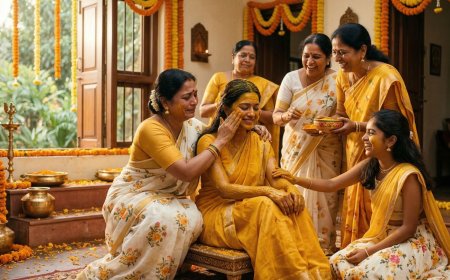
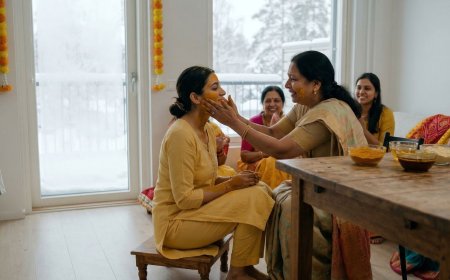
The Vatna paste — prepared by the family's senior women the previous evening or on the morning of the ceremony — is brought to the ceremony in a brass or copper vessel. The application begins with the bride's or groom's mother, who applies the first palmful to the face with both hands, followed by grandmothers, maternal aunts, paternal aunts, elder sisters, and close family friends in descending order of seniority and intimacy. Each woman applies the paste with her full hands rather than her fingertips — the gesture is generous, unhurried, complete.
Throughout the application, the assembled women sing Suhag and Boliyan [Punjabi wedding folk songs specific to the Vatna ceremony] — verses that have been sung at this ceremony for generations, each one encoding specific wisdom, specific blessings, specific love for the person sitting still in the centre of the circle.
The paste is left on the skin for a period before being gently rinsed with warm water infused with neem [a purifying herb] and rose petals. The resulting glow — the particular luminosity of turmeric-touched skin — is both a physical and a spiritual reality, the external sign of an internal preparation.
Community Comparison Table
| Community/State | Local Name | Key Tradition | How NRIs Abroad Adapt It |
|---|---|---|---|
| Punjabi (Hindu) | Vatna / Ubtan | Turmeric-besan-mustard oil paste; family application in seniority order; Suhag songs; paat ceremony | Full ceremony maintained at home; paste prepared from sourced ingredients; paat decorated; songs taught to family |
| Punjabi (Sikh) | Vatna / Maiya Ubtan | Same tradition with Gurbani recited; Ardas offered before application begins | Gurbani played; Ardas offered; ceremony maintained; paste recipe unchanged |
| Rajasthani | Peethi / Ubtan | Elaborate multi-day turmeric paste ceremony; Rajasthani folk songs; community women participate | Single-day adaptation; Rajasthani songs played; community women invited; peethi paste sourced locally |
| Gujarati | Pithi | Turmeric and sandalwood paste over multiple pre-wedding days; family-intimate ceremony | Condensed to single ceremony; Gujarati songs sung; pithi ingredients sourced from Indian stores |
| Bengali (Hindu) | Gaye Holud | Turmeric ceremony with elaborate gift exchange between families; two separate ceremonies for bride and groom | Both ceremonies maintained; Bengali community women participate; mustard oil and turmeric sourced |
| Marathi | Halad | Turmeric application on specific pre-wedding days; elder roles defined; Marathi songs | Elder roles preserved; Marathi songs played; halad paste sourced from local stores |
| Tamil (Hindu) | Nalungu | Turmeric, gingelly oil, and ritual application; playful games between family sides accompany | Games adapted for diaspora setting; ingredients sourced from Tamil grocery stores |
| Kashmiri Pandit | Livun / Mantarazvun | Mustard oil and turmeric purification with specific Kashmiri mantras; walnuts offered | Kashmiri pandit engaged; mustard oil and turmeric sourced; walnut tradition maintained |
| Himachali / Garhwali | Ubtan / Haldi ritual | Turmeric paste applied by community women; Pahadi folk songs accompany | Community Pahadi women in diaspora city invited; folk songs played; paste prepared from sourced ingredients |
| Sindhi | Vatna equivalent / Ubtan | Similar turmeric paste tradition; maternal family involved; community celebration follows | Sindhi community invited; paste ingredients sourced; ceremony maintained at home |
The Meaning Behind the Ritual
To apply turmeric to someone's skin with your own hands is, in the Indian sacred tradition, one of the most intimate acts of care that one person can perform for another. The Vatna elevates this gesture into a formal ceremony of preparation — but the philosophy behind it is as old as the understanding of Sandhi [the sacred threshold between life stages].
Haldi [turmeric — known in Sanskrit as Haridra, the golden one] is not merely a spice in the Vedic and Ayurvedic traditions. It is one of the most sacred substances in the Indian pharmacopeia — purifying, protective, and auspicious simultaneously. Associated with the sun, with Lakshmi [the goddess of prosperity], and with Agni [the sacred fire], turmeric transforms what it touches. The person who emerges from a Vatna ceremony is visibly different from the person who sat down — golden, luminous, marked as someone who has been prepared by love.
The mustard oil in the Punjabi Vatna adds its own layer of meaning. Sarson da tel [mustard oil] is the oil of Punjab — the same oil used in the cooking that has fed every generation of the family, now applied to the skin of the person about to leave. It is a gesture of nourishment extended from the table to the body, from the daily to the sacred.
The besan [chickpea flour] is the substance of the earth, of agriculture, of the physical abundance that Punjab has always represented. Applied to the skin before a wedding, it connects the bride or groom to the land their family came from, even when that land is an ocean away.
The Vatna says: before you cross into your new life, let us cover you in everything that has nourished us — the gold of the sun, the oil of our kitchen, the earth of our fields — so that you carry all of it with you.
Doing the Vatna Abroad: The Practical Reality
The Vatna is one of the most home-centred and ingredient-dependent of all Punjabi pre-wedding ceremonies, which means that doing it properly in a diaspora city requires advance sourcing, careful preparation, and the deliberate creation of a domestic atmosphere that the ceremony requires.
The Vatna paste preparation is the most important practical task and should be done the evening before the ceremony to allow the ingredients to combine and the paste to reach the correct consistency. The traditional Punjabi Vatna paste requires besan [chickpea flour], fresh haldi [turmeric — both powder and fresh root if available], sarson da tel [mustard oil], dahi [yoghurt], rose water, and chandan [sandalwood powder] for fragrance. Some families add malai [fresh cream] and kesar [saffron] for additional skin benefit and auspiciousness.
Fresh turmeric root gives the most authentic colour, fragrance, and skin benefit — in London, Wembley's Ealing Roadand Southall's Lady Margaret Road carry fresh turmeric root year-round and sarson da tel in good quality. In Toronto, Gerrard Street East and the stores along Brampton's Dixie Road stock all Vatna ingredients reliably. In Houston, Hillcroft Avenue's South Asian grocers carry fresh turmeric and mustard oil. In Sydney, Harris Park in Parramattastocks fresh turmeric through most of the year. In Dubai, Meena Bazaar in Bur Dubai carries every ingredient required. Order or purchase all ingredients at minimum one week before the ceremony — fresh turmeric in particular should be bought three to four days before to ensure availability.
The consistency of the paste is critical and the most common point of failure for families making Vatna for the first time. The paste should be spreadable but not liquid — thick enough to stay on the skin when applied, not so thick that it requires force to spread. The ratio is approximately two parts besan to one part turmeric powder, with mustard oil and yoghurt added gradually until the correct consistency is reached. If using fresh turmeric root, grate or blend it finely before combining. The paste will deepen in colour overnight — this is correct and desirable.
The paat and ceremony space should be set up the morning of the Vatna. A low wooden stool or a cushioned platform at floor level, decorated with marigold garlands and covered with a clean white or yellow cloth, creates the correct ceremonial atmosphere. Place waterproof sheeting beneath and around the paat — turmeric stains everything it touches, including flooring, furniture, and the clothing of anyone standing nearby. Inform guests to wear old clothes or yellow and white specifically, which both show turmeric staining least.
The Suhag and Boliyan songs are the Vatna's soundtrack and soul. Share recordings with family women at least two weeks before and ask them to learn the chorus verses. If your family has a grandmother or senior aunt who knows the traditional verses from memory — centre her in the ceremony. Her voice, singing the same words she sang at her daughter's Vatna, is the ceremony's most irreplaceable element.
A pandit is not typically required for the Vatna — the ceremony is family-led and women-centred. However, families who want formal Ardas [Sikh prayer] or specific Vedic mantras recited during the application should engage a community pandit or Granthi. NRI.Wedding's network includes verified pandits and Granthis across all major diaspora cities.
For India family on video call, the Vatna's most significant moments to share live are the mother's first application and the grandmother's application if present. Set up a dedicated device with clear audio — the Suhag singing should be audible through the stream. If your ceremony is in the morning in Toronto (EST), your Punjab family can join comfortably in the evening IST.
Doing the Vatna as a Destination Wedding in India
For NRI Punjabi families returning to India for the Vatna, Amritsar and Ludhiana are the natural homes of this ceremony — the cultural context, the ingredient availability, and the community understanding of the ritual's requirements exist here without any explanation or adaptation needed.
For families with ancestral roots in specific Punjab villages or towns, the Vatna in the family's home village carries an emotional resonance that no city venue can replicate. The ancestral courtyard, the neighbourhood women gathering without being asked because this is simply what is done, the marigolds from the family's own garden rather than a florist — these elements create the Vatna's authentic atmosphere in its fullest form.
Chandigarh offers a more contemporary destination option with full vendor infrastructure — ingredient suppliers, experienced ceremony photographers, and coordinators accustomed to NRI returnee families whose members are arriving from multiple countries. Brief any local vendors on the specific paste recipe your family uses, as regional variations exist and your family's specific Vatna may differ from the standard local preparation.
For non-Indian guests attending a destination Vatna in India, the ceremony's meaning translates without language — watching a mother's hands apply golden paste to her child's face while singing is universally understood as an act of profound love. A brief written explanation of each ingredient's significance, prepared in advance, will deepen the experience for international guests considerably.
What You Need: Vatna Ceremony Checklist
Ritual Items Fresh turmeric root and turmeric powder, besan [chickpea flour], mustard oil [sarson da tel], yoghurt [dahi], rose water, sandalwood powder [chandan], malai [fresh cream — optional], saffron [kesar — optional], a large mixing bowl for paste preparation, a decorated wooden paat [low stool], marigold garlands and yellow cloth for paat decoration, toran [mango leaves and marigold strings] for doorway decoration, waterproof sheeting for floor and furniture protection, a brass or copper vessel to bring the paste to the ceremony, neem leaves and rose petals for the rinse water, a large vessel for rinse water, yellow or old clothing for all participants, Suhag and Boliyan song recordings as guide, and fresh flowers for the ceremony space.
People Required The mother of the bride or groom to perform the first application — her presence is the ceremony's emotional foundation, grandmothers and senior female relatives in order of seniority for subsequent applications, women of the family to lead the Suhag and Boliyan singing, a pandit or Granthi if your family tradition includes formal prayers, a dedicated video call coordinator for India family, and a photographer with specific Vatna experience — the low light, the golden paste, and the emotional intensity of the application sequence require a photographer who has worked with this ceremony before.
Preparation Steps Source all paste ingredients minimum one week before the ceremony. Prepare the Vatna paste the evening before. Set up the paat and ceremony space the morning of the ceremony. Lay waterproof sheeting under the ceremony area. Share song recordings with family women two weeks before. Set up and test the video call device the day before. Brief all participating family members on the application sequence. Prepare the rinse water vessel with neem leaves and rose petals two hours before the ceremony.
NRI.Wedding's vendor directory, verified pandit and Granthi network, and Vatna ceremony planning checklists connect you to experienced professionals across the UK, US, Canada, UAE, and Australia.
5 Questions NRI Couples Always Ask About the Vatna
What is the difference between Vatna and Haldi? Are they the same ceremony?
They are related but distinct, and the distinction matters more than many contemporary NRI families realise. The Vatna is the Punjabi-specific pre-wedding purification ceremony — it is a complete ritual with its own specific paste recipe, its own songs, its own application sequence, and its own theological framework of preparation and transition. The Haldi [which means simply turmeric in Hindi] is a broader term used across many Indian communities for any pre-wedding turmeric application ceremony. In contemporary usage, particularly in diaspora cities, "Haldi" has become a catch-all term that often absorbs what was originally a distinct Vatna ceremony. If your family is Punjabi, restoring the Vatna's specific elements — the mustard oil, the Suhag songs, the paat ceremony, the application sequence — recovers something genuinely distinct and meaningful that the generic "Haldi" designation does not fully contain.
How do we prevent the turmeric from staining our venue, furniture, and guests' clothes?
Turmeric's staining capacity is absolute and should be treated as a feature rather than a problem — but managed deliberately. Lay heavy-duty waterproof sheeting under and around the paat before the ceremony begins, extending at minimum two metres in every direction. Cover any furniture within reach. Inform all guests in advance to wear old clothing, or specify yellow, white, or orange as the dress code — these colours either show turmeric staining least or absorb it most gracefully. The bride or groom should wear old or specially designated clothing for the ceremony, not the outfit they will wear later in the day. Fresh turmeric stains are best addressed immediately with cold water and mild detergent — do not use hot water, which sets the stain.
Can the Vatna be performed for the groom as well, or is it only for the bride?
The Vatna is traditionally performed for both the bride and the groom — separately, in their respective family homes, on the same or proximate days before the wedding. The groom's Vatna follows the same structure as the bride's, with the women of his family performing the application and singing the songs. In many contemporary NRI families, a combined Vatna for both bride and groom at a single venue has become common — which has the advantage of requiring only one ceremony setup and allowing both families to witness each other's preparation ritual. If combining, maintain the separation of the two ceremonies within the event — the bride's Vatna conducted first with her family's women, then the groom's, rather than applying paste to both simultaneously, which loses the individual intimacy that is the ceremony's essential quality.
My partner is not Punjabi. How do we involve their family in the Vatna?
The Vatna's application sequence begins with the closest family — mother, grandmothers, aunts — and typically concludes with close friends and more extended family. The most natural point of inclusion for your partner's non-Indian family is toward the later stages of the application, after the immediate family has performed their roles. Brief your partner's mother or female relatives on the ceremony's meaning before it begins — that they are being invited to contribute their love and blessing through the physical gesture of applying the paste. Most non-Indian mothers respond to this invitation with great emotional seriousness and are deeply moved by the experience of participating in a pre-wedding ritual through touch rather than words. Prepare a small pot of paste specifically for their use so they have the full experience of mixing and applying.
Should we hire a professional for the Vatna paste application, or should it only be family?
The Vatna's meaning is inseparable from the identity of the hands that apply it — the ceremony is constituted by the fact that it is your mother's hands on your face, your grandmother's hands on your arms, your maasi's hands on your feet. A professional application would change the ceremony's fundamental character from a family act of love to a beauty treatment, which is not what the Vatna is. The answer is always family. If your family members are anxious about technique or consistency, the solution is practice — make a trial batch of the paste beforehand and have family members practise the application gesture on their own hands or arms so they arrive at the ceremony confident. Imperfect application by loving hands is infinitely more meaningful than perfect application by professional ones.
The Emotional Angle
Your mother's hands are on your face. She is applying the paste with both palms, the way you have watched her apply things to your skin your whole life — the suncream at the beach when you were seven, the Vicks on your chest when you were sick at eleven, the sandalwood on your forehead at every Diwali puja for as long as you can remember. Her hands know your face with a completeness that no one else's hands will ever achieve, because they have been learning it since before you were born.
The turmeric is warm from the mixing bowl. The mustard oil smells exactly like it always smells — that specific sharp green smell that means Punjab, that means kitchen, that means home in a way that transcends the specific geography of where home actually is. You are in Mississauga or Melbourne or Manchester, and the smell of sarson da tel is the smell of every house your family has ever lived in, every meal your grandmother ever cooked, every morning you watched your mother stand at a stove and make something out of nothing.
The Suhag is being sung behind you. Imperfectly. Bravely. By women who learned the verses from recordings shared on a WhatsApp group three weeks ago and are singing them now with the full commitment of people who understand that the words matter even when the tune is approximate.
For NRI families, this moment is not about what has been lost to distance. It is about what has been carried. The paste is the same paste. The hands are the same hands. The love doing the applying is precisely, exactly, irreducibly the same love it has always been.
The turmeric dries golden on your skin. You are ready.
A Moment to Smile
At a Vatna ceremony in Houston two summers ago, the paste had been prepared with exceptional care by the bride's mother and two aunts — fresh turmeric grated by hand, mustard oil measured precisely, besan sifted to eliminate lumps, the consistency tested and approved by three generations of women who took the matter very seriously.
What the preparation committee had not tested was the paste's behaviour at room temperature over the four hours between preparation and ceremony. Houston in July had other ideas. The paste, when brought to the paat, had achieved a consistency that the bride's grandmother described diplomatically as "enthusiastic."
The first application — by the bride's mother, with full ceremonial seriousness — resulted in a quantity of paste on the bride's left cheek that significantly exceeded the ceremonial norm. The bride, to her credit, remained perfectly still. Her younger sister, standing to the side, did not remain perfectly still. The grandmother added cold water to the remaining paste with the efficiency of someone who had been solving kitchen emergencies for seventy years.
The corrected paste was perfect. The ceremony was beautiful. The photograph of the bride's left cheek in the first thirty seconds of her Vatna is, by unanimous family vote, the greatest wedding photograph ever taken in their family's history.
Quotes From the Diaspora
"My dadi sang the Suhag at my Vatna in Mississauga. She had not sung it in forty years — not since she sang it at my mother's Vatna in Jalandhar. She said she wasn't sure she remembered the words. She remembered every word. When she finished, the room was so quiet that I could hear the marigolds. I don't know how you hear flowers but I heard them. That is what her singing did to the room." — Simran Bhullar, Punjabi Sikh bride, originally from Jalandhar, now in Mississauga
"My son married a girl whose family are from Ireland. Her mother came to the Vatna not knowing what to expect. When I explained that the mustard oil in the paste was the same oil we cook with — that we were applying our kitchen to her daughter's skin before she joined our family — she was quiet for a long time. Then she said: that is the most generous thing I have ever heard of one family doing for another. She applied the paste herself. Her hands were very careful. Very loving. She understood exactly what she was doing." — Paramjit Kaur, Punjabi mother of the groom, originally from Amritsar, now in Birmingham
"I had my Vatna in our garden in Melbourne. My nani joined on video from Ludhiana at 4 a.m. her time — she had set three alarms. When my mother applied the first paste to my face, my nani started singing the Suhag through the phone speaker propped against the flower pot. Her voice and the garden and the smell of haldi and sarson da tel and the Melbourne morning light — I will spend the rest of my life trying to describe that moment and never fully succeeding. Some things are only available to the people who were there." — Navneet Dhaliwal, Punjabi bride, originally from Ludhiana, now in Melbourne
Your Golden Preparation Travels With You
The Vatna is the ceremony in which a Punjabi family does the most ancient and most human thing possible — covers the person they love in the substances that have nourished them, sings them the songs that have accompanied their family's most sacred moments, and sends them into their new life smelling of turmeric and mustard oil and everything that home has ever meant. For NRI families performing this golden ritual in diaspora homes across the world, the paste is mixed with the same hands, the songs are sung with the same love, and the paat holds the same person it has always been meant to hold — the child of this family, being prepared by this family, for the crossing that every family must eventually make.
NRI.Wedding supports Punjabi families across the UK, US, Canada, UAE, and Australia with vendor directories for sourcing Vatna ingredients in diaspora cities, verified pandit and Granthi networks for families who want formal prayers alongside the ceremony, experienced NRI wedding photographers who understand the Vatna's specific light and emotional atmosphere, and planning checklists built for diaspora families restoring this ceremony to its full and rightful place in the wedding week.
Source your haldi. Press your paat. Gather your women. Teach them the songs.
Let the golden hands do what only golden hands can do.
This article explores the Vatna ceremony — the Punjabi pre-wedding turmeric paste purification ritual — alongside related ubtan traditions across Indian communities including Rajasthani Peethi, Gujarati Pithi, Bengali Gaye Holud, Marathi Halad, and Tamil Nalungu, with practical planning guidance for NRI families in the US, UK, Canada, UAE, and Australia.
What's Your Reaction?
 Like
0
Like
0
 Dislike
0
Dislike
0
 Love
0
Love
0
 Funny
0
Funny
0
 Angry
0
Angry
0
 Sad
0
Sad
0
 Wow
0
Wow
0