





































































The Group That Makes the Groom: The NRI Groom's Complete Guide to Groomsmen Attire for Indian Weddings
The groomsmen attire conversation is the one NRI grooms leave too long, coordinate too loosely, and regret most visibly in the photographs. This guide delivers a complete framework covering every attire option from matching sherwanis and coordinated kurta pyjamas to bandhgalas and hybrid approaches, the measurement and alteration logistics of dressing men across four countries, how to manage non-Indian groomsmen with cultural sensitivity, event-by-event attire planning, accessory coherence strategy, and the five mistakes that make groomsmen group photographs look under-planned. Start this conversation at month four and give the men beside you the preparation they deserve.

Groomsmen Attire for Indian Weddings: Traditional and Modern Options
The Conversation That Happens Too Late
The groomsmen conversation in NRI wedding planning follows a remarkably consistent pattern across the vast majority of weddings where it eventually becomes a problem.
The sherwani has been selected. The bride's lehenga has been confirmed. The venue is booked, the photographer is contracted, the catering menu is in discussion. The wedding is approximately three months away, the planning spreadsheet has several hundred rows, and somewhere near the bottom of the active items column — below the mehendi artist and above the wedding favours — is a row that reads: groomsmen attire.
It has been in the spreadsheet for months. It has not been actioned for months. Because the groomsmen conversation feels like one of the things that will sort itself out — that will be resolved with a quick group call, a couple of decisions, and a trip to the appropriate market during the India visit.
It is not one of those things.
The groomsmen attire decision — made well — requires understanding what options actually exist, what each option requires in terms of lead time and coordination, how to manage the specific logistical challenge of dressing men who may be spread across four countries and three continents, how to balance the groom's specific aesthetic vision against the practical constraints of six different body types, and how to avoid the specific failure modes that make groomsmen photographs look uncoordinated, under-planned, or visually disconnected from the wedding's overall aesthetic.
Made poorly — or made too late — it produces photographs that the groom looks at for the rest of his life and notices the inconsistency in.
This guide is the groomsmen attire conversation that should happen at month four, not month one.
The Core Reality: What Groomsmen Attire Actually Involves for NRI Weddings
The Specific NRI Groomsmen Challenge
The NRI groomsmen attire challenge has specific dimensions that a domestic Indian wedding does not face.
The groomsmen are typically spread across multiple countries. Some are NRI themselves — in the UK, Canada, Australia, the USA — and their relationship to Indian traditional dress varies from complete comfort to significant unfamiliarity. Some are India-based family members or friends who have worn sherwanis at dozens of weddings and have specific opinions about fit, fabric, and style. Some are non-Indian friends of the groom for whom the sherwani or kurta will be the first traditional Indian garment they have worn, and for whom the sizing, the fastening, and the basic wearing convention are genuinely unfamiliar.
This diversity of the groomsmen group — in geography, in familiarity with Indian traditional dress, in body type, and in cultural comfort with the garment being asked of them — is the foundational challenge that the groomsmen attire plan must address.
The honest starting point: Not every groomsmen attire option serves every groomsmen group equally well. The plan that works for a groomsmen group of six India-based cousins who wear sherwanis regularly is not the same plan that works for a group that includes three non-Indian best friends from university who have never worn anything remotely similar.
The Three Questions That Determine the Approach
Before any specific attire decision, three questions must be answered — honestly, with the specific groomsmen group in mind rather than the idealised version of the group.
Question 1: How diverse is the groomsmen group in terms of cultural background? A groomsmen group that is entirely from Indian backgrounds — regardless of how NRI or how India-based — shares a cultural reference point for traditional Indian dress that a mixed-background group does not. The all-Indian groomsmen group can be asked to wear a full traditional sherwani with accessories and turban without requiring the explanation and comfort management that the same request requires from a non-Indian group.
Question 2: How much coordination is realistically manageable from abroad? Six groomsmen in six cities across three countries require a different coordination approach from six groomsmen who are all attending the same India visit at the same time. The attire plan must be achievable given the coordination realities — not the coordination ideals.
Question 3: What is the groom's priority for the overall visual effect? Maximum cultural traditionalism — the full sherwani, the coordinated safa or turban, the matching juttis — requires maximum coordination and the highest comfort level from every groomsmen group member. Maximum visual coherence with minimum coordination burden requires a different approach — typically contemporary, simpler, with less regional specificity. The groom's honest priority determines which end of this spectrum the plan should target.
The Options: What NRI Groomsmen Can Actually Wear
Option 1 — The Matching Sherwani
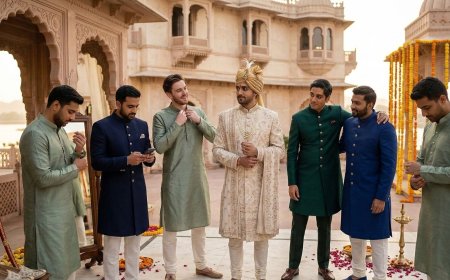
The matching sherwani — all groomsmen in the same sherwani design, colour, and fabric, coordinated with but distinct from the groom's sherwani — is the most traditionally ambitious and most visually impactful of the groomsmen attire options. When it works, it produces wedding photographs of genuine elegance — the groomsmen group presenting as a coherent visual unit, the cultural register of the occasion fully expressed, the Indian wedding aesthetic delivered without compromise.
What the matching sherwani actually requires:
Every groomsmen member must be measured — with measurements accurate enough to produce a correctly fitting sherwani, which means professional measurements rather than self-reported numbers estimated from the last suit fitting. For groomsmen in the UK, Canada, or Australia who will not be visiting India before the wedding, this means either sourcing a local tailor to take professional measurements and transmitting them to the Indian boutique, or wearing a standard size sherwani that is sufficiently forgiving of fit variation to be acceptable.
The sherwani must be delivered to each groomsmen in sufficient time to allow for alterations if the fit requires adjustment. For groomsmen outside India, this means international shipping with appropriate lead time — a minimum of six to eight weeks before the wedding to allow for delivery, assessment, and any required alterations.
The full accessory set — the safa or turban if being worn, the pocket square, the footwear — must be coordinated across the group with the same completeness as the sherwani itself. A groomsmen group in matching sherwanis with inconsistent accessories — one wearing a safa, another without, one in juttis, another in formal shoes — undermines the coherence that the matching sherwani was intended to create.
When the matching sherwani is the right choice:
The matching sherwani works best when the groomsmen group is entirely or predominantly Indian in background, when the groom has a strong traditional aesthetic vision, when the wedding's overall production level is high, and when the logistical coordination is manageable — either because most groomsmen will be in India for a fitting, or because a trusted coordinator is managing the remote measurements and delivery process.
Option 2 — The Coordinated Colour Kurta Pyjama
The kurta pyjama — the two-piece outfit of a knee-length or longer kurta top with matching or contrasting pyjama trousers — is a significantly more accessible and significantly more logistically manageable alternative to the full sherwani that nonetheless delivers a strong traditional Indian aesthetic in the wedding photographs.
The kurta pyjama's specific advantages for the NRI groomsmen context are multiple and significant. It is lighter and less structured than a sherwani — more comfortable for groomsmen unfamiliar with traditional Indian dress, more forgiving of fit variation, and more wearable across the full duration of a wedding day in warm conditions. It is significantly more accessible in price — enabling the groom to dress a larger groomsmen group at a lower total cost. It is easier to source outside India — quality kurta pyjama sets are available in Indian clothing stores in the UK, Canada, and USA, enabling groomsmen who cannot visit India to source their attire locally.
The colour coordination approach:
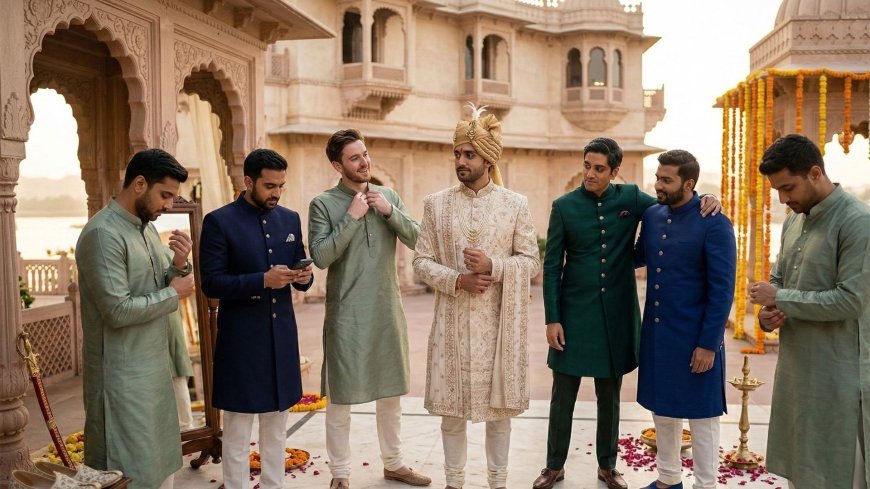
The standard NRI groomsmen approach with kurta pyjamas is to select a specific colour family — ivory and gold, navy and silver, sage green and cream, blush and white — and allow the groomsmen to source their individual kurtas within that colour family. This approach balances visual coherence — the group reads as coordinated in photographs — with individual flexibility in exact shade, fabric texture, and specific design, reducing the coordination burden while maintaining the visual outcome.
The fabric options within kurta pyjama:
Silk kurtas create a formal register appropriate for the main ceremony or a formal evening event. Cotton-silk or blended fabric kurtas are more comfortable for longer events and for groomsmen in warmer climates. Cotton kurtas are appropriate for the mehendi or sangeet context where the register is more relaxed and the daytime heat makes lighter fabrics necessary.
When the kurta pyjama is the right choice:
The kurta pyjama works best when the groomsmen group includes non-Indian members for whom the sherwani's cultural unfamiliarity is a genuine concern, when the logistical coordination of a full matching sherwani is not manageable, when the event in question is the mehendi or sangeet rather than the main ceremony, or when the groom's aesthetic vision is contemporary rather than traditionally maximalist.
Option 3 — The Bandhgala or Nehru Jacket Over Western Trousers
The bandhgala jacket — the structured, mandarin-collared jacket of the Indo-Western fashion tradition — over well-fitted trousers is the groomsmen attire option that most comfortably bridges the Indian and Western aesthetic registers. It is recognisably Indian in its cultural reference — the bandhgala's collar and closure are distinctively of the Indian tailoring tradition — while being sufficiently familiar in its overall structure and formality level to be comfortable for groomsmen with no previous experience of Indian dress.
The bandhgala over trousers is also among the most logistically manageable of the groomsmen attire options for NRI groups. The jacket can be sourced from Indian tailors and boutiques operating internationally, from the growing range of Indian fashion brands with international delivery, or from established Indian fashion stores in the UK, Canada, and USA. The trousers can be the groomsmen's existing well-fitted formal trousers in a coordinated colour — reducing the sourcing burden significantly.
The styling approach:
The bandhgala works in a range of fabrics — silk, linen, cotton-silk, and structured synthetic blends — each producing a different formality level and a different climate appropriateness. In jewel tones — deep burgundy, bottle green, royal blue — the bandhgala jacket creates a cohesive, visually distinctive groomsmen look that reads as specifically Indian without requiring the full commitment of a sherwani.
The accessory integration:
The bandhgala over trousers does not require the full traditional accessories of the sherwani — no turban, no juttis necessarily, though both can be incorporated if desired. A pocket square, a simple brooch, and formal footwear in a coordinated colour are typically sufficient to complete the look at an appropriate level of formality.
When the bandhgala is the right choice:
The bandhgala is the right choice when the groomsmen group includes non-Indian members who would be uncomfortable in a full sherwani or kurta pyjama, when the wedding's overall aesthetic is contemporary rather than traditional, when the logistical coordination of fully Indian attire is not manageable, or when the groom's own attire is a contemporary sherwani or bandhgala rather than a traditional heavily embroidered sherwani.
Option 4 — The Colour-Coordinated Western Formal
For NRI weddings with predominantly non-Indian groomsmen groups, or for weddings where the cultural register is deliberately contemporary and the traditional Indian aesthetic is present in the venue and decor rather than in the groomsmen attire, a colour-coordinated Western formal — suits or blazers in a specific colour family that coordinates with the wedding palette — is a legitimate option that produces coherent, photographically satisfying results without the cultural and logistical challenges of traditional Indian dress.
The colour coordination is the critical element of this option's success. A group of men in well-fitted suits that are all within the same colour family — all navy, all charcoal, all in the warm earth tones of the wedding palette — reads as coordinated in photographs. A group of men in varying colours of Western formal wear, without a specific coordinating logic, reads as uncoordinated regardless of individual suit quality.
The NRI hybrid approach:
Many NRI weddings with mixed groomsmen groups use a hybrid of this option with the previous options — the India-based groomsmen or the Indian-background groomsmen in kurta pyjamas or bandhgalas, and the non-Indian groomsmen in Western formal in a coordinated colour. This approach respects the cultural comfort levels of the different group members while maintaining overall visual coherence through colour coordination.
The Event-by-Event Approach
Many NRI weddings have multiple events across multiple days — the mehendi, the sangeet, the ceremony, the reception — each with a different register and a different attire appropriateness. The groomsmen attire plan can — and often should — differentiate by event rather than requiring a single coordinated look across the entire wedding programme.
| Event | Recommended Attire Register | Specific Options | Key Consideration |
|---|---|---|---|
| Mehendi | Relaxed, colourful, comfortable | Cotton or cotton-silk kurta pyjama in bright or earthy tones | Daytime outdoor conditions — prioritise comfort and breathability |
| Sangeet | Festive, energetic, performance-appropriate | Silk or cotton-silk kurta pyjama, bandhgala in jewel tone | Must hold up through dancing — avoid heavy embellishment that restricts movement |
| Main Ceremony | Maximum formality and cultural expression | Full sherwani or formal kurta pyjama with complete accessories | Highest photographic importance — most worth the coordination investment |
| Reception | Formal but more contemporary | Bandhgala over trousers, contemporary sherwani, or Western formal | Long evening event — comfort across duration important |
| Cocktail / Pre-wedding party | Contemporary, personal, least traditional | Western formal in coordination colour, bandhgala, or festive kurta | Most flexible — follows couple's aesthetic direction |
The Coordination Logistics: Managing the NRI Groomsmen Group
The Measurement Problem
The single most consistent logistical failure point in NRI groomsmen attire is measurements — specifically, the gap between the measurements that groomsmen provide and the measurements that would produce a correctly fitting garment.
Self-measured numbers are unreliable. Numbers estimated from a memory of the last suit fitting are unreliable. Numbers taken by a non-specialist friend or partner are unreliable. The only reliable measurements are professional measurements taken by an experienced tailor.
For groomsmen in the UK, Canada, Australia, and the USA, professional measurements can be taken at any tailoring shop, dry cleaner with alteration services, or formal wear retailer — the service typically costs very little or nothing when framed as preparation for a wedding order. The measurements should be taken with a tape measure in centimetres, covering the chest, waist, hip, shoulder width, sleeve length, and height.
The groom or the designated attire coordinator should provide every groomsmen with a specific measurement template — the exact measurements required, in the correct units, for the specific garment being ordered — rather than asking for general measurements and attempting to translate them into the Indian boutique's sizing system.
The Sizing and Alteration Reality
Sherwanis, kurtas, and bandhgalas from Indian boutiques are sized for Indian body proportions — which are, on average, different from the body proportions of NRI men who have grown up and live in the UK, Canada, or Australia. The shoulder width, the chest-to-hip differential, the sleeve length, and the overall garment length all require specific assessment against each groomsmen's actual measurements rather than a standard size assignment.
For groomsmen receiving their garments outside India, alterations must be possible at a local tailor. This means that the garment must be delivered with sufficient seam allowance to allow the relevant alterations — and it means that the garment must be received sufficiently in advance of the wedding to allow for the alteration appointment, which may require a lead time of its own.
The alterations timeline for groomsmen outside India:
Garments should be delivered a minimum of six weeks before the wedding. This allows two weeks for delivery assessment and alteration identification, two weeks for the alteration appointment and completion, and two weeks of buffer for any alteration that requires a second attempt.
The Budget Coordination
The question of who pays for the groomsmen attire — the groom or the individual groomsmen — varies by family tradition, by the friendship context, and by the overall budget of the wedding. In Indian wedding tradition, the groom's family gifting the attire to the groomsmen is a common and culturally established practice. In the NRI context, the tradition varies — some NRI grooms follow the Indian convention of providing the attire, others follow the Western convention of asking groomsmen to source and pay for their own within specific guidelines.
The honest guidance: Whichever convention is followed, communicate it clearly and early. A groomsmen member who discovers three months before the wedding that they are expected to pay for a sherwani — a cost they had not budgeted for — is a groomsmen member who is managing a financial surprise in addition to the logistical challenge of sourcing and fitting the garment.
The Non-Indian Groomsmen: Special Considerations
The Cultural Comfort Conversation
The non-Indian groomsmen member who is asked to wear a sherwani or kurta pyjama at an Indian wedding is being asked to do something that falls outside his cultural comfort zone — and the groom who is making this request has a specific responsibility to manage the experience proactively rather than assuming that the goodwill of friendship is sufficient to carry the unfamiliar experience.
The proactive management approach:
Explain what the garment is and how it is worn — before sending a photograph and hoping for the best. A non-Indian groomsmen member who has never seen a sherwani being worn in person does not know how the collar fastens, which way the side slits open, whether the kurta goes inside or outside the pyjama, or how the dupatta if present is arranged. These are genuine questions that require specific answers — and the answers are most helpfully provided before the wedding morning when the groomsmen is standing in his hotel room with an unfamiliar garment and insufficient time.
Provide written wearing instructions — ideally with photographs — for every element of the attire. The collar closure, the kurta length relative to the pyjama, the footwear convention, the accessory wearing sequence if applicable. This is not condescension — it is the same courtesy that any host provides when asking guests to participate in an unfamiliar cultural practice.
Offer an alterations resource in the local city if the garment does not fit correctly. A non-Indian groomsmen member who receives a sherwani that does not fit and does not know where to take it for alterations is in a worse position than a groomsmen member who received clear guidance along with the garment.
The Size Accommodation Reality
Indian traditional garments — particularly sherwanis and kurtas — are designed for a specific range of body types, and the size range available from most Indian boutiques does not always accommodate the full range of body types present in an NRI groomsmen group that includes non-Indian members.
The groom who is planning matching sherwanis for a groomsmen group that includes non-Indian members should confirm — before committing to the boutique — that the boutique can accommodate the specific size range required. Boutiques that specialise in custom rather than ready-made garments are significantly better positioned to accommodate non-standard sizes.
Styling the Groomsmen Look: The Complete Visual Framework
The Colour Coordination Principles
The groomsmen attire colour should be determined in relation to three reference points: the groom's sherwani, the bride's outfit, and the overall wedding colour palette established by the decor and floral design.
The most effective groomsmen colour strategy is not to match any of these three exactly but to coordinate with all of them through a considered relationship. The groomsmen in ivory and gold coordinate with a groom in cream and gold without competing with his look. They coordinate with a bride in red and gold without clashing. They sit within a wedding palette of warm white, gold, and floral colours without visual conflict.
The specific colour relationship — whether the groomsmen are in a deeper shade of the groom's colour, in an accent colour from the wedding palette, or in a neutral that allows the groom's distinctive colour to remain the primary statement — should be discussed with the boutique and with the wedding photographer, whose experience of how specific colour relationships read in photographs is directly relevant to the decision.
The Accessory Coherence Principle
The groomsmen accessories should follow the same coherence principle as the attire itself — not necessarily identical, but within the same aesthetic vocabulary and colour family.
If the groomsmen are wearing safas, the safas should be in the same colour or in coordinated colours — not one groomsmen in ivory and another in bright pink. If the groomsmen are wearing pocket squares, the pocket squares should be in the same colour or in the same colour family. If the groomsmen are wearing juttis, the juttis should be coordinated in colour even if not identical in design.
The accessory that most consistently undermines groomsmen attire coherence — and the one most often overlooked — is the footwear. A groomsmen group in matching sherwanis where three members are wearing juttis and three are wearing formal shoes reads as inconsistently planned, regardless of how well the sherwanis themselves are coordinated.
The Groom's Visual Distinction
The groomsmen attire should make the groom distinctively visible as the groom — not as one of an indistinguishable group of similarly dressed men. This distinction is achieved through several specific mechanisms.
The groom's sherwani should be more heavily embellished than the groomsmen's attire — richer embroidery, a more elaborate design, or a more precious fabric — so that his garment reads as the principal piece within the coordinated group.
The groom's colour should be distinctly different from the groomsmen's colour — either a deeper version of the same tone, a complementary colour, or a specifically different but related hue — so that in group photographs the groom is immediately identifiable as the central figure.
The groom's accessories should be more elaborate than the groomsmen's accessories — a kalgi on the turban when groomsmen wear a simple brooch, a more elaborate haar when groomsmen wear simpler chains, more embellished juttis when groomsmen wear plainer versions — creating a hierarchical distinction that makes the groom the primary visual focus of every group photograph.
The Complete Attire Options Comparison
| Option | Cultural Register | Non-Indian Comfort | Logistical Complexity | Cost | Best Event | Photography Impact |
|---|---|---|---|---|---|---|
| Matching Sherwani | Highest — full traditional | Low — significant unfamiliarity | High — measurements, fitting, shipping | ₹₹₹₹ | Main ceremony | Outstanding — maximum visual coherence |
| Coordinated Kurta Pyjama | High — traditional | Medium — more accessible | Medium — colour coordination, sourcing | ₹₹–₹₹₹ | All events | Very good — culturally specific, flexible |
| Bandhgala over Trousers | Medium — Indo-Western | High — familiar structure | Low — jacket sourced independently | ₹₹₹ | Reception, sangeet | Good — contemporary, sophisticated |
| Western Formal Coordinated | Low — no Indian reference | Highest — fully familiar | Low — sourced locally everywhere | ₹₹₹ | Reception, cocktail | Good — coherent if colour-coordinated |
| Hybrid (mixed attire) | Varies by group member | Varies — managed by comfort level | Medium — multiple streams managed | Varies | All events | Good if colour logic is clear |
Common Mistakes NRI Grooms Make With Groomsmen Attire
The first and most consistent mistake is starting the groomsmen attire conversation too late. The groomsmen attire decision — particularly for a matching sherwani approach — requires a minimum of four to five months of lead time when international shipping and remote measurements are involved. The groom who begins this conversation three months before the wedding with six groomsmen in four countries has already lost the time buffer that resolves the inevitable complications.
The second mistake is assuming that self-reported measurements are adequate. They are not. The sherwani that is cut to a groomsmen's self-reported measurements and arrives not fitting correctly, six weeks before a wedding, with no local alteration resource identified, is among the most stressful attire logistics failures in NRI wedding planning.
The third mistake is not considering the non-Indian groomsmen's experience proactively. The groom who asks his non-Indian best friend to wear a sherwani and then provides no guidance, no wearing instructions, and no alteration resource is asking for the goodwill of friendship to carry more than it should. Proactive guidance and support converts an uncomfortable cultural experience into a memorable one.
The fourth mistake is coordinating the attire without coordinating the accessories. Matching sherwanis with inconsistent footwear, inconsistent safas, and inconsistent pocket squares do not read as fully coordinated in photographs. The accessories plan must be as deliberate as the attire plan itself.
The fifth mistake is not distinguishing the groom visually from the groomsmen. A groom in the same colour, the same fabric weight, and the same embellishment level as his groomsmen is not visually identifiable as the groom in group photographs — the principal figure of the occasion reads as one of a group rather than as the centre of a group.
The Groomsmen Attire Planning Checklist
Four to five months before the wedding, the groom should confirm the groomsmen group composition and assess the diversity of backgrounds, geographic locations, and cultural comfort levels. He should decide the attire approach — matching sherwani, coordinated kurta, bandhgala, or hybrid — and begin boutique or supplier research for the chosen option. He should communicate the attire plan to every groomsmen member, including cost expectations and who is responsible for payment.
Three to four months before, every groomsmen should provide professional measurements using a specific template provided by the groom. The boutique or supplier should confirm size availability and production timeline. Any custom or semi-custom orders should be placed at this point with confirmed delivery timelines.
Two to three months before, garments should be ordered and production confirmed. International shipping arrangements should be made for groomsmen outside India, with tracking and sufficient buffer for customs clearance. Each groomsmen should be provided with wearing instructions for their specific garment.
Six to eight weeks before, all garments should be delivered. Each groomsmen should try on the complete look — attire and accessories — and identify any alteration requirements. Alteration appointments should be booked immediately for any garments that require adjustment.
Two weeks before, all alterations should be complete. Every groomsmen should confirm that their complete look is ready — attire, accessories, and footwear. The groom should have confirmation photographs from each groomsmen member showing the complete look in the correct combination.
On the wedding day, groomsmen should dress with adequate time — a minimum of forty-five minutes for unfamiliar attire — with wearing guidance available. The groom or a designated coordinator should be available to assist with any dressing questions that arise on the day itself.
The Group That Makes the Groom
The groomsmen are the groom's context.
In every group photograph — the baraat arrival, the ceremony processional, the reception standing shot — the groomsmen frame the groom, define his visual setting, and communicate through their collective appearance the register and the character of the occasion being celebrated.
A groomsmen group that is well-dressed, visually coherent, and culturally appropriate for the wedding's tradition amplifies the groom's appearance. A groomsmen group that is inconsistently dressed, clearly under-planned, or visually disconnected from the overall wedding aesthetic diminishes it — not because any individual member looks wrong, but because the group does not read as deliberate.
The investment in getting the groomsmen attire right — the early planning, the professional measurements, the logistical management of international coordination, the careful accessory coherence, the proactive support for non-Indian group members — is the investment that makes the group photographs look the way they should: like a group of men who were dressed for an occasion that deserved their best appearance.
The groom deserves that group around him. The groomsmen deserve the guidance and the logistics that allow them to provide it.
Start the conversation at month four. Manage the logistics with the same care as every other element of the wedding. And trust that the photographs — taken on the day when it is too late to change anything — will show the result of the preparation that preceded them.
Published by NRIWedding.com — The Premium Global Platform for Non-Resident Indians Planning Indian Weddings From Abroad.
What's Your Reaction?
 Like
0
Like
0
 Dislike
0
Dislike
0
 Love
0
Love
0
 Funny
0
Funny
0
 Angry
0
Angry
0
 Sad
0
Sad
0
 Wow
0
Wow
0