

























































Grooming Guide for NRI Grooms — The Complete Timeline and Services Handbook
The NRI groom is in every wedding photograph — yet the grooming preparation that determines how he looks in those permanent images is consistently the most underplanned element of the entire NRI wedding process. This complete guide gives NRI grooms the honest, practical framework they actually need — covering the six-month skincare routine establishment, the beard decision framework with a full options table, professional facial and barber scheduling, the complete month-by-month grooming timeline table, India visit grooming plan, climate transition skin adaptation, the final haircut and beard shape timing, service pricing comparison between the UK and India, manicure and hand care for ring exchange photographs, the wedding morning routine, and a common mistakes table that covers the six grooming errors that leave NRI grooms arriving at their wedding day underprepared for the most photographed occasion of their life.


Grooming Guide for NRI Grooms: Timeline and Services
The Conversation Nobody Has With the Groom
There is a specific asymmetry in Indian wedding planning that every NRI groom quietly notices and almost none of them mention out loud.
The bride has a skincare timeline. A makeup artist. A hair trial. A mehendi appointment. A bridal beauty consultation that began six months before the wedding and involves a professional roadmap, monthly treatments, and a carefully managed final week of protective protocol.
The groom has a haircut.
Sometimes the haircut is preceded by a conversation about whether to get a facial. Sometimes there is a brief discussion about the beard — whether to grow it, trim it, or shave it — that is resolved in the week before the wedding with whatever the neighbourhood salon can manage. Sometimes there is a last-minute visit to the hotel spa the morning after arrival in India that is motivated more by jet lag recovery than by genuine grooming intention.
The disparity is understandable. The wedding industry — in India and globally — is oriented toward the bride. The visual emphasis of the wedding is the bride. The cultural conversation about wedding preparation is the bride's conversation. The groom's appearance is assumed to take care of itself, or to require only the most basic preparation.
The disparity is also, from a practical standpoint, a missed opportunity.
The groom is in every wedding photograph. His skin, his hair, his beard, his hands — the physical presentation that he brings to the wedding day — is as permanently recorded as the bride's. The difference is that the bride's appearance on the wedding day reflects six months of deliberate preparation, while the groom's appearance typically reflects a haircut and a prayer.
This guide changes that. Not by imposing on the NRI groom a skincare regimen of twenty steps and six months of intensive treatment — the guide is not trying to turn the groom's preparation into the bride's preparation. But by providing the honest, practical, straightforwardly useful framework that the NRI groom actually needs: the specific grooming timeline, the specific services that make a genuine difference, the India visit logistics, and the investment of time and attention that is proportionate to the permanence of the photographs.
The groom in those photographs deserves to look like himself at his best. This guide is how that happens.
The Core Reality: What NRI Groom Grooming Actually Involves
The Three Dimensions of Groom Grooming
Groom grooming for an Indian wedding has three distinct dimensions — each requiring different planning, different lead times, and different professional services.
The first is the skin — the base on which everything else is built. Skin that is clear, hydrated, and healthy photographs differently from skin that is reactive, oily, or dull. For grooms who have never followed a skincare routine, the six months before the wedding is the time to establish one — not a complex one, but a consistent and effective one.
The second is the hair. The haircut that will be visible in the wedding photographs must be planned rather than improvised. The specific style, the timing of the cut relative to the wedding, and the maintenance between the cut and the wedding day all require more thought than the average groom's default approach provides.
The third is the beard. For NRI grooms who wear beards — which represents the majority of contemporary NRI grooms — the beard decision is among the most impactful grooming choices of the entire wedding. The length, the shape, the density, the maintenance — these are decisions that benefit from professional guidance and from deliberate planning that begins months before the wedding, not days.
The NRI-Specific Grooming Context
For NRI grooms specifically, the grooming journey has dimensions that a domestic groom does not navigate.
The skin that has been managed in the dry-heated indoor environment of a London or Toronto winter will behave differently in the humidity and heat of a Jaipur or Mumbai winter. The oiliness that increases. The hydration that shifts. The specific effects of Indian water on a skincare routine calibrated to soft European or filtered North American water. Planning for this transition — with appropriate product adaptation and realistic expectations — is part of the NRI groom grooming plan.
India's barbershop landscape — from the traditional neighbourhood barber to the high-end grooming salons of Delhi and Mumbai — offers services and skill levels that vary enormously. Knowing where to go, what to ask for, and how to manage the haircut and beard appointment during the limited India visit is practical planning information that the average grooming guide does not provide.
NRI grooms typically have shorter India visits than NRI brides — and the India visit agenda is filled with family obligations, wedding functions, and logistical commitments that leave minimal space for grooming appointments. The groom who arrives in India planning to sort out the grooming will find the India visit schedule has other plans. Pre-planning the grooming appointments — with specific barbers or salons, at specific times in the visit schedule — is the non-negotiable first step.
The Six-Month Grooming Timeline
Month 6 — The Baseline Assessment
Six months before the wedding is the time for the NRI groom to take an honest inventory of the current state of his grooming and establish the baseline from which the pre-wedding preparation will proceed.
On the skin: what is the current condition honestly? Clear, with occasional breakouts? Consistently oily in the T-zone? Dry and flaky in winter? Post-shave irritation that has been managed with varying success for years? The honest assessment — without the optimism that proximity to the wedding sometimes produces — is the foundation of a realistic improvement plan.
On the hair: what is the current condition and style? Is the current style what the groom wants for the wedding, or is there a transition planned? Does the hair have the density, the length, or the health at the six-month mark to achieve the wedding day style through ordinary maintenance — or does it require active management?
On the beard: is there a beard? What is its current condition — even, patchy, maintained, unkempt? What is the intended beard status for the wedding — full beard, stubble, clean-shaven? If the wedding requires a beard length or style that is different from the current state, the six-month mark is when the growth or reduction plan must begin.
The NRI groom's core skincare routine — four steps, non-negotiable:
The first step is a gentle, pH-balanced face wash used morning and evening. Not the shower gel that has been repurposed for face washing. A dedicated face wash appropriate to the skin type — gel formula for oily skin, cream formula for dry skin, foaming formula for combination.
The second step is a low-percentage retinol — 0.1% to 0.3% in an OTC formulation — applied every other night. Retinol is the most evidence-supported ingredient for improving skin texture, reducing the appearance of enlarged pores, and addressing minor hyperpigmentation. The groom who begins retinol at Month 6 and uses it consistently will have visibly different skin quality by the wedding day.
The third step is a lightweight moisturiser applied morning and evening after cleansing. Oily-skinned grooms specifically resist moisturiser — under the mistaken belief that moisturising oily skin increases oiliness. The opposite is true. Dehydrated oily skin produces more oil to compensate for the lack of hydration.
The fourth step is SPF every morning without exception. SPF is not a cosmetic preference — it is the single most effective daily intervention for maintaining skin quality and preventing the hyperpigmentation and premature aging that sun exposure causes.
The beard decision at Month 6 is as important as the skincare decision. The beard options and their six-month implications are covered in the comparison table below — but the principle is consistent: make the decision at Month 6 and commit to it fully. The wedding day beard is the product of a decision made six months earlier, not six days earlier.
Month 5 — The Treatment Introduction
Month 5 is the time to add professional grooming services to the home routine established at Month 6.
For NRI grooms who have never had a professional facial, the concept can feel alien — the association of facials with a category of grooming that is not for them. This association is worth overcoming because the professional facial in Month 5 performs a practical function that no home routine can replicate: professional-grade extractions of congested pores performed correctly without the post-extraction inflammation that amateur extraction creates, a professional assessment of the skin's current condition, and a deep cleansing treatment that removes the accumulation of product, pollution, and sebum that daily cleansing does not fully address.
For bearded grooms, Month 5 is the time for a professional beard assessment with a quality barber — not the haircut, but the beard assessment. A barber who specialises in beard grooming can assess the beard's current shape, identify any patchiness or density issues, and advise on the beard care products that will improve the beard's health and appearance over the remaining months.
The three beard care products that make a genuine difference are beard oil, beard balm, and beard wash. Beard oil — applied daily to the beard and the skin beneath — conditions both the hair and the skin, reducing itching and giving the beard a healthy sheen that photographs well. Beard balm provides light hold for longer beards and helps tame hairs that grow in conflicting directions. Beard wash, used two to three times per week, maintains the beard's cleanliness without stripping the oils that the beard needs.
Month 4 — The Consistency Month
Month 4 is the month in which the routines established at Month 6 and Month 5 should be running with the consistency that produces visible results. The retinol adjustment period is complete. The skin is responding. The beard is responding to the daily conditioning treatment.
Adding a hyaluronic acid serum to the morning routine — applied to slightly damp skin before the moisturiser — significantly improves the skin's hydration level in a way that moisturiser alone does not. Well-hydrated skin has a different quality in photographs — a depth and luminosity that surface moisturisation does not create.
A dedicated eye cream or eye gel, applied morning and evening, addresses the under-eye area — the dark circles, the mild puffiness, the fine lines — that is among the most visible indicators of sleep quality and skin hydration in photographs.
Month 4 is also the natural time to have a conversation with a quality barber about the specific haircut that will be worn at the wedding. Not the final cut — that happens closer to the wedding — but the shape, the length, and the specific style that will be maintained from this point to the wedding day. The wedding day haircut is not the first haircut of the pre-wedding period. It is the latest in a series of consistent cuts. A groom who gets his hair cut in the intended style at Month 4, maintains that style with a cut every four to six weeks, and gets a fresh cut seven to ten days before the wedding arrives on the wedding day looking like his best version — not like someone who had a haircut specifically for the occasion.
Month 3 — The Midpoint and India Planning
Month 3 is the midpoint of the six-month grooming timeline and the appropriate point for both a progress assessment and the formalisation of the India visit grooming plan.
Is the skin noticeably improved from the Month 6 baseline? The retinol, the consistent SPF, and the professional treatments should be producing visible improvement in texture and any hyperpigmentation concerns. If the improvement is not visible, the Month 3 professional skin assessment is the time to identify what adjustment is needed.
For NRI grooms, the India visit grooming plan requires the same advance planning as the NRI bride's India visit skincare plan — because the grooming appointments needed in India must be booked in advance, not arranged upon arrival. The final haircut and beard shape before the wedding must be planned for seven to ten days before the wedding — a cut that is too close risks the specific sharpness of a fresh cut that does not yet look settled, while a cut that is too far risks growing out before the photographs. Many quality Indian grooming salons offer a groom's pre-wedding package — a combination of facial, haircut, beard grooming, and body treatment specifically designed for the wedding week. These packages should be booked at Month 3, not upon arrival in India.
Month 2 — The Preservation Phase
Month 2 for the groom follows the same principle as Month 2 for the bride: the preservation phase. The improvements achieved in the preceding four months are protected and maintained — not experimented with.
No new products. The routine is established and working. New products — however appealing — carry the risk of introducing a reaction, a breakout, or a sensitivity that the skin does not have time to resolve before the wedding. The beard that has been conditioned and shaped over the preceding months is maintained with the same frequency and the same products. The Month 2 temptation to change the beard length, try a new shape, or experiment with a new grooming product is the temptation that produces the most common pre-wedding beard disasters.
Sleep and hydration deserve specific emphasis in Month 2. The stress of the two months before the wedding disrupts sleep in ways that are directly visible in the skin and in the eyes — treating sleep as a grooming priority is among the most high-return grooming decisions of the pre-wedding period.
Month 1 — The India Transition
Month 1 is the India transition month — encompassing the specific challenges of the climate transition, the water change, and the compressed grooming schedule of the India visit.
In the two weeks before departing for India, the groom should maximise the skin's barrier function through consistent moisturisation, reduced exfoliation, and the addition of a barrier repair product if the skin has any tendency toward sensitivity. The skin arrives in India in the best possible condition when it departs from the country of residence with a healthy, intact barrier.
The India grooming schedule follows a specific sequence: rest and adjustment in the first two days, the pre-wedding facial on Day 3 to 5, the final haircut and beard shaping appointment seven to ten days before the wedding, any final touch-up trimming two to three days before the wedding, and the specific morning grooming routine on the wedding day itself.
The Complete Grooming Timeline at a Glance
| Timeframe | Skin | Hair | Beard | Professional Services |
|---|---|---|---|---|
| Month 6 | Establish four-step routine — cleanser, retinol, moisturiser, SPF | Assess current condition and intended wedding style | Make the beard decision — commit fully | First professional facial |
| Month 5 | Continue routine, assess skin response to retinol | Begin transitioning toward intended style if needed | First professional beard assessment with barber | Second professional facial; beard assessment appointment |
| Month 4 | Add hyaluronic acid and eye cream | Haircut consultation — establish wedding day style; cut every 4–6 weeks from this point | Begin daily beard oil, balm, and wash routine | Third professional facial |
| Month 3 | Progress assessment — adjust if needed | Maintain established style consistently | Consistent conditioning — assess density and shape | Formalise India grooming plan; book all India appointments |
| Month 2 | Preservation phase — nothing new | Maintain consistent style | Consistent maintenance — no changes | Maintenance facial — gentle, no downtime |
| Month 1 — India | Barrier maximisation pre-departure; climate adaptation on arrival | Final cut 7–10 days before wedding | Final professional shape 7–10 days before wedding | Pre-wedding facial Day 3–5; manicure and pedicure 7–10 days before wedding |
| Wedding Week | Maximum hydration; nothing new | Touch-up only if needed | Touch-up trim 2–3 days before if needed | Touch-up kit assembled |
| Wedding Morning | Cleanse, hyaluronic acid, moisturiser, SPF | Style with established product | Beard oil then styling product; settled 30 minutes before photography | — |
The Beard Decision: A Framework
The beard decision is the grooming choice with the longest lead time and the most significant visual impact — and it must be made at Month 6, not Month 1. The following table covers the four principal options and what each requires.
| Beard Option | Current State Required | Six-Month Plan | Key Risk |
|---|---|---|---|
| Full beard, maintained | Existing full beard | Condition consistently, professional shape monthly, final shape 7–10 days before wedding | Neglect leading to uneven density or unkempt appearance |
| Growing beard for wedding | Clean-shaven or stubble | Begin growing immediately at Month 6 — full growth takes 3–6 months depending on genetics | Insufficient growth by wedding day if started too late |
| Clean-shaven | Any | Skincare focus intensified — clean-shaven face leaves skin condition entirely unobscured | Post-shave irritation or ingrown hairs visible in photographs |
| Transitioning beard to clean-shaven | Full beard | Transition no earlier than Month 3 — allows skin beneath beard to adjust and be treated | Skin under beard may be uneven in tone or texture and needs treatment time |
The Service Guide: What Each Grooming Service Actually Does
The Pre-Wedding Facial
The pre-wedding facial for men follows the same timing principle as the bridal facial: seven to ten days before the wedding. The first facial in the week before the wedding is not the ideal introduction to professional facials — any new technique or product carries the risk of a reaction that has no time to resolve.
A men's pre-wedding facial typically takes sixty to ninety minutes and covers a deep cleanse and steam, controlled extractions of congested pores, a hydrating or brightening treatment mask, and a finishing moisturiser and SPF. The specific benefit is the professional extraction of congested pores — particularly in the nose, chin, and forehead areas — that reduces pore visibility in photographs in a way that no home care can replicate.
What to avoid in the men's pre-wedding facial is as important as what to include. No new treatment techniques not previously tested. No aggressive chemical peels in the week before the wedding. No bleaching treatments — widely offered in Indian salons and not appropriate in the pre-wedding period.
The Haircut
Seven to ten days before the wedding — not the day before, not the morning of. The haircut that has had a week to settle looks naturally groomed rather than freshly barbered, and the sharpness of a very fresh cut gives way to the naturally settled look that is most flattering in photographs.
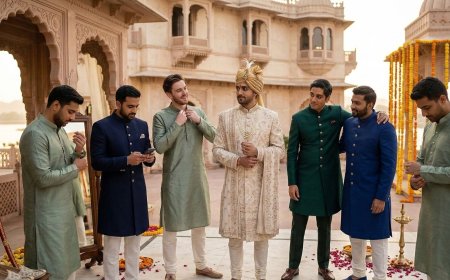
For traditional Indian wedding outfits — the sherwani, the kurta — a clean, classic taper that sits well with formal necklines is the most reliable choice. For contemporary NRI grooms wearing indo-western outfits, the more relaxed silhouette is compatible with a wider range of hair lengths and styles. Whatever the specific style, the pre-wedding haircut brief should include the specific length at the back and sides, the specific length on top, the taper or fade if applicable, and the specific styling direction that will be used on the wedding day.
The Beard Shape
A quality barber appointment for beard shaping — not a trim, but a full professional shape — takes forty-five to sixty minutes and involves the assessment of the beard's natural growth pattern, the establishment of both the neckline and the cheek line, the shaping of the overall beard form, and the edge definition with a straight razor that distinguishes a professionally shaped beard from a home-trimmed one.
The neckline deserves specific attention because it is visible in every photograph of the groom's face. A neckline that is too high looks like a goatee regardless of the beard length above it. A neckline that is too low creates a formless, unkempt lower face. The correct neckline sits slightly above the Adam's apple and falls in a clean arc between the ear and this point.
The Manicure, Pedicure, and Hand Care
The exchange of rings, the holding of hands during the ceremony, the specific hand gestures of the wedding rituals — the groom's hands appear in multiple wedding photographs in every Indian wedding. A basic men's manicure — cleaning under the nails, filing to a uniform length, buffing the nail surface, cuticle management, and a moisturising hand treatment — conducted seven to ten days before the wedding ensures the hands do not detract from the ring exchange and hand photographs. This is not a nail polish treatment. It is maintenance grooming. The pedicure conducted in the same appointment addresses the feet, which are occasionally photographed in traditional Indian ceremonies involving barefoot rituals.
Hand cream applied consistently in the month before the wedding improves the condition of the skin on the hands — reducing the dryness, cracking, and rough texture that the groom's hands often carry from professional and manual activities.
The India Barber Selection Guide
India's barbershop landscape spans an enormous quality range — and the quality indicators worth looking for are consistent regardless of city or price point. The barber who starts cutting immediately without a consultation is not the right barber for the wedding week. A willingness to consult before beginning, a portfolio of beard work in photographs of actual clients, experience with the specific beard style the groom is planning, the use of quality tools including sharp scissors and a straight razor for edge work, and basic hygiene standards — fresh towels, sanitised tools, a clean environment — are the non-negotiable indicators.
For NRI grooms planning destination weddings in Jaipur, Kerala, or other non-metropolitan locations, the premium grooming studio may not be available at the venue location. The options are either to schedule the pre-wedding grooming in the nearest metropolitan city during the India visit or to identify the best available local option through the wedding planner's network and community recommendations rather than hotel concierge referrals.
Service Pricing: Country of Residence vs. India
| Service | UK / Canada / USA | India — Quality Salon |
|---|---|---|
| Professional facial | £50–£150 per session | ₹2,000–₹8,000 |
| Haircut | £30–£80 | ₹500–₹3,000 |
| Professional beard shape | £25–£60 | ₹500–₹2,500 |
| Manicure and pedicure | £30–£70 | ₹500–₹2,000 |
| Full groom's pre-wedding package | £150–£400 | ₹5,000–₹20,000 |
| Home skincare routine (monthly) | £60–£135 per month | — |
| Total six-month home investment | £300–£700 | — |
| Total India pre-wedding investment | — | ₹8,000–₹25,000 |
The Wedding Morning Routine
The wedding morning is not the time for experimentation. It is the time for the routine that has been established and practised — executed with calm, with adequate time, and with the confidence that comes from knowing exactly what to do.
The night before the wedding, wash the beard with beard wash — the last deep cleanse before the wedding — and apply beard oil generously for the overnight conditioning that leaves the beard soft and well-conditioned for the morning. A gentle face cleanse and the established evening moisturiser complete the night-before routine. Early sleep is the most valuable grooming decision of the night before.
On the wedding morning, ninety minutes before the ceremony, the sequence is a gentle face cleanse, hyaluronic acid on slightly damp skin, eye cream or eye gel for morning puffiness, a lightweight moisturiser, SPF if outdoor elements are involved, beard oil worked through the beard after the skincare routine, beard balm or wax if needed for shape, and hair styling with the established product in the specific style planned for the wedding.
The grooming routine should be complete at least thirty minutes before any wedding morning photography begins — so that the products have absorbed, the beard is settled, and the groom's appearance is at its natural best rather than freshly applied.
The groom's wedding day touch-up kit should contain blotting papers for T-zone oiliness management, a translucent setting powder that reduces shine in photographs, a small beard comb for managing any displacement during the baraat or emotional moments, lip balm, eye drops for clarity if the wedding follows a late arrival or an early morning ceremony, and a breath freshener for the specific proximity of the ceremony rituals.
Common Mistakes NRI Grooms Make With Wedding Grooming
| Mistake | Why It Happens | The Correction |
|---|---|---|
| Starting skincare two weeks before the wedding | Grooming is left as an afterthought until the India visit | Begin the four-step routine at Month 6 — retinol requires months to produce results |
| Making a major beard change in the week before | Last-minute anxiety about the look | Make the beard decision at Month 6 and commit — the wedding look should refine, not depart from, the established appearance |
| Getting the final haircut the day before | Assuming fresh equals best | Seven to ten days before — the settled cut looks naturally groomed, not freshly barbered |
| Not researching the India barber in advance | Assuming a hotel concierge recommendation is sufficient | Research and book the specific barber through community recommendations and the wedding planner's network before arriving in India |
| Ignoring the hands and feet | These areas are not in the groom's visual reference when planning | Book the manicure and pedicure in the same appointment as the haircut and beard shape — both appear in wedding photographs |
| Abandoning the routine under wedding week stress | The pressure of the final weeks disrupts established habits | The routine is most valuable when circumstances make it hardest — consistency in the final weeks produces the result |
The Groom Who Prepared
The wedding photographs are permanent.
The groom in those photographs — in every photograph, from the baraat to the ceremony to the reception — is as permanently present as the bride. His skin, his hair, his beard, his hands — these are all recorded with the same fidelity and the same permanence as every other element of the wedding day.
The difference between the groom who prepared and the groom who did not is visible in those photographs. Not dramatically — the groom is not transformed beyond recognition by a six-month skincare routine and a professional beard shaping appointment. But meaningfully. The skin has a quality that casual grooming does not produce. The beard has a shape that home trimming does not achieve. The hair is at its best version of itself rather than its default version.
This is not vanity. It is the same preparation that the NRI groom applies to every other important professional and personal presentation of his life — the job interview, the client meeting, the formal occasion — except that it is applied to the occasion that will be photographed and remembered for the longest.
The investment is modest. A skincare routine that costs less per month than a dinner out. A professional facial every six to eight weeks. A barber appointment every four to six weeks. A pre-wedding grooming package in India that represents a fraction of one percent of the total wedding cost.
The return is permanent.
Begin at Month 6. Follow the timeline. Show up on the wedding day as the best version of yourself — prepared, confident, and present.
The photographs will show it. For decades.
Published by NRIWedding.com — The Premium Global Platform for Non-Resident Indians Planning Indian Weddings From Abroad.
What's Your Reaction?
 Like
0
Like
0
 Dislike
0
Dislike
0
 Love
0
Love
0
 Funny
0
Funny
0
 Angry
0
Angry
0
 Sad
0
Sad
0
 Wow
0
Wow
0