
























































Jalandhar’s Jewellery Market vs Delhi’s Dariba Kalan — Which One Actually Makes the Better Punjabi Bridal Set?
Choosing where to buy bridal jewellery in India often turns into a debate between two legendary markets: Jalandhar’s jewellery hubs in Punjab and Delhi’s historic Dariba Kalan in Chandni Chowk. Both claim exceptional craftsmanship, deep artisan history, and the ability to create heirloom-quality bridal sets — but they offer very different strengths. This in-depth comparison explains how each market actually performs when examined through the lens of an NRI bridal shopping trip. Understand how Dariba Kalan’s Mughal-influenced craftsmanship — polki, kundan, and meenakari gemstone work — compares to Jalandhar’s tradition of heavy Punjabi gold bridal jewellery designed to carry both cultural meaning and long-term value. Learn how making charges differ by market, why the BIS hallmarking system means purity is the same in both cities, how negotiation culture varies, and which pieces each market produces best. Discover the real price differences on full bridal sets, the importance of karigar craftsmanship, and how family jeweller relationships in Punjab can significantly affect pricing and service. With a clear side-by-side comparison covering gold purity, making charges, design tradition, shopping experience, negotiation style, and price differentials, this guide helps NRI brides decide where to shop before their India trip begins — and when combining both markets may produce the best bridal jewellery collection.


Jalandhar's Jewellery Market vs Delhi's Dariba Kalan — An Honest Side-by-Side
The argument had started, as most jewellery arguments in Punjabi families start, over chai.
Harleen's mother was sitting at the kitchen table in Surrey with a printout of three quotations — two from Jalandhar and one from Delhi — and the specific expression of a woman who has decided what she thinks and is now assembling the case for why she is correct. Her mother-in-law, who had arrived from Jalandhar four days earlier and whose opinion on the jewellery question had been formed approximately forty years before this conversation and had not materially shifted since, was sitting across from her with the expression of a woman who has already decided and does not require the printout.
Harleen's mother said: the Delhi gold is purer. Everyone knows this.
Harleen's mother-in-law said: the Delhi goldsmiths have never made a Punjabi set. They make jewellery for people who wear jewellery to look at. We make jewellery for people who wear jewellery to mean something.
Harleen's mother said: the Dariba Kalan karigars have been working since the Mughal period.
Harleen's mother-in-law said: the Jalandhar karigars have been working since the karigars who left Delhi during the Partition came to Punjab and brought everything they knew with them.
There was a silence.
Harleen, who had been listening from the doorway with her chai going cold in her hand, understood that this conversation was not going to resolve itself through the deployment of additional opinions. It was going to require the deployment of actual information — the kind that comes from visiting both markets, comparing both on the same criteria, and returning with the specific knowledge that the chai-table argument cannot produce but that the wedding jewellery decision requires.
She had visited both markets. She had spent four days in Jalandhar and two days in Delhi. She had asked the questions that the printout of quotations does not contain.
This article is what she found — the honest, specific, side-by-side account of Jalandhar's jewellery market and Delhi's Dariba Kalan, written for the NRI bride and her family who need the comparison rather than the argument.
Why This Comparison Matters More Than It Appears To
The choice between Jalandhar's jewellery market and Delhi's Dariba Kalan is not, on its surface, a complicated question. Both are established, reputable jewellery markets with centuries of combined craft history. Both produce bridal gold jewellery that is, at the premium end of each market, genuinely excellent. Both have jewellers who are accredited, whose gold quality is verifiable, and whose craft tradition is deep enough to produce the kind of Punjabi bridal set — the haar, the choker, the tikka, the jhumki, the bangles, the payal, the nath — that the wedding photographs will hold for three generations.
The comparison matters because the NRI bride who is purchasing her wedding jewellery during a trip to India — a trip whose duration is fixed, whose budget has been established, and whose emotional weight is the specific weight of a decision that is simultaneously financial, cultural, and deeply personal — needs to know which market to go to before the trip begins. Going to both is sometimes possible. It is not always efficient. And the bride who arrives in Delhi having already purchased in Jalandhar, or who arrives in Jalandhar having already committed in Delhi, has made a choice whose basis she may not have examined as carefully as the decision required.
The comparison also matters because the two markets are not interchangeable, and the ways in which they are different are the ways that are most relevant to the specific purchasing requirements of the Punjabi bridal set. The differences are real, specific, and worth understanding in their particularity rather than in the simplified form that the chai-table argument produces.
The History That Shapes the Present Product
To understand what each market makes and why it makes it the way it makes it, the history that shaped each market's craft tradition is necessary context rather than decorative background.
Dariba Kalan — whose name translates approximately as "the lane of the precious" — is a jewellery market in the Chandni Chowk area of Old Delhi whose origins are documented to the Mughal period, when the lane housed the jewellers who supplied the imperial court with the gems, the goldwork, and the ornamental objects whose craft requirements were at the apex of what the subcontinent's artisan tradition produced. The Mughal court jewellery tradition — its emphasis on polki work, on kundan settings, on the integration of gemstones into goldwork whose craftsmanship was architectural in its precision — is the tradition that Dariba Kalan's established jewellers are the inheritors of, and whose influence on the product the market produces today is visible in the specific aesthetic of the finest Delhi jewellery: the elaborate setting, the gemstone integration, the surface complexity that rewards close examination.
Jalandhar's jewellery market has a different origin story whose specific historical moment is the Partition of 1947. The displacement that Partition produced brought to Punjab — and specifically to the cities of the Doaba and Malwa regions, including Jalandhar — the artisan communities whose craft traditions had been established in Lahore, in Delhi, and in the jewellery-making centres of undivided Punjab. The karigars who arrived in Jalandhar in 1947 and 1948 brought with them the techniques, the tools, and the design vocabulary of a craft tradition that had its own specific character — heavier goldwork, bolder forms, the emphasis on the jewellery's weight and presence as the primary aesthetic values, the specific forms of the Punjabi bridal set whose design language is recognisable across the diaspora that carries it.
What this history produces, in the present, is two markets whose craft identities are genuinely different rather than merely geographically separated. The finest Dariba Kalan jewellery is the jewellery of the court tradition — intricate, gem-set, architecturally precise. The finest Jalandhar jewellery is the jewellery of the Punjabi domestic tradition — substantial, gold-forward, emotionally direct in its visual language. Both are excellent. They are excellent at different things.
Gold Quality and Purity: The Claim That Started the Argument
The claim that Harleen's mother had made at the kitchen table — that Delhi gold is purer — is the claim that this comparison takes seriously enough to examine rather than dismiss, because it is the claim that appears in enough NRI family conversations to suggest that it is either true in a way that matters or persistent in a way that requires addressing.
The factual position on gold purity in both markets is this: the Bureau of Indian Standards hallmarking system, whose implementation has been progressively strengthened since its mandatory extension in 2021, applies to both markets equally. A 22-karat hallmarked piece from a BIS-registered jeweller in Jalandhar has the same legal purity guarantee as a 22-karat hallmarked piece from a BIS-registered jeweller in Dariba Kalan. The hallmark is the purity guarantee. The city is not.
The origin of the "Delhi gold is purer" claim, to the extent it has a traceable origin, appears to be the pre-hallmarking era when the absence of a standardised verification system created genuine quality variation across markets, and when Delhi's longer-established and more formally organised jewellery trade may have had, on average, more consistent purity practices than smaller regional markets. This historical differential, to the extent it was real, has been substantially addressed by the mandatory hallmarking system whose enforcement is ongoing.
The practical implication of this for the NRI bride purchasing bridal jewellery in either market is the same: buy from BIS-registered jewellers whose pieces carry the current hallmarking standard, verify the hallmark before purchase, and do not allow the city of purchase to substitute for the hallmark verification as the purity assurance. The hallmark is the guarantee. The reputation of the market is context, not certification.
What this does not address is the making charge differential, which is real and which is where the practical comparison between the two markets becomes most consequential for the purchasing decision.
Making Charges: Where the Real Difference Lives
The making charge — the amount charged per gram of gold for the craftsmanship of converting the raw material into the finished piece — is the cost component that the gold price comparison between two markets does not capture and that the quotation comparison on a price-per-gram basis systematically misrepresents.
In Dariba Kalan, the making charges for premium bridal jewellery range from approximately twelve to twenty-two percent of the gold value for standard designs, and from twenty to thirty-five percent for the complex kundan, polki, and meenakari work whose surface elaboration is the specific craft tradition the Delhi market excels at. These making charges reflect the craft labour cost in Delhi, the karigan tradition whose specific skills command a premium, and the market's positioning at the apex of the Indian bridal jewellery consumer's aspiration.
In Jalandhar, the making charges for equivalent weight and design complexity range from eight to sixteen percent for standard designs, and from fourteen to twenty-four percent for elaborate work. The differential reflects the labour cost difference between the two cities, the overhead structure of the two markets, and — at the premium end — a pricing convention in Jalandhar that has not fully adjusted to the market positioning that the quality of the work justifies.
The practical consequence of this differential for a bridal set of, say, three hundred grams of 22-karat gold — a reasonable estimate for a comprehensive Punjabi bridal set including the major pieces — is significant. At gold prices of approximately seven thousand rupees per gram for 22-karat gold, the gold value is twenty-one lakhs. The making charge differential between Dariba Kalan's fifteen percent and Jalandhar's eleven percent is four percent of twenty-one lakhs, which is eighty-four thousand rupees — a meaningful sum on a single purchase.
For a full bridal set that includes the major gold pieces, the jadau work, and the stone-set items, the making charge differential between the two markets at comparable quality levels consistently produces a Jalandhar total that is ten to eighteen percent below the Dariba Kalan total for equivalent workmanship. This differential is real, it is consistently observed across the comparison's market research, and it is the reason that the Jalandhar market's argument is not merely sentimental.
Design Vocabulary: What Each Market Makes Best
This is the heart of the comparison — not the gold purity question, which the hallmarking system has largely resolved, and not the making charge differential, which is real but secondary to the more fundamental question of which market makes the specific jewellery that the specific bride actually wants.
What Dariba Kalan Makes Best
Dariba Kalan's craft tradition excels at the jewellery whose primary aesthetic value is surface complexity — the layered gemstone settings, the polki work whose uncut diamonds catch light in the specific diffuse way that modern brilliant cuts do not, the kundan work whose gold-foil-and-stone construction is the specific technique that Delhi's karigars have practiced continuously since the Mughal period, the meenakari enamel work whose colour and precision on the reverse of the piece is as finished as the face.
This is jewellery for the bride whose aesthetic is Indo-Persian, whose reference is the miniature painting and the Mughal portrait, whose wedding photographs will be examined for the detail in the setting rather than the weight of the piece. It is jewellery of extraordinary craft whose value is in its surface reading at close distance — the kind of piece that the photographer's macro lens rewards and the kind of piece whose craftsmanship the wearer explains to the guests who lean in to look.
For the NRI bride whose aesthetic is shaped by the Sabyasachi reference — the antique finish, the polki centre, the asymmetric layering of pieces whose collective effect is of jewellery worn rather than displayed — Dariba Kalan is the market whose product vocabulary best matches this aesthetic.
What Jalandhar Makes Best
Jalandhar's craft tradition excels at the jewellery whose primary aesthetic value is form and weight — the substantial gold pieces whose visual impact reads across a room rather than under a macro lens, the haar whose weight is the weight of significance rather than mere metal, the choker whose construction is the specific construction of the Punjabi bride's photograph across three generations, the bangles whose gold content makes them the specific heirloom object that the Punjabi family understands them to be.
This is jewellery for the bride whose aesthetic is the Punjabi domestic tradition — bold, gold-forward, emotionally direct, the kind of jewellery that the grandmother recognises and the great-grandmother would have recognised and that communicates its meaning in the visual language of the community that produced it. It is jewellery whose craft tradition is specific and whose forms are not decorative variations on an international bridal jewellery vocabulary but genuine cultural objects with specific histories.
The jadau work in Jalandhar — the stone-setting technique in which the stones are pushed directly into the gold without prongs — is as technically accomplished as the comparable work in Delhi, and the Jalandhar karigars who specialise in it produce pieces whose quality the Delhi market does not consistently surpass. The specific forms of the Punjabi bridal set — the nath, the tikka, the jhumki, the payal — are made in Jalandhar by people for whom these forms are native rather than studied, and the difference in the product is the difference between a form made by someone who has grown up with it and a form made by someone who has learned it.
The Shopping Experience: What the Markets Actually Feel Like
Dariba Kalan
Dariba Kalan is a lane in Old Delhi whose physical character is the physical character of a centuries-old market that has been continuously occupied by the same category of trade — narrow, dense, layered, its shop frontages six feet wide and its interiors extending back in the specific compressed manner of the haveli architecture that the Old Delhi commercial fabric is built from. The experience of shopping in Dariba Kalan is the experience of navigating this density with the specific intention of finding the specific shop whose product matches the specific requirement, in a market where the product variation between adjacent shops is sometimes enormous and sometimes invisible and whose identification requires either local knowledge or the research that local knowledge enables.
For the NRI bride whose knowledge of the Dariba Kalan market is limited and whose trip to Delhi is time-constrained, the Dariba Kalan shopping experience is most effectively managed with a guide — a jewellery consultant or a trusted local contact whose navigation of the market's specific shop landscape converts a potentially overwhelming experience into a directed one. Without this navigation, the density of the market produces the specific decision paralysis of too many options whose differentiation is not immediately legible to the visitor without context.
The negotiation culture in Dariba Kalan is the negotiation culture of the Old Delhi wholesale and retail market — present, expected, and consequential. The first price is not the final price. The making charges, the stone setting fees, and the delivery timeline are all negotiable, and the buyer who does not negotiate is the buyer who pays the tourist rate whose gap from the informed-buyer rate is significant. For the NRI who has not recently navigated the Old Delhi market negotiation, the gap between the first quote and the achievable price — with the right knowledge and the right approach — can be twelve to twenty percent.
Jalandhar's Jewellery Market
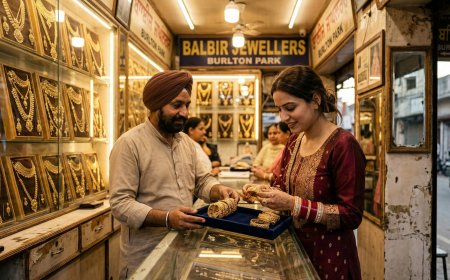
Jalandhar's primary jewellery market is concentrated in the Burlton Park and Rani Jhansi Road areas, with additional significant presence in the GT Road corridor whose shop density, while less architecturally dramatic than Dariba Kalan, is practically comparable in its range of product and price. The shopping experience in Jalandhar's jewellery market is, for the NRI bride whose family has connections in Jalandhar, a fundamentally different experience from the Dariba Kalan visit — because the Jalandhar market is a market in which the family network is a practical resource rather than merely a social one.
The Jalandhar jeweller whose shop the family has visited for three generations is a jeweller who knows the family, whose pricing for an established relationship is different from his pricing for a walk-in, and whose guidance on the current gold rates, the current making charge conventions, and the specific pieces whose quality is exceptional in his stock is guidance that the relationship produces and that the market visit without the relationship cannot access. For the NRI bride whose family has this relationship — whose mother or grandmother has a Jalandhar jeweller they have used for decades — the Jalandhar market's effective pricing and service quality is significantly better than the market's walk-in pricing and service would suggest.
The negotiation culture in Jalandhar's jewellery market is the negotiation culture of the Punjabi business relationship — direct, relationship-weighted, and less theatrical than the Old Delhi market's negotiation. The making charge is the primary negotiation point. The gold rate is not negotiated because the published daily gold rate applies uniformly. The making charge, whose range at the premium shops varies from eight to sixteen percent, is the number that the relationship and the order size move, and the movement is typically three to five percentage points for a full bridal set order from an established family.
The Karigar Question: Who Is Actually Making the Piece
Both markets claim, and both markets in their premium tier deliver, jewellery made by skilled karigars whose craft training is the product of apprenticeship systems whose depth is measured in decades rather than years. But the karigar question — the question of who is actually making the specific piece the bride is purchasing — is worth asking in both markets, because the answer changes the product assessment.
In Dariba Kalan's established shops, the karigars who make the premium jewellery are the karigars whose names the shop owners know and whose work they can identify and stand behind. The piece made by the shop's senior karigar is different from the piece made by the shop's junior karigar, and the buyer who asks to understand the attribution of the work they are purchasing will receive, in the established shops, an answer that the shop's reputation requires to be accurate.
In Jalandhar's premium jewellery shops, the equivalent karigar quality exists and is the product of the same craft apprenticeship system. The specific point of differentiation is the karigar's familiarity with the specific forms of the Punjabi bridal set — the jhumki's proportions, the payal's weight distribution, the nath's nose-wire gauge — whose correctness is the correctness of a craftsperson who has made these forms for the community that wears them rather than for a market that orders them. This familiarity produces a specific fit and finish in the Punjabi bridal pieces that the Jalandhar karigar delivers more consistently than the Delhi karigar whose primary practice is in the different forms that the Delhi market's broader customer base requires.
The Certification and Documentation Question for NRI Buyers
The NRI bride purchasing jewellery in either market and carrying it to Canada, the United Kingdom, Australia, or another country of residence is purchasing an asset whose documentation has implications for the customs declaration at the destination country, the insurance valuation for the country of residence's insurance market, and the provenance documentation that resale or inheritance may require in the future.
Both markets, at the BIS-registered premium end, provide the hallmarking documentation that is the Indian government's purity certification. The certificate from the jeweller — the invoice that specifies the gold weight, the purity, the making charges, the stone details if applicable, and the total paid — is the document that the insurance valuation and the customs declaration require, and it should be requested, specified, and retained regardless of which market the purchase is made in.
The customs declaration requirement for jewellery carried to the country of residence is specific to each country and is the buyer's responsibility to research before the purchase. The duty-free allowance for jewellery carried by Indian passport holders returning from India varies by country and by the duration of the stay, and the NRI bride whose purchase exceeds the allowance is the NRI bride whose jewellery declaration at the destination country is not optional.
The specific practical advice from the comparison's research is this: retain every document the jeweller provides, request an invoice whose specificity — weight per piece, purity, making charge breakdown — is sufficient for insurance purposes, and research the customs allowance for the destination country before the purchase rather than at the airport.
The Honest Side-by-Side
| Criteria | Jalandhar Jewellery Market | Dariba Kalan, Delhi |
|---|---|---|
| Gold Purity Guarantee | BIS hallmark (same standard) | BIS hallmark (same standard) |
| Making Charges (standard) | 8–16% | 12–22% |
| Making Charges (elaborate work) | 14–24% | 20–35% |
| Speciality Craft | Punjabi bridal forms, jadau, heavy gold | Polki, kundan, meenakari, Mughal-influenced |
| Design Vocabulary | Bold, gold-forward, Punjabi domestic tradition | Intricate, gem-set, Indo-Persian court tradition |
| Market Navigation | Family network essential; manageable independently | Guide strongly recommended; density is challenging |
| Negotiation Culture | Relationship-weighted, direct | Present and consequential; theatrical |
| Karigar Familiarity with Punjabi Forms | Native | Studied |
| Price Differential (full bridal set) | 10–18% lower at comparable quality | Base reference |
| Market Physical Character | Accessible, spread across multiple commercial streets | Dense, narrow lanes, historic architecture |
| Best For | Punjabi bridal sets, heirloom gold pieces, family-relationship purchases | Kundan/polki sets, gemstone jewellery, Mughal aesthetic brides |
| Trip Duration Required | 2–3 focused days | 2 focused days with guide |
| NRI Family Network Advantage | High — family relationships change pricing and access | Low — relationship network less transferable for most NRI families |
What to Buy Where: The Practical Allocation
The NRI bride who has the time and the itinerary to visit both markets — whose India trip includes time in both Punjab and Delhi — should consider the purchase allocation that the comparison's honest assessment suggests rather than the all-or-nothing approach that the chai-table argument between the two mothers implies.
The pieces whose primary value is the weight and form of the Punjabi bridal tradition — the haar, the heavy gold choker, the bangles, the payal, the tikka whose design is the classic Punjabi form — are the pieces that the Jalandhar market makes best and prices most honestly. These are the pieces that the Jalandhar karigar has been making in their correct forms for generations, and whose purchase in Jalandhar, through the family jeweller whose relationship the family has maintained, is the purchase that delivers the best combination of quality, cultural specificity, and value.
The pieces whose primary value is the surface complexity of the stone-setting tradition — the kundan necklace, the polki set, the meenakari work whose colour and craftsmanship is the Delhi market's specific excellence — are the pieces that the Dariba Kalan karigars produce at a quality that the Jalandhar market does not consistently match. If the bride's aesthetic includes these pieces and the trip itinerary includes Delhi, these are the pieces whose Delhi purchase is justified by the quality differential even against the making charge premium.
The pieces that fall in between — the jadau work, the stone-set jhumki, the decorated bangles — are the pieces whose purchase decision depends on the specific shop and the specific karigar in each market, and whose comparison requires the site visit rather than the generalisation.
What Harleen Bought and Where
She had gone to Jalandhar first, because the family jeweller was there and because the family jeweller's opinion of what she needed to buy and what she did not need to buy was worth the four days that the Jalandhar market visit required.
The family jeweller had looked at her reference photographs — which were, as reference photographs for NRI bridal jewellery almost always are, a combination of things that were possible, things that were possible at a different budget, and things that were the product of photographer styling that would not survive the transition to an actual wedding day — and had separated them into three piles without being asked.
He had said: this pile, we make here and it will be better than the photograph. This pile, you go to Delhi for the kundan, they do it better there. This pile, these are not real, this is styling, you don't want these.
Harleen had said: how do you know what I want.
He had said: I made your mother's set. I know your family's taste.
She had bought the haar, the choker, the bangles, the payal, and the tikka in Jalandhar. The gold weight was three hundred and twelve grams. The making charge was nine percent, which was the family rate on an order of this size, and which represented a saving of approximately one lakh twenty thousand rupees against the Delhi making charge on the same weight.
She had gone to Delhi for the kundan necklace and the polki jhumki, whose surface complexity was the surface complexity that the Dariba Kalan karigar had spent thirty years learning to produce and that the comparison's research had told her was genuinely better in Delhi and that the site visit had confirmed.
At the kitchen table in Surrey, later, with the jewellery laid out on the velvet that the Jalandhar jeweller had wrapped it in, Harleen's mother and her mother-in-law had looked at the pieces for a long time without speaking.
Her mother-in-law had picked up the haar. She had turned it over. She had said: this is Jalandhar work. I can see his hands in it.
Her mother had picked up the kundan necklace. She had said: this is Delhi work. Look at the setting.
They had both looked at the full set together on the velvet.
Harleen's mother had said: it works.
Harleen's mother-in-law had said: of course it works. The best of both places always works.
There was no argument after that.
Published by NRIWedding.com — The Premium Global Platform for Non-Resident Indians Planning Indian Weddings From Abroad.
For jewellery market guidance, trusted vendor referrals in both Jalandhar and Delhi, and the full NRI bridal shopping guide, visit nriwedding.com.
What's Your Reaction?
 Like
0
Like
0
 Dislike
0
Dislike
0
 Love
0
Love
0
 Funny
0
Funny
0
 Angry
0
Angry
0
 Sad
0
Sad
0
 Wow
0
Wow
0