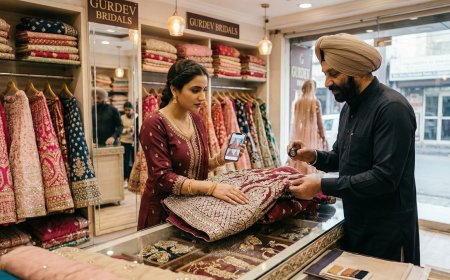













































































How to Ship Wedding Purchases from Jalandhar to UK, Canada, USA and Australia — The Complete NRI Guide
For many NRI brides visiting Punjab for wedding shopping, the biggest logistical challenge appears at the very end of the trip. After days of successful purchases — bridal lehengas, jewellery sets, embroidered dupattas, juttis, fabrics, gifts for relatives, and decorative pieces for the new home — the final question becomes unavoidable: How does all of this actually get back overseas safely? Airline baggage allowances are limited. Bridal purchases are often delicate, heavy, and too valuable to risk improper transport. And each destination country — whether the UK, Canada, the United States, or Australia — has its own customs rules, duty structures, and import restrictions. This guide explains exactly how NRI brides can ship wedding purchases from Jalandhar internationally with confidence. It covers the full process step by step: choosing between express couriers and postal shipping, packing delicate textiles and jewellery safely for long-distance transit, completing customs documentation correctly, understanding import duty rules in major NRI destinations, and planning shipping timelines so purchases arrive well before the wedding date. From the moment boxes leave Jalandhar to the day they arrive at a London apartment, a Toronto house, a California home, or a Sydney address, this guide ensures that the wedding purchases that took so much care to choose arrive safely, legally, and on time.

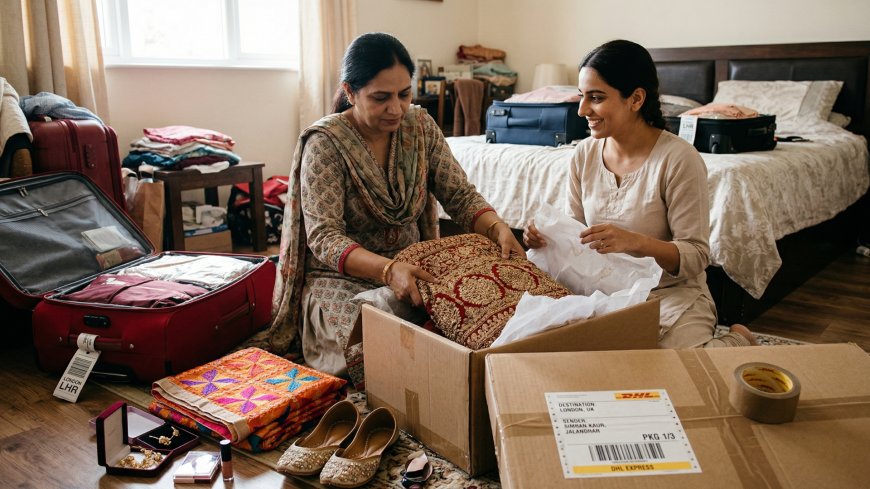
How to Ship Wedding Purchases from Jalandhar to UK, Canada, USA and Australia: The Complete NRI Guide
The Suitcase That Was Never Going to Be Enough
It is the last morning of your Jalandhar planning visit.
Your flight back to Toronto is at six in the evening. You have been in the city for nine days. The wedding shopping — the lehenga, the jewelry, the juttis, the phulkari dupattas, the suit lengths for your bridesmaids, the handloom pieces for the house, the spices, the children's occasion wear, the custom pieces that were commissioned at the beginning of the visit and collected yesterday — has been more successful than you dared hope when you arrived.
The problem is now visible and concrete in the corner of the bedroom you have been sleeping in at your parents' house.
There are four large bags. You came with two. The two you came with are already at capacity with the things you brought from Toronto — the gifts, the personal items, the documents, the laptop. The two additional bags — purchased from a shop near Guru Nanak Mission Chowk specifically to accommodate the shopping overflow — are now also at capacity and you have not yet packed the phulkari pieces that your mother has been keeping in her room, or the brass ceremonial items that your aunt insisted on purchasing for you, or the three additional suit lengths that appeared at dinner two nights ago as a gift from a relative whose generosity you were not in a position to decline.
Your airline allows two checked bags at twenty-three kilograms each. You have approximately ninety-two kilograms of purchases. The mathematics of this situation are clear. The solution is less clear.
This is the shipping problem. And it is a problem that a significant proportion of NRI brides who successfully navigate the Jalandhar wedding shopping process encounter at the end of their planning visit — the realisation that the volume and weight of what has been purchased exceeds what can be practically transported in personal baggage, and that a systematic approach to international shipping from Jalandhar is required rather than a last-minute scramble.
The good news is that international shipping from Jalandhar to the UK, Canada, USA, and Australia is entirely manageable when approached with the right knowledge, the right timeline, and the right understanding of what each country's customs system will do with incoming shipments from India. The bad news is that most NRI brides approach it without this knowledge — booking couriers at the last minute, misdeclaring customs values, failing to pack correctly for international transit, and discovering the specific peculiarities of their destination country's import regulations at the least convenient possible moment.
This guide eliminates every one of those problems. It is the complete, practical, country-specific shipping resource for NRI brides sending wedding purchases from Jalandhar — covering courier selection, packing requirements, customs documentation, duty calculation, prohibited items, timeline planning, and the specific intelligence that makes the difference between a shipment that arrives on time in perfect condition and one that spends six weeks in a customs warehouse accumulating storage charges.
The Core Reality: What International Shipping from Jalandhar Actually Involves
Before the country-specific guidance, the foundation — the understanding of what international shipping from Jalandhar actually involves at every stage of the process, because each stage has implications for what you need to prepare and what can go wrong if you do not.
The pickup and domestic transit stage:
The shipment begins with a courier agent collecting the packed boxes from your collection point — your parents' house, the hotel, or the vendor's premises if you are shipping directly from the place of purchase. The agent takes the consignment to the nearest hub of the international courier network — in Jalandhar's case, typically the Phagwara or Ludhiana hub for major international couriers, or the local post office for India Post EMS services. This domestic transit stage typically takes one to two days before the shipment enters the international network.
The export customs stage:
Before the shipment can leave India, it passes through Indian export customs — the process by which the Indian government records what is leaving the country and confirms that the export is compliant with Indian export regulations. For most wedding purchase categories — textiles, jewelry, footwear, household items — Indian export customs is straightforward. The items that require specific attention are gold and silver jewelry above certain value thresholds, which may require export permits, and items that contain protected materials such as ivory or certain wildlife products, whose export is prohibited.
The international transit stage:
Once cleared through Indian export customs, the shipment enters the international courier network. For express courier services such as DHL, FedEx, and UPS, the international transit time from Jalandhar to the UK is typically three to five business days. To Canada and the USA, four to seven business days. To Australia, five to eight business days. These are transit times under normal operating conditions — peak periods, public holidays, and customs delays can extend them.
The import customs stage:
When the shipment arrives in the destination country, it enters that country's import customs system — the stage at which import duty and taxes are assessed and at which the accuracy of your customs documentation determines whether the shipment clears quickly or is held for inspection, re-valuation, or compliance resolution. This is the stage that generates the most problems for NRI brides who have not prepared their documentation correctly.
The final delivery stage:
Once import customs clearance is obtained, the shipment is released to the local delivery network for final delivery to the destination address. For express courier services, this stage typically adds one to two business days after customs clearance.
Choosing the Right Shipping Method
The shipping method decision should be made before the shopping visit begins — not at the end of the visit when the boxes are packed and the flight is in six hours. Different methods have different lead times, cost structures, and reliability profiles, and the right choice depends on the volume, the value, the content, and the timeline of the shipment.
International Express Couriers
DHL Express, FedEx International Priority, UPS Worldwide Express
These are the premium international shipping options — the fastest, most trackable, and most reliable services available from Jalandhar, and the ones that provide the strongest protection for high-value shipments through comprehensive insurance options and established customs clearance expertise.
Advantages: Speed — three to seven business days to most NRI destinations. Tracking — real-time, end-to-end shipment visibility. Customs expertise — these couriers have dedicated customs clearance teams in the destination country who are experienced in managing the specific documentation requirements for each market. Insurance — comprehensive cargo insurance is available for declared value coverage. Reliability — established networks with consistent service levels.
Disadvantages: Cost — express international courier rates from Jalandhar are significantly higher than postal or economy freight options. For a twenty-kilogram box of textiles, an express courier to the UK costs approximately twelve thousand to eighteen thousand rupees. To Canada or the USA, fifteen thousand to twenty-two thousand rupees. To Australia, eighteen thousand to twenty-five thousand rupees. For multiple boxes of high-value wedding purchases, the shipping cost is a meaningful line item in the total purchase budget.
When to use: For high-value items — jewelry, heavily embellished lehengas, custom pieces — where the replacement cost of loss or damage justifies the premium. For time-sensitive shipments that need to arrive before a specific date with reliable confidence. For first-time shippers who want the most straightforward customs clearance experience.
India Post EMS (Express Mail Service)
India Post's international express mail service is the government postal option for international parcels — significantly cheaper than the express couriers but with longer transit times and more variable reliability.
Advantages: Cost — EMS rates from Jalandhar to the UK, Canada, USA, and Australia are forty to sixty percent lower than equivalent express courier rates for comparable box weights. Accessible — India Post outlets are available across Jalandhar including in the main post office near Burlton Park and in branch offices across the city's commercial areas.
Disadvantages: Slower transit — EMS transit times range from seven to fourteen business days under normal conditions and can extend significantly during peak periods or with customs complications. Less tracking granularity — EMS tracking is available but less detailed and less real-time than express courier tracking. Variable customs clearance — EMS shipments are processed through postal customs channels rather than dedicated courier customs lanes, which can produce more variable clearance times.
When to use: For lower-value, non-time-sensitive shipments — the suit lengths, the phulkari dupattas, the home textiles, the spice and food products that are within customs value thresholds — where the cost saving justifies the slower and less precise service.
Economy Air Freight and Consolidated Freight
For very large shipments — multiple large boxes with a total weight exceeding thirty to forty kilograms — economy air freight or consolidated freight services may offer better value than per-shipment express courier rates.
The consolidated freight model: Several shipping agents in Jalandhar operate consolidated freight services — grouping multiple customers' shipments into a single freight consignment that is shipped to the destination country and then distributed to individual addresses. The per-kilogram rate in consolidated freight is typically lower than express courier rates, but the transit time is longer — ten to twenty-one days to most destinations — and the customs clearance process requires more active management by the shipper.
When to use: For total shipment weights above thirty kilograms where the volume justifies the complexity of freight booking and the timeline accommodates the longer transit. Not appropriate for high-value jewelry or heavily embellished pieces that require express service insurance coverage.
Sea Freight
Sea freight — the slowest and lowest-cost international shipping option — is occasionally used for very large volumes of heavy items that are not time-sensitive. The transit time from India to the UK by sea freight is approximately twenty to twenty-five days. To Australia, twenty-five to thirty-five days. To Canada and the USA, twenty-five to forty days depending on the port.
For wedding purchases, sea freight is appropriate only for large, heavy, non-urgent items — significant volumes of fabric, bulk food items, or large household goods — where the time is available and the value does not justify the insurance cost of air freight.
Packing for International Transit: The Standards That Protect Your Purchase
The packing quality of an international shipment from Jalandhar is the primary determinant of whether the contents arrive in the same condition they were in when they left. International transit subjects packages to handling, stacking, temperature variation, and moisture exposure that domestic shipping does not — and the packing that would adequately protect a package in domestic transit may not adequately protect the same package across a twelve-thousand-kilometre international journey.
The Textile Packing Standard
Textiles — the lehengas, the dupattas, the suit lengths, the phulkari pieces — require specific packing protection against moisture, compression, and the staining risk that contact with other materials in transit creates.
The correct textile packing sequence:
Each individual textile piece should be wrapped in acid-free tissue paper before being packed. This protects embellishment from contact damage and provides a moisture-resistant layer between the fabric and the outer packaging. Heavily embellished pieces — those with zardozi, mirror work, or heavily structured embroidery — should be wrapped with the embellished surface facing inward against the tissue, with additional tissue padding between the embellishment and the fabric layer beneath it.
Wrapped pieces should be placed in individual polythene bags that are sealed against moisture before being packed into the outer box. The polythene layer protects against condensation — the moisture that forms on cold surfaces when a temperature-controlled environment is entered — which is a particular risk for shipments from warm Indian conditions into cold UK or Canadian winter conditions.
The outer box should be a double-wall corrugated cardboard box of adequate size to hold the packed contents without compression. Compression of embellished textiles during transit can flatten embellishment and deform structured elements. Fill any void spaces in the box with additional tissue paper or biodegradable packing chips to prevent contents shifting during transit.
Seal the box with minimum three layers of reinforced packing tape applied in the H-pattern across the top and base seams. Label the box clearly with the destination address and return address in permanent marker on at least two faces of the box.
The Jewelry Packing Standard
Jewelry — particularly pieces with delicate setting work such as kundan or polki, and pieces with hanging elements such as kalire or jhumar — requires the most careful packing of any wedding purchase category.
The correct jewelry packing sequence:
Individual pieces should be wrapped in anti-tarnish cloth or acid-free tissue before being placed in rigid individual boxes or firm compartment trays. Gold pieces should not be packed in contact with silver pieces — the metal contact can cause tarnishing. Pieces with hanging elements should be secured so that the hanging elements cannot move during transit — wrapping them individually against the main piece with additional tissue prevents the movement that causes hanging elements to tangle or damage each other.
Individually boxed pieces should be placed in a rigid outer container — a wooden or heavy cardboard box — with padding material between each piece to absorb transit shock. The outer container should be wrapped in bubble wrap before being placed in the shipping box, providing an additional shock absorption layer.
Jewelry shipments above certain declared values may require specific insurance documentation and may attract specific attention from customs. Understand the value declaration requirements before shipping and ensure the declared value accurately reflects the replacement cost of the pieces.
The Juttis Packing Standard
Juttis — particularly heavily embellished pairs — require protection against compression and against the moisture that can damage both the leather and the thread work embellishment.
Each pair should be wrapped in tissue and placed in a rigid individual box — the original box if retained from purchase, or a similarly rigid alternative. Pairs should not be packed without individual boxes — unpacked juttis in a shared box will damage each other's embellishment during transit. Box pairs individually, then pack multiple boxes in the outer shipping box with void filling between them.
Customs Documentation: The Foundation of Smooth Clearance
The quality of the customs documentation accompanying an international shipment from Jalandhar is the primary determinant of whether the shipment clears customs quickly or is held for inspection, re-valuation, or compliance resolution. Poor documentation is the most common cause of customs delays and additional charges for NRI brides shipping from India.
The Commercial Invoice
Every international shipment requires a commercial invoice — the document that declares the contents, quantity, and declared value of the shipment. For courier shipments, the courier will provide a standard commercial invoice format. For postal shipments, a customs declaration form serves the same function.
The declared value question:
The declared value on the customs invoice should accurately reflect the actual purchase value of the items in the shipment. Under-declaring value — declaring goods at a fraction of their actual purchase price to avoid import duties — is customs fraud. It is illegal in both India and the destination country. It is also ineffective when it results in customs inspection, as an experienced customs officer can identify the market value of textile and jewelry goods from India and will re-value the shipment accordingly, typically resulting in additional charges, delays, and in some cases penalties.
Accurate description:
Each item on the commercial invoice should be described with sufficient specificity to allow customs to correctly classify it. "Embroidered silk lehenga" is a better description than "dress." "Handmade leather jutti" is better than "shoes." "22-karat gold nath" is better than "jewelry." Accurate description prevents misclassification, which can result in incorrect duty rates being applied.
Country of origin:
All items should be declared as originating in India. This is relevant for duty rate calculation — India has specific trade agreements with some countries that affect applicable duty rates — and for compliance with country-of-origin labelling requirements.
The Gift Declaration
Items that have been purchased as gifts — the suit lengths for the bridesmaids, the jutti pairs for family members — may qualify for gift relief in some destination countries, reducing or eliminating import duty on items that meet specific value and condition criteria. Understanding the gift relief provisions in your destination country before shipping allows you to structure your shipment declarations to take advantage of applicable reliefs legitimately.
Country-Specific Customs Guide
Shipping to the United Kingdom
The post-Brexit customs reality:
Since the UK's departure from the European Union, all goods imported into the UK from outside the UK — including from India — are subject to UK import duty and VAT. The simplified trade rules that previously applied to goods below certain thresholds have been revised, and NRI brides shipping from Jalandhar to UK addresses need to understand the current UK customs regime specifically.
The import VAT threshold:
The UK charges import VAT at the standard rate of twenty percent on the customs value — the declared purchase value plus the cost of shipping — of goods imported from outside the UK. There is no de minimis threshold for import VAT — it is charged on all commercial imports regardless of value. However, shipments below one hundred and thirty-five pounds in customs value may qualify for simplified customs procedures.
Import duty rates for common wedding purchase categories:
| Category | UK Import Duty Rate | Notes |
|---|---|---|
| Silk textiles and garments | 12% | Applies to silk content above certain threshold |
| Cotton textiles and garments | 12% | Standard textile rate |
| Leather footwear | 3.7–8% | Rate varies by construction |
| Gold jewelry | 2.5% | Applied to declared value |
| Costume jewelry | 4% | Applied to declared value |
| Handmade craft items | 0–3.7% | Rate varies by category |
| Food products (spices, dried goods) | Variable | Some categories restricted |
Total UK landed cost calculation:
For a UK-bound shipment from Jalandhar, the total import cost is calculated as: Declared customs value + Shipping cost = Customs value Import duty percentage × Customs value = Import duty (Customs value + Import duty) × 20% = Import VAT Import duty + Import VAT = Total import charges
Example calculation:
A box containing an embroidered silk lehenga declared at £400 (approximately 42,000 rupees), shipped via express courier at a cost of £120: Customs value: £400 + £120 = £520 Import duty at 12%: £62.40 Import VAT at 20%: (£520 + £62.40) × 20% = £116.48 Total import charges: £178.88
The personal baggage relief:
Goods brought into the UK as personal baggage — carried in the passenger's luggage or in accompanied freight — may qualify for traveller's allowance relief on goods up to a value of £390 per person. This is relevant for NRI brides who are returning to the UK after a Jalandhar visit and who can carry purchases as personal baggage rather than shipping them separately.
Prohibited and restricted items for UK import:
Certain food products from India — fresh fruits, vegetables, meat products — are subject to specific import restrictions and may be seized by UK Border Force. Dried spices, commercially packaged food products, and sealed processed goods are generally admissible. Confirm specific food product admissibility before including them in a UK-bound shipment.
Recommended UK couriers from Jalandhar: DHL Express, FedEx International Priority, India Post EMS.
Shipping to Canada
The Canada Border Services Agency and the de minimis threshold:
Canada applies import duty and GST/HST to goods imported from outside Canada above a de minimis threshold of CAD $20 for postal shipments and CAD $40 for courier shipments. This is one of the lowest de minimis thresholds among the major NRI destination countries, which means that virtually all wedding purchase shipments from Jalandhar will attract Canadian import charges.
Import duty rates for common wedding purchase categories:
| Category | Canada Import Duty Rate | Notes |
|---|---|---|
| Silk garments and textiles | 18% | Full tariff rate applies |
| Cotton garments and textiles | 18% | Full tariff rate |
| Leather footwear | 18% | Full tariff rate |
| Gold jewelry | 0% | Gold jewelry is duty-free in Canada |
| Costume jewelry | 8.5% | Applied to declared value |
| Embroidered textile items | 18% | Classified as textile |
| Handcrafted items | Variable | Classification-dependent |
GST/HST:
In addition to import duty, Canada charges GST (or HST in provinces that have harmonized the taxes) on the customs value of imported goods. The federal GST rate is five percent. HST rates vary by province — thirteen percent in Ontario, fifteen percent in Nova Scotia, New Brunswick, PEI, and Newfoundland.
Total Canadian landed cost calculation:
Declared customs value + Shipping cost = Customs value Import duty % × Customs value = Import duty (Customs value + Import duty) × GST/HST rate = GST/HST Import duty + GST/HST + CBSA processing fee = Total import charges
The CBSA processing fee:
Canada charges a CBSA processing fee on courier-imported commercial goods — typically CAD $9.95 per shipment for postal imports and a courier handling fee (charged by the courier, not CBSA) of approximately CAD $10–30 per shipment for courier imports.
Gift provisions:
Goods imported into Canada as gifts — with a declared gift status on the customs declaration — may qualify for gift relief on values up to CAD $60. Above this threshold, the standard duty and tax rates apply. The gift relief applies per gift recipient and per individual sender — a box containing multiple gifts for multiple recipients may qualify for multiple individual gift reliefs if correctly documented.
Recommended Canadian couriers from Jalandhar: DHL Express, FedEx International Priority, India Post EMS to Canada Post.
Shipping to the United States of America
The US de minimis threshold — the best news for NRI brides:
The United States maintains the highest de minimis threshold among the major NRI destination countries — USD $800 per shipment. Shipments with a declared customs value below USD $800 enter the United States duty-free and are processed through a simplified customs clearance procedure called Section 321. This threshold is per shipment and per day — multiple shipments arriving on the same day to the same recipient from the same origin country may be consolidated for threshold purposes.
The practical implication:
For NRI brides shipping to US addresses, structuring the Jalandhar purchases into multiple shipments — each with a declared value below USD $800 — can eliminate import duty entirely on purchases that would otherwise attract significant duty charges. A lehenga declared at USD $600 in one shipment and a dupatta collection declared at USD $400 in a second shipment — shipped on different days — would both qualify for Section 321 de minimis clearance, while a single shipment containing both items declared at USD $1,000 would attract duty on the full value.
Import duty rates above the de minimis threshold:
| Category | US Import Duty Rate | Notes |
|---|---|---|
| Silk garments | 0–4.4% | Relatively low silk rates |
| Cotton garments | 6.6–12% | Rate varies by garment type |
| Leather footwear | 8.5–12.5% | Rate varies by construction |
| Gold jewelry | 5.5% | Applied to declared value |
| Costume jewelry | 11% | Applied to declared value |
| Embroidered garments | 12% | Classification as embroidered affects rate |
| Handcrafted items | Variable | May qualify for craft exemptions |
State sales tax:
US states do not typically apply state sales tax to imported goods at the border — sales tax is a point-of-sale charge rather than an import charge. However, some states have use tax provisions that technically apply to goods purchased outside the state for use within it. Enforcement of use tax on personal purchases is minimal.
Recommended US couriers from Jalandhar: DHL Express, FedEx International Priority, UPS Worldwide Express, India Post EMS to USPS.
Shipping to Australia
The Australian Border Force and GST on imports:
Australia applies GST at ten percent to all imported goods above the de minimis threshold of AUD $1,000. Goods with a declared customs value below AUD $1,000 — approximately 55,000 rupees at current exchange rates — are imported duty-free and GST-free. This threshold represents a meaningful relief for many standard wedding purchase categories.
However: From July 2018, Australia extended its GST to all goods imported by consumers, regardless of value, through an Integrated Tax System that requires overseas sellers and digital marketplaces to collect and remit GST on sales to Australian consumers. This affects purchases made through online retailers but generally does not apply to personal purchases brought back as baggage or shipped as personal imports.
Import duty rates above the de minimis threshold:
| Category | Australia Import Duty Rate | Notes |
|---|---|---|
| Silk textiles and garments | 5–10% | Rate varies by specific classification |
| Cotton garments | 5–10% | Standard textile rate |
| Leather footwear | 10% | Applied to customs value |
| Gold jewelry | 5% | Relatively low jewelry rate |
| Costume jewelry | 5% | Applied to declared value |
| Embroidered items | 5–10% | Classification-dependent |
| Handcrafted items | 0–5% | May qualify for craft relief |
GST on dutiable imports:
For shipments above the AUD $1,000 threshold, GST at ten percent is applied to the customs value plus the import duty — not just the customs value alone.
Biosecurity restrictions — the most significant consideration for Australian imports:
Australia maintains the strictest biosecurity restrictions of any major NRI destination country, and these restrictions have specific implications for wedding purchase shipments from Jalandhar.
Items that require declaration and inspection:
All plant materials — dried flowers, decorative dried botanicals, flower-based décor items. All food products — spices, dried goods, packaged food items. All wooden items — decorative wooden objects, wooden components of furniture or accessories. All items that may have been in contact with soil.
Items that may be seized:
Fresh food products. Untreated wood products. Items containing plant material that fails biosecurity inspection. Animal products that do not meet Australian import standards.
The practical implication for NRI brides:
The spice purchase — the large collection of Jalandhar market spices that appears earlier in this guide as a recommended purchase — requires specific attention for Australian-bound shipments. Commercially packaged, sealed spices from known manufacturers are generally admissible. Loose, market-purchased spices in unlabelled packaging may be seized at the border. Phulkari dupattas with dried flower embellishment — a category that has become popular in the contemporary NRI bridal market — may require declaration and could be subject to inspection or seizure depending on the specific plant materials used.
The Australian Border Force's biosecurity declaration requirement means that all items that may be subject to restriction must be declared on the incoming passenger card or customs declaration. Non-declaration of restricted goods is a serious offence in Australia — fines begin at AUD $420 for inadvertent non-declaration and can be significantly higher.
Recommended Australian couriers from Jalandhar: DHL Express, FedEx International Priority, India Post EMS to Australia Post.
The Gold and Jewelry Shipping Question: A Specific Guide
Jewelry — particularly gold and silver pieces — requires specific attention in the shipping planning because it attracts different regulatory treatment from textiles and other wedding purchases in almost every destination country.
Indian Export Regulations for Jewelry
India does not generally restrict the export of gold jewelry purchased in India by NRI visitors — the jewelry is considered personal effects purchased for personal use. However, gold jewelry above certain value thresholds may require a purchase receipt from a reputable jeweler to satisfy export customs that the items have been legitimately purchased rather than exported without appropriate documentation.
For high-value gold jewelry — pieces with a declared value above approximately one lakh rupees — carrying the original purchase receipt and the jeweler's invoice is advisable when exiting India, whether the jewelry is in personal baggage or in a shipped consignment.
Declaring Jewelry for International Shipment
Jewelry should always be declared at its accurate replacement value for international shipment. The temptation to declare jewelry at a fraction of its value to avoid import duties is tempting and is consistently counterproductive — customs systems in the UK, Canada, USA, and Australia have established reference values for Indian gold jewelry and will identify significant under-declarations.
For insurance purposes, declared value on the shipping documentation determines the maximum insurance payout in the event of loss or damage. A piece declared at a fraction of its value for duty avoidance purposes will be compensated only at the declared value if lost — which represents a significant financial exposure for high-value pieces.
The Personal Carry Alternative for Jewelry
For high-value jewelry — the primary bridal set, the main pieces — the safest transport option is personal carry in accompanied baggage rather than shipping. Jewelry carried as personal baggage benefits from the traveller's baggage allowance in most destination countries — the UK's £390 personal baggage relief, the US passenger's reasonable personal baggage allowance, Australia's AUD $900 personal concession, and Canada's CAD $800 personal exemption after an international absence of 48 hours or more.
Personal carry of high-value jewelry should be declared at the immigration and customs stage upon arrival. Non-declaration of high-value jewelry being carried as personal import is a customs violation in all destination countries.
Timeline Planning: When to Ship and When to Carry
The shipping timeline — understanding when items need to leave Jalandhar to arrive before a specific date — is a planning element that most NRI brides think about too late.
| Item Category | Recommended Shipping Method | Latest Departure from Jalandhar | Safety Buffer |
|---|---|---|---|
| Bridal lehenga | Express courier with insurance | 3 weeks before wedding | Allows for customs delay and any alteration after arrival |
| Primary jewelry | Personal carry if possible | Travel back from planning visit | Eliminates shipping risk entirely |
| Family outfits | Express courier or EMS | 4 weeks before wedding | Allows for any alterations needed |
| Phulkari and textiles | EMS or economy courier | 6 weeks before wedding | Accommodates slower EMS service |
| Juttis | Express courier | 3 weeks before wedding | Time for any break-in before wedding |
| Home textiles and gifts | EMS or consolidated freight | 8 weeks before wedding | Longest category — not time-critical |
| Spices and food | EMS if admissible | 4 weeks before wedding | Allow customs inspection time |
| Custom commissions | Express courier | 2 weeks after collection | Collect as late as possible in planning visit |
Common Mistakes NRI Brides Make in Shipping from Jalandhar
Mistake 1: Not Planning the Shipping Budget Before the Shopping The shipping cost is a meaningful percentage of the total purchase cost for large volume shipments. A bride who spends one lakh rupees on purchases and then discovers that shipping them to London costs an additional twenty thousand rupees has incurred a twenty percent overhead that was not in the planning budget. Estimate shipping costs before shopping and include them in the total purchase budget.
Mistake 2: Under-Declaring Customs Value Under-declaration is customs fraud. It is also ineffective when customs systems identify the market value of declared goods through independent assessment. Declare accurately and factor the duty cost into the purchase budget rather than attempting to avoid it through misrepresentation.
Mistake 3: Not Retaining Purchase Receipts The purchase receipt is the customs documentation for the declared value. A shipment containing goods declared at a specific value whose accompanying documentation does not include purchase receipts is a shipment that cannot demonstrate the declared value to customs' satisfaction. Retain every receipt from every purchase and include copies with every shipped box.
Mistake 4: Packing High-Value Items in the Same Box as Lower-Value Items From a customs perspective, a box containing both high-value embellished pieces and lower-value items is a box whose entire contents attract the duty rate applicable to the highest-value category. From an insurance perspective, a single box whose total declared value includes both high-value jewelry and lower-value textiles is a box that, if lost, results in the insurance claim covering the mixed valuation. Separate high-value categories into dedicated boxes whose documentation clearly relates to their contents.
Mistake 5: Booking the Courier at the Last Minute Last-minute courier bookings — arranged on the final day of the Jalandhar visit — do not allow time for the proper packing, documentation, and quality-checking that international shipments require. Plan the shipping timeline as part of the planning visit agenda, book couriers in advance, and pack with adequate time for a pre-departure quality check of both the packing and the documentation.
Mistake 6: Not Checking Australian Biosecurity Requirements for Food and Plant Items The Australian biosecurity system is both strict and consistently enforced. NRI brides shipping to Australian addresses who include market-purchased spices, dried botanical items, or untreated wooden goods without checking admissibility risk having those items seized and the entire shipment held pending inspection. Check every item in an Australian-bound shipment against the Australian Border Force admissibility list before packing.
The Post-Arrival Process: What to Do When the Boxes Arrive
When the shipped boxes arrive at the destination address, the process does not end with signing the courier's delivery confirmation. The post-arrival process includes a quality check of every item against the packing list, a documentation of any transit damage for insurance claims, a confirmation that all declared items are present, and for any items subject to import duty payment, confirmation that the duty has been correctly assessed and paid.
The arrival quality check:
Photograph the sealed boxes before opening. Photograph the opened boxes showing the initial state of the contents. These photographs constitute evidence for any insurance claim relating to transit damage or loss and should be taken before any item is removed from the packaging.
Check every item in the box against the packing list that was prepared before shipping. Confirm that every item is present and that no items have been removed during customs inspection — customs agencies are authorised to open and inspect packages, and some items may have been removed for inspection without the box being resealed to its original condition.
Inspect every item for transit damage. Embellishment on heavily worked pieces should be checked for loose elements, missing mirrors, or displaced zardozi. Jewelry should be checked for setting damage. Leather items should be checked for moisture damage or compression damage.
Transit damage claims:
Transit damage claims must be filed with the courier within the courier's specified claim window — typically seven to fourteen days of delivery. Claims filed after this window are not admissible. File promptly and with the photographic documentation that the arrival quality check provides.
The Complete Shipping Checklist
Before the Shopping Visit
- Estimate total purchase volume and weight
- Research courier options and rates for destination country
- Book courier services in advance for post-visit shipping
- Understand destination country customs thresholds and duty rates
- Purchase packing materials — acid-free tissue, polythene bags, double-wall boxes, reinforced tape
During the Shopping Visit
- Retain every purchase receipt and invoice
- Photograph every significant purchase for insurance documentation
- Separate high-value from lower-value items for separate box allocation
- Pack progressively rather than leaving all packing to the final day
Before Shipping
- Complete customs documentation accurately with correct declared values
- Attach purchase receipt copies to every box as supporting documentation
- Photograph sealed boxes before handover to courier
- Confirm courier insurance coverage for declared values
- Confirm Australian biosecurity compliance for Australian-bound shipments
After Arrival
- Photograph boxes before opening
- Complete arrival quality check against packing list
- Document any transit damage photographically
- File insurance claims within courier claim window if applicable
- Confirm import duty payment has been correctly processed
The Boxes That Arrived Perfectly
The ninety-two kilograms of wedding purchases from Jalandhar that were sitting in the corner of your parents' bedroom on the last morning of the planning visit did not all fit in the four bags. Two bags went on the flight. Four boxes were handed to the DHL agent the following day. The phulkari pieces that your mother had been keeping in her room were packed separately by your aunt with the specific thoroughness of a woman who has been sending things internationally for twenty years and who wrapped each piece with a care that you recognised as love expressed practically.
The boxes arrived in Toronto eleven days later. Every piece intact. Every item on the packing list present. The customs assessment was correct, the duty was paid through the courier's online portal before delivery, and the total import charges were within the range the calculation had predicted.
You opened the boxes in your Toronto apartment on a Tuesday evening. The lehenga was exactly as it had been in the shop. The phulkari had the same warmth in Toronto light that it had in Jalandhar morning light. The juttis were still perfect.
The planning visit had ended. The shipping had worked. The purchases were home.
All of it — the courier booking, the packing, the documentation, the customs calculation, the eleven-day wait — had been worth exactly what it cost and not a rupee more than it needed to be.
That is what good shipping planning delivers.
Now you know how to deliver it.
What's Your Reaction?
 Like
0
Like
0
 Dislike
0
Dislike
0
 Love
0
Love
0
 Funny
0
Funny
0
 Angry
0
Angry
0
 Sad
0
Sad
0
 Wow
0
Wow
0