





































































Why Jalandhar Is the New Destination for NRI Punjabi Wedding Shopping — A 2025 Perspective
For years, NRI Punjabi wedding shopping trips followed a predictable route: Delhi for bridal lehengas, Mumbai for designer labels, and Punjab mainly for family visits. But the landscape has changed — and in 2025, many NRI brides are discovering that Jalandhar itself has quietly become one of the most efficient and authentic wedding shopping destinations in North India. This guide explores how the city’s retail ecosystem has evolved in response to the global Punjabi diaspora. Boutique bridal wear stores in Model Town now source fabrics directly from regional weavers, phulkari workshops continue to produce heirloom-quality embroidery, and jewellery markets have modernised with certification, professional retail presentation, and designs that blend traditional Punjabi bridal aesthetics with contemporary styles. For NRI brides planning wedding shopping during a short India trip, the advantages are practical as well as cultural: closer access to artisans, better pricing due to shorter supply chains, and family networks that help identify trusted vendors. From bridal lehengas and traditional gold jewellery to trousseau textiles, invitations, and handcrafted phulkari, Jalandhar offers a surprisingly complete wedding shopping ecosystem. Through a narrative journey of a typical NRI bride’s trip — balancing family visits, market exploration, and careful purchasing decisions — this article explains why many modern NRI Punjabi wedding itineraries now begin in Jalandhar rather than ending there.

Why Jalandhar Is the New Destination for NRI Punjabi Wedding Shopping — A 2025 Perspective
The itinerary had started, as most NRI wedding shopping itineraries start, with a list that was longer than the trip could reasonably accommodate.
Navjot had written it on the Notes app of her phone during the Air Canada flight from Toronto to Delhi, somewhere over Greenland, at the hour of the flight when the cabin lights are dimmed and most people are sleeping and the ones who are not sleeping are the ones whose minds are running the specific calculations of a complex project whose deadline is fixed and whose variables are not yet settled. The list had seventeen items. The trip was twelve days. Delhi was on the itinerary for three of them, Amritsar for two, and Jalandhar — her family's original city, the place where her father's parents still lived in the house on Lajpat Nagar whose gate had the specific creak she could reproduce from memory — for the remaining seven.
She had allocated the seven Jalandhar days for family visits and the wedding ceremony itself.
She had not allocated them for shopping.
Her nani had corrected this misallocation on the first morning, over the paratha that was the paratha Navjot had been thinking about since the last time she had eaten it, two years and four months ago, when she had made the same mistake of not eating it slowly enough and had regretted the speed for the duration of the return flight.
Her nani had looked at the seventeen-item list and said: why are you going to Delhi for the lehenga.
Navjot had said: because Delhi has the designers.
Her nani had said: Jalandhar has the weavers who made the fabric the designers are selling you.
Navjot had said: it's not the same.
Her nani had looked at her with the specific patience of someone who has been right about more things than can be efficiently catalogued and said: stay seven days instead of three. Shop here. See what you find. Then go to Delhi if you still need to.
Navjot had stayed. She had shopped. She had not needed to go to Delhi.
This article is the account of what changed between the list on the plane and the reality of Jalandhar in 2025 — the specific shifts in the city's wedding shopping landscape that are bringing NRI Punjabi brides back to the source, and why the 2025 version of Jalandhar's wedding market is not the market that the previous generation's assumptions about it describe.
The Assumption That Needs Updating
There is a version of Jalandhar that lives in the NRI imagination as a fixed image — a city of a certain era, a certain scale, a certain commercial character — that was formed during the visits of the previous decade or the decade before that and that has not been updated by direct experience because the NRI visits have become less frequent, shorter, or more focused on family than on commerce.
In this fixed image, Jalandhar is the city where you buy the basics — the everyday gold, the simple salwar kameez, the standard wedding favour boxes whose uniformity is part of their function — and where you do not go for the things that require the design sensibility, the quality premium, and the brand vocabulary that Delhi or Mumbai or even Ludhiana is assumed to offer at a superior level.
This image was, at its moment of formation, not entirely wrong. It reflected a real differential in the sophistication of Jalandhar's retail landscape relative to the metropolitan markets whose scale and competition had driven faster commercial evolution. The Jalandhar market of 2010 or 2015 was a market whose gaps — in designer bridal wear, in premium jewellery retail, in wedding services whose quality matched the NRI family's international consumption experience — were real and consequential enough to justify the Delhi detour.
The Jalandhar market of 2025 is a different market. Not in every category, not without remaining gaps, and not in ways that erase every reason the Delhi or Mumbai detour makes sense for specific purchases. But different enough — significantly, specifically, and in the exact categories that matter most to the NRI Punjabi wedding shopping list — that the assumption needs updating, and the updating is worth doing before the itinerary is written on the plane rather than after the nani corrects it on the first morning.
What Changed and When It Started Changing
The shift in Jalandhar's wedding shopping landscape is not a sudden development. It is the accumulated product of several converging forces that have been operating for approximately a decade and whose combined effect has become legible at the retail level in 2025 in ways that earlier visits may not have registered.
The first force is the NRI wedding economy itself. The increasing volume and expenditure level of NRI destination weddings in Jalandhar — the four-day events whose guest lists fly in from Brampton and Birmingham and whose budgets are denominated in Canadian dollars and pounds sterling — has created a sustained commercial demand for wedding shopping at a quality level that the market had insufficient incentive to supply when the primary customer was the domestic Jalandhar family. The NRI bride who is spending two crore rupees on the wedding event and who wants to shop in the city where the event is happening is a customer whose purchasing power the Jalandhar market has responded to, and whose response has elevated the quality and range of the retail landscape in specific and measurable ways.
The second force is the return of the NRI entrepreneur. The Punjabi diaspora that left Jalandhar in the 1970s, 1980s, and 1990s has, in its second and third generation, produced a cohort of entrepreneurs whose capital, whose international retail experience, and whose understanding of what the NRI Punjabi consumer wants from a shopping experience has been invested, in increasing numbers, in Jalandhar retail ventures. The boutique bridal wear store whose visual merchandising reflects a sensibility formed in Toronto or Birmingham, whose fabric sourcing is from the Varanasi and Amritsar weavers whose product the designer markets have been selling at multiples for years, and whose customer service operates on the responsiveness expectations of the international retail experience — this store exists in Jalandhar in 2025 in numbers and quality that did not exist in 2015.
The third force is the supply chain transparency that the last five years have produced. The NRI bride who has shopped in Delhi's designer markets and then traced the supply chain of the lehenga she purchased there — who is the weaver, where is the embroidery done, what is the relationship between the fabric's production cost and the designer's retail price — has, in growing numbers, concluded that the journey to the source is more interesting and more economical than the journey to the middleman. Jalandhar is closer to the source than Delhi for the specific product categories — the Phulkari embroidery, the woven Punjabi textiles, the gold jewellery whose karigars are in Punjab — that the Punjabi wedding shopping list contains.
Category One: Bridal Lehenga and Wedding Wear
This is the category that the itinerary assigns to Delhi most automatically, and it is the category where the 2025 Jalandhar market most directly challenges the assumption.
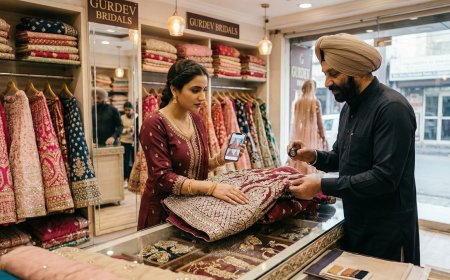
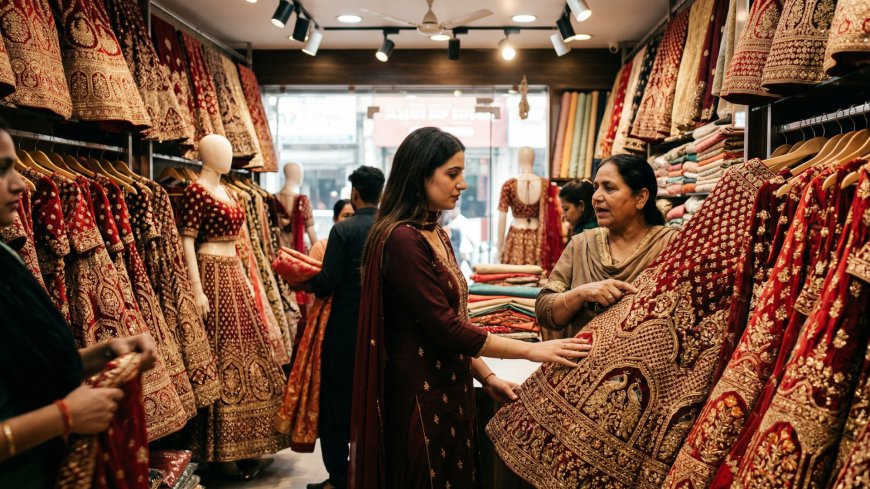
The bridal lehenga market in Jalandhar has undergone a specific transformation in the last three years whose primary driver is the boutique store model — the independently owned, design-conscious retail establishment whose product is sourced directly from the weaver and embroidery artisans whose work the Delhi designer market sells at a markup that the boutique's direct sourcing does not require.
The specific geography of this market in 2025 is concentrated in the Model Town and Jawahar Nagar areas, where a cluster of boutique stores has developed whose product range — the hand-embroidered lehenga, the phulkari-worked dupatta, the silk blouse whose fabric is Banarasi and whose tailoring is Jalandhar — is the product range that the NRI bride was previously making the Delhi trip to access.
The price differential between the Jalandhar boutique and the equivalent Delhi designer for comparable quality is the differential that the supply chain proximity produces. The lehenga whose embroidery is done in the same district as the boutique selling it, whose fabric is sourced by the boutique owner directly from the mill, whose tailoring is done by the in-house or contracted karigars whose work the boutique owner supervises — this lehenga costs, at the Jalandhar boutique, sixty to seventy percent of what the same work costs at the Delhi designer whose overhead, whose marketing, whose flagship store in a premium South Delhi market, and whose brand premium are embedded in the price.
What the Jalandhar boutique in 2025 does not offer is the specific social currency of the designer label — the name on the garment bag that communicates a specific message to the social context in which the garment is displayed. For the NRI bride for whom this label currency is a genuine priority, the Delhi trip remains necessary for the specific purchase of the social signal rather than the garment. For the NRI bride whose priority is the garment — its quality, its craft, its fit, its cultural specificity — the 2025 Jalandhar market is the market that the Delhi market was previously the only way to access.
The specific stores whose product the comparison's research identifies as the benchmark for the 2025 Jalandhar bridal wear market are concentrated in the streets between Nehru Garden and Burlton Park, and their identification — specific names, specific product strengths, specific price ranges — is the research that the local wedding coordinator or the family network's current knowledge produces more reliably than any published list whose currency date is uncertain.
Category Two: Phulkari — The Purchase That Only Makes Sense Here
There is one category in the NRI Punjabi wedding shopping list whose purchase in Jalandhar is not a matter of value comparison or market sophistication assessment. It is a matter of source authenticity that no other market can provide, and whose understanding changes the shopping itinerary's logic more fundamentally than any other single insight.
Phulkari — the embroidery tradition of Punjab whose name means "flower work" and whose actual visual register ranges from the dense, all-over bagh whose surface is entirely covered with silk thread embroidery to the lighter, more dispersed phulkari whose floral motifs float on the khaddar ground — is Punjab's specific textile contribution to the Indian craft tradition. It is the embroidery that the Punjabi bride's mother and grandmother and great-grandmother made and wore and passed down. It is the dupatta that the anand karaj photographs hold. It is the textile object that the Punjabi diaspora carries to Brampton and Birmingham as the specific portable piece of cultural homeland that the phulkari represents.
The phulkari sold in Delhi's craft markets, in the boutiques of Khan Market and the stalls of Dilli Haat, is Punjabi phulkari in the sense that it originates from the same craft tradition. The phulkari sold in Jalandhar in 2025, at the workshops and retail outlets whose production is done by the artisan communities whose families have been doing this specific work for generations, is Punjabi phulkari in the sense that it is made by the people for whom this is not a craft market product but a living inheritance.
The practical difference between these two sources is visible in three specific dimensions. The first is the range — the Jalandhar market's phulkari range, from the antique pieces whose age and condition require the specialist knowledge to assess correctly, to the contemporary production phulkari whose price reflects the current artisan labour market, to the custom-commission phulkari whose design and size can be specified for the specific wedding use, is a range that no Delhi retail outlet can match. The second is the price, which at the Jalandhar source is consistently below the Delhi retail price for comparable work by twenty to forty percent. The third is the knowledge — the phulkari seller in Jalandhar who has been selling phulkari for thirty years knows the difference between the machine-embroidered phulkari whose thread work mimics the hand-embroidered original and the genuine hand work whose back is as finished as its face, and will tell you which is which because their reputation in a market where the same families return across generations depends on this honesty.
For the NRI bride whose wedding shopping list includes any phulkari purchase — the bridal dupatta, the mother's shawl, the decorative pieces for the venue, the gift items for the diaspora guests whose wedding favour is the specifically Punjabi textile object — the Jalandhar market in 2025 is not one option among many. It is the source, and the source is where the purchase belongs.
Category Three: Jewellery — The Market That Has Professionalised
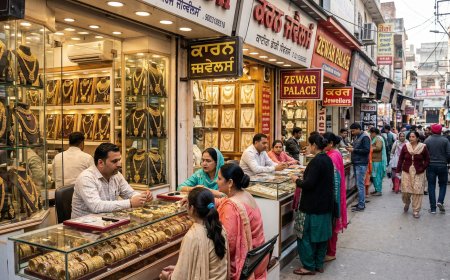
The Jalandhar jewellery market's evolution in the direction of the NRI customer is one of the most specific and legible changes in the city's wedding shopping landscape between 2018 and 2025. The market has always had the karigars whose skill produced the heavy gold Punjabi bridal set that the tradition requires. What it has added in this period is the retail infrastructure — the presentation, the certification, the documentation, the customer service protocols — that the NRI customer's purchasing experience and expectations require.
The BIS hallmarking system's mandatory extension, combined with the increasing consumer awareness among NRI buyers whose international consumption experience has made certification a baseline expectation rather than a premium feature, has pushed the Jalandhar jewellery market's established shops to formalise practices that were previously informal. The invoice that specifies gold weight per piece, purity, making charge breakdown, and stone details — the document that the Canadian or UK insurance market requires for the bridal jewellery valuation — is now a standard output of the established Jalandhar jeweller's transaction rather than the special request it required as recently as five years ago.
The design vocabulary of the Jalandhar jewellery market in 2025 has also expanded in response to the NRI customer's aesthetic range, which includes the traditional Punjabi bridal forms but also includes the lighter, more contemporary gold jewellery whose design references are international rather than regional. The established shops whose primary expertise is the traditional heavy gold set have, in many cases, added design capability in the contemporary direction — the younger family member who studied design, the collaboration with the artisan community whose work ranges more broadly, the catalogue whose pages include both the haar that the grandmother wore and the delicate layered set that the bride wants for the reception evening.
What has not changed, and should not be expected to change, is the Jalandhar market's specific excellence in the traditional Punjabi forms. The nath, the jhumki, the payal, the tikka — these are the pieces that the Jalandhar karigar makes as the native speaker of the design language rather than the student, and whose purchase in Jalandhar in 2025 remains the purchase that delivers the best combination of craft quality, cultural authenticity, and value in the Indian jewellery market.
Category Four: The Trousseau — Bedding, Home Textiles, and Household Items
The trousseau category — the bedding, the home textiles, the embroidered linen, the household items that the Punjabi bride's family assembles as the material provision for the new household — is the category that the NRI shopping itinerary most consistently underestimates in terms of the Jalandhar market's specific strength and the value differential it represents.
Jalandhar is the city that produces a significant proportion of the textile goods — the embroidered bedsheets, the phulkari cushion covers, the woven table linens, the decorative household textiles — that are sold in the retail markets of Delhi and Mumbai and exported to the diaspora retail stores in Brampton and Southall and Parramatta. The NRI bride who purchases the embroidered bedsheet set in a Toronto South Asian goods store is purchasing something that was, in significant probability, made in or near Jalandhar and whose journey from production to Toronto retail has added a cost multiple that the Jalandhar source price does not contain.
The trousseau shopping in Jalandhar in 2025, at the wholesale-adjacent markets in the Focal Point industrial area and the retail shops of the city's main commercial streets, produces a quantity and quality of household textile goods at a price that the NRI bride who has priced the equivalent in the diaspora retail market will find startlingly different. The difference is the supply chain. The Jalandhar source price for a hand-embroidered bedsheet set whose equivalent in Toronto costs four hundred Canadian dollars is approximately five to eight thousand rupees — roughly fifty-five to eighty-five Canadian dollars at current exchange rates. The difference is not the quality. The difference is the journey the product has not yet made.
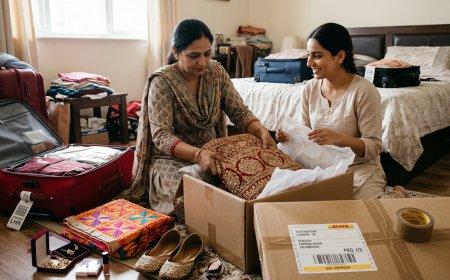
The practical management of the trousseau shopping in this category requires the specific logistics planning that the volume of purchase produces — the weight and dimension considerations of carrying textile goods on the return flight, the customs declaration implications of a purchase quantity that exceeds the duty-free allowance, and the alternatives of international shipping whose cost and reliability the coordinator or the shop owner can advise on. These logistics are manageable. They are not reasons to not make the purchase. They are the reasons to plan the purchase before the shopping rather than after it.
Category Five: Wedding Cards, Invitations, and Stationery
The wedding invitation in the Punjabi tradition is not stationery in the sense that the word implies functional information delivery. It is the first communication of the wedding's register — its scale, its cultural character, its family's social positioning — and it is an object whose design, material, and finish are read by the recipient as the announcement whose content precedes the wedding event.
The Jalandhar printing and stationery market in 2025 is one of the most directly evolved in response to the NRI customer's specific requirements, and its evolution has produced a market whose product range — from the traditional boxed invitation with the multiple inner cards and the specific layering of information that the Punjabi wedding card tradition requires, to the contemporary minimalist designs whose aesthetic vocabulary is more influenced by international wedding stationery than by the traditional form, to the fully customised production whose design brief can be managed remotely and whose print run can be shipped to the NRI family's country of residence — is a range that the 2025 market delivers at a quality and price point that the comparative research consistently favours over the Delhi or Mumbai alternatives.
The specific advantage of the Jalandhar invitation market for the NRI family is the combination of the Punjabi wedding stationery tradition's native understanding — the hierarchy of the invitation's information, the specific text conventions of the Punjabi wedding announcement, the design vocabulary that reads correctly to the Jalandhar-based recipient whose reading of the card is part of the communication — with the modern production capabilities that offset printing, digital finishing, and premium materials access has made available to the Jalandhar market in ways that were not present a decade ago.
The price differential between Jalandhar invitation printing and equivalent Delhi printing for a run of three hundred to five hundred cards with the premium materials and finish that the NRI destination wedding requires is approximately thirty to forty percent in Jalandhar's favour. The quality differential, at the premium end of the Jalandhar market, is negligible to the naked eye and only visible under the specific examination that the print quality comparison requires.
What the 2025 NRI Shopping Itinerary Actually Looks Like
The NRI bride who approaches the 2025 Jalandhar wedding shopping market with the updated understanding that this article provides — rather than the fixed image of the previous decade — builds a different itinerary from the one that was written on the plane over Greenland.
The itinerary begins, before the departure from Brampton or Birmingham, with the specific research that the 2025 market rewards — the identification of the specific boutiques, jewellers, phulkari workshops, and invitation printers whose product has been verified by recent NRI visitors whose reviews exist in the specific social networks — the WhatsApp groups, the NRI wedding planning forums, the community Facebook groups — where the current market knowledge lives. This research is the preparation that converts the seven Jalandhar shopping days from an undirected exploration into a directed campaign whose outcome is determinable rather than hopeful.
The first two days are the market orientation days — the walks through the relevant commercial areas whose specific geography the research has identified, the conversations with the shops whose product is the target category, the preliminary quotations whose comparison the following days will use as the reference. These days are not buying days. They are the days that make the buying days efficient.
The middle three days are the serious shopping days — the return visits to the shops whose preliminary quotations and product quality have passed the first-round assessment, the negotiation whose preparation the market orientation days have enabled, the final selections whose decision is made with the specific knowledge that three days of market immersion has produced. These are the days that require the energy, the focus, and the willingness to make decisions under the specific conditions of the Jalandhar market — the family member's opinion, the shop owner's counter-argument, the comparison piece that the next shop has produced — without the paralysis that too many good options in a concentrated time produces.
The final two days are the collection and logistics days — the pickup of the custom orders whose production timeline the middle three days' purchases have set, the packing and weight management whose coordination the volume of purchase requires, the documentation whose completeness — the invoices, the hallmarking certificates, the receipt records — the return journey and the customs declaration will need.
The Price of Staying Seven Days
Navjot had stayed seven days. She had not gone to Delhi.
She had found the lehenga at the boutique in Model Town whose owner had trained in Delhi and returned to Jalandhar because the rent was different and the supply chain was better and the customers who were coming were the customers whose money was real and whose appreciation for the work was genuine. The lehenga was hand-embroidered. The fabric was from a mill in Amritsar. The price was sixty-two percent of the Delhi boutique whose Instagram the lehenga's aesthetic most closely resembled.
She had found the phulkari at the workshop whose address her nani had given her and whose proprietor had been selling phulkari since before Navjot's mother was born. The dupatta was the dupatta that the anand karaj photographs would hold for the three generations who would look at them. The proprietor had shown her the back of the piece, which was as finished as the face, and had said: this is how you know.
She had found the jewellery at the family jeweller whose relationship was measured in decades and whose making charge was nine percent and whose knowledge of what a Punjabi bridal set should weigh was the knowledge of a craftsperson for whom this was not an aesthetic judgment but a technical specification inherited from a tradition that knew what it was doing.
She had found the invitations at the printer on Lajpat Nagar Extension who had done her parents' wedding invitations twenty-seven years earlier and who had shown her the samples from the NRI weddings he had printed that season with the specific pride of someone who knows that the product is good and is glad to have the chance to demonstrate it.
The seventeen-item list had been completed. Twelve of the seventeen items had been completed in Jalandhar. Three had been completed in Amritsar, which is forty-five minutes from Jalandhar and which has its own specific textile and craft market whose proximity to Jalandhar makes it a practical extension of the Jalandhar shopping itinerary rather than a separate destination. Two items — the destination wedding photographer and the international floral designer whose brief was specific enough to require the video call rather than the market visit — had been managed remotely.
Delhi had not been necessary.
On the return flight over Greenland, Navjot had opened the Notes app and written: tell everyone the assumption is wrong. Jalandhar in 2025 is not the Jalandhar of ten years ago. The nani was right. Start there. See what you find.
She had added, after a pause: eat the paratha slowly.
The Practical Guide: What to Know Before You Go
The NRI bride whose updated itinerary now allocates serious shopping time to Jalandhar needs the specific practical knowledge that makes the seven days productive rather than merely present.
Timing within the year. The Jalandhar wedding shopping market is at its most complete and most competitive between October and February — the peak wedding season whose demand concentrates the market's best product and most responsive vendors. The off-season visit — the summer trip whose primary purpose is family and whose secondary purpose is preliminary shopping research — is the preparation trip rather than the buying trip, and its value is in the market orientation and the preliminary conversations whose relationship foundation makes the October return visit more productive.
The coordinator as shopping guide. The Jalandhar wedding coordinator whose primary role is the event planning is also the person whose knowledge of the 2025 shopping market — the specific boutiques, the specific jewellers, the specific phulkari workshops whose product is currently exceptional — is the navigation tool that converts the general market knowledge into the specific visit list. The coordinator whose NRI wedding practice is current will have this knowledge because the NRI families whose weddings they manage are the families whose shopping questions they answer every season.
The family network as research tool. The Jalandhar-based family member whose social network includes the families who have recently completed NRI wedding shopping in the city is the research source whose currency is guaranteed by the proximity of the experience. The cousin who attended three weddings this season knows which decorator's phulkari backdrop was made from genuinely good stock and which was made from the cheap printed substitute. The maasi whose neighbour bought the bridal lehenga in Model Town knows whether the boutique's customer service survived the fitting process. This network knowledge is the knowledge that no published guide can provide with the currency that the social network provides.
The budget allocation shift. The NRI bride who shifts budget from the Delhi leg of the shopping itinerary to the Jalandhar leg — who allocates the lehenga budget to a Jalandhar boutique rather than a Delhi designer, who allocates the trousseau budget to the Jalandhar wholesale market rather than the diaspora retail store — will find that the same budget produces more, and often better, than the allocation it was originally designed to fund. The reallocation is not a compromise. It is the application of the market knowledge that the 2025 reality supports.
A Note on What Jalandhar Still Does Not Do Best
The honest 2025 assessment of the Jalandhar wedding shopping market includes the acknowledgment of the categories where the Delhi or Mumbai market remains the superior option, because the assessment whose conclusion is "Jalandhar for everything" is the assessment that the evidence does not support and that the NRI bride who follows it will find corrected by experience.
The high-fashion bridal wear whose value is the designer label and whose social currency is the specific name is still most efficiently and authentically purchased in Delhi or Mumbai, where the designer's own retail presence or the authorised multi-brand store provides the genuine article and the genuine label whose reproduction Jalandhar boutiques do not attempt. For the bride whose wedding wear brief includes a specific designer whose name is part of the brief, the designer's city is the correct destination.
The contemporary fine jewellery — the diamond sets, the white gold pieces, the jewellery whose aesthetic reference is international rather than specifically Punjabi — is better served by the metropolitan markets whose access to the international cutting and setting standards that this category requires is more established than the Jalandhar market's access to the same supply chain. The traditional Punjabi gold set belongs in Jalandhar. The contemporary diamond solitaire belongs in Mumbai or Delhi.
The specialist beauty services — the bridal makeup artists whose work the NRI bride has identified by name from Instagram portfolios whose quality is specific and whose booking in Jalandhar requires the same advance timeline as the venue — are a category where the individual artist's quality matters more than the city, and where the 2025 Jalandhar market has good options and occasional gaps that the research identifies but the generalisation cannot resolve.
What the Nani Already Knew
The knowledge that Navjot's nani had was not the knowledge of the 2025 Jalandhar market, which is the knowledge that this article has assembled. It was the older and more fundamental knowledge that the source is always closer to what you are looking for than the market that sells you the source's product at the source's distance plus the distance the product has travelled.
The phulkari in the Southall store is Punjab's phulkari. It is not Punjab. The lehenga in the Brampton designer boutique is Jalandhar's embroidery. It is not Jalandhar. The gold in the Delhi shop is Punjab's gold. It is not Punjab's goldsmith, whose hands made it, whose family has been making it since the karigars came from Lahore with everything they knew.
The 2025 argument for Jalandhar as the NRI Punjabi wedding shopping destination is the argument that the market has evolved to meet the buyer who is finally willing to look. The coordination is better. The quality is verified. The prices reflect the supply chain advantage that proximity to the source has always represented.
But the deeper argument — the one that the nani made without statistics or market research or supply chain analysis — is the argument about what the purchase means when it is made in the place where the thing was made and by the people who made it, for the wedding that will happen in the same place, among the community for whom these objects are not products but the specific material language of an inheritance that the diaspora carries and the homeland keeps.
The market has caught up to this argument. The 2025 itinerary reflects it.
Start in Jalandhar.
See what you find.
Published by NRIWedding.com — The Premium Global Platform for Non-Resident Indians Planning Indian Weddings From Abroad.
For the complete 2025 Jalandhar wedding shopping guide, vendor recommendations, and coordinator referrals, visit nriwedding.com.
What's Your Reaction?
 Like
0
Like
0
 Dislike
0
Dislike
0
 Love
0
Love
0
 Funny
0
Funny
0
 Angry
0
Angry
0
 Sad
0
Sad
0
 Wow
0
Wow
0