





































































Jalandhar vs Chandigarh vs Delhi for NRI Wedding Shopping — The Definitive Punjabi Diaspora Guide
For Punjabi brides planning weddings from Canada, the UK, Australia, or the United States, choosing where to shop in India is often the first strategic decision of the entire wedding preparation process. Family members may recommend different cities based on their own experiences. Some insist that Jalandhar remains the heart of Punjabi wedding shopping, with its textile markets, jewellery lanes, and deep connections to the diaspora community. Others argue that Chandigarh’s boutiques offer a more contemporary and design-focused bridal experience, while Delhi supporters point to the vast scale and luxury couture options of the capital’s famous wedding markets. Each of these positions contains some truth. The challenge for the NRI bride is that the question is rarely about choosing one city over the others. Instead, it is about understanding which specific categories of wedding shopping are best served in each location, and how to structure a practical itinerary that allows those strengths to be used effectively. This guide provides a clear, category-by-category comparison of Jalandhar, Chandigarh, and Delhi for bridal lehengas, jewellery, textiles, contemporary outfits, accessories, and remote shopping capability. It also explains how Punjabi diaspora brides can design a hybrid shopping strategy that combines the strengths of multiple cities while avoiding unnecessary travel, confusion, and wasted time during a short India visit. For NRI brides planning a wedding trip that may last only a week or ten days, knowing which city is best for each purchase category can transform the entire shopping experience.


Jalandhar vs Chandigarh vs Delhi for NRI Wedding Shopping — The Definitive Punjabi Diaspora Guide
The family had been having the argument for three months. Not a destructive argument — the kind that produces heat without light, that circles the same positions without advancing — but the productive kind, the kind where each party has genuinely different information and genuinely different experience and the argument is actually a negotiation toward the right answer rather than a performance of entrenched positions. Sukhpreet's mother was for Jalandhar. Her mother-in-law was for Chandigarh. Her maid of honour — a Punjabi woman who had grown up in New Delhi and who had opinions about everything, including the relative merits of Indian wedding shopping cities, that she expressed with the cheerful authority of someone who has never been wrong enough times to become cautious — was for Delhi.
Sukhpreet was in Toronto, where she had been living for seven years and where she had built a career in corporate law that had trained her, among other things, to assess competing arguments on their merits rather than their emotional force. She had listened to all three positions across three months of planning conversations. She had found that each position was correct in the ways its advocate believed it was correct, and that none of the three advocates had the full picture — because the full picture required knowing not just which city had the best market in the abstract, but which city had the best market for the specific brief that Sukhpreet had, at the specific budget she was working with, within the specific constraints of the eight-day India trip that her law firm's leave policy would accommodate.
She had spent a Sunday assembling the comparative analysis that the three-month argument had not produced. She had mapped each city against her specific brief — the bridal lehenga, the jewellery, the family coordination, the budget, the remote shopping requirements, the timeline. She had looked at each city not as a general wedding shopping destination but as the specific answer or non-answer to her specific question.
The analysis had taken four hours. It had produced a conclusion that surprised her — not because the conclusion was counterintuitive but because it was a hybrid, and hybrids are rarely the conclusion that anyone arguing for a single position is prepared to accept. The conclusion was that the three-month argument had been asking the wrong question. The question was not which city was best. The question was which category belonged in which city, and whether the eight-day trip could accommodate the hybrid approach that the category analysis produced.
It could. With planning, it could.
This article is for Sukhpreet — and for every NRI bride from the Punjabi diaspora who is facing the city choice question and who deserves the complete, specific, evidence-based comparison of what Jalandhar, Chandigarh, and Delhi actually offer, category by category, and the framework for deciding which city or which combination of cities serves their specific brief.
The Three Cities — Their Identities and What Shapes Them
The Jalandhar versus Chandigarh versus Delhi comparison cannot be made usefully without first understanding the distinct commercial identities of the three cities — not their general cultural character, but the specific economic and commercial history that has shaped their wedding shopping markets into what they are today.
Jalandhar is a manufacturing and diaspora city. Its commercial identity has been formed by the intersection of two forces: the industrial textile and garment manufacturing base that gives the city its production capacity, and the extraordinary density of its diaspora connections — the NRI families from the UK, Canada, Australia, and the United States who have been shopping this market for generations and whose presence has shaped the vendor community's knowledge, service model, and aesthetic vocabulary. The Jalandhar market knows the NRI bride. It has been serving her mother, her aunt, and her grandmother before her. The specific capabilities that the NRI remote purchase requires — the video call fitting, the measurement chart management, the international shipping protocol, the aesthetic sensitivity to what the globally located Indian professional wants rather than what the domestic market produces — are not innovations in Jalandhar. They are the established practice of a market that has been oriented toward this customer profile for decades.
Chandigarh is a planned city with a planned city's specific commercial character. Its wedding shopping market has developed in the context of a well-educated, well-travelled professional class — the city's residents are among the most prosperous in Punjab, with a per-capita income and a consumer sophistication that shapes the commercial offering accordingly. The Chandigarh market is not manufacturing-adjacent in the way Jalandhar's is. It is retail-sophisticated — the boutiques of Sector 8, Sector 17, and the newer commercial developments of the city cater to a customer who has been to the Delhi boutiques, who has shopped internationally, and who is not easily impressed by the standard bridal fare. This customer profile has produced a Chandigarh market with a specific strength in the contemporary, design-forward, and internationally-aware bridal categories — the market where the NRI bride whose aesthetic has been shaped by London or Toronto will find pieces that reflect that aesthetic education rather than pieces designed for a more traditional brief.
Delhi is the national capital of wedding shopping. Its market is not the most affordable — it is not even close to the most affordable — but it is the most comprehensive, the most design-forward at the top end, and the most varied across every quality and price tier. The Delhi bridal market encompasses everything from the couture ateliers of South Extension and Greater Kailash whose waiting lists extend to the next wedding season to the wholesale fabric markets of Chandni Chowk whose prices approach the manufacturing rate and whose selection is unmatched in the country. Delhi is the city where any brief — any aesthetic, any budget at the higher end, any design vision — can be realised, if the buyer has the time, the local knowledge, and the navigational capacity to access the specific part of the market that serves the specific brief.
The Bridal Lehenga — City by City
The bridal lehenga comparison across the three cities is the most significant individual category in the analysis, because it is the primary purchase decision and because the three cities offer genuinely different propositions at different price points and for different aesthetic briefs.
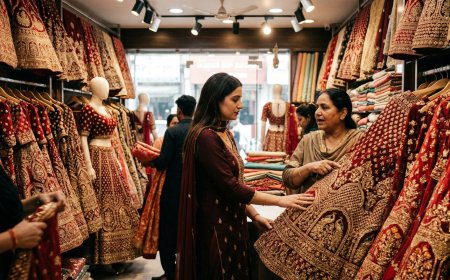
Jalandhar's bridal lehenga market has been covered comprehensively in the guides that precede this one in the series. Its strength is in the mid-to-upper price range — the fifty to eighty thousand rupee bridal lehenga at the quality boutiques of Model Town, where the NRI service infrastructure is well-developed and the craft quality is genuinely excellent. The Jalandhar market's specific advantage for the bridal lehenga is the combination of quality and NRI-specific service — the vendor who knows how to manage the remote purchase, who has the measurement protocol in place, who has the international shipping infrastructure established. For the NRI bride whose lehenga brief sits in the mid-range budget and whose aesthetic is in the heavily embellished north Indian bridal tradition, Jalandhar is the most efficient and most reliable market.
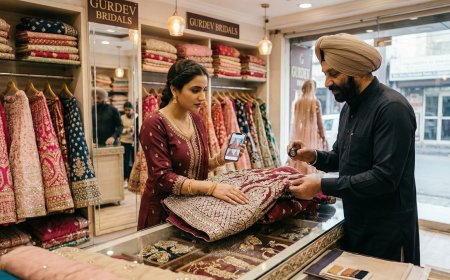
Chandigarh's bridal lehenga market has a different character. The city's boutiques have developed a specific aesthetic vocabulary that leans toward the cleaner, lighter, more contemporary interpretation of the bridal lehenga — less of the maximally embellished traditional piece and more of the considered, restrained embellishment on quality fabric that the Chandigarh professional bride and the NRI bride with a contemporary aesthetic are drawn to. The price range at the better Chandigarh boutiques sits slightly above Jalandhar for comparable construction quality — the city's higher commercial overheads are reflected in the pricing — but the design investment at the better Chandigarh boutiques is genuinely different and genuinely attractive for the bride whose aesthetic sits outside the traditional Jalandhar bridal vocabulary.
The specific Chandigarh advantage for the bridal lehenga is in the design sophistication — the boutiques of Sector 8 and the newer commercial areas carry pieces that have been designed with the internationally aware bride in mind, that reflect a design sensibility shaped by a professional customer who follows international bridal fashion and whose brief is not the traditional Punjabi bridal look but something more considered and more individual. For this specific brief, Chandigarh's market has a depth and quality that Jalandhar does not match.
Delhi's bridal lehenga market is the most comprehensive of the three cities, covering every price point from the wholesale-adjacent markets of Chandni Chowk to the couture houses of South Extension that charge from two lakhs upward for their flagship commissions. The specific Delhi advantage is at the extremes of the range — the budget buyer who has the time and local knowledge to navigate Chandni Chowk will find fabric and construction options that undercut the Jalandhar mid-range boutique at comparable quality, and the budget-unconstrained bride who wants a piece from one of Delhi's established designers will find no equivalent in Jalandhar or Chandigarh. The middle of the Delhi range — the boutiques of Greater Kailash and the independent designers of Lajpat Nagar in Delhi — offers quality and price points comparable to Jalandhar but without the NRI-specific service infrastructure that the Jalandhar market has built.
For the NRI bride specifically, the Delhi mid-range is less accessible than the Jalandhar mid-range because the support infrastructure — the vendor's familiarity with the remote purchase process, the established measurement protocol, the international shipping arrangement — is less consistently available. The Delhi vendor who serves the domestic professional bride primarily and whose NRI client volume is low has not built the specific service capabilities that the Jalandhar vendor has developed over decades of NRI-primary clientele.
The Jewellery Comparison — The Category That Most Clearly Differentiates the Three Cities
The jewellery comparison across the three cities is the category where the differences are most pronounced and where the choice of city has the most direct financial and quality implications.
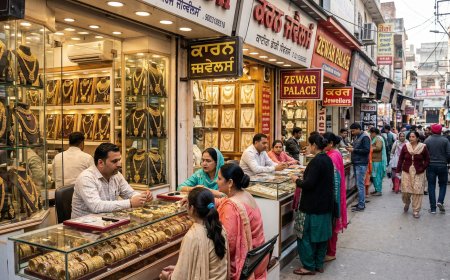
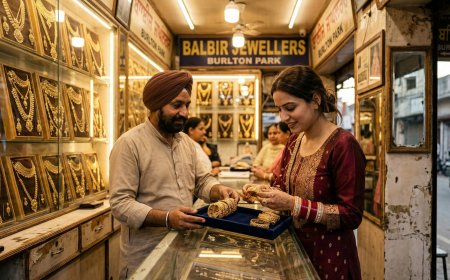
Jalandhar's jewellery market — the Lajpat Nagar jewellery lanes and the established jewellers of the older commercial areas — has been covered in the jewellery guide in this series. Its specific strength is in the Kundan and quality fashion jewellery categories, with exceptional value at the twenty-five to forty thousand rupee range for a complete bridal set. The NRI-specific service awareness of the Jalandhar jewellery market — the vendor who conducts the video call assessment with the quality indicators the remote buyer needs, who manages the international shipping with the hallmark documentation required — makes it the most accessible market for the NRI bride who is purchasing remotely.
Chandigarh's jewellery market has a different strength profile. The city's jewellery sector is dominated by the established gold jewellers of Sector 17 and Sector 22 — the large, reputable jewellery houses that have been serving Chandigarh's professional class for decades and that offer genuine gold and high-quality Kundan at prices that reflect the city's premium commercial environment. The specific Chandigarh advantage in jewellery is in the genuine gold category — the city's jewellery houses have the BIS hallmarking infrastructure, the weight transparency, and the design range that the NRI bride whose family tradition requires real gold will find reassuring. The price premium relative to Jalandhar is real — Chandigarh's gold jewellery prices are five to twelve percent above Jalandhar's for comparable pieces — but the service and presentation standard at the better Chandigarh jewellers is also genuinely higher.
Delhi's jewellery market is the most diverse and the most extreme in its range. The Karol Bagh jewellery market is one of the largest and most comprehensive gold jewellery markets in India — the range of designs, the depth of stock, and the price competitiveness at the wholesale-adjacent level are unmatched by any Punjab market. For the NRI bride with a significant real gold jewellery budget and the local knowledge to navigate Karol Bagh effectively, the Delhi jewellery market represents the best combination of range and value at the higher budget levels. The specific challenge is the navigation — Karol Bagh requires market knowledge and local contacts to access its genuine value, and the NRI bride without these assets will find the market overwhelming rather than productive.
Contemporary and Fusion Wear — Where Chandigarh Leads
The contemporary and fusion occasion wear category is the one where the city ranking diverges most clearly from the traditional bridal category comparison, and where Chandigarh's market position is strongest relative to both Jalandhar and Delhi.
Chandigarh's boutique market for contemporary Indian occasion wear — the fusion lehengas, the Indo-Western pieces, the concept sarees, the reception gowns in contemporary silhouettes — has developed in direct response to the city's sophisticated professional consumer base. The Chandigarh woman who shops for her wedding outfit has been to London, has followed international fashion, and expects the boutique market to reflect this aesthetic education. The boutiques that have developed to serve her have built a design vocabulary that is more contemporary, more internationally influenced, and more responsive to the aesthetic sensibility that the NRI bride also brings to her shopping brief.
For the NRI bride whose primary brief is in the contemporary and fusion categories — the sangeet outfit that should feel fashion-forward, the reception second look that is a genuine Indo-Western hybrid, the concept saree that sits at the intersection of traditional form and contemporary construction — Chandigarh's market has a depth and sophistication that Jalandhar's boutique market, which skews more toward the traditional bridal vocabulary, does not consistently match.
Delhi's contemporary occasion wear market is the most sophisticated nationally — the designers of Mehrauli and the contemporary boutiques of Select Citywalk and Khan Market produce work at the cutting edge of Indian occasion wear design. But the Delhi contemporary market operates at a price point that makes it inaccessible for most NRI brides at the mid-range budget, and the navigation complexity of accessing the right part of the Delhi market for contemporary occasion wear is significant.
Wholesale and Volume Purchases — The City That Wins on Price
The wholesale fabric, family coordination, and volume purchase categories are where the city comparison produces its clearest winner and where the recommendation is most specific.
Delhi's Chandni Chowk is the national standard for wholesale fabric pricing in India. The sheer scale of the market, the proximity of fabric manufacturing supply chains, and the intensity of the competition among the thousands of fabric houses that operate in the Chandni Chowk geography produce prices that are consistently below the Jalandhar and Chandigarh wholesale markets for comparable quality. The NRI family that has a large volume fabric requirement — the wedding favour fabric for two hundred guests, the coordination fabric for forty family members — and that has the time, the local contacts, and the logistical capacity to navigate Chandni Chowk will find that the Delhi fabric market represents significant savings at scale.
The challenge is the navigation. Chandni Chowk is vast, dense, and requires specific market knowledge to access its genuine value rather than its tourist-facing surface. The NRI family without a Delhi local guide will find Chandni Chowk overwhelming rather than productive, and the time cost of navigating without direction is significant enough to offset the price advantage for families with a compressed India visit window.
Jalandhar's wholesale fabric market is more accessible than Delhi's for the NRI family without Delhi local contacts, and while its prices are not at the Chandni Chowk level, they are competitive with the Chandigarh market and accessible through the navigation infrastructure that the NRI community's Jalandhar connections provide.
Chandigarh's wholesale market is the least developed of the three cities — the city's commercial identity is retail rather than wholesale, and the fabric market does not have the depth or the price competitiveness of either Jalandhar or Delhi for volume purchases.
The Remote Shopping Comparison — The Variable That Matters Most for the NRI Bride
The remote shopping capability comparison across the three cities is the analysis variable that most specifically serves the NRI bride's actual situation — the bride who is managing the purchase from Toronto across a ten and a half hour time difference and who needs the vendor community to have the specific capabilities that remote purchase management requires.
Jalandhar wins this comparison decisively and across every category. The Jalandhar vendor community's NRI orientation — the decades of service to the diaspora customer, the established video call fitting protocols, the WhatsApp measurement management, the international shipping infrastructure — produces a remote shopping capability that neither Chandigarh nor Delhi matches as a systematic market characteristic. In Jalandhar, the NRI remote purchase capability is the market norm. In Chandigarh and Delhi, it is the exception — available at specific vendors who have specifically oriented their practice toward the NRI market, but not the default expectation of the vendor community as a whole.
The Chandigarh market has individual vendors — particularly in the boutique sector — who serve the NRI market effectively and whose remote purchase capabilities are well-developed. But these are individual vendor capabilities rather than market-wide norms, and identifying them requires the specific research that the Jalandhar market does not require because the NRI-capable vendor is the standard rather than the exception.
The Delhi market has, at the premium boutique level, vendors whose NRI client volumes are significant and whose remote purchase capabilities are accordingly well-developed. But the Delhi premium boutique operates at a price point that exceeds the mid-range budget of the typical NRI bride, and the mid-range Delhi market's NRI remote purchase capability is inconsistent.
The Table: Jalandhar vs Chandigarh vs Delhi — The Definitive Category Comparison
| Category | Jalandhar | Chandigarh | Delhi | Winner | Notes |
|---|---|---|---|---|---|
| Bridal Lehenga (mid-range, ₹50–80k) | Excellent — NRI-aware boutiques | Good — design-forward | Good — navigation complex | Jalandhar | Best combination of quality, price and NRI service |
| Bridal Lehenga (contemporary/fusion) | Good | Excellent — design sophistication | Excellent — premium only | Chandigarh for mid-range; Delhi for premium | Design vocabulary stronger in Chandigarh |
| Bridal Lehenga (budget, under ₹40k) | Good — fabric-and-tailor route | Limited | Excellent — Chandni Chowk | Delhi (with local guide) | Requires Delhi navigation capability |
| Real Gold Jewellery | Good — honest market | Excellent — reputable houses | Excellent — Karol Bagh | Delhi for volume; Chandigarh for service | Price advantage at Delhi with local knowledge |
| Kundan / Fashion Jewellery | Excellent — Lajpat Nagar | Good | Good | Jalandhar | Best combination of quality, value and NRI service |
| Phulkari and Handcraft | Excellent — Basti Sheikh | Limited | Limited | Jalandhar — no contest | Manufacturing tradition is Jalandhar-specific |
| Wholesale Fabric (volume) | Good | Limited | Excellent — Chandni Chowk | Delhi (with local guide) | Jalandhar second for NRI without Delhi contacts |
| Contemporary Occasion Wear | Good | Excellent | Excellent — premium only | Chandigarh for mid-range | Design sophistication advantage |
| Remote Shopping Capability | Excellent — market norm | Moderate — vendor specific | Moderate — premium only | Jalandhar — decisively | Decades of NRI orientation produce market-wide capability |
| Men's Wedding Wear | Good | Good | Excellent — full range | Delhi for full range; Jalandhar for efficiency | All three adequate for standard brief |
| Accessories (potli, mojdis) | Excellent — Lajpat Nagar | Good | Good | Jalandhar | Market depth and NRI service advantage |
| Family Coordination Fabric | Good | Limited | Excellent — scale | Delhi (with guide); Jalandhar (without) | Navigation determines Delhi's advantage |
| Budget Bridal (total under ₹80k) | Excellent | Limited | Good — complex navigation | Jalandhar | NRI service infrastructure critical at tight budget |
| Premium Bridal (total over ₹3 lakh) | Limited | Good | Excellent | Delhi — no contest | National couture market is Delhi |
| NRI First-Time Visitor | Excellent | Good | Limited without guide | Jalandhar — clearly | NRI infrastructure reduces navigation burden |
The Practical Logistics — What It Takes to Shop Each City
The logistics of shopping each city are a significant component of the city choice analysis for the NRI bride with a compressed India visit, and they require specific attention because the logistical demands of each city are genuinely different and the differences have material consequences for the bride who is managing an eight-day trip.
Jalandhar is the most logistically efficient city for the NRI bride shopping a focused bridal wardrobe. The primary shopping geography — Model Town, Lajpat Nagar, the associated market areas — is compact enough to be navigated without a car for the connected visits, and the NRI-oriented vendor community means that the boutique appointments can be structured efficiently because the vendors are accustomed to managing their NRI clients' time constraints. The accommodation options in Jalandhar that are convenient for the shopping geography are adequate and accessible. The Amritsar airport, the closest international entry point, is approximately sixty kilometres from the city and the road journey is manageable.
Chandigarh is the most comfortable city to stay in of the three, with the infrastructure, the hotel quality, and the general livability that the planned city model produces. The shopping geography is more dispersed than Jalandhar — the boutiques of Sector 8, the jewellery of Sector 17, the fabric market of Sector 26 — and cross-city movement requires a vehicle and an understanding of the city's sector-based navigation system. For the NRI bride who is staying in Chandigarh and shopping Chandigarh, the shopping trip is efficient. The bride who is shuttling between Jalandhar and Chandigarh across a single trip — the hybrid approach — adds the sixty-kilometre road journey between the cities to the logistical load.
Delhi is the most logistically demanding of the three cities. The scale of the city — the distance between the Chandni Chowk fabric market and the South Extension boutiques, the traffic between the Karol Bagh jewellery market and the Lajpat Nagar Delhi accessory market — requires a vehicle, a local guide, and significant time allocation for cross-city movement. The NRI bride who allocates a single day to Delhi in the context of a Punjab-based trip will find that the day's logistics consume a significant portion of its available shopping time. The Delhi component of the hybrid approach requires a minimum of three days and a local guide to justify the time and cost.
The Hybrid Strategy — The Definitive Recommendation
The city comparison that produces the most practically useful recommendation is not the single-city recommendation but the hybrid strategy — the allocation of specific categories to the city that genuinely serves them best, within the logistical constraints of the NRI bride's specific trip structure.
The standard Punjabi diaspora NRI bride's hybrid strategy, for an eight-to-ten day India trip with a Jalandhar base, is as follows. Jalandhar handles the bridal lehenga, the Kundan and fashion jewellery, the phulkari chope and handcraft, the accessories, the family coordination fabric, and all remote shopping requirements before and after the trip. Chandigarh handles any contemporary or fusion occasion wear brief that Jalandhar's market does not serve adequately — a half-day or full-day Chandigarh shopping visit for the sangeet outfit or the reception second look in the contemporary category. Delhi is included only if the real gold jewellery budget is significant, the wholesale fabric volume is large, or the bridal lehenga brief is specifically at the premium end that only Delhi's couture market serves.
For most NRI brides from the Punjabi diaspora — whose bridal brief sits in the mid-range, whose wedding is in Jalandhar or Punjab, and whose shopping trip is eight to ten days — the Jalandhar-primary hybrid with a single Chandigarh day for contemporary wear covers the brief comprehensively without the logistical complexity of a Delhi component. Delhi is justified only for the specific categories where its market genuinely excels over both Jalandhar and Chandigarh — the premium bridal commission, the significant gold jewellery purchase, the large-volume wholesale fabric.
The bride whose brief does not include these specific categories should not make the Delhi component of the trip a tourism obligation dressed as a shopping necessity. Delhi is a magnificent city. It is also a four-hour drive from Jalandhar or a one-hour flight, and the shopping category that justifies this journey in a compressed trip is the shopping category whose brief genuinely requires the Delhi market rather than the shopping category that makes the Delhi visit feel like a thorough approach.
Common Mistakes NRI Brides Make in the City Choice Decision
The first mistake is choosing the city based on where the family is from rather than where the brief is served. The Punjabi diaspora's geographic loyalty to Jalandhar is genuine and is built on real family connections and real market knowledge that the family network provides. But the specific brief — particularly if it includes contemporary occasion wear, significant gold jewellery, or premium bridal lehenga — may be better served by Chandigarh or Delhi for specific categories. The brief should drive the city allocation. The family geography should inform the navigation and the agent relationships within the city where the brief directs the shopping.
The second mistake is treating Delhi as the automatic premium choice for everything. Delhi is the best market for specific categories at specific budget levels — the premium bridal commission, the large-volume wholesale fabric, the Karol Bagh gold jewellery at significant budget. It is not the automatic improvement over Jalandhar for the mid-range bridal lehenga, the Kundan jewellery, or the NRI remote shopping categories where Jalandhar's market orientation provides a specific advantage. The automatic Delhi premium assumption leads the NRI bride to allocate trip time and budget to a city whose advantage for her specific brief is marginal while underinvesting in the Jalandhar market where her brief is better served.
The third mistake is underestimating the Delhi navigation requirement. The NRI bride who has been to Delhi as a tourist, who is comfortable in the city, and who has been told that the wedding shopping markets are extensive will arrive at Chandni Chowk or Karol Bagh without the specific market knowledge required to navigate them effectively and will spend a significant portion of the allocated shopping day orienting rather than purchasing. Delhi's markets reward the buyer with prior knowledge and penalise the buyer without it more severely than Jalandhar or Chandigarh, because the scale of the market makes the disorientation more expensive in time and energy.
The fourth mistake is not accounting for the travel time between cities in the trip itinerary. The Jalandhar-to-Chandigarh road journey is approximately sixty kilometres and takes between one and two hours depending on traffic. The Jalandhar-to-Delhi road journey is approximately three hundred kilometres and takes four to five hours. These are not negligible time costs in a compressed trip, and the hybrid strategy that includes both Chandigarh and Delhi visits within an eight-day trip needs to account for the travel days — the day whose primary content is the drive to Delhi rather than the shopping in it — in the itinerary planning.
The fifth mistake is trying to shop all three cities in a single trip without the itinerary structure that makes it viable. The NRI bride who decides to shop all three cities because each city has something she wants, without the specific category allocation and itinerary structure that determines what happens in which city on which day, will find the three-city trip producing fragmented, pressured shopping across three markets rather than the efficient, category-focused purchasing that each city's specific brief requires. The three-city hybrid works when it is planned. It fails when it is assembled optimistically without the planning that its complexity demands.
The Resolution
Sukhpreet's Sunday analysis produced a three-city allocation that she presented to her mother, her mother-in-law, and her maid of honour on the following weekend's video call — the call that had been scheduled, optimistically, as a planning meeting and that had been functioning, less optimistically, as a forum for the restatement of established positions.
She shared the table — the category-by-category comparison, the city allocations, the hybrid strategy recommendation. She explained the logic. The bridal lehenga was in Jalandhar because the brief was mid-range and the NRI service infrastructure was critical for the remote management before the trip. The sangeet outfit — the contemporary fusion piece that her brief specified — was in Chandigarh because the Chandigarh market's design vocabulary was better suited to what she wanted. The gold jewellery — her mother-in-law's family required real gold, the budget was adequate for it, and the Karol Bagh market in Delhi represented the best combination of range and price for the specific pieces — was in Delhi, which justified a single forty-eight-hour Delhi component at the end of the trip before the return flight from Indira Gandhi International.
Her mother, whose position had been Jalandhar for everything, was quiet for a moment and then said that the Chandigarh boutiques she had seen on a recent visit were genuinely very good for the contemporary pieces.
Her mother-in-law, whose position had been Chandigarh for everything, said that the Karol Bagh gold jewellers were indeed the best choice for the specific pieces her family tradition required.
Her maid of honour said: I told you Delhi.
Sukhpreet said: you told me Delhi for everything. I am going to Delhi for one category.
Her maid of honour considered this. Then she said: for that one category, you are correct.
The three-month argument concluded in approximately forty-five minutes. The hybrid strategy was confirmed. The itinerary was built the following week.
The city that won was not Jalandhar. It was not Chandigarh. It was not Delhi.
The city that won was the right city for the right category — which is the only answer to the city comparison that the NRI bride's specific brief actually requires and the only answer that the definitive guide can honestly produce.
Allocate by category, not by loyalty. The brief determines which city. The family geography determines the navigation infrastructure within that city. These are separate variables.
Use Jalandhar as the base for the NRI bride with a Punjab wedding and a mid-range brief. The NRI service infrastructure is the market advantage that no other city consistently replicates.
Add Chandigarh for the contemporary and fusion categories that Jalandhar's traditional bridal market does not serve with the same design depth.
Add Delhi only when the category brief genuinely requires it — the premium bridal commission, the significant gold jewellery purchase, the large-volume wholesale fabric. Delhi justified by category is an asset. Delhi justified by completeness is a logistical burden.
Plan the hybrid's logistics before committing to the itinerary. The travel time between cities is a real cost in a compressed trip. The category allocation that looks complete on a spreadsheet needs to survive contact with the actual driving hours.
Because the NRI bride from the Punjabi diaspora who approaches the city choice question with the category analysis rather than the family loyalty is not the bride who is being disloyal to Jalandhar or dismissive of Chandigarh or overawed by Delhi. She is the bride who is using each city for the thing it genuinely does best — which is the most useful thing anyone can do with a city, and the most useful thing anyone can do with a wedding shopping trip that has eight days, a fixed budget, and the intelligence to use both as well as they deserve to be used.
Published by NRIWedding.com — The Premium Global Platform for Non-Resident Indians Planning Indian Weddings From Abroad.
What's Your Reaction?
 Like
0
Like
0
 Dislike
0
Dislike
0
 Love
0
Love
0
 Funny
0
Funny
0
 Angry
0
Angry
0
 Sad
0
Sad
0
 Wow
0
Wow
0