


























































Before the Fire Is Lit, the Groom Must Be Welcomed — Inside Gujarat's Most Ancient Wedding Ritual
Madhuparka — the Vedic ritual of welcoming the groom with a sacred mixture of honey and curd at the threshold of a Gujarati Hindu wedding — is one of the oldest continuously observed ceremonies in Indian wedding tradition, with an unbroken literary record spanning over 3,000 years. Far more than a hospitality gesture, it is a theological statement: the groom arrives as Vishnu incarnate, and the bride's family receives him accordingly. This guide explores Madhuparka's deep Vedic roots, its practice across Gujarati communities, and complete practical guidance for Gujarati NRI families recreating it in the UK, USA, Canada, East Africa, and Australia.


In Gujarati Hindu wedding tradition, before the sacred fire is lit, before the pheras begin, before any vow is spoken — the groom is welcomed. Not with applause, not with fanfare, but with a small clay pot containing one of the oldest ritual offerings in Vedic civilisation: a mixture of honey and curd that has been welcoming honoured guests for over three thousand years. Madhuparka is Gujarat's most ancient act of hospitality, and for Gujarati NRI families from Ahmedabad, Surat, and Vadodara now living in Leicester, Edison, Toronto, Nairobi, and Melbourne, it is the ritual that reminds them that some forms of welcome are too old and too important to be replaced by a champagne reception.
You grew up watching your father treat guests with a particular intensity of care. Not just politeness — intensity. The best chair, the first cup of chai, the insistence that they eat before they leave. You thought this was just your family. Then you got older and realised it was Gujarat. Then you got even older and started planning your wedding and someone mentioned Madhuparka and you realised it was something older than Gujarat entirely.
You are in Edison, New Jersey, or in Leicester's Golden Mile, or in a suburb of Nairobi, or in a high-rise in Dubai, and your mother is explaining over video call that when the groom arrives, before anything else happens, he must be welcomed properly. With the honey. With the curd. With the correct words. With the understanding that this man is not merely a guest — he is an honoured arrival, a Vishnu incarnate, a sacred presence that the family must receive with everything they have.
You are writing it down. You are realising that hospitality, in Gujarat, is not a gesture. It is a theology.
🌟 DID YOU KNOW?
- Madhuparka is one of the oldest documented rituals in Vedic literature — it appears in the Rigveda, the Atharvaveda, and multiple Grihyasutras [ancient household ritual manuals] as the prescribed welcome offering for six categories of honoured guests, of which the bridegroom is specifically named as the most significant recipient, making it one of the few wedding rituals with an unbroken literary record spanning over 3,000 years.
- The mixture itself — madhu [honey] combined with dadhi [curd or yoghurt] — is not arbitrary. In Vedic nutritional and ritual philosophy, honey represents the sweetness of the divine and the preservation of wisdom across time, while curd represents the transformation of something raw into something cultured — together they symbolise a union of the eternal and the evolved, the perfect metaphor for what a marriage is meant to be.
- The Gujarati NRI community is one of the most globally dispersed and culturally cohesive Indian diaspora groups in the world — with significant populations in the UK (particularly Leicester, Wembley, and Harrow), the USA (Edison, New Jersey; Fremont, California), Canada (Toronto, Brampton), East Africa (Nairobi, Kampala), and Australia (Melbourne, Sydney) — and Gujarati wedding ritual preservation rates among diaspora communities consistently rank among the highest of any Indian regional group.
What Is Madhuparka?
Madhuparka [from madhu — honey, and parka — offering or mixture] is the ancient Vedic ritual of welcoming the groom to the bride's family home with a ceremonial offering of a honey-and-curd mixture, performed at the threshold of the wedding ceremony before any other sacred rite begins. It is simultaneously an act of hospitality, a ritual of spiritual recognition, and a theological statement about the status of the groom on his wedding day.
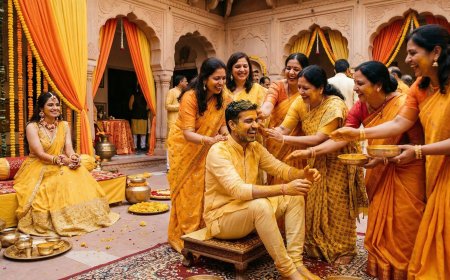
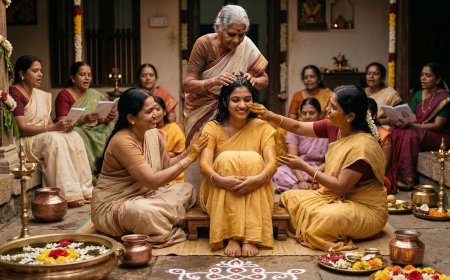
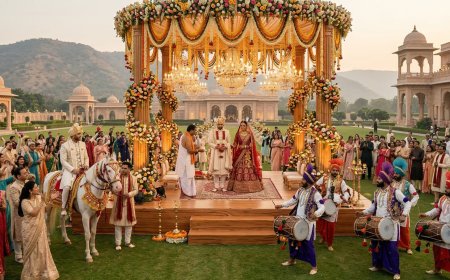
The ritual occurs at the moment of Vara Swagatam [the formal welcoming of the groom] — when the groom arrives at the wedding venue and is received by the bride's family. In traditional Gujarati practice, the groom arrives in a procession, dressed in his wedding attire, and is met at the entrance by the bride's mother and senior female relatives. Before he crosses the threshold, before he sees the bride, before the ceremony formally begins, he is welcomed with Madhuparka.
The Madhuparka patra [the ritual vessel containing the offering] is typically a small clay or brass pot. The mixture inside contains five or sometimes six ingredients depending on family tradition: madhu [honey], dadhi [curd], ghee[clarified butter], water, and sugar — the five-ingredient version is called Panchamrita [five nectars] in some traditions, though the specifically wedding-oriented Madhuparka typically centres on the honey-curd combination with the other ingredients as supporting elements. Some Gujarati families also add tulasi [sacred basil leaves] to the mixture.
The bride's father — or the senior male elder of the bride's family — receives the groom at the entrance and performs Pada Prakshalana [the washing of the groom's feet with water and milk], an act that in Vedic tradition elevates the guest to the status of the divine. The groom is understood, at this moment, as a representative of Lord Vishnu — specifically Vishnu in his aspect as the preserver of the universe, the one who maintains the order of things. To receive him with Madhuparka is to receive the divine itself.
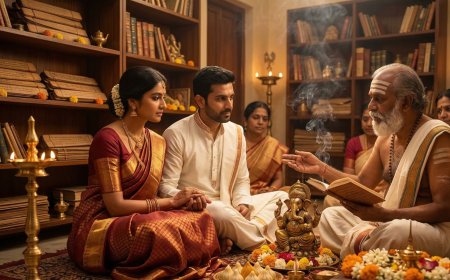
The groom is then invited to sip or taste the Madhuparka mixture — three times, in some traditions — while the family priest chants the specific Madhuparka mantras from the relevant Grihyasutra. The bride's father speaks the formal words of welcome, acknowledging the groom's arrival and his family's acceptance of him. This verbal acknowledgement — spoken aloud, in sacred space, witnessed by the assembled family — is as important as the physical offering.
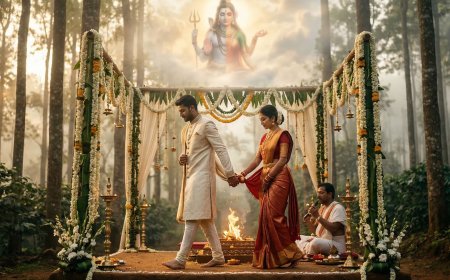
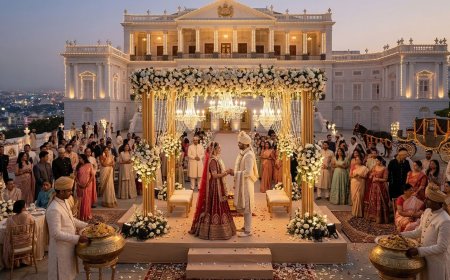
The entire Madhuparka sequence typically takes between ten and twenty minutes, after which the groom is led to the mandap [the sacred wedding canopy] where the main ceremony begins. It is the gateway ritual — the ceremony before the ceremony — and its completion signals that the wedding has truly, formally, begun.
Community Comparison: How Different Indian Communities Welcome the Groom
| Community / State | Local Name | Key Tradition | How NRIs Abroad Adapt It |
|---|---|---|---|
| Gujarati Hindu | Madhuparka | Honey-curd mixture in clay/brass vessel; pada prakshalana; groom received as Vishnu; mantras from Grihyasutra | Conducted at venue entrance; clay pot sourced from Indian stores; bride's father briefed on verbal welcome |
| Himachali | Dwaar Pooja | Groom welcomed at threshold with tilak and aarti; community women participate | Adapted to venue entrance; women of diaspora community participate |
| Garhwali | Dwar Puja | Threshold ceremony with lamp and offerings; groom's feet washed symbolically | Conducted in home or venue lobby; Garhwali community members attend |
| Kumaoni | Dwar Puja | Similar threshold welcome; emphasis on community participation | Kumaoni diaspora WhatsApp groups coordinate attendance |
| Kashmiri Pandit | Dwar Pooja / Milni | Elaborate threshold ceremony; exchange of garlands between family elders | Kashmiri Pandit sabhas in UK and USA support ritual |
| Punjabi | Milni | Formal meeting of male relatives from both families with garland exchange; emotional and communal | Extremely well-preserved in diaspora; Milni a celebrated moment at Punjabi NRI weddings |
| Marathi | Antarpat / Madhuparka | Bride's parents welcome groom with Madhuparka before curtain ceremony | Maharashtra Mandals in USA and Australia support ceremony |
| Tamil Brahmin | Kashi Adaraval | Groom welcomed after Kashi Yatra; bride's father washes feet; similar Madhuparka offering | Tamil Brahmin pandits in Markham, Harrow, Melbourne conduct full ritual |
| Telugu Hindu | Vara Swagatam | Formal welcome with aarti, tilak, and offering; groom's feet washed by bride's parents | Telugu pandits in Houston, London conduct ceremony |
| Bengali | Bor Boron | Bride's mother welcomes groom with conch shell, ululation, and sweets; deeply matriarchal moment | Bengali community centres in London, Toronto preserve tradition |
| Rajasthani | Toran / Dwar Pooja | Groom strikes a ceremonial toran [hanging decoration] at threshold; bride's family performs aarti | Rajasthani Samaj networks in UAE and UK coordinate |
| Ladakhi | Chang offering | Groom welcomed with traditional barley beer and ceremonial scarves | Adapted to symbolic offering; Ladakhi community elders guide |
The Meaning Behind the Ritual
Madhuparka is a philosophical statement disguised as a hospitality gesture. At its deepest level, it asks: how do we receive what is most sacred? And it answers: with our finest offering, our most ancient words, and our complete humility.
The elevation of the groom to the status of Vishnu at the moment of his arrival is not hyperbole — it is a Vedic theological position rooted in the concept of Atithi Devo Bhava [the guest is God]. But the bridegroom is not merely any guest. He is the one who will carry forward the kula [clan lineage], the dharma [sacred duty], and the gotra [ancestral lineage] of his family into a new branch. In receiving him with Madhuparka, the bride's family is acknowledging the magnitude of what is about to happen — not just a marriage, but the continuation of two family lines into a shared future.
The honey in the Madhuparka speaks to amrita [divine nectar, the substance of immortality in Vedic mythology] — it says: may this union be undying. The curd speaks to transformation — milk, acted upon by culture and time, becomes something more complex, more nourishing, more layered. It says: may this marriage take what is good and make it into something better. The ghee speaks to Agni [the sacred fire], to the clarity and purity that fire brings — it says: may this union burn clean.
Together, the three primary ingredients of Madhuparka encode a complete prayer: may this be eternal, may it transform and deepen, may it be pure.
For a non-Indian partner or family member: "It is the bride's family saying to the groom — we see you as sacred, and we will receive you accordingly."
Doing Madhuparka Abroad: The Practical Reality
The good news for Gujarati NRI families is that Madhuparka is one of the most portable and ingredient-accessible rituals in the entire wedding sequence. Honey, curd, ghee, sugar, and water are available in every city in the world. The ritual vessel — traditionally a small clay or brass pot — can be sourced from Indian grocery and homeware stores in virtually every diaspora hub. The ceremony requires no fire, no specialist equipment, and no large space. What it requires is the right pandit, the right words, and the understanding that this ten-minute ritual at the venue entrance is not a formality to be rushed through — it is the gateway through which the whole wedding passes.
For the Madhuparka vessel: in Leicester, the Belgrave Road Golden Mile is one of the best-stocked South Asian retail corridors in Europe — brass and clay vessels, along with every ritual ingredient, are available at stores like Patel Brothers and the specialist puja item shops along the same stretch. In London, Wembley's Ealing Road and Southall's The Broadway carry Gujarati ritual supplies. In Edison, New Jersey, Oak Tree Road is essentially a Gujarati cultural hub — the concentration of Gujarati-owned stores means Madhuparka ingredients and vessels are available within walking distance of each other. In Toronto, Gerrard Street East and the Brampton South Asian retail area serve the Gujarati community. In Nairobi, the South Asian retail areas of Westlands and Parklands have served the Gujarati community for generations and stock traditional ritual items. In Melbourne, the Dandenong South Asian shopping precinct and the Springvale Road corridor carry Gujarati puja supplies. In Dubai, Meena Bazaar in Bur Dubai and the Indian stores in Karama are comprehensive.
The pandit question for Madhuparka is particularly important because the mantras are drawn from specific Grihyasutras — ancient household ritual texts — and differ between Shukla Yajurveda and Sama Veda traditions, both of which are observed in different Gujarati communities. A Gujarati Brahmin pandit who knows your family's specific Vedic tradition is essential. NRI.Wedding's pandit directory lists Gujarati priests by Vedic tradition and diaspora city. The Swaminarayan temple networks — BAPS [Bochasanwasi Akshar Purushottam Sanstha] and Nar Narayan Devbranches — have extensive pandit networks in the UK, USA, Canada, and Australia, and while their primary tradition is Vaishnava devotional, many affiliated priests are experienced in traditional Vedic wedding rituals including Madhuparka.
The venue logistics of Madhuparka require one specific conversation with your events coordinator: the ceremony takes place at the venue entrance, not inside. The bride's family needs to be positioned at the entrance before the groom arrives, the pandit needs to be present at the threshold, and the groom's arrival needs to be coordinated so that he does not enter the venue before the ritual is complete. This means communicating clearly with whoever is managing the baraat [the groom's wedding procession] — the groom must pause at the entrance, not proceed directly inside. Most Gujarati wedding planners abroad are familiar with this requirement; if yours is not, a brief written ceremony note will clarify.
For fire restrictions: Madhuparka itself does not involve fire. However, the aarti [the ritual of waving a lamp in welcome] that often accompanies it does involve a small flame. Check with your venue whether open flames are permitted at the entrance area. Battery-operated aarti lamps are a widely accepted alternative in venues with strict fire regulations — the light and the intention are what matter.
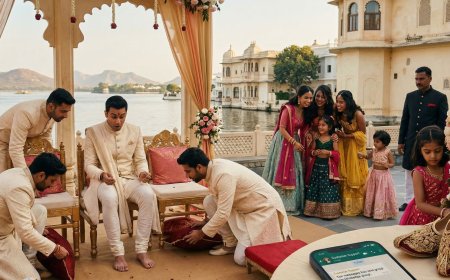
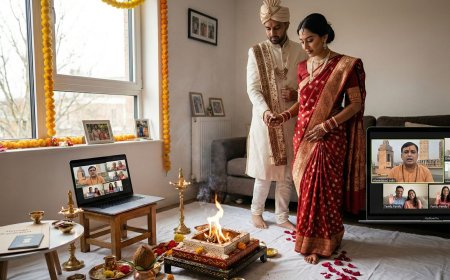
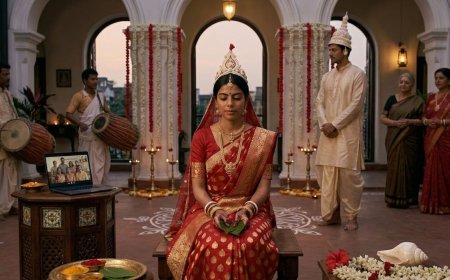
For relatives in India watching via video call: position your streaming device at the venue entrance for the Madhuparka sequence — this is a visually dynamic moment with the groom's arrival, the bride's father's welcome, the vessel presentation, and the pada prakshalana all occurring in quick succession. A 10 AM ceremony in Leicester is 3:30 PM IST. From Edison EST, a 6 PM ceremony is 3:30 AM IST — consider this when planning your India call-in. From Melbourne AEDT, a 10 AM ceremony is 4:30 AM IST — pre-record the Madhuparka sequence for India relatives if the time zone makes live streaming impractical.
Doing Madhuparka as a Destination Wedding in India
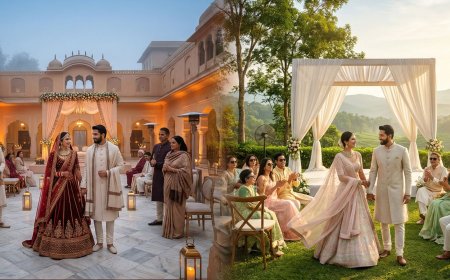
Gujarat offers wedding settings of extraordinary beauty and cultural resonance — the heritage havelis [ancestral mansions] of Ahmedabad's old city, the riverside properties of Vadodara, the coastal venues near Surat, and the palace hotels of Rajkot all provide backdrops that make a Madhuparka ceremony feel exactly as ancient as it is.
Ahmedabad is the natural heart of Gujarati wedding tradition, and the city's concentration of experienced Gujarati Brahmin pandits, traditional ritual supply vendors, and wedding planners familiar with Vedic ceremony sequences makes it the easiest destination for a complete, unabbreviated Madhuparka. The old city's pols [traditional neighbourhood clusters] and heritage havelis provide architectural settings that mirror the courtyard homes where Madhuparka has been performed for centuries.
For NRI families coordinating from abroad, most Ahmedabad and Vadodara wedding planners who work with NRI clients are experienced with the specific requirements of Madhuparka — the vessel preparation, the pada prakshalana arrangement, the groom's arrival choreography, and the translation of the ritual for non-Indian guests. Brief your planner on your family's specific Vedic tradition and gotra, and request a pandit who is specifically experienced in Grihyasutra-based Madhuparka, not merely a generalist wedding officiant.
For non-Indian guests at a destination wedding in Gujarat, the Madhuparka is the most immediately accessible ritual of the entire ceremony — the image of a bride's father washing a groom's feet and offering him a small pot of honey and curd is universally legible as an act of profound welcome. Prepare a bilingual ceremony programme and consider having a family member narrate the ritual softly in English for international guests as it unfolds.
What You Need: Ritual Checklist
Ritual Items — Madhuparka patra [small clay or brass vessel]; pure honey [raw, unprocessed preferred]; fresh curd [full-fat, homemade preferred]; pure ghee; clean water; sugar; tulasi leaves [if family tradition includes them]; a small copper or brass vessel for the pada prakshalana water [mixed with milk]; a clean white cloth for the groom to stand on; aarti thali [lamp, flowers, kumkum, rice, and incense arranged on a brass plate]; fresh flower garland for the groom; tilak ingredients [kumkum and chandanam]; akshata [turmeric-blessed rice]; thamboolam or equivalent tray of auspicious items for the post-welcome exchange; the printed Grihyasutra mantra sheet for the pandit if required.
People Required — the officiating Gujarati Brahmin pandit familiar with Grihyasutra Madhuparka mantras; the bride's father [primary welcomer and speaker of formal acceptance]; the bride's mother [aarti performer]; senior female relatives to assist with the aarti and welcome; the groom; a family member to coordinate the groom's arrival timing; a designated photographer positioned at the venue entrance; the assembled family as witnesses.
Preparation Steps — prepare the Madhuparka mixture the morning of the ceremony [honey and curd should be fresh]. Confirm the pandit's familiarity with Madhuparka mantras at least one month before. Brief the groom's baraat coordinator on the entrance pause requirement. Confirm venue permission for the threshold ceremony and any flame elements. Set up the entrance area with the white cloth, vessels, and aarti thali at least thirty minutes before the groom's arrival. Confirm the streaming device position for India relatives. Brief the photographer specifically on the pada prakshalana and the vessel offering as the two core non-repeatable moments.
NRI.Wedding connects Gujarati families abroad with verified Gujarati Brahmin pandits experienced in Grihyasutra Madhuparka, ritual supply sourcing guidance, and photographers who specialise in the entrance ceremony sequence. Begin at NRI.Wedding.
5 Questions NRI Couples Always Ask
Can Madhuparka be done indoors if the venue has no accessible entrance area?
Yes — and many NRI Gujarati families adapt Madhuparka to an indoor threshold. The key is identifying a clear symbolic entrance point within the venue — the doorway between the lobby and the ceremony hall, for example — and designating this as the ritual threshold. The bride's family positions themselves on the interior side, the groom approaches from the lobby side, and the ritual proceeds at the doorway. The symbolic power of the threshold is fully preserved even when the physical threshold is a carpeted hotel doorway rather than a carved haveli gate.
My partner is not Gujarati — how do we explain Madhuparka to their family without making it feel like a test the groom has to pass?
Frame it as the opposite of a test — it is an unconditional welcome. The Madhuparka is the bride's family saying: we receive you as sacred, we honour your arrival, we are grateful you are here. Brief your partner's family in advance with a short written explanation, and consider asking the pandit or a family elder to speak a few words of English explanation before the ritual begins. Most non-Indian families, once they understand that this is a three-thousand-year-old act of welcome being performed in their son's honour, respond with moved appreciation rather than confusion.
We are BAPS Swaminarayan — does Madhuparka apply to our tradition?
The BAPS Swaminarayan tradition has its own specific wedding ceremony structure — the Saptapadi and associated rituals in BAPS weddings follow the Swaminarayan sampraday's guidelines, which may differ from traditional Shukla Yajurveda Grihyasutra practice. Consult your BAPS mandal's designated wedding coordinator for guidance on which pre-wedding welcome rituals align with your sampraday's practice. NRI.Wedding can connect you with BAPS-affiliated pandits in your city who can advise specifically.
How do we handle the pada prakshalana [foot washing] if our groom is uncomfortable with the gesture?
This is increasingly common in NRI contexts where the symbolic elevation of washing a guest's feet feels culturally unfamiliar to the groom or his family. The pada prakshalana can be performed symbolically — a small ceremonial pour of water over the feet rather than a full washing — or it can be preceded by a brief explanation from the pandit or family elder that reframes it as an honour being given, not received. Most grooms, once they understand that this gesture places them at the level of the divine in their new family's home, find it deeply moving rather than uncomfortable.
Can we do a simplified Madhuparka if time is very limited at the venue?
Yes — and the core of Madhuparka is resilient to simplification. The essential elements are: the vessel with honey and curd, the bride's father's formal verbal welcome, and the offering. The pada prakshalana and extended mantra sequence can be abbreviated without losing the ritual's central meaning. A five-minute Madhuparka, done with full intention and the correct words, carries more weight than a twenty-minute ceremony conducted distractedly. Discuss the abbreviated version with your pandit and agree on the irreducible minimum that your family needs to feel the ritual has been properly honoured.
The Emotional Angle
There is a particular quality to the moment when the bride's father stands at the entrance of a venue — not inside where the flowers are, not at the mandap where the fire will be — but at the threshold, in the in-between space, holding a small clay pot — and waits.
He has been planning this wedding for months. He has negotiated with caterers and argued with decorators and driven relatives from the airport at midnight. He has been the logistics person, the financial person, the calm person. And now he is standing at a doorway holding honey and curd, and his son-in-law is approaching, and he is about to say words that his father said and his father's father said, in a language whose full meaning he may only partially understand, in a city that would not have been imaginable to the men who first spoke those words.
And he says them anyway. He says them in Leicester and in Edison and in Nairobi and in Melbourne, at the threshold of whatever room has been rented, because the threshold is the threshold wherever it is, and the groom arriving is always arriving, and the welcome is always owed.
For NRI Gujarati families, this is what Madhuparka means at its deepest level: not the honey, not the curd, not even the ancient words. It is a father standing at a door, refusing to let the magnitude of what is happening go unmarked. Refusing to let his daughter's husband enter his family's life without being told, formally, ceremonially, with the full weight of three thousand years behind the gesture: you are welcome here. You are more than welcome. You are sacred.
A Moment to Smile
At a Gujarati wedding in Toronto two summers ago, the Madhuparka had been prepared with great care — fresh honey from a Gujarati-owned grocery on Gerrard Street, full-fat homemade dahi that the bride's mother had been setting since the previous evening, pure ghee in a separate small vessel, everything arranged beautifully on the aarti thali.
What nobody had anticipated was that the bride's seven-year-old cousin — positioned near the entrance specifically because he looked angelic in his kurta and was meant to scatter flower petals — had discovered that the Madhuparka honey vessel was unattended for approximately four minutes before the groom's arrival.
When the bride's father lifted the vessel to present it to the groom, it was noticeably lighter than it had been. The seven-year-old, standing nearby with an expression of complete innocence and a small golden gleam at the corner of his mouth, said nothing.
The pandit observed this situation with the serenity of a man who has seen everything. He chanted the mantras with full devotion. The groom sipped what remained of the Madhuparka with equal devotion.
Afterward, the bride's mother said that since the honey had first been offered to a child, it had already been blessed twice before the groom received it. The seven-year-old accepted this theological reframing with great satisfaction.
Quotes from the Diaspora
"My father practised the Madhuparka welcome words for two weeks before my wedding in Leicester. He wrote them on a card and carried it in his pocket. When the moment came, he didn't look at the card once. He looked at my husband and said everything from memory, in Gujarati, and his voice didn't shake at all. Mine did, watching from inside." — Mital Patel, Gujarati Hindu community, Leicester, UK
"We did the Madhuparka at the entrance of the banquet hall in Edison. The hall manager had never seen it before and stood watching the whole thing with his arms at his sides and his mouth slightly open. Afterward he said it was the most beautiful thing he had ever seen at a wedding in that building. He has seen several hundred weddings in that building."— Hetal Shah, mother of groom, Gujarati Hindu community, Edison, New Jersey
"My husband is from Nairobi — his family has been there for three generations. His grandfather remembered watching Madhuparka as a child in their community in Westlands. When we did it at our wedding in Melbourne, his grandfather — ninety-one years old, on a video call from Nairobi — started crying. He said he hadn't seen it since he was eight years old. Three generations and two continents and the honey was still there." — Priya Mehta, Gujarati Hindu community, Melbourne, Australia
Your Roots Travel With You
The honey in the Madhuparka vessel has been carried across more borders than almost any other ritual element in the Gujarati diaspora's long, wide, extraordinary journey. It has been prepared in kitchens in Leicester and Lagos and Los Angeles and Lusaka. It has been poured into clay pots and brass vessels and, in moments of creative necessity, into whatever was clean and available and held the intention correctly.
It has always been sweet. The sweetness has never been the point — the sweetness has always been the proof.
NRI.Wedding supports Gujarati families across the diaspora with verified Gujarati Brahmin pandits experienced in Grihyasutra Madhuparka, Vedic tradition-specific guidance, entrance ceremony logistics support, ritual supply sourcing in Leicester, Edison, Toronto, Nairobi, Melbourne, and Dubai, and photographers who understand that the Madhuparka is the photograph the whole day begins with. Your threshold ceremony deserves to be complete, wherever your threshold is.
Stand at the door. Hold the honey. Receive him as sacred. This is how Gujarat welcomes.
What's Your Reaction?
 Like
0
Like
0
 Dislike
0
Dislike
0
 Love
0
Love
0
 Funny
0
Funny
0
 Angry
0
Angry
0
 Sad
0
Sad
0
 Wow
0
Wow
0