





































































Muslim Nikah Guide for NRI Couples — Meaning, Conditions, Traditions and Practical Planning
For NRI Muslim couples, the Nikah is the sacred centre of the entire wedding occasion — the specific act of religious and legal significance from which the walima, the celebrations, and everything else derives its occasion — yet it consistently receives less deliberate preparation than the reception dinner menu. This complete guide gives NRI Muslim couples the knowledge and framework to engage with their Nikah with the seriousness it deserves — covering the Nikah as a sacred contract and its four essential conditions, the Ijab and Qabul with the specific Arabic phrases and their meanings, the Mahr as a genuine financial right and commitment, the Wali's role across schools of jurisprudence, the Nikah Nama and its legal significance, the walima as Sunnah, regional traditions across South Asian and Arab Muslim communities, the interfaith and inter-community Nikah, the legal dimension across Indian and NRI country of residence jurisdictions, the complete Qazi selection framework and pre-Nikah meeting guide, the ceremony programme for non-Arabic-speaking guests, the complete planning checklist, and the spiritual preparation that transforms the Nikah from a religious component of the wedding day into its sacred centre.


Muslim Nikah Guide for NRI Couples
The Ceremony That Deserves More Than a Checklist
There is a specific quality of attention that the Nikah receives in most NRI Muslim wedding planning conversations — and it is, in most cases, not the attention the ceremony deserves.
The wedding weekend is planned with genuine care. The walima reception venue is researched and booked with months of lead time. The bride's outfit — the lehenga or the sharara or the gharara — has involved international travel, multiple fittings, and a level of aesthetic investment that reflects the occasion's significance. The catering menu, the floral design, the photography brief, the guest accommodation logistics — each has received sustained, focused attention.
The Nikah itself — the Islamic marriage contract that is the religious and legal core of the entire wedding occasion — is often planned in less detail than the reception dinner menu. The Qazi or Imam is contacted, the date is confirmed, the witnesses are identified, and the assumption is made that the ceremony will take its own form on the day with whatever explanation the officiant chooses to provide.
This assumption produces a specific outcome: the couple participates in the most significant religious ceremony of their lives without understanding what is happening in it, what is being contracted, what the Arabic phrases mean, or what the specific obligations and rights that the Nikah establishes actually are.
The Nikah is not a preamble to the wedding. It is the wedding — the specific act of religious and legal significance from which everything else derives its occasion. The walima, the celebrations, the photography, the reception — all of these exist because the Nikah has happened. The Nikah is the centre. Everything else is the celebration of it.
This guide gives the Nikah the attention it deserves — the meaning of its components, the significance of its conditions, the specific obligations it creates, the regional and cultural variations within the unified Islamic framework, and the practical guidance for NRI couples navigating the ceremony from abroad.
The Foundation: What the Nikah Actually Is
The Nikah as a Sacred Contract
The Nikah — from the Arabic root meaning union or joining — is the Islamic marriage contract, and understanding it as a contract is the beginning of understanding its significance correctly. In Islamic jurisprudence, the Nikah is a legally binding agreement between two parties — the bride and the groom — that is governed by specific conditions, creates specific rights and obligations for both parties, and is witnessed and ratified by the Islamic community.
The contractual nature of the Nikah is not a reduction of its spiritual significance — it is an expression of it. Islam's treatment of marriage as a formal contract reflects the tradition's deep commitment to the protection of both parties' rights, the clarity of the obligations each assumes, and the seriousness with which the union is regarded in the divine framework. The contract is not a bureaucratic formality — it is a sacred covenant, described in the Quran as a mithaqan ghaliza — a solemn covenant — the same phrase used to describe the covenant between Allah and the Prophets.
The Prophet Muhammad, peace be upon him, described marriage as completing half of one's deen — one's religious practice and commitment. The Nikah is the ceremony that formalises this completion — the specific act of religious significance in which two people enter the solemn covenant of marriage under the witness of Allah, the assembled community, and the legal framework of Islamic jurisprudence.
The Four Essential Conditions
For a Nikah to be valid in Islamic jurisprudence, four essential conditions must be present. Understanding these conditions is not merely academic — it is the practical knowledge that allows NRI couples to confirm that their ceremony meets the requirements of validity.
The first condition is the Ijab and Qabul — the Offer and Acceptance.
The Ijab is the offer — typically made by the bride's Wali or by the bride herself depending on the school of jurisprudence — and the Qabul is the acceptance by the groom. Both must be made in the same sitting, must be clear and unambiguous, and must be made in a state of free will — without coercion, duress, or deception. The specific Arabic phrases used for the Ijab and Qabul are the ceremonial heart of the Nikah — the moment at which the contract is formally offered and formally accepted.
The second condition is the Wali — the Guardian.
In the Shafi'i, Maliki, and Hanbali schools of jurisprudence, the presence and consent of the bride's Wali — her male guardian, typically her father or in his absence another male family member in a specific order of precedence — is a condition of the Nikah's validity. In the Hanafi school, the Wali's presence is recommended but the bride may contract her own marriage without the Wali's presence under specific conditions. The specific school of jurisprudence that the family follows determines the Wali's role in the ceremony.
The third condition is the Mahr — the Bridal Gift.
The Mahr is the specific gift — in money, property, or another agreed valuable — that the groom gives or commits to give to the bride as an individual right. The Mahr is not a symbolic gesture and it is not the bride's family's payment — it belongs to the bride alone, is her absolute right, and cannot be taken from her without her consent. Its amount is negotiated and agreed before the Nikah and is specified in the marriage contract. The Mahr has two components: the Mahr al-Muajjal, which is the portion paid immediately, and the Mahr al-Muwajjal, the deferred portion that the bride holds as a financial right throughout the marriage and which becomes immediately payable in the event of divorce or the husband's death.
The fourth condition is the Shuhud — the Witnesses.
A minimum of two adult Muslim male witnesses — or according to some schools, one male and two female witnesses — must be present at the Nikah and must hear the Ijab and Qabul. Their presence is not ceremonial — it is a condition of validity. The witnesses attest to the free and willing nature of the contract, to the presence of all required elements, and to the specific terms agreed including the Mahr.
The Nikah Ceremony: What Happens and What It Means
The Opening — Al-Fatiha and the Khutbat al-Nikah
The Nikah ceremony typically begins with the recitation of Al-Fatiha — the opening chapter of the Quran — and the Khutbat al-Nikah, the marriage sermon that the Qazi or Imam delivers before the formal contract is made.
The Khutbat al-Nikah is drawn from three specific Quranic verses and a hadith that the Prophet Muhammad, peace be upon him, himself delivered at wedding ceremonies. The three verses — one from Surah Al-Imran, one from Surah Al-Nisa, and one from Surah Al-Ahzab — each address the theme of taqwa, God-consciousness, and the collective responsibility of the Muslim community. The hadith that follows these verses establishes the framework of the marriage relationship within the Islamic ethical tradition.
For NRI couples: The Khutbat al-Nikah is typically delivered in Arabic — and for NRI couples whose Arabic is limited, the sermon can feel like the ceremony's background rather than its beginning. Asking the Qazi or Imam to provide a translation or explanation of the Khutbat al-Nikah before the ceremony — in a pre-Nikah meeting rather than during the ceremony itself — allows the couple to engage with its content as the meaningful opening it is intended to be.
The Mahr Negotiation and Agreement
The Mahr is agreed before the Nikah ceremony begins — typically in a conversation between the families, the couple, and the Qazi or Imam in the days or weeks before the wedding. Its amount, its form, and the proportion that is paid immediately versus deferred are specified and documented in the Nikah contract.
For NRI Muslim couples, the Mahr conversation sometimes receives less deliberate attention than it deserves — it becomes a number agreed upon in a brief conversation rather than a genuine engagement with what the Mahr represents and what the couple is committing to.
The honest framework for the Mahr conversation:
The Mahr is the bride's right — her individual financial security within the marriage, an amount that acknowledges her worth and her autonomy. Islamic tradition encourages a Mahr that is neither so minimal as to be dismissive nor so excessive as to be burdensome — the Prophet Muhammad, peace be upon him, emphasised that the most blessed marriages are those with the least burden, but also that a woman should not be entered into marriage as though she has no worth.
The deferred Mahr — the Mahr al-Muwajjal — is particularly worth discussing seriously rather than treating as a formality. It is a genuine financial commitment that becomes payable in the event of divorce or the husband's death. For NRI couples who are also signing a civil marriage contract and managing financial planning across two legal jurisdictions, understanding the Mahr as a real financial right and real financial commitment — rather than as a ceremonial number — is part of the honest engagement with what the Nikah involves.
The Ijab and Qabul — The Offer and Acceptance
The Ijab and Qabul is the ceremonial heart of the Nikah — the specific exchange that constitutes the marriage contract. In the traditional form, the Wali — typically the bride's father — addresses the groom with the Ijab, the formal offer:
"I give you in marriage my daughter [name] with the agreed Mahr of [amount]."
The groom responds with the Qabul, the formal acceptance:
"I accept the marriage of your daughter [name] with the agreed Mahr of [amount]."
The Qabul is typically repeated three times — once in response to each of three offers — with each repetition affirming the groom's free and willing acceptance of the contract.
In the Hanafi school, the bride may offer her own Ijab through the Qazi or Imam, specifying her own consent to the marriage. In practice, many contemporary Nikah ceremonies — particularly those conducted with NRI couples who are sensitive to the bride's agency in the contract — incorporate a specific moment for the bride's own consent, separate from the Wali's Ijab, that makes her active and willing participation explicitly visible in the ceremony.
The Arabic phrases:
The traditional Ijab phrase is: "Zawwajtuka ibnatī [name] 'alā al-Mahr al-mazkūr" — I marry you my daughter [name] upon the mentioned Mahr.
The traditional Qabul phrase is: "Qabiltu hādhā al-Nikāh" — I accept this marriage.
For NRI couples who do not speak Arabic, having these phrases transliterated and their meanings explained before the ceremony — so that the groom can hear the Arabic and understand what he is accepting — transforms the ceremonial exchange from a formal repetition into a genuine act of conscious commitment.
The Signing of the Nikah Nama
The Nikah Nama — the written marriage contract — is signed by the groom, by the bride (or her Wali on her behalf depending on the tradition), by the witnesses, and by the Qazi or Imam. It records the names of the parties, the date, the Mahr amount and its terms, and the witnesses' attestation.
The Nikah Nama is both a religious document and a legal one — it is the written record of the Islamic marriage contract, and for NRI couples who are also registering their marriage in India under civil law, it serves as an important supporting document for the civil registration process.
For NRI couples: Request a copy of the Nikah Nama — in both its Arabic or Urdu form and with an English translation if available. Keep the original in a secure location alongside other important documents. Confirm with a legal specialist whether the Nikah Nama is sufficient for marriage recognition in the country of residence or whether additional civil registration is required.
The Dua — The Supplication
Following the Ijab, Qabul, and the signing of the Nikah Nama, the Qazi or Imam makes a dua — a supplication — for the couple's marriage. The traditional dua for the newly married couple is drawn from the hadith of the Prophet Muhammad, peace be upon him:
"Bāraka Allāhu laka wa bāraka 'alayka wa jama'a baynakumā fī khayr"
— May Allah bless you and shower His blessings upon you, and may He unite you both in goodness.
This dua — offered by the Qazi or Imam and joined by the assembled witnesses and guests — is the community's collective invocation for the marriage's blessing. For NRI couples, the moment when the dua is being made — when the ceremony has concluded, the contract is signed, and the assembled family and friends are offering their collective supplication for the couple's happiness — is among the most emotionally powerful moments of the wedding occasion.
The Regional Traditions Within the Islamic Framework
The Unified Framework and the Cultural Expression
The Nikah's essential conditions — the Ijab and Qabul, the Wali, the Mahr, the witnesses — are consistent across the Islamic world because they derive from the Quran and Sunnah rather than from regional cultural practice. But the cultural expression of the Nikah — the specific ceremonies, the specific customs, the specific aesthetic traditions that surround the religious core — varies significantly across the Muslim communities from which NRI Muslims derive their heritage.
Understanding the distinction between the religious requirements of the Nikah and the cultural traditions that accompany it is practically important for NRI couples who are navigating family expectations, community conventions, and their own personal preferences in planning the ceremony.
South Asian Muslim Traditions
South Asian Muslim wedding traditions — spanning Pakistani, Bangladeshi, and Indian Muslim communities — are among the most elaborate in the Islamic world, reflecting the specific cultural history of Islam's encounter with the Indian subcontinent's existing ceremonial traditions.
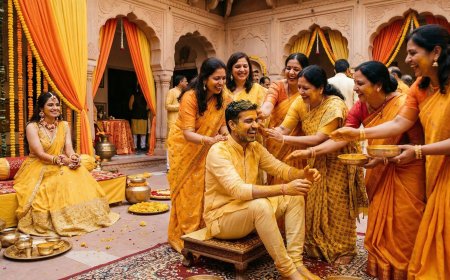
The Mehndi: The mehndi ceremony — the application of henna to the bride's hands and feet — is shared across Hindu and Muslim South Asian traditions, reflecting the deep cultural exchange between communities on the subcontinent. The mehndi in the Muslim tradition retains its celebratory character — the gathering of the women of both families, the songs, the food — while its specific ceremonial framing is distinct from the Hindu context.
The Baraat: The groom's procession to the wedding venue — the baraat — is as much a feature of South Asian Muslim weddings as of Hindu ones, with the dhol and the dancing and the specific energy of the groom's arrival that is the public declaration of the wedding's beginning.
The Rukhsati: The bride's departure from her family home — the rukhsati — is among the most emotionally intense moments of the South Asian Muslim wedding. The specific customs associated with the rukhsati — the bride's farewell to her family, the specific prayers offered as she leaves, the rituals that mark the transition — vary by community but share the common character of a deeply felt departure that the wedding photographs almost always capture in their most emotionally raw images.
The Nikah in the South Asian context: In many South Asian Muslim communities, the Nikah is conducted separately from the main wedding reception — sometimes the day before, sometimes on the morning of the wedding day, sometimes in the bride's family home rather than in the wedding venue. The Nikah in this context is an intimate ceremony — witnessed by close family and the required witnesses — while the walima and the reception function as the larger community celebration of the marriage.
North African and Arab Muslim Traditions
For NRI Muslims with North African or Arab heritage — or for interfaith or inter-community NRI Muslim couples — the specific cultural traditions of these communities add their own distinctive character to the Nikah framework.
The Zaffa — the Arab wedding procession that escorts the bride to the ceremony with music and celebration — is one of the most visually spectacular elements of Arab wedding tradition. The specific instruments used in the Zaffa vary by country of origin, but the procession's character — the public, joyful declaration of the wedding through music and movement — is consistent.
The specific Nikah customs of Moroccan, Egyptian, Lebanese, and Gulf Arab communities each have their own character, and for NRI couples from these backgrounds, the specific traditions of the family's community are the authoritative source for the cultural elements that surround the religious core of the Nikah.
The Interfaith and Inter-Community Nikah
NRI Muslim weddings increasingly involve couples from different Muslim communities — a Pakistani groom and a Bangladeshi bride, an Indian Muslim bride and a convert groom, couples from different schools of jurisprudence who need to navigate the specific differences in how the Nikah's conditions are understood across those schools.
For these situations, the Qazi or Imam who conducts the Nikah should be informed of both parties' backgrounds and should be experienced in conducting ceremonies that bridge different community traditions. The specific question of which school of jurisprudence governs the ceremony — and how the Wali's role, the Mahr's structure, and the Ijab and Qabul's form are understood — is a question for a learned Islamic scholar rather than for the families to resolve through negotiation.
The Walima — The Wedding Feast
The walima — the wedding feast that follows the Nikah — is not merely a reception. It is a Sunnah — a practice of the Prophet Muhammad, peace be upon him — and its performance is an act of religious significance as well as social celebration.
The Prophet Muhammad, peace be upon him, said: "Hold a walima, even if it is only with a sheep." The walima is the public announcement of the marriage — the celebration that makes the Nikah known to the community, that invites the community to share in the couple's happiness, and that fulfils the Sunnah of the Prophet in celebrating the marriage.
The walima is traditionally held within three days of the Nikah — though in contemporary NRI practice, the walima reception is often held on the same day as the Nikah or the day after, reflecting the practical realities of a wedding programme that brings guests from multiple countries together for a specific period.
The walima as a religious act:
For NRI Muslim couples who engage with the walima as a Sunnah — as a religious practice that has significance beyond the social function — the walima is approached differently from a reception that happens to follow a religious ceremony. The invitation of guests, the provision of food, the celebration of the marriage — these become deliberate fulfilments of a religious obligation rather than a social programme that follows the Nikah.
Ensuring that all invited guests can attend — including those who may not be able to afford formal wedding reception attendance, the less affluent members of the community whose inclusion is specifically encouraged in the Islamic tradition of the walima — is part of the honest engagement with what the walima represents.
The Legal Dimension: The Nikah and Civil Law
The Nikah's Legal Status for NRI Couples
The Nikah's legal status in the country of residence is among the most practically important and most frequently misunderstood dimensions of the NRI Muslim wedding.
In India, the Nikah is governed by the Muslim Personal Law (Shariat) Application Act of 1937, which gives the Nikah legal status as a valid marriage for Muslim couples in India. The registration of the Nikah under the Muslim Marriages Registration Act — which is not mandatory in all Indian states but is strongly advisable — creates the official written record that is important for a range of subsequent legal purposes.
In the country of residence:
The UK, Canada, the USA, and Australia all have their own requirements for the recognition of a foreign religious marriage, and the Nikah conducted in India is not automatically recognised in these countries without additional process.
In the UK specifically, a Nikah conducted in India — even if registered in India — may require additional civil registration steps for full legal recognition in the UK. The UK's law on marriage recognition is specific and has been the subject of significant legal discussion in recent years. NRI Muslim couples planning a Nikah in India should consult a legal specialist in the UK (or their country of residence) who specifically understands cross-border marriage recognition before the wedding rather than after.
In many cases, NRI Muslim couples conduct both the Nikah in India and a civil marriage registration — either in India under the Special Marriage Act or upon return to their country of residence — to ensure complete legal protection for both parties in both jurisdictions.
The Mahr as a Legal Right
The Mahr's legal enforceability varies by jurisdiction. In India, the deferred Mahr is legally enforceable under Muslim Personal Law and can be claimed by the wife in a Muslim court or through the civil legal system. In the UK, the Mahr's enforceability under English law has been considered in a number of cases, with outcomes that are not always consistent. In Canada and the USA, the enforceability of Mahr as a contractual provision has similarly been addressed in various courts with varying outcomes.
For NRI couples: The deferred Mahr should be understood as a genuine financial commitment — not a ceremonial number — and both parties should understand its terms clearly. For significant Mahr amounts, legal advice on its enforceability in the relevant jurisdiction is worthwhile as part of the broader legal preparation for the marriage.
Working With the Qazi or Imam: The Essential Preparation
Finding the Right Officiant for NRI Couples
The Qazi or Imam who conducts the Nikah is the most important professional engagement of the entire ceremony — more important in many ways than any other vendor, because the Qazi or Imam is not providing a service but conducting a sacred ceremony whose validity and meaning depend on their knowledge, their integrity, and their ability to engage with the specific situation of the NRI couple.
The Qazi or Imam who is most appropriate for an NRI Muslim couple is one who combines genuine Islamic scholarship with the ability to explain the ceremony in English, who is experienced with the specific situations that NRI couples bring — the interfaith guest list, the request for English translation, the questions about contemporary modifications to traditional practices — and who conducts the Nikah with the seriousness it deserves rather than as a rote performance.
The questions to ask a Qazi or Imam before confirming the engagement:
Can you walk us through the Nikah's specific conditions and what each one means in our specific situation? A Qazi or Imam who can explain the conditions of validity clearly and specifically is demonstrating the knowledge that the ceremony requires.
Can you provide an English translation or explanation of the key phrases — the Ijab and Qabul, the Khutbat al-Nikah, the dua — either before the ceremony or during it? This is the question that distinguishes the Qazi or Imam who makes the ceremony accessible from one who performs it as an Arabic recitation that most guests cannot follow.
How do you approach the bride's consent in the ceremony? The specific question about whether the bride's consent is made visible and explicit in the ceremony — rather than being assumed through the Wali's Ijab — is an important one for many contemporary NRI Muslim couples.
Are you registered to conduct legally valid marriages in India? For couples who want the Nikah itself to serve as a legally registered marriage in India, the Qazi or Imam must be registered under the relevant state's Muslim marriage registration provisions.
The Pre-Nikah Meeting
A dedicated pre-Nikah meeting with the Qazi or Imam — separate from the ceremony booking conversation — is among the most valuable pre-wedding preparations an NRI Muslim couple can make. This meeting is the opportunity to cover the Nikah's meaning in depth, to discuss any questions about the specific conditions and their application to the couple's situation, to agree on the ceremony's format and language, and to ensure that the couple arrives at the Nikah with a genuine understanding of what they are about to enter into.
The meeting should cover: the specific Mahr amount and terms, the Wali's role in the specific school of jurisprudence being followed, the format of the Ijab and Qabul, the language and structure of the ceremony, and any specific considerations that arise from the couple's particular circumstances — an interfaith guest list, a request for a ceremony programme in English, specific family dynamics that affect who participates in which role.
The Ceremony Programme: Making the Nikah Accessible
The Guest Experience at a Nikah
The guests at an NRI Muslim wedding represent a range of relationships to Islamic practice and the Arabic language — from guests who are deeply familiar with the Nikah's structure and language to guests who are attending their first Islamic ceremony and may not understand anything that is being said.
A ceremony programme that explains the Nikah's structure in English — the significance of the Khutbat al-Nikah, the meaning of the Ijab and Qabul, the significance of the Mahr, the role of the witnesses — transforms the ceremony from an opaque Arabic performance into a shared communal experience of genuine meaning.
Some NRI Muslim couples work with their Qazi or Imam to include English commentary at key moments in the ceremony — a brief explanation before the Khutbat al-Nikah, a translation of the Ijab and Qabul as it is performed, a translation of the dua. This approach requires a Qazi or Imam who is comfortable with this format and a ceremony timeline that allows for it — but the result is a ceremony that is genuinely accessible to every guest present, regardless of their Arabic language ability or their familiarity with the Nikah's structure.
The Complete Nikah Planning Checklist
Six months before the wedding, the couple should identify and confirm the Qazi or Imam, begin the Mahr discussion, confirm the witnesses, understand the legal requirements in both India and the country of residence, and decide whether civil registration will be conducted alongside the Nikah or separately.
Three to four months before, the pre-Nikah meeting with the Qazi or Imam should take place. The Mahr amount and terms should be finalised. The ceremony format — language, English translation approach, ceremony programme — should be agreed. Any legal registration requirements should be confirmed with legal advice.
Two months before, the Nikah Nama preparation should be confirmed with the Qazi or Imam. The ceremony programme should be drafted and reviewed. The Mahr al-Muajjal — the immediately payable portion — should be prepared for presentation at the ceremony.
One month before, all logistics should be confirmed — the ceremony location, the time, the attendance of all required participants. The ceremony programme should be finalised. Any civil registration appointments should be scheduled.
The week before, the couple should read the Khutbat al-Nikah verses and their meanings, understand the specific Ijab and Qabul phrases and their significance, and reflect on the Mahr and its meaning for the marriage they are entering.
On the day of the Nikah, the required documents should be prepared — identification for both parties, documents for the Qazi or Imam's registration requirements, the agreed Mahr al-Muajjal. Adequate time should be allocated to the Nikah before the walima celebrations begin. The witnesses should be confirmed and present.
The Spiritual Preparation: What the Nikah Actually Asks of the Couple
The Covenant That Changes Everything
The Nikah is, in the Islamic framework, a mithaqan ghaliza — a solemn covenant. The same phrase is used in the Quran for the covenant between Allah and the Prophets. This is not rhetorical elevation — it is the tradition's honest assessment of what marriage is and what it asks of the people who enter it.
The groom who says "Qabiltu hādhā al-Nikāh" — I accept this marriage — is accepting a covenant of mutual rights and obligations, of compassion and mercy, of the shared construction of a home and a life that reflects the divine qualities of mawaddah — love — and rahmah — mercy — that the Quran identifies as the foundations of the marital relationship.
The bride who gives her consent — through her Wali's Ijab or through her own expression of acceptance — is entering the same covenant, with the specific rights that Islamic jurisprudence protects for her: the right to the Mahr, the right to be treated with honour and kindness, the right to maintenance, and the right to a marriage that is conducted in accordance with the divine framework.
The couple who enters the Nikah with this understanding — who has read the relevant Quranic verses, who knows what the Ijab and Qabul means and has considered what they are accepting, who has engaged seriously with the Mahr rather than treating it as a number — is entering a genuinely different ceremony from the couple for whom the Nikah is the religious component of the wedding day rather than its sacred centre.
The Dua on the Morning of the Nikah
On the morning of the Nikah, before the ceremony begins and before the photographs are taken and before the guests arrive, there is a period — however brief — that belongs to the couple and to their relationship with what they are about to do.
This period is the opportunity for the specific preparation that no planner or Qazi can provide: the personal prayer for the marriage that is about to begin, the specific intention brought to the covenant that is about to be made, the quiet acknowledgment of what the mithaqan ghaliza asks and the willingness to give it.
The dua the Prophet Muhammad, peace be upon him, taught for this moment is simple and profound:
"Allāhumma bārik lanā fī mā razaqtanā wa qinā 'adhāba al-nār"
— O Allah, bless us in what You have provided for us and protect us from the punishment of the fire.
The asking of it, on the morning of the Nikah, is itself the preparation.
The Nikah at the Centre
The walima will be beautiful. The photographs will capture moments that will be looked at for the rest of the couple's lives. The floral arrangements, the catering, the outfit, the venue — each will be everything that the months of careful planning produced.
And at the centre of all of it — preceding everything, giving everything else its occasion — is the Nikah.
The specific exchange of words. The solemn covenant. The Mahr given and received. The witnesses who attest. The dua of the assembled community. The moment when two people become, in the eyes of Allah and in the framework of Islamic jurisprudence and in the witness of the community that loves them, husband and wife.
This is what the wedding is for.
Not the photographs, though the photographs will be treasured. Not the reception, though the reception will be joyful. Not the outfit, though the outfit will be magnificent. All of these are the celebration of the Nikah — the joy that follows the covenant.
Give the Nikah the preparation it deserves. Understand what is being said. Know what is being accepted. Engage seriously with the Mahr and the conditions and the rights and the obligations. Find the Qazi or Imam who can make the ceremony genuinely accessible. Create the ceremony programme that brings every guest into the meaning of what they are witnessing.
And then stand before Allah, before the witnesses, before the assembled family and friends — and make the covenant with full understanding of what it is.
"Qabiltu hādhā al-Nikāh."
I accept this marriage.
Say it like you mean it. Because you do.
Published by NRIWedding.com — The Premium Global Platform for Non-Resident Indians Planning Indian Weddings From Abroad.
What's Your Reaction?
 Like
0
Like
0
 Dislike
0
Dislike
0
 Love
0
Love
0
 Funny
0
Funny
0
 Angry
0
Angry
0
 Sad
0
Sad
0
 Wow
0
Wow
0