





































































She Leads for Four. He Leads for Three. Inside the Saat Phere Only Gujarati Brahmin Families Walk This Way
The Saat Phere — seven sacred circumambulations around the holy fire — is the legal, spiritual, and emotional climax of every Gujarati Brahmin wedding. But Gujarat's Brahmin tradition carries customs that set it apart from every other regional interpretation: the bride leads the first four rounds, the groom leads the last three, the bride's brother performs the sacred laja homa, and the couple walks bound together by the granthi bandhan cloth. This guide explores the unique customs of Gujarati Brahmin Saat Phere in full depth, with complete practical guidance for NRI families recreating this ancient ceremony in the UK, USA, Canada, East Africa, and Australia.

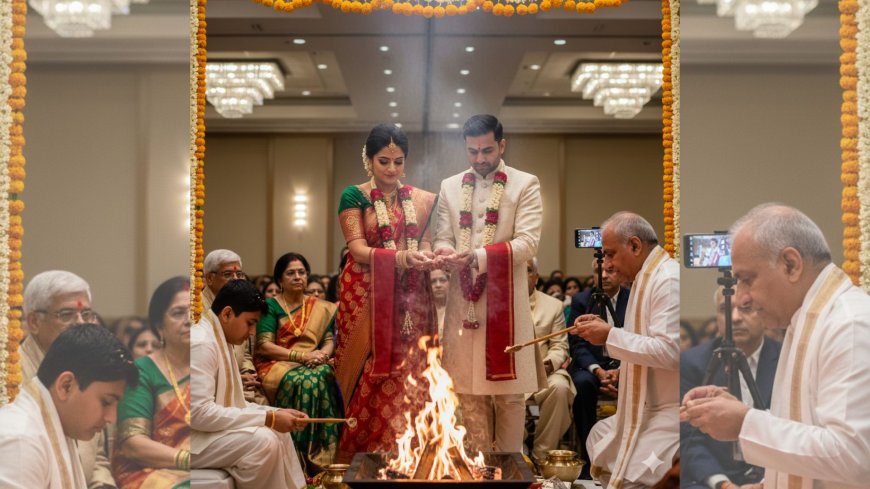
The Saat Phere — the seven sacred circumambulations around the fire — is the moment every Hindu wedding builds toward. But in Gujarati Brahmin tradition, the seven steps carry customs, prayers, and philosophical weight that are distinct from every other regional interpretation of this ancient rite. For Gujarati Brahmin NRI families from Ahmedabad, Vadodara, and Surat now living in Leicester, Edison, Toronto, Nairobi, and Melbourne, understanding the specific texture of their community's Saat Phere is not a matter of academic interest — it is the difference between a ceremony that feels inherited and one that merely feels performed.
You have watched Saat Phere in Bollywood films your whole life. The fire, the flowers, the slow circumambulation, the priest chanting. You thought you understood it. Then you attended your cousin's wedding in Ahmedabad — or your maasi's daughter's wedding in a community hall in Leicester — and watched the Gujarati Brahmin version unfold, and realised that what you had seen in films was a generalisation, and what you were watching now was the specific thing. The real thing. Your thing.
The way the laja [puffed rice] was offered into the fire. The particular sequence of the vows. The moment the bride's brother poured rice into her joined hands. The precise words the pandit spoke for each of the seven rounds — not generic blessings, but specific, named intentions, each one a different dimension of what a marriage is meant to be.
You are in Edison or in Nairobi or in a suburb of Melbourne, planning a wedding that will happen in a hired hall far from Gujarat, and you want that specific thing. Not a version. Not an approximation. The actual Saat Phere that your grandmother's mother walked, on a day that became your family's beginning.
🌟 DID YOU KNOW?
- The Saptapadi [seven steps] — the Vedic name for what Gujarati families call Saat Phere — is the only element of a Hindu wedding ceremony that is given explicit legal recognition in the Hindu Marriage Act of 1955, which states that a Hindu marriage is legally solemnised when the seventh step is completed, making it simultaneously the most spiritually significant and legally decisive moment of the entire ceremony.
- In Gujarati Brahmin tradition, the seven circumambulations are not merely walked — they are walked with the bride leading for the first four rounds and the groom leading for the final three, a sequence that encodes a sophisticated understanding of feminine and masculine energies in a marriage: the bride leads the household's nourishment, prosperity, and domestic foundation; the groom leads the family's dharmic, social, and spiritual direction.
- The sacred fire (Agni) around which the Saat Phere are performed is not merely a ritual prop in Vedic understanding — Agni is a deva [deity], specifically the divine messenger who carries offerings between the human and celestial realms, and the couple's circumambulation of Agni is understood as making their vows not merely to each other but to the divine itself, witnessed by the most ancient of the Vedic gods.
What Is Saat Phere in Gujarati Brahmin Tradition?
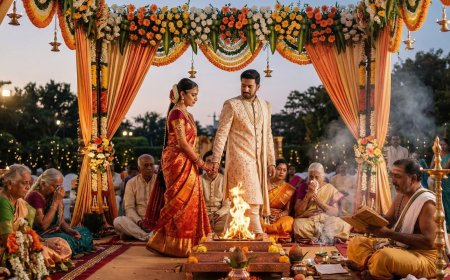
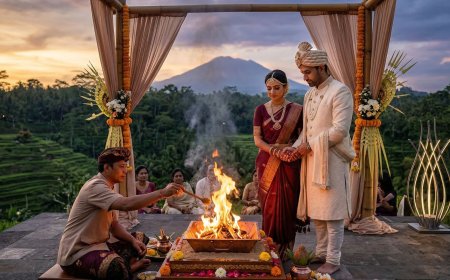
Saat Phere [seven circumambulations, from saat — seven, and phere — rounds or turnings] is the central sacred ritual of the Gujarati Brahmin wedding — the moment the bride and groom walk seven times around the Agni [sacred fire] in the havan kund [fire pit], each round accompanied by specific Vedic mantras, specific intentions, and in Gujarati Brahmin tradition, specific ceremonial actions that distinguish this community's practice from all other regional interpretations.
The ceremony occurs at the muhurtham [the auspicious time window] calculated by the family's pandit, after the preliminary rituals of Ganesh Puja, Var Swagatam [groom's welcome], Kanya Daan [the giving of the bride by her father], and Hast Milap [the joining of the bride and groom's hands with a sacred thread]. The Hast Milap — the moment the bride's right hand is placed in the groom's right hand by her father — is considered by many Gujarati Brahmin families to be the formal beginning of the marriage, but it is the Saat Phere that seals it in sacred, witnessed, and legally binding terms.
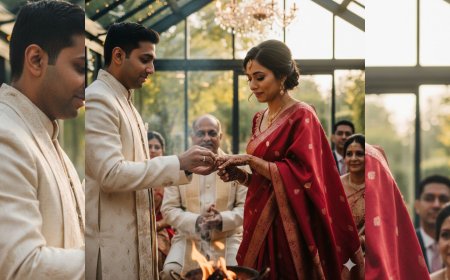
In Gujarati Brahmin practice, the bride and groom are connected during the circumambulations by the granthi bandhan[the sacred knot] — a length of cloth or sacred thread that ties the groom's uttariya [upper garment or shawl] to the bride's pallu [the end of her saree]. This physical connection — the couple literally tied together as they walk — is a powerful visual metaphor: they are bound, they move together, and neither can complete the journey without the other.
Before each round, or in the transition between rounds, the sapta padi mantras [seven-step sacred verses] are chanted by the pandit. Each of the seven rounds in Gujarati Brahmin tradition carries a specific named intention — food and nourishment for the first step, strength and vitality for the second, prosperity and wealth for the third, happiness and spiritual growth for the fourth, children and progeny for the fifth, seasonal abundance and health for the sixth, and eternal friendship and companionship for the seventh. The seventh round — Saptami — is the most sacred, the most witnessed, and the most emotionally resonant: it is the round of sakha [friendship], the vow that above all else, these two people will be companions to each other through everything life brings.
The laja homa [the offering of puffed rice into the sacred fire] is performed during the Saat Phere in a sequence that is specific to Gujarati Brahmin tradition: the bride's brother stands at the havan kund and pours laja [puffed rice] into his sister's joined hands, and she offers it into the fire as each round is completed. This act — the bride's brother providing the offering, the bride making it — encodes the continued presence of her natal family within her new life. She is not simply leaving; her brother's hands are in her hands, all the way around the fire.
Community Comparison: How Different Indian Communities Observe the Sacred Circumambulations
| Community / State | Local Name | Key Tradition | How NRIs Abroad Adapt It |
|---|---|---|---|
| Gujarati Brahmin | Saat Phere | Bride leads first four rounds, groom leads last three; laja homa with bride's brother; granthi bandhan; sapta padi mantras | Havan kund adapted for indoor venues; fire regulations addressed; smoke extraction arranged |
| Himachali | Saat Phere / Parikrama | Seven circumambulations with community witnessing; emphasis on community participation | Community members from Himachali sabhas attend; adapted to venue space |
| Garhwali | Saat Phere | Similar structure; local folk songs accompany each round; community women sing | Folk songs played via recording if community women unavailable |
| Kumaoni | Saat Phere | Emphasis on the seventh round as the most binding; community elder witnesses required | Kumaoni diaspora elders serve as witnesses in UK and Canada |
| Kashmiri Pandit | Lagan / Saat Phere | Fire ceremony central; specific Kashmiri Brahmin mantras; Kash [sacred grass] used | Kashmiri Pandit sabhas in New Jersey, London coordinate pandits |
| Punjabi Hindu | Saat Phere | Similar Vedic structure; Anand Karaj is the Sikh equivalent with four rounds | Hindu Punjabi families observe full seven rounds; Sikh families observe Lavaan |
| Marathi Brahmin | Saptapadi | Seven steps with specific Maharashtrian Brahmin mantra sequence; Antarpat [curtain] lowered before ceremony | Maharashtra Mandals in USA and Australia coordinate pandits |
| Tamil Brahmin | Sapthapathi | Seven steps; bride's saree tied to groom's dhoti; specific Tamil Brahmin mantra sequence | Extremely well-preserved in Tamil diaspora; pandits in Markham, Harrow, Melbourne |
| Telugu Hindu | Saptapadi | Seven steps around fire; precise muhurtham; Talambralu [rice shower] accompanies | Telugu pandits in Houston, London conduct full ceremony |
| Bengali Brahmin | Saat Paak / Saptapadi | Seven rounds; bride carried on wooden seat for first set of rounds in some traditions | Bengali community centres in London, Toronto support ceremony |
| Rajasthani | Saat Phere | Seven rounds with specific Rajasthani Brahmin mantra tradition; Phoolon ki Chaadar [floral canopy] held over couple | Rajasthani Samaj networks in UAE and UK coordinate |
| Kannada Brahmin | Saptapadi | Seven steps; specific Smartha or Madhwa mantra sequence; precise muhurtham | Kannada Brahmin pandits available in major diaspora cities |
The Meaning Behind the Ritual
The Saat Phere is the most theologically dense moment in a Hindu wedding — seven rounds that are not repetitions but progressions, each one adding a dimension to the marriage that the previous round did not contain. In Vedic cosmology, seven is not arbitrary. There are seven lokas [realms of existence], seven chakras [energy centres in the body], seven notes in the musical scale, seven colours in the spectrum of light. Seven is the number of completeness — a thing done seven times has been done in every possible dimension.
The fire — Agni Deva — is the witness that matters most. In Vedic theology, Agni is Havyavahana [the carrier of offerings], the intermediary between the human and divine. When the couple circles the fire, they are not merely performing a ritual in front of their family. They are making their vows to the cosmos itself, carried upward by the fire's smoke into the presence of every deity invoked at the ceremony's beginning. This is why the Saat Phere cannot be rushed — each round is a transmission, and the transmission requires the fire to be present and alive throughout.
The specific Gujarati Brahmin sequencing — bride leading for four, groom for three — reflects a Shakta philosophical understanding of feminine energy as the foundation of the household. The home, in this tradition, is primarily the domain of the Grihalakshmi [the goddess of the household, embodied by the wife] — it is her energy that makes it sacred, her presence that makes it prosperous, her management that makes it function. The groom's three leading rounds acknowledge his dharmic, protective, and spiritual responsibilities. Together, four and three make seven: the domestic and the transcendent, the earthly and the cosmic, the house and the universe.
For a non-Indian partner or family member: "They are walking a circle around fire, but what they are really doing is walking through every dimension of what a marriage will ask of them — and saying yes to each one."
Doing Saat Phere Abroad: The Practical Reality
The greatest logistical challenge of Saat Phere abroad is the fire — and it is a challenge that must be addressed months before the wedding, not the week before. Most banquet halls, hotel ballrooms, and function venues in the UK, USA, Canada, Australia, and East Africa have strict fire safety regulations that govern or prohibit open flames indoors. This does not mean the Saat Phere cannot be performed — it means the conversation with your venue must happen early, in writing, with full documentation.
Begin by asking your venue three specific questions: whether open flames are permitted indoors, whether a havan kund[fire pit, approximately 12 to 18 inches in diameter] can be placed on a heat-resistant surface on the ceremony floor, and whether the venue's ventilation can accommodate wood-fire smoke for approximately 45 to 60 minutes. Many venues — particularly those in areas with large South Asian communities — have developed specific fire safety protocols for Hindu weddings that allow contained havan fires with proper precautions: fire extinguisher on standby, smoke alarms temporarily covered or adjusted with prior notice to the fire safety authority, and a heat-resistant mat beneath the kund.
In Leicester, venues on and around the Belgrave Road corridor are the most experienced in the UK with Hindu fire ceremony requirements — many have hosted hundreds of Gujarati weddings and have established protocols. In London, venues in Wembley, Harrow, and Ilford with South Asian event experience will often have existing havan kund policies. In Edison, New Jersey, the concentration of Gujarati community events means most local venues are familiar with havan requirements. In Toronto, venues in Brampton and Mississauga that regularly host South Asian weddings have navigated fire safety protocols for havan ceremonies repeatedly. In Melbourne, the Dandenong and Springvale venue corridor serves the South Asian community and is increasingly experienced with fire ceremony accommodation. In Nairobi, the South Asian community event venues in Westlands and Parklands have managed havan ceremonies for generations.
If your venue genuinely cannot accommodate an open havan fire after thorough investigation, there are two honourable alternatives that most experienced Gujarati pandits will accept: a symbolic fire using a specially designed flameless electric havan unit (available from specialist Hindu ritual suppliers), or conducting the havan outside the venue — in a garden, a courtyard, or a designated outdoor area — and then returning indoors for the remainder of the ceremony. The former is more practical in cold climates; the latter is spiritually preferred if weather permits.
For the pandit: Gujarati Brahmin Saat Phere requires a priest familiar with the specific Shukla Yajurveda mantra sequence used in Gujarati communities, including the sapta padi mantras in their Gujarati Brahmin form and the specific laja homa sequence. A generalist pandit who conducts multi-community weddings may abbreviate or substitute mantras without the family realising — and family elders will notice. Specify your sub-community and Vedic tradition when engaging a pandit. NRI.Wedding's pandit directory lists Gujarati Brahmin priests by tradition and city. The BAPS Swaminarayan and Nar Narayan Dev temple networks in Leicester, London, Toronto, Edison, and Melbourne all maintain pandit contacts.
For the bride's brother's role in the laja homa: if the bride has no brother, the laja pouring role is traditionally taken by the bride's closest male cousin from the maternal line, or in some families, by the bride's father. Brief whoever takes this role on the specific sequence — they will stand at the havan kund for the duration of the Saat Phere and pour laja into the bride's hands before each offering. Prepare them in advance so the ceremony flows without hesitation.
For relatives in India watching via video call: position the streaming device at the havan kund level, angled to capture both the fire and the couple's movement around it. The smoke and flame of the havan create a visually dramatic and emotionally resonant image. A 7 PM ceremony in Leicester is 12:30 AM IST — late for Ahmedabad relatives; consider a morning ceremony or pre-record the Saat Phere for sharing. From Edison EST, a 6 PM ceremony is 3:30 AM IST — the same consideration applies. From Melbourne AEDT, a 10 AM ceremony is 4:30 AM IST.
Doing Saat Phere as a Destination Wedding in India
Gujarat offers some of the most architecturally magnificent and spiritually resonant settings for a Saat Phere ceremony in India. The heritage havelis of Ahmedabad's old city — particularly in the pols [traditional neighbourhood clusters] of Manek Chowk and Khadia — provide courtyard spaces where havan fires have burned for centuries and where the Saat Phere feels embedded in the very stones. The palace hotels of Rajkot and the riverside properties of Vadodara offer scale and beauty. The coastal venues near Dwarka — a city sacred to Lord Krishna, the presiding deity of Gujarat's spiritual imagination — carry a particular resonance for Vaishnava Gujarati Brahmin families.
Ahmedabad remains the most practical destination for a Gujarati Brahmin Saat Phere — the density of experienced pandits who know the specific mantra sequence, the availability of traditional ritual supplies, and the familiarity of venue staff with full havan ceremonies make it the easiest location for a complete, unabbreviated ceremony. Brief your Ahmedabad wedding planner specifically on your family's gotra, your Vedic tradition, and your expectation of the full laja homa sequence with the bride's brother's role preserved — not all planners assume this level of detail without being asked.
For non-Indian guests at a destination Saat Phere in Gujarat, the fire ceremony is the most universally legible sacred act in the Indian wedding repertoire. The sight of two people walking, tied together, around a living flame, in an ancient courtyard, with Sanskrit verses filling the air, requires no translation. Prepare a brief bilingual programme and let the ceremony speak for itself.
What You Need: Ritual Checklist
Ritual Items — havan kund [fire pit with grate, approximately 12–18 inches]; samidha [sacred wood — mango wood preferred in Gujarati tradition]; pure ghee [for fire offerings]; laja [puffed rice for the laja homa]; havan samagri [herbal mixture for the fire]; heat-resistant mat for beneath the kund; granthi bandhan cloth or sacred thread [for tying bride and groom]; fresh flowers for the mandap; akshata [turmeric-blessed rice]; coconut; betel leaves and arecanut; brass vessels for the pandit's ritual use; pancha gavya [five cow-derived substances — milk, curd, ghee, dung, urine — used in ritual purification, the first three being the practically observed elements]; mango leaves for mandap decoration; new clothes for both bride and groom; printed sapta padi mantra sheet for the pandit if required.
People Required — the officiating Gujarati Brahmin pandit familiar with Shukla Yajurveda Saat Phere mantras; the bride and groom; the bride's father [for Kanya Daan preceding the Saat Phere]; the bride's brother or designated male relative [for laja homa]; both sets of parents; assembled family and community as witnesses; a designated fire tender to maintain the havan flame throughout; photographer and videographer briefed on the seven-round sequence; a family timekeeper for the muhurtham window.
Preparation Steps — confirm venue fire permission in writing at least three months before. Source samidha and havan samagri from Gujarati grocery or puja supply stores. Confirm the pandit's familiarity with Gujarati Brahmin sapta padi mantras. Brief the bride's brother on his laja homa role. Prepare the granthi bandhan cloth. Confirm the muhurtham window with your pandit and share with the venue and photographer. Test the venue's smoke extraction before the wedding day. Position the streaming device for India relatives. Brief the photographer specifically on each of the seven rounds as distinct moments.
NRI.Wedding connects Gujarati Brahmin families with verified pandits experienced in Shukla Yajurveda Saat Phere, havan kund logistics support, and photographers who understand that each of the seven rounds deserves to be documented. Begin at NRI.Wedding.
5 Questions NRI Couples Always Ask
Our venue has banned all open flames — do we have a meaningful alternative?
Yes, and it is more common than you might think. The most widely accepted alternative among Gujarati Brahmin pandits abroad is the electric symbolic havan — a specially designed unit that uses heat-resistant materials and LED lighting to represent the fire without producing flame or smoke. Some pandits prefer to adapt by performing the fire ceremony in a designated outdoor space and then completing the Saat Phere indoors around the symbolic arrangement. The key is discussing this with your pandit well in advance — the right priest will have navigated this situation many times and will have a position that honours both the tradition and the practical constraint.
My partner is from a different Hindu community — whose Saat Phere tradition do we follow?
This is one of the most common questions for NRI intercommunity couples, and the answer requires a conversation with both families and a pandit experienced in intercommunity ceremonies. The most common approach is to follow the bride's family tradition if the wedding is hosted by her family, or to construct a ceremony that draws from both traditions in a way the pandit and both families agree is complete and respectful. What matters most is that neither family feels their tradition has been erased. A skilled pandit will navigate this with both knowledge and sensitivity.
Can the Saat Phere be done if we have already had a civil ceremony abroad?
Completely and without qualification. The Saat Phere — and the Saptapadi it enacts — operates in the sacramental register, entirely independently of civil registration. Many NRI Gujarati couples register legally in their country of residence at one time and conduct the full religious ceremony including Saat Phere at a separate, later date. Under the Hindu Marriage Act, it is the completion of the seventh step that constitutes the religious marriage. Your civil certificate and your Saat Phere are two separate acts in two separate registers, and both are complete and valid independently.
How do we preserve the bride-leads-first-four-rounds tradition if our pandit is not familiar with it?
This is where community-specific knowledge becomes critical. The bride leading the first four rounds is a specific Gujarati Brahmin custom — not universal across all Hindu communities — and a pandit who is not from your tradition may default to the groom leading all seven rounds, which is the more generic practice. Before engaging a pandit, ask specifically: "In Gujarati Brahmin tradition, the bride leads the first four rounds. Are you familiar with this and will you observe it?" A pandit who says yes with confidence and without hesitation is the right choice. NRI.Wedding's directory notes community-specific custom familiarity for each listed pandit.
What if the bride has no brother for the laja homa — is the ceremony incomplete without this element?
No ceremony is incomplete when conducted with full intention and the guidance of a knowledgeable pandit. The bride's brother's role in the laja homa is a deeply meaningful tradition, but in families where the bride has no brother, the role passes to the closest male relative of the bride's maternal line — a cousin, an uncle, or the son of a maternal aunt. In some families, the bride's father takes this role. The spiritual significance of the gesture — the natal family present in the bride's hands as she makes her offering to the fire — is fully preserved regardless of which male relative provides the laja.
The Emotional Angle
Nobody tells you that the Saat Phere will be the longest and shortest thirty minutes of your life simultaneously.
You have been planning this wedding for a year. You have argued about flowers and negotiated with caterers and driven relatives from airports and held your family together through every logistical crisis with a smile. And then the fire is lit, and the pandit begins the first mantra, and someone ties you to this person — this specific person you have chosen — with a length of cloth, and you begin to walk.
The first round, your feet feel the heat of the fire from your left side. The second round, you are aware of every person in the room watching you. The third round, you stop being aware of anyone except the person you are tied to. The fourth round — the last one you lead — something shifts. You have been walking toward something for four rounds. Now you will walk behind for three. The transition between the fourth and fifth round is, for many Gujarati Brahmin brides, the moment that arrives like a wave they did not see coming: the understanding that leading and following are both part of the same journey, that this marriage will require both, that the fire has witnessed the promise of both.
For NRI Gujarati families watching from the chairs, this is the moment their own Saat Phere comes back to them — the specific weight of the granthi bandhan, the specific sound of the mantras, the specific smell of the mango wood smoke. They are watching their child walk a circle they themselves have walked. The circle has no end point. That is the entire point.
A Moment to Smile
At a Gujarati Brahmin wedding in Toronto last spring, everything about the Saat Phere had been planned with extraordinary care. The havan kund was set up, the samidha was sourced from a specialist supplier in Brampton, the pandit was experienced and prepared, and the bride's brother — who had flown in from San Francisco specifically to perform the laja homa — had been briefed thoroughly on his role.
What nobody had briefed him on was that the laja [puffed rice] would be significantly lighter than he expected, and that when he poured it into his sister's joined hands for the third round, he would pour with the enthusiasm of a man who wanted to do the job properly.
The resulting cloud of puffed rice was magnificent. It went into the bride's hands, out of the bride's hands, into the fire, across the fire, over the pandit's left shoulder, and into the hair of the groom's aunt seated in the front row.
The pandit did not pause his mantra. The groom's aunt removed the puffed rice from her hair with the dignity of a woman who has attended many weddings and is not surprised by anything. The bride's brother performed the remaining four rounds with considerably more restraint.
The marriage is thriving. The puffed rice remains a family story.
Quotes from the Diaspora
"When we got to the seventh round — the sakha round, the friendship round — the pandit explained in Gujarati what it meant, and my husband turned and looked at me in a way he had never looked at me before. Not romantic. Something older than romantic. Like he was making a decision he had been thinking about for a long time and had finally made. I will never forget that look as long as I live." — Riya Desai, Gujarati Brahmin community, Leicester, UK
"My son's wedding was in Edison. We sourced the mango wood samidha from a supplier in Queens who imports it specifically for Hindu weddings. When the fire started and the smell of the mango wood filled the room, my mother — who was on video call from Ahmedabad — started crying immediately. She said it smelled exactly like the courtyard at home. That smell crossed eleven thousand kilometres through a phone screen." — Bharti Shah, mother of groom, Gujarati Brahmin community, Edison, New Jersey
"My husband is not Gujarati — he is Tamil. His family does Sapthapathi; my family does Saat Phere. Our pandit sat with both our grandmothers for two hours and built a ceremony that was both. Seven rounds. Two traditions. One fire. Both grandmothers satisfied. I still don't know how he managed it." — Pooja Mehta, Gujarati Brahmin community, Melbourne, Australia
Your Roots Travel With You
The fire travels. It has been lit in courtyard havelis in Ahmedabad and in banquet halls in Leicester and in community centres in Edison and in garden venues in Melbourne, and it has been the same fire every time — the same ancient, witnessing, carrying flame that has been present at the centre of Gujarati Brahmin marriages for thousands of years.
The seven rounds have been walked on marble and on carpet and on heat-resistant mats over parquet flooring, and they have meant the same thing every time — the same seven dimensions of commitment, the same progression from nourishment to friendship, the same bride leading and then following, the same granthi bandhan tying two people to the same direction.
NRI.Wedding supports Gujarati Brahmin families across the diaspora with verified pandits experienced in Shukla Yajurveda Saat Phere, havan kund logistics and venue fire regulation guidance, laja homa preparation, and photographers who understand that each of the seven rounds is a distinct and documentable vow. From Leicester to Edison to Toronto to Melbourne to Nairobi — wherever the fire is lit, the ceremony can be complete.
Light the fire. Tie the knot. Walk the seven rounds. Let the fire carry it upward.
This article explores the Saat Phere — the seven sacred circumambulations around the fire — in Gujarati Brahmin wedding tradition, including the unique customs of the bride leading four rounds, the laja homa with the bride's brother, and the granthi bandhan, and their practice among the Gujarati NRI diaspora in the UK, USA, Canada, East Africa, and Australia.
What's Your Reaction?
 Like
0
Like
0
 Dislike
0
Dislike
0
 Love
0
Love
0
 Funny
0
Funny
0
 Angry
0
Angry
0
 Sad
0
Sad
0
 Wow
0
Wow
0