






















































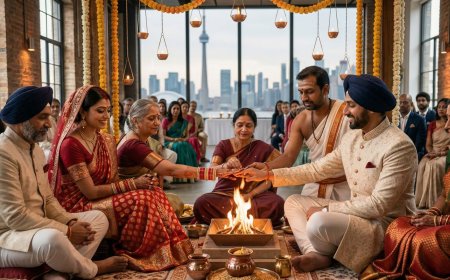



Where Two Souls Meet the Flame: The Sacred Significance of Agni in Indian Weddings
The sacred fire — Agni — is the theological heart of the Hindu wedding ceremony, functioning as divine witness, cosmic medium, and the force that makes marriage spiritually binding across four thousand years of Vedic tradition. For NRI couples planning weddings across the UK, US, Canada, UAE, and Australia, maintaining the ritual integrity of the Vivah Agni requires specialist pandits, compliant equipment, and careful venue negotiation. This guide covers the fire's meaning, community variations, and full practical guidance for diaspora couples.

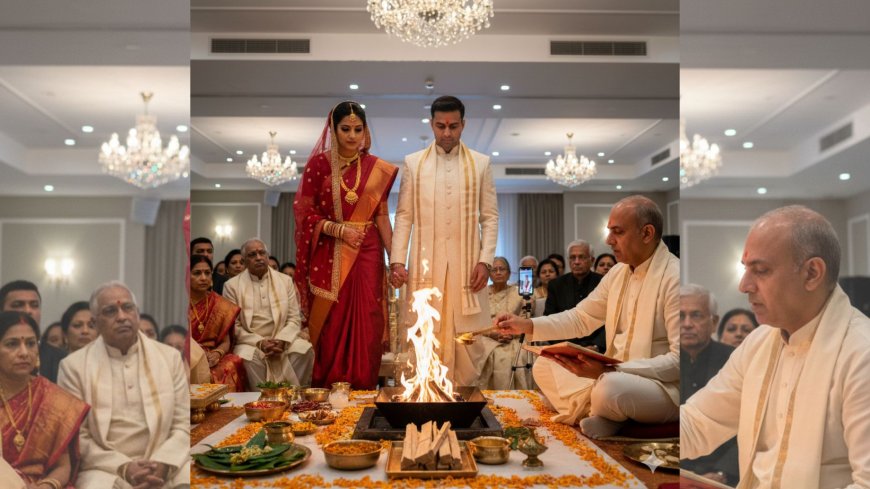
The sacred fire at the centre of the Hindu wedding ceremony is not a decorative element, a photographic backdrop, or a cultural formality — it is the oldest and most theologically precise witness available to any human event, a divine presence that the Vedic tradition has understood for four thousand years as the direct intermediary between human intention and cosmic reality. For NRI couples planning weddings from Singapore to Seattle, understanding what the fire actually is — what it means, what it witnesses, and why nothing in the Hindu wedding can be considered complete without it — transforms the ceremony from a beautiful ritual into a genuinely sacred act. This is the guide that gives the fire back its meaning.
You have seen it in every photograph. The orange light on the bride's face, the smoke rising, the pandit's hands moving through the flame with a precision that suggests long practice and deep knowledge. You have sat beside it, or you will sit beside it, and felt its heat on your face while Sanskrit words you may or may not fully understand moved through the air around you.
But here is what you may not have been told: the fire is not the backdrop to your wedding. The fire is the witness. Everything else — the flowers, the outfit, the guests, the venue — is the backdrop. The fire is the point.
You are in Auckland now, or in Atlanta, or somewhere in the East Midlands, and you are planning a ceremony in a venue with smoke detectors and sprinkler systems and a events manager who has sent you a politely worded email about open flames. And somewhere in you — beneath the logistics, beneath the vendor spreadsheets — is a feeling that something essential must not be lost. This article is about that essential thing.
🌟 DID YOU KNOW?
• Agni [the Vedic god of fire] is one of the most invoked deities in the entire Rigveda [the oldest of the four Vedas, composed approximately 1500–1200 BCE], appearing in more hymns than almost any other deity — a measure of how central fire was to every aspect of Vedic ritual life, from the domestic hearth to the cosmic ceremony.
• The Saptapadi [the seven sacred steps taken by bride and groom around the fire] is the legally recognised element of the Hindu marriage ceremony under the Hindu Marriage Act of 1955 in India — meaning that in Indian law, it is the completion of the seven steps around the sacred fire, not the exchange of rings or the signing of a register, that constitutes the marriage.
• In the Indian diaspora, the management of the ceremonial fire has become one of the most practically complex elements of the Hindu wedding — with NRI couples in the UK, US, Canada, and Australia increasingly commissioning specially designed portable Havan Kund [the sacred fire vessel] units that comply with venue fire safety regulations while maintaining the ritual integrity of the Vivah Agni [the wedding fire].
What Is Agni in the Hindu Wedding?
Agni — the sacred fire — occupies a position in the Hindu wedding ceremony that has no direct equivalent in any Western religious tradition. It is simultaneously a god, a witness, a medium of communication, a purifying force, and the living embodiment of the cosmic principle that makes the marriage real. When the Hindu wedding ceremony is described as being conducted "before Agni," this is not metaphor. Agni is understood to be genuinely present — summoned, invoked, and active — and the vows spoken in the fire's presence are understood to be received, recorded, and carried to the cosmos by the flame itself.
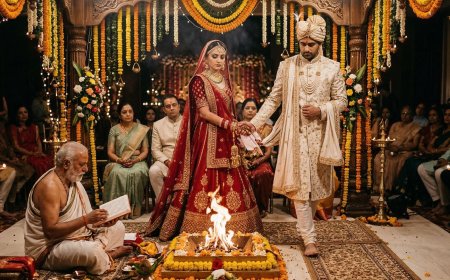
The fire used in the Hindu wedding ceremony is called Vivah Agni [the marriage fire] and it is kindled specifically for the ceremony through a ritual called Agni Sthapana [the establishment of the sacred fire], in which the Pandit [officiating priest] invokes Agni through specific Vedic mantras and offerings of Ghee [clarified butter], Samagri [the sacred mixture of herbs, grains, and aromatic woods], and Samidha [the sacred kindling sticks]. The fire is not lit casually — it is summoned with intention, welcomed as a guest of honour, and maintained throughout the ceremony with specific offerings at specific ritual moments.
The physical vessel of the fire is called the Havan Kund [the sacred fire pit] — traditionally a square pit dug in the earth or a specially constructed vessel, whose dimensions and proportions follow Vedic specifications encoding mathematical and cosmological principles. The square shape represents the four directions and the earthly plane; the fire rising from its centre represents the axis connecting earth and heaven.
The ceremony unfolds around and in relationship to the fire. The Panigrahana [the taking of hands] occurs beside the fire. The Laavan or Phere [the circumambulations around the fire] are the ceremony's central act — the couple's movement around the sacred flame encoding their joint commitment to the cosmic principles represented by each circuit. The Saptapadi — the seven steps — is the culmination, each step taken with a specific vow, each step witnessed by the fire, each step understood to forge an unbreakable bond in the presence of the divine witness.
Community Comparison Table
| Community / State | Name for the Fire Ritual | Number of Circumambulations | Key Distinctive Practice | How NRIs Abroad Adapt It |
|---|---|---|---|---|
| North Indian Hindu Brahmin | Phere / Saat Phere | 7 | Seven complete circumambulations; bride leads first four, groom leads last three | Portable Havan Kund used; venue fire permission obtained in advance |
| South Indian Tamil Brahmin | Homam / Sapthapadi | 7 steps, not full circles | Steps taken beside fire rather than circumambulation; fire central to Homam rituals | Tamil temple pandits manage fire; smaller ceremonial flame used in venues |
| Telugu | Homam / Saptapadi | 7 steps | Similar to Tamil; fire accompanied by specific Telugu Vedic mantras | Telugu pandits manage compliance; portable fire vessels used |
| Gujarati | Saat Phere | 7 | Seven circumambulations; specific Gujarati Vedic recitations accompany each round | Gujarati pandits widely available in Leicester and Edison NJ |
| Marathi | Saptapadi | 7 | Specific Marathi ritual sequence; Antarpat [ceremonial curtain] lowered at fire's first sight | Marathi mandal networks provide pandits; portable Havan Kund used |
| Bengali Hindu | Saat Paak | 7 | Bride carried on wooden seat around fire seven times by brothers; distinct from other traditions | Bengali community networks source wooden seat; brothers' role maintained |
| Rajasthani | Saat Phere | 7 | Fire accompanied by specific Rajasthani folk songs; vivid ceremonial context | Community singing maintained; folk musicians hired in diaspora cities |
| Punjabi Hindu | Saat Phere | 4 (in some traditions) | Some Punjabi Hindu families do four Phere; Sikh Anand Karaj has no fire | Punjabi pandits in Southall and Brampton advise on family-specific tradition |
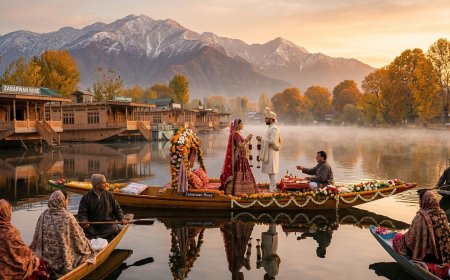
| Kashmiri Pandit | Lagan / Saptapadi | 7 | Highly specific KP ritual sequence around fire; distinct mantras | KP pandits remote-consulted; in-person KP priests rare outside major cities |
| Himachali / Garhwali | Phere | 7 | Mountain community traditions include specific local offerings to fire | Community elders maintain tradition; hill-region pandits consulted remotely |
The Meaning Behind the Fire
To understand why Agni witnesses the Hindu marriage, you must understand what Agni is in the Vedic worldview. Agni is not simply combustion. Agni is the transformative principle of the universe — the force that converts the physical into the spiritual, the material into the immaterial, the human intention into cosmic reality. When the oblations of ghee and samagri are offered to the fire, they do not merely burn. They are transformed — carried by the smoke from the earthly plane to the divine one, received by the devas [gods] as communication from the human world below.
This is why the Hindu marriage must be conducted before Agni. The vows spoken in the fire's presence are not simply heard by the witnesses in the room — they are carried to the cosmos by the transformative medium of fire itself. They become permanent in a way that no human witness, no legal document, and no social institution can make them permanent. The fire makes the marriage real at a level beyond the human.
The Phere — the circumambulations — encode this philosophy in movement. Each circuit around the fire is a circuit around the cosmic axis, a declaration to all four directions and the heavens above that these two people are choosing each other in full sight of the universe. The number seven is not arbitrary — the Saptapadi corresponds to the seven Dvipas[continents of the Vedic cosmological map], the seven Svaras [notes of the musical scale], and the seven vows that together constitute a complete human life lived in partnership.
The fire at the centre of the Hindu wedding is the universe's way of saying: I was there, I witnessed this, it is real.
Keeping the Sacred Fire Burning Abroad: The Practical Reality
The fire is the element of the Hindu wedding ceremony that causes the most logistical anxiety for NRI couples — and for understandable reasons. The venues that host weddings in the UK, US, Canada, and Australia are designed around Western event formats, and their fire safety systems are not designed with the Havan Kund in mind.
The good news is that this problem is entirely solvable, and hundreds of NRI couples solve it successfully every year. The key is early communication, the right equipment, and a pandit who has navigated this before.
The first step is the venue conversation, and it must happen before you sign any contract. Ask specifically about open flame policies, smoke detector sensitivity, ventilation systems, and whether previous Indian wedding ceremonies with fire have been conducted at the venue. Many experienced Indian wedding venues in diaspora cities — particularly in Southall, Leicester, Brampton, Mississauga, and Parramatta — have hosted enough Hindu weddings to have established protocols. If the venue has no experience, you are their first conversation on this topic and you will need to educate them.
The equipment solution used by most NRI pandits in diaspora cities is a compact, lidded, smoke-minimising Havan Kund — a portable sacred fire vessel designed to maintain ritual integrity while dramatically reducing smoke output. These units use specific wood combinations and controlled ventilation to produce a genuine sacred fire with minimal smoke. They are available through Indian religious supply shops and through pandit networks in major diaspora cities. In London, the religious supply shops of Ealing Road in Wembley and the Southall Broadway carry or can order these. In Toronto, the Gerrard Street East and Mississauga corridors have religious supply stores. In Houston, Hillcroft Avenue is the primary source. In Sydney, Harris Park in Parramatta carries religious supplies.
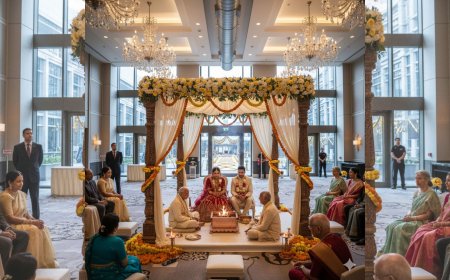
Some venues require a fire suppression assessment before permitting any open flame. In this case, your pandit should accompany you to the venue walkthrough — an experienced NRI pandit will know exactly what questions the venue's safety officer will ask and how to answer them. The British Hindu community has developed specific guidance for Hindu ceremonies in UK venues; the Hindu Council UK and similar organisations can provide documentation that has been used successfully in venue negotiations.
The Ghee and Samagri required for the fire rituals are available from Indian grocery suppliers in all major diaspora cities. Specific varieties of Samidha [sacred kindling] can be sourced from Indian religious supply stores or ordered online from specialist suppliers. Your pandit will provide a specific list of what is required; source everything at least two weeks before the ceremony to allow time for any substitutions if specific items are unavailable.
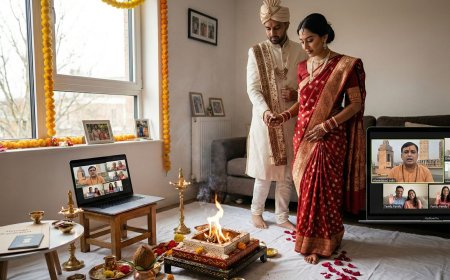
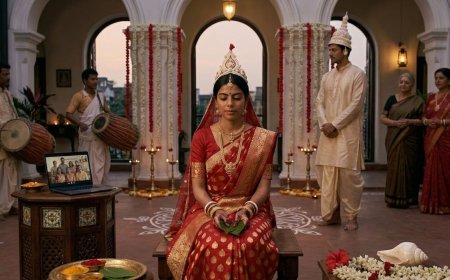
For coordinating with relatives in India watching via video stream, ensure that the camera placement captures the fire centrally — the fire's presence in the video frame matters to relatives who understand its significance. Test your streaming setup the day before the ceremony, and position the camera low enough to show both the couple and the flame together.
The Sacred Fire at a Destination Wedding in India
For NRI couples planning destination weddings in India, the fire question resolves entirely — the Havan Kund will be prepared by the pandit according to full traditional specifications, the samagri will be of the highest quality, and no smoke detector negotiation will be required. The fire can be as it was always meant to be: generous, fragrant, and fully present.
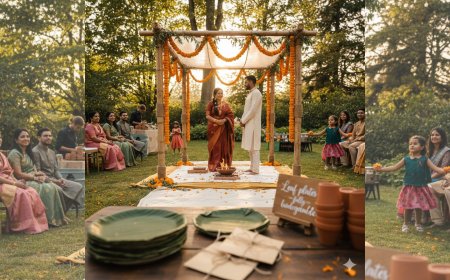
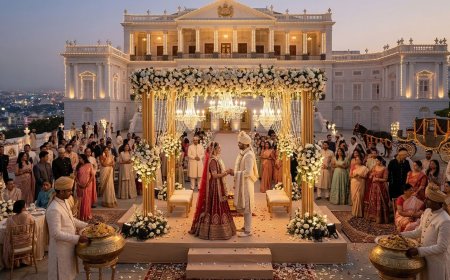
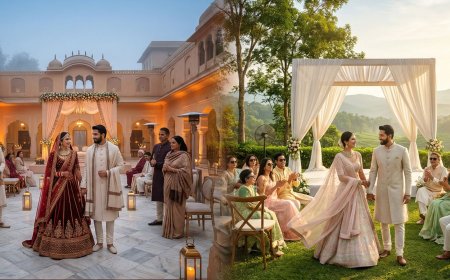
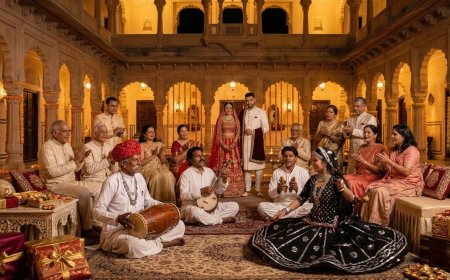
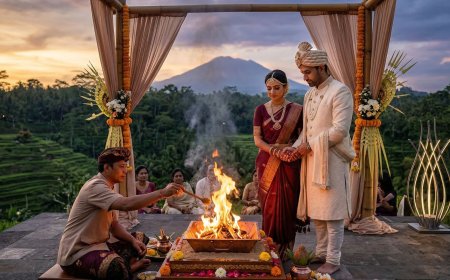
Destination wedding venues in Rajasthan — the heritage palaces and havelis of Jaipur, Udaipur, and Jodhpur — have conducted thousands of Hindu fire ceremonies in their courtyards and mandap spaces, and their event teams understand exactly what is required. The open-air mandap settings of Rajasthan are among the most beautiful contexts for the Vivah Agni in the world — the fire visible against an open sky, the smoke rising freely, the ceremony unfolding in the physical landscape that produced the tradition.
For non-Indian guests attending a destination wedding in India, the fire ceremony is often the most profound and memorable element of the entire celebration. A brief explanation in the wedding booklet — describing Agni as the sacred witness, explaining the Phere and the Saptapadi — transforms bewildered observation into genuine participation. Most non-Indian guests, when they understand what they are watching, find the fire ceremony deeply moving. Several NRI couples have reported that their non-Indian in-laws were more visibly emotional during the Phere than any other element of the wedding.
What You Need: Fire Ritual Checklist
Ritual Items: Portable smoke-minimising Havan Kund or traditional Havan Kund depending on venue, pure Desi Ghee[clarified butter from indigenous cow breed, preferred for ritual use], Samagri [the sacred herbal and grain mixture for fire offerings], Samidha [sacred kindling sticks], Paan ke Patte [betel leaves], Supari [areca nuts], specific offerings required by your community tradition, fire safety equipment as required by venue.
People Required: Qualified pandit experienced in conducting fire ceremonies at diaspora venues, venue fire safety coordinator briefed in advance, a designated family member to manage fire safety compliance on the day, both sets of parents for specific ritual roles around the fire.
Preparation Steps: Confirm venue fire permissions at least four months before the ceremony, source smoke-minimising Havan Kund through pandit or religious supply store, brief pandit on venue-specific requirements, obtain all samagri and ghee at least two weeks before the ceremony, prepare a fire ritual explanation for non-Indian guests, test video streaming setup for relatives in India, confirm pandit's arrival time allows full Agni Sthapana before the ceremony begins.
NRI.Wedding connects couples with experienced pandits who have conducted Hindu fire ceremonies across diaspora venues in the UK, US, Canada, UAE, and Australia — priests who know both the full depth of the Vedic fire tradition and the practical requirements of getting a Havan Kund approved in a Hertfordshire country house or a Toronto hotel ballroom.
5 Questions NRI Couples Always Ask
Our venue has refused to allow any open flame. Is there a ritually valid alternative to the sacred fire?
This is the most difficult question in NRI Hindu wedding planning, and it deserves an answer. The traditional Vedic position is clear: the fire is not optional. The Vivah Agni is the witness without which the ceremony is not complete in the tradition's own terms. However, most experienced NRI pandits distinguish between the ideal and the workable — and many have developed approaches for genuinely fire-prohibited venues. Some use a deeply symbolic small flame in a sealed glass vessel; some use electric flame simulations with full ritual intention; some relocate the fire element to a separate outdoor ceremony space and conduct the indoor elements without it. None of these are the full tradition. All of them are preferable to abandoning the ceremony entirely. Discuss this openly with your pandit, who will give you guidance rooted in both ritual knowledge and practical experience. And do everything possible to find a venue that will permit the fire before accepting that it cannot be done — because it almost always can.
How many times should we circumambulate the fire, and does it matter which direction we go?
The number of circumambulations — and which partner leads which circuit — varies by community tradition. Most North Indian Hindu communities observe seven full Phere, with the bride leading the first four circuits and the groom leading the final three. Some Punjabi Hindu families observe four circumambulations. South Indian Tamil and Telugu traditions observe seven Sapthapadi steps taken beside the fire rather than full circumambulations. The direction is clockwise — Pradakshina [the sacred clockwise direction] — which in the Vedic worldview represents alignment with the sun's movement and the natural order of the cosmos. Confirm the specific tradition of your community with your pandit before the ceremony, as family variations exist within these broad patterns.
Can a female pandit conduct the fire ceremony, and is this ritually valid?
Female pandits — Panditayin or Purohita— are increasingly available in diaspora communities and in progressive Hindu communities in India. The question of ritual validity is one that different families and different branches of Hindu tradition answer differently. The Vedic tradition itself contains examples of women as ritual specialists; the restriction of the priestly role to men is a later social convention rather than a theological absolute. Many NRI couples in diaspora communities are choosing female pandits for their wedding ceremonies, finding that the combination of ritual knowledge and a more inclusive ceremonial presence reflects their values. If this is important to you, NRI.Wedding can connect you with qualified female pandits available in major diaspora cities.
How do we explain the fire ceremony to our non-Indian guests so they understand what they are witnessing?
The most effective explanation is the one that speaks to something universal: every culture has understood that some promises need a witness more permanent than human memory, more reliable than human institutions. In the Hindu tradition, that witness is fire — the transformative force of the universe, the medium through which human intention reaches the divine. When your non-Indian guests understand that the couple walking around the fire is not performing a picturesque custom but making the most binding commitment their tradition knows how to make — in the presence of a witness understood as divine — the ceremony becomes immediately legible and deeply moving. A one-paragraph explanation in your wedding booklet, or a brief word from the pandit at the ceremony's beginning, achieves this transformation completely.
We are having a civil ceremony the day before our Hindu wedding. Which ceremony is our "real" marriage?
Both are real — in different and complementary ways. The civil ceremony creates a legal marriage recognised by the state in which you live. The Hindu fire ceremony creates a marriage recognised by your tradition, your community, your ancestors, and — in the Vedic worldview — the cosmos. Most NRI couples experience the civil ceremony as necessary and the Hindu ceremony as sacred — the one that makes them feel married in the way that matters most. There is no contradiction between them. Many NRI couples describe the civil ceremony as the legal instrument and the Phere as the moment they actually became husband and wife. Both deserve to be conducted with full attention and care.
The Emotional Angle
There is a specific moment during the Phere when the fire does something. You are moving, and the smoke is rising, and the Sanskrit is filling the air, and then you look at the person beside you — your person, the one you chose — and the fire is between you and above you and around you, and something becomes true that was not true before you started walking.
This is not poetry. NRI couples describe it consistently, across communities and cities and generations of diaspora experience: the moment during the circumambulations when the ceremony stops being something happening to them and becomes something happening in them. When the fire stops being an element of the venue and becomes what the tradition always said it was — a witness, a presence, a divine confirmation of something the two of you already knew.
For NRI families, this moment carries everything. It carries the grief of the relatives who could not travel, watching on a phone screen eleven time zones away. It carries the pride of parents who brought their traditions across oceans and kept them alive in living rooms and community halls and temple basements, so that this moment could happen. It carries the love of grandparents who performed these same circuits around a fire in a courtyard that no longer exists, in a city the family left, in a world that has changed entirely — except for this. Except for the fire. Except for the walking.
The fire does not know it is in Birmingham. The fire does not know about the smoke detector above it or the events manager outside the door. The fire knows what it has always known: that two people are making a promise in its presence, and that it is witnessing something true.
A Moment to Smile
At a wedding in Melbourne two years ago, the carefully sourced smoke-minimising Havan Kund performed exactly as advertised — minimal smoke, beautiful flame, full ritual integrity. The venue's smoke detector, however, had not received this information and activated with spectacular thoroughness approximately forty seconds into the first Phere.
What followed was a four-minute pause in which the groom, still holding the bride's hand in full wedding attire, stood beside an actively beeping alarm while the venue manager climbed a chair with a folded programme to fan the detector, the pandit waited with the serene patience of someone who has seen everything, and the bride's mother filmed the entire sequence on her phone while making the specific face of a woman who has planned this day for eleven months.
The alarm was silenced. The Havan Kund was repositioned. The Phere resumed. The marriage was completed with full ritual validity.
The video, which the bride's mother had not intended to share but mentioned to one cousin, has now been seen by the entire extended family across four countries. The groom considers it the funniest thing that has ever happened to him. The bride considers it character-building. The pandit has not commented.
Quotes From the Diaspora
"I did not expect to cry during the Phere. I am not someone who cries at ceremonies. But when we started walking and the fire was there — really there, not a candle, not a symbol, the actual fire — something happened that I cannot explain rationally. I understood for the first time why it had to be fire. Why nothing else would do." — Arjun Sharma, North Indian Hindu, London
"My mother flew from Chennai to Toronto for my wedding specifically to ensure the Homam was conducted correctly. She sat beside the pandit the entire ceremony. Afterward she said: now it is done properly. That was the highest praise available from my mother. I treasure it." — Priya Venkataraman, Tamil Brahmin, Toronto
"My husband is Irish. He told me before the wedding that he found the idea of the fire ceremony beautiful but abstract. After the Phere, he said: I understand now why you needed it to be this way. I said: good. He said: the fire was real. I said: yes. That is exactly the point." — Meera Iyer, South Indian Hindu, Dublin
Your Roots Travel With You
The sacred fire has been at the centre of the Hindu marriage for four thousand years — through migrations and invasions and the complete transformation of the world around it, it has remained the one indispensable element of the ceremony. It crossed the oceans with the Indian diaspora. It burns in hotel ballrooms in Birmingham and community halls in Brampton and heritage venues in Houston, summoned by pandits who know how to call it forth wherever they stand.
NRI.Wedding connects couples with experienced pandits who have conducted Vivah Agni ceremonies across diaspora venues worldwide — priests who carry the full depth of the Vedic fire tradition and the practical wisdom to make it happen wherever you are. We also connect you with photographers who know how to capture the fire the way it deserves to be captured: as the witness it is, not the backdrop it is sometimes mistaken for.
Find your pandit. Light your fire. Make your vows in its presence.
The fire has been waiting for this moment since the tradition began. Step into its light.
This article covers the significance of Agni and the sacred fire in Hindu weddings, including Vivah Agni, Havan Kund, Saptapadi, and Phere traditions across North Indian Brahmin, Tamil, Telugu, Gujarati, Bengali, Marathi, Punjabi, Rajasthani, Kashmiri Pandit, and Himachali communities, with practical guidance for NRI couples conducting fire ceremonies in the UK, US, Canada, UAE, and Australia.
What's Your Reaction?
 Like
0
Like
0
 Dislike
0
Dislike
0
 Love
0
Love
0
 Funny
0
Funny
0
 Angry
0
Angry
0
 Sad
0
Sad
0
 Wow
0
Wow
0