





































































Why the Sagai Means More to NRI Families Than the Wedding Itself — And How to Do It Properly Wherever You Are
The Sagai — India's formal engagement ceremony — is far more than a ring exchange. For NRI families across the US, UK, Canada, UAE, and Australia, it is the moment two families formally unite across cultures, continents, and traditions. Known as Mangni in Rajasthan, Nischayathamboolam in Tamil communities, and Saakhar Puda in Maharashtra, this pre-wedding ritual carries deep spiritual and emotional significance. This guide covers regional variations, practical planning advice, sourcing ritual items abroad, finding community-specific pandits, and coordinating with family in India.


Before the Wedding Comes the Promise: The Complete Guide to Sagai — India's Engagement Ceremony — For NRI Families
The Sagai is where two families stop being strangers and begin becoming one. For NRI couples navigating the space between cultures, continents, and expectations, this ancient engagement ritual carries a weight that no civil registry or ring exchange can fully replicate — and understanding it deeply is the first step to doing it right.
You remember the day your cousin's Sagai happened in Lucknow. The house smelled of roses and freshly fried mathri. The women were in their best salwar suits at ten in the morning. Someone's aunt had been crying since dawn — not from sadness, but from the particular overwhelm of watching something beautiful begin. You were young enough to find it exciting and old enough to understand it mattered.
Now it is your turn. Or your child's. And you are in Mississauga, or Manchester, or Melbourne, trying to figure out how to hold this moment with the same gravity it deserves — in a house that does not smell of rose water yet, in a city that does not know what a Sagai is, with a guest list arriving from three different continents.
This guide exists for that moment. For the family that knows the Sagai is not just a party — it is a declaration. A formal beginning. The first stitch in the fabric of two families becoming one.
🌟 DID YOU KNOW?
The word Sagai derives from the Sanskrit root sakha (companion or friend), reflecting the ancient understanding that an engagement is not merely a legal agreement but the formal beginning of a lifelong companionship between two people and their extended families.
In many North Indian communities, the Sagai historically preceded even the formal fixing of the wedding date — the ceremony itself was considered binding enough that breaking a Sagai was treated with the same social gravity as a divorce, a tradition that persists in cultural memory even in diaspora communities today.
Community surveys among South Asian diaspora families in the UK and Canada consistently show that engagement ceremonies are among the most frequently retained traditional rituals among second-generation NRIs, with over 70% of British Indian and Canadian Indian couples opting for a traditional Sagai over or alongside a Western-style engagement party.
What Is Sagai?
Sagai (the formal engagement ceremony) is one of the oldest and most emotionally significant pre-wedding rituals in Indian tradition, marking the moment a marriage alliance moves from discussion to declaration. Known by different names across regions — Mangni in Rajasthan and parts of North India, Nischayathamboolam in South India, Ashirwadin Bengal — the ceremony serves a universal purpose: to formally announce, in the presence of family and community, that two people have chosen each other and that their families stand united behind that choice.
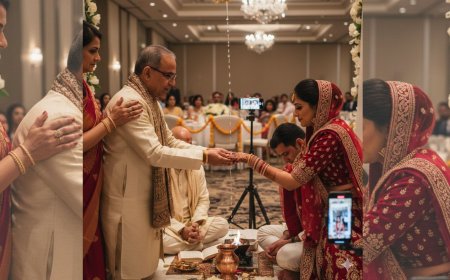
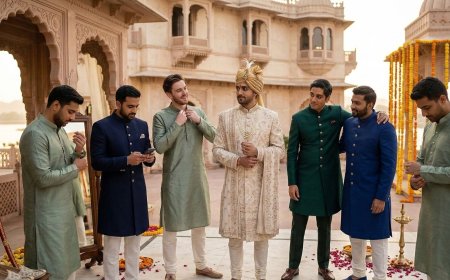
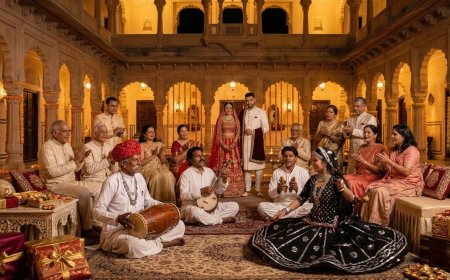
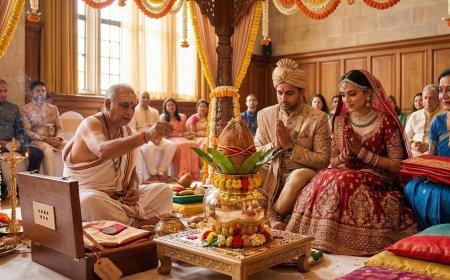
The Sagai typically occurs weeks or months before the wedding itself, though in some communities it takes place just days before. The ceremony begins with the arrival of the groom's family at the bride's home, bearing gifts — typically sweets, dry fruits, jewellery, and clothing. The centrepiece of the ritual is the exchange of anguthi [rings], in which the bride and groom place rings on each other's fingers before the assembled family. This moment — simple in its physicality, enormous in its meaning — is witnessed by elders who offer their aashirvad (blessings).
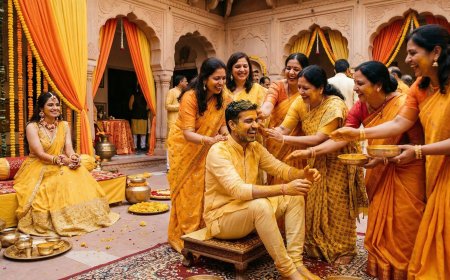
The tilak [sacred mark applied to the forehead] plays a central role in many regional versions of the Sagai. The bride's family applies a tilak to the groom, formally welcoming him into their family's affection and acknowledging his status as their daughter's chosen partner. In return, gifts are exchanged between families in a ritual of reciprocal generosity called shagun [auspicious gift-giving], with each item carrying symbolic meaning — turmeric for auspiciousness, coconut for fertility and new beginnings, sweets for the sweetness wished upon the couple's life together.
A pandit [priest] may or may not be present depending on the family's tradition, but in most communities the ceremony is accompanied by prayers, the application of haldi [turmeric paste] or kumkum [vermillion], and the sharing of food. The moment the rings are exchanged and the elders' blessings are given, the couple is formally considered engaged — not in the Western legal sense, but in the deeper social and emotional sense that Indian family structures honour most.
Community Comparison Table
| Community/State | Local Name | Key Tradition | How NRIs Abroad Adapt It |
|---|---|---|---|
| Punjabi | Kurmai / Sagai | Groom's family brings sweets and ring; roka (formal stopping of search) may precede; women sing folk songs | Ring exchange in banquet hall or home; Punjabi folk music played via speaker; shagun gifts sourced from local Indian shops |
| Rajasthani | Mangni | Elaborate gift exchange; groom's family brings thali with coconut, sweets, jewellery; community witness essential | Community members from local Rajasthani sabha invited; thali items sourced from Indian stores; pandit engaged for formal blessings |
| North Indian (General Hindu) | Sagai / Mangni | Ring exchange, tilak on groom, shagun gifts; pandit may recite brief prayers | Home or hired hall celebration; pandit found through temple network; gifts ordered online or sourced locally |
| Gujarati | Gol Dhana / Sagai | Gol Dhana (jaggery and coriander seeds) distributed as formal announcement; ring exchange follows | Gol Dhana distributed to community via WhatsApp announcement and local gathering; sourced from Indian grocery stores |
| Marathi | Saakhar Puda | Literally "sugar packet" — groom's family brings a packet of sugar to the bride's home as formal acceptance | Sugar packet tradition maintained; Marathi families in Melbourne and Toronto hold intimate home ceremony |
| Bengali | Ashirwad / Paka Dekha | Formal meeting of families; exchange of sweets and blessings; no ring exchange traditionally — family elders' blessing is the formal seal | Family gathering with mishti (Bengali sweets) sourced from Indian stores; video call with India elders for blessing |
| Tamil (Hindu) | Nischayathamboolam | Exchange of betel leaves and areca nuts between families; formal declaration of alliance; priest recites Sanskrit shlokas | Betel leaves sourced from Indian grocery stores; Tamil-speaking pandit engaged; ceremony streamed for Chennai family |
| Telugu | Nischitartham | Similar to Tamil tradition; exchange of coconuts, betel, and gifts; families formally announce the alliance | Adapted to home setting; Telugu community pandit found through local temple; shagun items sourced locally |
| Kashmiri Pandit | Livun / Kuth | Pre-engagement purification ritual; formal family meeting with exchange of gifts and dry fruits | Purification ritual maintained at home; dry fruits and walnuts (central to Kashmiri tradition) sourced from Indian stores |
| Himachali / Pahadi | Shagun / Sagai | Elder-led ceremony; community blessing essential; local deity invoked before formal engagement | Video call with village pandit for deity invocation; community elders in diaspora city invited to witness |
The Meaning Behind the Ritual
In the Indian worldview, a marriage is never solely between two individuals — it is a covenant between two families, two lineages, and in the most ancient understanding, two sets of ancestors. The Sagai is the moment this covenant is made visible.
The ring, in the Indian context, carries meaning beyond Western romantic symbolism. It is a bandhan [bond] — a physical object that represents the invisible tie now formed between two people and, through them, between two families. When a mother places a ring on her son's finger to give to his bride, she is not simply participating in a ceremony — she is releasing him into a new primary bond while simultaneously gaining a daughter. That emotional complexity — the joy and the letting go — is what makes the Sagai, for many families, more emotionally significant than the wedding itself.
The shagun gifts are equally layered. Turmeric is not simply a spice — it is Haridra [the golden one], associated in Vedic tradition with auspiciousness, purification, and the sun's transformative power. The coconut is Shriphal [the sacred fruit of Lakshmi], offered whenever a new and important beginning is being consecrated. Every item in the Sagai thali is a prayer in object form.
The Sagai says, in the oldest language human beings know: we see you, we choose you, and we will stand as witness to this choosing.
Doing Sagai Abroad: The Practical Reality
The Sagai abroad is one of the most manageable of all Indian pre-wedding rituals to execute with full authenticity — and yet it is also the one most commonly diluted into a generic "engagement party" by NRI families who do not know where to begin. Here is how to do it properly.
The venue question is simpler than you might expect. The Sagai is fundamentally a home ritual — it was designed for a house, not a hall. Many NRI families find that their own home or the home of a close relative creates exactly the right intimacy. If guest numbers require a larger space, look for community halls or Indian cultural centres that allow you to set up a traditional atmosphere rather than a corporate event space. In most diaspora cities, South Asian wedding halls and gurudwara community halls offer flexible spaces that accommodate the ritual setup.
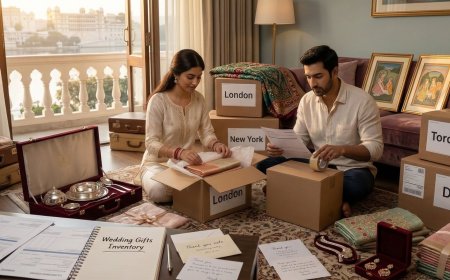
Sourcing Sagai items is straightforward in any major diaspora city. The core items — rings (purchased from a jeweller of your choice), sweets, coconut, turmeric, kumkum, betel leaves and areca nuts, red cloth for the thali, and dry fruits — are available in Indian grocery stores across all major NRI cities. In London, Wembley's Ealing Road and Southall's Lady Margaret Road have everything, with sweet shops that will prepare fresh mithai [Indian sweets] to order. In Toronto, Gerrard Street East and Peel Region's Brampton shops cover all requirements. In Houston, Hillcroft Avenue carries full Sagai supplies. In Sydney, Harris Park in Parramatta is your destination. In Dubai, Meena Bazaar in Bur Dubaihas every item required. The Sagai thali itself can be purchased ready-made from most Indian home decor stores or assembled at home.
The pandit question depends on your community tradition. Many Sagais do not require a pandit — the ceremony is led by family elders. However, if your family tradition includes a formal prayer or Sanskrit shlokas, a community pandit adds significant depth to the moment. Book your pandit at least six to eight weeks in advance, specifying your regional tradition. A Punjabi family needs someone familiar with Punjabi engagement customs; a Tamil family needs a Tamil-speaking priest who knows the Nischayathamboolam sequence. NRI.Wedding's pandit directory connects you to verified, community-specific priests across all major diaspora cities.
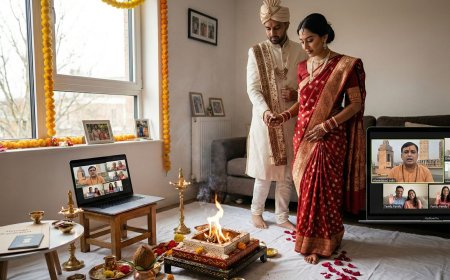
Coordinating with India via video call requires careful setup. Designate one device — not a shared phone — positioned to show the full ceremony space, particularly the moment of ring exchange and the tilak. If your family in India is in multiple locations, use a group video call platform that all family members are comfortable with, and do a test call 24 hours before. The Sagai moment — when the rings are exchanged and the elders give their blessing — should be experienced in real time by everyone, wherever in the world they are. If your India family is in IST and your ceremony is in the afternoon in Toronto (EST), that translates to a late evening in India — manageable and worth the wait.
Doing Sagai as a Destination Event in India
For NRI couples returning to India specifically for their Sagai — an increasingly popular choice among diaspora families who want the full cultural immersion — the location choice should follow the family's regional roots.
For North Indian and Punjabi families, Delhi and Amritsar offer the most culturally resonant settings, with established event spaces and full vendor ecosystems accustomed to NRI returnee families. Jaipur is the natural heartland for Rajasthani Sagai traditions, with venues that understand the specific ritual requirements of a Mangni ceremony. For Gujarati families, Ahmedabad and Surat both have strong traditions and experienced local vendors. For South Indian families, Chennai, Hyderabad, and Bengaluru all have experienced pandits and venues familiar with Telugu and Tamil engagement rituals.
When briefing local pandits in India as an NRI family, bring a written note of your specific community tradition, sub-regional customs, and any family-specific practices you want preserved. Most experienced city pandits are accustomed to NRI families and are happy to incorporate specific requests. For non-Indian guests attending the Sagai in India, prepare a simple printed English guide to the ceremony's meaning — international guests consistently describe Indian engagement rituals as among the most moving ceremonies they have ever attended, particularly when they understand what each element represents.
What You Need: Sagai Checklist
Ritual Items Two rings (bride's and groom's, chosen together or as a family surprise), a decorated thali [ritual plate] lined with red cloth, coconut, turmeric, kumkum, betel leaves and areca nuts (minimum 5 pairs), dry fruits, sweets (fresh mithai preferred), a red dupatta or cloth for the bride, a shawl or kurta for the groom from the bride's family (in many traditions), flowers for decoration, incense, a small diya, and shagun envelopes for family gift-giving.
People Required Both sets of parents, at least one senior elder from each family to lead the blessing, a pandit if your tradition requires formal prayers, a designated family member to manage the video call setup for India relatives, and a photographer — this moment deserves to be documented properly.
Preparation Steps Confirm the Sagai date and time with both families at minimum two months in advance. Book your pandit early if required. Source all ritual items two weeks before. Prepare or order fresh sweets three days before. Set up a dedicated video call device one day before and test the connection. Brief all participating family members on the ritual sequence so the ceremony flows without confusion. Arrange seating so elders are prominently placed and visible both in the room and on the video call.
NRI.Wedding's vendor directory, pandit network, and Sagai planning checklist connect you to verified professionals across the UK, US, Canada, UAE, and Australia — explore our directory to ensure your engagement ceremony is everything it deserves to be.
5 Questions NRI Couples Always Ask About Sagai
Can we combine the Sagai with a Western-style engagement party to accommodate non-Indian guests?
Many NRI couples do this beautifully — and the key is sequencing, not compromise. Conduct the traditional Sagai ritual first, with full ceremonial integrity, and then transition into a reception-style gathering for broader guests. This way, the ritual is not diluted by a mixed audience who may not understand its significance, and your non-Indian guests get to witness it as something complete and meaningful before the celebration begins. A brief printed or spoken explanation of the Sagai ritual for non-Indian guests at the start of the ceremony makes an enormous difference to their experience and their appreciation.
My partner is not Indian. How do we make the Sagai meaningful for both families?
The Sagai translates across cultures more easily than most Indian rituals because its core gesture — the exchange of rings and the formal blessing of elders — has parallels in many traditions worldwide. The key is preparation: brief your partner thoroughly on what each element means, give them a specific role (receiving the tilak, presenting a gift to your family), and consider asking your pandit or a bilingual family member to narrate each step in English as it unfolds. Most non-Indian partners and families find the Sagai deeply moving precisely because of its formality and sincerity — the explicit involvement of elders and community is something many Western families find quietly beautiful.
How do we find a pandit in our city who knows our specific regional Sagai tradition?
Specificity is essential here. Do not contact a generic temple and ask for any available pandit — ask explicitly for a priest familiar with your community's engagement customs. A Rajasthani Mangni has different ritual requirements from a Tamil Nischayathamboolam, and a pandit unfamiliar with your tradition will conduct a generic ceremony that may feel hollow to family elders. NRI.Wedding's verified pandit directory organises priests by community and tradition. Your local regional cultural association — Punjabi sabha, Gujarati samaj, Tamil cultural centre — is also a reliable source of personal referrals for community-specific priests.
How formal does the Sagai need to be? Can we do something small and intimate?
The Sagai is entirely scalable to your family's preference and circumstances. Its ritual requirements — the ring exchange, the tilak, the shagun gifts, the elders' blessing — can be fulfilled in a living room with ten people as authentically as in a hall with two hundred. What matters is the intention, the presence of both families (physically or virtually), and the correct ritual elements. Some of the most beautiful NRI Sagais happen in small apartments with home-cooked food and family elders on video call — and they are no less meaningful for their intimacy. Do not let the question of scale prevent you from doing the ritual at all.
Should the civil engagement (or notice of intent to marry) happen before or after the Sagai?
Most NRI families treat the civil and religious processes as entirely parallel tracks that operate independently. The Sagai is the emotionally and culturally primary event — it is the moment the family considers the couple formally engaged. Civil registration of the marriage itself happens separately, typically close to the wedding date. There is no requirement for these to be sequenced in any particular order, and most NRI couples complete civil paperwork in the weeks before or after the wedding, treating the Sagai as the real beginning regardless of what the registry office says.
The Emotional Angle
Nobody tells you that the Sagai might be harder than the wedding. The wedding has so much ritual, so much movement, so many people pulling your attention in every direction that the emotion becomes almost abstract. But the Sagai — particularly abroad, in a smaller room, with the people who matter most — has a stillness to it that catches you completely unprepared.
It is the moment your mother takes the ring from its box and places it in your partner's hand, and you watch her fingers — the same fingers that braided your hair, that checked your fever at midnight, that packed your suitcase the day you left for university abroad — touching the hands of the person you have chosen. It is the moment your future mother-in-law ties a dupatta around your shoulders and calls you her daughter, in a room thousands of miles from the village where that gesture was first invented.
For NRI families, the Sagai carries an extra layer that is difficult to name. It is the relief of tradition continuing. The proof that despite the distance, despite the years of navigating between two cultures, despite everything that was quietly given up in the act of immigration — this was not given up. This was carried. This is still here, being performed in a living room in Brampton or a garden in Melbourne, with the same rice grains and the same red cloth and the same trembling hands.
That is not a small thing. That is everything.
A Moment to Smile
At a Sagai in Houston two years ago, the bride's family had prepared a magnificent thali — coconut, kumkum, sweets, the works — and positioned it carefully on the coffee table for the ceremony. What they had not accounted for was the family's three-year-old nephew, who had been eyeing the sweets since the guests arrived and chose the exact moment of the ring exchange to make his move.
As the groom slipped the ring onto the bride's finger and the room fell into the particular emotional hush that only Sagais produce, a small hand appeared from beneath the coffee table and removed an entire ladoo from the thali with surgical precision. The bride's grandmother, seated directly opposite, watched this happen with full visibility and said nothing — but the expression on her face, caught perfectly by the photographer, told the whole story.
The nephew was retrieved, the thali was reassembled, and the grandmother declared the ladoo theft auspicious. "It means the children will come quickly," she said. The room erupted. The couple, still holding hands, laughed until they cried. It is the first photograph in their Sagai album.
Quotes From the Diaspora
"We did our Sagai in our living room in Mississauga with thirty people and my entire extended family in Jaipur on a TV screen via video call. When my father applied the tilak to my fiancé from across the room — the physical tilak in Canada, my father watching and giving his blessing from Rajasthan — I felt something settle inside me that I didn't know had been unsettled. Like a door closing gently." — Anjali Sharma, Rajasthani bride, originally from Jaipur, now in Mississauga
"My son's fiancée is from Ireland. She had never attended any Indian ceremony before the Sagai. When my sister tied the dupatta around her shoulders and called her 'beti' [daughter], this Irish girl — who had been completely composed all morning — just broke down. She told me later she had never felt so formally welcomed into a family in her life. That is what the Sagai does. It does not ask you to be Indian. It asks you to be family." — Sunita Malhotra, Punjabi mother of the groom, originally from Amritsar, now in Birmingham
"My mother flew from Chennai to Melbourne specifically for my Sagai. She brought the betel leaves from Tamil Nadu in her hand luggage — she didn't trust Australian shops to have the right kind. She was correct. They didn't. Those leaves were on my Nischayathamboolam thali, and when the pandit recited the shlokas, I could hear my grandmother's voice underneath his, the way she used to recite them at every family ceremony when I was a child. My mother brought that sound with her, across twelve time zones, in a plastic bag of betel leaves." — Kavitha Subramaniam, Tamil Brahmin bride, originally from Chennai, now in Melbourne
Your Promise Travels With You
The Sagai is where your story as a couple begins — not in the registry office, not at the altar, but in the room where your families first stand together and say: yes, this is right, we are with you. For NRI families, making that moment happen across oceans and time zones and cultural distances is an act of extraordinary love — for each other, for your families, and for the tradition that has survived everything to reach this moment.
NRI.Wedding supports couples and families across the UK, US, Canada, UAE, and Australia with verified community pandits for every regional Sagai tradition, Sagai vendor directories for ritual items and jewellery, experienced NRI wedding photographers who understand the significance of every moment, and planning checklists built specifically for diaspora families navigating engagements across two continents.
Your engagement is the beginning. Make it everything it deserves to be.
Your promise was made here — carry it forward with the same intention.
This article explores the Sagai engagement ceremony and its regional variations across Indian communities — including Mangni, Nischayathamboolam, Ashirwad, Saakhar Puda, and Kurmai — with practical planning guidance for NRI families in the US, UK, Canada, UAE, and Australia.
What's Your Reaction?
 Like
0
Like
0
 Dislike
0
Dislike
0
 Love
0
Love
0
 Funny
0
Funny
0
 Angry
0
Angry
0
 Sad
0
Sad
0
 Wow
0
Wow
0