





































































Seven Steps, One Journey: The Real Meaning of Saptapadi and Why It Changes Everything About How NRIs Think About Their Wedding Vows
The Saptapadi — seven sacred steps taken together around the holy fire — is not an exchange of vows or a marriage contract. It is one of the oldest continuously practised wedding rituals in the world, first documented in Vedic texts from 300 BC. Rooted in the philosophy of partnership over promise, this guide explores the Saptapadi's spiritual origins, regional variations across Punjabi, Tamil, Bengali, and Kashmiri traditions, and offers practical guidance for NRI couples performing the ritual in Toronto, London, Melbourne, Houston, and Dubai.

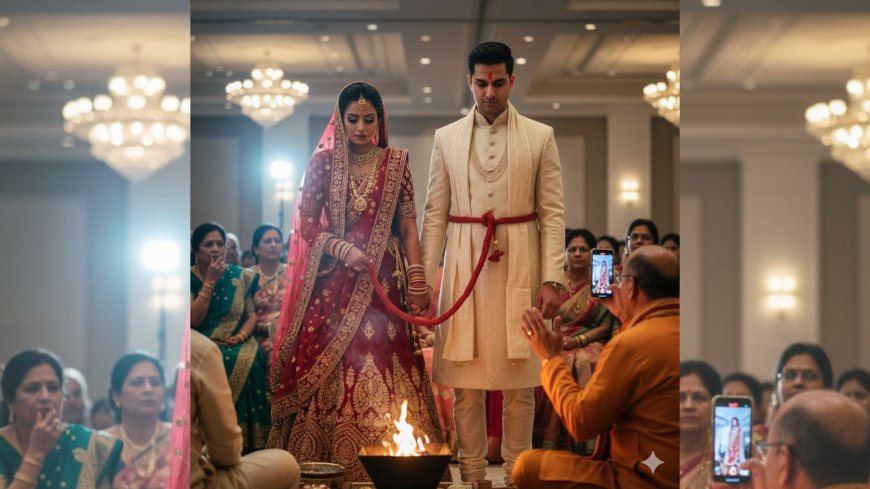
The Saptapadi — seven steps taken together around the sacred fire — is not a promise, not a contract, and not a vow. It is something far more profound: an acknowledgement of partnership, witnessed by fire, family, and the cosmos itself. For NRI couples navigating two worlds, understanding what these seven steps actually mean may be the most important thing they do before they take them.
You have probably heard it called "the seven vows." Your wedding planner mentioned it. Your parents described it as the moment the marriage becomes official. Someone at the mandir told you it is the most sacred part of the Hindu wedding ceremony, and they were right — but the word "vows" is where the explanation usually goes slightly wrong.
You grew up in Toronto or Birmingham or Melbourne, in countries where weddings are built around promises. "I promise to love you. I promise to honour you. I promise to stay." The Western wedding — shaped by centuries of Christian and then civil contract tradition — is fundamentally an exchange of pledges. Two people face each other and make binding declarations. There is a moment of consent. There is, sometimes, a signature.
The Saptapadi is not that. It has never been that. And understanding the difference between a promise and a partnership — between a contract and a shared walk — is the key to understanding why those seven steps around the fire have endured for over two thousand years, and why they will still mean something real on the day you take them, wherever in the world that day occurs.
🌟 DID YOU KNOW?
The Saptapadi is first mentioned in the Grihya Sutras [ancient Vedic scriptures governing household rituals], texts dated to approximately 300 BC — making it one of the oldest continuously practised wedding rituals in the world, predating most contemporary religious wedding ceremonies by centuries.
In Hindu legal tradition, the Saptapadi holds specific legal recognition: under the Hindu Marriage Act of 1955, the marriage is considered complete and binding at the moment the seventh step is taken — not at the signing of any document, but at the completion of the shared walk.
The concept of marriage as a samskara [rite of passage or life-transforming sacrament] rather than a contract means that in classical Hindu understanding, the Saptapadi does not bind two people through obligation — it transforms them into a single unit, a grihasta [householder partnership] responsible together for family, community, ancestors, and the cosmos.
What Is the Saptapadi?
Saptapadi [from Sanskrit: sapta meaning seven, padi meaning steps] is the central and most sacred ritual of the Hindu wedding ceremony, in which the bride and groom walk seven steps together — around the sacred fire [Agni, the divine witness and messenger between humans and gods] — each step representing one of the fundamental dimensions of a shared life. It is the moment at which, in both spiritual and legal terms, two individuals become one partnership.
The ritual appears first in the Grihya Sutras, the ancient Vedic texts governing domestic and household ceremonies, composed around 300 BC. Unlike many wedding rituals that evolved from folk practice or royal custom, the Saptapadi has Vedic textual authority from its earliest documented form — though scholars note that it likely has pre-Vedic, possibly matriarchal origins in women's ritual traditions that were later absorbed into the Vedic framework.
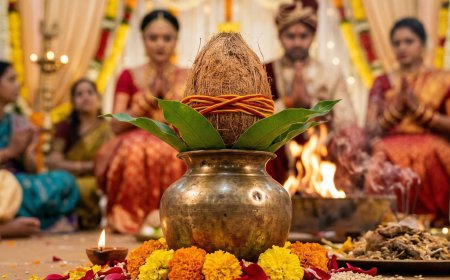
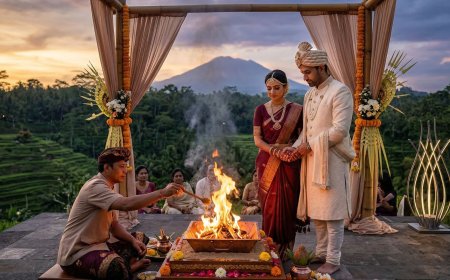
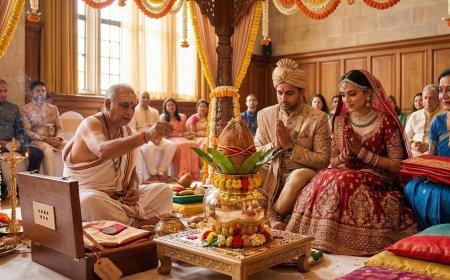
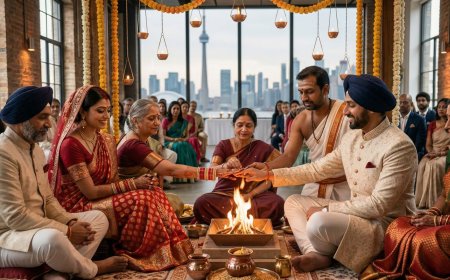
The physical structure of the ritual varies by community and region, but the core is consistent: the couple is joined — often by a cloth or garland — and walks seven steps together around Agni [the sacred fire], with the pandit [priest] reciting specific mantras [sacred sound formulas] for each step. In some traditions, the groom leads; in others, the bride leads certain steps; in many contemporary ceremonies, they walk side by side. The direction of circumambulation, the specific mantras recited, and the meaning assigned to each of the seven steps differ across communities — but the destination is always the same.
What the seven steps represent is deliberately open. The Grihya Sutras and later texts offer varying interpretations, but the most widely understood version encompasses: nourishment, strength, prosperity, happiness, progeny, seasonal abundance, and lifelong friendship. The seventh step — sakhyam [friendship, companionship] — is often described as the most important, the one that binds all the others. At the completion of the seventh step, the couple are considered sakha and sakhi — friends and partners — which is understood to be the highest form of the marital relationship.
Crucially, the Saptapadi is not an exchange of promises. Each step is an acknowledgement — a public enactment of what is already being chosen and shared — not a conditional pledge that can be kept or broken.
Community Comparison Table: Saptapadi Across Indian Traditions
| Community / State | Local Name | Key Variation in the Seven Steps | How NRIs Abroad Adapt It |
|---|---|---|---|
| Punjabi | Saptapadi / Saat Phere [seven circumambulations] | Seven full circles around the fire; groom leads first four, bride leads final three in many families; specific Punjabi folk songs sung by women during the phere | NRI couples in Toronto and London perform saat phere around a portable havan kund [fire vessel]; regional pandits recite Punjabi-tradition mantras |
| Sikh | Anand Karaj[ceremony of bliss] — Lavan [four circumambulations of the Guru Granth Sahib] | Four rounds rather than seven; circumambulation of the Guru Granth Sahib rather than fire; each round accompanied by a specific lav [sacred verse] from the Guru Granth Sahib | NRI Sikh couples perform Anand Karaj at the local Gurdwara; the ceremony is fully replicable abroad with an officiating Granthi [Sikh priest] |
| Rajasthani / Marwari | Saat Phere with Satapadi mantras | Seven circles; significant emphasis on the kanyadaan [gifting of the daughter] immediately preceding the phere; specific Rajasthani folk rituals accompany each step | NRI Rajasthani families in Houston and Melbourne source region-specific pandits; Rajasthani folk songs performed by women during the phere |
| Himachali | Saptapadi with regional Pahari mantras | Seven steps taken; in some hill communities, the steps are taken in a straight line rather than in circles; nature elements — water, grain — placed at each step | NRI Himachali families coordinate with pandits familiar with Pahari ritual traditions; steps adapted for indoor venues |
| Garhwali | Saat Phere with Garhwali folk traditions | Seven circles; mangal geet [auspicious songs] specific to Garhwal sung by women; the fire is considered especially sacred as Agni witnesses the mountain community's vow | Garhwali NRI communities in Vancouver perform the ritual with portable havan kund; elder women lead the folk song tradition |
| Kumaoni | Saptapadi with Kumaoni ritual additions | Seven steps with specific Kumaoni mantras; grain and water offered at each step; the seventh step has particular emphasis as the friendship vow | Kumaoni NRIs in Sydney coordinate with pandits via video to ensure regional mantra accuracy |
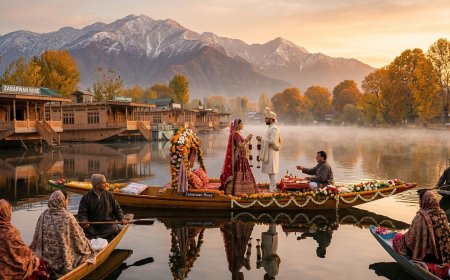
| Kashmiri Pandit | Lagan ceremony incorporating seven steps | The Kashmiri Pandit wedding has a distinct ritual structure; the seven steps are integrated into a longer ceremony with specific Kashmiri Pandit mantras and ritual objects including the thaal [ceremonial plate] | NRI Kashmiri Pandits in New Jersey and London work with specialist Kashmiri Pandit pandits; the diaspora community has been careful to preserve regional ritual specificity |
| Marathi | Saptapadi with Sapta Padi mantras | Seven steps taken; in Maharashtrian tradition, a supari [betel nut] is placed at each step as a witness; the bride's brother plays a significant role in the ceremony | NRI Marathi couples in Melbourne and Houston source supari and regional ritual items from Indian grocery stores; Maharashtrian pandits available in major diaspora cities |
| Tamil | Sapthapathi with distinct South Indian structure | Seven steps taken in a straight line in many Tamil traditions rather than around a fire; specific Tamil mantras; the oonjal [swing ceremony] often precedes the sapthapathi | NRI Tamil couples in London and Toronto work with Tamil Brahmin pandits; the ceremony structure differs significantly from North Indian saat phere |
| Bengali | Saat Paak [seven rounds] with distinct Bengali ritual | In Bengali weddings, the bride is carried on a wooden seat for seven circumambulations; fire is present but the structure differs from North Indian phere | NRI Bengali couples in London's Newham area and Toronto's Scarborough work with Bengali pandits to preserve the distinct ritual structure |
The Meaning Behind the Ritual
The most important thing to understand about the Saptapadi is the philosophy it encodes — and how radically different that philosophy is from the contract-based model of marriage that most NRI couples have grown up surrounded by.
In ancient Mesopotamian law, codified in the Hammurabi code around 1800 BC, marriage was explicitly a contract: terms, obligations, consequences for transgression. This contractual understanding of marriage flows through Biblical tradition, through Christian sacramental theology, through Islamic nikah [marriage contract], and into the secular civil marriage certificates that NRI couples sign at the registry office before or after their Hindu ceremony. The contract model says: I promise. You promise. These promises bind us. Breaking them has consequences.
The Saptapadi says something entirely different. It says: we walk. Not "I promise to walk with you" — but the walking itself, performed publicly, witnessed by Agni [fire, the most ancient divine witness in Vedic tradition], is the marriage. The enactment is the reality. There is no conditional clause, no penalty for transgression, no signature. There is only the shared movement — two people choosing, step by step, to go in the same direction.
This is why Agni witnesses rather than a priest officiating. Fire does not judge. Fire does not enforce. Fire illuminates and transforms. In the Vedic worldview, Agni is the messenger between the human and the divine — what is witnessed by fire is witnessed by the cosmos itself.
The partnership the Saptapadi creates is not between two people and an institution. It is between two people and the universe.
For a non-Indian partner or family member trying to understand what happened at those seven steps: she did not promise him anything, and he did not promise her anything — they simply walked together, and in walking together, they became one thing.
Performing the Saptapadi Abroad: The Practical Reality
The Saptapadi is the ritual that NRI couples most frequently describe as the emotional peak of their wedding — and the one that requires the most careful logistical preparation when performed abroad.
The central practical challenge is Agni — the sacred fire. Almost every element of the Saptapadi requires a fire, and fire at a wedding venue requires advance planning, negotiation, and sometimes creative problem-solving. The havan kund [fire vessel] used in most Hindu ceremonies produces smoke, and UK, Canadian, and Australian venues typically have smoke detector systems that will trigger unless precautions are taken. The solution is two-fold: notify your venue in advance and request that smoke detectors in the ceremony space be temporarily disabled or covered during the ritual — most experienced South Asian wedding venues in diaspora cities know how to handle this request. Alternatively, use a havan kund with a controlled, minimal-smoke flame and position it beneath an open window or near an air extraction point.
In London, venues along the Southall and Wembley corridors that regularly host Hindu weddings are fully experienced with this requirement. In Toronto, the South Asian wedding venue cluster in Brampton and Mississauga handles havan kund requests routinely. In Houston, venues on and around Westheimer Road with South Asian wedding experience are your best starting point. In Sydney, venues in Parramatta and the broader western suburbs have significant experience. In Dubai, hotel ballrooms in Deira and Bur Dubai frequently host Hindu ceremonies with fire — but always confirm in writing.
The pandit is the most critical practical element of the Saptapadi. The mantras recited at each of the seven steps are not generic — they are community-specific, and a Punjabi family's saat phere mantras differ from a Tamil family's sapthapathi, which differs from a Kashmiri Pandit's lagan ceremony. An experienced pandit from the wrong regional tradition can perform a technically correct but spiritually hollow version of your community's ritual. NRI.Wedding's pandit network is organised by regional tradition — you can specify Punjabi, Rajasthani, Tamil Brahmin, Kashmiri Pandit, or Maharashtrian and be connected with a pandit who knows your community's specific mantra tradition.
For families coordinating with relatives in India via video call during the ceremony, position the camera to have a clear view of the fire and the couple's feet — the steps are the ritual, and the people watching from India should be able to see each one. A 6 PM ceremony in Toronto corresponds to approximately 3:30 AM IST — which means India-side family will need to be specifically invited to stay up or wake early for this moment. A 2 PM ceremony in London corresponds to 6:30 PM IST, which is significantly more practical for live participation.
The Saptapadi as a Destination Wedding in India
For NRI couples choosing to marry in India, the Saptapadi in its home context reaches a fullness that is difficult to replicate abroad — not because the ritual is less valid elsewhere, but because every element that supports it is natively present. The pandits know the regional tradition without briefing. The havan kund produces its smoke freely. The family is gathered without time zones.
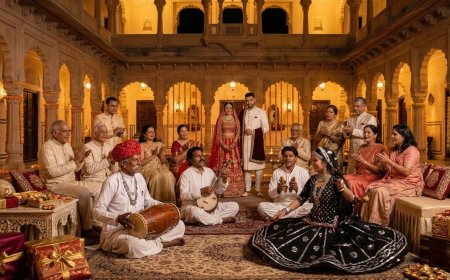
Rajasthan offers the most spectacular destination context — a Saptapadi performed in a Jaipur haveli courtyard at dusk, the fire reflecting off sandstone walls, is an experience that no ballroom abroad can match. Amritsar and Chandigarh are ideal for Punjabi traditions. For Tamil Brahmin ceremonies, Chennai or temple towns in Tamil Nadu offer pandits with the deepest knowledge of the sapthapathi tradition. Rishikesh and Haridwar in Uttarakhand are increasingly popular for NRI couples who want a Saptapadi performed on the banks of the Ganges — considered among the most auspicious possible settings for the seven steps.
Brief your Indian pandit in advance about any diaspora adaptations your family has incorporated — some NRI families have a tradition of both bride and groom reading a personal reflection at each step, which a traditional pandit will need to accommodate rather than resist. NRI.Wedding's India coordinator network can facilitate this briefing and ensure your regional ritual specificity is preserved.
What You Need: The Saptapadi Checklist
Ritual Items — a havan kund [fire vessel] of appropriate size for your venue, samagri [sacred fire offering materials including ghee, herbs, and grains], laja [puffed rice for fire offerings at each step], a cloth or garland to join the couple, sindoor [vermilion] for the sindoor daan [vermilion application] that follows the phere in many traditions, and akshat[unbroken rice grains] for blessings.
People Required — a regional pandit familiar with your community's specific mantra tradition, the bride and groom, the bride's brother or male relative for specific ritual roles in many communities, the groom's family for the reception of the bride into the family lineage at the ritual's conclusion, and a photographer and videographer positioned specifically for the fire and the seven steps.
Preparation Steps — confirm your venue's fire policy in writing at least three months before the wedding; book your regional pandit at least two to three months in advance; source havan samagri from Indian grocery stores or online vendors; conduct a rehearsal walk-through with the pandit the day before so both bride and groom understand the sequence; and if the ceremony will be attended by non-Indian guests, prepare brief printed explanations of each of the seven steps so that the meaning travels with the ritual.
NRI.Wedding's planning checklist, regional pandit network, and vendor directory for havan kund supplies and ceremony coordination are available at nri.wedding.
5 Questions NRI Couples Always Ask About the Saptapadi
Our venue will not allow an open fire. Can we perform the Saptapadi without the havan kund?
This is the most common practical challenge NRI couples face, and there are several approaches. First, always push back on the venue's initial refusal — most experienced South Asian wedding venues can accommodate a controlled havan kund with advance notice and proper precautions, including temporarily disabling nearby smoke detectors and ensuring ventilation. If a live fire is genuinely impossible, some pandits perform a modified ceremony using a diya [oil lamp] as the Agni witness — this is a diaspora adaptation that many families have adopted. Discuss this explicitly with your pandit, who can advise on the spiritual validity of the adaptation within your community's tradition.
My partner is not Hindu. Can they participate in the Saptapadi meaningfully?
Yes — and many non-Hindu partners find the Saptapadi more meaningful than the exchange-of-vows format they grew up with, precisely because it asks them to do something rather than say something. Brief your partner on what each step represents. Some couples prepare a personal reflection for each step — a shared private meaning for each of the seven dimensions of partnership — which the partner reads silently or aloud as they walk. The ritual's power is in the walking, not in a doctrinal belief system, and non-Hindu partners regularly describe the Saptapadi as the most profound moment of their wedding day.
How do we find a pandit who knows our specific regional tradition in a city like Calgary or Perth?
Start with your local mandir, which maintains connections to visiting pandits and can refer you to someone familiar with your regional tradition. NRI.Wedding's pandit network is categorised by regional tradition and covers major diaspora cities including those with smaller Indian communities. For very specific regional traditions — Kumaoni, Himachali, Kashmiri Pandit — a remote video-guided ceremony with a specialist pandit in India, supplemented by a local pandit for the fire, is an increasingly common and effective solution.
Our civil marriage was registered months before the wedding. Does the Saptapadi still "count" as the real marriage?
For Hindu families, the Saptapadi is the marriage — the civil registration is a legal formality that the Indian state and diaspora host countries require. The seventh step is the moment of completion in spiritual and traditional terms, regardless of what any government register says. Many NRI couples register civilly well in advance for visa or administrative reasons and then experience the Saptapadi as the true beginning of their married life. Both are real. They operate in different registers of reality.
Can we personalise what the seven steps mean rather than using the traditional Vedic interpretations?
Yes — and this is actually deeply consistent with the ritual's own tradition. The texts themselves offer varying interpretations of what each step represents, and the philosophical openness is intentional. Many contemporary pandits welcome couples who have thought carefully about what each step means to them personally — nourishment, creativity, adventure, laughter, chosen family — and incorporate these personal meanings alongside or within the traditional mantras. Discuss this with your pandit in advance. The Saptapadi is not a recitation of fixed promises; it is a choreography of shared intention, and your intention is its most important ingredient.
The Emotional Angle
There is something that happens on the fourth step that nobody quite prepares you for.
The first three steps, you are managing it. You are aware of the fire and the pandit's voice and your outfit and the faces of your family and whether you are walking at the right pace. You are present but also slightly outside yourself, watching the ritual happen as much as being in it.
And then somewhere around the fourth step — or the fifth, it varies — something shifts. The fire has been burning long enough that it feels real rather than ceremonial. Your hand is in your partner's hand and you have been walking together long enough that it has become natural. The pandit's mantras have become a rhythm rather than a script. And you realise, with a clarity that surprises you: this is it. This is the actual thing. This is what my grandparents did. This is what their grandparents did. This is the oldest human gesture — two people choosing to go in the same direction.
For NRI couples, this moment arrives carrying extra weight. You have spent years navigating between two worlds — the one you were born into and the one you were born in, the India of your family's memory and the country of your daily life. And here, in a hotel ballroom in Mississauga or a garden venue in Melbourne or a haveli in Jaipur, you are performing the oldest ritual your culture possesses. Seven steps around a fire that has been burning, in various forms, for three thousand years.
Nobody told you it would feel this ancient. Nobody told you that you would feel, on the fourth step, every generation of your family walking with you.
A Moment to Smile
In Melbourne, Victoria, at a South Asian wedding venue in Dandenong, a Telugu-Punjabi couple named Arjun and Navneet were performing their Saptapadi. They had two pandits — one from each family's tradition — who had agreed in advance to collaborate. The collaboration, it turned out, had not extended to agreeing on the direction of circumambulation.
The Punjabi pandit indicated clockwise. The Telugu pandit indicated anti-clockwise. Arjun looked at Navneet. Navneet looked at Arjun. The fire burned serenely between them, offering no guidance.
After a whispered three-way consultation that the wedding photographer later described as "the most important summit meeting of the evening," the couples' fathers — who had been at friendly diplomatic loggerheads for eighteen months of wedding planning — spontaneously agreed: clockwise for the first four, anti-clockwise for the final three. Both pandits accepted the compromise with the grace of men who had seen stranger things.
Arjun and Navneet's families still argue about whose direction was correct. The couple themselves have decided that walking in two directions and still arriving at the same place was, on reflection, a perfect metaphor for everything.
Quotes from the Diaspora
"I was raised Catholic. When my husband's pandit explained before the ceremony that the Saptapadi is not about promises — it is about walking — something unlocked in me. I had been nervous about making vows I couldn't guarantee. But walking? Walking together I could do. I could do that every day. That framing changed everything about how I entered those seven steps." — Siobhan Kaur Malhotra, Irish-Punjabi, Mississauga, Ontario
"My son wanted to skip the longer rituals and just do the phere. I said: the phere IS the longer ritual. It is the only ritual that actually matters. Everything else is beautiful. The saat phere is the moment you become a husband. You cannot abbreviate becoming." — Sudha Ramachandran, Tamil Brahmin, mother of groom, London, UK
"We wrote our own meanings for each of the seven steps and read them to each other quietly as we walked. The pandit recited the Sanskrit. We whispered our own words. It felt like we were having two conversations at once — one with the cosmos and one with each other. I will never forget what he said on the seventh step. I am not going to share it. But I will never forget it." — Ananya Sharma, Rajasthani, Dubai, UAE
Your Roots Travel With You
The Saptapadi is the oldest, most enduring answer the Hindu tradition has ever given to the question of what marriage is. Not a contract. Not a promise. Not a transaction between families or a sacrament requiring institutional witness. A walk. Seven shared steps around a fire that connects you to every generation before you and every generation that will come after.
For NRI couples taking those steps in cities their grandparents never visited, the Saptapadi is an act of cultural continuity so profound it barely needs explaining — and yet it deserves to be fully understood before you take it. NRI.Wedding's regional pandit network, ceremony planning checklists, havan kund vendor directory, and bilingual ceremony guides for non-Indian guests are all designed to ensure that when you reach the seventh step, you feel everything it was always meant to carry.
Take the seven steps. Feel every generation walk with you. Arrive, together, at the beginning.
This article explores the spiritual philosophy, cultural significance, and practical guidance for the Saptapadi — the seven sacred steps of the Hindu wedding ceremony — across Punjabi, Rajasthani, Tamil, Bengali, Kashmiri Pandit, Himachali, and Marathi traditions, with specific guidance for NRI couples in Toronto, London, Melbourne, Houston, and Dubai.
What's Your Reaction?
 Like
0
Like
0
 Dislike
0
Dislike
0
 Love
0
Love
0
 Funny
0
Funny
0
 Angry
0
Angry
0
 Sad
0
Sad
0
 Wow
0
Wow
0