









































































Seven Promises That Last a Lifetime: What the Saptapadi Really Means for NRI Couples
The Saptapadi — the seven sacred steps and vows taken around the holy fire — is the legally and spiritually constitutive heart of the Hindu wedding ceremony. For NRI families across the US, UK, Canada, UAE, and Australia, performing this three-thousand-year-old Vedic ritual abroad requires a community-specific pandit, careful fire management at overseas venues, and deep understanding of each vow's meaning. This guide covers all seven vows in detail, regional variations, practical planning, and how to make every step count wherever in the world you stand.

The Saptapadi — the seven sacred steps of the Hindu wedding — are not merely a ritual performed within the ceremony. They are the ceremony itself, the moment at which two people stop being individuals and become, in the eyes of the cosmos and their community, a unit of life built on seven specific and unbreakable promises. For NRI couples stepping into this ancient sequence in cities far from India, each step carries the full weight of three thousand years of the same vows, spoken into the same fire, by every couple in their lineage before them.
You have been to enough Indian weddings to know the moment. The pandit's voice changes register. The room shifts. Everyone who was half-watching, half-talking to their neighbour, suddenly turns and pays attention. The couple rises and begins to move around the fire, and something in the air changes — becomes heavier, more serious, more sacred. Even people who do not understand a word of Sanskrit understand that something irreversible is happening.
You have watched this from the outside many times. Now it is your turn. You are in London or in Houston or in Melbourne, and you are planning a wedding, and somewhere in the planning — between the caterer and the florist and the seating chart — is this: the Saptapadi. The seven steps. The seven vows. The ancient sequence that has been the heart of the Hindu Vivah for longer than most civilisations have existed.
You want to do this properly. Not just perform it — understand it. Know what each step means before you take it. Know what you are promising, and to whom, and why those specific seven things were chosen three thousand years ago by people who understood something profound about what a marriage actually requires.
This guide is for that couple. For the NRI family that knows the Saptapadi deserves more than a walk around a fire — it deserves to be fully understood.
🌟 DID YOU KNOW?
The Saptapadi [seven steps] is explicitly codified in the Manusmriti [the ancient legal text of Hindu tradition] as the defining act of Hindu marriage, with the text specifying that the marriage becomes legally and spiritually binding upon the completion of the seventh step — making it one of the oldest documented legal definitions of marriage in human history, predating most Western legal frameworks by well over a thousand years.
The seven vows of the Saptapadi correspond directly to the Sapta Loka [the seven planes of existence in Vedic cosmology], connecting the couple's earthly promises to the full architecture of the universe — meaning that each step taken is understood not merely as a human commitment but as a cosmic alignment, witnessed and recorded at every level of existence simultaneously.
Linguistic scholars studying Vedic Sanskrit have traced the specific mantra recited during the Saptapadi to the Rigveda's wedding hymns, making the words spoken at a Hindu wedding in a Birmingham hotel ballroom today — if recited correctly — virtually identical to the words spoken at Hindu weddings in the Indus Valley over three thousand years ago, an extraordinary continuity of human language and intention.
What Is the Saptapadi?
Saptapadi [from Sanskrit sapta meaning seven and pada meaning step or foot] is the central and legally constitutive ritual of the Hindu Vivah [wedding ceremony], in which the bride and groom take seven steps together around the Agni[sacred fire], with each step corresponding to a specific sacred vow that the couple makes to each other and to the cosmos. It is the moment at which, in the Hindu theological and legal framework, the marriage is actually and irrevocably made.
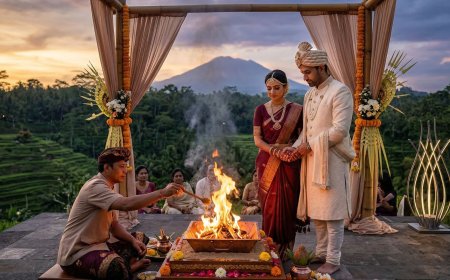
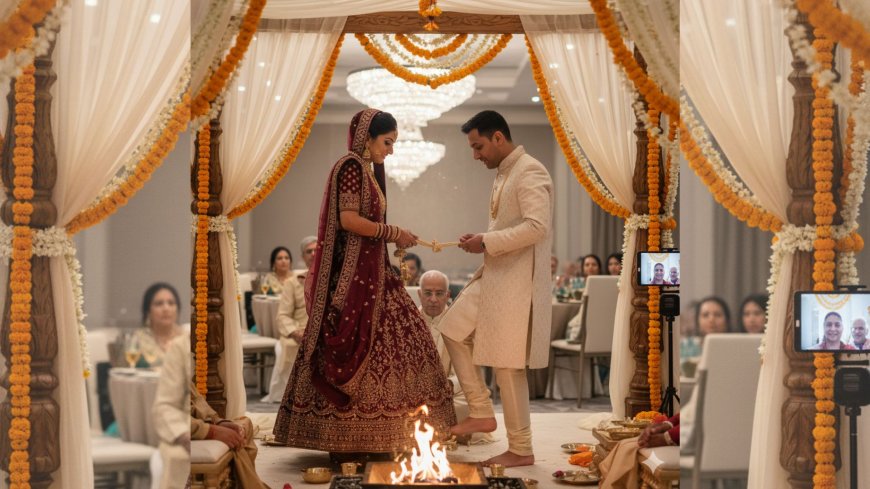
The ceremony takes place at the Vivah Mandap [the sacred ceremonial canopy], before the Havan Kund [the sacred fire vessel]. The bride's pallu [the trailing edge of her saree] or chunri [ceremonial dupatta] is tied to the groom's angavastram [ceremonial shawl] in the ritual of Gath Bandhan [the tying of the knot] before the first step is taken — this physical binding ensures they move together, that no step is taken alone.
The pandit [priest] recites the specific mantra [sacred verse] for each step before the couple moves, and the couple affirms each vow with swaha [so be it — the sacred affirmation of Vedic ritual]. In most North Indian traditions, the groom leads the first six steps with the bride following; in many South Indian traditions, the bride leads for certain steps, reflecting different theological understandings of the couple's relationship within the ceremony.
The seven vows, though they vary in exact wording across regional traditions, address in their classical formulation: Anna [food and nourishment], Bala [strength and vitality], Dhana [prosperity and abundance], Sukha [happiness and harmony], Praja [progeny and family continuity], Ritu [health across all seasons of life], and Mitra [eternal friendship and companionship]. Upon the completion of the seventh step, the pandit declares the couple married. Everything that follows is celebration of what the fire has already witnessed and the cosmos has already recorded.
The Seven Vows: Step by Step
The First Step — Anna [Nourishment] With the first step, the couple vows to provide nourishment for each other and for the household they are building together — not merely food, but the sustenance of body, spirit, and home. This vow establishes that the marriage is a practical unit of care as much as an emotional one, and that feeding each other — literally and metaphorically — is a sacred responsibility they are taking on together.
The Second Step — Bala [Strength] The second step is a vow of mutual strength — to be each other's source of courage when courage is required, to not leave the other to face difficulty alone. In the Vedic understanding, strength is not only physical; it is the capacity to stand firm when the world demands compromise of what is essential. This vow commits each partner to being the other's backbone.
The Third Step — Dhana [Prosperity] The third step addresses material prosperity — not as an end in itself but as the means by which a household fulfils its Dharma [sacred duty] toward family, community, and the wider world. The couple vows to create and steward abundance together, to neither squander what they are given nor close their hands to those who need what they have.
The Fourth Step — Sukha [Happiness] The fourth step is the vow of happiness — to actively seek joy together, to make the home a place of warmth and lightness, to choose each other's happiness as a daily practice rather than a passive hope. This is the most tender of the seven vows, and in many ceremonies it is the step at which the room is most visibly moved.
The Fifth Step — Praja [Progeny and Continuity] The fifth step extends the marriage beyond the couple themselves — it is the vow of family continuity, the acknowledgement that the couple's union is part of a larger lineage that existed before them and will continue after them. Whether or not the couple has children, this vow commits them to honouring the generations that made them and taking responsibility for what they will leave behind.
The Sixth Step — Ritu [Seasons of Health] The sixth step is perhaps the most quietly profound — a vow to care for each other's health through all the seasons of life, the seasons of ease and the seasons of illness, the seasons of abundance and the seasons of want. It is the vow that acknowledges that marriage is a long journey and that the body, like the year, moves through cold and warmth alike.
The Seventh Step — Mitra [Eternal Friendship] The seventh and final step is the one that seals all the others, and it is, in many ways, the most radical of all the seven: the pledge of Mitra — friendship. In the Vedic worldview, friendship is the highest and most durable form of human love, outlasting romantic passion, enduring through difficulty, and deepening rather than diminishing over time. The marriage that is built on friendship is the marriage that lasts. The seventh step makes it explicit: we are, above all things, each other's truest friend.
Community Comparison Table
| Community/State | Local Name | Key Tradition | How NRIs Abroad Adapt It |
|---|---|---|---|
| North Indian (General Hindu) | Saptapadi / Saat Pheras | Seven full circumambulations; groom leads first six; Gath Bandhan precedes; fire central | Full seven steps maintained; Mandap built in venue; fire managed per venue policy |
| Punjabi (Hindu) | Saat Phere | Seven circumambulations with Punjabi mantra variations; dhol played before ceremony | Punjabi community pandit engaged; dhol player present; ceremony streamed for Punjab family |
| Rajasthani | Saptapadi / Saat Pheras | Bride's brother escorts bride for first step; specific Rajasthani mantra sequence | Brother escort tradition maintained abroad; Rajasthani pandit briefed; community witness invited |
| Gujarati | Saptapadi | Seven steps; Madhuparka [honey-yoghurt offering] precedes; specific Gujarati mantra variations | Madhuparka maintained; Gujarati pandit essential; steps conducted at decorated Mandap |
| Marathi | Saptapadi | Seven steps follow removal of Antarpaat [cloth screen]; specific Marathi Vedic sequence | Antarpaat tradition maintained; Marathi pandit essential; full sequence conducted |
| Bengali (Hindu) | Saptapadi | Seven steps after Sampradaan [bride-giving]; specific Bengali mantra sequence; Subho Drishti precedes | Bengali pandit essential; Subho Drishti maintained; steps followed in correct sequence |
| Tamil (Hindu) | Saptapadi | Bride leads groom in Tamil tradition for some steps; specific Tamil Vedic mantra; Vadhyar leads | Tamil Brahmin Vadhyar essential; bride-leads tradition maintained; streamed for Chennai family |
| Telugu | Saptapadi | Seven steps with Telugu mantra variations; Talambralu [rice exchange] precedes | Telugu pandit engaged; Talambralu maintained; full step sequence conducted |
| Kashmiri Pandit | Saptapadi / Lagun | Seven steps within specific Kashmiri Pandit ceremony; unique Kashmiri Sanskrit mantras | Kashmiri Pandit community pandit non-negotiable; specific mantra sequence essential |
| Himachali / Garhwali | Saat Pheras / Vivah Parikrama | Seven circumambulations with Pahadi ritual elements; community witness considered essential | Community elders from diaspora Pahadi association invited as witnesses; regional pandit engaged |
The Meaning Behind the Ritual
To understand the Saptapadi is to understand how the Vedic mind approached the question of what a marriage actually is. In Western romantic tradition, marriage is fundamentally about love — an emotion, a feeling, a state of being. The Saptapadi proposes something more demanding and more durable: marriage is a practice, constituted by seven specific commitments that cover the full spectrum of human life.
Agni [the fire deity] witnesses the vows not merely as a symbol but as a living presence in the Vedic understanding — the eternal witness who is present at every sacred threshold of human existence, from birth to death. What Agni witnesses is permanent. It cannot be undone by human will or human forgetting.
The Gath Bandhan [the physical tying together of the couple's garments] before the first step is a declaration of the marriage's essential nature: you cannot take these steps alone. The knot is not a restraint — it is a reminder. Every step forward is taken together, or it is not taken at all.
The choice of seven as the number of steps is not arbitrary. Seven is the number of the Sapta Rishi [the seven great cosmic sages], the Sapta Loka [the seven planes of existence], the Sapta Swara [the seven notes of the sacred musical scale]. Seven is the number of completeness in the Vedic cosmology — the number that represents the full architecture of existence. To take seven steps together is to say: we have covered everything. We have made promises that span the entire range of what a human life requires.
The Saptapadi says: we are not promising to love each other when it is easy — we are promising to nourish, strengthen, sustain, and befriend each other across the full length and breadth of whatever life brings.
Doing the Saptapadi Abroad: The Practical Reality
The Saptapadi is the ritual that NRI families most consistently refuse to abbreviate — and for good reason. But performing it abroad with full integrity requires specific, practical preparation that begins months before the wedding date.
Finding the right pandit is the most critical task and must be done first, before the venue, before the caterer, before anything else that is less important — which is everything else. The Saptapadi mantras are community-specific. A Tamil Saptapadi sounds fundamentally different from a Rajasthani one, which is distinct from a Bengali sequence. A pandit who does not know your community's specific mantra tradition will conduct a ceremony that every elder in your family will recognise as generic — and that you may feel as a hollow echo of the real thing even if you cannot name exactly why.
When booking your pandit, state your community, your regional tradition, your gotra if known, and ask explicitly which Saptapadi mantras they will recite. An experienced, community-specific pandit will answer this immediately and in specific detail. NRI.Wedding's regional pandit directory lists verified priests by community tradition specifically for this reason. Book your pandit a minimum of four to six months before the wedding — the best community-specific pandits in diaspora cities are booked far in advance, particularly for peak wedding season.
The sacred fire is the most practically complex element for overseas venues. The Havan Kund requires real fire — open flame, some smoke, the specific smell of ghee and samagri that is as much a part of the Saptapadi's atmosphere as the mantras themselves. Most hotel and banquet venues have concerns about open flames, but most of these concerns are negotiable with the right approach. Contact your venue manager specifically about the Havan Kund, not open flames in general — explain the scale and the management. Many venues have outdoor courtyards, covered terraces, or dedicated areas near kitchen ventilation where the fire can be safely managed. Your pandit will adjust the fire size to minimise smoke while preserving the ritual's integrity.
Sourcing ritual items requires a specific list from your pandit, requested immediately upon booking. The core items — samagri [the sacred herb and grain mixture], ghee, samidha [sacred wood sticks], the Havan Kund vessel, the Gath Bandhan cloth, marigold garlands, coconut, betel leaves — need to be sourced three weeks before the ceremony. In London, Wembley's Ealing Road and Southall's Lady Margaret Road carry complete Vivah samagri kits. In Toronto, Gerrard Street East and Brampton's Dixie Road area stock full ritual supplies. In Houston, Hillcroft Avenue is your destination. In Sydney, Harris Park in Parramatta carries puja supplies reliably. In Dubai, Meena Bazaar in Bur Dubai is fully stocked.
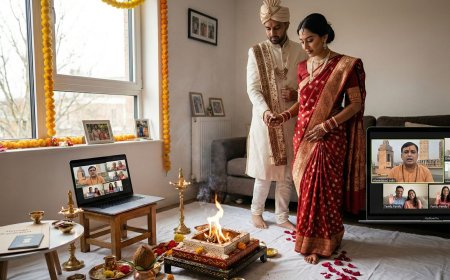
For India family on video call, the Saptapadi is the moment that matters most to witness in real time — and the setup must be flawless. Use a dedicated device on a professional stand positioned to capture both the couple and the fire clearly. Hire a videographer with live-streaming experience to manage this specifically. Calculate the IST timing of your ceremony carefully — if your Muhurtham is at 11:00 a.m. in Toronto (EST), that is 9:30 p.m. IST, comfortably watchable for India family. If you are in Melbourne (AEST) with an 11:00 a.m. ceremony, that is 5:30 a.m. IST — prepare your India family for an early vigil they will not regret.
Doing the Saptapadi as a Destination Wedding in India
For NRI couples returning to India for their Saptapadi, the location choice should align with both regional tradition and the specific atmosphere the couple wants for this most sacred of moments.
For North Indian and Rajasthani families, a haveli courtyard in Jaipur, Jodhpur, or Udaipur provides an architectural beauty and an open-sky quality that makes the Havan Kund's fire visible against the night in a way no indoor venue can replicate. Varanasi holds the deepest spiritual gravity for Hindu wedding ceremonies — the proximity of the Ganges and the city's ancient Brahminic tradition creates an atmosphere that simply cannot be manufactured elsewhere. For South Indian families, Chennai's traditional Kalyana Mandapams in Mylapore and T. Nagar are purpose-built for the full Tamil Vedic wedding sequence, with experienced Vadhyars and proper fire ventilation. For Bengali families, Kolkata'sestablished wedding venues understand the specific sequence of the Bengali Hindu Vivah and have experienced pandits who know the correct mantra tradition.
When briefing your local Indian pandit as an NRI returnee family, bring a written document specifying your gotra, your family's specific mantra preferences, and any regional variations important to your elders. Request that your pandit provide English commentary for each step for your non-Indian guests — most experienced Indian wedding pandits do this readily when asked, and international guests consistently describe the Saptapadi, when explained in real time, as the most moving ceremony they have ever attended.
What You Need: Saptapadi Checklist
Ritual Items Havan Kund [sacred fire vessel, brass or copper], samagri [ritual mixture — request specific list from pandit], ghee [clarified butter, minimum 500ml], samidha [sacred wood sticks], Gath Bandhan cloth or thread for tying bride and groom's garments, marigold garlands for Mandap, mango leaves for decoration, coconut, betel leaves and areca nuts, kumkum, turmeric, a clean white cloth beneath the Havan Kund, and any additional items specified by your pandit for your community tradition.
People Required A qualified community-specific pandit booked four to six months in advance, both sets of parents for specific ritual roles, the bride's brother or male relative for escort traditions in applicable communities, family elders to witness and offer blessings following the seventh step, a dedicated video call coordinator for India family, a fire safety liaison if required by your venue, and a photographer and videographer with specific Hindu wedding ceremony experience.
Preparation Steps Book your pandit a minimum of four to six months before the wedding. Request the complete ritual items list immediately upon booking. Confirm venue fire policy in writing two months before. Source all ritual items three weeks before the ceremony. Brief both families on the step sequence and their specific roles one week before. Practise the Gath Bandhan tying with your pandit. Set up and test your video call system the day before. Arrange fire safety supervision if required by your venue.
NRI.Wedding's verified regional pandit network, Vivah ritual vendor directory, and ceremony planning checklists connect you to experienced professionals across the UK, US, Canada, UAE, and Australia.
5 Questions NRI Couples Always Ask About the Saptapadi
Can we have the seven vows explained in English during the ceremony so our non-Indian guests understand what we are promising?
Not only can you — you absolutely should, and most experienced diaspora pandits now do this as standard practice. Ask your pandit explicitly to provide a brief English explanation before each step, naming the specific vow and its meaning before the Sanskrit mantra is recited. This transforms the Saptapadi from a ceremony that non-Indian guests observe politely into one that they experience with genuine understanding and emotion. Many non-Indian guests and partners describe this moment — understanding in real time what each step promises — as the most moving of the entire wedding. Prepare a printed bilingual guide for guests as an additional support.
My partner is not Hindu. What does it mean spiritually for them to take these seven steps?
The Saptapadi's vows — nourishment, strength, prosperity, happiness, family, health, friendship — are universal human commitments that require no pre-existing theological belief to make sincerely and completely. Brief your partner thoroughly on each vow before the ceremony. Have your pandit explain each step in English during the ritual. Many non-Hindu partners who have taken the Saptapadi describe it as the most meaningful promise they have ever made — precisely because the vows are so specific, so practical, and so ancient that they carry a weight that general declarations of love do not. Intention and understanding transform a gesture into a vow.
Our venue fire policy means we can only have a very small flame. Does this compromise the ritual?
No — and your pandit will confirm this. The Vivah Homa does not require a large fire; it requires a real fire. A small, properly maintained flame in a contained Havan Kund, with ghee and samagri offered correctly, fulfils every theological requirement of the ritual. The fire's sanctity is not measured by its size but by the intention and correctness of the offering. Many experienced diaspora pandits have conducted the Saptapadi over a modest Havan Kund in venues with strict fire policies, and the ceremonies have been entirely complete and valid. Discuss the specific constraints with your pandit at booking and they will advise on the appropriate Havan Kund size.
How do we find a pandit who knows our specific community's Saptapadi mantra sequence?
This requires specificity from your very first inquiry. State your community, sub-community, and gotra explicitly, and ask directly about the Saptapadi mantra sequence your pandit will use. A qualified, community-specific pandit will discuss this fluently and in detail. A pandit who gives vague answers to this question is not the pandit for your ceremony. Personal referrals from your community network — Rajasthani sabha members, Tamil cultural associations, Kashmiri Pandit community groups — are the most reliable source of community-specific pandit recommendations in diaspora cities. NRI.Wedding's pandit directory organises verified priests by regional tradition to support exactly this search.
Should we do the Saptapadi before or after the civil marriage registration?
The overwhelming majority of NRI families treat these as entirely separate and parallel processes. The Saptapadi is the emotionally, spiritually, and culturally primary event — the moment the family considers the marriage to have occurred. Civil registration is completed separately as an administrative legal process, typically in the days or weeks before or after the religious ceremony. In the UK, some venues hold a civil ceremony licence that allows legal registration at the same location on the same day — this can be arranged in advance if you prefer both in one setting. In the US, the marriage licence is signed following the ceremony. Your venue manager and a local NRI wedding planner familiar with your city's requirements can advise on the most practical sequencing.
The Emotional Angle
Nobody tells you that you will count the steps. That somewhere between the first and the seventh, you will become aware — with a clarity that surprises you — of exactly how many remain. That each step will feel distinct from the one before, that the seventh will feel different from all of them, that when the pandit's voice indicates you have arrived at the end, something will settle inside you that you did not know was unsettled.
You are walking around a fire in a hall in Harrow or a garden in Houston, your garment tied to his, and the Sanskrit is rising and falling around you, and you do not understand every word but you understand everything. You understand that the first step is about feeding each other. That the fourth is about choosing each other's happiness deliberately. That the seventh — the one that seals everything — is about friendship. That someone three thousand years ago understood that the marriages which last are built not on passion alone but on the willingness to be, above all else, each other's truest companion.
For NRI couples, this moment carries an additional layer that is hard to name. Because the Saptapadi you are taking was taken by your parents, by their parents, by every couple in your lineage stretching back further than you can see. And you are taking it in a country that does not know the word. You sourced the samagri from a shop three suburbs away. You found the pandit through a community network built by people who refused to let this disappear. You are here, taking seven steps around a fire, because someone in your family decided long ago that some things are worth carrying across every ocean.
Seven steps. Three thousand years. The same vow. Your voice.
A Moment to Smile
At a wedding in Southall two years ago, the Saptapadi was proceeding with full beauty — the fire perfectly maintained, the pandit in excellent form, the couple moving with genuine reverence through each step. The Gath Bandhan had been tied firmly, perhaps slightly too firmly, by an enthusiastic maternal uncle who had taken his role extremely seriously.
By the fifth step, the groom had developed a pronounced leftward lean necessitated by the height difference between himself and his bride and the unyielding tension of the knot. By the sixth step, the bride had noticed and was attempting to compensate by leaning right. By the seventh step, they were both leaning toward each other at approximately fifteen degrees, completing the final circumambulation in a configuration that one guest later described as "structurally inadvisable but aesthetically perfect."
The pandit declared them married without any indication that he had noticed anything unusual. The uncle was extremely proud. The photograph of the seventh step — both of them leaning into each other, the fire between them, both of them trying not to laugh — is the photograph displayed largest in their home.
Quotes From the Diaspora
"When the pandit explained the seventh vow — the pledge of friendship — my husband turned and looked at me in a way that had nothing to do with the ceremony and everything to do with us specifically. Like he was making a private decision in a public moment. That look is the thing I remember most from our entire wedding day. Seven steps. But that look on the seventh one." — Ananya Verma, North Indian bride, originally from Delhi, now in London
"My son's wife is from South Korea. She had read about the Saptapadi before the wedding and memorised what each step meant. When the pandit recited the fourth vow — happiness — she squeezed my son's hand and looked at him, and I watched him understand that she understood. I have never felt more certain that my son had made the right choice." — Meena Krishnamurthy, Tamil Brahmin mother of the groom, originally from Chennai, now in Mississauga
"We streamed our Saptapadi for my grandparents in Jaipur on a large screen at the venue. When the seventh step was completed and the pandit declared us married, my grandmother — who had been silent the entire time — said one word loudly enough for everyone in the room to hear, in Rajasthani, which roughly translates as: finally. The entire room laughed. Including the pandit. Including us." — Priya Rathore, Rajasthani bride, originally from Jaipur, now in Melbourne
Your Seven Steps Travel With You
The Saptapadi is the oldest definition of marriage that still speaks the language of the living. Seven vows, seven steps, seven specific promises that cover everything a shared human life will ask of two people. For NRI couples taking these steps in diaspora cities across the world, the fire burns no less holy and the vows carry no less weight for being spoken in a hotel ballroom rather than a Kalyana Mandapam. What matters is that they are spoken correctly, understood fully, and taken with the intention that three thousand years of the same ceremony deserves.
NRI.Wedding supports families across the UK, US, Canada, UAE, and Australia with a verified regional pandit directory for every community's Saptapadi tradition, complete Vivah ritual vendor networks for samagri and ceremony supplies, experienced NRI wedding photographers who understand the sacred sequence of each step, and planning checklists built specifically for diaspora families. You deserve to take these seven steps properly — with the right fire, the right words, and the right support.
Find your pandit. Light your fire. Take all seven.
Seven steps forward, together, into everything that comes next — that is what a marriage is.
This article explores the Saptapadi — the seven sacred steps and vows of the Hindu Vivah ceremony — across regional Indian traditions including North Indian, Tamil, Bengali, Gujarati, Rajasthani, Marathi, and Kashmiri Pandit communities, with practical planning guidance for NRI families in the US, UK, Canada, UAE, and Australia.
What's Your Reaction?
 Like
0
Like
0
 Dislike
0
Dislike
0
 Love
0
Love
0
 Funny
0
Funny
0
 Angry
0
Angry
0
 Sad
0
Sad
0
 Wow
0
Wow
0