
















































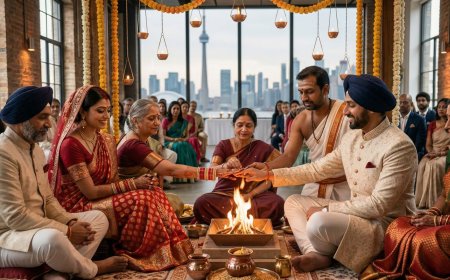



Why the Tamil Iyer and Iyengar Saptapadi Are Not the Same Ceremony — And Why Every NRI Tamil Family Needs to Know the Difference
The Saptapadi — the seven sacred steps that constitute the legal and spiritual heart of the Hindu wedding — is performed at every Tamil Brahmin wedding, but the Tamil Iyer and Tamil Iyengar Saptapadi are two distinct ceremonies rooted in two different philosophical traditions. For NRI Tamil families across the US, UK, Canada, UAE, and Australia, understanding which Saptapadi your family performs — and finding a vadhyar with the correct tradition expertise — is the most important ceremony decision of the Tamil wedding. This guide explains both traditions in full, covers mixed Iyer-Iyengar ceremony approaches, and provides complete practical planning guidance.

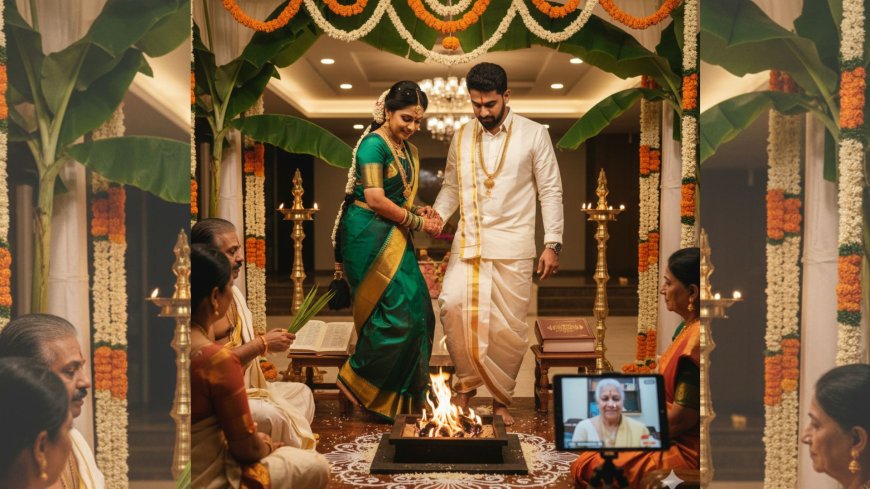
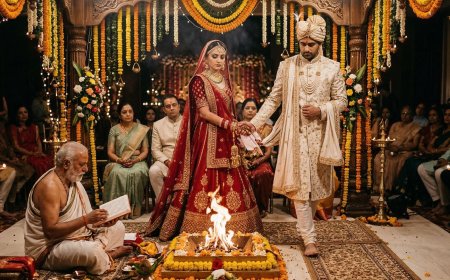
The Saptapadi — the seven sacred steps taken together around the sacred fire that constitute the legal and spiritual heart of the Hindu wedding — is performed at every Tamil Brahmin wedding. But the Saptapadi of a Tamil Iyer wedding and the Saptapadi of a Tamil Iyengar wedding are not the same ceremony. They differ in the direction the couple walks, in who leads, in the mantras recited, in the theological understanding of what the fire represents, and in the specific meaning assigned to each of the seven steps — differences that reflect two distinct and equally ancient philosophical traditions within Tamil Brahminism that have developed separately for over a thousand years. For NRI Tamil families navigating this most sacred of ceremonies across oceans, understanding which Saptapadi your family performs is not a detail — it is the foundation.
You grew up Tamil Brahmin and you know which one you are. Iyer or Iyengar — the distinction was made clear early, in the specific way your family conducted puja at home, in the names of the deities on your family's prayer shelf, in the particular Tamil your grandparents used in religious contexts, in the specific pride with which your family identified with one tradition and distinguished itself from the other. The distinction felt, in childhood, like one of those things that mattered enormously to the older generation and was perhaps slightly less critical to your own.
Now you are planning a wedding. And you have discovered that the distinction matters more than you understood, because the ceremony at the centre of your wedding — the Saptapadi, the seven steps, the moment the marriage is legally and spiritually constituted — is different depending on which tradition your family follows. Different mantras. Different direction. Different leading partner. Different theology. And if you have a mixed Iyer-Iyengar couple, as many NRI Tamil families now do, the question of which Saptapadi to perform — or how to honour both — is the most important ceremony question your vadhyar will need to answer.
This guide is for that family. For the NRI Tamil household that wants to understand not just what the Saptapadi is but which Saptapadi it is — and why the difference is as profound as the ceremony itself.
🌟 DID YOU KNOW?
The Iyer and Iyengar traditions within Tamil Brahminism represent two distinct schools of Vedanta[the philosophical tradition derived from the Upanishads] — Iyers following Advaita Vedanta [non-dualism, associated with the philosopher Adi Shankaracharya, 8th century CE] and Iyengars following Vishishtadvaita Vedanta [qualified non-dualism, associated with the philosopher Ramanujacharya, 11th century CE] — making the differences in their Saptapadi not liturgical variations but expressions of two genuinely distinct philosophical understandings of the relationship between the individual soul, the divine, and the cosmos.
The Iyengar Saptapadi includes the recitation of verses from the Divya Prabandham [the collection of four thousand Tamil devotional verses composed by the Alvars, the Vaishnava saint-poets, between approximately 600 and 900 CE] alongside the Sanskrit Vedic mantras — making the Iyengar Saptapadi one of the very few Hindu wedding ceremonies in which classical Tamil devotional poetry is formally incorporated into the Vedic ritual sequence, creating a bilingual sacred ceremony that exists nowhere else in the Indian wedding tradition.
Among NRI Tamil families in the UK, US, Canada, UAE, and Australia, the increasing frequency of Iyer-Iyengar marriages has made the question of Saptapadi tradition one of the most actively researched and discussed ceremony questions in the diaspora Tamil community — with Tamil community associations in cities including London, Toronto, Sydney, and Singapore specifically developing guidance for vadhyars conducting mixed-tradition Saptapadi ceremonies, reflecting a diaspora reality in which the traditional community boundaries of Tamil Brahmin marriage are being thoughtfully renegotiated by the second and third generation.
What Is the Saptapadi in Tamil Brahmin Tradition?
Saptapadi [from Sanskrit — Sapta meaning seven and Padi meaning steps or feet] is the ceremony in which the bride and groom take seven steps together, typically around or in the presence of the Agni [sacred fire], with each step accompanied by a specific mantra and understood to constitute a specific vow or commitment. In the Hindu Marriage Act 1955, the completion of the Saptapadi is the legally constitutive moment of the Hindu marriage — the ceremony after which the marriage exists in law as well as in sacred understanding.
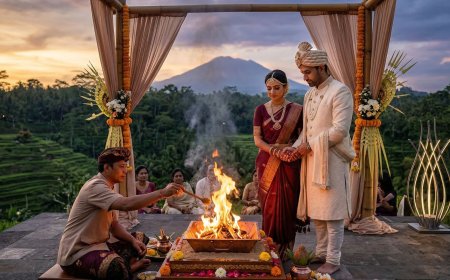
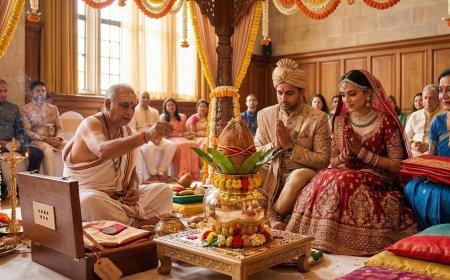
In the Tamil Brahmin tradition, the Saptapadi occurs within the broader wedding ceremony sequence after the Kanyadanam [the giving of the bride by her father] and the Muhurtham [the auspicious ceremony moment] and is conducted by the vadhyar [Tamil Brahmin priest] through a specific sequence of mantras from the Rigveda and other Vedic sources. The sacred fire — the Agni — is present throughout as the divine witness, and the Mangalyadharanam[the tying of the sacred marriage thread] typically precedes the Saptapadi in the Tamil sequence, unlike in many North Indian traditions where Sindoor Daan and the Saptapadi conclude the ceremony.
But beyond this shared framework, the Iyer and Iyengar Saptapadi diverge in ways that are immediate, visible, and philosophically significant.
The Iyer Saptapadi: Advaita in Motion
In the Tamil Iyer wedding tradition, which follows the Smartha [broad Vedic] tradition and philosophically the Advaita Vedanta of Shankaracharya, the Saptapadi has a specific character that reflects its non-dualist foundation.
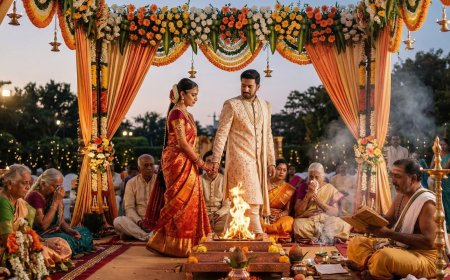
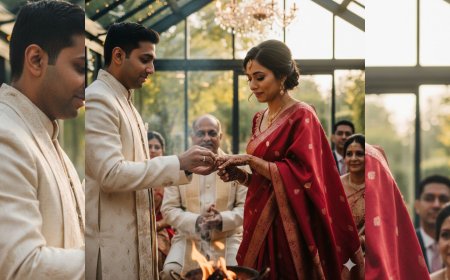
Direction and leadership: In the Iyer Saptapadi, the groom leads — he takes each step first, with the bride following. The couple moves in a clockwise direction around the sacred fire, which in the Vedic tradition is the Pradakshina [the auspicious circumambulation direction, the direction of the sun's movement, the direction of cosmic order]. The fire is understood as Agni Devata [the fire deity as witness] — a living divine presence that makes the vows permanent by receiving them in the presence of the divine.
The seven steps and their meanings in the Iyer tradition:
The first step — Anna [food and nourishment] — the groom vows to provide sustenance for the household, the bride accepts the responsibility of its management.
The second step — Bala [strength and energy] — the couple vows mutual support in the cultivation of physical and spiritual strength.
The third step — Dhana [prosperity and wealth] — the vow of material provision, understood as the means by which Dharma [righteous duty] is fulfilled.
The fourth step — Sukha [happiness and wellbeing] — the vow to actively cultivate joy within the household, to make the home a place of genuine happiness.
The fifth step — Praja [children and continuity] — the vow related to family, lineage, and the honouring of ancestors through the continuation of the family line.
The sixth step — Ritu [seasons and health] — the vow to care for each other through all seasons of life — illness and ease, youth and age, abundance and difficulty.
The seventh step — Mitra [friendship and companionship] — the seal of all previous vows, the declaration that this is above all a friendship, the most durable form of love.
The Iyer mantras are drawn primarily from the Rigveda and the Grihyasutras [household ritual manuals], recited in Sanskrit by the vadhyar as each step is taken. The Advaita philosophical foundation of the Iyer tradition is expressed in the ceremony through the understanding of Agni as a manifestation of Brahman [the universal consciousness] — the fire is not merely a symbol but a literal presence of the divine.
The Iyengar Saptapadi: Vishishtadvaita and the Divya Prabandham
In the Tamil Iyengar wedding tradition, which follows the Sri Vaishnava tradition and philosophically the Vishishtadvaita Vedanta of Ramanujacharya, the Saptapadi has a distinct character that reflects its qualified non-dualist foundation — the understanding that individual souls are real and distinct but exist within and as part of the divine rather than being ultimately identical with it.
Direction and leadership: In the Iyengar Saptapadi, the couple's movement and the leading partner vary by sub-tradition — in the Vadakalai [northern school] Iyengar tradition, the dynamics differ from the Thenkalai [southern school] tradition. Most significantly, the Iyengar Saptapadi often has the bride leading in certain steps — a distinctive feature that reflects the Sri Vaishnava theological understanding of the feminine divine as Mahalakshmi [the consort of Vishnu], whose role in the marriage ceremony carries a specific sacred agency. The presence of the sacred fire is understood through the Sri Vaishnava lens as the presence of Narayana [Vishnu] himself as divine witness.
The Divya Prabandham incorporation: The most distinctive feature of the Iyengar Saptapadi is the formal recitation of verses from the Divya Prabandham alongside the Sanskrit Vedic mantras. The Alvars' Tamil devotional poetry — composed in the rich literary Tamil of the early medieval period — is woven into the ceremony's mantra sequence, creating a bilingual sacred text in which Sanskrit and classical Tamil speak simultaneously. For Iyengar families, this element is not optional or decorative — it is theologically essential, reflecting the Sri Vaishnava tradition's equal honouring of the Sanskrit Vedic tradition and the Tamil Prabandha tradition as the two eyes of the community's religious life.
The seven steps in the Iyengar tradition address similar themes — nourishment, strength, prosperity, happiness, children, health, and friendship — but the specific mantras, the specific Sanskrit-Tamil bilingual formulations, and the specific theological framing of each step differ from the Iyer tradition. Each step in the Iyengar ceremony explicitly invokes Narayana and Mahalakshmi as the divine model for the couple — the marriage is understood not merely as a human commitment witnessed by the divine but as a participation in the divine marriage itself.
The Iyengar vadhyar's role is correspondingly more complex — requiring command of both the Sanskrit Vedic mantra tradition and the Tamil Divya Prabandham recitation tradition. An Iyengar vadhyar is trained in both, and this dual competence is non-negotiable for an Iyengar Saptapadi.
Community Comparison Table
| Tradition | Direction | Who Leads | Mantra Language | Divya Prabandham | Fire Theology | Sub-tradition Notes |
|---|---|---|---|---|---|---|
| Tamil Iyer (Smartha) | Clockwise | Groom leads all seven steps | Sanskrit only | Not included | Agni as Brahman manifestation | Common across most Iyer sub-groups |
| Tamil Iyengar Vadakalai | Clockwise | Varies by step | Sanskrit + Tamil | Included — essential | Narayana as witness | Northern school; follows Vedic primacy |
| Tamil Iyengar Thenkalai | Clockwise | Bride leads in specific steps | Sanskrit + Tamil | Included — essential | Narayana as witness | Southern school; Tamil Prabandha primacy |
| Telugu Brahmin | Clockwise | Groom leads | Sanskrit | Not typically included | Agni as witness | Closest to Iyer structure; Telugu mantras |
| Kannada Brahmin (Smartha) | Clockwise | Groom leads | Sanskrit | Not included | Agni as Brahman | Similar to Iyer tradition |
| Kannada Brahmin (Madhva) | Clockwise | Groom leads | Sanskrit | Not included | Vishnu as witness | Madhva Vedanta theology; distinct mantras |
| Mixed Iyer-Iyengar | Typically clockwise | Negotiated with vadhyar | Sanskrit + selective Tamil | Partial inclusion | Combined approach | Requires vadhyar experienced in both traditions |
| Tamil Christian (adapted) | Variable | Variable | Tamil/English | Not included | Symbolic fire if present | Church blessing primary; Tamil customs adapted |
| Tamil Vellalar | Clockwise | Groom leads typically | Sanskrit/Tamil adapted | Community-specific | Agni as witness | Non-Brahmin adaptation of Saptapadi |
| Diaspora mixed tradition | Clockwise | Discussed with vadhyar | Sanskrit + explanation | Optional | Vadhyar-guided | Most flexible — vadhyar manages tradition balance |
The Meaning Behind the Difference
The Iyer and Iyengar Saptapadi are not two versions of the same ceremony — they are two expressions of two genuinely different philosophical understandings of what is happening when a couple takes seven steps around a sacred fire.
For the Iyer tradition, rooted in Advaita [non-dualism], the Saptapadi's fire is a manifestation of the Brahman — the universal, undivided consciousness that underlies all apparent reality. When the couple takes seven steps around this fire, they are circumambulating the absolute. Their marriage vows are taken in the presence of the ground of all being. The groom leads because the ceremony's mantra tradition assigns this specific initiatory role to the male partner in the householder stage's Vedic framework.
For the Iyengar tradition, rooted in Vishishtadvaita [qualified non-dualism], the sacred fire is the presence of Narayana— the personal God of the Sri Vaishnava tradition, who is not merely the universal ground but a specific, loving, relational divine presence. When the Iyengar couple takes seven steps, they do so in the presence of a God who knows them, loves them, and has a relationship with them — not merely an absolute that contains them. The inclusion of the Divya Prabandham verses — the Tamil love poetry of the Alvars addressed to Narayana — brings the ceremony's emotional register into the specifically devotional, the specifically relational, the specifically personal.
The bride's leading in certain Iyengar steps reflects the Sri Vaishnava theology in which Mahalakshmi is not merely Vishnu's consort but the essential mediator between the human soul and the divine — the one whose grace makes the relationship possible. A bride who leads in the Saptapadi is enacting this theology in her own body.
The Iyer Saptapadi says: we take these steps in the presence of the absolute. The Iyengar Saptapadi says: we take these steps in the presence of a God who loves us, and we speak to Him in His own language and ours.
Navigating the Mixed Iyer-Iyengar Saptapadi: The Practical Reality
The Iyer-Iyengar marriage is increasingly common among NRI Tamil families, and the Saptapadi question is the ceremony's most important practical challenge. Here is what you need to know.
The vadhyar must be experienced in both traditions — this is the single most critical requirement and must be established before any other ceremony planning begins. An Iyer vadhyar who does not know the Divya Prabandham cannot conduct an adequate Iyengar Saptapadi. An Iyengar vadhyar who does not know the Smartha Vedic sequence cannot conduct an adequate Iyer Saptapadi. What you need is a vadhyar with deep knowledge of both traditions who has conducted mixed-tradition ceremonies before. NRI.Wedding's Tamil vadhyar directory specifies community affiliation and mixed-tradition ceremony experience — this is the first inquiry to make when booking. In London, the Tamil community networks of Wembley and East Ham maintain vadhyar contacts with cross-tradition experience. In Toronto, the Tamil community of Scarborough has vadhyars experienced in mixed ceremonies. In Sydney, the Tamil community of Parramatta has established this expertise.
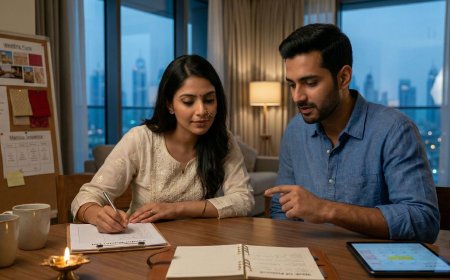
The family conversation must happen first. Before the vadhyar is consulted, both families must have an explicit, open conversation about which tradition's Saptapadi will be primary and how the other tradition will be honoured. The most respectful approaches NRI Tamil families have found include: conducting the full Saptapadi in one tradition followed by specific elements of the other [typically the Divya Prabandham recitation for the Iyengar element if the primary ceremony is Iyer]; conducting a ceremony in which the vadhyar explicitly integrates specific elements of both traditions with explanation at each stage; or — in some families — conducting two brief Saptapadi sequences, one in each tradition. Whatever is decided must be agreed by both families before the vadhyar is briefed, so that the vadhyar is managing the ceremony's execution rather than the family's negotiation.
Sourcing the Agni correctly is a venue challenge that applies equally to both Iyer and Iyengar ceremonies — the sacred fire is non-negotiable in both traditions and cannot be simulated. Confirm with your venue that a contained sacred fire is permitted at minimum three months before the wedding. Most South Asian wedding venues in diaspora cities are familiar with this requirement — but get the permission in writing, specify the type of fire vessel [Havan Kund], and confirm the fire management protocol with your vadhyar. In venues that genuinely prohibit any open flame, discuss with your vadhyar whether the ceremony can be conducted with a lamp substitute — this is a family and vadhyar decision with theological implications that must be made thoughtfully.
For the Iyengar element specifically, the vadhyar must have the Divya Prabandham verses prepared and must know which specific verses are appropriate for the Saptapadi context. The four thousand verses of the Divya Prabandham are not all equally appropriate for the wedding ceremony — specific passages from specific Alvars are traditionally used, and a vadhyar who knows the tradition will select and recite these correctly. Confirm this with your vadhyar explicitly during your consultation.
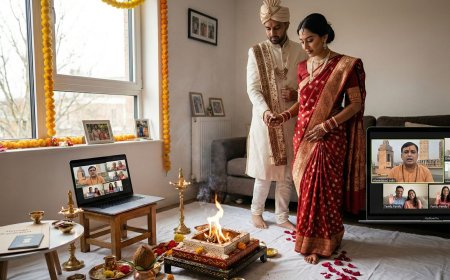
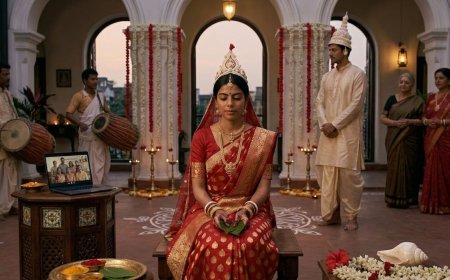
For India family on video call, both families' India-based elders will be watching the Saptapadi with the specific knowledge of their own tradition — they will notice if something is absent or incorrect. Ensure the video call audio is strong enough for India grandparents to hear both the Sanskrit mantras and the Divya Prabandham recitation clearly. Position the camera to show both the couple and the sacred fire throughout the Saptapadi.
What You Need: Saptapadi Checklist
For Both Traditions A verified vadhyar of the correct tradition or with confirmed mixed-tradition experience [booked minimum four to six months before], written venue permission for a contained sacred fire, a Havan Kund [sacred fire vessel] appropriate to the ceremony space, ghee and samagri [ritual offerings] for the sacred fire, fresh flowers for the ceremony space [jasmine and marigold central], the Mangalya [sacred marriage thread] for the Mangalyadharanam that precedes the Saptapadi in the Tamil sequence, and a dedicated video call setup for India family positioned to show both couple and fire.
Additional for Iyengar Ceremonies Confirmation that the vadhyar knows the specific Divya Prabandham verses for the Saptapadi context, a ceremony programme that explains the Divya Prabandham and its role for guests unfamiliar with the Sri Vaishnava tradition, and clarity from the vadhyar on which steps the bride leads and which the groom leads according to the family's specific Vadakalai or Thenkalai tradition.
For Mixed Iyer-Iyengar Ceremonies A vadhyar with confirmed experience in both traditions, a family agreement on the primary ceremony tradition and the complementary elements, a written ceremony outline from the vadhyar showing the complete sequence and where each tradition's elements appear, and a ceremony programme for guests explaining both traditions and the family's approach to honouring both.
NRI.Wedding's verified Tamil vadhyar directory specifies Iyer, Iyengar [Vadakalai and Thenkalai], and mixed-tradition ceremony experience across the UK, US, Canada, UAE, and Australia.
5 Questions NRI Couples Always Ask About the Tamil Saptapadi
We are an Iyer-Iyengar couple. Which tradition's Saptapadi should we follow?
There is no single correct answer — this is a family decision that must be made through conversation between both families and then confirmed with your vadhyar. The most important principle is that whichever tradition is chosen as primary, the other tradition's most significant elements are acknowledged and honoured rather than simply absent. For many mixed-tradition couples, the solution that satisfies both families most completely is a ceremony in which the vadhyar conducts the Saptapadi with elements of both traditions woven together — the Sanskrit mantras from the Iyer tradition, the Divya Prabandham recitation from the Iyengar tradition, and a clear explanation to the assembled family of what is being honoured from each. This requires a vadhyar with deep knowledge of both traditions, which is the most critical booking requirement for a mixed-tradition wedding.
What is the difference between Vadakalai and Thenkalai in the Iyengar Saptapadi?
The Vadakalai and Thenkalai are two sub-traditions within the Sri Vaishnava Iyengar community, divided primarily along questions of scriptural primacy — Vadakalai [northern school] gives primacy to the Sanskrit Vedic tradition alongside the Divya Prabandham, while Thenkalai [southern school] gives primacy to the Tamil Divya Prabandham alongside the Sanskrit. In the Saptapadi, this difference manifests in the relative proportion of Sanskrit and Tamil recitation, in certain specific mantra choices, and in some communities, in the question of which partner leads which steps. Your vadhyar must be from the correct sub-tradition — an Iyengar vadhyar who does not specify their Vadakalai or Thenkalai affiliation should be asked directly, as the ceremonies they conduct will differ. Most NRI Iyengar families know their sub-tradition from their family's religious practice — if you are uncertain, ask your parents or your family's senior members.
Can a non-Tamil South Indian vadhyar conduct a Tamil Brahmin Saptapadi?
The mantras of the Saptapadi are Sanskrit and therefore linguistically shared across South Indian Brahmin traditions — a Telugu or Kannada vadhyar who knows the Vedic mantra tradition can conduct the Sanskrit elements of a Tamil Iyer Saptapadi with competence. However, the Tamil Iyer ceremony has specific elements — including the Grihyasutra [household ritual manual] tradition specific to the Apastamba school followed by most Tamil Brahmins — that differ from the Telugu Baudhayana and Kannada traditions. For an Iyengar ceremony, the Divya Prabandham requirement makes a specifically trained Iyengar vadhyar non-negotiable. In diaspora cities where Tamil vadhyars are scarce, a knowledgeable non-Tamil vadhyar who has studied the Tamil tradition may be acceptable for an Iyer ceremony with advance briefing — discuss this explicitly with the vadhyar before booking and ask them to specify their knowledge of the Apastamba Grihyasutra tradition specifically.
How important is it that the sacred fire be real rather than symbolic at the Saptapadi?
In both Iyer and Iyengar theology, the sacred fire of the Saptapadi is not symbolic — it is the divine witness whose presence makes the vows permanent and whose testimony to the marriage exists beyond the human domain. The Agni in the Iyer tradition is a manifestation of Brahman; in the Iyengar tradition it is the presence of Narayana. The substitution of a lamp or an LED candle for the actual fire changes the ceremony's theological character fundamentally. The most committed position, held by most traditional vadhyars, is that the sacred fire is non-negotiable and that venue selection should accommodate this requirement rather than the ceremony accommodating the venue. If your chosen venue absolutely prohibits open flame after all negotiation, discuss the specific theological implications with your vadhyar before making any substitution — some vadhyars will agree to a lamp in specific circumstances with specific additional mantras; others will not, and their position deserves respect.
How do we explain the difference between the Iyer and Iyengar Saptapadi to non-Tamil guests — Indian and non-Indian — who do not know the distinction?
A ceremony programme insert of approximately one page explaining the Advaita-Vishishtadvaita distinction in accessible terms — the non-dualist versus qualified non-dualist understanding of the divine, the meaning of the Divya Prabandham, the theology behind the bride leading in certain steps — gives non-Tamil guests the context to understand what they are witnessing. Frame it not as a sectarian distinction but as a philosophical one: two schools within the same broad tradition that have developed distinct and equally beautiful ways of conducting the same sacred ceremony. Most guests — Indian and non-Indian — find this explanation genuinely interesting and the distinction between the two ceremonies intellectually illuminating rather than merely liturgical. The deeper the guests understand what the vadhyar is doing and why, the more moving the Saptapadi will be for everyone present.
The Emotional Angle
The fire is burning and the vadhyar is reciting and you are about to take the first of seven steps and you know — because you grew up Tamil Brahmin and this knowledge is cellular — what those seven steps mean. Not abstractly. Concretely. Each step a specific commitment, each commitment a specific aspect of the life you are choosing, each word of the mantra a thread connecting this moment to every Saptapadi in your family's history at which the same words were spoken in the same language around the same kind of fire.
For NRI Tamil families, the Saptapadi carries a specific weight that is different from any other wedding ceremony. Because the mantras are in Sanskrit — the language that has never been anyone's mother tongue, the language that exists only for the sacred — and the ceremony's language is therefore the same in Chennai and in Scarborough, in Mylapore and in Melbourne. The Sanskrit does not age. It does not emigrate. It does not require adaptation for a diaspora context. It is simply itself, in every room where it is recited, unchanged.
And then the vadhyar begins the Divya Prabandham verses — if you are Iyengar — and the classical Tamil fills the room alongside the Sanskrit, and you are inside two languages simultaneously, the language of the cosmos and the language of your ancestors' poetry, and both of them are speaking about the same thing: the sacred nature of this commitment you are making with your feet, one step at a time, around a fire that has been burning at this ceremony since before writing recorded it.
You take the first step. Then the second. Then the third.
Somewhere in Chennai or Coimbatore, your grandmother is watching on the video call with her eyes closed and her lips moving. She knows the mantras. She has always known them. She is saying them with you, across twelve thousand kilometres of ocean, around a fire she cannot see.
The same fire. The same steps. The same words.
Seven steps from ordinary life to the life that begins now.
A Moment to Smile
At a mixed Iyer-Iyengar wedding in Toronto three years ago, the vadhyar — a man of considerable experience and even more considerable thoroughness — had prepared a ceremony that honoured both traditions with great care, weaving the Smartha Vedic mantras and the Divya Prabandham recitation into a sequence of genuine beauty and theological precision.
What the vadhyar had prepared for in ceremony he had not fully prepared for in logistics — specifically, the question of which direction the bride leads when she leads, which direction the groom leads when he leads, and whether the clockwise direction of one tradition and the specific step-leading protocol of the other tradition could be simultaneously honoured in a ceremony space that contained both families, a sacred fire, several aunts with very definite views, and a considerable quantity of jasmine.
The first step proceeded beautifully. The second step produced a brief navigational conference between the vadhyar and the groom conducted entirely in urgent whispered Tamil. The bride, who had been briefed that she would lead certain steps and was prepared to do so, waited with the patience of someone who had practised this specific patience for the entire preceding year of wedding planning.
The vadhyar resolved the question with the authority of a man who had been resolving ceremony questions for thirty years. The subsequent five steps were navigated without incident. The Saptapadi was complete. Both families wept. The aunts with definite views agreed it had been conducted correctly. This was the highest available praise and was received as such.
Quotes From the Diaspora
"Our vadhyar recited the Divya Prabandham verses during our Saptapadi in Mississauga and I felt something I was not prepared for — the Tamil in the middle of the Sanskrit, the Alvars' voices inside our wedding, the specific recognition that this language my grandparents used for prayer was being used at the centre of my marriage. My paati on the video call from Chennai heard the Prabandham verses and said one thing: Seri. Correct. That single word from her was the most important review the ceremony received." — Priya Venkataraman, Tamil Iyengar bride, originally from Chennai, now in Mississauga
"My son is Iyer. His wife is Iyengar Thenkalai. We found a vadhyar in Birmingham who knew both traditions. He explained at each stage of the Saptapadi which tradition the element came from and why it was being included. My mother-in-law — Iyengar, very traditional — watched the Divya Prabandham recitation with her eyes closed and tears on her face. My own mother watched the Sanskrit mantras with the same expression. Both women, at the same ceremony, finding their own tradition inside the shared one. That is what the right vadhyar can do." — Meenakshi Krishnaswamy, Tamil Iyer mother of the groom, originally from Trichy, now in Birmingham
"I grew up not fully understanding the difference between Iyer and Iyengar — my parents explained it but it felt abstract. At our wedding ceremony in Melbourne, watching the vadhyar conduct a Saptapadi that held both my tradition and my husband's tradition with equal care and equal depth, I understood for the first time that these were not two versions of the same thing but two genuinely different philosophical traditions that had each developed for a thousand years and were both present in our marriage. That understanding felt like a wedding gift I had not expected." — Lakshmi Srinivasan, Tamil Iyengar bride, originally from Coimbatore, now in Melbourne
Your Steps Travel With You
The Saptapadi is seven steps — and for Tamil Brahmin families, those seven steps are the most sacred and the most legally constitutive seven steps in human life, taken around a fire that is not merely a symbol but a presence, recited over in mantras that have not changed since the Vedic period, conducted by a vadhyar who carries the tradition in his body as much as in his memory. For NRI Tamil Iyer and Iyengar families performing this ceremony in diaspora cities across the world, the specific tradition matters — the specific mantras, the specific direction, the specific theology of who leads and what the fire represents. These are not details. They are the ceremony.
NRI.Wedding supports Tamil Brahmin families across the UK, US, Canada, UAE, and Australia with a verified vadhyar directory specifying Iyer, Iyengar Vadakalai, Iyengar Thenkalai, and mixed-tradition ceremony experience, ceremony planning checklists covering both the Iyer and Iyengar Saptapadi sequences, guidance on venue fire permission for diaspora wedding spaces, and experienced NRI wedding photographers who understand the specific visual requirements of the Tamil Brahmin ceremony including the sacred fire and the seven-step sequence.
Find your vadhyar. Know your tradition. Confirm your fire.
Take the seven steps — in Sanskrit, in Tamil, in the language of whatever fire burns at the centre of your ceremony — and let them carry you into the life that begins now.
This article explores the Saptapadi in Tamil Iyer and Tamil Iyengar wedding traditions — including Advaita and Vishishtadvaita theology, Vadakalai and Thenkalai sub-traditions, the Divya Prabandham incorporation, and mixed Iyer-Iyengar ceremony guidance — with practical planning advice for NRI Tamil families in the US, UK, Canada, UAE, and Australia.
What's Your Reaction?
 Like
0
Like
0
 Dislike
0
Dislike
0
 Love
0
Love
0
 Funny
0
Funny
0
 Angry
0
Angry
0
 Sad
0
Sad
0
 Wow
0
Wow
0