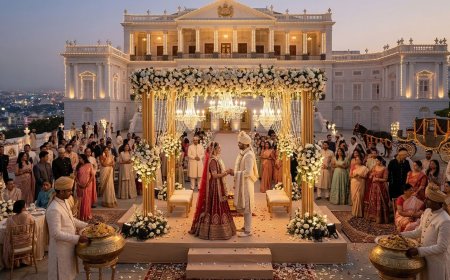
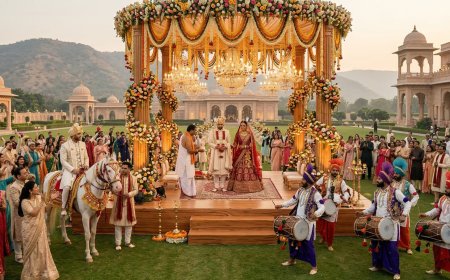





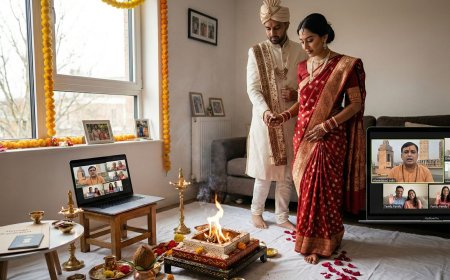
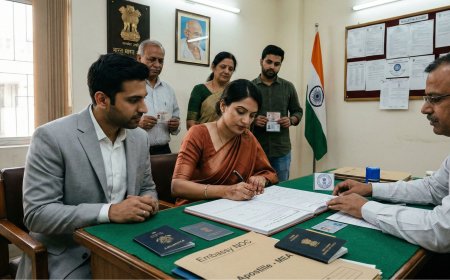






















































Why Your Wedding Date Is Written in the Stars: A Complete Vedic Astrology Guide for NRI Couples
For NRI couples planning weddings from Toronto to Dubai, choosing a wedding date involves far more than venue availability. Rooted in 3,000 years of Vedic tradition, Jyotish astrology governs auspicious timing through Muhurta calculation, Kundali Milan compatibility matching, and Panchang guidance. This practical guide explains the ancient science behind Indian wedding date selection and helps diaspora couples navigate astrological requirements, family expectations, and venue logistics across time zones and communities.


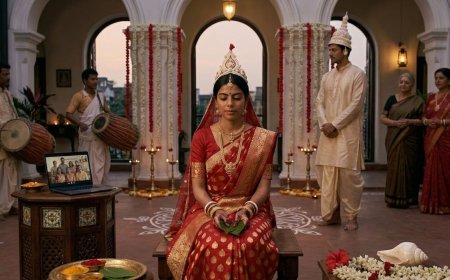
In the Indian wedding tradition, the date is never just a date. It is a cosmic alignment — a specific window in time identified through thousands of years of astronomical observation, astrological calculation, and spiritual wisdom, during which the universe is understood to be most favourably disposed toward the beginning of a new life together. For NRI couples planning their wedding from Toronto to Dubai, understanding why the date matters — and how to find the right one from abroad — is not superstition. It is civilisational intelligence.
You have had this conversation. You found the venue, you loved it, the date was available, and then you called home. Your mother paused. Your grandmother made a specific sound. Someone said the words Rahu Kaal [an inauspicious period of time governed by the shadow planet Rahu, avoided for auspicious beginnings] and suddenly the date you had already mentally committed to was being examined with the seriousness of a legal document.
You are in Sydney now, or Dallas, or somewhere in the East Midlands, and the venue has a waiting list and the date is either available or it isn't and you need to decide by the end of the week. But your family in India is consulting a Jyotishi[a Vedic astrologer, from the Sanskrit Jyotish meaning the science of light] who is working from a Panchang [the traditional Indian almanac that tracks lunar days, constellations, planetary positions, and auspicious periods] and the conversation is happening in two languages across a twelve-hour time difference and somehow none of the dates your venue has available seem to fall in an auspicious window.
This article will explain exactly what is happening in that conversation — the ancient science behind it, the community variations in how it is practised, and the very practical guidance on how to navigate it as an NRI couple bridging two worlds and two calendars.
🌟 DID YOU KNOW?
Jyotish — Vedic astrology — is one of the six Vedangas [auxiliary disciplines of the Vedas], meaning it is considered a limb of the Vedic body of knowledge, as fundamental to traditional Indian scholarship as grammar, phonetics, or ritual procedure. The tradition of consulting celestial positions for auspicious timing dates back at least three thousand years in the Indian subcontinent, making it one of the oldest continuously practised systems of astronomical-astrological calculation in the world.
The Indian wedding season is directly determined by astrological calculations. Certain months — particularly the periods when Jupiter (Guru) and Venus (Shukra) are in specific positions — are considered universally auspicious for weddings, while others are avoided entirely. This is why Indian wedding venues in diaspora cities like Southall, Brampton, and Parramatta experience dramatic peaks and troughs in bookings that correspond directly to the Vedic auspicious calendar rather than to Western seasonal preferences.
The Kundali Milan [the compatibility matching of two horoscopes, also called Guna Milan] is considered by many traditional Indian families to be the most important step before a marriage is confirmed — more important than the meeting of the families, more important than the couple's own assessment of compatibility. The system scores the match across thirty-six points (Gunas), and a score below eighteen is traditionally considered inauspicious. The system is so widely used that matrimonial websites serving the Indian diaspora commonly include automated Kundali Milan features.
What Is Vedic Astrology and Why Does It Govern Indian Weddings?
Jyotish — translated literally as the science of light — is the ancient Indian system of astronomy and astrology that maps the positions of celestial bodies and interprets their influence on human affairs. It is distinct from Western astrology in several fundamental ways: it uses the Sidereal zodiac [based on the actual positions of constellations] rather than the Tropical zodiac used in Western astrology, it gives central importance to the Moon sign rather than the Sun sign, and it incorporates twenty-seven Nakshatras [lunar mansions or star clusters through which the moon passes in its monthly cycle] as a primary framework for interpretation.
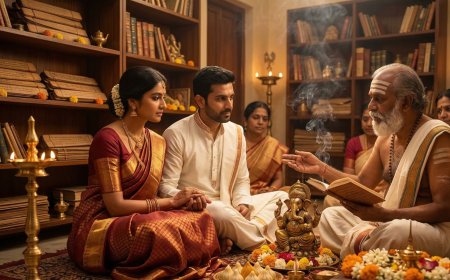
At the centre of Jyotish wedding planning is the concept of Muhurta [an auspicious moment or time window, selected through precise astrological calculation for the beginning of significant events]. A Muhurta is not simply a lucky day — it is a specific window of time, sometimes as narrow as forty-eight minutes, during which the planetary configurations are understood to be most supportive of the event being initiated. Selecting the right Muhurta for a wedding is considered as important as any other element of the ceremony — because in the Jyotish worldview, beginnings carry the energy of their inception point throughout their entire duration.
The Jyotishi — the Vedic astrologer — calculates the wedding Muhurta by examining multiple factors simultaneously. The Tithi [the lunar day, of which there are thirty in a lunar month, each with specific qualities] must be auspicious. The Nakshatra [the lunar mansion in which the moon sits on the wedding day] must be favourable for marriage. The Vara[the day of the week, each governed by a specific planet] must be appropriate. The Yoga [one of twenty-seven time-quality indicators calculated from the positions of the sun and moon] must be positive. And the Karana [half of a Tithi, used for more precise timing] must be favourable.
The Rahu Kaal — the daily period of approximately ninety minutes governed by the shadow planet Rahu — must be avoided entirely for auspicious beginnings. Its timing shifts every day of the week and varies by geographic location, which is why diaspora families must calculate it for their specific city rather than simply using the timing that applies in India.
Beyond daily calculations, the Jyotishi examines the broader planetary periods to ensure that neither the bride nor the groom is in a particularly inauspicious Dasha [a planetary period in the Vedic system, each planet governing a specific number of years] at the time of the wedding. The Shani Dasha [Saturn's period] and specific phases of Rahu and Ketu[the lunar nodes, considered shadow planets] are examined with particular care.
Community Comparison Table
| Community/State | Astrological System Used | Key Considerations | How NRIs Abroad Navigate It |
|---|---|---|---|
| North Indian Hindu (Brahmin) | Vedic Jyotish with Vishwa Panchang | Full Muhurta calculation, Kundali Milan, Rahu Kaal avoidance | Consult Jyotishi in India via video call; use Drik Panchang app for verification |
| South Indian Tamil Brahmin | Vedic Jyotish with Tamil Panchangam | Naalu [auspicious time] specific to Tamil tradition, Nakshatras given highest priority | Tamil Brahmin priests abroad consult Tamil Panchangam; temple priests provide guidance |
| Telugu | Vedic Jyotish with Telugu Panchangam | Subha Muhurtam calculation, specific Nakshatra preferences for weddings | Telugu cultural associations maintain pandit networks; video call consultations common |
| Gujarati | Vedic Jyotish with Gujarati Panchang | Sade Sati [seven-and-a-half year Saturn period] avoidance especially emphasised | Gujarati community associations and mandals maintain Jyotishi contacts |
| Bengali | Vedic Jyotish with Bengali Almanac | Subho Drishti timing calculated astrologically; specific Bengali calendar considerations | Bengali priests abroad consult Bengali Almanac; community Jyotishis available |
| Marathi | Vedic Jyotish with Marathi Panchang | Manglik status of bride and groom carefully examined | Marathi mandals maintain pandit networks; online Jyotishi consultations common |
| Punjabi Hindu | Vedic Jyotish | Muhurta selected, though Punjabi families often somewhat more flexible | Pandits in Southall, Birmingham, Brampton, Surrey widely consulted |
| Sikh | Nanakshahi Calendar | Anand Karaj not governed by astrology per Sikh Rehat Maryada; date often chosen for practical convenience | Gurdwara booking determines date; astrological consultation is a personal family choice |
| Meitei (Manipur) | Meitei Panchang[Meitei lunar calendar] | Maiba consulted for date selection using Meitei-specific calendar system | Maiba in Imphal consulted remotely; Meitei Panchang apps increasingly available |
| Parsi Zoroastrian | Zoroastrian Shahenshahi or Fasli calendar | Auspicious dates identified through Zoroastrian calendar; fire temple priest consulted | Zoroastrian Association in diaspora city provides calendar guidance |
The Meaning Behind the Ritual
Jyotish rests on a philosophical foundation that the contemporary Western world finds simultaneously alien and increasingly compelling: that the universe is not a collection of unrelated objects moving through empty space, but a living system of interconnected forces whose rhythms and cycles affect every event that occurs within them — including the moment a marriage begins.
The ancient Rishis [sages or seers of the Vedic tradition] who developed Jyotish were not simply primitive astronomers making lucky guesses. They were systematic observers who mapped celestial cycles over generations, noticed correlations between planetary positions and earthly events, and developed an interpretive system of extraordinary complexity and internal consistency. Whether or not one accepts the metaphysical claims of Jyotish, the astronomical precision of its calculations is remarkable — the Panchang's tracking of lunar phases, Nakshatra positions, and planetary movements is accurate to within fractions of a degree.
The deeper philosophical claim of Jyotish is that time is not uniform. Every moment has a quality — some moments are expansive, some contractive; some support beginnings, others support endings; some carry the energy of Jupiter's wisdom and generosity, others carry Saturn's weight and restriction. A marriage begun in a moment of expansive, benevolent planetary energy is understood to carry that quality into its future. This is not fatalism — it is temporal intelligence, the understanding that choosing the right moment for a beginning is itself an act of wisdom.
The Kundali Milan — the matching of horoscopes — expresses a similar philosophy at the level of individual compatibility. The thirty-six Gunas that are matched represent different dimensions of compatibility: physical, psychological, spiritual, and practical. The system acknowledges that two people bring different energies into a union and that some combinations of energies are more naturally harmonious than others.
For any non-Indian partner or guest trying to understand why the date matters so much, the simplest explanation is this: in the Indian worldview, a marriage is not just a human event — it is a cosmic one, and it deserves to begin at the most auspicious moment the universe can offer.
Navigating Astrology Abroad: The Practical Reality
This is the section NRI couples need most, because the gap between what the tradition requires and what diaspora logistics allow is where most of the friction happens. Here is what actually works.
Finding a Jyotishi Abroad: In major diaspora cities, qualified Jyotishis are available — often connected to Hindu temples or South Asian cultural organisations. In the UK, the Hindu temples of Neasden, Southall, and Leicester maintain connections to Jyotishis. In Canada, the temple networks of Brampton, Mississauga, and Surrey provide access. In the US, the Hindu temples of Edison NJ, Houston, and Fremont maintain Jyotishi referral networks. In Australia, the Hindu Society of Victoria and similar organisations in Sydney and Brisbane can assist.
However, the most widely used approach for NRI couples is the remote consultation — a video call with a Jyotishi in India who has been recommended by family or community. This is entirely workable. The Jyotishi requires the birth date, time, and place of both the bride and groom to cast the horoscopes, and needs to know the geographic location of the wedding for location-specific calculations like Rahu Kaal timing. A good Jyotishi in India will provide multiple Muhurta options across a range of months, giving you flexibility to match an auspicious window with venue availability.
The Venue and Date Problem: This is the central practical challenge for NRI couples, and it requires managing two systems simultaneously. The approach that works best is to obtain a list of auspicious Muhurtas from the Jyotishi first — ideally a range of options across six to twelve months — and then approach venues with those dates rather than selecting a venue date and then checking it against the Panchang. This reversal of the conventional booking sequence eliminates the most common source of conflict between the tradition's requirements and diaspora logistics.
Digital Panchang Tools: Apps like Drik Panchang, Panchang.com, and Astrosage provide Panchang calculations for any location in the world, adjusted for local time zones. These are useful for initial orientation and for understanding the landscape of auspicious dates — but they should supplement rather than replace a consultation with a qualified Jyotishi for a wedding, which is a once-in-a-lifetime event deserving professional guidance.
The Rahu Kaal Problem: Rahu Kaal varies by day of the week and by geographic location, which means the Rahu Kaal timing for a Sunday wedding in London is different from that in Mumbai. Ensure your Jyotishi calculates Rahu Kaal for your specific city. The Drik Panchang app calculates Rahu Kaal for any location, which is useful for verification.
Managing Family Disagreements: In NRI families, it is extremely common for different family members — often the bride's family and the groom's family, sometimes from different regional communities with different Panchang traditions — to receive different auspicious dates from different Jyotishis. This is not a sign that astrology is arbitrary — it reflects the fact that different regional traditions use different Panchangs and prioritise different factors. The solution is to agree early on which Jyotishi's guidance will be authoritative for the couple's wedding, ideally someone respected by both families, and to share that Jyotishi's findings with both sets of parents before any alternative opinions are solicited.
When No Auspicious Date Aligns With Your Venue: This happens, and it is more common than anyone admits. The workable approach is flexibility on venue rather than flexibility on Muhurta — if the date is auspicious and the venue is not available, find a different venue. If the venue is a non-negotiable, share the full list of auspicious dates with the venue manager and ask specifically about availability for those dates. Most experienced Indian wedding venues in diaspora cities understand the Panchang-based booking pattern and will often have last-minute cancellations on auspicious dates as other families' plans change.
Specific Sourcing for Panchang Guidance by Community: For Tamil Brahmin families, the Tamil Panchangampublished annually by major South Indian temples is the authoritative source. For Telugu families, the Telugu Panchangam serves the same function. For Gujarati families, the Vikram Samvat calendar is the framework. For Bengali families, the Bengali Almanac published annually carries the relevant calculations. All of these are available digitally and through community organisations in diaspora cities including Wembley in London, Gerrard Street in Toronto, Devon Avenue in Chicago, and Harris Park in Sydney.
Time Zone Guidance for Consultation: When booking a video call with a Jyotishi in India, the ideal time windows are early morning India time — 7 AM to 9 AM IST — which corresponds to late evening UK time, mid-afternoon US East Coast time, and early evening Gulf time. This timing ensures the Jyotishi is fresh and the calculation session is unhurried.
Astrology in a Destination Wedding in India
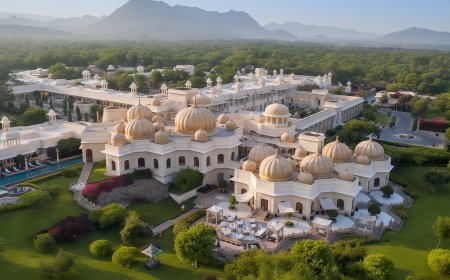
For NRI couples planning a destination wedding in India, the astrological date selection becomes simultaneously simpler and more complex. Simpler because the Jyotishi can calculate for a fixed Indian location rather than a diaspora city; more complex because the Indian wedding season is intensely concentrated into specific auspicious windows, meaning that venues in Udaipur, Jaipur, Goa, Kerala, and other popular destination wedding locations are booked years in advance for the most auspicious dates.
The most sought-after auspicious periods for Indian weddings — the Vivah Muhurtas [specifically auspicious windows for marriages] that fall between November and February when Jupiter and Venus are both well-positioned — are the same periods when every popular destination wedding venue in India is fully booked. NRI couples planning a destination wedding in India should ideally begin venue conversations eighteen months to two years ahead, provide the venue with a range of auspicious dates from their Jyotishi, and be prepared to commit to a booking before the full ceremonial planning has been completed.
Jaipur, Udaipur, and Jodhpur in Rajasthan are the most popular destination wedding locations for NRI couples, and their heritage hotel venues operate on a sophisticated understanding of the Panchang-based booking pattern. Kerala's backwater resorts and Goa's coastal venues are increasingly popular for more contemporary NRI couples who want a beautiful Indian setting with a lighter ceremonial structure.
When briefing local wedding coordinators in India, share your Jyotishi's Muhurta details in full — the specific auspicious window including start and end times — so that all ceremonial elements can be timed correctly. A good Indian wedding coordinator will understand immediately and plan the ceremony sequence backward from the Muhurta window.
What You Need: Ritual Checklist
For the Astrological Consultation: Birth date, time, and place of both bride and groom, geographic location of wedding venue, range of preferred months for the wedding, contact details of a trusted Jyotishi recommended by family or community, access to Drik Panchang or equivalent app for verification.
For the Muhurta: Confirmed auspicious date and time window from Jyotishi, Rahu Kaal timing calculated for your specific city, confirmation that neither bride nor groom is in an inauspicious Dasha at the time of the wedding, community-specific Panchang consulted for regional traditions.
For the Kundali Milan: Both horoscopes cast from birth details, Guna score calculated and explained, any remedial measures recommended by the Jyotishi if score is below eighteen or specific doshas are identified.
NRI.Wedding maintains a network of trusted Jyotishis available for remote consultations with diaspora couples, experienced in calculating Muhurtas for wedding locations across the UK, US, Canada, UAE, and Australia. We also connect couples with pandits who understand how to conduct ceremonies timed to the specific Muhurta window confirmed by the family's Jyotishi.
5 Questions NRI Couples Always Ask
Our venue is only available on a date that our Jyotishi says is inauspicious. What do we do?
The tradition's clear guidance is that the Muhurta takes precedence over the venue — but the tradition was formulated before non-refundable deposits and eighteen-month waiting lists. In practice, most NRI couples in this situation take a middle path: they consult a second Jyotishi for a second opinion, they look carefully at whether the inauspiciousness is mild or severe, and they examine whether specific remedial measures — Puja [ritual worship] or Graha Shanti [planetary pacification rituals] performed before the wedding — can mitigate the challenging planetary factors. A good Jyotishi will always offer remedial options alongside a negative assessment, because the tradition understands that human circumstances are complex and that remediation is as much a part of the system as avoidance.
My partner is not Hindu and their family does not understand why we cannot just pick a date that works for everyone. How do I explain this?
The most effective explanation is the one that speaks to a universal human instinct: that beginnings matter, and that different traditions have developed different ways of identifying the most auspicious moment for a significant beginning. Many non-Indian families, when it is explained to them that the Indian tradition has been refining its method of identifying auspicious timing for three thousand years, and that the system is astronomically precise even if its metaphysical claims are debated, respond with genuine curiosity rather than dismissal. Frame it as temporal wisdom — the understanding that the moment of a beginning carries the quality of that moment into the future — and most thoughtful people will find it compelling regardless of their own tradition.
We have received conflicting advice from two different Jyotishis about whether our Kundali Milan is compatible. How do we resolve this?
Conflicting Jyotishi opinions are more common than the tradition's authority figures admit, and they arise from genuine methodological differences — different weighting of Gunas, different assessment of mitigating factors, different regional traditions of interpretation. The resolution is not to keep consulting until you find the answer you want. It is to choose one Jyotishi whose methodology and reputation you trust — ideally someone recommended by a family member who has long-term experience with that Jyotishi's guidance — and accept their assessment as authoritative for your wedding planning. A Guna score below eighteen with strong mitigating factors in the rest of the horoscope comparison is understood by most experienced Jyotishis as acceptable; a score above eighteen with no significant mitigating factors is universally considered auspicious.
Can we use an astrology app for our wedding date selection rather than consulting a Jyotishi in person or by video call?
Astrology apps are useful for understanding the landscape of auspicious and inauspicious periods and for verifying specific calculations like Rahu Kaal timing. They are not a substitute for a professional Jyotishi for a wedding Muhurta, for the same reason that a medical app is not a substitute for a doctor for a significant diagnosis. The Muhurta calculation for a wedding involves the specific birth details of both individuals, their current planetary Dasha periods, and an assessment of the full chart interaction — a level of personalised calculation that an app cannot perform. Use apps for orientation and verification; use a Jyotishi for the actual Muhurta selection.
We are Sikh and our families are divided on whether to consult a Jyotishi at all, since the Sikh Rehat Maryada does not include astrological date selection. How do we navigate this?
This is a genuinely complex question that reflects a real tension within many Punjabi Sikh families, particularly those with Hindu Punjabi relatives or deep roots in the pre-Sikh conversion traditions of the region. The Sikh Rehat Maryada is clear that Anand Karaj does not require astrological date selection and that superstitious practices are not in keeping with Sikh teachings. At the same time, many Sikh families consult Jyotishis as a cultural rather than a religious practice — separating it from the ceremony itself. The resolution is ultimately a family conversation rather than a doctrinal one: decide together whether this is a practice your family wishes to observe as cultural heritage or set aside in keeping with strict Sikh practice, and make that decision consciously rather than drifting into it by default.
The Emotional Angle
There is a particular moment in every NRI wedding planning conversation when the astrology question arrives, and it is always the moment when the distance between where you live and where you come from feels most acute. You are practical. You have a career and a mortgage and a calendar that syncs across devices. You think in quarterly planning cycles. And then your mother says the word Muhurta and suddenly you are standing at the edge of something three thousand years deep and the quarterly planning cycle feels very recent indeed.
But here is what actually happens when you go through the process properly — when you call the Jyotishi and give him the birth details and he works through the Panchang and comes back to you with a date that falls on a Tuesday morning in November at nine forty-seven and says this window is open until eleven fifteen. Here is what happens: you feel something settle. Something that had been quietly anxious — not about the venue or the catering or the photography but about something underneath all of that — becomes quiet.
Because the date is not just a date. It is the moment your marriage begins. And in the tradition you come from, that moment has always been chosen with care, because beginnings carry their inception point forward. Your grandparents' wedding date was chosen this way. And theirs before them. And theirs before them, in a line going back further than anyone can trace, each couple beginning their marriage in the window the stars had opened for them.
You book the venue for the Tuesday in November. Your mother exhales.
A Moment to Smile
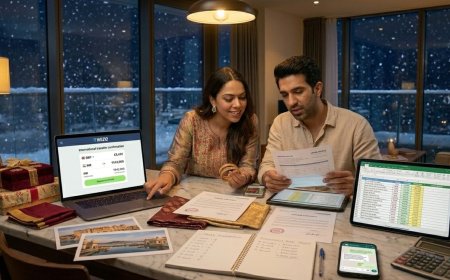
At a wedding planning session in Mississauga three years ago, the bride — a software engineer with a particular fondness for data-driven decision making — had, before consulting the family Jyotishi, independently built a spreadsheet comparing eighteen potential wedding dates across four venues, weighted by cost, seasonal weather probability, guest travel convenience, and photographer availability.
The Jyotishi, consulted the following week by video call from Jaipur, provided three auspicious Muhurtas. None of them appeared in the spreadsheet.
After a period of silence that her fiancé later described as "the most concentrated expression of conflicting worldviews I have ever personally witnessed," the bride opened a new tab in her spreadsheet, added a column labelled "Muhurta Score," assigned each of the Jyotishi's dates a value of one hundred, and selected the date that best balanced the Muhurta Score against the other weighted factors.
The wedding took place on a Wednesday morning in February, which had appeared on none of her original eighteen dates but scored highest once the Muhurta column was included. The venue was available, the photographer was free, and the weather was, by February Mississauga standards, entirely acceptable.
The spreadsheet is considered by everyone who has seen it to be one of the great achievements of NRI wedding planning.
Quotes From the Diaspora
"My mother and his mother consulted two different Jyotishis and got two different dates. We ended up on a three-way video call with both Jyotishis at the same time. It took four hours. The date we chose was suggested by neither of them — it was a compromise that both agreed was acceptable. It was also, as it turned out, a beautiful day." — Priyanka Sharma, North Indian Hindu, Toronto
"I was resistant to the whole astrology process. I'm a doctor — I think in evidence and data. But when I actually read about Jyotish properly, I found a system of astronomical precision that had been refined over three thousand years. I don't know if I believe in all of it. But I respect it. And our wedding date, as it turned out, was a genuinely beautiful day in every sense." — Vikram Iyer, Tamil Brahmin, Melbourne
"The Muhurta my Jyotishi gave us was at seven thirty in the morning on a Saturday. My fiancé's English family thought we had made a scheduling error. But when the ceremony was done by nine and the whole day stretched out in front of us with the best light of the morning still on everything, they said it was the most civilised wedding timing they had ever encountered." — Deepa Nair, Malayali Hindu, London
Your Stars Are Already Aligned
The Indian astrological tradition is not a barrier to planning your wedding. It is a gift — the accumulated wisdom of three thousand years of watching the sky and asking the question: when is the best moment to begin? The answer your Jyotishi gives you is the same kind of answer your great-grandmother received before her wedding, and hers before her, all the way back through the generations to the Rishis who first mapped the Nakshatras and understood that time, like everything else in the universe, has a quality that can be known.
NRI.Wedding connects couples with trusted Jyotishis available for remote consultations, experienced in calculating Muhurtas for diaspora cities across the UK, US, Canada, UAE, and Australia. We also connect you with pandits, Granthis, and ceremonial coordinators who understand how to time every element of your ceremony within the Muhurta window your Jyotishi has confirmed.
Find your date. Trust the stars that chose it.
Your stars are already aligned. Step into the light they are offering.
This article covers the role of Vedic astrology and Jyotish in Indian wedding date selection, including Muhurta calculation, Kundali Milan, Rahu Kaal, and Panchang guidance for NRI Hindu, Sikh, Meitei, and Parsi couples planning weddings in the UK, Canada, Australia, the US, and UAE, with guidance for destination weddings in Rajasthan, Kerala, and Goa.
What's Your Reaction?
 Like
0
Like
0
 Dislike
0
Dislike
0
 Love
0
Love
0
 Funny
0
Funny
0
 Angry
0
Angry
0
 Sad
0
Sad
0
 Wow
0
Wow
0