









































Warli Wedding Art Explained: The Complete NRI Guide to How Ancient Paintings Narrate Indian Wedding Stories
Warli wedding art is one of India's oldest living visual traditions — a geometric white-on-red pictorial language developed by the Warli tribal communities of Maharashtra's Palghar district, used for over 3,000 years to record and bless the sacred moment of marriage. From the chowk motif to the tarpa dance circle, every element carries profound spiritual meaning. For NRI couples in London, Toronto, Houston, Melbourne, and Dubai, incorporating authentic Warli art into a modern wedding is not a decorative trend — it is an act of cultural reconnection with one of humanity's oldest storytelling traditions.

Warli art is one of India's oldest living visual traditions — a geometric, white-on-earth-red pictorial language developed by the Warli tribal communities of Maharashtra's Palghar district that has been used for thousands of years to record the most sacred moments of human life, including marriage. For NRI couples from Maharashtra, Gujarat, and the broader Indian diaspora now living in London, Toronto, Houston, Melbourne, and Dubai, incorporating Warli wedding art into a modern ceremony is not a decorative choice — it is an act of reconnection with one of humanity's oldest storytelling traditions.
You have seen the image a hundred times without knowing its full weight. The white figures with their triangular bodies and stick limbs, dancing in a circle around a central motif, painted against a warm red-brown background. You saw it on a friend's wedding invitation. You noticed it on a fabric panel at a reception in Mississauga. You watched a street artist reproduce it on a café wall in Bangalore and felt something stir that you could not quite name.
What you were feeling was recognition. Not personal memory — something older. The Warli image speaks to something in the Indian visual nervous system that responds before the mind has time to analyse. It says: community. It says: celebration. It says: we have always gathered in circles and we have always danced.
Now you are planning a wedding, and you want Warli art woven into it — on the invitations, the mandap, the mehndi, the décor — and you want to do it with the cultural understanding it deserves rather than as a Pinterest trend. This is that guide.
🌟 DID YOU KNOW?
Warli art is estimated to be at least 2,500 to 3,000 years old, with some historians tracing its origins to 10,000 BCE based on cave painting similarities found in the Palghar and Dahanu regions of Maharashtra. This makes it one of the oldest continuously practised art forms in the world — older than the Indus Valley Civilisation's urban phase and contemporary with the earliest known cave art traditions globally.
The Suhasini or chowk [the central sacred square motif in Warli wedding paintings] is always painted by the Suvasini — a married woman whose husband is alive — and never by a widow or an unmarried woman. This rule has been observed without interruption for thousands of years and carries profound spiritual significance: the married woman's auspicious status is believed to consecrate the painting and transfer its blessing to the couple.
Warli art entered mainstream Indian and global consciousness largely through the work of Jivya Soma Mashe, a Warli artist from Palghar who began painting on paper in the 1970s at the encouragement of cultural researcher Bhaskar Kulkarni. Before this, Warli paintings existed exclusively on the mud walls of homes and were never considered art objects — they were living ritual documents that were painted, used, and allowed to fade.
WHAT IS WARLI WEDDING ART?
Warli chitra [Warli painting] is the visual language of the Warli tribal community — the Adivasi [indigenous] people of the Palghar, Dahanu, and Mokhada regions of northern Maharashtra and parts of Gujarat and Dadra and Nagar Haveli. The name Warli comes from the word waral [a piece of land], reflecting the community's deep connection to the agricultural landscape they have inhabited for millennia.
The visual grammar of Warli art is deceptively simple and philosophically profound. All human and animal figures are constructed from two triangles joined at their tips — the upper triangle representing the torso, the lower the hips — with a circle for the head and lines for limbs. This geometric reduction is not artistic limitation; it is a deliberate spiritual choice. In Warli cosmology, the triangle represents the fundamental tensions of existence: earth and sky, male and female, birth and death. The circle represents the sun, the moon, and the cycle of time.
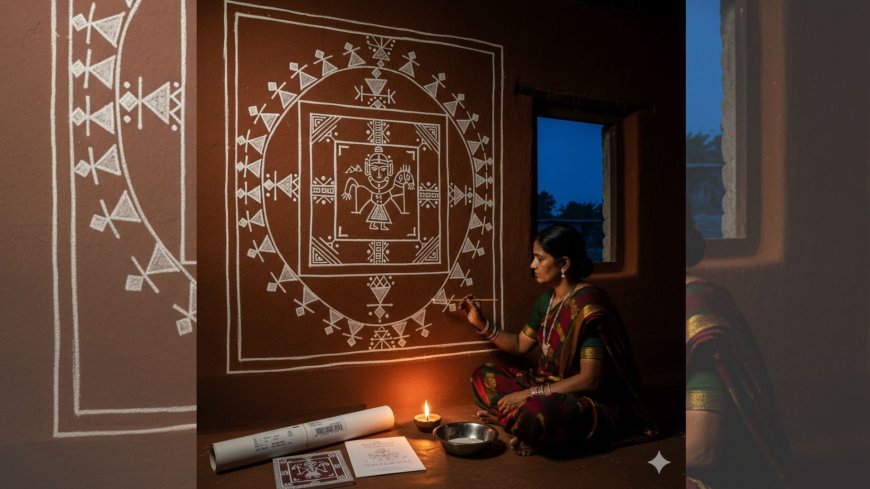
The wedding painting — called Lagnachi Warli [marriage Warli] — is the most sacred and elaborate category of Warli art. It is painted on the walls of the bride's home on the day before the wedding, always at night by lamplight, always by a suvasini [married woman of auspicious status]. At its centre is the chowk — a large square containing the image of Palghat Devi or Palaghata [the Warli goddess of fertility and marriage] flanked by her horse. Around this central image, the suvasini paints the entire cosmology of the wedding: the procession, the feast, the dancing, the community gathered in their sacred circle called the tarpa dance [a circular chain dance performed around a musician playing the tarpa, a wind instrument made from a gourd].
The painting is made using a paste of chawl [rice paste] mixed with water, applied with a brush made from a bamboo twig chewed at one end to create bristles. The background is prepared from a mixture of cow dung, mud, and geru [red ochre earth] — materials that connect the painting physically to the earth it celebrates.
In the wedding sequence, the Warli painting is not décor. It is a living ritual document — a prayer painted into the wall of the home that witnesses and blesses the ceremony about to take place within it.
COMMUNITY COMPARISON TABLE
| Community / State | Wedding Art Tradition | Key Visual Elements | How NRIs Abroad Incorporate It |
|---|---|---|---|
| Warli – Maharashtra (Palghar) | Lagnachi Warli | Chowk motif, tarpa dance circle, Palaghata goddess, rice paste on red earth | Warli artist commissioned for mandap backdrop, invitation design, mehndi patterns |
| Madhubani – Bihar/Mithila | Madhubani Vivah Chitra | Kohbar room painting, fish and lotus motifs, bridal couple portrait | Canvas paintings for reception backdrop; Madhubani invitation cards widely used in diaspora |
| Gond – Madhya Pradesh | Gond Wedding Art | Dot-and-dash patterns, tree of life, animal totems | Gond art panels for wedding décor; commissioned digitally from Bhopal/Jabalpur artists |
| Pattachitra – Odisha | Pattachitra Vivah | Palm leaf or cloth scroll paintings, Krishna-Rukmini wedding narrative | Scroll gifted to couple; used on invitations and wedding programmes |
| Kalamkari – Andhra Pradesh | Kalamkari Wedding | Pen-drawn mythological wedding scenes, natural dyes on cloth | Kalamkari fabric used for mandap draping and bridal dupatta |
| Phulkari – Punjab | Phulkari Embroidery | Embroidered wedding shawls, geometric floral patterns | Phulkari dupattas and table runners at diaspora receptions universally |
| Pichwai – Rajasthan | Pichwai Wedding Art | Krishna and Radha wedding scenes, gold leaf on cloth | Pichwai panels as mandap backdrop; commissioned from Nathdwara artists |
| Tanjore Painting – Tamil Nadu | Tanjore Vivah Chitra | Gold-embossed bridal couple portraits, gemstone inlay | Gifted as wedding portrait; used as centrepiece at Tamil NRI receptions |
| Cheriyal Scroll – Telangana | Cheriyal Wedding Scroll | Narrative scroll depicting wedding story, bright primary colours | Scrolls gifted as keepsakes; used as table runner décor |
| Tikuli – Bihar | Tikuli Art | Lacquer-based gold and colour paintings on glass | Used as wedding invitation inserts and gift box decorations |
THE MEANING BEHIND THE RITUAL
The tarpa dance circle that appears at the centre of almost every Warli wedding painting is the key to understanding the entire tradition. In it, a chain of figures holds hands around a central musician, moving in a continuous circle that has no beginning and no end. This image is not a depiction of a specific dance — it is a cosmological statement.
In the Warli worldview, the individual exists only in relation to the community. The circle of dancers says: no one stands alone. The marriage at the centre of the painting is not the union of two individuals — it is the addition of a new bond to an existing web of human connection that stretches back through generations and forward into futures not yet born.
The chowk at the painting's centre — that sacred square presided over by Palaghata, the goddess who governs the transition from girlhood to wifehood — represents the threshold. The square is the most stable of geometric forms: it does not roll, does not tip, does not transform easily. By placing the goddess on a square, the Warli tradition is saying that the transition of marriage, for all its joy and disruption, rests on a foundation that holds.
The choice of white on red — rice paste on red earth — is itself a theological statement. White is the colour of rice, of sustenance, of new beginnings. Red is the colour of the earth, of blood, of continuity. Every Warli wedding painting is a meditation on how new life grows from ancient ground.
For a non-Indian partner trying to understand: think of a Warli wedding painting not as decoration but as a map — a map of everything a community believes about what marriage is, drawn on the wall of the house where it is about to happen.
INCORPORATING WARLI WEDDING ART ABROAD: THE PRACTICAL REALITY
For NRI couples wanting to incorporate Warli wedding art into a ceremony abroad, the most important principle is this: commission an actual Warli artist rather than using a digital template or a generic Indian folk art print. The difference in meaning, quality, and cultural integrity is significant — and in the age of Instagram, the difference in visual impact is also significant.
Several established Warli artists from the Palghar district now accept international commissions for wedding-related work. The Warli Art Foundation and various Maharashtra government craft promotion bodies maintain artist directories. Platforms like Etsy have a small number of genuine Warli artists selling original work and accepting custom commissions — look for artists who name their village and demonstrate knowledge of the ritual context, not just the visual style. Budget three to four months for a commissioned piece to be completed and shipped internationally.
For wedding invitations — one of the most popular diaspora uses of Warli art — several Indian graphic designers based in Mumbai and Pune specialise in Warli-inspired digital invitation design that uses the authentic visual grammar rather than generic geometric imitation. A well-designed Warli invitation immediately signals cultural depth and seriousness to recipients. In diaspora communities where wedding invitations are a significant social communication, this matters enormously.
For mandap decoration — the most visually impactful use of Warli art at a wedding — the options include commissioned canvas panels (most practical for abroad), fabric prints on natural cotton or jute, hand-painted wooden panels, or for couples with the time and budget, a commissioned artist who travels to paint directly on a venue wall or a large canvas on-site. Several Warli artists based in Mumbai and Nashik have undertaken international travel commissions for diaspora weddings in London, Dubai, and New Jersey. The cost is significant but the result is extraordinary.
For mehndi design incorporating Warli motifs — an increasingly popular choice among Maharashtrian NRI brides — the tarpa dance circle, the chowk, and the procession figures translate beautifully into mehndi patterns and offer a striking alternative to standard Rajasthani or Arabic mehndi styles. Brief your mehndi artist with reference images at least one month ahead and confirm they are familiar with Warli geometry. In London, several South Asian mehndi artists in the Wembley and Harrow areas are familiar with Warli patterns. In Toronto, the Gerrard Street area's mehndi artists have increasing experience with tribal art motifs. In Dubai, Meena Bazaar's mehndi artists will require clear reference images and a detailed brief.
For wedding favours and gifts, small Warli-painted wooden boxes, terracotta tiles, and cotton tote bags are all available from Maharashtra craft cooperatives and can be ordered in bulk for diaspora weddings. Dastkar — the Delhi-based craft NGO — and Craftsvilla ship internationally and carry authentic Warli craft items. The Maharashtra government's Handicrafts Development Corporation also ships internationally and provides certificates of authenticity — important for couples who want to gift something genuinely meaningful rather than commercially produced.
For coordinating with artists in India: Maharashtra is IST (UTC+5:30). A 9:00 AM call in London is 2:30 PM in Palghar — ideal. In Toronto, a 9:00 AM call is 7:30 PM in Palghar — perfectly workable for an evening consultation.
INCORPORATING WARLI ART AT A DESTINATION WEDDING IN INDIA
For NRI couples planning a destination wedding in Maharashtra, the opportunity to incorporate authentic Warli art in its original context is extraordinary. Palghar district — just two hours north of Mumbai — is the heartland of Warli culture and has seen growing interest from wedding planners seeking culturally authentic ceremonies.
A destination wedding in the Palghar-Dahanu region allows for the full traditional experience: a suvasini painting the Lagnachi Warli on an actual mud wall the night before the ceremony, the tarpa music played live, and the visual landscape of the Western Ghats foothills as backdrop. Several heritage properties and eco-resorts in the Jawhar and Mokhada areas of Palghar now offer wedding packages that incorporate Warli artist residencies as part of the ceremony.
For weddings held in Mumbai or Pune, commission a Warli artist to create a large-format painting on canvas or board as the ceremony backdrop, and incorporate Warli motifs into the floral design, table settings, and printed materials. Mumbai-based wedding designers with expertise in tribal art integration include several who specialise specifically in Warli, Madhubani, and Gond art incorporation.
For non-Indian guests, prepare a one-page visual guide to the Warli symbols they will encounter — the meaning of the chowk, the tarpa circle, the triangle figures — placed at each seat. Guests who understand what they are looking at will be moved by it in ways that guests who simply see pretty patterns never will.
WHAT YOU NEED: WARLI WEDDING ART CHECKLIST
Art and Décor Items: Commissioned Warli painting for mandap backdrop or wall installation, Warli-designed wedding invitations and programme cards, Warli mehndi design brief for the mehndi artist, Warli-printed fabric for table runners or mandap draping, small Warli-painted favour items for guests, and a framed original Warli painting as a permanent keepsake for the couple.
People Required: A commissioned Warli artist for original work, a graphic designer familiar with Warli visual grammar for printed materials, a mehndi artist briefed on Warli geometry, and ideally a cultural narrator — a family member or coordinator — who can explain the symbolism to non-Indian guests during the reception.
Preparation Steps: Research and contact Warli artists for commission minimum six months ahead. Finalise invitation design three to four months ahead. Brief mehndi artist with Warli reference images two months ahead. Order favour items from Maharashtra craft cooperatives two months ahead. Prepare visual symbol guide for guests. Arrange framing and shipping of original commissioned artwork.
NRI.Wedding connects couples with verified Warli artists accepting international commissions, Maharashtra wedding designers with tribal art expertise, and photographers who understand how to capture the visual language of Warli art at its most powerful. Explore our Indian folk art wedding directory today.
5 QUESTIONS NRI COUPLES ALWAYS ASK
Is it culturally appropriate for a non-Warli, non-tribal Indian couple to use Warli art at their wedding?
This is the question most diaspora couples ask first and most sincerely, and it deserves a careful answer. Warli art has been shared with the broader Indian and global public through the deliberate outreach of Warli artists and cultural organisations since the 1970s — Jivya Soma Mashe and his successors have actively sought wider engagement with the tradition. The critical distinction is between respectful incorporation and superficial appropriation. Respectful incorporation means commissioning actual Warli artists, understanding the symbolism you are using, crediting the tradition publicly at your wedding, and ensuring your wedding purchases benefit the Warli artist community financially. Using a generic digital template that mimics the style without engaging the community is the version that causes cultural harm.
Can we commission a Warli artist to paint on the actual wall of our wedding venue in London?
Yes — and this has been done at diaspora weddings in London, New Jersey, and Dubai. It requires early coordination with your venue to obtain permission for wall painting, a conversation about whether the paint will be permanent or temporary, and sufficient budget and lead time to arrange the artist's travel. Several Warli artists from Palghar have undertaken international commissions and are comfortable with travel. The result — an authentic Warli painting on the wall of a London venue — is one of the most powerful visual statements an NRI couple can make about where they come from.
How do we incorporate Warli art into a non-Maharashtrian Indian wedding without it feeling out of place?
Warli art's geometric universality means it translates beautifully across cultural contexts when used thoughtfully. The key is to use it as a frame for your own wedding story rather than as a replacement for your own community's traditions. Commission an artist to incorporate your specific community's symbols — a Bengali couple might request the tarpa dance circle surrounding a figure in a banarasi saree; a Punjabi couple might request the procession motif rendered in Warli style with a doli. When the art adapts to your story rather than imposing its own, the result is a genuinely original cultural synthesis.
We want Warli-inspired mehndi for the bride but our mehndi artist in Toronto has never done this style. How do we brief them?
Prepare a detailed visual brief with at least ten to fifteen reference images showing the specific Warli elements you want — the chowk, the tarpa circle, the procession figures, the horse and rider. Clearly explain the geometric principles: triangles for bodies, circles for heads, straight lines for limbs. Ask your artist for a small test patch at least three weeks before the wedding to confirm they can execute the style cleanly. The Warli style's clean geometric lines actually suit mehndi application very well — many mehndi artists find it refreshing after the dense florals of standard Rajasthani style.
Where do we find authentic Warli art items for wedding favours that genuinely support the Warli artist community?
The most reliable sources for ethically sourced authentic Warli craft items are the Maharashtra government's craft promotion shops, the Dastkar craft NGO, and direct purchase from Warli artist collectives in Palghar through their verified social media accounts and websites. When ordering in bulk for wedding favours, contact the artists or collectives directly and negotiate a custom order — most are experienced with wedding favour commissions and can produce consistent small items like painted tiles, wooden boxes, or cotton pouches in quantities of fifty to two hundred at reasonable prices. Every purchase that goes directly to the artist community rather than through a commercial intermediary is a meaningful act of cultural support.
THE EMOTIONAL ANGLE
There is a particular kind of grief that comes with being an NRI who loves Indian art traditions. It is the grief of knowing that somewhere in Maharashtra, a suvasini is grinding rice into paste by lamplight and painting white figures onto a red wall for a wedding that will happen tomorrow morning — and that this act, which has been performed without interruption for three thousand years, is invisible to most of the world.
It is the grief of knowing that when your own grandmother's house was sold, the Warli-style rangoli she made every morning in the courtyard disappeared with it. That the visual language your ancestors used to record the most important moments of their lives is now more likely to appear on a corporate PowerPoint template than on the wall where it was born.
And then something shifts. You find an actual Warli artist through a Maharashtra craft cooperative. You commission a painting for your wedding mandap. It arrives rolled in brown paper, smaller than you expected, and you unroll it on your living room floor in London or Houston and the white figures dance against their red ground and the chowk sits at the centre exactly as it has sat at the centre of Warli weddings for three thousand years.
And you realise that the grief was misplaced. The tradition is not disappearing. It is travelling. It is arriving in your living room in brown paper. It is being painted on a canvas that will hang on the wall of your first home together. It is being drawn in henna on your hands the night before your wedding.
Three thousand years of one community's understanding of what marriage means — and it is yours to carry forward, if you choose to carry it with care.
A MOMENT TO SMILE
At a Maharashtrian wedding in Houston in 2022, the couple had commissioned a beautiful large-format Warli painting from a Palghar artist to serve as the mandap backdrop. The painting arrived perfectly, was framed magnificently, and was positioned behind the mandap with great ceremony the morning of the wedding. What nobody had anticipated was the couple's five-year-old nephew, who had been told that the white figures were dancers and had interpreted this information as an invitation.
Forty minutes before the ceremony, the wedding photographer found him standing in front of the painting performing what he described as the tarpa dance — a vigorous personal interpretation involving significant arm movement — for an audience of three equally small cousins. He had also, with a marker retrieved from the gift table, added what he called his own figure to the lower left corner of the painting. He explained that he wanted to be at the wedding too.
The artist, when shown the photograph later, said it was the most Warli thing that could possibly have happened. The addition, the family decided, stays.
QUOTES FROM THE DIASPORA
"I am a Marathi woman living in Melbourne. My husband is Australian. When we commissioned the Warli painting for our mandap, I tried to explain to his mother what the figures meant — the circle, the goddess at the centre, the dancer with the tarpa. She listened very carefully and then said: 'So the painting is a prayer.' Yes. Exactly. That is exactly what it is." — Priyanka Deshmukh, Maharashtrian community, Melbourne
"We used Warli motifs throughout our wedding — the invitations, the mehndi, a painted wooden frame for the seating chart. My mother said it was too much. Then a guest — a professor of Indian art history — came to her specifically to say the wedding was the most culturally thoughtful she had attended in twenty years. My mother has not said it was too much since." — Rujuta Patil, Maharashtrian community, Toronto
"My daughter asked me why the Warli figures all look the same. I told her: because in a community, everyone is equal. No one is bigger or more important. Everyone holds hands and dances in the same circle. She thought about this for a long time. Then she said she wanted Warli at her wedding too. She is nine years old. I consider this a victory." — Sanjivani Kulkarni, Maharashtrian community, Dubai
YOUR ROOTS TRAVEL WITH YOU
Warli wedding art has survived three thousand years not because it was preserved in museums or protected by institutions, but because the women who carried it — the suvasinis who ground the rice paste and picked up the bamboo brush and painted through the night by lamplight — refused to stop. They painted through drought and flood, through colonial disruption and economic hardship, through the long invisibility of a tradition the world was too busy to notice.
NRI.Wedding is here for the couples who refuse to let this tradition become invisible. Our directory of verified Warli artists accepting international commissions, Maharashtra wedding designers with tribal art expertise, mehndi artists briefed in Warli geometry, and destination wedding specialists in the Palghar region exists because your wedding deserves art that carries meaning older than any trend.
Commission the painting. Brief the mehndi artist. Hang the chowk on your wall.
Your roots travel with you. Let them be painted in white on red, as they always have been.
This article covers Warli wedding art traditions including Lagnachi Warli paintings, the chowk motif, tarpa dance symbolism, Palaghata goddess imagery, and how NRI couples in London, Toronto, Houston, Melbourne, and Dubai are incorporating authentic Warli tribal art from Maharashtra's Palghar district into modern Indian weddings.
What's Your Reaction?
 Like
0
Like
0
 Dislike
0
Dislike
0
 Love
0
Love
0
 Funny
0
Funny
0
 Angry
0
Angry
0
 Sad
0
Sad
0
 Wow
0
Wow
0