


















































Worn Like a Prayer: The Complete Region-by-Region Guide to Traditional Indian Bridal Jewellery
Indian bridal jewellery is among the world's most sophisticated sacred adornment traditions — varying dramatically across communities from Tamil temple Vanki to Bengali Shankha Pola and Kashmiri Pandit Dejhoor. For NRI brides planning weddings across the UK, US, Canada, UAE, and Australia, sourcing authentic community-specific pieces requires specialist knowledge, careful planning, and deep cultural understanding. This region-by-region guide covers the meaning, ritual significance, and diaspora sourcing of traditional Indian bridal jewellery across ten major communities.


Indian bridal jewellery is among the most sophisticated decorative tradition in human history — a language of gold, gemstone, and sacred symbolism that varies so dramatically from one community to the next that a Tamil bride and a Kashmiri bride standing side by side are wearing two entirely different conversations with their ancestors. For NRI brides planning weddings from London to Los Angeles, understanding the specific jewellery traditions of their community — what each piece means, when it is worn, and why it matters — transforms the act of getting dressed on the wedding morning from a styling decision into a spiritual one. This guide is the most complete region-by-region reference available for the Indian diaspora bride who wants to wear her heritage correctly, beautifully, and with full knowledge of what she is carrying.
You remember watching her get dressed. Your mother, or your maasi, or your bua — whoever it was in your family who wore the jewellery first in your living memory. You remember the specific weight of it, the sound it made, the way the light moved differently in the room when it was on. You did not understand what each piece was called or what it meant. You only understood that it was serious. That it mattered. That the women around her handled it with a reverence usually reserved for things kept in the puja room.
You are in Toronto now, or in Dubai, or somewhere in the Home Counties, and your wedding is in four months and you are standing in a jewellery shop that does very beautiful work but the man behind the counter keeps showing you things that are not quite right — not wrong, exactly, but not yours. Not your community's. Not the specific vocabulary of gold and stone that your grandmother wore and her mother before her.
This guide will give you the words. And the knowledge to find what belongs to you.
🌟 DID YOU KNOW?
• The Mangalsutra [the sacred black-and-gold necklace tied by the groom during the Hindu wedding ceremony] varies so dramatically in design across Indian communities that a jeweller trained only in North Indian traditions may not recognise the Maharashtrian, Tamil, or Telugu version as the same piece — each carries distinct symbolism encoded in its specific construction and bead pattern.
• Indian bridal gold jewellery represents one of the world's largest concentrations of personal gold ownership — India accounts for approximately 25 percent of global gold demand annually, with a significant proportion driven by bridal jewellery purchases, making the Indian bride one of the most economically significant figures in the global precious metals market.
• In the Indian diaspora, the tradition of the Streedhan [the bride's personal wealth in jewellery, considered legally and spiritually her own property] is being actively reclaimed by modern NRI brides as a feminist as much as a cultural act — the understanding that the jewellery is hers, not her family's and not her husband's, resonates powerfully with educated diaspora women navigating questions of financial independence within traditional marriage frameworks.
What Is Indian Bridal Jewellery?
Indian bridal jewellery — known collectively as Solah Shringar [the sixteen adornments of a Hindu bride] in the North Indian tradition — is not decoration. It is a complete system of sacred ornamentation in which every piece has a specific name, a specific placement on the body, a specific spiritual function, and a specific point in the wedding sequence at which it is worn or presented.
The Solah Shringar encompasses the Maang Tikka [the forehead pendant suspended from the hair parting], the Nath [the bridal nose ring], the Haar [necklace], the Mangalsutra [the sacred marriage necklace], the Kaan ke Jhumke [earrings], the Chura [the ceremonial bangles], the Kangan [wrist bangles], the Haath Phool [the hand flower — a ring connected by chains to a bracelet], the Bichhiya [toe rings], the Payal [anklets], and related pieces that complete the full bridal ensemble. Not every community observes all sixteen, and the specific pieces considered essential vary significantly by region, caste, and family tradition.
Gold is the universal medium of Indian bridal jewellery, understood in the Indian worldview as the most auspicious metal — the colour of the sun, the metal of the goddess Lakshmi [the goddess of wealth and prosperity], and the most appropriate material for marking a transition as significant as marriage. The purity of gold used in bridal jewellery — traditionally 22 karats in most Indian communities — reflects the seriousness of the occasion and the permanence of what is being marked.
The jewellery is presented at specific ritual moments: some pieces come from the bride's family as part of her Dahej[dowry or bridal gifts], others are given by the groom's family, and some are purchased by the bride herself or chosen jointly by the couple. The gifting of jewellery is itself a ritual act, carrying meaning about the relationship between the families.
Community Comparison Table
| Community / State | Key Bridal Pieces | Distinctive Features | How NRIs Abroad Source It |
|---|---|---|---|
| North Indian Brahmin / Hindu | Maang Tikka, Nath, Polki haar, Chura, Haath Phool, Payal, Mangalsutra | Kundan and Polki uncut diamond work; red and ivory Chura bangles | Jewellers in Southall, Wembley, Devon Avenue Chicago, Hillcroft Houston |
| Punjabi Hindu / Sikh | Kaleere [hanging ornaments on bangles], Chura, Nath, Passa [side headpiece] | Gold Kaleere hung from Chura; Passa worn on side of head | Punjabi jewellers in Southall, Brampton, Surrey widely available |
| Rajasthani | Borla [large Maang Tikka], Nath, Aad [throat ornament], Kangan, Bichhiya | Meenakari enamel work in vivid colours; large ornate Borla | Rajasthani jewellers in Leicester and Houston; specialist importers |
| Gujarati | Maang Tikka, Nath, Haar, Kangan, Kamarbandh [waist belt], Bichhiya | Intricate gold filigree work; Kamarbandh essential | Gujarati jewellers in Leicester, Edison NJ, Parramatta |
| Maharashtrian | Nath, Mangalsutra [distinctive Maharashtrian black bead design], Kolhapuri Saaj, Thushi | Nath extremely large and ornate; green glass bangles essential | Maharashtrian jewellers in Melbourne and New Jersey; community networks assist |
| Tamil Brahmin | Maatal [temple jewellery headpiece], Jimikki earrings, Vanki [upper arm band], Oddyanam [waist belt] | Temple jewellery in gold with rubies and emeralds; Vanki essential | Tamil jewellers in Harrow, Scarborough, Parramatta; temple jewellery importers |
| Telugu | Jada Pirulu [hair ornament], Vanki, Oddyanam, Kasulaperu [coin necklace] | Elaborate hair jewellery; coin necklace historically significant | Telugu jewellers in New Jersey, Sydney; specialist importers from Hyderabad |
| Bengali Hindu | Shankha Pola [white conch and red coral bangles], Loha [iron bangle], Noa, Chik necklace | Shankha Pola is non-negotiable; worn for life after wedding | Bengali jewellers in Mississauga, Melbourne; Shankha sourced from specialist suppliers |
| Kashmiri Pandit | Dejhoor [ear ornament worn through cartilage], Athrebanth necklace, Aath | Dejhoor is community-defining piece; worn through upper ear | KP community networks provide jeweller contacts; specialist craftsmen in Jammu |
| Keralite Hindu | Kasumala [coin necklace], Manga Mala [mango-shaped gold necklace], Elakkathali | Emphasis on pure gold with minimal stone; clean sculptural forms | Keralite jewellers in Southall and Melbourne; specialist importers from Kerala |
The Meaning Behind the Jewellery
Every piece of Indian bridal jewellery is a map of the body read as sacred geography. The Maang Tikka sits at the Ajna Chakra [the third eye energy centre], understood to activate intuition and protect the bride's consciousness at the moment of her greatest vulnerability and transformation. The Nath adorns the left nostril, which in Ayurvedic tradition is connected to the female reproductive system and is understood to ease childbirth. The Bichhiya toe rings are worn on the second toe of each foot, where a nerve is believed to connect to the uterus — their pressure understood to regulate the menstrual cycle and support fertility.
The Mangalsutra is the most sacred piece — the physical embodiment of the marriage itself, tied by the groom's hands and understood to contain his life force as protection for his wife. In communities where the Mangalsutra is worn for life, removing it is understood as inauspicious; it is the jewellery equivalent of the marriage vow made visible on the body every day.
The gold itself carries the energy of the sun — warming, vitalising, auspicious — and the act of adorning the bride in gold on her wedding day is understood as surrounding her with solar protection at the threshold moment of her life's greatest transition.
Indian bridal jewellery is the tradition's way of writing the bride's new identity onto her body in the most permanent and beautiful language available — gold, sacred geometry, and ancestral love.
Finding and Wearing Your Bridal Jewellery Abroad: The Practical Reality
The bridal jewellery search is one of the most emotionally loaded elements of NRI wedding planning — and one of the areas where the diaspora experience most sharply diverges from the experience of brides planning weddings in India. In India, the jewellery conversation happens within a web of family knowledge, community jewellers known across generations, and the ability to visit multiple specialists in a single afternoon. In London or Toronto or Melbourne, the landscape is very different.
The first practical reality is that not all Indian jewellers in diaspora cities carry community-specific traditional pieces. The majority of Indian jewellery retailers in Southall, Wembley, Leicester, Brampton, and Parramatta stock beautiful jewellery — but it skews toward North Indian and broadly pan-Indian styles. If you need Maharashtrian Kolhapuri Saaj, Tamil temple jewellery Vanki, Bengali Shankha Pola, or Kashmiri Pandit Dejhoor, you will need to seek out community-specific suppliers.
In London, the most community-specific jewellery sourcing happens through Southall and Wembley for North and West Indian pieces, Harrow and Tooting for South Indian temple jewellery, and through community networks for the more specialist regional traditions. The Golders Green and Edgware areas have jewellers serving the Gujarati community with particular depth of stock. In Toronto, the Mississauga and Brampton corridors serve the Punjabi and Gujarati communities well; the Scarborough area has Tamil jewellery specialists. In Sydney, Harris Park in Parramatta is the primary hub. In Houston, Hillcroft Avenue is comprehensive for North and South Indian pieces. In Dubai, the Gold Souk in Deira carries an extraordinary range of Indian bridal jewellery from multiple regional traditions, making Dubai arguably the best city outside India for Indian bridal jewellery sourcing.
For truly community-specific pieces — particularly those from less widely represented traditions in diaspora cities — the most reliable approach is to commission jewellery directly from craftsmen in India, coordinating through family members or through specialist import services. This requires planning at least six to eight months ahead of the wedding. Photographs, measurements, and weight specifications can be communicated digitally; the finished pieces can be brought to the diaspora city by a travelling family member or shipped through specialist jewellery courier services.
The insurance question is important and often overlooked. Bridal jewellery collections of significant value should be insured specifically for the wedding period — check whether your existing home contents policy covers jewellery outside the home, and arrange specific event insurance if it does not. This is especially important for pieces borrowed from family members or brought from India for the occasion.
For NRI brides managing the weight and heat of a full traditional jewellery set in venues without the climate control of Indian wedding halls, practical adaptations are worth discussing with your jeweller: lighter-weight versions of traditional pieces, adjustable fastenings that allow pieces to be removed between ceremony and reception, and the strategic decision about which pieces are essential for the ceremony versus which can be worn only for the photography.
Bridal Jewellery in a Destination Wedding in India
For NRI brides planning destination weddings in India, the jewellery opportunity is extraordinary — and the jewellery shopping in India's major cities is an experience that many NRI brides describe as one of the highlights of the entire wedding planning process.
Jaipur is the undisputed capital of Kundan and Polki jewellery — the uncut diamond and gold work that characterises North Indian bridal jewellery at its most spectacular. The jewellery bazaars of Johari Bazaar in Jaipur allow a bride to commission exactly the pieces she wants from master craftsmen whose families have worked in this tradition for generations. For South Indian temple jewellery, Chennai's T. Nagar district — particularly the Usman Road jewellery strip — is the authoritative source. For Bengali Shankha Pola, Kolkata's Bow Bazaar has the most complete range of traditional pieces. For Hyderabadi jewellery including the magnificent Satlada [seven-strand pearl necklace] and Jadau work, the jewellers of the Charminar area in Hyderabad are unrivalled.
When coordinating jewellery shopping as part of a destination wedding trip, allocate a dedicated day for it — with a trusted family member who knows the tradition accompanying you, a clear list of pieces required, and a realistic understanding of what can be purchased off the shelf versus what requires commissioning time.
What You Need: Jewellery Checklist
Ritual Pieces by Category: Maang Tikka or community equivalent head ornament, Nath or community nose ornament, primary necklace set appropriate to community tradition, Mangalsutra [if applicable in your tradition], earrings appropriate to community style, bangles including any ceremonially specific pieces such as Chura or Shankha Pola, upper arm Vanki if applicable to South Indian tradition, Kamarbandh or Oddyanam waist belt if applicable, Haath Phool hand ornament, Payal anklets, Bichhiya toe rings.
People Required: Trusted family elder who knows your community's specific jewellery traditions, community-specific jeweller for sourcing and commissioning, professional bridal makeup artist experienced with the weight and placement of traditional jewellery, a dedicated jewellery custodian for wedding day logistics.
Preparation Steps: Research your community's specific traditional pieces at least eight months before the wedding, identify community-specific jewellers in your city or plan India sourcing trip, arrange insurance for all high-value pieces, schedule a full jewellery trial with your bridal outfit and makeup six to eight weeks before the wedding, assign a trusted person to manage the jewellery on the wedding day, photograph each piece individually for insurance and memory records.
NRI.Wedding connects brides with community-specific jewellery advisors and verified jewellers across diaspora cities — and with wedding stylists who understand the correct placement and ritual significance of traditional bridal pieces from every major Indian community.
5 Questions NRI Brides Always Ask
My family does not have heirloom jewellery because pieces were lost or sold during migration. How do I build a traditional bridal set from scratch?
This is more common in the NRI community than anyone discusses openly, and it is nothing to feel diminished by — migration involves loss, and jewellery is among the first things lost in displacement. Building a bridal set from scratch is an act of reclamation, and it deserves to be treated as such. Begin with research into your community's specific traditional pieces — this guide is a starting point, but conversations with older women in your community, temple networks, and community cultural organisations will give you deeper specificity. Commission or purchase the pieces that carry the most ritual significance first — the Mangalsutra, the Maang Tikka, the community-defining piece like the Dejhoor or the Shankha Pola — and build outward from there. The set you create will become the heirloom your daughter wears.
My partner is not Indian and their family does not understand the significance of the jewellery. How do I explain it?
The most effective explanation connects each piece to something universal. The Maang Tikka protects the mind. The Nath honours the body's connection to fertility and new life. The Mangalsutra is the physical form of the marriage vow. The bangles fill the home with the sound of the bride's presence. When the jewellery is explained in these terms — as a complete system of sacred protection and blessing worn on the most significant day of a woman's life — most non-Indian families respond with genuine wonder rather than confusion. A short note in your wedding booklet explaining the key pieces is a small gesture that transforms your guests' experience of watching you walk in.
How do I manage the weight of a full traditional bridal jewellery set during a long ceremony and reception?
This is a practical question every traditional bride faces, and the honest answer is that full traditional Indian bridal jewellery is heavy and requires physical preparation. In the weeks before your wedding, wear your jewellery pieces for increasing periods during trial runs with your outfit. Ensure your hair is pinned and padded to distribute the weight of the Maang Tikka. Have a trusted person nearby during the ceremony who can make adjustments if a piece becomes uncomfortable. Many brides choose to wear the full traditional set for the ceremony and formal photography, then transition to a lighter selection for the reception — this is entirely culturally acceptable and worth discussing with your family in advance rather than making a last-minute decision under pressure.
Can I mix jewellery from two different regional traditions if my parents come from different communities?
This question is becoming increasingly relevant as inter-community marriages become more common in the diaspora. The answer is yes, with thoughtfulness. The key is intentionality — choosing pieces from each tradition that carry personal and family significance, understanding what each piece means and why you are wearing it, and being able to explain the combination to curious family members as a celebration of both heritages rather than a confusion of them. A skilled bridal stylist with knowledge of multiple Indian jewellery traditions can help you create a combined look that is coherent rather than chaotic — and NRI.Wedding can connect you with stylists who have this specific expertise.
How do I authenticate the quality of gold jewellery purchased from diaspora jewellers or brought from India?
Gold purity in Indian bridal jewellery is traditionally measured in karats — 22 karat being the standard for most traditional Indian pieces, 18 karat for jewellery with more intricate stone settings. In the UK, all gold jewellery sold commercially must carry a hallmark from an Assay Office certifying its purity — look for the hallmark and verify it. In the US and Canada, gold purity must be disclosed at point of sale and can be independently tested. For jewellery brought from India, reputable Indian jewellers will provide a purity certificate; major Indian jewellery brands including Tanishq, Malabar Gold, and Kalyan Jewellers operate certification standards that are internationally recognised. For vintage or heirloom pieces of unknown purity, a local assay or independent jeweller testing service can provide verification before the piece is insured or worn.
The Emotional Angle
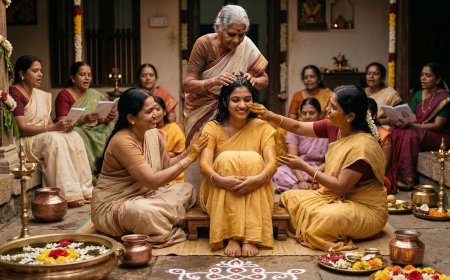
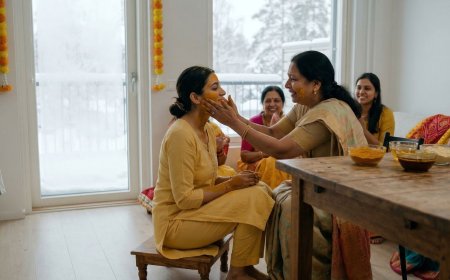
There is a moment on the wedding morning — before the guests, before the ceremony, before any of the day's public performance — when the jewellery goes on. It is usually just the women of the family in the room. A mother's hands, or a grandmother's, or an aunt's — someone who has done this before, who knows the correct sequence, who handles each piece with a competence born of having watched it done and then done it themselves.
And something happens in that room that has nothing to do with how the jewellery looks. It has to do with what passes through the hands. The knowledge that these hands are doing what hands in this family have always done. That the Maang Tikka being placed on this forehead has been placed on other foreheads, in other rooms, in other decades, by other hands that are gone now but present anyway in the gesture.
For NRI brides, this moment carries a particular kind of grief alongside its joy — the grief of the room not being in the right city, of the grandmother who could not travel, of the cousins who are twelve time zones away watching on a phone screen. The jewellery travels. The hands that know how to put it on do not always travel with it.
But here is what is also true: those hands taught other hands. The knowledge was passed forward. And when your mother places your Maang Tikka this morning in Birmingham or Brisbane or Burlington, she is carrying every hand that came before hers.
The gold remembers. That is what gold is for.
A Moment to Smile
At a wedding in Houston three years ago, the bride's Nath — a magnificent piece that had been in the family for two generations, brought specially from Jaipur for the occasion — was discovered on the wedding morning to have a fastening that no one in the room knew how to operate. It was an older style, a specific mechanism that the bride's grandmother had always managed herself, and the grandmother was in Jaipur watching on a video call.
What followed was a twenty-minute international technical support session in which the grandmother, peering at a phone screen held six inches from the Nath by a cousin, provided verbal instructions in rapid Rajasthani to four women in a Houston hotel room who were taking turns attempting the fastening while the bride sat perfectly still, in full makeup, making the expression of someone who has decided that serenity is the only available option.
The Nath was successfully attached with eleven minutes to spare. The grandmother, satisfied, signed off with the observation that this was why you learned these things properly and not from a video call.
She was correct. The bride wore the Nath beautifully for the entire ceremony. She has since learned the fastening herself. She will teach her daughter.
Quotes From the Diaspora
"My Vanki was made by a craftsman in Chennai whose family has been making them for four generations. When I put it on my upper arm on my wedding morning, I thought about all the women it had been made for before me — women I would never know, who had stood in a different room in a different century wearing something made by the same hands. That is not something I expected jewellery to make me feel." — Kavitha Subramaniam, Tamil Brahmin, Melbourne
"I brought my daughter's Shankha Pola from Kolkata myself — I carried it in my handbag on the flight, I did not put it in the hold. When I put it on her wrists on her wedding morning in Mississauga, I thought — this is why we came here. So she could have both. The new world and this." — Mala Chatterjee, Bengali Hindu, Mississauga
"My fiancé is English and he asked me what each piece meant while I was getting dressed. I explained every single one. By the time I finished, he was crying. He said he had not understood until that moment what he was marrying into. I said — now you know. He said — I am very glad I know." — Priya Sharma, North Indian Hindu, London
Your Roots Travel With You
The jewellery you wear on your wedding day is not an accessory. It is an archive — a portable museum of your community's aesthetic intelligence, spiritual philosophy, and generational love, worn on your body at the moment your life changes most completely. Every piece has a name. Every piece has a meaning. Every piece has been worn before, by women who wanted for you exactly what you are stepping into now.
NRI.Wedding connects brides with community-specific jewellery advisors, verified jewellers across diaspora cities, and bridal stylists who understand the correct ritual placement and cultural significance of traditional Indian bridal jewellery from every major community. We also connect you with photographers who know how to document the jewellery — and the morning it goes on — with the reverence both deserve.
Find your pieces. Learn their names. Wear them with everything they carry.
Your jewellery is your ancestors saying: we see you, we bless you, we are with you still.
This article covers traditional Indian bridal jewellery traditions across North Indian Hindu, Punjabi, Rajasthani, Gujarati, Maharashtrian, Tamil Brahmin, Telugu, Bengali, Kashmiri Pandit, and Keralite communities, with practical sourcing guidance for NRI brides in the UK, US, Canada, UAE, and Australia.
What's Your Reaction?
 Like
0
Like
0
 Dislike
0
Dislike
0
 Love
0
Love
0
 Funny
0
Funny
0
 Angry
0
Angry
0
 Sad
0
Sad
0
 Wow
0
Wow
0