







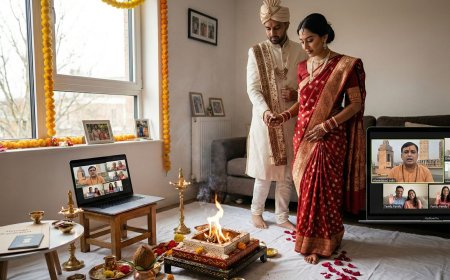







































































Vendor Cancelled Before Your Indian Wedding? Here's Exactly What Every NRI Couple Must Do
A last-minute vendor cancellation before an Indian wedding is every NRI couple's worst nightmare — and it happens far more often than the industry admits. This guide covers exactly what to do when a photographer, caterer, decorator, makeup artist, or wedding planner cancels close to your wedding date, with a category-by-category replacement playbook built for couples planning from the UK, USA, Canada, Australia, and UAE. From the first two hours after the call to building a pre-wedding contingency system that makes recovery possible, this is crisis planning for the reality of remote wedding management in India. The most thorough last-minute vendor cancellation guide written specifically for NRI couples worldwide.


Backup Plans When Vendors Cancel Last Minute
The call comes at 11 PM, two days before your wedding.
It's the photographer. Or the caterer. Or the decorator who has been holding your vision together for the past eleven months. Their voice is apologetic, their reason is some variation of unavoidable, and the feeling that spreads through your chest in the seconds after you hang up is something between panic and disbelief. You are five thousand miles from India. Your wedding is in forty-eight hours. And the vendor you trusted — the one you vetted carefully, paid on time, and stayed in regular contact with — has just removed themselves from the picture entirely.
This is not a hypothetical. It happens with enough regularity in the Indian wedding vendor market that every NRI couple planning from abroad should treat it not as an unlikely worst case but as a genuine operational risk that deserves a genuine contingency plan. The couples who navigate last-minute vendor cancellations without their wedding unravelling are not lucky. They are prepared.
This guide is about how to be prepared — and what to do in the hours and days after a cancellation when the pressure is at its most intense and the decisions you make matter most.
Why Last-Minute Vendor Cancellations Happen More Than You Think
Understanding why cancellations happen is not about assigning blame. It is about knowing which vendor categories carry the highest risk and what circumstances tend to trigger a cancellation — so you can take targeted precautions rather than spreading your contingency energy equally across every vendor relationship.
The Overbooking Problem
The Indian wedding season — primarily October through February, with secondary peaks around Akshaya Tritiya in April and May — creates extreme demand compression. During peak season, popular vendors in metro markets and destination wedding hubs like Udaipur and Jaipur receive far more enquiries than they can service. Some vendors, particularly photographers and makeup artists with strong social media followings, respond to this demand by overbooking and managing the fallout as it comes.
This is more common than any vendor will admit openly, and it disproportionately affects NRI couples. A local couple who books a vendor and maintains regular in-person contact is harder to quietly deprioritise than an NRI couple managing the relationship entirely through video calls and WhatsApp from a different time zone.
Genuine Emergencies — Which Are Real
Not every last-minute cancellation is a symptom of unprofessionalism. Vendors are human beings. A photographer gets hospitalised. A lead decorator's parent dies three days before your wedding. A caterer's kitchen suffers a fire. These things happen, and a vendor who cancels under genuine emergency circumstances deserves empathy — but your wedding still needs to happen, and the emotional complexity of feeling both compassion and panic simultaneously is something NRI couples rarely feel prepared for.
The Subcontractor Chain Problem
Many Indian wedding vendors — particularly large catering companies, décor firms, and entertainment agencies — operate through subcontractor networks. The company you've contracted with may be managing a chain of their own supplier relationships, any of which can fail. A floral vendor's supplier from the Bengaluru flower market fails to deliver. A caterer's staffing agency falls through. A sound system hire company cancels. The primary vendor suddenly cannot deliver what they promised — and their contract with you doesn't always protect you from the consequences of their supply chain problems.
The NRI Distance Disadvantage
When a vendor is overwhelmed, stressed, or facing conflicting obligations, the clients they prioritise are almost always the ones who are physically present, socially connected, or most likely to create immediate social consequences. An NRI couple in Canada, however organised and however significant their booking, operates at a natural disadvantage in that calculus. Being aware of this dynamic — and actively working against it throughout your planning process — is part of what makes a contingency strategy necessary.
The Contingency Mindset: Building Resilience Before Crisis Hits
The most effective backup plans are not made at 11 PM the night a vendor cancels. They are made months earlier, during the planning process, when you have time and leverage and clarity of thought on your side.
Identify Your Critical Path Vendors
Not all vendor cancellations are equally catastrophic. A last-minute cancellation from your mehendi artist is stressful and disappointing. A last-minute cancellation from your caterer for a 300-person wedding is an entirely different scale of crisis. Before you build your contingency strategy, map your vendor list by impact level.
Critical path vendors — the ones whose cancellation would materially compromise the wedding — typically include your main caterer, your photographer, your event management company or wedding coordinator, and your primary décor team. These are the relationships that need the most robust backup thinking. Everything else can be managed with less formal contingency planning.
The Backup Vendor List: Do This Now
For every critical path vendor you book, identify at least one backup option at the time of booking — not after a crisis. This means doing enough research during your initial shortlisting process to know who your second and third choices were, keeping their contact details, and making a note of their availability around your wedding date.
You don't need to contact these vendors or hold any kind of informal reservation. You simply need to know who they are and have a way to reach them quickly. When a cancellation happens at 11 PM forty-eight hours before your wedding, the last thing you want to be doing is starting a vendor search from scratch in a state of panic. A pre-researched backup list transforms a crisis into a problem — still stressful, but solvable.
Build the Relationship, Don't Just Hold the Booking
One of the most effective risk mitigation strategies available to NRI couples is also one of the least discussed: staying in active contact with your vendors throughout the planning period. Not obsessively, but consistently. A check-in call every six to eight weeks. A message when you've made a decision that affects their brief. A response to their Instagram stories occasionally.
Vendors who feel genuinely connected to a client — who know your names, your story, your vision, who feel invested in the outcome — are significantly less likely to deprioritise or cancel on you than vendors who filed your booking paperwork eleven months ago and haven't heard from you since. Relationship maintenance is not just good for the quality of what vendors deliver. It is a genuine cancellation risk reduction strategy.
When It Actually Happens: The First Two Hours
The first two hours after a vendor cancellation are the ones that matter most for determining your outcome. What you do — and don't do — in that window shapes everything that follows.
Don't Spiral. Assess.
This is easier said than controlled, particularly if the call comes late at night or if the cancellation is for a vendor whose work you've been looking forward to all year. Give yourself fifteen minutes to feel whatever you feel. Then close the emotion down for the next few hours and move into operational mode. The feelings will be there to process after the wedding. Right now, you need clarity.
The first question is not "how could this happen" but "what exactly do I need to replace, and by when?" The answer to that question determines everything: how urgently you need to act, how wide you need to cast your search, and what compromises you might need to accept.
Activate Your Coordination Layer Immediately
If you have a wedding planner or on-ground coordinator — and if you don't, this is the single most important reason to have one — they need to know about the cancellation within the first hour. A good wedding planner in India will have an active vendor network, existing relationships, and real-time knowledge of who is available on your date. They can make calls at midnight that you can't, follow up in person in ways you can't, and navigate the local vendor market with fluency that you, operating from abroad, simply don't have.
If you don't have a planner, your next call is to whoever your most trusted on-ground contact is — a sibling, a cousin with good connections, a family friend with genuine influence in the local vendor community. Someone needs to be making physical calls and visits on your behalf. This is not the moment for solo remote management.
Contact the Cancelling Vendor for a Referral
This step is counterintuitive when you're furious, but it is often one of the most productive. Ask the cancelling vendor directly for a referral to someone who can replace them. Vendors in the same city and category know each other. A photographer who cancels on you knows which other photographers in their market are excellent and may be available. A caterer who can't service your event may know exactly who can.
A vendor who is cancelling in genuine distress will often go out of their way to help find a replacement — it partially alleviates their guilt and their professional responsibility. A vendor who is cancelling for less defensible reasons may be equally motivated to help simply to manage the reputational damage of a clean handover versus an abandoned client.
Either way, the referral costs you nothing to ask for and can save you hours of search time.
Category-by-Category: How to Replace a Vendor in 48 Hours
The playbook for emergency vendor replacement differs meaningfully by category. Here is what to do when each critical vendor cancels close to your wedding date.
Photography and Videography
Photography is the cancellation that NRI couples most dread, and with good reason. The images from your wedding are permanent. There is no second attempt. And the photography market, while large, has a genuine quality ceiling — truly exceptional wedding photographers in a given city are finite in number, and the best ones are usually booked solid during peak season.
Your first move is Instagram. Search the city your wedding is in, filtered by recent posts, using hashtags like #delhiweddingphotographer, #udaipurweddingphotographer, or #mumbaiweddingphotography. Look for photographers who have posted recently — recently posted work suggests they are active and potentially available. DM directly with a brief, clear message: your date, your venue, what you need, and the fact that you are in an emergency situation. Photographers who are available will respond quickly. Those who aren't usually say so within hours.
WedMeGood's chat feature allows you to message multiple photographers simultaneously and filter by city and availability. Use it aggressively. Cast a wide net in the first hour — you can narrow down once you have responses.
For NRI couples specifically: consider accepting a photographer whose aesthetic is slightly different from your original choice rather than spending precious time searching for an exact match that may not exist. The best available photographer on short notice will produce better results than a frantic last-minute booking of someone significantly less experienced simply because their Instagram feed looks more similar to your original photographer's style.
Catering
A catering cancellation close to the wedding date is logistically the most complex to replace, because catering involves ingredient procurement, staffing, equipment, and coordination with your venue — all of which take time to assemble.
Your venue is your first call. Most hotels and banquet venues maintain relationships with approved or preferred catering vendors and can facilitate emergency replacements with far more speed than you can achieve independently. Even if your original caterer was an independent operator you brought in yourself, the venue's banquet or events manager has dealt with catering emergencies before and will have numbers to call.
For weddings at independent venues — farmhouses, havelis, private properties — your wedding planner or a well-connected local family member becomes essential. The catering market in most Indian cities has enough operational capacity that replacing a caterer with 72 to 96 hours notice is difficult but genuinely possible, particularly if you are flexible on some menu details and willing to pay a premium for expedited service.
Be prepared to simplify. A replacement caterer assembled under time pressure may not be able to execute the full complexity of your original menu. Identify in advance which elements of your catering vision are non-negotiable and which can flex — the food quality and quantity matter more than the number of live stations.
Décor and Floral
Décor cancellations are painful but generally more recoverable than photography or catering, because the décor market in most major Indian wedding cities is large and competitive enough that alternatives exist even at short notice.
Your wedding planner's vendor network is your fastest route here. Most planners maintain relationships with multiple décor vendors and can activate an alternative team quickly. If you're working without a planner, call every décor vendor in your longlist from the original shortlisting process — these are people who already know your venue and your approximate brief, which compresses the briefing time significantly.
Accept that a last-minute décor replacement will require you to trust the vendor's judgment more than you would normally be comfortable with. You will not have time for the back-and-forth of mood boards, revisions, and detailed approvals. Brief the replacement vendor on your three or four non-negotiables — colour palette, scale, a specific element that matters deeply to you — and give them creative latitude on everything else. Experienced décor vendors work well under pressure. Let them.
Makeup Artist
Bridal makeup artist cancellations hit with particular emotional weight because the relationship with a good makeup artist is personal in a way that other vendor relationships often aren't. For NRI brides especially, who may have spent months on video calls building a shared vision, a last-minute cancellation from a makeup artist feels like a betrayal of something intimate.
Instagram and peer recommendation are your fastest tools here. Post immediately in NRI wedding Facebook groups explaining your situation — the community response to genuine emergencies is usually fast and generous, and someone will know a makeup artist in your wedding city who is available and excellent.
Also consider contacting luxury hotels directly. Five-star properties in Indian wedding cities — particularly in Delhi, Mumbai, Jaipur, and Udaipur — often have in-house or on-call hair and makeup teams that cater to guests and wedding parties. The aesthetic may be slightly more conventional than a sought-after independent artist, but the quality is usually reliable and the availability is often better than the independent market at short notice.
The Wedding Coordinator or Planner
If your wedding planner or coordinator cancels — which is rare but not impossible — the situation is uniquely serious because they are the person who holds the entire operational picture of your wedding. Every vendor contact, every timeline, every logistical detail lives in their head and their files.
Your first demand, before any conversation about refunds or replacements, is a complete handover document: every vendor contact, every contract, every timeline, every outstanding payment. This is non-negotiable and should be in your original contract with your planner as a data ownership clause. If it isn't, insist on it anyway — any professional will comply.
Then call the next best planner you considered during your original shortlisting process. Explain the situation with complete transparency. Offer appropriate compensation for emergency onboarding. Many planners, if their schedule allows, will take on a handover situation — it is professionally interesting and the client is clearly serious.
What Your Contracts Should Already Cover
If you have followed good contracting practice, some of this contingency work is already done for you. A well-drafted vendor contract should include:
A substitution clause that requires the vendor to provide an alternative of equivalent quality if they cannot fulfil the booking, rather than simply cancelling and refunding. This doesn't always prevent a cancellation, but it creates a legal and ethical obligation for the vendor to actively assist in finding a replacement rather than simply walking away.
A data and materials clause that ensures all deposits, briefs, mood boards, and planning documents are returned to you immediately upon cancellation — not held pending a dispute about refund amounts.
A cancellation refund schedule that is specific about what you are owed back at different stages before the wedding. A vendor who cancels on you two days before the event should be returning significantly more of your payment than one who cancels three months out — your contract should make this explicit.
If your contracts don't currently contain these clauses, this is the most important thing you can change for any vendor relationships not yet formalised.
The Role of Your Wedding Planner as Insurance
If there is a single piece of advice in this entire guide that NRI couples most consistently undervalue, it is this: a good Indian wedding planner is the most effective insurance policy you can buy against last-minute vendor catastrophe.
Not because planners prevent cancellations — they don't. But because a planner with an active vendor network, local presence, and professional relationships can replace a cancelled vendor in hours rather than days. They know who is available because they know the market in real time. They can make calls that carry professional weight rather than the desperation of a panicked client. They can be physically present at vendor premises in ways you never can from abroad.
For NRI couples especially, the value of a wedding planner is not primarily in their ability to execute your vision on the day — though that is significant. It is in their ability to manage the unpredictable, absorb the shocks, and protect the experience you've spent a year building from the operational failures that are a realistic part of planning a major event in India from another country.
If you are currently planning without a coordinator of any kind, this guide is as good a reason as any to reconsider that decision.
Building Your Emergency Contact Protocol
Before you travel to India for your wedding, create a single document — shareable with your partner, your parents, and your on-ground coordinator — that contains the following:
Every vendor's name, contact number, and WhatsApp number. The name of the specific person you have contracted with at each vendor, not just the company name. The backup vendor names and contact details you identified during your original shortlisting. The contact details for your venue's events or banquet manager. The contact details for two or three trusted people in the wedding city who can physically reach a vendor location if needed. Your own contract documents, stored in a shared cloud folder accessible to everyone in your coordination team.
This document takes perhaps two hours to assemble properly. In a crisis, it is worth more than almost anything else you could have prepared.
Common Mistakes NRI Couples Make When Vendors Cancel
Spending the first three hours being angry instead of acting. The anger is completely justified. The wedding is in two days. Process it after — right now, every hour matters.
Trying to manage the replacement search entirely from abroad without activating on-ground support. You cannot call vendors in India at the speed and volume the situation requires from a different time zone. Get someone physically local onto this immediately.
Refusing to compromise on any element of the replacement vendor's profile. A last-minute replacement who is excellent but slightly different from your original choice will serve you far better than a search that burns forty-eight hours looking for a perfect match that doesn't exist.
Not asking the cancelling vendor for a referral. It costs nothing, it takes thirty seconds, and it sometimes produces the fastest and best solution available.
Forgetting to confirm the replacement vendor in writing before they arrive. Even in an emergency, a brief written confirmation — via WhatsApp message is fine — stating the date, the scope, the location, and the agreed fee protects both parties and prevents scope confusion on the day.
Assuming the venue will sort it out. Venues will help where they can, but they are not responsible for independently sourced vendors. Don't wait for the venue to take the initiative — take it yourself and loop them in.
Not telling your family what's happening until it's resolved. The instinct to protect your parents from stress is understandable. But keeping them uninformed delays the activation of their own networks, local knowledge, and community relationships — which are often the fastest route to an emergency replacement in the Indian wedding market.
A last-minute vendor cancellation is, in the vocabulary of wedding planning, a genuine crisis. It deserves to be named as such — not minimised, not met with false reassurance that everything will be fine.
But crises are not the end of the story. They are a test of the systems you've built, the relationships you've maintained, and the people you've surrounded yourself with throughout this process. The couples who come through them well are not the ones who never had anything go wrong. They are the ones who, when something did go wrong, had already done the quiet, unglamorous work of preparation that made recovery possible.
Your wedding in India is going to happen. It is going to be beautiful. And on the day itself — when the light falls across the mandap and the people you love most are gathered from every corner of the world to witness something extraordinary — no one in that room will know about the forty-eight hours that almost weren't.
Only you will. And you will know that you handled it.
What's Your Reaction?
 Like
0
Like
0
 Dislike
0
Dislike
0
 Love
0
Love
0
 Funny
0
Funny
0
 Angry
0
Angry
0
 Sad
0
Sad
0
 Wow
0
Wow
0