
























































The Wedding Rituals That Will Make You Question Everything You Know About Saying "I Do"
There is a moment in every wedding, regardless of where it is taking place or which tradition it is honouring, when the ceremony stops being about logistics and becomes about something older and stranger and harder to name. Weddings are humanity's most persistent ritual technology — every culture on earth has them, and every culture has built around them a specific set of customs that encode, in symbolic form, what that community believes about love, commitment, and the beginning of a shared life. From the Tujia bride in China who cries for a full month before her wedding to the Congolese couple who must not smile once during the entire ceremony, from Scotland's flour-and-treacle blackening to Borneo's three-day bathroom ban — these traditions are not arbitrary. Every ritual that looks bizarre from the outside makes a specific kind of sense from the inside. This guide travels through the world's most extraordinary wedding customs with the respect and genuine curiosity that every living tradition deserves.


The Wedding Rituals That Will Make You Question Everything You Know About Saying "I Do"
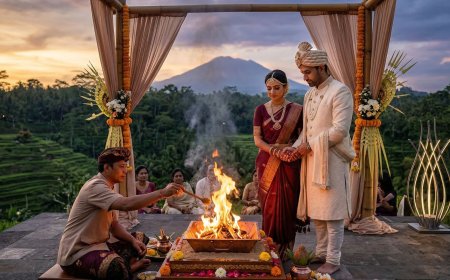
There is a moment in every wedding, regardless of where it is taking place or which tradition it is honouring, when the ceremony stops being about logistics and becomes about something older and stranger and harder to name. The moment the priest's voice drops into the specific register of ritual. The moment the fire is lit, or the bread is broken, or the hands are joined under a canopy of flowers. Something ancient surfaces, and the room feels it, and nobody needs to explain what it means because it has been meaning that for longer than anyone present can remember.
Weddings are humanity's most persistent ritual technology. Every culture on earth has them. Every culture on earth has built around them a specific set of customs — some solemn, some joyful, some genuinely bewildering to any outsider who encounters them without context — that encode, in symbolic form, what that community believes about love, commitment, family, and the beginning of a shared life. These customs are not arbitrary. The ritual that looks bizarre from the outside almost always makes a specific kind of sense from the inside, once you understand what it is trying to say and what it has always been trying to say.
Some of them, however, require a considerable amount of inside knowledge before they begin to make sense. And some of them — it must be admitted — remain surprising even with full context.
Here is a journey through some of the world's most extraordinary wedding customs, with the respect and the genuine curiosity that every living tradition deserves.
When Tears Are the Gift: The Tujia Crying Ritual of China
In the Tujia culture of China's Hunan and Hubei provinces, a bride does not simply prepare for her wedding in the weeks before the ceremony. She weeps. Every day, for an hour, for a full month before the wedding, the bride sits and cries — and she does not cry alone. Her mother joins her. Her grandmother joins her. Her aunts, her sisters, her closest female relatives form what can only be described as a chorus of communal grief, each woman crying in her own key, the sounds overlapping and building into something that is not sad in the simple sense but is instead one of the most honest acknowledgements in any wedding tradition of what a wedding actually represents.
Because what is a wedding, if not a leaving? The bride is departing one life and entering another. The family she has been part of since birth will no longer be her primary household. The Tujia crying ritual does not pretend that this transition is only joyful. It creates a structured space in which the grief of departure can be fully expressed — not suppressed in favour of celebration, not acknowledged with a single emotional moment and then moved past, but honoured daily, collectively, for thirty days, as the genuine counterweight to the joy that the wedding also represents.
The crying is not considered inauspicious. It is considered a gift — the expression of a love so real that its partial loss is genuinely mourned. A bride who cries beautifully, whose grief is eloquent and deep, is a bride who has been truly loved.
The Test Before the Night: South Korea's Foot-Beating Tradition
The Korean tradition of falahaka — the beating of the groom's feet after the wedding ceremony — is the custom that most reliably produces a particular expression on the face of the person hearing about it for the first time. The expression is a mixture of disbelief and sympathy, which is understandable but slightly misses the point.
After the ceremony concludes, the groom's friends and family remove his shoes, bind his ankles with rope, and proceed to strike the soles of his feet with dried fish or a wooden cane. The beating is vigorous enough to be genuinely uncomfortable but measured enough to be survivable — this is, after all, a celebration rather than a punishment. The groom typically endures it with the specific expression of a man who knew this was coming and has made his peace with it.
The tradition exists within a specific cultural logic. The beating tests the groom's physical and mental fortitude at the threshold of marriage. It is a form of initiation — a ritual marking of the transition from one state to another, conducted by the community of men who know him best and who are, in their way, preparing him for what comes next. The laughter that accompanies it is genuine. The solidarity it expresses is also genuine. The groom who survives the beating with good humour has demonstrated, in the way that rituals demonstrate things, that he is ready.
Bread, Salt, and the Full Truth of Life: Russia's Wedding Welcome
The Russian wedding custom of greeting the newlyweds with bread and salt is one of the most beautiful and most honest of all wedding rituals, and it deserves more international recognition than it typically receives.
As the couple arrives at the reception, the parents present them with a ceremonial loaf of bread — the karavai, an elaborately decorated round loaf that symbolises prosperity — and a small dish of salt. The couple tears bread from the loaf, dips it in the salt, and eats together. The symbolism is specific and complete: the bread represents the abundance they hope to build together, and the salt represents the difficulty, the bitterness, and the challenge that life will also bring. By eating both together, in the same bite, the couple declares their willingness to share everything — not only the sweetness but the hardness.
Most wedding rituals are optimistic by design. The Russian bread and salt tradition is optimistic and honest simultaneously, which is a rarer and perhaps more durable combination.
Covered in Everything: Scotland's Blackening Ceremony
Scotland's pre-wedding blackening tradition is not for the faint-hearted or the formally dressed. In the days before the wedding, the bride, the groom, or both are ambushed by friends and family, restrained with varying degrees of theatrical struggle, and covered comprehensively in a mixture that typically includes flour, soot, treacle, feathers, fish sauce, and whatever additional substances the assembled company has decided to contribute to the occasion.
The covered individual is then paraded through their town or village, often in a vehicle, for the inspection and entertainment of the community. The more public the humiliation, the more effective the ritual is considered to be.
The logic is protective rather than punitive. The blackening is believed to ward off evil spirits in the period of vulnerability before the wedding — the idea being that no malevolent force would bother with someone who is already covered in treacle and fish sauce. There is also a more earthly logic: the individual who can endure being covered in flour and paraded through their hometown with genuine good humour is demonstrating the specific resilience that marriage requires. If you can laugh at this, the tradition suggests, you can probably handle what comes next.
The Serious Face of Forever: Congo's No-Smiling Rule
Of all the wedding customs in this collection, the Congolese tradition of prohibiting smiling during the ceremony and reception is the one that most directly challenges the Western wedding aesthetic — the beaming bride, the tearfully grinning groom, the photographs in which everyone is demonstrating visible happiness at maximum volume.
In Congolese wedding tradition, the bride and groom maintain composed, serious expressions throughout the entire event. Not sad expressions — serious ones. The distinction matters. The absence of smiling is not a sign of reluctance or unhappiness. It is a sign of the gravity with which the couple is entering the commitment. Marriage is among the most serious decisions a human being will ever make, and the Congolese tradition encodes this in the couple's bearing on the day itself. To smile broadly throughout the ceremony would suggest, within this cultural logic, that the couple is treating the occasion as entertainment rather than as the profound and permanent covenant it represents.
There is something genuinely worth considering in this. The wedding culture of many Western and Westernised contexts has become so thoroughly oriented toward the production of joyful content — the photographs, the video, the social media presence of the event — that the solemnity at the heart of the ceremony can be difficult to access. The Congolese tradition protects that solemnity deliberately.
Sawing Through It Together: Germany's Log-Cutting Ceremony
After the ceremony in many German weddings, the couple is presented with a large log and a two-handed saw. They are expected to saw the log in half, together, in front of their guests. The log is not pre-cut. The saw is a real saw. The task requires genuine coordination, genuine physical effort, and genuine cooperation — and because it is being performed in formal wedding attire in front of two hundred guests, it also requires the specific ability to do a difficult thing well under observation.
The symbolism is direct and practical in the way that German symbolism often is. This is the first task you will face as a married couple. It requires both of you, working in coordination, applying equal effort, maintaining a shared rhythm. If one partner pulls while the other pushes, the saw binds and the log does not yield. If both pull together, at the same moment, with the same intention, the thing gets done.
There are worse metaphors for marriage, and most of them require more words to deliver.
The Tooth of the Whale: Fiji's Proposal Tradition
In Fijian tradition, a man who wishes to propose marriage to a woman must first present her father with a tabua — a sperm whale's tooth, polished and prepared, of specific quality and size. The tabua is not merely a gift. It is among the most sacred objects in Fijian culture, used in the most significant moments of community life: births, deaths, reconciliations, and the formal request for a daughter's hand.
The practical challenge of obtaining a sperm whale's tooth is, in contemporary Fiji, considerable — which is precisely the point. The effort required to source, prepare, and present a tabua of appropriate quality is itself a demonstration of the seriousness of the intention. A man who has done the work of obtaining a proper tabua has already shown, before a single word of proposal has been spoken, that he understands the weight of what he is asking for.
The French Toast: La Soupe
The French tradition known as La Soupe involves the newlyweds drinking together from a vessel that is shaped like a toilet bowl. In its original form, this vessel was precisely what it sounds like. In contemporary practice, it is a bowl or cup made in the shape of a toilet, filled with the remaining punch or champagne from the reception.
The custom is understood to fortify the couple for the beginning of married life — the slightly absurd shared act of drinking from a ridiculous vessel together, surrounded by their laughing guests, functioning as a kind of inoculation against the excessive seriousness that can sometimes overtake the newlywed period. You have just made the most solemn commitment of your lives. Now drink punch from a toilet bowl with your spouse and your friends. La vie continues.
The Father's Blessing: The Maasai Tradition of Kenya
In Maasai wedding tradition, the father of the bride blesses his daughter at the moment of her departure by spitting on her head and chest. The gesture is deliberate, specific, and deeply respectful within its cultural context. Spitting, in Maasai tradition, is not an insult or an expression of contempt — it is a form of blessing, associated with good fortune, protection, and the genuine wish for prosperity. The father who spits on his daughter as she leaves to begin her married life is giving her the most sincere blessing available to him in the vocabulary of his tradition.
The tradition also includes, after the blessing, the father's refusal to look back at his daughter as she walks away — another act of deliberate severance, the formal completion of one relationship so that the next can begin fully.
Three Days of Stillness: The Tidong Tradition of Borneo
Perhaps the most physically demanding wedding custom in this collection belongs to the Tidong people of Borneo, who require their newlyweds to remain confined to their home for three days and three nights after the wedding ceremony, during which time they are not permitted to use the bathroom. The restriction is observed with the support of the community — the family ensures the couple eats and drinks as little as possible during the period — and the successful completion of the three days is believed to ensure a long, faithful, and prosperous marriage.
The logic is one of shared endurance. The couple's first act as a married unit is to face a significant physical challenge together, supported by their community, in a state of mutual vulnerability and mutual dependence. Whatever the marriage brings — and marriage brings difficulty as reliably as it brings joy — the couple who has already endured three days of this has a specific reference point for what it means to get through something together.
Every one of these traditions, however strange it appears from outside its context, is doing the same essential work: marking the threshold between one life and another, encoding the community's values in symbolic form, and creating a shared memory that the couple will carry into the years ahead. The ritual that covers you in flour and treacle, the ritual that makes you cry for a month, the ritual that asks you to saw through a log together in front of everyone you know — all of them are saying, in their specific language, the same thing.
This matters. We are here. What comes next is real.
Published by NRIWedding.com — The Premium Global Platform for Non-Resident Indians Planning Indian Weddings From Abroad.
What's Your Reaction?
 Like
0
Like
0
 Dislike
0
Dislike
0
 Love
0
Love
0
 Funny
0
Funny
0
 Angry
0
Angry
0
 Sad
0
Sad
0
 Wow
0
Wow
0