




































































The Shaadi Ka Card: The NRI Couple's Complete Guide to Digital vs. Print Wedding Invitations
The PDF that circulated in three family WhatsApp groups before the groom knew the invitations had gone out. The grandmother in Ludhiana asking whether there was not going to be a proper invitation. The international guest who received a beautifully designed physical card that did not survive the postal journey. The NRI wedding invitation decision is more culturally loaded, more logistically complex, and more personally significant than it first appears. This guide delivers a complete framework covering the cultural weight of the physical Indian wedding invitation, what digital does well and what it does not, the hybrid approach that serves different guest categories appropriately, design imperatives for both formats, the specific considerations for India-based guests, diaspora guests and non-Indian international guests, and the practical checklist that makes the decision explicit before production begins.


Digital vs. Print Wedding Invitations: What Works for NRI Weddings
The NRI couple's complete guide to navigating the invitation decision that is more culturally loaded, more logistically complex, and more personally significant than it first appears — with honest guidance on what each format does well, what it does not, and how to design a hybrid approach that serves everyone
The Invitation That Arrived as a PDF
The WhatsApp message came at eleven in the evening. It was from the groom's cousin in Chandigarh, forwarding a message from her mother, which was itself a forward of a message from the bride's aunt, which contained a screenshot of a digital wedding invitation that someone had shared in a family group and that had been circulating for approximately four hours before the groom's cousin saw it.
The groom had not yet been informed that the invitations had gone out. The wedding planner had sent the digital invitations to the bride's email list at nine that morning, and by eleven in the evening the PDF invitation had been screenshot, forwarded, re-screenshot, added to three family WhatsApp groups, and seen by approximately sixty percent of the invited guests — including several who had been on the fence about whether to attend and who had made their attendance decision based on the screenshot quality rather than the actual invitation design.
The groom's grandmother — eighty-one years old, in Ludhiana, who had been expecting a physical invitation card that she could place on her mantelpiece next to the cards from her granddaughter's wedding and her nephew's son's wedding — had seen the screenshot in the family group and had asked her daughter, in a voice note of some emotional weight, whether there was not going to be a proper invitation.
This situation — some version of it — is the specific collision between the efficiency of digital invitation logistics and the cultural weight that the physical wedding invitation carries in Indian family culture. Understanding this collision is the beginning of making the invitation decision well.
The Cultural Weight of the Indian Wedding Invitation
Before the format decision, a genuine understanding of what the wedding invitation means in Indian cultural context — because the format decision cannot be made well without this understanding.
The Indian wedding invitation — the shaadi ka card — is not primarily a logistics document. It is not, in the first instance, a way of communicating event details to people who need to know them. It is a cultural artifact whose physical presence carries specific meaning that the logistics summary it contains does not.
The physical invitation is the family's public declaration of the event. Its quality — the paper, the printing, the design, the box or envelope it arrives in — communicates the family's pride in the occasion and their respect for the people they are inviting. Its physical delivery — the specific act of personally handing the card to the senior members of the family and community, the specific visit made to the elders' homes to invite them in person — is itself a ceremony of relationship acknowledgment that the card enables but does not contain.
The physical invitation placed on the grandmother's mantelpiece is not a piece of stationery. It is the family's visible presence in her home during the weeks between the invitation's receipt and the wedding itself. It is the object that triggers the specific pride of being invited to this family's significant occasion — the pride that generates the social conversations that amplify the family's standing in the community.
For the generation that built the families whose weddings NRI couples are now planning, the physical invitation is the correct and proper form of the wedding invitation, and the digital invitation is either an addition to the physical invitation or a reduction of it. This understanding does not mean that digital invitations are wrong. It means that the decision to send only digital invitations — without a physical card for specific recipients — carries specific cultural consequences that should be decided explicitly rather than defaulted to for logistical convenience.
What the Digital Invitation Does Well
The International Reach
The digital invitation's most significant practical advantage for NRI weddings is its ability to reach a geographically dispersed guest list simultaneously, without the shipping complexity, the customs risk, and the delivery uncertainty that international physical mail involves.
Sending a physical wedding invitation to a guest in Auckland or Vancouver or Stockholm involves international postage, customs declaration, uncertain delivery timelines, the risk of the invitation arriving damaged, and the specific problem that Indian wedding invitation packaging — which tends toward the elaborate and the beautiful in ways that are also the ways that customs agencies sometimes open and occasionally lose — is not well suited to the international postal system.
The digital invitation arrives simultaneously, in perfect condition, at exactly the same moment to guests in New Zealand, Canada, Sweden, India, and the UAE. For the international guest communication function — getting the event information accurately to a globally dispersed guest list — the digital format is functionally superior in almost every dimension.
The Information Density
The digital invitation can contain, link to, and update information in ways that the physical card cannot. The digital invitation that links to the wedding website gives the recipient immediate access to the full event schedule, the accommodation options, the travel guidance, the dress code information, and the RSVP mechanism — all from the moment of receipt.
The physical card's information is fixed at the time of printing. If the ceremony time changes, if the venue name changes, if an event is added or removed from the schedule, the physical card cannot be updated. The digital invitation can be updated and a revised version resent within hours.
For NRI weddings where the schedule is evolving, where venue decisions are finalised later than the invitation timeline requires, or where specific information needs to be communicated quickly to a large group, the digital invitation's updateability is a specific functional advantage.
The RSVP Management
The digital invitation's integration with digital RSVP systems — the Google Form, the wedding website RSVP page, the specific wedding app that collects dietary requirements alongside attendance confirmation — simplifies the guest response management significantly.
The physical card's RSVP mechanism — the reply card with a return envelope — produces responses that must be manually recorded. The digital RSVP produces a database that is automatically organized, easily sortable, and directly usable for seating planning, catering headcounts, and the accommodation coordination that NRI wedding planning requires.
For a wedding with three hundred guests spread across fifteen countries, the digital RSVP's automatic data organization is not a minor convenience. It is a significant management advantage.
The Cost
The digital invitation costs a fraction of the physical invitation — the design cost, which is shared regardless of the distribution format, and the distribution cost, which for digital is effectively zero. The physical invitation's printing, packaging, and posting costs — for an NRI wedding where a significant proportion of invitations are being sent internationally — can represent a substantial budget line.
For couples who are managing a tight overall wedding budget, the cost difference between digital and physical invitation suites is a genuine financial consideration — one that should be weighed honestly against the cultural and relational implications of the format choice rather than ignored.
What the Digital Invitation Does Not Do Well
The Cultural Statement
The digital invitation cannot make the cultural statement that the physical invitation makes. The beautifully designed, beautifully printed, beautifully packaged physical invitation card is a specific cultural signal — of the family's pride in the occasion, of the family's respect for the recipient, and of the seriousness with which the family is approaching the wedding.
For the senior members of the family and community whose goodwill is important to the family's social standing — the grandparents, the senior relatives, the community elders whose presence at the wedding is a specific mark of honor — the physical invitation is not a preference. It is an expectation whose non-fulfillment communicates something specific about the family's relationship with them, whether or not this communication is intended.
The Personal Delivery Convention
The specific Indian wedding convention of personally delivering invitations to the senior family members and important community figures — visiting their homes, being received by them, having the specific conversation that personal delivery occasions — cannot be replicated by digital distribution. The personal delivery is not simply efficient invitation logistics. It is a relationship act that uses the invitation as its occasion.
The family elder who receives a digital invitation to the wedding has been informed of the event. The family elder who receives the same invitation from the couple in person, who has the specific conversation about the wedding with the couple who have come to their home to invite them, who has been honored by the specific act of personal delivery — this person has been included in the wedding in a way that the digital recipient has not.
The Archival Quality
The physical invitation card is kept. The grandmother's mantelpiece has the cards from three generations of family weddings. The physical card is the artifact that marks the family event in the physical record of the household in a way that a PDF in an email inbox does not.
For the family members whose relationship to the couple is defined by love and history — the parents, the grandparents, the aunts and uncles who have been present for the couple's entire life — the physical invitation is the artifact of the occasion that they keep. The digital invitation is information they received.
The Forwarding Problem
The digital invitation, once sent, cannot be controlled. The screenshot taken by the first recipient becomes the forward that reaches sixty percent of the guest list before the couple has finished sending the initial distribution. The information in the digital invitation — and the invitation design itself, which may be valuable and may be the couple's intellectual property — is distributed without the couple's control the moment the first recipient receives it.
For families where the sequence of invitation — who receives the invitation first, who is honored by early receipt — is culturally significant, the digital invitation's simultaneous distribution and easy forwarding collapses a social protocol that the physical invitation's sequential delivery preserves.
The Hybrid Approach: The Framework That Works for Most NRI Weddings
The most effective invitation strategy for most NRI weddings is not a choice between digital and physical but a hybrid approach that uses each format for the guest categories and the functions it serves best.
The Physical Invitation: Who Receives It and What Form It Takes
The physical invitation should be sent to: every guest in India whose cultural expectations include a physical card, the senior family members in the diaspora whose relationship to the couple's family includes the expectation of a physical invitation, the community elders and figures of specific importance whose receipt of a physical card is a specific mark of respect, and any guest — regardless of location — for whom the physical invitation carries specific relational significance that the couple recognizes.
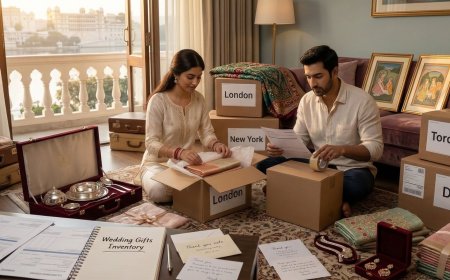
The physical invitation suite for an NRI wedding can range from the single printed card in an envelope to the elaborate boxed invitation — the heavy board box with a ribbon closure, containing the invitation card, the inner envelope, the event cards for individual events, the map card, and the specific artisanal or traditional element — a small bag of kumkum, a piece of fabric, a small decorative object — that makes the invitation a gift rather than only an announcement.
The elaborate boxed invitation is a specific expression of NRI wedding culture that has developed in the past decade — partly in response to the physical invitation's competition with digital formats, and partly as an expression of the wedding's cultural and familial significance in a material form that guests receive, handle, and keep. It is expensive to produce, complex to ship internationally, and — for the recipients for whom it is intended — an extraordinary expression of the couple's pride in the occasion and their respect for the person receiving it.
For international shipping, the boxed invitation requires specific packaging to survive the postal journey — the elegant box must be encased in a robust shipping container, the contents must be secured against movement, and the weight and dimensions must be within the postal limits of both the sending and receiving countries. This requires specific planning and testing before the full invitation run is shipped.
The Digital Invitation: Who Receives It and What Form It Takes
The digital invitation should be sent to: international guests whose location makes physical delivery impractical, the younger generation of guests for whom the digital invitation is the expected and preferred form, guests for whom the couple's relationship is personal and modern rather than formal and traditional, and all guests as a supplement to the physical invitation — providing the link to the wedding website, the digital RSVP mechanism, and the updated event information that the physical card cannot contain.
The digital invitation for an NRI wedding should be professionally designed — not a WhatsApp message with a text announcement, not a Canva template that looks like a Canva template, but a specifically designed digital artifact that reflects the same design quality as the physical invitation suite and that makes the same cultural statement about the couple's pride in the occasion.
The professional digital invitation design — a motion graphic that reveals the invitation information with specific animation, a static design that uses the wedding's visual identity with the same care as the physical suite, or a beautifully designed PDF that is the digital equivalent of the physical card — communicates quality and care in the digital medium in the same way that the physical card's paper and printing communicate quality and care in the physical medium.
The Sequence: Physical First, Digital Second
For guests who receive both a physical and a digital invitation, the sequence should be: the physical card arrives first, as the primary invitation, and the digital communication follows with the link to the wedding website and the RSVP mechanism.
The physical card is the invitation. The digital communication is the supplement — providing the information and the interaction mechanism that the physical card cannot contain. This sequence honors the cultural primacy of the physical invitation while capturing the practical benefits of the digital format.
The Design Imperative: Both Formats Deserve Care
The invitation decision — digital, physical, or hybrid — is only as good as the design quality of the invitation produced. An elegant physical invitation suite poorly designed is worse than a beautifully designed digital invitation. A beautiful digital invitation poorly distributed is less effective than a well-managed physical card.
The Physical Invitation Design
The physical Indian wedding invitation design is a specific creative discipline — the integration of the couple's aesthetic vision, the cultural and religious conventions of the wedding tradition, the practical information requirements of the multi-event NRI wedding, and the specific production constraints of the paper, the printing process, and the packaging.
The specific design elements that require specific decisions: the color palette that reflects the wedding's visual identity, the typography that balances legibility with aesthetic quality, the illustration or motif that carries the cultural identity of the tradition being celebrated, the paper weight and texture that communicates quality through touch, and the overall proportion and form of the card that creates the specific visual experience of opening and reading it.
For NRI weddings that span two regional Indian traditions or that incorporate Western aesthetic elements, the invitation design is the first visual expression of the wedding's specific cultural character — the first statement of how the two traditions or the two cultures are being held together in this specific celebration.
The Digital Invitation Design
The digital invitation's design requires specific knowledge of the digital medium — the way color renders on screen versus in print, the way typography reads on a mobile device versus on a desktop, the specific file formats and resolution requirements of different digital distribution channels, and the specific design language of motion graphics if animation is being used.
The digital invitation that is clearly designed for print and adapted for digital — with fine serif typography that is beautiful in print and illegible on a mobile screen, with color combinations that work in CMYK print and do not render well in RGB screen display — communicates a specific lack of care for the digital recipient that the equivalent print quality failure communicates for the physical recipient.
The digital invitation designed specifically for digital — with typography scaled for screen reading, with color selected for screen rendering, with information hierarchy designed for the scroll and the tap rather than the fold and the unfold — communicates the same care and quality as the best physical invitation suites.
The Specific NRI Considerations
The India-Based Guest
The India-based guest — the family and community in the wedding city, in the family's home city, and across India — has the strongest expectation of a physical invitation and the weakest need for the digital invitation's logistical advantages, because they are in the same country and the physical card can reach them without international shipping complexity.
For India-based guests, the physical invitation is the appropriate primary format, supplemented by a digital communication — WhatsApp message with the wedding website link — that provides the additional information and the RSVP mechanism.
The personal delivery convention for India-based senior family members and community elders is specifically important and should be planned as a specific activity in the couple's India visit — the specific visits made to specific households to personally deliver the invitation and to have the specific conversation that the personal delivery occasions.
The Diaspora Guest
The diaspora guest — the NRI family and community in the UK, North America, Australia, the UAE, and other diaspora locations — exists in a cultural middle ground. Many have the cultural expectation of a physical invitation but are also comfortable with digital communication in ways that their India-based counterparts may not be.
The diaspora guest who is a senior family member or community figure of specific importance deserves a physical invitation, sent by international post or — for the most important relationships — hand-delivered by a family member who is traveling between the countries in the invitation period.
The diaspora guest who is a contemporary peer of the couple — the friend, the colleague, the university acquaintance — is typically comfortable with a digital primary invitation supplemented by a physical card if the couple's aesthetic vision has produced a physical suite worth sending.
The Non-Indian International Guest
The non-Indian international guest — the British colleague, the American university friend, the Australian flatmate — has no cultural expectation of a physical Indian wedding invitation and receives the digital invitation without the cultural weight that makes it feel like a reduction for Indian recipients.
For non-Indian international guests, a beautifully designed digital invitation is entirely appropriate as the primary format — potentially supplemented by a beautifully designed printed welcome booklet, delivered at the hotel, that provides the cultural context and practical information the digital invitation cannot contain.
The Practical Checklist
The invitation decisions that must be made explicitly before the design and production process begins:
Which guests receive physical invitations, which receive digital, and which receive both. The answer should be determined by the guest category framework described above rather than by logistical convenience alone.
What form the physical invitation takes — the single card, the envelope suite, the boxed invitation — and what budget this requires.
What form the digital invitation takes — the static PDF, the motion graphic, the wedding website integration — and who is designing it.
Who is responsible for the personal delivery of physical invitations to the senior family members and community figures, and when this will happen in the India visit schedule.
What the sequence of physical and digital invitation distribution is — which goes first, what the interval is, and how the two are coordinated so that the digital supplement does not arrive before the physical primary.
What the RSVP mechanism is and how responses from both physical and digital recipients are consolidated into a single manageable database.
What the follow-up protocol is for guests who have not responded by the RSVP deadline — the specific follow-up call or message that converts the non-response into a confirmed attendance or a confirmed absence.
The Invitation as the Wedding's First Impression
The wedding invitation is the first experience any guest has of the wedding — before the venue, before the food, before the ceremony, before any of the elements that the couple has spent months designing and preparing. It is the wedding's first impression, and first impressions in the context of a significant cultural occasion carry weight that subsequent impressions cannot fully revise.
The couple who has thought carefully about what the invitation communicates — about the occasion, about the family, about the specific recipients, and about the respect and love with which the invitation is offered — has made a specific and important contribution to their guests' experience of the wedding before a single event has taken place.
Whether that contribution is made through a beautifully designed physical card placed in a silk-lined box, a motion graphic that reveals the wedding details with specific elegance, or a hybrid approach that serves each recipient in the format most appropriate to their relationship and their expectations — the quality of the thinking behind the decision is what matters.
The grandmother's mantelpiece is waiting. The international guest's inbox is open. The invitation is the couple's first act of hospitality.
Make it worthy of what follows.
NRIWedding.com — Expert guidance for Indian weddings planned across borders.
What's Your Reaction?
 Like
0
Like
0
 Dislike
0
Dislike
0
 Love
0
Love
0
 Funny
0
Funny
0
 Angry
0
Angry
0
 Sad
0
Sad
0
 Wow
0
Wow
0