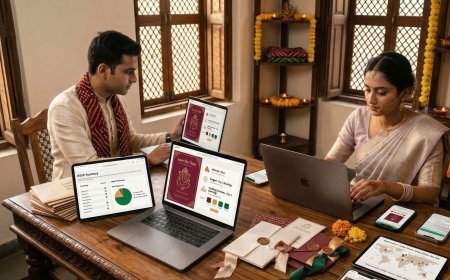















































































How to Create Separate Invitation Versions for India-Based and International Guests — The Complete NRI Wedding Planning Guide
The NRI couple who sends the same invitation to every guest — the grandmother in Coimbatore and the colleague in Amsterdam receiving identical cards — is sending an invitation that was written for the Indian audience to an international guest who does not know what a sangeet is, which events they are invited to, what traditional attire means in practice, or how to RSVP to a family they have met twice without a phone number for. One invitation for everyone produces one invitation that is right for everyone and perfect for no one. This complete guide gives NRI couples the full framework for building a two-version invitation strategy that serves every guest precisely — covering the fundamental tension that makes a single version an unavoidable compromise, the equality objection and why separate versions are the genuine expression of equal hospitality rather than a hierarchy, the core two-version structure and the extended architecture including NRI diaspora version and regional language variants, the complete content of the India version in the established conventions of the Indian invitation tradition, the specific additions of the international version including event name descriptors, invitation scope indicators, dress code specifics with garment names, maps and venue information, transport details, destination and accommodation pointers, the accessible RSVP mechanism and the cultural welcome statement, the three production format options of insert model, parallel design model and digital supplement model with their respective advantages, the guest list segmentation criteria applied guest by guest rather than by address alone, the production tracking system including colour-coding and checklist verification, addressing management at the handoff point, and the five common mistakes that produce the wrong version for specific guests or the right version assembled incorrectly.


The Invitation That Was Right for Everyone and Perfect for No One
The couple had made a decision early in the planning process that they were proud of.
They had decided to send the same invitation to every guest. The same card, the same wording, the same suite, the same everything — from the bride's grandmother in Coimbatore to the groom's colleague in Amsterdam. The decision had come from a genuine and admirable impulse: the desire to treat every guest equally, to communicate through the uniformity of the invitation that the gathering they were creating made no distinction between the family from India and the friends from abroad.
It was a beautiful impulse. It produced a specific problem.
The invitation had been written — as most Indian wedding invitations are written — primarily for the Indian guest. The events were listed by their Indian names without descriptors. The venues were listed as addresses without maps or context. The dress code said "traditional attire preferred." The RSVP asked guests to "kindly respond to the family" without specifying which family member or through which channel. The invitation was written in the specific register of the Indian wedding invitation tradition — a register that is warm and formal and entirely legible to the Indian guest who has received dozens of similar invitations and entirely opaque to the international guest for whom this is the first.
The grandmother in Coimbatore received the invitation and understood every element without assistance. She called the bride's mother the same day to confirm her attendance and the attendance of eleven family members.
The colleague in Amsterdam received the same invitation and understood approximately half of it. He knew there was a wedding. He knew the names of the people getting married. He did not know what a sangeet was, which events he was invited to, what "traditional attire" meant in practice, whether his partner was also invited or whether the invitation was addressed to him alone, or how to RSVP to "the family" when he had met the family twice and did not have a phone number for them.
He emailed the groom with six questions. The groom answered them. The colleague attended. But the six-email exchange was the specific friction that the invitation's wording had created — friction that was entirely avoidable and that the couple had not intended and had not anticipated.
One invitation for everyone had meant one invitation that was right for everyone and perfect for no one.
This guide is about building the invitation strategy that serves every guest precisely — the one that the grandmother in Coimbatore and the colleague in Amsterdam both receive and both immediately understand.
The Core Reality: Why Separate Versions Are the Right Strategy
The Single Invitation's Fundamental Tension
The single wedding invitation written for a global guest list faces a fundamental tension that cannot be fully resolved within a single document: the information that is necessary for the international guest is redundant for the Indian guest, and the conventions that are natural for the Indian guest are opaque for the international guest.
The international guest needs: explicit description of each event, specific dress code guidance with garment names, maps and transport information for unfamiliar venues, cultural context for ceremonies and rituals, an RSVP mechanism that does not require prior knowledge of who to contact, and the specific practical information about destination and accommodation that domestic guests already know.
The Indian guest needs: none of these things, because they already know them. The Indian wedding invitation's compressed, convention-dependent wording is efficient precisely because it communicates a great deal of specific information to a reader who knows the conventions — without the explicitness that would make the same information accessible to a reader who does not.
The invitation that includes everything the international guest needs is an invitation that is over-explained for the Indian guest. The invitation that is written at the level of the Indian guest's knowledge is an invitation that leaves the international guest with six questions to email the groom.
The resolution is not a compromise between these two positions — a single invitation that is somewhat over-explained for one audience and somewhat under-explained for the other. The resolution is separate versions: an invitation for each audience that serves that audience precisely, without the compromises that a single version requires.
The Equality Objection and Its Answer
The most common objection to separate invitation versions is the equality objection — the feeling that sending different invitations to different guests implies a hierarchy, a distinction between more-valued and less-valued guests, that the couple does not intend and does not want to communicate.
This objection misunderstands what equality means in the hospitality context.
Treating guests equally does not mean treating all guests identically. It means giving every guest what they need to be fully included in the occasion — the specific information, the specific guidance, the specific support that their specific situation requires. The international guest who receives a version of the invitation that is designed for their specific situation is not receiving a lesser invitation. They are receiving an invitation that takes their specific situation seriously and provides what they specifically need.
The grandmother in Coimbatore does not need a description of what a sangeet is. The colleague in Amsterdam does. Providing the description to the colleague while not burdening the grandmother with it is not a distinction between guests — it is the specific recognition that different guests are in different positions relative to the occasion's conventions.
The equality that genuine hospitality requires is the equality of outcome — every guest arrives at the wedding knowing what they need to know, feeling warmly and specifically invited, having had the experience of receiving an invitation that was designed for them. Separate versions are the mechanism that produces this outcome.
The Version Architecture: How Many Versions and What They Cover
The Core Two-Version Structure
The foundational architecture for the NRI wedding invitation is two versions — one for India-based guests and one for international guests. This structure addresses the primary information gap between the two audiences and is manageable to produce without requiring the couple to create and manage a large number of distinct invitation versions.
Version One — The India Version:
Written in the established conventions of the Indian wedding invitation tradition. Assumes familiarity with event names, ceremony conventions, and the general cultural context of the occasion. Provides the logistical information — dates, times, venues — in the standard Indian invitation format. Includes the standard Indian RSVP conventions. May include regional language elements appropriate to the family's tradition.
Version Two — The International Version:
Built on the same structural foundation as the India version — same design, same couple's names, same event dates, same general format — but with specific additions and modifications that serve the international audience. Includes English descriptors for event names, specific dress code guidance, maps and transport information, cultural context for ceremonies, a clear RSVP mechanism, and destination and accommodation guidance.
The two-version structure produces invitations that are visually and tonally consistent — a guest who sees both versions recognises them as belonging to the same wedding — while serving their respective audiences' specific information needs.
The Extended Version Architecture
For NRI weddings with a more complex guest landscape, the two-version structure can be extended to serve additional specific audiences.
The NRI diaspora version:
A significant proportion of the international guest list at many NRI weddings is not non-Indian but NRI — Indian-origin guests who have grown up or lived for many years in the UK, USA, Canada, Australia, or other countries. These guests are in a specific intermediate position: they are familiar with the Indian wedding tradition but may not be fully familiar with the couple's specific regional or community tradition, and they are managing international travel logistics that the India-based guests are not.
The NRI diaspora version — which sits between the India version and the fully international version — assumes familiarity with the general Indian wedding tradition while including the logistical and travel-specific information that international guests need.
The regional variant:
For weddings that draw guests from multiple Indian linguistic communities, a regional language version of the India invitation — in Tamil, Telugu, Kannada, Marathi, Gujarati, Bengali, or Punjabi depending on the family's community — serves the older generation of guests for whom the regional language is the primary reading language. This is not a fundamentally different version — the content is the same as the India version — but a translation into the appropriate regional language.
The simplified international version:
For non-Indian guests who have no familiarity with the Indian wedding tradition and for whom even the international version's culturally specific content may require additional context, a simplified version — which leads with the essential information in the most accessible format and treats all cultural context as supplementary — may serve this specific audience better than the standard international version.
The India Version: What It Contains and How It Is Written
The Content of the India Version
The India version of the invitation follows the established conventions of the Indian wedding invitation tradition — adapted for the specific family, community, and regional tradition of the couple.
The opening blessing or auspicious phrase:
In the tradition's language — Sanskrit shloka for Hindu weddings, Quranic verse for Muslim weddings, Gurbani for Sikh weddings — appropriate to the religious tradition being celebrated. This is not modified for the India version — it is the natural opening of the Indian invitation tradition.
The family announcement:
The names of the hosting families — the bride's parents and the groom's parents — in the format appropriate to the family's community and tradition. The South Indian convention, the Gujarati convention, the Bengali convention — each has its specific format, and the India version uses the community-appropriate format without modification.
The couple's names:
In the format appropriate to the community tradition — which may be the full formal name including the father's name and the family name in the community-specific sequence, or the given name only if that is the community's convention.
The event listings:
In the standard Indian wedding invitation format — event name, date, time, venue. Without descriptors, because the Indian audience knows what each event is. Without maps, because the Indian audience has the spatial familiarity with the destination city that makes a map an unnecessary addition rather than a useful tool.
The blessing language:
The specific phrases of the Indian wedding invitation tradition — the invitation "with the blessings of" the specific deity or ancestors, the request for "your esteemed presence and blessings," the specific closing that asks for the guest's good wishes — in the register that the Indian wedding invitation has established over generations.
The RSVP:
In the form that is natural for the Indian guest — a phone number for the family member who is managing the responses, or the instruction to contact the family directly. The Indian guest knows how to interpret "please contact the family" and knows which family member to call.
The Design of the India Version
The India version's design should follow the full aesthetic programme of the couple's invitation — the paper quality, the printing technique, the calligraphy, the decorative elements, the invitation suite components — without modification for the domestic audience.
The India version is not a simplified or reduced version. It is the full invitation in the form that serves the Indian guest — which is, for most of the invitation's visual and aesthetic elements, the same form as the international version.
The International Version: What It Adds and How It Differs
The Additions to the Core Content
The international version begins from the same foundation as the India version — the same design, the same structure, the same couple's names, the same event dates — and adds specific content that serves the international audience without removing the cultural character of the original.
Event name descriptors:
Every event is listed with its name followed by a brief English descriptor. "Mehendi (Henna Ceremony)," "Sangeet (Music and Dance Celebration)," "Baraat (Groom's Wedding Procession)," "Vivah (Wedding Ceremony)," "Reception (Wedding Dinner and Celebration)." The descriptor is in parentheses — present for the international guest who needs it, unobtrusive for any Indian guest who also receives this version.
Invitation scope indicators:
Each event explicitly indicates which guests are invited. "All guests warmly welcome," "Family and close friends," "Immediate family only." This indicator is the single addition that prevents the largest category of international guest confusion — the colleague who books flights for the mehendi because the invitation listed it without indicating it was family-only.
Dress code specifics:
Each event has a specific dress code indication — not the general "traditional attire" of the India version but the specific guidance that the international audience needs. "Traditional Indian attire warmly welcomed — kurta pyjama or sherwani for men, saree or salwar kameez or lehenga for women. Smart Western formal equally welcome. See our wedding website for outfit guidance and retailer recommendations."
Maps and venue information:
Each venue listing includes a map reference — the Google Maps link or the what3words address — alongside the street address. For international guests navigating to unfamiliar addresses in Indian cities, the map reference is the practical tool that the address alone is not.
Transport information:
The shuttle service, the airport transfer arrangements, the transport between accommodation and venues — included as specific fields in the international version's event listings.
Destination and accommodation pointer:
A specific section — not present in the India version — that acknowledges the destination wedding's nature and directs international guests to the wedding website for accommodation options, visa information, health preparation guidance, and the complete practical planning framework.
The RSVP mechanism:
A specific, accessible RSVP mechanism — an email address, a wedding website RSVP form link, and a WhatsApp number — rather than the instruction to contact the family. The international guest who has met the family twice and does not have their phone number needs a specific channel for their RSVP.
The cultural welcome statement:
A brief, warm statement — one to two sentences — that acknowledges the international guest's position and expresses genuine enthusiasm about sharing the tradition with them. "We are so glad to be sharing this celebration with guests from around the world. Our wedding website has everything you need to know about the ceremonies, the traditions, and what to expect — we hope you will find it as exciting as we do."
What the International Version Does Not Change
The international version adds to the India version. It does not fundamentally alter the invitation's character, its cultural authenticity, or its emotional register.
What remains unchanged:
The design — the paper, the printing, the calligraphy, the decorative elements, the overall visual character of the invitation suite. The international guest receives the same beautiful object as the India guest.
The opening blessing — the Sanskrit shloka or Quranic verse or Gurbani that opens the invitation. This element may be supplemented with a translation but is not removed.
The cultural warmth of the invitation's tone — the specific register of the Indian wedding invitation that communicates the weight and joy of the occasion. The additions are practical — they do not change the emotional character of the invitation.
The couple's names and the family announcement — in the same form as the India version, with the addition of a brief parenthetical clarification where naming conventions may be unclear.
The Format Options: How to Produce Two Versions Efficiently
Option One: The Insert Model
The most production-efficient approach to the two-version structure is the insert model — a core invitation suite that is identical for all guests, supplemented by a specific insert that contains the additional content for international guests.
The insert model:
The core suite — the main invitation card, the events card, the RSVP card — is produced in a single print run for all guests. The international insert — a single additional card containing the event descriptors, the dress code specifics, the transport information, the destination pointer, and the RSVP mechanism — is produced separately and included in the suites destined for international guests.
The advantages of the insert model:
Production efficiency — a single print run for the core suite reduces the cost per unit and simplifies the production management. The insert is a smaller, simpler production than a complete separate suite.
Visual consistency — all guests receive the same core invitation, which addresses the equality concern. The insert is an addition rather than a replacement.
Flexibility — the insert can be updated or modified without reprinting the core suite, which is useful if the international-specific information changes during the planning process.
The disadvantage of the insert model:
The insert is a separate physical element that can become separated from the core suite — either in production, in mailing, or at the recipient end. An international guest who receives the core suite without the insert has received the India version rather than the international version.
Option Two: The Parallel Design Model
The parallel design model produces two complete invitation suites — the India suite and the international suite — that share the same visual design but have different wording throughout.
The parallel design model:
The design files for the invitation — the layout, the typography, the decorative elements — are produced once and then populated with two different sets of text content. The India suite is printed with the India version's text. The international suite is printed with the international version's text.
The advantages of the parallel design model:
Complete control — every element of both suites can be optimised for its specific audience without the constraint of a shared core. The international suite's events card can be formatted entirely for international readability; the India suite's events card can follow the traditional Indian format.
No separation risk — there is no insert to become separated from the core suite. Each recipient receives a complete, self-contained invitation.
The disadvantage of the parallel design model:
Higher production cost — two separate print runs, or a single run with careful management of the two versions, costs more than the insert model.
More complex production management — ensuring that the correct version reaches each guest requires careful management of the assembly and mailing process.
Option Three: The Digital Supplement Model
The digital supplement model produces a single physical invitation suite — in the India version format — supplemented by a detailed digital communication sent specifically to international guests.
The digital supplement model:
All guests receive the same physical invitation — the India version. International guests additionally receive a digital communication — an email, a WhatsApp message, or both — that provides all the additional content the international version would contain: the event descriptors, the dress code specifics, the transport information, the destination pointer, and the accessible RSVP mechanism.
The advantages of the digital supplement model:
Lowest production cost — a single physical invitation suite for all guests, with the international version's additional content delivered digitally at no additional printing cost.
Flexibility — the digital supplement can be updated easily if information changes, and can include dynamic elements — map links, website links, video messages — that the physical invitation cannot.
The disadvantage of the digital supplement model:
The international guest's invitation experience is divided between a physical object and a digital communication — which means the physical invitation they receive does not contain everything they need, and the completeness of their experience depends on them reading both.
The Recommended Approach
For most NRI weddings, the insert model represents the optimal balance of production efficiency, visual consistency, and content completeness. The insert is produced as a single, beautiful card that complements the core suite rather than appearing as a practical afterthought — printed on the same paper as the core suite, in the same design language, with the same quality of production.
For couples for whom the equality of the physical object is specifically important — who want every guest to receive an identical physical object — the digital supplement model is the appropriate approach, with the understanding that the digital supplement must be comprehensive and must be delivered reliably to every international guest.
For couples with the production budget and the production management capacity, the parallel design model produces the cleanest outcome — two complete, optimised invitation suites — and is worth the additional cost and management.
The Guest List Segmentation: Who Gets Which Version
The Segmentation Criteria
The segmentation of the guest list into India version and international version recipients is not simply a matter of geography — it requires specific judgment about each guest's position relative to the invitation's information requirements.
The India version is appropriate for:
India-based guests who are managing their attendance from within India, who are familiar with the Indian wedding tradition, and who have a family or community relationship with the hosts that provides them with the contextual knowledge the invitation assumes.
Indian guests living abroad who have a direct, close family relationship with the couple — family members who are in regular contact with the hosts and who will receive logistical support and guidance through family channels regardless of the invitation.
The international version is appropriate for:
All guests who are managing travel to India from an international origin — regardless of their cultural background. The NRI guest in London managing a flight and hotel booking for a Rajasthan wedding has the same logistical information needs as the non-Indian colleague managing the same journey.
Non-Indian guests regardless of their location — even a non-Indian guest living in India who is not familiar with the Indian wedding tradition benefits from the international version's cultural context and event descriptors.
Indian-origin guests who have been living outside India for many years and for whom the practical guidance about India travel — the visa situation, the currency, the health preparation — is as relevant as it is for non-Indian international guests.
The judgment call:
The second-generation NRI who grew up in the UK, is culturally Indian, speaks the family's regional language, and has attended Indian weddings regularly — but who is managing the flight booking and the India logistics from a British address — is an international guest for logistical purposes even if they are an Indian guest for cultural purposes. The international version serves their logistical needs; the India version would be adequate for their cultural familiarity. The couple's judgment about which is more useful determines which version this guest receives.
The Guest List Tagging System
The guest list management system — the spreadsheet or database in which the couple is tracking their guest list — should include a version field for every guest: India version, International version, or NRI diaspora version if the extended architecture is being used.
The version field should be completed at the point when each guest is added to the list — not left for a separate segmentation exercise at the end — because the production planning for the two versions requires knowing the approximate numbers of each version early in the process.
The Production Management: Keeping the Versions Organised
The Production Tracking System
The most significant operational risk of the two-version approach is the version mix-up — the India version sent to an international guest, the international version sent to an India guest, the insert omitted from the international suite. These errors are entirely preventable with a specific production tracking system.
The production tracking system:
Colour-coding — a specific colour indicator on the addressing labels or on the assembly checklist for each version. The India suite gets a green dot; the international suite gets a blue dot. The assembly team checks the colour before sealing each envelope or box.
Separate assembly — the India suites and the international suites are assembled in physically separate batches, at separate times if possible, rather than interleaved in a single assembly process where confusion is more likely.
Checklist verification — each suite is checked against a specific checklist before sealing: core suite components, version-specific components, addressing accuracy, postage.
The version tracking column in the guest list spreadsheet — updated to "assembled" and "dispatched" as each suite is completed and mailed, so that the status of every guest's invitation is visible at a glance.
The Addressing Management
The two-version approach requires that the addressing process — whether by calligrapher, printer, or handwriting — correctly assigns each version to each guest. The guest list's version field should be the basis for the addressing assignment — the calligrapher or printer receives two separate address lists, one for each version, and produces the corresponding addresses for each.
The risk point is the handoff between the addressing process and the assembly process — the moment when the addressed envelopes or labels are matched to the assembled suites. A verification step at this handoff — checking that the version indicated on the addressing label matches the version of the assembled suite — prevents the version mix-up before it is sealed and dispatched.
Common Mistakes NRI Couples Make With Multiple Invitation Versions
The first mistake is treating the two-version approach as the India version and a "dumbed-down" version for international guests. The international version is not a simplified invitation — it is a more complete invitation that serves a guest with different information needs. The design quality, the paper quality, the calligraphy quality should be identical across both versions. The additions are content additions, not quality reductions.
The second mistake is not segmenting the guest list carefully. The India-resident non-Indian guest who receives the India version, the NRI family member who receives the international version when a family-specific version would serve them better — imprecise segmentation produces the wrong version for specific guests. The segmentation criteria should be applied guest by guest rather than assumed from address alone.
The third mistake is producing the international version as an afterthought — creating the India version first, finalising it, printing it, and then attempting to adapt it for the international audience. The two versions should be developed in parallel from the beginning of the design process — the additions and modifications for the international version should inform the design decisions rather than being retrofitted to a completed design.
The fourth mistake is not testing the international version with an actual international reader before printing. The couple who has spent months immersed in the planning of their Indian wedding may not be able to accurately assess what is clear and what is opaque in the international version from the international reader's perspective. A friend or colleague who fits the international audience profile — genuinely unfamiliar with the Indian wedding tradition — should read the international version before it goes to print and should be asked specifically what they do not understand.
The fifth mistake is not briefing the assembly team on the version management. The aunts and cousins who are assembling two hundred and forty invitation suites at the kitchen table are doing an enormous amount of work with goodwill and care. They need a specific, clear briefing on how to distinguish the two versions, how to assemble each correctly, and how to verify the version before sealing — because the version mix-up that happens at the kitchen table is not discovered until an international guest contacts the couple with six questions.
The Invitation That Was Made for You
The grandmother in Coimbatore and the colleague in Amsterdam are both guests at the wedding. They are both loved by the couple. They are both important to the occasion. They are both receiving an invitation that announces the same wedding, in the same visual language, with the same warmth and the same cultural character.
They are not in the same position relative to the information that the invitation contains. The grandmother knows what a sangeet is. The colleague does not. The grandmother knows who to call to RSVP. The colleague does not have the number. The grandmother knows what "traditional attire" means. The colleague needs to know what to buy and where to buy it.
The invitation that serves both of them precisely — that gives the grandmother the invitation she recognises and the colleague the invitation that answers his questions — is not one invitation. It is two invitations that are the same wedding, the same couple, the same love, expressed in the specific form that serves each recipient.
The colleague in Amsterdam who receives the international version does not receive a lesser invitation. He receives an invitation that was made for him — that anticipated his questions and answered them, that acknowledged his unfamiliarity and addressed it, that said, in its specific completeness, that the couple had thought about him as an individual and had created something that would allow him to arrive at the wedding knowing exactly what he needed to know.
That is what the grandmother's invitation says to her.
Both of them should feel it.
Two versions. One wedding. Every guest served precisely.
Published by NRIWedding.com — The Premium Global Platform for Non-Resident Indians Planning Indian Weddings From Abroad.
What's Your Reaction?
 Like
0
Like
0
 Dislike
0
Dislike
0
 Love
0
Love
0
 Funny
0
Funny
0
 Angry
0
Angry
0
 Sad
0
Sad
0
 Wow
0
Wow
0