





































































Fort Rajwada Jaisalmer — Rooftop Weddings Above the Golden City: The Complete NRI Destination Guide — The Complete NRI Wedding Planning Guide
Meera had been to Jaisalmer once before, on a college trip she remembered in fragments — the fort visible on the ridge above the town in the specific gold of early morning sandstone, a sunset on the dunes that had stayed with her longer than expected, and the general quality of a place that did not quite fit into the category of places she had visited before. She was thirty-one now and living in Singapore and planning a wedding from a flat in Tiong Bahru, and the unresolved quality of Jaisalmer had returned with the specific force of an answer to a question she had been asking for six months. The question was where. She closed the latest planner proposal showing the same four Jaipur properties she had already seen three times. She typed: Jaisalmer wedding venue. What she needed was not a resort outside the city or a camp in the dunes but a venue genuinely of the Golden City — inside the yellow sandstone context of Jaisalmer, with the Sonar Qila visible from the event space, the carved jharokha windows of the haveli tradition framing the view, the fort turning its specific deep gold at four forty-five in the afternoon when the desert light does what it does at that hour and no other. Fort Rajwada gave her the rooftop. The rooftop gave her the fort. The fort gave her everything else. This guide gives NRI couples the complete framework for the Fort Rajwada Jaisalmer wedding — every event space with detailed pricing, the golden hour imperative, the Manganiyar musical tradition, the dune evening, the arrival logistics, and the specific mistakes that separate the couple who uses Jaisalmer fully from the couple who merely holds a wedding above it.


Fort Rajwada Jaisalmer — Rooftop Weddings Above the Golden City: The Complete NRI Destination Guide — The Complete NRI Wedding Planning Guide
Meera had been to Jaisalmer once before, on a college trip that she remembered in fragments — the train arriving at dawn, the fort visible on the ridge above the town in the specific gold of early morning sandstone, a camel ride she had not enjoyed as much as she had expected, a sunset on the dunes that she had enjoyed considerably more than she had expected, and the general quality of a place that did not quite fit into the category of places she had visited before and that had stayed in her memory as something unresolved, something she had not finished with.
She was thirty-one now and living in Singapore and planning a wedding from a desk in a flat in Tiong Bahru, and the unresolved quality of Jaisalmer had returned to her with the specific force of an answer to a question she had been asking for six months. The question was where. The answer, arriving without preamble on a Tuesday morning while she was reviewing yet another venue proposal from a Jaipur planner who had sent her the same four properties she had already seen from three other planners, was Jaisalmer.
She closed the proposal. She opened a new browser window. She typed: Jaisalmer wedding venue.
The first result that appeared with the specific quality she was looking for — not the resort hotels outside the city, not the camp properties in the dunes, but a venue that was genuinely of the city, that was inside the golden sandstone context of Jaisalmer rather than adjacent to it — was Fort Rajwada. The name contained the answer to the question she had not fully articulated: Rajwada, the Rajput term for a royal residence, combined with Fort, the word that meant what it meant in Jaisalmer, where the fort was not a monument at a remove from the city but the city itself, the living Sonar Qila that had been continuously inhabited for nine centuries and that turned gold in the afternoon sun in the way that no other city in India turned gold and that no visitor who had seen it ever fully recovered from.
Fort Rajwada was not inside the Jaisalmer Fort. It was a palace hotel built in the style of the Jaisalmer architectural tradition, using the Jaisalmer yellow sandstone — the same dunnai that the fort and the havelis of the old city were built from — with the carved stone screens and the jharokha windows and the specific vocabulary of Jaisalmer stone craft applied to a contemporary hotel that had been designed to be a worthy addition to the architectural conversation of the city rather than a resort that happened to be near it.
She looked at the rooftop photographs for a long time. The rooftop of Fort Rajwada looked across the city of Jaisalmer to the fort on its ridge, the Sonar Qila, and the distance between the hotel rooftop and the fort was not the distance of separation but the distance of the best possible view — close enough to see the detail of the fort's carved facades, far enough to see the full silhouette, the golden stone against the blue sky of the Thar Desert, the city spreading below in the same stone and the same colour, as though everything had been built from the same quarry by the same hands.
She sent the link to her fiancé Karthik in Chennai. She said: I think Jaisalmer. He said: the Golden City? She said: the Golden City. He said: the rooftop photographs. She said: I know. He said: book a site visit.
This guide is for every NRI couple who has been looking at Jaisalmer and sensing that the standard resort-outside-the-city answer is not the right answer — for Meera in Singapore and every couple who deserves the complete framework for the rooftop wedding above the Golden City that the Jaisalmer sandstone has been waiting to provide.
Understanding Fort Rajwada and Jaisalmer: The Golden City Context
To fully understand Fort Rajwada as a wedding venue requires understanding Jaisalmer as a city — because the specific quality of the Fort Rajwada experience is inseparable from the specific quality of being in Jaisalmer, and the couple who chooses this venue is choosing the city as much as the property.
Jaisalmer was founded in 1156 by Rawal Jaisal of the Bhati Rajput clan on a ridge of Triassic sandstone that rises from the surrounding desert plain and that has been known ever since by the name that its character demands: the Sonar Qila, the Golden Fort. The sandstone of the Jaisalmer ridge is the Jaisalmer yellow — a warm, pale gold stone that changes colour across the day in response to the changing angle of the light, from the pale cream of early morning to the deep gold of the afternoon sun to the almost orange warmth of the sunset hour. The entire city, built from this stone across nine centuries of continuous construction, performs this daily colour sequence simultaneously, so that Jaisalmer is not merely a city of golden buildings but a city that is gold, collectively and completely, in the specific hours of the day when the light is right.
The Jaisalmer Fort — the Sonar Qila — is not a monument that you visit and leave. It is a living city within a city, continuously inhabited since its founding, with approximately four thousand people living inside its walls today and with temples, havelis, shops, and residences occupying every level of its internal structure. This living quality — the fort as home rather than the fort as museum — is the specific character of Jaisalmer that distinguishes it from every other fort city in Rajasthan, and it is the quality that the NRI couple who marries in Jaisalmer is marrying inside.
Fort Rajwada was built to be in conversation with this city and this fort. The property occupies a position in Jaisalmer that gives it the specific view of the Sonar Qila — the view from the city toward the fort, the view that every painter who has painted Jaisalmer and every photographer who has photographed it has sought — and the building itself, constructed in the Jaisalmer yellow sandstone with the carved stone craft vocabulary of the local tradition, is designed to look as though it belongs to the city rather than to be a hotel inserted into it.
The architectural vocabulary of Fort Rajwada — the carved jharokha windows, the stone screens, the pillared corridors, the internal courtyards, and above all the rooftop terraces — is the vocabulary of the Jaisalmer haveli tradition, which produced in the merchant families of the old city's golden period some of the finest carved stone architecture in India. The havelis of Patwon Ki Haveli, Salim Singh Ki Haveli, and Nathmal Ki Haveli, which are among the most celebrated examples of the tradition, display the specific quality of Jaisalmer stone carving at its peak — the fineness of the tracery, the three-dimensionality of the projecting jharokhas, the composition of the facade as a complete decorative statement — and Fort Rajwada's architecture draws consciously from this vocabulary while being a contemporary hotel rather than a nineteenth-century merchant house.
The Rooftop: Why It Is the Defining Element
Every wedding venue in this series has a defining element — the frescoes of Samode, the floating island of the Taj Lake Palace, the desert dual landscape of Khimsar, the Edwardian synthesis of Laxmi Niwas. At Fort Rajwada, the defining element is the rooftop, and it is the rooftop that makes this venue different from every other Jaisalmer property and from every other wedding venue in this guide.
The Fort Rajwada rooftop is not a rooftop in the standard hotel sense — a flat, functional space with some outdoor furniture added as an afterthought. It is an architectural space — a series of connected terraces at the summit of the property, designed with the specific intention of being the best possible position from which to experience the view of the Sonar Qila and the city of Jaisalmer that the property's location makes available.
The view from the rooftop is as follows: directly ahead, the Jaisalmer Fort on its ridge, the carved facades of the fort's internal palaces visible above the outer wall, the chattris and the towers of the Raj Mahal and the Jain temples visible against the sky. In the middle ground, the rooftops and the carved jharokha windows of the old city's havelis, the same golden stone as the fort, the same architectural vocabulary at a domestic scale. In the foreground, the property's own carved stone elements — the jharokhas projecting from the upper story levels below the terrace, the carved parapets of the terrace edge — framing the view as the best Jaisalmer architectural tradition always framed views, with the carved stone as the border and the living city as the picture.
In the late afternoon, when the sun is descending toward the desert horizon to the west and the light is hitting the Jaisalmer stone from the west, the fort and the city simultaneously turn the specific deep gold that gives Jaisalmer its name and its defining quality. The rooftop of Fort Rajwada at this moment — with a wedding ceremony or reception in progress, the guests gathered on the terrace, the golden city in the background, the desert sky above — is producing the single most visually specific and most geographically located wedding setting in the whole of India. There is nowhere else where this view is available. There is nowhere else where the city itself becomes the backdrop in this way.
The Event Spaces: The Full Fort Rajwada Wedding Architecture
The Rooftop Terraces: The Ceremony and Reception Heart
The rooftop terraces of Fort Rajwada are configured across multiple connected levels, providing different scales and different perspectives on the Jaisalmer view for different elements of the wedding program. The primary terrace — the largest and most centrally positioned — accommodates up to two hundred and fifty guests for a standing reception and up to one hundred and eighty for a seated ceremony or dinner. The connected secondary terraces provide additional space for the pre-dinner reception, the cocktail gathering, and the overflow of a larger event.
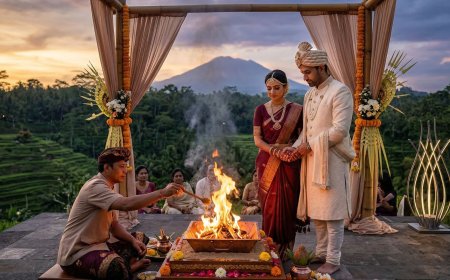
The ceremony on the primary rooftop terrace, with the mandap positioned to frame the fort view rather than obstruct it, with the Sonar Qila visible to the guests seated in front of the ceremony structure, is the defining image of the Fort Rajwada wedding — the marriage taking place inside the view that Jaisalmer provides, the couple becoming, for the duration of the ceremony, part of the golden city's visual composition.
The evening reception on the rooftop, as the fort transitions from the gold of the late afternoon to the illuminated stone of the night — the Jaisalmer Fort is lit after dark and the illuminated fort visible from the Fort Rajwada rooftop is a different and equally extraordinary experience from the golden afternoon view — is the event that most consistently produces the images that guests and photographers describe as the best available at any wedding venue in this series.
The Jharokha Lawn: The Ground-Level Outdoor Space
The Jharokha Lawn — the formal outdoor space at the ground level of the property, named for the carved jharokha windows that overlook it from the hotel's facade — is the primary ground-level outdoor event space. The lawn accommodates up to three hundred guests for a seated dinner and up to four hundred and fifty for a standing reception, making it the largest single event space at the property and the natural choice for the main reception dinner when the guest count exceeds the rooftop's comfortable capacity.
The specific character of the Jharokha Lawn is the enclosure provided by the hotel's carved stone facade on one side and the view of the fort visible above the roofline on the other — the wedding that is simultaneously inside the property's architectural embrace and oriented toward the city beyond. The evening event on the Jharokha Lawn, lit by torches and lanterns against the carved stone facade, with the illuminated fort visible above, is the ground-level version of the rooftop's golden city experience.
The Durbar Hall: The Indoor Ceremonial Space
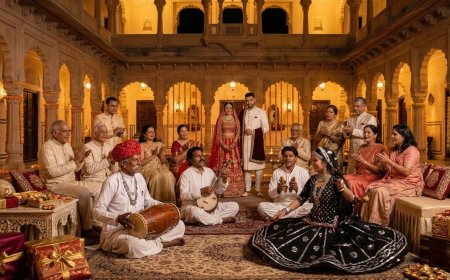
The Durbar Hall of Fort Rajwada — the indoor ceremonial and reception space at the heart of the hotel — provides the weather-protected alternative to the rooftop and lawn events and the intimate indoor option for the smaller, more formal events of the wedding program. The hall's carved stone arches, the traditional Rajasthani decorative painting, and the specific quality of a contemporary interior designed in the vocabulary of the Jaisalmer architectural tradition produce a space that reads as genuinely palatial rather than merely decorated.
The Durbar Hall accommodates up to one hundred and twenty guests for a seated ceremony or dinner and up to one hundred and eighty for a standing reception. The acoustic quality of the carved stone interior makes it an exceptional space for the musical and performance elements of the wedding — the classical music evening, the folk performance by the desert musicians that are among the most extraordinary available anywhere in India.
The Pool Terrace: The Social Heart
The pool terrace of Fort Rajwada — a semi-outdoor space with the property's pool as its centrepiece and the fort visible on the horizon — is the social gathering space of the wedding program. The daytime events, the mehendi ceremony, the informal guest gatherings of the hours between the main wedding events — these are the occasions that the pool terrace accommodates with the specific combination of relaxation and extraordinary visual context that the Jaisalmer setting provides even in its most casual moments.
The pool terrace accommodates up to one hundred guests for a standing reception and up to seventy for a seated event. The morning at the Fort Rajwada pool — with the early light on the fort across the city and the specific quality of the Jaisalmer dawn that the desert air's clarity produces — is an experience that guests who wake early for it consistently describe as the unexpected gift of the wedding visit.
The Desert Extension: The Dune Evening
Jaisalmer's proximity to the most dramatic sand dunes in Rajasthan — the Sam Sand Dunes and the Khuri dunes, each approximately forty-five minutes to an hour from the city — provides the same desert extension opportunity that Khimsar offers, and in Jaisalmer the dune experience is even more developed and more specifically extraordinary because the Jaisalmer dunes are among the most celebrated in India.
The dune dinner — the event in the desert, under the Thar sky, with the folk musicians of the Manganiyar and Langa communities who are the musical heritage of this desert region — is the event that completes the Jaisalmer wedding experience in the way that no amount of rooftop grandeur can substitute for. The Manganiyar musicians in particular — whose hereditary musical tradition has been described by musicologists as among the most extraordinary folk music traditions in the world — provide a quality of cultural experience that is specific to this desert and not available anywhere else. The dune dinner with Manganiyar musicians is not an entertainment option. It is an encounter with one of the great living musical traditions of India, made possible by the specific geography of the Jaisalmer wedding.
Comprehensive Pricing and Planning Reference
| Event Space | Seated Capacity | Standing Capacity | Approximate Venue Hire Per Event | Best Suited For |
|---|---|---|---|---|
| Rooftop Terraces (primary) | Up to 180 | Up to 250 | ₹6,00,000–₹12,00,000 | Ceremony, reception, sangeet above the fort |
| Jharokha Lawn | Up to 300 | Up to 450 | ₹7,00,000–₹13,00,000 | Large reception, baraat arrival, dinner |
| Durbar Hall | Up to 120 | Up to 180 | ₹3,50,000–₹7,00,000 | Ceremony, formal dinner, cultural performance |
| Pool Terrace | Up to 70 | Up to 100 | ₹2,50,000–₹5,00,000 | Mehendi, haldi, daytime reception |
| Desert Dune Evening (off-site) | Up to 200 | Up to 300 | ₹5,00,000–₹10,00,000 | Dune dinner, Manganiyar performance, camel safari |
| Full Property Exclusive Buyout | All spaces combined | All spaces combined | ₹18,00,000–₹35,00,000 per day | Complete exclusive use; strongly recommended |
| Budget Category | Approximate Range | Notes |
|---|---|---|
| Accommodation — Standard Room per night | ₹7,000–₹12,000 | Jaisalmer stone throughout; fort views |
| Accommodation — Deluxe Room per night | ₹11,000–₹18,000 | Superior position; carved stone details |
| Accommodation — Suite per night | ₹20,000–₹40,000 | Rooftop suites; direct fort views |
| Accommodation — Full Property Buyout per night | ₹5,00,000–₹9,00,000 | Exclusive possession; all rooms |
| Catering per cover — multi-course dinner | ₹2,000–₹3,800 | Rajasthani desert cuisine; Jaisalmer specialities |
| Catering per cover — lunch or daytime | ₹1,200–₹2,200 | Full service; rooftop and lawn options |
| Décor and florals per event | ₹4,00,000–₹14,00,000 | Golden sandstone palette; warm tones essential |
| Photography and videography | ₹2,50,000–₹8,00,000 | Golden hour specialists essential |
| Sound and lighting per event | ₹1,50,000–₹4,00,000 | Rooftop wind contingency required |
| Desert experiences — Manganiyar musicians | ₹1,50,000–₹4,00,000 | Hereditary folk tradition; book far in advance |
| Desert experiences — dune event logistics | ₹2,00,000–₹5,00,000 | Transport, setup, catering in dunes |
| Wedding planner fee | ₹4,00,000–₹10,00,000 | Jaisalmer and desert experience essential |
| Transport — Jodhpur to Jaisalmer per vehicle | ₹4,000–₹6,500 | 4.5 hours; scenic desert highway |
| Transport — Jaipur to Jaisalmer per vehicle | ₹7,000–₹10,000 | 6 hours; overnight option recommended |
| Total three-day wedding (80 guests, full buyout) | ₹50,00,000–₹90,00,000 | Full program including dune evening |
| Total three-day wedding (120 guests, full buyout) | ₹70,00,000–₹1,20,00,000 | Three nights; peak season premium applies |
Getting to Jaisalmer: The NRI Arrival Framework
Jaisalmer is the most remote of all the venues covered in this series in terms of connectivity, and the arrival planning requires the most specific attention of any venue in the guide. Understanding the arrival options and designing them correctly is the first planning task of the Jaisalmer wedding.
Jaisalmer Airport operates domestic services connecting the city to Delhi, Jaipur, and Jodhpur. The Delhi to Jaisalmer flight is approximately ninety minutes and is the most convenient option for international guests arriving via IGI Airport. The flight frequency is limited — typically one or two daily services depending on the season — and seats sell out during the peak Rajasthan wedding season of November through February. The NRI couple planning a Jaisalmer wedding must block seats on the Jaisalmer flights for their international guests as early as the guest list is confirmed, not after, because the available seat count on these services is genuinely limited and the peak season demand is genuinely high.
The Jodhpur option — flying internationally to or via Jodhpur and driving the four and a half hours to Jaisalmer — is the alternative for guests for whom the Jaisalmer direct flight is unavailable. The drive from Jodhpur to Jaisalmer through the Thar Desert is one of the most extraordinary road journeys available in Rajasthan — the landscape transitioning from the rocky Aravalli terrain around Jodhpur to the flat, increasingly arid desert of the Thar as the road approaches Jaisalmer — and it should be designed as an experience rather than a transfer. The convoy departure from Jodhpur in the early morning, arriving in Jaisalmer in the early afternoon with the fort visible on the horizon for the last thirty kilometres of the approach, is the arrival experience that the Jaisalmer wedding deserves.
The overnight train from Jodhpur to Jaisalmer — the Jodhpur Jaisalmer Express — is the option for the guests who want the specific experience of arriving in the Golden City by train at dawn, the fort appearing in the early morning light as the train approaches the station in a manner that has been moving travellers to specific, inarticulate responses since the railway reached Jaisalmer in 1968. Design this option into the guest information package for the guests who are open to it. Some of the most vivid accounts from Jaisalmer wedding guests are accounts of the dawn train arrival.
The Golden Hour: The Non-Negotiable Photography Imperative
At every venue in this series, the photography brief has been discussed as an important element of the planning. At Fort Rajwada Jaisalmer, it must be discussed as the most critical single element, because the golden hour at Jaisalmer — the period between approximately four-thirty and six in the afternoon when the Jaisalmer stone turns the colour that gives the city its name — is the most extraordinary single photography light available at any wedding venue in India, and the couple who does not organise their ceremony and photography schedule around it is missing the defining opportunity of the venue.
The golden hour at Jaisalmer is not a metaphor or a generalisation. It is a specific, measurable, predictable phenomenon: the Jaisalmer yellow sandstone's colour, combined with the specific quality of the desert afternoon light at the low angle of the pre-sunset period, produces a warmth and a saturation of colour in the stone that is genuinely different from what the stone looks like at other times of day. The photographer who has been to Jaisalmer before will know this without being told. The photographer who has not been must be briefed specifically: the ceremony or the couple portraits or the reception arrival must be scheduled for the golden hour, and everything else in the day must be arranged around that constraint.
The ceremony at four-thirty, with the mandap on the rooftop terrace, the Sonar Qila turning gold in the background, the light hitting the carved stone of the fort's facades from the west, the desert sky beginning its evening colour sequence — this is the ceremony that produces the Fort Rajwada wedding's defining images. It requires a ceremony start time that the couple's family and guests may find unconventional. It is worth every conversation required to secure it.
The Manganiyar Musical Tradition: Why It Matters
The Manganiyar musicians of the Jaisalmer and Barmer districts are the single most significant cultural resource available to the NRI couple marrying in Jaisalmer, and their inclusion in the wedding program — specifically in the dune evening or in a dedicated performance event — is the recommendation that this guide makes most strongly of any specific planning decision.
The Manganiyar are a hereditary musician community of the western Rajasthan desert whose musical tradition spans several centuries and whose repertoire encompasses the devotional, the romantic, the ceremonial, and the seasonal in a body of music that has been described by ethnomusicologists as one of the great living folk music traditions in the world. Their instruments — the kamaicha, the khartal, the dholak, the morchang — produce a sound that is specific to the desert and that is heard nowhere else in India in the same form. Their voices, trained across generations in a musical lineage that passes directly from father to son, produce a quality of vocal performance that has moved listeners without prior exposure to the tradition to responses of genuine, unmediated emotion.
The Manganiyar musicians who perform at the dune dinner or the evening performance of the Fort Rajwada wedding are not performing background music for a social event. They are presenting one of the great musical traditions of India to an audience that, in the majority of cases, is encountering it for the first time. The NRI couple who builds this encounter into the wedding program — who gives their guests from London and Singapore and Toronto the specific gift of sitting in the Thar Desert at night listening to musicians whose tradition was ancient when the Jaisalmer Fort was new — is giving those guests the most specifically Indian and the most specifically extraordinary experience available in the whole of this destination wedding series.
Book the Manganiyar musicians early. They are sought after, their schedules fill during the peak season, and the specific ensemble quality — the combination of kamaicha players, vocalists, and percussionists that produces the full Manganiyar sound — requires advance coordination with the musicians' community. The wedding planner with Jaisalmer experience will know the specific musicians and the specific booking process. This is one of the clearest reasons why the Jaisalmer-experienced planner is not optional at this venue.
Common Mistakes NRI Couples Make With the Fort Rajwada Wedding
The first mistake is not scheduling the ceremony during the golden hour. The golden hour at Jaisalmer is the most specific and most extraordinary photography and experiential light available at any venue in this series. The couple who schedules the ceremony at six in the evening, or at ten in the morning, or at any time other than the pre-sunset golden period, is choosing a different, lesser version of the Fort Rajwada experience. Every other scheduling constraint — the caterer's service window, the family's preferred ceremony time, the guest arrival schedule — must be negotiated around the golden hour, not the other way around.
The second mistake is not including the Manganiyar performance in the program. The Jaisalmer wedding that does not include a Manganiyar performance is a wedding that has accessed the setting without accessing the most significant cultural content that the setting makes available. This is the equivalent of marrying at Samode Palace without using the Sheesh Mahal — a specific opportunity of the venue not taken. Include the Manganiyar. Design the dune evening around them. Give your guests the music of the desert.
The third mistake is not managing the rooftop wind contingency. The Fort Rajwada rooftop is an outdoor space at the summit of the property, exposed to the desert winds that can develop with speed and without much warning in the evening hours, particularly in the spring months and at certain transitional weather periods. The outdoor event that has not been designed with wind contingency — the candles that cannot survive a gust, the décor elements that require still air, the sound system that cannot compete with wind noise — is the event that will be disrupted. Build the wind contingency into every rooftop event.
The fourth mistake is not booking the Jaisalmer flight seats for international guests early enough. The limited seat count on the Jaisalmer domestic services during peak wedding season — November through February — is a genuine constraint that catches NRI couples who assume that domestic Indian flights are always available. Block the seats on the Jaisalmer services at the same time as the venue booking, not after the guest list has been finalised and the invitations issued.
The fifth mistake is treating Jaisalmer as only the venue and not also the experience. The NRI couple who comes to Jaisalmer, uses Fort Rajwada for the wedding events, and does not design the Sonar Qila visit, the haveli walk, the camel experience, and the dune events into the program is marrying in one of the most extraordinary cities in India without giving their guests the city. The fort interior, the Jain temples within the fort, the carved havelis of the old city, the specific food culture of Jaisalmer — the dal baati churma, the ker sangri, the specific sweets of the desert city's confectionery tradition — these are experiences that give the wedding visit its fullest content and that give international guests the encounter with the Golden City that the Fort Rajwada rooftop has been promising from the moment they first saw the photographs.
Meera's wedding was in December, at four-thirty in the afternoon, on the rooftop of Fort Rajwada. The mandap was positioned to frame the Sonar Qila directly behind the ceremony. The guests were seated facing the fort. The light, which arrived on schedule at approximately four forty-five as the sun descended toward the desert horizon, turned the Jaisalmer stone the colour that it always turns at that hour — the colour that Meera had seen in photographs and that had brought her back to Jaisalmer after the unresolved college trip of ten years earlier, the colour that she had described to Karthik as the reason and that she now understood, standing in the middle of it, was not a colour at all but a quality of being in a specific place at a specific time in a specific light that no photograph had fully communicated and that she was now inside.
The fort turned gold behind the ceremony. The guests who were facing the fort saw both things simultaneously — the couple taking their vows in the foreground and the golden city in the background — and the photographs showed both things simultaneously, and there was no way to separate them, and there was no reason to try.
Schedule the ceremony for the golden hour and defend that scheduling against every competing constraint. Book the Jaisalmer flight seats on the day the venue is confirmed. Include the Manganiyar musicians. Build the wind contingency. Give your guests the city as well as the venue.
The fort has been turning gold at four forty-five every afternoon for nine centuries. It will do it again on your wedding day. Be on the rooftop when it does.
Published by NRIWedding.com — The Premium Global Platform for Non-Resident Indians Planning Indian Weddings From Abroad.
What's Your Reaction?
 Like
0
Like
0
 Dislike
0
Dislike
0
 Love
0
Love
0
 Funny
0
Funny
0
 Angry
0
Angry
0
 Sad
0
Sad
0
 Wow
0
Wow
0