







































































From London to Udaipur: How We Planned Our Wedding at a Rajasthan Palace — The Complete NRI Wedding Planning Guide
Priya was on the Piccadilly line on a Tuesday in February when she saw the photograph. A palace on Lake Pichola. She showed it to Dev that evening. He said: okay. What followed was eighteen months of planning a wedding in a city neither of them had visited, from a flat in Islington, across a five and a half hour time zone gap, with families in Ahmedabad and Leicester whose expectations were specific and whose views were strongly held. This guide gives NRI couples in the UK the complete framework for planning a Udaipur palace wedding — covering the full timeline, real venue costs, vendor selection, family coordination, guest travel logistics, and everything Priya and Dev got right and wrong.


From London to Udaipur: How We Planned Our Wedding at a Rajasthan Palace
Priya remembered the exact moment she knew it had to be Udaipur. She was on the Piccadilly line, somewhere between Green Park and Hyde Park Corner, on a Tuesday morning in February, standing with her face six inches from a stranger's shoulder and her phone open to an Instagram account she had found at eleven the previous night and had not been able to stop looking at since. The account belonged to a wedding photographer based in Jaipur. The photographs were of a wedding at a palace hotel on Lake Pichola. The photographs were, by any reasonable assessment, extraordinary — the kind of images that make you feel the heat and the light and the specific quality of the Rajasthan evening even when you are looking at them on a phone screen on a tube train in February.
She showed them to Dev that evening. He was making dinner — a Sunday routine transplanted to a Tuesday because the weekend had been consumed by a work crisis — and she stood in the kitchen doorway of their Islington flat and held her phone out to him without saying anything. He looked at the photographs for a long time. Then he said: where is this. She said: Udaipur. He said: how far is it from where your parents are. She said: four hours by car from Ahmedabad, maybe five. He said: okay.
That was the beginning. It did not feel like a beginning at the time — it felt like an Instagram moment, a fantasy entertained for an evening that would yield to practicality by morning. But by morning the fantasy had not yielded. It had, if anything, intensified. Priya had spent two hours before her alarm went off reading about palace hotels on Lake Pichola, about the wedding logistics of Udaipur, about the caterers and photographers and decorators and planners who operated in the city, and about the specific administrative and financial requirements of hosting a wedding at a heritage palace property. By the time she arrived at her desk at the architecture firm in Clerkenwell where she worked as a senior associate, she had a document open on her laptop titled, with the directness that was characteristic of her professional approach to everything, Wedding Research: Udaipur — Initial.
Dev, who ran a technology consultancy from an office in Shoreditch and whose default orientation toward large projects was systematic rather than romantic, came home that evening to find the document had grown to eleven pages. He sat down and read it. He said: if we're doing this, we're doing it properly. Priya said: we're doing it properly. That was the second conversation.
What followed was eighteen months of planning a wedding in a city neither of them had ever visited for a ceremony they had never attended, from a flat in Islington, across a time zone gap of five and a half hours, with families in Ahmedabad and Leicester whose expectations were specific and whose involvement was enthusiastic and whose views on vendors and catering and guest lists and ceremony timing were all strongly held and frequently divergent. It was, by any objective measure, an exceptionally complex logistical undertaking. It was also, when it was over, the most beautiful thing either of them had ever been part of.
This is not the story of a perfect plan perfectly executed. Plans are not perfect and execution is never perfect. This is the story of what they got right, what they got wrong, what they would do differently, and the complete framework that the eighteen months of planning made possible — so that the couple sitting in Islington or Hammersmith or Wembley, with a phone full of palace hotel photographs and a question about where to begin, has a map rather than a blank page.
This guide is for every NRI couple in the United Kingdom who has looked at a photograph of Udaipur and felt the specific pull of that place — and who deserves the complete, honest, practical framework for turning that pull into a wedding that actually happens.
Why Udaipur: Understanding What You Are Choosing
Before the planning can begin in any useful sense, the choice of Udaipur must be understood completely — not as a romantic abstraction but as a specific logistical, financial, and cultural context that will shape every decision that follows.
The City as a Wedding Destination
Udaipur is not simply a beautiful city with palace hotels. It is one of the most developed wedding destination ecosystems in India, with a vendor infrastructure — photographers, decorators, caterers, planners, transportation providers, accommodation coordinators — that is specifically oriented toward large, high-production weddings from both domestic and international clients. This maturity of the wedding ecosystem means that the logistical support available in Udaipur is substantially more developed than in most Indian cities of comparable size, and it means that the vendors operating in this market are experienced in managing the specific requirements of NRI clients who are planning from abroad.
The city's geography — the lakes, the Aravalli hills, the concentration of heritage palace properties within a relatively small area — creates a wedding aesthetic that is genuinely distinctive. The light in Udaipur, particularly in the October to February wedding season, is the specific warm golden light of the Rajasthan winter, and it photographs in ways that make even ordinary moments look like paintings. This is not marketing language. It is the honest assessment of what the city's physical environment provides as a backdrop for wedding photography and videography.
The limitations are equally real and must be understood before the commitment is made. Udaipur is not easily accessible. The city's airport — Maharana Pratap Airport — handles a limited number of direct flights, and most guests travelling from the UK will require a connection through Delhi or Mumbai, adding two to four hours to an already long journey. Guests travelling from North America or Australia face journey times of twenty to twenty-eight hours minimum. The accommodation infrastructure, while excellent at the top end, has limited capacity at the palace hotel level, meaning that guests who are not accommodated at the wedding venue itself will be spread across multiple properties of varying quality. Managing guest accommodation across multiple properties, coordinating the transfers between them and the wedding venue, and ensuring that every guest arrives at every event on time is a logistical undertaking that requires specific planning infrastructure.
The Palace Hotel Landscape
The palace hotel market in Udaipur operates at several distinct levels, and understanding the differences between them is essential before any venue enquiry is made.
The Taj Lake Palace, occupying an island in Lake Pichola, is the most iconic wedding venue in Udaipur and possibly in all of India. Its exclusivity — the entire hotel must be booked for a wedding, which at its current rates represents a budget commitment that begins at several crore rupees for a three-day event — means that it is the right choice for a specific kind of wedding and a specific scale of budget, and not relevant for couples whose requirements are different. It is mentioned here because it is the venue that appears most frequently in the Instagram photographs that inspire couples to choose Udaipur, and because the gap between the Instagram inspiration and the actual cost of that specific venue should be understood early.
The Leela Palace Udaipur, the Fateh Garh, the Chunda Palace, and the Devigarh — a converted fort forty-five minutes from the city — represent the next tier of palace wedding venues, each with different characteristics, different capacity, different aesthetic, and different price points. The Devigarh in particular is a venue whose architecture — a fort interior transformed into a boutique heritage hotel with an extraordinary series of event spaces — produces a wedding aesthetic that is distinct from the lakeside palace hotels and that is the right choice for couples whose visual reference is more raw heritage than manicured luxury.
Beyond these, Udaipur has a second tier of heritage properties — havelis, smaller palace hotels, and heritage bungalows — that offer the aesthetic credentials of the city at a more accessible price point and that are the realistic choice for the majority of NRI couples planning from the UK on professional-but-not-unlimited budgets.
The Planning Timeline: Eighteen Months From London
The timeline of planning a Udaipur palace wedding from London is not compressible below twelve months without accepting meaningful compromises in venue choice, vendor selection, and logistical quality. Eighteen months is comfortable. Fourteen months is workable. Twelve months is the minimum for a wedding at the palace hotel level with full vendor infrastructure in place.
Months One to Three: The Foundation Work
The first three months of planning are not the exciting months. They are the months of research, budget establishment, and the initial vendor conversations that determine whether the wedding being imagined is the wedding that is financially and logistically possible.
The budget conversation must happen in the first month, not the third. The specific, honest, total budget — including the contingency that every Indian wedding requires and that every Indian wedding underestimates — must be established before any venue enquiry is made, because the venue choice is the decision that sets the financial envelope for everything that follows. A couple who falls in love with a venue before establishing their budget is a couple who will either overcommit financially or spend the rest of the planning process grieving the venue they could not afford.
The venue enquiry process should begin in month two. Not one enquiry — multiple enquiries, to multiple properties, with the same brief sent to each, so that the responses can be compared on equivalent terms. The brief should specify the approximate guest count, the number of days and events, the approximate budget range, and the preferred dates or date range. A venue that responds promptly, specifically, and with genuine engagement with the brief is demonstrating, at the first point of contact, something important about how they will manage the relationship through the eighteen months of planning that follow.
The initial family conversations — about the vision, the budget, the guest list parameters, and the roles that each family will play in the planning — should happen in month two as well. The NRI couple planning a Udaipur wedding with families in Ahmedabad and Leicester is not planning in isolation. They are planning within a family system that has its own expectations, its own priorities, and its own capacity to help or to complicate. Establishing the conversation framework early — who is consulted on which decisions, who has veto power on which categories, who is responsible for which logistics — prevents the specific exhaustion of relitigating the same decisions repeatedly as the planning progresses.
Months Four to Six: The Vendor Infrastructure
Once the venue is confirmed and the deposit paid, the vendor infrastructure must be assembled in months four through six. The vendor categories for a Udaipur palace wedding are: the wedding planner, the photographer, the videographer, the decorator, the caterer, the entertainment — musicians, DJs, mehendi artists, performers — the transportation coordinator, and the accommodation coordinator. Each of these categories contains vendors of widely varying quality, experience, and NRI-client sophistication, and the selection process for each requires specific research rather than reliance on the venue's preferred vendor list alone.
The wedding planner deserves particular attention. For an NRI couple planning from London, a local Udaipur-based wedding planner is not a luxury — it is the operational infrastructure that makes the wedding possible. The planner is the physical presence in Udaipur that the couple cannot be: the person who visits the venue, meets the vendors, attends the site inspections, manages the timeline, and is available in Indian business hours when the couple is at work in a different time zone. The quality of the wedding planner is the single most consequential vendor decision in the entire planning process, and it deserves more due diligence than any other vendor category.
Months Seven to Twelve: The Detail Architecture
The middle months of the planning timeline are the months in which the broad decisions of the foundation work are translated into the specific, granular detail that a three-day wedding requires. Guest list finalisation, accommodation allocation, event-by-event run sheets, catering menus, décor concepts per event, photography briefing, transportation logistics for each event — each of these tasks is substantial, and each is made more complex by the NRI context.
The guest list for a Udaipur wedding requires specific management that a local wedding does not. Every guest travelling from the UK, from North America, from Australia, from Southeast Asia, or from East Africa — the diaspora geographies that NRI weddings typically draw from — is making a significant travel commitment. Flight costs, hotel costs, and the time cost of the journey must be considered when the guest list is built. Guests who are invited to a Udaipur wedding from London are being asked to spend between fifteen hundred and three thousand pounds on travel and accommodation, and the invitation carries that implicit financial ask. The guest list must be built with awareness of this, and the couple's approach to managing the cost for guests who cannot afford it — whether through subsidised accommodation, contribution to flights, or the graceful acknowledgment that some people who would be at a local wedding will not be at a destination wedding — must be decided explicitly rather than left implicit.
Months Thirteen to Eighteen: The Final Coordination
The final six months of a Udaipur wedding plan are the months of confirmation, contingency planning, and the management of the accelerating complexity that every wedding generates as the date approaches. Vendor confirmations, final payments, run sheet refinements, accommodation check-in coordination, airport transfer logistics, last-minute guest list changes — each of these is manageable in isolation and collectively constitutes a significant administrative load that the couple in London is managing across a time zone gap, around full-time work commitments, and with the emotional intensity that the proximity of the wedding produces.
The Budget: What a Udaipur Palace Wedding Actually Costs
The most useful service this guide can provide on the budget question is specificity, because the range of costs for a Udaipur palace wedding is wide enough that vague guidance is worse than useless.
The Venue Cost
Palace hotel venue costs in Udaipur are structured around a combination of accommodation room nights, event space rental, and minimum food and beverage spends. For a mid-tier palace hotel — not the Taj Lake Palace, but a property of genuine heritage quality and event infrastructure — a three-day wedding with two hundred guests requires booking approximately sixty to eighty rooms across three nights, at rates ranging from eight thousand to twenty-five thousand rupees per room per night depending on the property and the season. The event space rental is typically waived or discounted when the accommodation commitment meets a minimum threshold. The minimum food and beverage spend per event varies by property and is typically negotiable within a range.
The total venue cost — accommodation plus event space, excluding catering — for a mid-tier palace hotel wedding of two hundred guests across three days is typically between forty and eighty lakh rupees, depending on the specific property and the negotiated terms.
The Vendor Costs
Vendor costs for a Udaipur wedding operate at a premium relative to non-destination Indian weddings, because the city's reputation as a wedding destination has established a price floor that reflects both the quality of the vendors operating there and the willingness of destination wedding clients to pay destination wedding prices. A premium wedding photographer in Udaipur charges between three and eight lakh rupees for a three-day shoot. A decorator of the quality appropriate for a palace wedding charges between ten and twenty-five lakh rupees for a three-event décor package. A wedding planner charges between three and eight lakh rupees for full-service planning, or a percentage of total wedding budget typically between ten and fifteen percent.
The Hidden Costs
The hidden costs of a Udaipur wedding are the costs that do not appear in the initial planning spreadsheet and that collectively account for the gap between the original budget and the final spend — a gap that is, in the experience of virtually every couple who has planned a destination wedding, larger than anticipated.
Generator costs — because Indian wedding venues depend on diesel generators for backup power and because a three-day palace wedding consumes substantial generator fuel — are often not included in venue packages and can add three to five lakh rupees to the total cost. Guest transportation — the coordination of airport transfers, venue transfers, and day trip logistics for two hundred guests across three days — adds another three to eight lakh rupees depending on the fleet size and the distance between the accommodation properties and the wedding venues. The costs of feeding and accommodating the wedding planning team, the families in the days before and after the wedding, and the extended entourage that Indian weddings inevitably produce must be budgeted explicitly rather than absorbed into the general catering estimate.
Managing the London-Udaipur Distance
The distance between London and Udaipur is not only geographical. It is operational, communicative, and psychological, and each of these dimensions requires a specific management approach.
The Time Zone Protocol
The five and a half hour time zone difference between London and Udaipur creates a communication window that is narrower than most couples appreciate when they begin the planning. Indian vendor business hours — approximately ten in the morning to seven in the evening Indian Standard Time — correspond to four thirty in the morning to one thirty in the afternoon in London. In practice, the usable overlap window — when the couple is awake and at a point in their work day where a vendor call is possible — is approximately twelve noon to one thirty in the afternoon London time, which is five thirty to seven in the evening in Udaipur.
This ninety-minute daily window is the primary communication channel for the entire planning process, and it must be managed with the intentionality that its narrowness demands. Weekly scheduled calls with the wedding planner, the venue coordinator, and the primary vendors — scheduled in advance, with agendas prepared, and with decisions made rather than deferred — are the operational infrastructure that makes the distance manageable. Ad hoc communication through WhatsApp fills the gaps, but the decisions that matter must be made in scheduled calls where both parties are prepared and available.
The Site Visit Strategy
Priya and Dev made three trips to Udaipur during the eighteen months of planning. The first was the reconnaissance trip — five days in month four, after the venue was shortlisted but before the deposit was paid, during which they visited every shortlisted venue, met the wedding planner candidates, and built the physical familiarity with the city that no amount of online research can replace. The second was the vendor confirmation trip — four days in month ten, during which they met the confirmed vendors, reviewed the décor concepts in the actual spaces, and worked through the event logistics with the planner on the ground. The third was the pre-wedding trip — arriving in Udaipur five days before the wedding, during which the final preparations were managed, the families were received, and the specific chaos of the pre-wedding period was navigated with the support of the planner and the venue team.
Three trips is the minimum for a wedding of this complexity. Two trips is possible but produces a higher risk of discovering, on arrival before the wedding, that something confirmed in a video call looks different in person. One trip — arriving only for the wedding itself — is an approach that some couples attempt and that the experience of many NRI couples suggests produces a specific kind of last-minute crisis that more site visits would have prevented.
The Family Coordination Infrastructure
Priya's parents were in Ahmedabad, four hours from Udaipur. Dev's parents were in Leicester, two hours from London by train. These two families, separated by continents and connected by the wedding they were both co-planning, had different communication styles, different expectations about their involvement in the planning, and different views on several of the major decisions — the catering style, the guest list composition, the ceremony timing, and the relative weight given to Gujarati traditions in a wedding being planned by a couple who lived in London and who had their own relationship to those traditions.
The coordination of these two families — managing their involvement, their expectations, their contributions, and their occasional conflicts — was, by Priya's own assessment, the most emotionally demanding aspect of the entire planning process. More demanding than the venue negotiation. More demanding than the vendor coordination. More demanding than the logistics of moving two hundred people through a city they had never visited.
The framework that worked for them was the establishment of clear lanes — specific categories of decision that each family owned, specific categories that the couple owned, and a specific escalation process for the inevitable decisions that fell between the lanes. Dev's mother owned the Leicester guest list, subject to a maximum number that Dev and Priya set and held. Priya's mother owned the Ahmedabad-side logistics — the family arrivals, the pre-wedding functions at her parents' home before the wedding party moved to Udaipur. The couple owned the venue, the vendors, the event design, and the ceremony structure. These were not perfect lanes and they were not perfectly observed, but they created enough clarity to prevent the decision-by-committee paralysis that destroys the planning experience of couples who do not establish them.
The Vendor Selection: What Priya and Dev Got Right and Wrong
What They Got Right
They hired the wedding planner before any other vendor. This was, in retrospect, the single best decision of the entire planning process. The planner — a Udaipur-based woman with twelve years of experience in destination weddings and a specific track record with UK-based NRI clients — became the operational centre of gravity for the entire planning process. She knew which vendors were reliable and which were not. She knew how to negotiate with the palace hotel. She knew the city's logistical quirks. She knew how to manage the family dynamics that are a predictable feature of every Indian wedding. She cost three percent of the total wedding budget and was worth every rupee.
They hired the photographer early and briefed him specifically. The brief was not "beautiful photographs of our wedding." It was a detailed document specifying the moments that were non-negotiable inclusions, the aesthetic references that captured the tone they wanted, the specific people whose presence in the photographs mattered most, and the specific elements of the Udaipur setting — the lake, the evening light, the palace architecture — that they wanted used intentionally rather than incidentally. The photographs, when they arrived, reflected the brief with a specificity that would not have been possible without it.
What They Got Wrong
They underestimated the catering coordination. The catering for a Udaipur palace wedding involves a specific relationship between the palace hotel's in-house catering team — who typically manage the kitchen infrastructure and some portion of the food — and the external catering vendor who manages the wedding-specific menu. The contract between these two entities, and the division of responsibility between them, is a source of confusion and conflict that caught Priya and Dev off guard at the menu confirmation stage, eight weeks before the wedding. The lesson: the catering brief should specify, in the contract with each party, exactly who is responsible for exactly what food category, and the palace hotel's kitchen access and use terms should be clarified before the external caterer is confirmed.
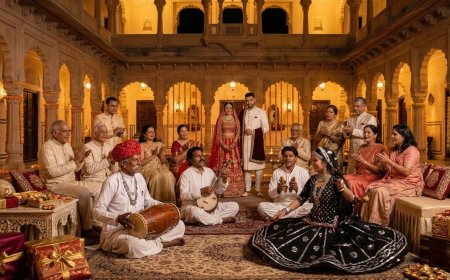
They waited too long to confirm the entertainment. The musicians and performers they wanted for the sangeet — a specific type of folk ensemble from Rajasthan that would have given the evening a quality of authenticity that no DJ set could replicate — were unavailable at the point when Priya finally reached out to confirm them, because another wedding had booked them three months earlier. They found an alternative that was good but not what they had imagined. The lesson: entertainment bookings for a Udaipur destination wedding should be confirmed in month five at the latest, not month ten.
The Guest Experience: Your Responsibility Beyond the Ceremony
An NRI couple hosting a wedding in Udaipur is not only hosting a wedding. They are hosting a travel experience for every guest who attends. The responsibility that comes with that — the responsibility to ensure that guests who have spent significant money and significant time to be present have an experience that justifies that investment — is a responsibility that the best destination weddings take seriously and that the worst ones ignore until it is too late.
The Guest Communication Infrastructure
Every guest attending a Udaipur wedding from abroad needs a specific set of information that a local wedding does not require: the travel options to Udaipur and their relative costs, the accommodation options and their costs, the event schedule in enough detail to plan their travel around, the dress code for each event, the local context that will help them understand what they are attending, and the contact information for someone on the ground who can help them if something goes wrong.
A dedicated wedding website — not a social media page, a properly structured website — is the minimum infrastructure for this communication. The website should be live and shared with guests at the point the invitations are sent, not the week before the wedding. It should be updated as the planning develops and should include a FAQ section that anticipates the questions that guests from abroad will have and answers them specifically.
The On-Ground Guest Support
Priya and Dev designated two of their most organised friends — one based in London, one whose family was in Ahmedabad and who would be arriving in Udaipur early — as the guest liaison team. These two people were the first points of contact for any guest who had a question, a problem, or a confusion about anything related to the wedding logistics. This designation — communicated to all guests at the time of the invitation, with the liaisons' contact details included — reduced the volume of guest queries that reached Priya and Dev directly in the final weeks of planning from what would have been overwhelming to what was merely significant.
Common Mistakes NRI Couples Make Planning a Udaipur Wedding From London
The first mistake is choosing the venue before establishing the budget. The palace hotel photographs that inspire the Udaipur wedding decision are, by definition, images of the most beautiful and most expensive venues. Falling in love with a specific venue before the budget is established produces either financial overcommitment or a planning process haunted by the comparison between the venue being planned and the venue that was imagined. The budget must come first.
The second mistake is underestimating the guest travel cost as a factor in the guest list. Inviting a hundred and fifty guests to a Udaipur wedding from London is implicitly asking those guests to spend between fifteen hundred and three thousand pounds each. Some guests will be delighted to do so. Some will not be able to. Some will feel obligated to attend despite the financial strain. Building a guest list for a destination wedding requires honest consideration of this implicit ask, and the couple who does not consider it will be managing the fallout of declined invitations and strained relationships in the weeks after the invitations are sent.
The third mistake is not building a contingency budget. Every Indian wedding exceeds its original budget. Every destination Indian wedding exceeds it by more. The specific costs that are hardest to anticipate — the generator fees, the last-minute accommodation upgrades, the transportation additions, the extended family members who arrive with unstated accommodation requirements — are all real and all predictable in aggregate even when they are unpredictable in detail. A contingency of twenty percent of the total budget is not excessive. It is the honest acknowledgment of the gap between the plan and the execution.
The fourth mistake is managing the family involvement informally. The families of an NRI couple planning a Udaipur wedding have real and legitimate roles in that planning, and those roles, left undefined, will be claimed in ways that may not align with the couple's vision. The establishment of clear decision lanes — early, explicitly, and with the genuine involvement of both families in drawing the lanes — is the specific intervention that converts family involvement from a source of conflict into a source of support.
The fifth mistake is not visiting the venue before the deposit is paid. No amount of virtual tours, video calls with venue coordinators, and Instagram research substitutes for standing in the physical space and understanding it with your body as well as your eyes. Couples who pay deposits on the basis of digital research alone discover, on their first site visit, that the space is different from how they imagined it — sometimes better, sometimes worse, always different — and that the differences require replanning that would not have been necessary if the physical visit had preceded the financial commitment.
What the Wedding Was
The wedding was in November. The evening of the ceremony, the light on Lake Pichola was the specific warm gold that had appeared in the Instagram photograph on the Piccadilly line in February, twenty months earlier. The marigolds — two tonnes of them, coordinated by the decorator across three days of events — caught that light and held it. The Rajasthani folk ensemble that had been unavailable played at a different couple's wedding that evening, somewhere else in the city. The alternative ensemble played beautifully.
Priya stood at the top of the entrance staircase of the haveli where the ceremony was held and looked out at two hundred people who had come from Leicester, from Ahmedabad, from Toronto, from Melbourne, from Dubai, from Singapore, and from three postcodes in North London, all gathered in a courtyard in Udaipur because she had looked at a photograph on a phone screen on a tube train in February and shown it to a man who was making dinner in an Islington kitchen and said: okay.
She thought about the eighteen months. She thought about the forty-three vendor calls and the one hundred and seventeen WhatsApp groups and the three trips to Udaipur and the contingency budget that had been almost entirely consumed and the family conversations that had been difficult and the ones that had been beautiful and the specific, unrepeatable quality of the year and a half during which two people in London had built, from a distance of four thousand miles, something that was happening right now, in real time, in the light she had seen in a photograph.
She thought: it was worth every single hour.
Start with the budget, not the venue. Hire the wedding planner first. Make the reconnaissance trip before the deposit is paid. Build the guest list with awareness of the travel cost it implies. Establish clear decision lanes with both families before the planning begins. Build a contingency of twenty percent.
The distance between London and Udaipur is real. The wedding you can build across that distance, with the right framework and the right team, is more real still.
Published by NRIWedding.com — The Premium Global Platform for Non-Resident Indians Planning Indian Weddings From Abroad.
What's Your Reaction?
 Like
0
Like
0
 Dislike
0
Dislike
0
 Love
0
Love
0
 Funny
0
Funny
0
 Angry
0
Angry
0
 Sad
0
Sad
0
 Wow
0
Wow
0