





























































The Gold Border That Says You Already Belong: Pudamuri and the Ritual of Welcome in Kerala Weddings
Pudamuri — the ritual gifting of a Kasavu saree and complete set of clothes by the groom's family to the bride before the wedding — is one of Kerala's most quietly powerful pre-wedding traditions. It is the moment two families stop being strangers, the moment a bride is dressed for her new life by the hands that will welcome her into it. Rooted in Kerala's ancient matrilineal traditions and practiced across Nair, Namboothiri, Syrian Christian, and Mappila communities, Pudamuri is the ritual that begins the marriage before the mantras do. For Malayali NRIs planning weddings abroad, this is your complete guide.


Before the mantras are chanted, before the banana leaf is laid, before the Mangalsutra is tied — there is Pudamuri. The ritual gifting of new clothes by the groom's family to the bride before the wedding is one of the most quietly powerful traditions in Kerala's wedding culture, a gesture that says everything about welcome, acceptance, and the love that travels between two families before a single vow is spoken. For Malayali NRIs from Thiruvananthapuram to Toronto, from Kochi to California, from Thrissur to the United Arab Emirates, Pudamuri is the ritual that makes the bride feel, for the very first time, that she is already home.
You have heard the story in your family at some point — the morning before the wedding when the groom's mother arrived with a neatly folded saree wrapped in a cloth, the way your grandmother or aunty received it with both hands, the specific formality and warmth of the exchange that was neither a transaction nor simply a gift but something in between that Malayalam has a word for and English does not quite reach. You filed it away as one of those things that happens at Kerala weddings, one of those rituals you would understand properly when it was your turn.
Your turn has arrived. You are in a house in Fremont or a flat in Harrow or an apartment in Mississauga, and your future mother-in-law is on a video call from Ernakulam asking about the Pudamuri — what saree, what colour, what time, who will carry it, who will receive it. Your own mother is on another call saying the same things from the other direction. Between the two of them, across three time zones, a ritual that began in the courts of Kerala's ancient kingdoms is being negotiated over WhatsApp and Zoom with the same seriousness it has always deserved.
This is Pudamuri. And it is the moment two families stop being strangers.
🌟 DID YOU KNOW?
- Pudamuri literally translates from Malayalam as "bundle of clothes" — puda meaning cloth or garment and muri meaning a folded or tied bundle — and the ritual gift traditionally includes not just a saree but a complete set of clothing and accessories, the specific contents of which are governed by community tradition and family custom and can include up to seven or nine items in elaborate ceremonies.
- The Pudamuri saree in traditional Kerala Hindu weddings is almost always a Kasavu saree — the iconic Kerala saree of cream or off-white cotton or silk with a gold zari (metallic thread) border — which the bride wears during the wedding ceremony itself, making the Pudamuri gift not merely a pre-wedding gesture but the literal clothing of the bride for the most sacred moment of her life.
- According to Kerala wedding tradition scholars, Pudamuri has its documented roots in the Nair matrilineal system of marumakkathayam (inheritance through the mother's line), in which the groom's family's formal gifting of clothes to the bride represented the first act of integration of the bride into a new family network — a social and legal significance that preceded its purely ceremonial meaning.
What Is Pudamuri?
Pudamuri — from the Malayalam puda (cloth, garment) and muri (a tied or folded bundle) — is the pre-wedding ritual in which the groom's family formally presents the bride with new clothes and accessories that she will wear on her wedding day. It occurs typically one to three days before the wedding ceremony itself, or in some family traditions on the morning of the wedding day, and marks the formal beginning of the bride's transition from her family of origin into her new family.
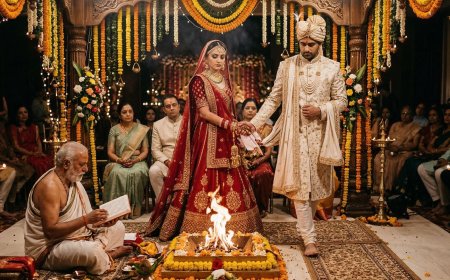
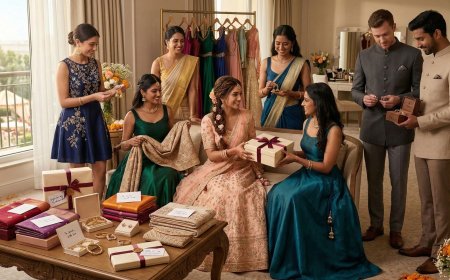
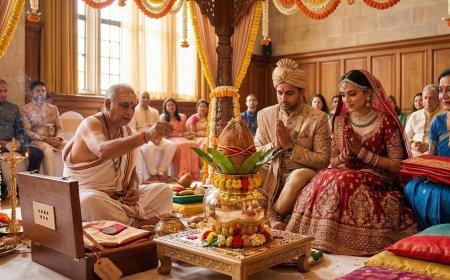
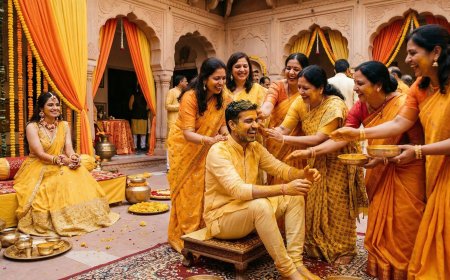
What physically happens varies by community and family tradition, but the essential structure is this: the groom's mother, accompanied by senior female relatives from the groom's family, visits the bride's home carrying the Pudamuri — a carefully assembled set of gifts wrapped in a fresh cloth or placed in a decorated basket or tray. The contents are presented formally to the bride's mother and then to the bride herself. The bride receives the gifts with both hands — never one hand, which would be considered disrespectful — and the groom's mother or senior female relative may drape the saree over the bride's shoulder briefly as a gesture of welcome and blessing.
The core of the Pudamuri gift is the Kasavu saree — the cream-and-gold Kerala saree that the bride will wear during the wedding ceremony. In many family traditions, the set also includes a blouse piece (fabric for the saree blouse), a mundu(the traditional Kerala lower garment), bangles (glass or gold, depending on the family's means and custom), flowers for the bride's hair (typically jasmine — mulla in Malayalam — which is inseparable from the image of a Kerala bride), a necklace or gold ornament, kumkum (vermillion powder), chandanam (sandalwood paste), and sometimes fruits and betel leaves as auspicious additions.
In some communities and family traditions, the Pudamuri is an elaborate, witnessed ceremony with prayers and the involvement of a priest. In others, it is an intimate family moment — the groom's mother and the bride's mother in a room together, the saree changing hands, something unspoken but completely understood passing between two women who are, from this moment forward, family.
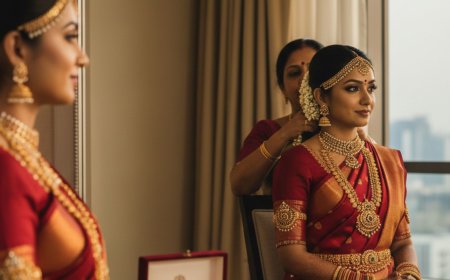
The bride wears the Pudamuri saree for the wedding. This is not decoration — it is declaration. She is dressed by his family for the day she becomes part of it.
Community Comparison Table
| Community / State | Local Name | Key Tradition | How NRIs Abroad Adapt It |
|---|---|---|---|
| Kerala (Nair) | Pudamuri | Kasavu saree gifted by groom's mother; complete set of seven or nine items; pre-wedding ceremony | Kasavu saree ordered from Kerala online retailers; ceremony held at bride's home or hotel room |
| Kerala (Namboothiri Brahmin) | Pudamuri | Stricter protocol; priest may be present; specific items determined by family tradition | Namboothiri family elder consulted; priest involved via video call if needed |
| Kerala (Christian — Syrian) | Pudamuri / Wedding Clothes Gift | Christian families adapt the tradition; white or gold saree or churidar gifted | Syrian Christian Malayali community tradition maintained; gifting ceremony preserved |
| Kerala (Muslim — Mappila) | Mahr & Wedding Dress Gift | Formal Mahr (dower) presented; wedding clothes gifted separately by groom's family | Mahr ceremony conducted with community witnesses; clothes gifted with Islamic blessing |
| Tamil (Iyer/Iyengar) | Sumangali Prarthanai Gifts | Elder women's blessing ceremony; new saree gifted to bride by groom's family | Ceremony held morning of wedding; saree gifted at hotel or bride's residence |
| Kannada (Brahmin) | Dhareyeddu / Saree Gift | Saree gifted by groom's family before wedding; Kasavu or Mysore silk traditional | Mysore silk saree ordered online; gifting ceremony preserved with family elders |
| Telugu | Pachha Thoranam / Saree Gift | New saree gifted before wedding; Kanchipuram or Pochampally silk traditional | Silk saree ordered from Telugu jewellers or online; ceremony preserved |
| Bengali | Tattwa | Elaborate gift-giving ceremony; saree, sweets, fish, cosmetics sent by groom's family in decorated trays | Decorated trays assembled by family; hilsa fish sourced from Bengali stores in diaspora |
| Punjabi | Chunni Ceremony | Groom's mother places chunni (dupatta) over bride's head as welcome gesture | Chunni ceremony preserved fully; dupatta chosen to match wedding outfit |
| Rajasthani | Pehraawa | Wedding clothes gifted by groom's family to entire bride's family; elaborate ceremony | Rajasthani family elder coordinates; clothes ordered from India or Indian stores |
| Himachali | Saree & Gifts Ceremony | Groom's family brings saree and gifts; elder women present and bless | Elder women's presence preserved; gifts assembled with community guidance |
The Meaning Behind the Ritual
To understand the depth of what Pudamuri represents, you need to understand what clothing means in the Kerala philosophical and social imagination — and it reaches far beyond the functional.
In Hindu thought, particularly in the Grihyasutra traditions that govern household ritual, the act of clothing another person is an act of profound responsibility and care. To give someone their clothing is to take responsibility for them — to say, with a specific and material gesture: I see you. I acknowledge what you need. I am providing it. The groom's family giving the bride her wedding clothes is therefore not merely generous — it is a statement of custodianship. From this moment, we clothe you. From this moment, you are ours to care for.
The choice of the Kasavu saree is itself philosophically deliberate. The cream-and-gold Kerala saree is not a colour choice — it is a cosmological statement. Cream or off-white in Kerala ritual tradition represents shuddha (purity and openness, the state of readiness for transformation). The gold zari border represents samrudhi (prosperity, abundance, the divine light of Lakshmi). Together — the pure field and the golden border — the Kasavu saree says: this woman comes to her new life clean and open and ready, and she comes adorned with the gold of her new family's hope for her.
The jasmine flowers included in many Pudamuri gifts carry their own symbolism. Mulla (jasmine) in Malayalam poetry and tradition is the flower of the bride — its white, its fragrance, its smallness and persistence. To include jasmine in Pudamuri is to say: we know what a bride is. We know what this moment is. We are not approaching it casually.
For a non-Indian partner or family member seeking the simplest truth: this is the groom's family dressing the bride for the most important day of her life — and in that act, telling her she already belongs.
Doing Pudamuri Abroad: The Practical Reality
The beautiful truth about Pudamuri is that its logistical requirements abroad are simpler than almost any other Kerala wedding ritual — there is no fire, no priest necessarily, no special venue requirement, no water to pour or steps to count. What Pudamuri requires is the right saree, the right people, and the right intention. The first of these is the one that needs the most advance planning.
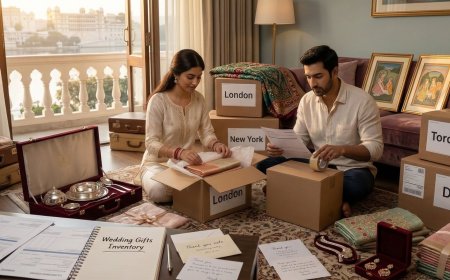
The Kasavu saree is the centrepiece, and for NRI families it must be sourced specifically — a generic cream saree from a British or Canadian department store is not a Kasavu saree. The genuine Kasavu saree is woven in Kerala, specifically in the weaving centres of Balaramapuram near Thiruvananthapuram and Chendamangalam near Ernakulam, and its gold zari border is a specific weaving tradition that produces a particular lustre and drape. For NRI families, there are three reliable sourcing routes. The first and most meaningful is to have the groom's family in Kerala select and purchase the saree from a reputable Kerala saree shop and carry it to the diaspora city when travelling for the wedding — the saree arriving in someone's hand luggage from Kochi carries a significance that no courier can replicate. The second route is online purchase from established Kerala saree retailers who ship internationally — several reputable Kerala saree brands have international shipping and offer authentic Kasavu sarees in cotton, silk-cotton blend, and pure silk varieties. Order at least six to eight weeks before the wedding to allow for shipping, customs, and any replacement if needed. The third route is diaspora city sourcing — in London, Southall and Wembley have several saree shops that stock Kasavu sarees, though the selection is more limited than what is available directly from Kerala. In the San Francisco Bay Area, the Fremont and Sunnyvale Indian saree stores that serve the large South Indian community carry Kasavu sarees. In Toronto, the Gerrard Street East shops and the Brampton saree stores stock them. In Dubai, the textile shops in Meena Bazaar and Bur Dubai carry Kerala sarees reliably.
The complete Pudamuri set beyond the saree requires coordination with your pandit or family elder to confirm what your specific community and family tradition includes. The standard items — blouse piece, bangles, flowers, kumkum, chandanam, betel leaves, and fruits — are all available at Indian grocery and puja supply stores in every major diaspora city. Fresh jasmine flowers for the bride's hair are the one item that requires specific sourcing — South Indian grocery stores and florists in diaspora cities with large Tamil and Malayali communities often stock jasmine garlands. In London, Southall florists carry jasmine during South Indian wedding season. In the San Francisco Bay Area, Fremont florists serving the South Indian community stock them. Confirm availability one week before the wedding and order specifically.
The ceremony space abroad requires almost no special arrangement. Pudamuri is traditionally held at the bride's home or family residence — a living room, a hotel suite if the family is staying in one, or even a dedicated room at the wedding venue set aside for the purpose. What the space needs is a clean, private area with seating for both families, a surface for presenting the gifts, and ideally a small puja lamp or nilavilakku (traditional Kerala brass oil lamp) lit in the corner to consecrate the space. A nilavilakku is available at Indian puja supply stores in most diaspora cities and is one of the most beautiful and portable elements of Kerala ritual — worth sourcing for Pudamuri even if no other special items are used.
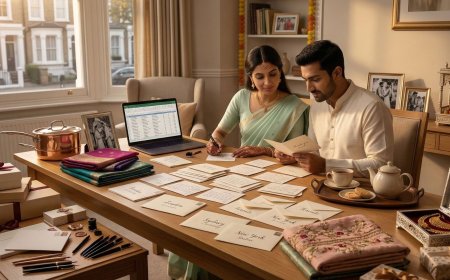
Coordinating the Pudamuri across families in different countries is the most common logistical complexity for NRI couples. In many diaspora weddings, the groom's family is flying in from India or from another diaspora city specifically for the wedding week, and the Pudamuri happens upon their arrival. Confirm the timing of the Pudamuri with both families at least a month in advance — it should not be squeezed into the morning of the wedding as an afterthought. Give it its own time slot, its own space, and its own small gathering. It deserves this.
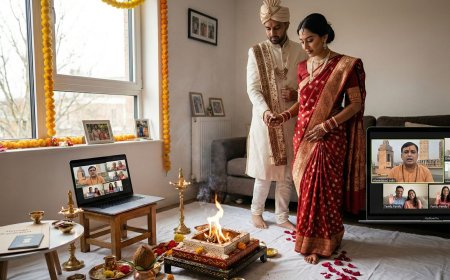
For family in India watching by video call, Pudamuri streams beautifully because it is intimate and visually clear — the saree being unfolded, the bride receiving it with both hands, the groom's mother's face. Begin the stream before the saree is unwrapped so your India-side family sees the full gesture. If your wedding is at a time when the Pudamuri happens the evening before, your family in Thiruvananthapuram will be watching at a reasonable morning or afternoon hour — confirm this timing in advance.
Doing Pudamuri as a Destination Wedding in Kerala
To receive the Pudamuri saree in Kerala — in your grandmother's house in Thrissur or in the tharavad in Palakkad or in a heritage home in Kozhikode — is to feel the ritual the way it was always meant to be felt. The groom's mother arrives with the bundle. The women of both families are gathered. The nilavilakku is lit. The saree is unfolded in the particular light of a Kerala morning — that specific warm, green-filtered light that exists nowhere else on earth.
For destination weddings in Kerala, the Pudamuri typically happens the day before the wedding ceremony, at the bride's family home or at the wedding venue if both families are staying there. The most resonant settings are the traditional tharavad (ancestral family homes) of Palakkad, Thrissur, and Ernakulam — where the high ceilings and tiled floors and courtyard light create the exact atmosphere in which this ritual was designed. Heritage homestays and boutique properties in these regions increasingly cater to NRI couples who want the full Kerala wedding experience, and many have spaces specifically designed for pre-wedding rituals like Pudamuri.
For non-Indian guests attending a Kerala destination wedding, Pudamuri is one of the most accessible rituals to witness — its meaning is immediately legible across cultures. A mother-figure bringing clothes and flowers and welcome to a young woman before the most important day of her life requires no translation. Brief your international guests anyway, because understanding that the Kasavu saree they will see on the bride tomorrow was gifted today, by this woman, in this room, transforms their experience of the wedding day itself.
What You Need: The Pudamuri Ritual Checklist
Ritual Items The Kasavu saree (cream-and-gold Kerala saree — sourced from Kerala, online Kerala retailers, or diaspora saree shops), matching blouse piece, fresh jasmine flowers or garland for the bride's hair, bangles (glass or gold depending on family tradition), kumkum (vermillion powder), chandanam (sandalwood paste), betel leaves and betel nuts (available at Indian grocery stores), fresh fruits (banana and coconut traditional), a nilavilakku (Kerala brass oil lamp — available at Indian puja stores) with oil and wick, clean white cloth for laying the gifts upon, and a decorated tray or basket for presenting the complete Pudamuri set.
People Required The groom's mother as the primary gift-giver (her role is non-negotiable — this is her moment as much as the bride's), senior female relatives from the groom's family, the bride's mother and senior female relatives from the bride's family, the bride herself, and optionally a family elder or priest to offer a brief blessing prayer over the gifts before they are presented. A photographer is strongly recommended — the Pudamuri gifting moment produces some of the most intimate and beautiful photographs of the entire wedding week.
Preparation Steps Source and confirm the Kasavu saree at least six to eight weeks before the wedding. Assemble the complete Pudamuri set at least one week before. Confirm the ceremony timing with both families at least one month before. Set up the ceremony space the morning of the Pudamuri with the nilavilakku, white cloth, and decorated tray. Brief the photographer on the ritual sequence the day before. Set up the India video call connection thirty minutes before the ceremony begins.
NRI.Wedding connects Malayali couples abroad with verified Kasavu saree suppliers, Kerala ritual item vendors, and wedding photographers experienced in capturing the intimate beauty of pre-wedding rituals like Pudamuri. Begin planning at NRI.Wedding.
5 Questions NRI Couples Always Ask
The groom's family is in Kerala and cannot travel abroad for the wedding. Can Pudamuri still happen?
Yes, and many NRI families handle this with a combination of physical and virtual presence that, far from diminishing the ritual, sometimes makes it more moving. The groom's family in Kerala selects and purchases the Kasavu saree and Pudamuri set, and carries or ships it to the diaspora city — ideally carried in person by the closest available family member travelling for the wedding, but shipped if necessary. The formal Pudamuri ceremony can then happen with the family members who are present, with the groom's mother participating via video call — her face visible on a tablet placed in the room, her words heard during the gifting. Many families have found that this arrangement, though born of necessity, produces one of the most emotionally resonant moments of the entire wedding week. The groom's mother watching from Ernakulam as the saree she selected is received by the bride in Toronto is not a lesser Pudamuri. It is a different one, and sometimes a more powerful one.
My partner is not Indian. How do we incorporate Pudamuri meaningfully into a cross-cultural wedding?
Pudamuri is one of the most universally legible Kerala wedding rituals for non-Indian partners and families, because its gesture — a mother welcoming a young woman into her family through the gift of beautiful clothes — translates immediately across cultures. For a cross-cultural wedding, the most natural approach is to perform the full Pudamuri as it is traditionally done, with a brief English explanation for the non-Indian family present — what the Kasavu saree represents, why the groom's mother is the one giving it, what the bride's two-handed receiving means. Many non-Indian mothers-in-law have participated in or witnessed Pudamuri and found it deeply moving. Some NRI couples also incorporate a reciprocal gesture — the bride's family presenting the groom with a traditional garment from their own cultural tradition — which creates a beautiful symmetry and honours both heritages simultaneously.
How do we find an authentic Kasavu saree in the UK with only three weeks to go?
Three weeks is tight but manageable. Your first call should be to the South Indian saree shops on Southall Broadway and in Wembley — call ahead and ask specifically for Kasavu sarees, as not every shop stocks them and you do not want to make the journey for nothing. Your second option is overnight or express international shipping from Kerala — several established Kerala saree brands offer international express shipping that can reach the UK within five to seven business days. Your third option is to ask within the Malayali community network in your city — it is not uncommon for Malayali families in diaspora cities to own multiple Kasavu sarees and to lend or gift one for a wedding in the community. Post in the Malayali association WhatsApp groups or Facebook groups in your city and you may be surprised by the generosity that arrives. NRI.Wedding's vendor directory includes Kerala saree suppliers who ship internationally with short lead times.
Should Pudamuri happen before the Mehendi, before the Seemantham, or at a separate time? What is the correct sequence?
The traditional placement of Pudamuri is one to three days before the wedding ceremony — typically after the Nichayathartham (engagement) and before the wedding day itself. In the context of a multi-day NRI wedding that includes Mehendi, Seemantham (the Malayalam baby shower, if relevant), and other pre-wedding functions, Pudamuri typically happens on the morning or evening before the wedding day, separate from the Mehendi which is a celebratory social event. The guiding principle is that Pudamuri should have its own time and space — it should not be squeezed between other events or treated as an add-on. Your pandit or family elder can advise on the specific sequence that is correct for your family's community tradition. When in doubt, give Pudamuri the morning before the wedding — when the house is quieter, the gathering is smaller, and the weight of what is about to happen is already present in the room.
We want to include the Pudamuri saree in our wedding photographs in a meaningful way. Any suggestions?
The Pudamuri saree produces some of the most beautiful wedding photographs precisely because it bridges the pre-wedding and wedding day. Brief your photographer specifically on the Pudamuri ceremony so they capture the key moments: the saree being unfolded from its wrapping, the groom's mother presenting it, the bride receiving it with both hands, and the moment the saree is held up or draped — that first glimpse of gold zari against cream silk. On the wedding day itself, ask your photographer to capture the bride in the Pudamuri saree with the groom's mother — the two of them together, the saree now worn — which completes the visual story of the gift. Some photographers incorporate a flat-lay of the complete Pudamuri set before the ceremony begins, which is a beautiful detail shot. The story of the Pudamuri told across three or four photographs — the gift, the receiving, the wearing — is one of the most emotionally complete visual narratives in any Kerala wedding album.
The Emotional Angle
Nobody prepares the groom's mother for what it feels like to carry the Pudamuri saree to the bride's home. She has been thinking about this moment for longer than she will admit — since the day her son told her about this woman, perhaps, or since the day she met the bride for the first time and understood, in the particular way that mothers understand things, that this was the one.
She chose the saree herself. She went to the shop in Ernakulam or Thrissur and she stood in front of the rows of Kasavu sarees and she held several up to the light and she thought about the woman her son loves and what colour of gold would suit her and whether cotton or silk would be more comfortable in the climate of whatever country they are in. She made this decision alone, or with her own mother, or with her daughters — but it was her decision, and she made it with the full weight of what it meant.
She is carrying the saree now in a bag on the plane to Toronto or London or Dubai, because she did not trust it to checked luggage and she did not trust it to a courier and some things you simply carry yourself. She has it in the overhead bin. She checks on it twice during the flight. Her husband tells her it is a bag, not a child. She does not dignify this with a response.
And when she unwraps it in the bride's home — when she holds it out with both hands and the bride receives it with both hands and their eyes meet over the gold border — something passes between two women that has nothing to do with fabric. It is the oldest welcome in the world. It is a mother saying to a woman who is about to become her daughter: I chose this for you. I thought about you. I wanted it to be right.
It is right. It was always going to be right. She made sure of it.
A Moment to Smile
At a Kerala Hindu wedding in Houston in the spring of 2023, the Pudamuri ceremony was proceeding with great beauty when the groom's grandmother — eighty-one years old, sharp as a new pin, and the acknowledged authority on all matters of Kerala tradition in the entire extended family — examined the Kasavu saree that had been purchased and declared, after a very long pause, that the zari border was slightly narrower than it should be.
The room went very quiet.
The groom's mother, who had spent three weeks sourcing this saree and carried it in her hand luggage from Kochi, took a breath that contained an entire autobiography.
The bride, who had been watching this exchange with wide eyes, leaned forward and looked at the saree closely. Then she looked up at the grandmother. "Ammachi," she said, using the Malayalam word for grandmother, "it is the most beautiful saree I have ever seen."
The grandmother looked at the bride for a long moment. Then she looked at her grandson. Then she nodded once, slowly, and said: "The border is fine."
The groom's mother has told this story at every family gathering since. The bride is her favourite person in the world. The grandmother's approval, when it finally came, was worth every millimetre of zari border.
Quotes from the Diaspora
"I carried the Pudamuri saree from Thiruvananthapuram to Melbourne in my hand luggage. My husband said I was being dramatic. When I placed it in her hands and saw her face, I thought: no. This is exactly the right amount of care. There is no such thing as too much care for this moment." — Leela Menon, Nair community, mother of the groom, Melbourne, Australia
"I did not expect to cry at the Pudamuri. I had been so practical about everything — the venue, the catering, the guest list. But when his mother unfolded that saree and it was exactly the right gold — the Kerala gold, the gold I grew up with — I understood that she had thought about me. She had thought about what I would love. I was not ready for that." — Anjali Krishnakumar, Namboothiri Brahmin community, Toronto, Canada
"My fiancé is from England. His mother participated in our Pudamuri — she stood beside my future mother-in-law and watched the saree being presented. Afterward she said to me: 'I wish we had something like this.' I told her: you can be part of ours. She was. She is in every photograph. She cried more than anyone." — Devika Pillai, Nair community, London, UK
Your Roots Travel With You
She carried the saree in her hand luggage from Kochi to Toronto. She sourced the jasmine from a Tamil florist in Scarborough who had to order it specially. She polished the nilavilakku the night before until it gleamed in the way that only a properly polished Kerala lamp gleams — warm and steady and completely itself.
And when she held out the Kasavu saree with both hands and you received it with both hands and the gold zari caught the light of a Canadian morning that looked nothing like Kerala and felt exactly like it — you understood what Pudamuri is. It is not a gift of clothes. It is a gift of belonging. It is a woman saying: before you even arrive, you are already ours.
NRI.Wedding is here for every fold of that journey — from connecting you with authentic Kasavu saree suppliers to sourcing your nilavilakku and jasmine, from planning your pre-wedding ritual timeline to finding photographers who know that the most intimate frames of any Kerala wedding are taken before the ceremony even begins.
Your roots traveled with you. Today, they dressed you for the rest of your life.
This article explores Pudamuri, the sacred pre-wedding ritual of gifting new clothes in Kerala Hindu weddings, its cultural and spiritual significance across Nair, Namboothiri Brahmin, Syrian Christian, and Mappila communities, and its practice among Malayali NRI communities in Toronto, London, Houston, Melbourne, and Dubai — offering complete practical guidance and emotional depth for diaspora couples honouring this intimate tradition abroad.
What's Your Reaction?
 Like
0
Like
0
 Dislike
0
Dislike
0
 Love
0
Love
0
 Funny
0
Funny
0
 Angry
0
Angry
0
 Sad
0
Sad
0
 Wow
0
Wow
0