
































































Resort Buyouts vs. Scattered Accommodations: Pros and Cons for NRI Wedding Couples
The accommodation strategy you choose for your Indian wedding does not just determine where guests sleep — it shapes the social dynamics, logistical complexity, financial structure, and overall guest experience of your entire celebration. This comprehensive guide gives NRI couples the complete analytical framework to decide between a full resort buyout, a scattered accommodation model, or the intelligent hybrid strategy that works best for most large Indian weddings. From financial structures and negotiation tactics to family allocation politics, risk distribution, and guest communication strategy, this is the most detailed accommodation planning resource available for NRI couples planning large Indian weddings from abroad.


The Decision That Shapes Everything Else
You have found the venue.
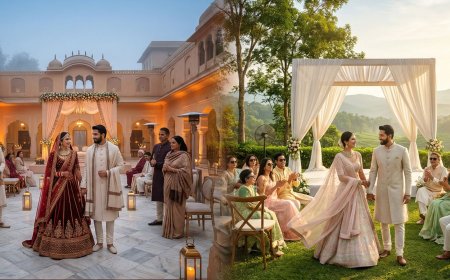
It is perfect. A boutique heritage resort in Udaipur, sitting on the edge of a lake, with architecture that makes every photograph look like it was shot for a luxury travel magazine. The lawns are immaculate. The function spaces are exactly what you imagined. The catering team has an extraordinary reputation. Your lighting designer visited last month and came back with seventeen pages of notes and barely contained excitement.
And then the resort coordinator sends you the buyout proposal.
The entire property — all forty-two rooms, all function spaces, all dining facilities, all recreational areas — exclusively yours for four nights. No other guests. No strangers wandering through your mehendi. No unfamiliar faces at breakfast. Complete privacy, complete control, complete exclusivity.
The number at the bottom of the proposal is significant. Not outrageous for what is being offered, but significant. And it raises an immediate question that you have not fully thought through yet.
Is a resort buyout actually the right choice for your wedding? Or would a smarter, more flexible accommodation strategy — your close family in the resort, other guests distributed across nearby hotels of varying price points — deliver a better overall experience for everyone, at a cost structure that makes more financial sense?
This is one of the most consequential and least discussed decisions in large Indian wedding planning. The accommodation strategy you choose does not just determine where people sleep. It shapes the social dynamics of your entire wedding, the logistics of every function, the financial structure of the overall budget, the experience of guests at every price point, and the degree of control you have over every element of the celebration.
For NRI couples planning Indian weddings from abroad, this decision carries even greater weight. You are coordinating guests traveling from multiple countries, managing family groups with different budgets and different expectations, and trying to create a coherent, connected wedding experience across a guest list that spans generations, geographies, and lifestyle preferences. The accommodation strategy is the physical infrastructure within which all of that human complexity either coheres or fractures.
This guide gives you the complete, honest, deeply practical analysis of resort buyouts versus scattered accommodations — covering financial structures, social dynamics, logistical implications, family management considerations, and the specific factors that should drive your decision for your specific wedding.
The Core Reality: What This Decision Actually Determines
Before the financial analysis and the logistical framework, it is worth understanding the full scope of what the accommodation strategy decision actually affects. It is broader than most couples initially appreciate.
Guest experience cohesion. When all or most of your wedding guests are staying in the same property, the wedding becomes a continuous, immersive experience rather than a series of discrete events. Guests encounter each other at breakfast, by the pool, in the corridors. Relationships form and deepen across the full duration of the stay rather than only during formal function hours. The wedding becomes a shared residential experience — which is a fundamentally different and often more memorable social event than a series of attended functions.
Logistical simplicity versus complexity. A resort buyout consolidates your entire guest accommodation, transportation, and hospitality operation into a single managed environment. Scattered accommodations distribute that operation across multiple properties with different standards, different contacts, different check-in procedures, and different logistical requirements. The difference in coordination complexity is substantial.
Financial concentration versus distribution. A resort buyout concentrates a large accommodation spend into a single negotiated contract, which creates leverage for rate negotiation, included services, and contractual protections. Scattered accommodations distribute spend across multiple vendors, reducing individual negotiating leverage but potentially reducing total accommodation cost for guests at lower price points.
Control over the environment. A bought-out resort is entirely yours — every space, every staff member, every operational decision during your stay is oriented toward your wedding. A partially occupied resort or a collection of separate hotels involves sharing environments with other guests whose presence and behavior you cannot control.
Family and social dynamics. The accommodation strategy determines who is proximate to whom across the duration of the wedding stay. Proximity creates connection — and sometimes friction. The decision about who stays where is not purely logistical. It is a social and family management decision with real implications for the dynamics of your wedding week.
The Case for a Resort Buyout: Where It Wins Completely
Complete Environmental Control
When you buy out a resort, you own the environment entirely for the duration of your stay. There are no other guests wandering through spaces that are set up for your functions. There are no strangers at the breakfast buffet. There is no competition for pool loungers or restaurant tables. Every member of staff on property during your stay is focused entirely on your wedding and your guests.
For NRI couples hosting guests from abroad who may be unfamiliar with India's destination wedding landscape, this controlled environment provides a level of hospitality consistency and predictability that scattered accommodations across multiple properties simply cannot replicate. You can guarantee the standard of every guest's accommodation experience because it is all happening within a single managed environment under a single contract.
Seamless Function Integration
When your guests are sleeping where your functions are happening, the logistical complexity of wedding day operations reduces dramatically. There is no guest transportation to coordinate between accommodation and venue. No arrival anxiety about coaches being late or guests getting lost on unfamiliar roads. No timeline pressure created by the travel time between where guests are staying and where the wedding is happening.
Guests can retreat to their rooms between functions, change outfits at leisure, rest before the evening's celebration, and return to the function space without any of the logistical friction that distributed accommodation creates. This is particularly valuable for elderly guests, for guests with young children, and for the immediate family members whose wedding day schedule is most demanding.
The Immersive Wedding Experience
This is the intangible but deeply real advantage of a resort buyout that no financial analysis fully captures.
When forty or sixty or eighty guests share a beautiful property exclusively for three or four days, something happens socially that transcends the formal wedding functions. Conversations happen by the pool that would never happen in a banquet hall. Relationships between families that have only met formally begin to develop naturally over shared breakfasts. Your college friends from Toronto and your cousins from Chennai discover each other's company over evening drinks in the resort garden. The wedding stops being a series of events and becomes a shared experience — a memory that lives in the full sensory richness of a place rather than in the highlight reel of individual function photographs.
For NRI couples who are trying to create a wedding that genuinely brings together the different worlds of their lives — their international networks, their Indian family, their childhood friends, their professional relationships — the resort buyout creates the physical conditions for that integration to happen naturally and completely.
Negotiating Power and Inclusive Value
A full resort buyout represents a significant guaranteed revenue commitment to the property. This creates substantial negotiating leverage that savvy NRI couples can use to extract considerable included value from the buyout contract.
Negotiate aggressively for included meals across the stay — breakfasts, lunches, welcome dinners, farewell brunches. Negotiate complimentary room upgrades for immediate family. Negotiate included spa access, recreational facilities, and activity programming. Negotiate flexible check-in and late check-out to accommodate international guests with long travel itineraries. Negotiate a dedicated wedding coordinator from the resort team who is accountable for the property's contribution to your wedding experience.
When all of these inclusions are properly negotiated and their value is factored into the total cost comparison, the effective cost per guest of a resort buyout often compares more favorably against scattered accommodation alternatives than the headline buyout figure initially suggests.
The Case Against a Resort Buyout: Where It Creates Problems
Capacity Constraints and Guest List Pressure
The most fundamental limitation of a resort buyout is also the most obvious: the property has a fixed room count. If your guest list exceeds the resort's accommodation capacity — which is frequently the case for large Indian weddings with 200 or more guests — a buyout covers only a portion of your total accommodation requirement regardless of the financial commitment.
This creates an immediate hierarchy problem. Who stays in the resort and who is accommodated elsewhere? This decision, which is at its heart a social and family management decision, becomes one of the most politically sensitive elements of the entire wedding planning process. Managing family expectations around accommodation allocation at a bought-out resort requires more diplomatic skill and more explicit communication than most couples anticipate.
Financial Concentration Risk
A resort buyout contract typically involves significant advance payment commitments and strict cancellation terms. You are concentrating a large financial exposure into a single vendor relationship governed by a single contract.
If the resort experiences operational issues — ownership changes, renovation disruptions, staffing problems, or force majeure events — your entire accommodation infrastructure for the wedding is affected simultaneously. Distributed accommodation across multiple properties provides natural risk distribution — a problem at one property affects some guests but not all.
Not Every Guest Wants the Immersive Experience
The continuous, communal nature of a resort buyout that creates such a powerful social experience for couples who embrace it can feel claustrophobic or overwhelming for guests who prefer more privacy and independence in their accommodation.
Some guests — particularly older family members accustomed to independent travel, or friends who do not know other guests well — may find the intensity of a shared residential wedding experience more demanding than enjoyable. A scattered accommodation model that gives guests the choice of proximity or independence accommodates this diversity of preference more flexibly.
Geographic Limitations
Not every destination wedding market has a single property with sufficient accommodation capacity, appropriate quality standards, and the right spatial configuration for a full resort buyout. Forcing a buyout model onto a property that is not truly suited to it — whether because of capacity, layout, or quality — produces a worse outcome than a well-managed scattered accommodation strategy centered on a strong primary property.
The Case for Scattered Accommodations: Where It Wins
Budget Flexibility Across Your Guest Profile
A large Indian wedding guest list almost always spans a significant range of financial circumstances. Immediate family, close friends, and international guests may be entirely comfortable with premium accommodation at the primary venue. More distant relatives, older guests on fixed incomes, or younger guests with limited travel budgets may find premium resort rates a genuine financial burden.
A scattered accommodation strategy allows you to match accommodation to guest profile — placing your immediate family and VIP guests in the primary property closest to the venue, and offering genuinely appropriate alternatives at accessible price points for guests whose circumstances call for them. This is not a compromise — it is genuine hospitality that considers the actual needs of your actual guest list.
Risk Distribution
As noted above, distributing accommodation across multiple properties distributes risk. No single property failure affects your entire guest accommodation infrastructure. This provides meaningful protection for a high-stakes event where accommodation disruption could cascade into function disruption.
Access to Specialist Properties for Different Guest Groups
A scattered accommodation strategy can be used intentionally to match different guest groups with accommodation that genuinely suits their preferences and requirements. Your international guests in a property with strong international hospitality standards and English-speaking staff. Your elderly relatives in a property with elevator access, ground-floor rooms, and proximity to medical facilities. Your younger guests in a more energetic, social property with active bar and recreational facilities.
This intentional matching of guest groups to appropriate properties is a sophisticated hospitality strategy that a single buyout property — however excellent — cannot fully replicate.
The Intelligent Hybrid: The Strategy Most NRI Couples Should Consider
For the majority of large NRI weddings, the most effective accommodation strategy is neither a pure resort buyout nor a fully scattered approach. It is an intelligent hybrid that captures the primary benefits of both.
The hybrid framework:
Negotiate a partial buyout or a large room block at your primary wedding venue property — covering your immediate family, your wedding party, your international guests, and your closest friends. This creates the immersive core experience for the people whose connection and proximity matters most to the wedding's social success.
Simultaneously, establish negotiated room blocks at two or three carefully selected nearby properties at different price points — a strong secondary property for guests who want comfort and quality without the premium of the primary venue, and a solid mid-range option for guests whose budget requires it.
Provide a clear, honest, well-communicated accommodation guide to your guests that explains the options available, the proximity of each to the wedding venue, the price points, and the booking process. Give guests genuine choice rather than imposing a single solution.
Manage the transportation between all properties and the venue as a coordinated system — with scheduled shuttle services that eliminate the logistical burden from guests while maintaining the connection between the distributed accommodation network and the central wedding experience.
This hybrid approach captures the social magic of a core immersive group while respecting the diversity of your guest list and distributing financial and logistical risk intelligently.
Common Mistakes NRI Couples Make in Accommodation Planning
Making the Buyout Decision Based on Aspiration Rather Than Analysis Resort buyouts are aspirationally appealing — the idea of owning an entire beautiful property for your wedding week is genuinely exciting. But the decision must be driven by honest analysis of your guest count, your guest profile, your budget structure, and whether the specific property is genuinely suited to the buyout model. Aspiration without analysis leads to expensive mismatches.
Underestimating the Allocation Politics If your resort buyout cannot accommodate your full guest list, the allocation of who stays in the resort and who stays elsewhere will generate family politics that require explicit, proactive management. Have this conversation early, establish clear and defensible allocation criteria, and communicate decisions directly and personally rather than allowing them to be discovered indirectly.
Not Negotiating Inclusions Aggressively Enough The headline buyout rate is a starting point, not a final offer. NRI couples frequently accept the initial proposal without negotiating the inclusions — meals, spa access, room upgrades, late checkout, dedicated staff — that can substantially increase the value of the buyout contract. Always negotiate.
Choosing Scattered Properties Without Coordinating Transportation Distributed accommodations without a coordinated shuttle system create a logistical burden that falls on individual guests — particularly problematic for elderly guests, international guests unfamiliar with local transportation, and guests with young children. If you choose a scattered model, the transportation system is not optional.
Not Reading Cancellation Terms Carefully Resort buyout contracts carry significant cancellation penalties. The standard industry terms may expose you to losing a substantial deposit if circumstances require cancellation or date change. Have every buyout contract reviewed by a legal professional and negotiate cancellation terms explicitly before signing.
Emotional and Cultural Insight: Accommodation as Hospitality
In Indian culture, the hosting of guests is not a logistical function — it is an expression of love, respect, and family pride. The quality of accommodation you arrange for guests who have traveled significant distances to celebrate with you is experienced by those guests as a direct reflection of how much their presence is valued.
This cultural dimension makes the accommodation strategy decision not just a logistical and financial one but a deeply personal and relational one. The NRI couple who thinks carefully about each guest group's needs, who matches accommodation to those needs with genuine attention, and who communicates options with warmth and clarity — that couple is practicing hospitality in its fullest Indian sense.
Whether that takes the form of a resort buyout that envelops every guest in a shared luxury experience, or a thoughtfully curated set of accommodation options that genuinely serves a diverse guest list — what matters is the intentionality and the care behind the decision.
Accommodation Planning Checklist for NRI Couples
Research and Assessment
- Assess primary venue property room count against total guest accommodation requirement
- Identify all accommodation properties within practical distance of venue
- Research quality standards, accessibility, and price points of all options
- Request rate proposals and minimum night stay requirements from all properties
Decision Framework
- Calculate full cost comparison between buyout and hybrid models including negotiated inclusions
- Assess guest list profile for accommodation preference and budget diversity
- Evaluate primary property suitability for buyout model specifically
- Identify allocation criteria for primary property rooms if buyout does not cover full guest list
Negotiation and Contracting
- Negotiate all inclusions aggressively before accepting any proposal
- Review all cancellation terms with legal professional
- Establish room block agreements with secondary properties for hybrid model
- Confirm accessibility requirements are met across all selected properties
Guest Communication
- Prepare comprehensive accommodation guide for all guests
- Communicate allocation decisions personally and early
- Provide booking links and deadlines for all accommodation options
- Distribute transportation schedule between accommodation properties and venue
Logistics
- Plan coordinated shuttle system between all accommodation properties and venue
- Confirm shuttle timing against function schedules for all wedding days
- Assign accommodation coordinator responsibility to specific team member
- Establish direct contact with accommodation manager at each property
The Accommodation Decision That Serves Your Wedding Best
There is no universally correct answer to the resort buyout versus scattered accommodations question. There is only the answer that is correct for your specific wedding — your guest count, your guest profile, your venue, your budget structure, your family dynamics, and your vision for the kind of experience you want to create.
What this guide has given you is the analytical framework to make that decision with complete clarity — understanding not just the financial implications but the social, logistical, and experiential dimensions that determine whether your accommodation strategy enhances or complicates your wedding.
The couples who get this right are the ones who approach the decision with honest analysis rather than aspiration, who consider their guest list as a community of real people with real needs rather than an abstract headcount, and who build an accommodation strategy that serves every guest's experience with the same genuine care they brought to every other element of the wedding.
That is the standard your wedding deserves. And with the right accommodation strategy behind it, every guest who traveled to be with you will arrive, settle, and celebrate with the comfort and ease that makes the entire experience — from first check-in to final farewell — feel like the extraordinary occasion it truly is.
What's Your Reaction?
 Like
0
Like
0
 Dislike
0
Dislike
0
 Love
0
Love
0
 Funny
0
Funny
0
 Angry
0
Angry
0
 Sad
0
Sad
0
 Wow
0
Wow
0