




















































Under ₹50,000 Bridal Lehenga in Delhi — Real Shops, Real Options: The Complete NRI Guide
Built the wedding budget spreadsheet with fifty thousand rupees on the bridal lehenga line and wondering whether that number can actually buy the genuine ceremony-appropriate piece in Delhi — or whether the research is going to tell you it cannot? This complete NRI guide delivers the real addresses, the honest quality calibration, and the specific assessment skills that make the under-fifty-thousand genuine bridal lehenga findable rather than theoretical. Learn why GK-1 M-Block's outer ring boutiques are the primary address for the craftsperson-embroidered ceremony lehenga at this budget, why the CP inner circle boutiques serve the same quality level with the metro-accessible central location advantage, why the Nai Sarak fabric plus Greater Kailash tailor combination produces the genuine bridal lehenga at twenty-three to thirty-five thousand rupees leaving the remainder for the dupatta and accessories, and why the Mehrauli outlet visit belongs before the boutique shopping because the occasional previous-season designer piece makes the boutique the fallback. Understand the quality assessment protocol that separates the craftsperson's embroidery from the production line at this price point, the complete-set budgeting that prevents the dupatta from taking the total above the ceiling, and the bundle negotiation that achieves the most significant reduction. Understand the five mistakes that cost NRI brides the most at this budget level.

Under ₹50,000 Bridal Lehenga in Delhi — Real Shops, Real Options: The Complete NRI Guide
The number had been in the spreadsheet since the beginning.
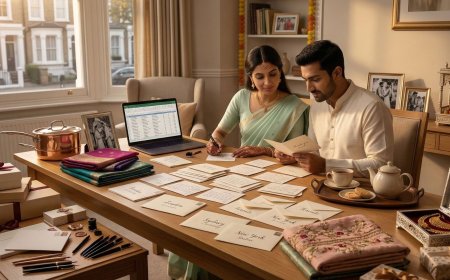
Divya had built the wedding budget spreadsheet on a Sunday afternoon in February — the specific, this-is-the-beginning-of-the-serious-planning Sunday that arrives a few months after the engagement when the pleasant, everything-is-possible quality of the early planning gives way to the arithmetic. She had allocated the budget across the functions, the venue, the catering, the photography, the invitations, the travel, the accommodation for the families coming from abroad, and the wedding wardrobe.
The bridal lehenga line in the spreadsheet said fifty thousand rupees.
She had arrived at the number through the specific, cross-referenced, multiple-source research of the person who takes the spreadsheet seriously — the Delhi shopping blogs, the NRI wedding planning communities online, the three bridesmaids who had been married in the previous two years whose shopping experiences she had interrogated in detail. The research had confirmed that fifty thousand rupees was a real and achievable budget for the bridal lehenga in Delhi — not the designer piece, not the premium atelier piece, but the genuine, ceremony-appropriate, this-will-be-in-the-photographs-for-fifty-years bridal lehenga at the quality level that the occasion required.
What the research had not confirmed — what she discovered when she arrived in Delhi for the shopping — was where, specifically, the fifty-thousand-rupee genuine bridal lehenga lived in the Delhi market's geography. The research had given her the number. The research had not given her the address.
The first day of the shopping had given her the address of the eighty-thousand-rupee lehenga. The second day had given her the thirty-thousand-rupee lehenga, which was the festive piece rather than the ceremony piece — the embroidery was the production-line embroidery rather than the craftsperson's embroidery, and she had identified the difference because the bridal lehenga guide in this series had told her what to look for. The thirty-thousand-rupee piece was beautiful. It was not the ceremony piece.
The forty-five-thousand-rupee piece — the ceremony-appropriate piece at the budget level the spreadsheet had allocated — was in the third boutique on the third day. She had found it because the coordinator she had engaged for the shopping trip had taken her to the specific address that the research had not produced.
This article is that address — the specific, real, named market sections and boutique types in Delhi where the genuine, ceremony-appropriate bridal lehenga under fifty thousand rupees actually lives, for the NRI bride whose spreadsheet has the right number and who deserves to know where that number's piece is.
The Under Fifty Thousand Reality: What Is and Is Not Possible
Before the addresses can be given, the honest calibration must be set — because the under-fifty-thousand-rupee bridal lehenga is a real and achievable purchase, and the NRI bride who arrives with the correct expectations will find it, and the NRI bride who arrives with the incorrect expectations will either overspend or underbuy.
What is possible at under fifty thousand rupees in the current Delhi market: the genuine ceremony-appropriate bridal lehenga with the quality retail embroidery — the embroidery above the production line, done by the craftsperson rather than the machine, at the density and the evenness that the boutique quality standard requires — in the silk or the silk-blend fabric at the boutique's quality fabric standard, with the construction quality that the ceremony's photographic scrutiny will sustain. This piece exists. It is not the designer piece. It is not the atelier piece. It is the genuine, well-made, ceremony-appropriate bridal lehenga at the quality retail level that the under-fifty-thousand budget correctly funds.
What is not possible at under fifty thousand rupees: the zardozi embroidery at the craftsperson density that the premium atelier produces over days; the sourced-from-the-specific-weaver Banarasi tissue silk whose cost alone approaches the budget's ceiling; the designer name that the social signal requires; the heavy Kundan work at the stone-and-setting quality of the premium jewellery ateliers. These elements belong at the one-and-a-half-lakh-and-above price point and are not available at the under-fifty-thousand level in the genuine form.
The NRI bride who understands this calibration — who is shopping for the genuine quality retail piece rather than the designer piece at the quality retail price — will find the under-fifty-thousand bridal lehenga satisfying, beautiful, and ceremony-appropriate. The NRI bride who is shopping for the designer piece at the under-fifty-thousand price will find the market's offerings disappointing because she is looking for something the budget cannot produce.
The Quality Assessment at This Price Point: What to Look For
The under-fifty-thousand bridal lehenga requires the quality assessment skill that the Banarasi saree guide and the bridal lehenga guide in this series have introduced — because at this price point, the range between the genuine quality retail piece and the production-line piece dressed up as the quality retail piece is the range that the assessment skill navigates.
The embroidery assessment at this price point: the quality retail embroidery at under fifty thousand rupees is the resham thread embroidery or the moderate zardozi embroidery at the craftsperson's standard, not the production-line worker's standard. The distinction is the evenness of the thread placement — the craftsperson's embroidery has the specific, slight, each-stitch-slightly-different irregularity that the handwork produces; the production-line embroidery has the specific, mechanical, each-stitch-identical regularity that the volume production requires. Paradoxically, the slight irregularity is the quality signal and the perfect regularity is the production-line signal, because the handwork's slight variation is the evidence of the human hand rather than the machine's consistency.
The fabric assessment at this price point: the silk or silk-blend fabric at the under-fifty-thousand quality retail level is not the sourced-from-the-specific-weaver fabric that the premium atelier's piece uses. It is the quality market silk — the silk purchased from the quality wholesale market rather than the weaver's direct — whose quality is above the synthetic approximation and below the premium weaver's specific standard. The assessment is the weight and the drape: the quality market silk has the weight and the drape of the genuine silk, not the flat, slightly plastic quality of the synthetic. The burn test on the loose thread confirms the genuine silk.
The construction assessment at this price point: the hem finishing, the internal lining quality, the seam allowance, and the zip installation are the construction indicators that distinguish the quality retail piece from the production-line piece at the price range where the surface embroidery can disguise the underlying construction quality. The under-fifty-thousand NRI bride should turn the lehenga inside out in the boutique and look at the lining, the seam finishing, and the hem before the outside's embroidery makes its impression.
The Specific Delhi Addresses: Where the Under-Fifty-Thousand Bridal Lehenga Lives
GK-1 M-Block Market: The Primary Address
Greater Kailash Part One's M-Block market is the primary address for the under-fifty-thousand bridal lehenga in Delhi — the specific, established, South Delhi neighbourhood market where the boutiques whose price positioning occupies the twenty-five-thousand to seventy-five-thousand rupee range have been serving the Delhi bride and the NRI bride for two to three decades.
The GK-1 M-Block bridal lehenga in the under-fifty-thousand range is the quality retail piece — the boutique piece with the design consideration, the craftsperson embroidery, and the quality fabric that distinguishes the boutique from the market. The boutiques in this market have the fitting room, the staff who know the collection, the alteration service, and the repeat customer relationship that the boutique model requires.
The specific walk in GK-1 M-Block for the under-fifty-thousand bridal lehenga: the outer ring of the M-Block market contains the boutiques whose bridal range includes the under-fifty-thousand ceremony piece. The walk of the outer ring in a single morning — beginning at the north end and moving clockwise — covers the bridal boutiques in the order that allows the price and quality comparison. The boutique that shows the forty-five-thousand-rupee piece with the craftsperson embroidery and the quality silk fabric in the third visit is the boutique that the first visit's benchmark makes assessable.
The GK-1 M-Block boutique's bridal lehenga at under fifty thousand: the deep red and gold combination of the Punjabi bridal palette, the deep burgundy and silver of the North Indian formal palette, the contemporary blush and rose gold of the current season's palette — all available in the craftsperson embroidery at the quality retail level within the budget.
CP Boutiques — Connaught Place Inner Circle: The Second Address
The Connaught Place inner circle boutiques — the specific, centrally located, metro-accessible bridal boutiques that occupy the ground-floor retail of the Connaught Place's inner and middle circles — carry the bridal lehenga in the under-fifty-thousand range in the format that the GK-1 M-Block boutique also serves but with the central location advantage that the South Delhi boutique cannot match.
The CP bridal boutique is particularly accessible for the NRI bride staying in the Connaught Place hotel corridor — the Janpath, the Patel Chowk, the Rajiv Chowk Metro catchment — who can reach the CP boutiques without the South Delhi car journey. The CP boutique's range at under fifty thousand rupees is comparable to the GK-1 M-Block range in quality and price, with the added advantage of the same-day fabric sourcing at the Janpath lane if the dupatta or the trim requires the supplementary purchase.
South Extension Part Two: The Established Mid-Range Boutique Address
The South Extension Part Two market contains the established, reputation-based bridal boutiques whose practice has been built over decades of serving the Delhi bride and whose under-fifty-thousand bridal lehenga is the established quality retail piece rather than the season's boutique launch.
The South Extension Part Two distinction from the GK-1 M-Block: the South Extension boutiques have the longer establishment history and the specific, only-in-this-boutique design vocabulary that the decade-old practice produces. The GK-1 M-Block boutiques are more contemporary in their design orientation. Both serve the under-fifty-thousand bridal lehenga at the quality retail level, and the choice between them is the choice between the established aesthetic and the contemporary aesthetic rather than a quality difference.
The Fabric-Plus-Tailor Route: The Most Cost-Effective Under-Fifty-Thousand Option
The most cost-effective route to the genuine ceremony-appropriate bridal lehenga under fifty thousand rupees in Delhi is the fabric-plus-tailor combination — the Nai Sarak fabric and the Greater Kailash tailor whose combined cost produces the genuine craftsperson-embroidered piece at the quality retail level for fifteen to thirty-five thousand rupees.
The Nai Sarak bridal fabric in the under-fifty-thousand range: the quality market silk at four thousand to eight thousand rupees per metre, plus the embroidered fabric from the Karol Bagh fabric buildings at six thousand to twelve thousand rupees for the skirt panel, plus the net for the overlay at five hundred to two thousand rupees per metre. The total fabric cost for the bridal lehenga's three metres of base fabric and four metres of net overlay: fifteen thousand to thirty-five thousand rupees depending on the quality level.
The Greater Kailash tailor's construction cost for the bridal lehenga: eight thousand to fifteen thousand rupees for the skirt, blouse, and dupatta construction at the bridal quality standard.
Total for the fabric-plus-tailor bridal lehenga: twenty-three thousand to fifty thousand rupees — the range that places the genuine craftsperson-embroidered bridal lehenga at the quality retail standard firmly within the under-fifty-thousand budget.
The fabric-plus-tailor route requires: the tailor appointment made before the Delhi trip; the fabric sourcing on the Nai Sarak and the Karol Bagh visit; the specific design brief communicated to the tailor with the reference photograph; and the two-to-three-week production timeline from the fabric sourcing to the collection. For the NRI bride whose Delhi trip is six to eight weeks before the wedding, the fabric-plus-tailor route is the most cost-effective and the most design-specific of the under-fifty-thousand options.
Lajpat Nagar Upper Range: The Market Tier at the Budget's Lower End
The upper range of the Lajpat Nagar Central Market — the boutique-format shops at the market's premium end rather than the wholesale shops at the market's volume end — carries the bridal lehenga in the thirty-five-thousand to fifty-thousand-rupee range that occupies the boundary between the market quality and the boutique quality.
The Lajpat Nagar upper range bridal lehenga is the piece whose embroidery is above the pure production line but below the GK-1 M-Block boutique's craftsperson standard. It is the appropriate ceremony piece for the budget that has the lower end of the under-fifty-thousand range as its maximum — the thirty-five to forty-five thousand rupee piece that is the genuine bridal lehenga rather than the sangeet piece but that is not the forty-five to fifty thousand rupee boutique quality.
The NRI bride who is shopping in the Lajpat Nagar upper range at this price point should apply the quality assessment — the embroidery's slight irregularity as the craftsperson signal, the inside-out construction inspection, the silk's weight and drape — with the understanding that the Lajpat Nagar upper range contains both the genuine craftsperson piece and the sophisticated production-line piece at this price point, and the assessment is the skill that separates them.
The Colour Question at Under Fifty Thousand: What the Budget Produces
The colour range available at the under-fifty-thousand bridal lehenga price point in Delhi's quality retail market is wider than the NRI bride whose research has been conducted at the luxury end of the market typically expects.
The traditional deep red — the specific, ceremony-appropriate, Punjabi bridal palette's primary colour — is the most widely available and the most reliably produced at the quality retail price. The deep red at the under-fifty-thousand level in the GK-1 M-Block boutique is the genuine deep red — the dye quality, the fabric's colour depth, the embroidery's coordination with the base colour — that the ceremony's photographs require.
The deep burgundy, the deep navy, the deep forest green — the non-red deep palette that the contemporary bride's departure from the traditional red produces — are available at the quality retail level within the budget, though the range within these colours is narrower than the deep red's range because the non-traditional colours occupy a smaller portion of the quality retail market's production volume.
The contemporary lighter palette — the blush, the peach, the dusty rose, the champagne — is available at the under-fifty-thousand level in the GK-1 M-Block and CP boutiques, and the embellishment at this palette's price point is the metallic thread work and the Kundan-style stone work that the lighter fabric's visual character requires rather than the deep-colour fabric's zardozi.
The colours that are not reliably available at this price point in the genuine quality retail form: the specific, heritage palette of the regional bridal tradition — the specific saffron of the Gujarati tradition, the specific yellow of the Bengali tradition, the specific off-white of the South Indian tradition — in the fabric quality and the regional embroidery tradition that the authentic regional piece requires. These pieces belong at the specialist regional textile boutique whose sourcing is the specific regional production rather than the Delhi quality retail market's general range.
The Dupatta at Under Fifty Thousand: Budgeting the Complete Set
The bridal lehenga under fifty thousand is the budget for the lehenga skirt and the blouse. The dupatta — the third element of the bridal lehenga's complete set — is the element whose cost the under-fifty-thousand budget must explicitly plan for, because the dupatta at the ceremony quality level is a separate purchase whose cost the boutique's lehenga price may or may not include.
The dupatta at the boutique quality level to match the under-fifty-thousand lehenga: five thousand to fifteen thousand rupees for the embroidered or embellished dupatta in the coordinating fabric and colour. The boutique that prices the lehenga at forty-five thousand and the dupatta separately at ten thousand has a complete set at fifty-five thousand — above the budget. The boutique that includes the dupatta in the forty-five-thousand lehenga price has the complete set within the budget.
The NRI bride's protocol: confirm whether the dupatta is included in the lehenga price before the negotiation on the lehenga's price begins. The dupatta inclusion is the most significant variable in the under-fifty-thousand budget's complete-set calculation.
The dupatta sourced separately at the Janpath lane — the block-printed or embroidered dupatta in the coordinating colour at two hundred and fifty to two thousand five hundred rupees — is the budget solution that the complete set requires if the boutique's dupatta price takes the set above the fifty-thousand ceiling. The Janpath dupatta at the coordinating colour, carried to the boutique for the colour-match assessment before the purchase, is the practical solution that brings the complete set within the budget.
The Negotiation at This Price Point: What Is Achievable
The under-fifty-thousand bridal lehenga at the GK-1 M-Block and the CP boutique is not the fixed-price retail that the DLF Emporio's designer boutique represents. It is the boutique retail with the negotiation that the boutique model at this price point expects and accommodates.
The realistic reduction achievable through negotiation at this price point: ten to twenty percent on the lehenga alone, fifteen to twenty-five percent if the dupatta and the blouse are negotiated as the complete set. The boutique that quotes forty-five thousand for the lehenga alone will typically settle at thirty-eight to forty thousand for the lehenga with the dupatta and the blouse included if the negotiation is conducted professionally and specifically.
The negotiation that works at this price point: the specific counter-offer rather than the general request for reduction; the complete-set negotiation that bundles the lehenga, dupatta, and blouse as a single transaction; and the alteration inclusion request that converts the alteration cost into the negotiated price rather than the separate post-purchase expense. The boutique that reduces the lehenga price by five thousand and includes the alteration at no additional cost has effectively reduced the total cost by eight to ten thousand rupees — a meaningful reduction at the fifty-thousand budget level.
The Complete Reference Table
| Source | Price Range | Quality Level | Best For | Lead Time | Dupatta Included? | NRI Planning Note |
|---|---|---|---|---|---|---|
| GK-1 M-Block boutiques | ₹25,000–₹70,000 | Quality retail; craftsperson embroidery | Primary recommendation; ceremony lehenga | 3–7 days alteration | Confirm at visit | Best combination of quality and price for NRI |
| CP inner circle boutiques | ₹20,000–₹65,000 | Quality retail | Central location advantage; metro accessible | 3–7 days alteration | Confirm at visit | Accessible without South Delhi car journey |
| South Extension Part Two | ₹30,000–₹80,000 | Established quality retail | Reputation-based buying; established aesthetic | 5–10 days | Confirm at visit | Decade-old boutiques with specific design vocabulary |
| Fabric plus tailor — Nai Sarak and GK tailor | ₹23,000–₹50,000 | Quality retail to premium | Most cost-effective; design-specific | 2–3 weeks production | Tailor-made | Most design control at this budget; tailor appointment before Delhi trip |
| Lajpat Nagar upper range | ₹35,000–₹50,000 | Market quality to lower boutique | Budget's lower end; volume range | 3–5 days alteration | Usually separate | Apply quality assessment carefully; production line present |
| Mehrauli outlet — previous season | ₹20,000–₹50,000 | Designer secondary market | Designer aesthetic at quality retail price | Immediate | Usually separate | Assessment skill essential; defect identification protocol |
| Deep red palette | Available across range | All quality levels | Traditional Punjabi; most reliable range | Per source | Confirm per source | Widest range at this price point |
| Contemporary light palette | ₹30,000–₹50,000 | Quality retail | Contemporary aesthetic; blush; dusty rose | Per source | Confirm per source | Narrower range than deep palette |
| Dupatta separate — Janpath | ₹250–₹2,500 | Coordinating function quality | Budget solution if boutique dupatta overpriced | Immediate | N/A | Bring to boutique for colour match before purchase |
| Alteration inclusion negotiation | Saves ₹3,000–₹8,000 | N/A | All boutique purchases | Adds 3–5 days | N/A | Negotiate alteration inclusion at purchase; not post-purchase |
| Complete set budget planning | ₹40,000–₹50,000 | Lehenga plus dupatta plus blouse | Full bridal set under ceiling | Per source | Budget as complete set | Never budget lehenga alone; dupatta and blouse are the set |
Common Mistakes NRI Brides Make at the Under-Fifty-Thousand Budget Level
The first mistake is not applying the quality assessment and buying the production-line piece at the boutique price. The under-fifty-thousand price point is the price point where the genuine quality retail piece and the sophisticated production-line piece exist in the same market section at prices that are close enough to create the confusion that the quality assessment skill resolves. The NRI bride who does not apply the embroidery assessment — the slight irregularity as the craftsperson signal, the inside-out construction inspection — will pay the boutique price for the market quality piece and will discover the difference in the wedding photographs' scrutiny. The assessment is not the optional element at this price point. It is the essential element.
The second mistake is budgeting the lehenga alone rather than the complete set. The under-fifty-thousand bridal lehenga budget is the complete-set budget — the lehenga, the dupatta, and the blouse together must come within the fifty-thousand-rupee ceiling. The bride who spends forty-eight thousand on the lehenga and discovers that the matching dupatta is twelve thousand additional has spent sixty thousand on the set rather than fifty. The complete-set budget planning — the explicit allocation of the fifty thousand across the three elements before the first boutique visit — is the planning decision that keeps the budget intact.
The third mistake is not considering the fabric-plus-tailor route. The NRI bride whose research has been conducted in the boutique market's framework will typically not think of the Nai Sarak fabric and the Greater Kailash tailor as the bridal lehenga route — because the boutique's finished-garment offer is more immediately accessible and more intuitively connected to the bridal lehenga concept than the fabric-and-construction route. But the fabric-plus-tailor combination at the quality level this budget can fund produces the genuine craftsperson-embroidered piece at twenty-three to thirty-five thousand rupees — significantly below the boutique's forty-five to fifty thousand — leaving the remainder for the dupatta, the blouse, and the accessories. The route requires the tailor relationship and the lead time. It produces the most cost-effective genuine bridal lehenga in Delhi.
The fourth mistake is not negotiating the complete set as a single transaction. The boutique that prices the lehenga separately from the dupatta and the blouse is the boutique whose total set price is negotiable as a bundle in a way that the individual piece prices are less negotiable separately. The NRI bride who negotiates the complete set — the lehenga, the dupatta, the blouse, and the alteration as a single transaction with a single agreed price — achieves the most significant reduction at this price point. The piecemeal negotiation of the individual elements produces smaller reductions than the bundle negotiation.
The fifth mistake is not visiting the Mehrauli outlet before the boutique shopping. The Mehrauli outlet's previous-season designer pieces occupy the twenty-five-thousand to fifty-thousand-rupee range with some regularity — the designer second or the previous-season piece whose primary retail was eighty thousand to one lakh fifty thousand and whose outlet price is within the under-fifty-thousand budget. The NRI bride who visits the Mehrauli outlet with the assessment skill and the open-to-what-is-there mindset may find the designer aesthetic at the quality retail price that the boutique cannot offer. The Mehrauli outlet visit belongs before the GK-1 M-Block boutique visit in the under-fifty-thousand shopping plan — because the outlet's occasional designer-quality piece at this budget makes the boutique's quality retail piece the fallback rather than the primary option.
What Divya Found
The third boutique on the third day was in the GK-1 M-Block outer ring, north end, the specific location that the coordinator had been leading to since the shopping began.
The coordinator had said, before the visit: I have been saving this boutique. I wanted you to have the benchmark from the first two days before you saw this.
Divya had understood. The first day had given her the eighty-thousand-rupee standard. The second day had given her the thirty-thousand-rupee standard. The third day's boutique would give her the comparison.
The boutique owner had shown her five pieces in the forty to fifty thousand rupee range. The fourth piece was the one.
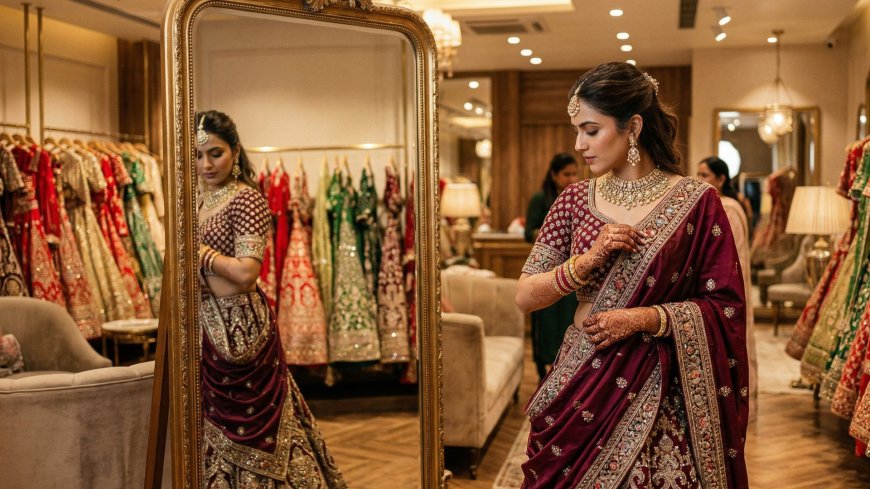
It was a deep burgundy — the specific, wine-dark, this-is-not-quite-red-and-not-quite-purple colour of the burgundy that photographs in its own category of beautiful under the ceremony's golden-hour light. The embroidery was the resham thread work in the gold and the copper — the craftsperson's embroidery, with the slight irregularity that the quality assessment framework had taught her to look for. The fabric was the quality market silk — the weight and the drape that the burn test on the loose thread confirmed was the genuine silk.
She turned it inside out. The lining was clean and even. The seams were finished. The hem was straight.
She looked at the price. Forty-three thousand rupees for the lehenga.
She said: Is the dupatta included?
The boutique owner said: The dupatta is eight thousand separate.
Divya said: I want the lehenga, the dupatta, and the blouse stitched to my measurements. I want the alteration included. I will pay forty-seven thousand for all three.
The boutique owner looked at her.
He said: Forty-eight thousand.
She said: Forty-seven.
He said, with the specific, professional, this-is-the-transaction quality of the person who has agreed: Forty-seven thousand. The blouse will be ready in five days.
Divya called her mother from the lane outside the boutique.
She said the price.
Her mother said: Is the embroidery the craftsperson's or the machine's?
Divya said: The craftsperson's. I looked for the slight irregularity.
Her mother said: Is the fabric the genuine silk?
Divya said: I did the thread test.
Her mother was quiet for a moment.
She said: Then the spreadsheet number was right.
It had been right from the beginning.
The spreadsheet had just needed the address.
Start at the Mehrauli outlet before the boutique shopping — the occasional designer-quality piece at this budget makes the boutique the fallback rather than the only option. Apply the quality assessment at every boutique — the slight embroidery irregularity, the inside-out construction, the silk's weight. Budget the complete set before the first visit, not the lehenga alone. Negotiate the complete bundle — lehenga, dupatta, blouse, alteration — as a single transaction. And consider the fabric-plus-tailor route if the lead time allows, because the most cost-effective genuine bridal lehenga in Delhi is the one that begins at Nai Sarak.
The fifty-thousand-rupee bridal lehenga exists.
It is in the third boutique on the outer ring, north end.
The coordinator knows where it is.
Ask her first.
Published by NRIWedding.com — The Premium Global Platform for Non-Resident Indians Planning Indian Weddings From Abroad.
What's Your Reaction?
 Like
0
Like
0
 Dislike
0
Dislike
0
 Love
0
Love
0
 Funny
0
Funny
0
 Angry
0
Angry
0
 Sad
0
Sad
0
 Wow
0
Wow
0