











































































Zero-Waste Indian Weddings: Is It Possible? — The Complete NRI Wedding Planning Guide
Ananya made the decision somewhere over the Arabian Sea. She was on the Emirates flight from Heathrow to Kochi, reading about textile waste and the Periyar river, and her mind went — as it had been going for fourteen months — to the wedding. The two thousand marigold garlands. The thermocol decorations. The thirty percent of prepared food that would go unconsumed. The seventeen sets of printed stationery that would survive the wedding by seventy-two hours. Ananya worked in sustainability consulting in London. She spent her professional life advising corporations on carbon reduction and circularity. And she was about to host an event that, by her own assessment, would generate more waste in three days than her household did in a year. She did not decide to cancel the wedding or deprive her family of the celebration they had imagined. She decided to apply the same professional rigour to the wedding's environmental impact that she applied to her clients' supply chains. This guide gives NRI couples the complete, honest framework for sustainable Indian wedding planning — covering food waste redistribution, floral upcycling, décor rental, stationery alternatives, vendor contracts, the family conversation, and what is actually achievable versus what is performance.


Zero-Waste Indian Weddings: Is It Possible?
Ananya made the decision somewhere over the Arabian Sea. She was on the Emirates flight from Heathrow to Kochi, seven hours in, somewhere between the meal service and the descent, reading a piece in The Guardian about textile waste in South Asia. The piece was not about weddings. It was about fast fashion supply chains and the Periyar river and the dye effluent that ran from garment factories into the water table of Kerala. But Ananya's mind went, as it had been going for fourteen months of planning, to the wedding.
She thought about the two hundred and forty shagun envelopes that would be used once and discarded. She thought about the thermocol decorations her mother's decorator used as a matter of course. She thought about the two thousand marigold garlands that would be assembled, displayed, wilted, and dumped. She thought about the single-use plastic cups at the bar and the styrofoam containers the caterer used for the staff meals and the seventeen different sets of printed stationery — invitations, inserts, menu cards, place cards, favour tags — that would survive the wedding by approximately seventy-two hours before being left on tables or tucked into bags and forgotten.
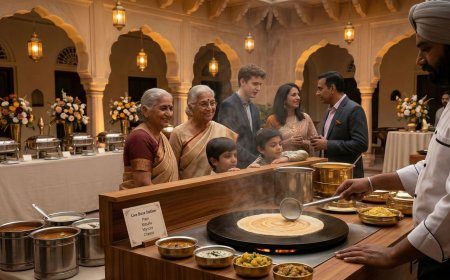
She thought about the food. The Indian wedding buffet is a specific kind of abundance — twelve curries, seven breads, five rice preparations, three dessert stations, a chaat counter, a live dosa station, a fruit arrangement sculpted into the shape of a peacock. At Ananya's wedding, with two hundred and twenty guests, the caterer's estimate was that roughly thirty percent of prepared food would be unconsumed. Thirty percent of a wedding spread for two hundred and twenty people is not a small number. She had done the arithmetic somewhere over Muscat. It was not a comfortable calculation.
Ananya worked in sustainability consulting in London. She spent her professional life advising corporations on their environmental commitments, writing carbon reduction frameworks, sitting in rooms with CFOs and explaining the business case for circularity. And she was about to host an event that, by her own professional assessment, would generate more waste in three days than her household did in a year.
She did not decide, at thirty-five thousand feet over the Arabian Sea, to cancel the wedding or radically reinvent it or deprive her family of the celebration they had been imagining since she was a child. She was not naive about what an Indian wedding meant to her parents, to Rohan's parents, to the aunties who had been waiting for this specific occasion to wear specific saris. She understood that a wedding is not only hers. She decided something more specific and more achievable: she would apply the same professional rigour to the wedding's environmental impact that she applied to her clients' supply chains. She would find out what was actually possible. She would not perform sustainability. She would practice it.
This guide is for every NRI couple who has asked the same question Ananya asked at thirty-five thousand feet — and who deserves an honest, specific, complete answer rather than a collection of feel-good gestures dressed up as environmental responsibility.
The Honest Starting Point: What an Indian Wedding Actually Produces
Before any framework for reduction can be useful, it requires an honest accounting of what an Indian wedding generates. Most sustainability guides for weddings are written with a Western template wedding in mind — a single ceremony, a reception, perhaps a hundred guests, a relatively contained set of vendors. The Indian wedding, and the NRI Indian wedding in particular, operates at a different scale and with a different structure.
The typical NRI Indian wedding in India involves three to five events across two to four days. Each event has its own décor, its own catering, its own stationery, its own floral requirement, and its own dressing for the couple and often for the immediate family. The guest count rarely falls below a hundred and fifty. The floral consumption alone — marigolds, roses, tuberoses, orchids, jasmine — across a three-day wedding can run to several tonnes of cut flowers, most of which have a display life of eight to twelve hours before they begin to wilt under event lighting and body heat.
The waste streams are specific and worth naming individually. Floral waste is the largest by volume. Food waste is the largest by ethical weight — the squandering of edible food at an event celebrating abundance is a specific kind of contradiction. Textile waste includes the single-use fabric used in pandal and mandap construction, the disposable dupattas sometimes given to guests, and the fabric decorations that are designed with no second life in mind. Paper and print waste includes all stationery plus the paper plates and napkins that many venues default to. Plastic waste includes bar service cups, water bottles, vendor packaging, and the thermocol structures that remain a staple of mid-tier décor vendors across India. Chemical waste includes the synthetic dyes used in rangoli powders, the adhesives used in décor assembly, and the cleaning products used by caterers and venue staff.
The honest answer to the question this article poses — is a zero-waste Indian wedding possible — is no. Not in any literal sense. The more useful question, and the one Ananya actually asked, is: what level of waste reduction is achievable without dismantling the wedding, and what does the path to that reduction actually look like?
The NRI-Specific Complications
For couples planning from abroad, the sustainability challenge has dimensions that domestic couples do not face. The first is the vendor knowledge gap. In London or Toronto or Singapore, Ananya could find a zero-waste caterer, a sustainable florist, and a compostable stationery designer with an afternoon of research. In Kochi, or Jaipur, or Hyderabad, the ecosystem of sustainability-oriented wedding vendors is smaller, less standardised, and harder to identify from abroad. Vendors who describe themselves as "eco-friendly" in their Instagram profiles may mean something quite different from what a sustainability professional would mean by the term.
The second complication is the family dynamic. NRI couples often find that their sustainability commitments are perceived by Indian family members as criticism of tradition, as cost-cutting dressed up as principle, or as the imposition of Western values on an Indian occasion. The aunty who has attended forty weddings and who knows exactly how a mandap should look does not want to be told that the thermocol pillars are being replaced with rented bamboo structures on environmental grounds. Managing this dynamic requires a specific kind of communication — more on which in a later section.
The third complication is the vendor coordination problem. Sustainable choices often require more coordination across the vendor chain than conventional choices do. If you want food waste to go to a redistribution organisation rather than a landfill, you need to arrange that relationship in advance, communicate it to the caterer, ensure the venue permits it, and have someone on the ground managing the logistics on the day. Each of these coordination points is a point of failure, and coordinating it from a different time zone, through a family intermediary who may not share your priorities, makes failure more likely.
The Framework: Where Meaningful Reduction Actually Lives
The sustainable Indian wedding is built on a hierarchy of impact. Not every waste stream is equal, and not every intervention is equally achievable. The framework that actually works concentrates effort where the impact is largest and where the feasibility is highest, rather than spreading thin across every possible intervention and achieving nothing substantial anywhere.
Food Waste: The Highest-Impact Category
Food waste reduction is where the most meaningful environmental and ethical impact lives, and it is also, counterintuitively, one of the more achievable interventions because it aligns with financial incentives. A caterer who wastes less food costs less to run. The conversation with a caterer about food waste reduction is therefore not only an environmental conversation but a budgetary one.
The specific interventions that work are: pre-confirmed guest attendance counts taken seriously rather than treated as estimates, with catering quantities calibrated to actual headcount rather than inflated buffers; live stations replacing pre-prepared bulk quantities for high-waste items like breads and rice dishes; and a pre-arranged relationship with a food redistribution organisation — Feeding India, Robin Hood Army, or a local equivalent depending on the city — to collect unconsumed food that is safe for redistribution within hours of the event.
The Robin Hood Army, which operates across more than thirty Indian cities, has a specific protocol for wedding food collection and has partnered with hundreds of weddings across India. Arranging this partnership requires a single call in advance and a point of contact on the day. It is one of the highest-impact, lowest-effort sustainability interventions available to an Indian wedding, and it is available in every major Indian wedding city.
Insist that your catering contract includes a food waste clause — a specific commitment to calibrated quantities, a prohibition on excessive pre-preparation, and a named redistribution partner for unconsumed food.
Floral Waste: The Highest-Volume Category
Flowers are the visual heart of an Indian wedding and also its most prolific source of biodegradable waste. The instinct of sustainability-conscious couples is often to eliminate flowers — replace them with potted plants, with fabric installations, with dried arrangements. This instinct, while understandable, tends to produce exactly the family conflict described earlier, and it sacrifices an element of the wedding that carries genuine cultural and emotional weight.
The more practical approach is a combination of three strategies. The first is flower upcycling, through organisations like Phool.co — which operates in multiple Indian cities and collects temple and event flowers for conversion into incense, vermicompost, and other products — or through local composting arrangements where the caterer or venue has an existing relationship with composting facilities. The second is design concentration: rather than flowers distributed across every surface of every venue, concentrating floral investment in the specific visual moments that matter most — the mandap, the entrance, the head table — and using reusable non-floral elements everywhere else. The third is working with a florist who designs for maximum display life, choosing blooms that hold for eighteen to twenty-four hours under event conditions rather than the exquisite but fragile arrangements that peak at setup and are wilting by dinner.
Décor: The Reuse and Rental Opportunity
The Indian wedding décor industry is structured almost entirely around single-use elements — thermocol, synthetic fabrics, printed backdrops, foam floral arrangements. The sustainable alternative is not the elimination of décor but a shift toward rental and natural materials. Bamboo, cane, terracotta, brass, and copper are all materials with deep roots in Indian aesthetic tradition and are also materials that can be rented, returned, and used again. Several décor vendors in major Indian wedding cities now operate rental-first models, and identifying them is a matter of specific research rather than general inquiry.
The practical approach for NRI couples managing from abroad is to make "rental-first" a stated requirement in every décor vendor brief. A vendor who cannot offer a rental-first approach or who cannot source natural materials for the structural elements of the décor is not the right vendor for a couple with genuine sustainability commitments.
Stationery: The Easiest Win
Wedding stationery is one of the most visible sustainability conversations and one of the easiest to act on, because the alternatives are mature, widely available, and often comparable in cost to conventional print. Seed paper invitations — embedded with wildflower or herb seeds and designed to be planted after the wedding — are available from Indian artisan printers and carry an elegantly appropriate metaphor for a wedding. Recycled paper with vegetable-based inks is available from most quality printers. Digital inserts for information that would otherwise require multiple printed cards — accommodation details, event schedules, travel instructions — reduce print volume substantially.
For NRI couples, digital communication also solves a genuine logistical problem: sending printed wedding stationery internationally is expensive, slow, and subject to loss. A beautifully designed digital wedding website, combined with a single printed invitation for guests who genuinely cannot receive digital communication, is both more sustainable and more practical than a full printed suite sent internationally.
Common Mistakes NRI Couples Make With Sustainable Wedding Planning
The first mistake is confusing sustainability performance with sustainability practice. Posting about seed paper invitations while ordering a thermocol-heavy décor package, or announcing a "zero-waste wedding" without having done the actual work of food redistribution arrangements and vendor audits, is not sustainability — it is branding. Vendors and family members who sense the gap between the stated commitment and the actual practice will lose confidence in both the commitment and the couple's judgment. The standard to hold yourself to is not the Instagram post. It is the waste audit.
The second mistake is trying to do everything simultaneously and achieving nothing thoroughly. NRI couples with genuine environmental commitments sometimes produce a list of twenty sustainability interventions and then find, in the coordination chaos of final planning, that none of them has been properly implemented. The framework that actually works is hierarchical: food waste first, because the impact is highest. Floral waste second, because the volume is highest. Décor materials third, because the visibility is highest. Stationery fourth, because the effort is lowest. Everything else is secondary.
The third mistake is failing to put sustainability requirements in vendor contracts. Verbal commitments from vendors to "do their best" on environmental grounds are worth nothing on the day. If the food redistribution arrangement is not in the catering contract, the caterer will not prioritise it when they are managing two hundred and twenty guests and a live dosa station. If the rental-first requirement is not in the décor contract, the decorator will default to what they know. Every sustainability commitment must be contractual, specific, and enforceable.
The fourth mistake is underestimating the family negotiation. NRI couples who approach the sustainability conversation with their Indian parents as a matter of informing rather than discussing tend to encounter resistance that hardens into conflict. The more productive approach is to start with shared values — the cultural roots of many sustainable practices in Indian tradition, the ethical weight of food waste at a celebration of abundance, the fact that marigolds composted into soil is a more dignified end for a sacred flower than a landfill — rather than the environmental framework of Western sustainability discourse. The conversation lands differently when it begins with Indian values rather than Guardian articles.
The fifth mistake is not appointing a sustainability coordinator for the day itself. Every well-intentioned sustainable wedding plan has the potential to collapse in the execution if nobody is specifically responsible for making sure the food redistribution partner arrives at the right time, the floral collection is arranged, the rental items are properly tagged for return, and the catering team is following the agreed protocols. This person does not need to be a professional. It can be a trusted family member or a friend who is not otherwise occupied with the wedding duties and who genuinely cares about the outcome. Without this person, the plan is a document. With them, it is a practice.
The Family Conversation
No section on sustainable Indian weddings would be honest without addressing directly the specific challenge of the family conversation — the parents in India who have imagined this wedding for decades, the relatives who associate abundance with respect and reduction with insult, and the mother-in-law who has already confirmed the thermocol decorator.
The single most useful reframe is this: many of the practices that sustainability discourse calls "innovative" are, in the Indian context, simply traditional. Banana leaf service is not a trendy sustainable choice — it is how food was served at weddings in South India for centuries, and it is fully compostable, requires no washing, and is available cheaply from local suppliers. Terracotta kulhads for chai service are not an environmental gesture — they are a return to a practice that most grandparents remember as standard. Flower offerings that end in composting rather than landfill are entirely consistent with the spiritual logic that treats flowers as sacred objects deserving of respectful disposal.
When sustainable choices are presented as recoveries of tradition rather than impositions of modernity, the family conversation changes character. The aunty who resists the bamboo mandap as "too simple" may respond differently to the same mandap presented as a return to the materials that built every mandap in her grandmother's village. This is not manipulation. It is accurate history.
What Ananya Actually Did
Ananya landed in Kochi, spent two days in a state of low-grade anxiety about the conversation with her mother, and then had it. Her mother, who had grown up in a house with a composting pit in the backyard and who had watched her own mother supervise the banana leaf service at every family wedding, was less resistant than Ananya had feared.
They kept the marigolds. They arranged for Phool.co to collect them afterward. They replaced the thermocol décor structures with rented bamboo and terracotta. They switched to banana leaf service for the lunch events and kept the conventional crockery for the formal dinner. They arranged the Robin Hood Army partnership for the post-dinner food collection. They printed invitations on seed paper that Ananya's London colleagues actually planted. They did not achieve zero waste. Nobody does. But the food waste estimate dropped from thirty percent to under ten. The décor was entirely rental and natural material. The flowers had a second life. The stationery became herb gardens in four countries.
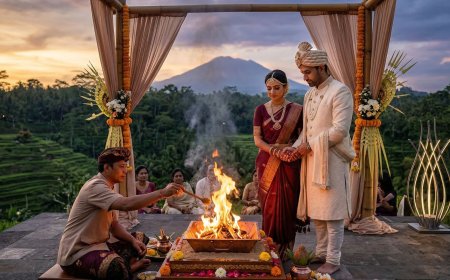
Rohan, who had been sceptical through most of the process and who had wondered privately whether any of it mattered, stood at the mandap — the bamboo mandap, with the terracotta lamps and the marigolds that would be composted in the morning — and thought that it was the most beautiful thing he had ever seen. Not in spite of the constraints. Because of them.
Do the waste audit first. Prioritise food redistribution above everything else. Put every sustainability commitment in the vendor contracts. Appoint someone to manage the day's environmental logistics. Have the family conversation through the lens of tradition rather than ideology.
The zero-waste Indian wedding is not possible. The significantly lower-waste Indian wedding, the one that treats abundance with respect and tradition with honesty, is entirely possible — and it is more beautiful for it.
Published by NRIWedding.com — The Premium Global Platform for Non-Resident Indians Planning Indian Weddings From Abroad.
What's Your Reaction?
 Like
0
Like
0
 Dislike
0
Dislike
0
 Love
0
Love
0
 Funny
0
Funny
0
 Angry
0
Angry
0
 Sad
0
Sad
0
 Wow
0
Wow
0