





































































Across Oceans, Under Royal Skies: Planning Your Rajasthan Destination Wedding
NRI.Wedding presents a comprehensive planning guide for destination weddings in Rajasthan, tailored for Non-Resident Indians seeking culturally authentic ceremonies. The article explores key locations, logistical considerations, vendor coordination, and emotional aspects of hosting a traditional Indian wedding in royal palace settings. It offers practical insights for couples planning from abroad, covering both heritage preservation and modern execution.


For Non-Resident Indians, Rajasthan is not just a wedding destination — it is a return to memory, ancestry, and emotional inheritance. From palace courtyards to desert sunsets, destination weddings in Rajasthan offer NRIs a rare chance to reconnect with cultural roots while hosting a globally elegant celebration. This guide explores not just how to plan such a wedding, but why it matters so deeply for families living far from home.
You grew up watching your parents talk about India like it was a place that existed in a different emotional dimension — not quite past, not quite present. You know the stories by heart: weddings that lasted three days, cousins sleeping on floors, grandmothers feeding entire villages. But your own life happened elsewhere — in Toronto apartments, London suburbs, Dubai high-rises, Sydney townhouses.
Now you’re engaged, and it’s midnight. You’re Googling “palace wedding in India” with one eye on the clock and one eye on a WhatsApp group with relatives you haven’t seen in years. You don’t just want a beautiful wedding. You want something that feels like belonging.
And suddenly, Rajasthan appears — golden, royal, waiting.
🌟 DID YOU KNOW? FACT BOX
• Over 38% of destination weddings booked by NRIs in India are in Rajasthan.
• Udaipur alone hosts more international Indian weddings than any other Indian city.
• Most NRI destination weddings in Rajasthan involve guests flying in from at least three continents.
WHAT IS A DESTINATION WEDDING IN RAJASTHAN?
A destination wedding in Rajasthan is not simply about choosing a luxury location. It is about entering a cultural landscape where weddings have always been ceremonial, communal, and grand. Historically, Rajput weddings were political, spiritual, and social alliances conducted in forts, havelis, and temple courtyards. These spaces were designed not just for celebration, but for memory.
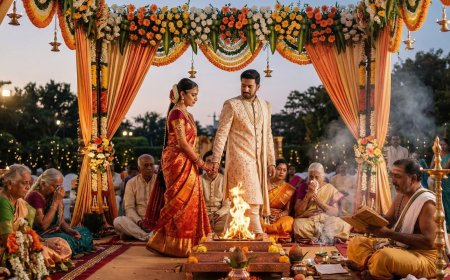
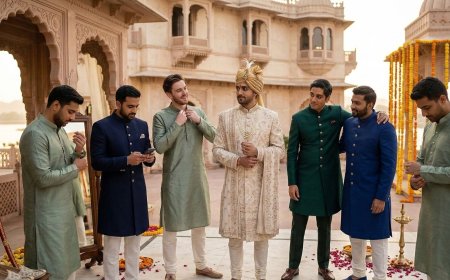
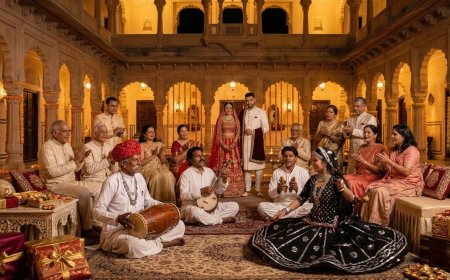
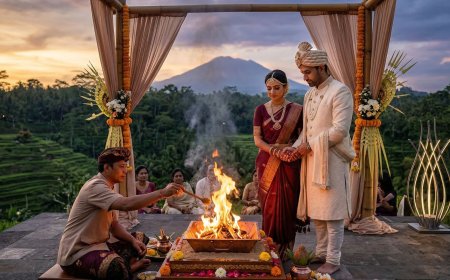
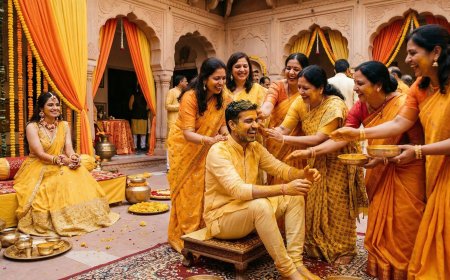
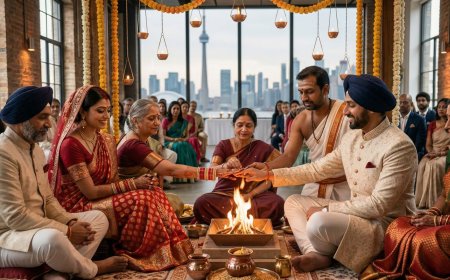
In modern NRI weddings, the sequence remains rooted in tradition. The celebrations begin with Haldi (turmeric ceremony) in sunlit courtyards, followed by Mehendi (henna ceremony) with folk musicians and mirror-work décor. The wedding day opens with Baraat (groom’s procession), often featuring elephants, camels, or vintage cars, before leading into Varmala (exchange of garlands) and the sacred Phere (seven vows around the fire).
What makes Rajasthan unique is how effortlessly the environment supports ritual. The forts, palaces, lakes, and deserts do not need to be decorated into grandeur — they already are. For NRIs, this creates a rare experience where Indian tradition feels not staged, but naturally at home.
COMMUNITY COMPARISON TABLE
| Community/State | Local Name | Key Tradition | How NRIs Abroad Adapt It |
|---|---|---|---|
| Himachali | Dham Wedding | Community feast | Destination dinner banquets |
| Garhwali | Pandav Vivah | Folk rituals | Simplified puja abroad |
| Kumaoni | Swayamvara style | Bride-led rituals | Fusion ceremonies |
| Ladakhi | Chang Marriage | Buddhist prayers | Symbolic rituals |
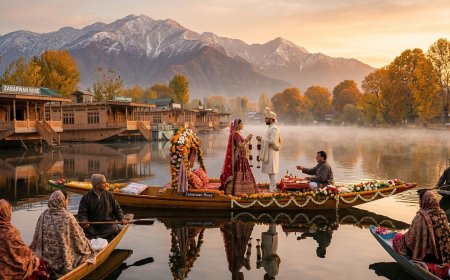
| Kashmiri Pandit | Lagan | Vedic ceremony | Temple + resort setup |
| Punjabi | Anand Karaj | Gurdwara vows | Palace Sikh ceremonies |
| Marathi | Lagnapatrika | Formal invites | Digital announcements |
| Tamil | Kalyanam | Temple rites | Resort mandaps |
| Bengali | Biye | Shubho drishti | Visual rituals adapted |
| Rajasthani | Rajput Vivah | Fort weddings | Royal heritage venues |
THE MEANING BEHIND IT ALL
Indian weddings have never been about the couple alone. They are about lineage, continuity, cosmic order, and community memory. In ancient belief systems, marriage is not just a contract — it is a Samskara (life transition ritual), marking a shift in spiritual responsibility.
For NRIs, Rajasthan amplifies this symbolism. The palaces remind you that your story didn’t begin with immigration. The rituals remind you that identity is inherited before it is chosen. The desert itself becomes metaphor: a vast emotional landscape where old roots still survive beneath modern life.
If someone ever asks why this matters, the simplest answer is this:
In Indian philosophy, a wedding is not about starting a new life — it is about continuing an old one.
DOING A DESTINATION WEDDING ABROAD: THE PRACTICAL REALITY
Trying to recreate an Indian wedding abroad is often an emotional negotiation with logistics. Venues in London, Toronto, Sydney, Houston, and Dubai frequently impose restrictions on fire rituals, noise levels, guest counts, and ceremony duration. Even when you find a luxury hotel that allows a mandap, it rarely feels spiritually authentic.
Sourcing ritual items becomes another challenge. Families spend weekends driving to Southall in London, Gerrard Street in Toronto, Harris Park in Sydney, Hillcroft Avenue in Houston, or Meena Bazaar in Dubai just to find coconuts, kalash, diyas, and region-specific items. Many rely on relatives flying in from India carrying sacred objects in suitcases.
Finding a region-specific priest is one of the hardest parts. Most NRIs settle for generic ceremonies because priests trained in specific customs are rare abroad. Language barriers, cultural mismatches, and scheduling conflicts are common.
Then there is the emotional complexity of remote family. Grandparents attend via video calls at odd hours. Blessings are given through screens. Important moments feel fragmented across time zones.
Rajasthan solves all of this at once. Instead of struggling to recreate tradition abroad, you step into a place where tradition never left.
DOING IT IN RAJASTHAN: THE DESTINATION EXPERIENCE
Planning from abroad is easier than most couples expect. Rajasthan’s wedding ecosystem is designed for NRIs — English-speaking planners, culturally trained priests, multilingual coordinators, and venues accustomed to global guests.
Udaipur offers lake palaces and heritage hotels. Jaipur provides forts, havelis, and royal gardens. Jodhpur and Jaisalmer bring desert romance and architectural drama.
For non-Indian guests, Rajasthan becomes cultural immersion. Rituals are explained, experiences are guided, and ceremonies feel educational rather than confusing. Instead of translating Indian tradition into Western spaces, you translate Western guests into Indian memory.
WHAT YOU NEED: RITUAL CHECKLIST
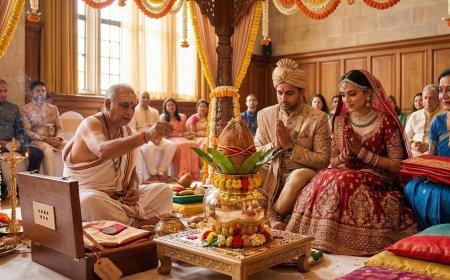
Ritual Items: sacred fire setup, kalash, flowers, garlands, turmeric, rice, coconuts, incense, diyas.
People Required: region-specific priest, planner, cultural coordinator, photographer, family elders.
Preparation Steps: guest coordination, ritual briefing, language planning, travel logistics, cultural orientation.
NRI.Wedding connects couples with vetted pandits, heritage venues, planners, and diaspora-friendly vendors across Rajasthan.
5 QUESTIONS NRI COUPLES ALWAYS ASK
Can we do a royal wedding without being extravagant?
Yes. Many couples choose heritage havelis and intimate guest lists while retaining full cultural depth.
What if my partner isn’t Indian?
Rajasthan is ideal for intercultural weddings. Rituals are explained, adapted, and made inclusive.
How do we coordinate family across time zones?
Most planners schedule ceremonies between 4–7 PM IST to accommodate global video calls.
Can we legally register abroad and do rituals in India?
Yes. Many couples separate civil and religious ceremonies.
Will it feel authentic or staged?
In Rajasthan, authenticity is embedded in the environment itself.
THE EMOTIONAL ANGLE
You don’t realise how much you miss India until you try to return to it for something that matters. A wedding is not just celebration — it is grief for what you left, pride in what you carry, and hope for what you pass on.
For NRI families, Rajasthan becomes emotional therapy. Parents see their culture respected. Grandparents feel continuity. Children witness heritage not as theory, but as lived experience.
It is not nostalgia. It is reclamation.
A MOMENT TO SMILE
In Mississauga, a family planned a palace wedding in Jaipur. The groom’s grandmother insisted on bringing her own spices in luggage. Customs opened her suitcase to find 12 kilos of haldi, cardamom, and dried flowers. She told the officer, “If my grandson is getting married in India, I’m not letting Rajasthan feed him without supervision.” She became the unofficial wedding caterer.
QUOTES FROM THE DIASPORA
“I didn’t want a Pinterest wedding. I wanted a memory my children would inherit.” — Anjali, Gujarati, Toronto
“Watching my son take vows in a palace felt like closing a circle we opened when we migrated.” — Rajesh, Punjabi, London
“My American friends said it felt like stepping into a living documentary.” — Meera, Tamil, San Francisco
CLOSING: YOUR ROOTS TRAVEL WITH YOU
Rajasthan doesn’t just host weddings. It hosts identity. It gives NRIs a place to return to themselves — not as tourists, but as descendants. Through heritage venues, traditional pandits, and culturally fluent planners, NRI.Wedding exists to make that return seamless.
You crossed oceans. Your culture waited.
Your roots travel with you. Let them bloom.
What's Your Reaction?
 Like
0
Like
0
 Dislike
0
Dislike
0
 Love
0
Love
0
 Funny
0
Funny
0
 Angry
0
Angry
0
 Sad
0
Sad
0
 Wow
0
Wow
0