











































































Haldi Ceremony Look — What to Buy in Delhi That You Won't Mind Getting Stained: The Complete NRI Guide
Planning your haldi ceremony outfit and wondering why the yellow silk salwar from the South Extension boutique that you bought for twelve thousand rupees cannot be saved by the dry cleaner? This complete NRI guide delivers the fabric-science-first, ceremony-honest framework that every NRI bride needs before the haldi outfit shopping — explaining why curcumin binds permanently to protein fibres like silk and wool within minutes while cotton resists the staining, and translating that chemistry into the specific Delhi sourcing map that protects the budget while producing the golden-light ceremony photograph the Instagram research has been promising. Learn why the Janpath lane's block-printed cotton anarkali at three hundred to two thousand rupees is the most photographically appropriate and most practically sound haldi outfit choice, why the Chanderi cotton is the single acceptable silk-blend exception, why buying two pieces at the Janpath price gives you one for the ceremony and one for the pre-paste photographs, how to coordinate the inner family circle through Delhi market cotton purchases rather than risking packed garments, and why the outfit the turmeric permanently claims is the ceremony's most honest physical record. Understand the five mistakes that cost NRI brides the most and the complete fabric reference table.


Haldi Ceremony Look — What to Buy in Delhi That You Won't Mind Getting Stained: The Complete NRI Guide
The conversation happened at the dry cleaner.
It was the Monday after the wedding — the specific, post-wedding, returning-to-ordinary-life Monday that follows the most extraordinary week of a person's experience — and Priya's mother was standing at the counter of the dry cleaner in the GK-2 market with a bundle of fabric that she was holding away from her body in the specific, this-is-already-a-lost-cause quality of the person who knows what she is about to be told but who has come to hear it said officially.
The dry cleaner looked at the fabric. He was the specific kind of dry cleaner who has been in business for thirty years and who has seen every variety of fabric emergency that the Delhi wedding season produces. He looked at the fabric and then he looked at Priya's mother with the expression of the professional who is about to deliver the news that the client already knows.
He said: How long was the turmeric on this?
She said: About four hours.
He said: And the fabric is silk?
She said: Yes.
He said: I can try. But turmeric on silk after four hours — I need you to understand that I cannot promise anything.
The fabric was the yellow salwar-kameez that Priya had worn to the haldi ceremony — the specific, bought-especially-for-the-haldi, this-is-my-haldi-outfit piece that had been purchased at a South Extension boutique six weeks before the wedding for twelve thousand rupees in the belief that the yellow would hide the turmeric staining and that the piece could be worn again after the ceremony.
The silk had not hidden the turmeric staining. The silk had absorbed it. The four hours of the ceremony's paste application and the subsequent sitting and the family photographs had driven the turmeric deep into the silk's protein fibre in a way that the dry cleaner's thirty years of professional experience was not optimistic about resolving.
The twelve-thousand-rupee piece was, in all probability, the twelve-thousand-rupee haldi memory.
Priya's mother stood at the dry cleaner's counter and understood, too late, the specific lesson that the haldi ceremony's shopping required and that nobody had told her daughter before the purchase.
This article is that lesson — the complete, fabric-honest, budget-specific, specifically-Delhi-sourced guide to the haldi ceremony look for the NRI bride and her family who want to be beautifully dressed for the turmeric without spending money on the garment that the turmeric will permanently claim.
The Haldi Ceremony and Why the Outfit Question Is Categorically Different
Before the shopping can be addressed, the haldi ceremony's specific character must be understood — because the haldi outfit question is the only wedding outfit question in the entire wedding wardrobe that is governed primarily by the fabric's relationship to turmeric rather than by the occasion's formality, the aesthetic preference, or the budget's capacity for the high-quality piece.
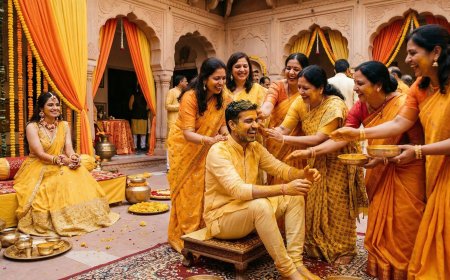
The haldi ceremony — the pre-wedding ritual in which the turmeric paste is applied to the bride and groom by the family members, accompanied by the water and the flower petals and the music and the specific, joyful, everyone-is-touching-you quality of the ceremony that is the most physically intimate of all the wedding's rituals — is the occasion when the outfit will be stained. Not might be stained. Will be stained. The turmeric paste that the maternal aunt applies to the bride's face and arms and feet and the flower water that follows and the haldi that lands on the surrounding family members' clothes — this is the ceremony's physical content, and the outfit that survives it unstained has not been at the haldi.
The NRI bride's specific relationship to the haldi ceremony's staining reality is complicated by two factors that the domestic Indian bride's relationship to the same question does not share in the same form.
The first factor is the Instagram reality gap. The haldi ceremony photographs that fill the NRI bride's research feed are the photographs of the ceremony's most beautiful moments — the golden light, the flower petals, the specific luminosity that the turmeric gives the skin in the pre-wedding photographs. They are not photographs of the ruined garments, the stained sleeves, the twelve-thousand-rupee silk that the dry cleaner could not save. The research feeds the aesthetic aspiration without the practical consequence, and the NRI bride who arrives at the haldi shopping with the Instagram reference has not been shown the full picture.
The second factor is the diaspora transmission gap. The domestic Indian bride whose grandmother has been dressing for haldis for forty years knows, from the family's accumulated knowledge, that the haldi outfit is not the good outfit. She knows it in the specific, this-is-not-even-a-question way of the person who has absorbed the information through proximity to the tradition. The NRI bride whose grandmother is in Chennai and whose wedding preparation has happened at the distance of London or Sydney has not necessarily absorbed this information. She arrives at the haldi shopping with the Instagram aesthetic and without the grandmother's practical knowledge, and the result is the South Extension boutique silk at twelve thousand rupees that the dry cleaner cannot save.
The Turmeric Staining Science: What Actually Happens to the Fabric
Understanding why turmeric stains the way it does — the specific, chemically-grounded, this-is-why-the-dry-cleaner-cannot-always-save-it explanation — is the most practically useful knowledge the NRI bride can bring to the haldi outfit shopping, because it directly determines which fabrics to buy and which to avoid.
Turmeric's staining power comes from curcumin — the specific, fat-soluble, photosensitive compound that gives the spice its deep yellow colour and that behaves, when it contacts fabric, in the manner of a dye rather than a surface contaminant. Curcumin does not sit on the fabric's surface. It binds to the fabric's fibre structure at the molecular level — the specific, chemical bonding that makes the industrial dye industry's permanent dyes permanent. When the turmeric paste is applied to the skin and the paste contacts the fabric, the curcumin in the paste begins binding to the fabric's fibres within minutes.
The binding rate varies by fabric type. The protein fibres — silk and wool — bind the curcumin most rapidly and most permanently, because the protein fibre's chemical structure is receptive to the curcumin's binding in the same way that it is receptive to the acid dye that the textile industry uses to colour these fibres permanently. The cellulose fibres — cotton, linen, viscose — bind the curcumin more slowly and less permanently, which is why the cotton garment that has been stained with turmeric responds better to washing than the silk garment. The synthetic fibres — polyester, nylon — bind the curcumin least readily, which is why the polyester garment is the most forgiving of the haldi's application.
The practical translation of this chemistry: the haldi outfit must be cotton or a cotton-rich blend. Not silk. Not the silk-cotton blend that is primarily silk with a small cotton content. Cotton. The fabric that the staining science designates as the most resistant to the permanent curcumin binding is the fabric that the haldi outfit should be made from.
The secondary translation: the colour of the haldi outfit matters, but not in the way the Instagram guidance suggests. The yellow outfit does not hide the turmeric staining — the curcumin's specific shade of yellow is different from the fabric dye's yellow and the distinction is visible in the right light. What the yellow outfit does is contextualise the staining — the stain on the yellow fabric is less visually dramatic than the stain on the white or the pale fabric, which reads as the contamination rather than the ceremony. But the contextualisation does not remove the stain. The cotton fabric removes — or at least resists — the stain. The yellow silk contextualises the stain that it cannot remove.
What to Buy: The Specific Fabric and Garment Categories
The Cotton and Cotton-Blend Category: The Primary Recommendation
The cotton garment — the pure cotton salwar-kameez, the cotton anarkali, the cotton lehenga in the lightweight cotton that the artisanal Indian textile tradition produces — is the haldi outfit's primary and most reliable category. The cotton's curcumin resistance, combined with the Indian textile tradition's extraordinary range of cotton garment aesthetics, makes the cotton haldi outfit the choice that is simultaneously the practical choice and the beautiful choice.
The specific cotton categories that serve the haldi ceremony well:
The block-printed cotton anarkali or salwar-kameez in the warm palette — the yellows, the oranges, the turmeric tones, the saffrons — whose colour vocabulary is the most naturally harmonious with the ceremony's visual character. The block-printed cotton anarkali at the Delhi price point of eight hundred to three thousand rupees from the Janpath lane, or two thousand to eight thousand rupees from the Lajpat Nagar market, is the haldi outfit that photographs beautifully in the ceremony's golden light, that washes with reasonable success after the ceremony, and that did not cost the twelve thousand rupees that the silk version would have cost and cannot be saved.
The hand-dyed or tie-dyed cotton in the traditional Indian dyeing traditions — the Bandhani, the Shibori-influenced, the natural dye cotton whose colour palette is the earth tones and the plant dyes that the Indian craft tradition has been using for centuries. The hand-dyed cotton's specific, organic, each-piece-slightly-different quality photographs beautifully, carries the artisanal aesthetic that the contemporary haldi ceremony's Instagram references celebrate, and is the fabric that the turmeric paste can stain without the permanent damage that the same stain would cause on the silk or the georgette.
The chanderi cotton — the specific, lightweight, slightly translucent cotton-silk blend from the Chanderi weaving tradition in Madhya Pradesh — is the single exception to the silk-avoidance rule, because the Chanderi's cotton content is sufficient to make the turmeric binding less permanent than the pure silk's, and because the Chanderi's specific, diaphanous quality photographs in the ceremony's light with the specific, flowing character that the pure cotton's more opaque drape does not produce. The Chanderi cotton for the haldi is the aesthetic upgrade from the pure cotton — more beautiful in the photograph, slightly more vulnerable to the staining, but not the catastrophic staining scenario that the pure silk produces.
The Mulmul and Voile Category: The Lightweight Option
Mulmul — the extremely lightweight, open-weave, double-layered cotton fabric of the Indian textile tradition — is the haldi ceremony's most practically comfortable fabric. Its lightness makes it ideal for the outdoor daytime ceremony that the summer or the early-spring haldi produces, its open weave allows the ceremony's turmeric paste to be washed through rather than absorbed, and its specific, soft, draped quality photographs with the flowing character that the ceremony's ritual physicality requires.
The mulmul kurta or the mulmul anarkali in the warm palette is available at the Delhi markets at prices between five hundred and two thousand five hundred rupees — the most affordable end of the appropriate haldi outfit range — and it is the outfit category that the NRI bride can buy without the anxiety of the investment piece at risk from the ceremony's paste.
The voile — the similar open-weave cotton that the international textile market calls by the French name — is the mulmul's close equivalent and is available in Delhi's Chandni Chowk fabric lanes as a fabric-to-tailor option at similar price points.
The Upcycled and Repurposed Category: The Grandmother's Option
The tradition's most specific answer to the haldi outfit question is not the new purchase. It is the old garment — the grandmother's specific, no-longer-worn, this-has-already-had-its-primary-life garment that is repurposed for the haldi ceremony in the spirit of the tradition that has always understood the haldi ceremony to be the occasion for the garment that is being offered to the ritual rather than displayed for the occasion.
The NRI bride who asks her grandmother for the old cotton salwar-kameez — the one that has been in the wardrobe since the 1980s, that the grandmother has not worn in twenty years, that carries the specific, lived-in quality of the genuinely used garment — is accessing the tradition's most honest answer to the haldi outfit question. The old garment offered to the turmeric is the tradition's version of the ceremony's spirit: the giving of the thing rather than the displaying of the thing.
For the NRI bride whose grandmother's old garment is in Chennai and whose haldi is in Delhi, the repurpose option takes the form of the least expensive cotton garment that the Delhi market carries — the five-hundred-rupee mulmul kurta, the eight-hundred-rupee block-print cotton set — purchased in the spirit of the old garment that is being offered to the ceremony rather than the investment piece that is being worn to it.
Where to Buy in Delhi: The Specific Sources
Janpath Lane — The Primary Source
The Janpath open-air market lane — addressed in the Janpath and Tibetan Market guide earlier in this series — is the primary sourcing destination for the haldi ceremony outfit, for the specific reason that its block-printed cotton range in the warm Indian palette is the most comprehensive and the most affordable in Delhi.
The Janpath lane's block-printed cotton kurta and salwar-kameez in the yellows, oranges, turmeric tones, and saffrons — the colour vocabulary that is most naturally harmonious with the haldi ceremony — is available at prices between three hundred and two thousand rupees per piece, and the range of prints, from the simple floral to the complex geometric to the Ajrakh and Bagru regional traditions, is wide enough to find the piece that serves the NRI bride's specific aesthetic reference without the boutique's premium price.
The practical guidance for the Janpath haldi purchase: buy slightly more than you think you need. The haldi ceremony's paste and water application will render the outfit permanently altered, and the outfit that looked like a post-ceremony wash might recover is the outfit that the wash confirms will not recover. Buying two pieces at the Janpath price rather than one means that the second piece is the backup — the garment that survives the ceremony unworn and that can be used for the ceremony's photographs in its un-stained form if the first piece is claimed early in the proceedings.
Lajpat Nagar Central Market — The Quality Step Up
For the NRI bride who wants the haldi outfit that photographs more formally than the Janpath lane's cotton range — the piece with the slightly better construction, the slightly more refined finish, the slightly more organised display that allows the considered choice rather than the market-floor discovery — the Lajpat Nagar Central Market carries the cotton and cotton-blend haldi outfit in the two-thousand to eight-thousand-rupee range that steps up from the Janpath without approaching the South Extension boutique's price.
The Lajpat Nagar cotton anarkali and the cotton-silk Chanderi suits in the warm palette are the haldi outfit options that the bride who wants the occasion-appropriate aesthetic without the investment piece's financial risk will find most reliably here.
Sarojini Nagar — The Export Surplus Option
The Sarojini Nagar market — addressed earlier in this series — carries, in its export surplus section, the cotton and cotton-blend garments in the international retail quality and the warm palette that the haldi ceremony requires, at the secondary market prices that the export surplus format produces.
The NRI bride who finds the Sarojini cotton anarkali or the Sarojini block-print kurta set in the haldi-appropriate palette has found the haldi outfit at the price — five hundred to two thousand rupees for quality pieces — that makes the turmeric's permanent claim on the garment the ceremony's memory rather than the financial loss.
The Sarojini quality inspection protocol is the same as the general Sarojini protocol: check the construction, check the seams, hold the fabric in the outdoor light. The haldi outfit's construction quality needs to be sufficient to last the ceremony rather than to last the decade, which lowers the quality threshold from the occasion wear standard to the one-significant-day standard.
The Chandni Chowk Fabric Option — The Tailor-Made Approach
The NRI bride whose haldi look is specifically designed — the specific print, the specific silhouette, the specific embellishment that expresses a deliberate aesthetic rather than the market's available range — can source the cotton fabric at Chandni Chowk's Nai Sarak and the Chandni Chowk fabric lanes and take it to a Greater Kailash tailor for a made-to-measure cotton piece at a total cost that is typically lower than the boutique's ready-made equivalent.
The cotton fabric at Nai Sarak — the block-printed cotton in the warm palette, the hand-dyed cotton in the artisan tradition, the mulmul and the voile — is available at two hundred to eight hundred rupees per metre. The tailor's construction of the anarkali or the salwar-kameez adds two thousand to five thousand rupees. The total for the made-to-measure haldi outfit in the specified print and the perfect-fit construction: two thousand five hundred to seven thousand rupees.
The tailor-made option requires the lead time that the fabric sourcing and the construction together produce — a minimum of one week, preferably two — and it requires the NRI bride to be in Delhi with sufficient time before the wedding to accommodate the fitting. For the NRI bride whose Delhi trip is timed correctly, the tailor-made cotton haldi outfit is the most aesthetically satisfying and the most practically sound of the sourcing options.
The Family Coordination: Dressing the Haldi Circle
The haldi ceremony's staining is not limited to the bride. The family members who apply the turmeric paste — the maternal aunt, the mother, the sisters, the cousins in the inner circle — will have turmeric on their garments too. The family that has not planned for this will have the turmeric on the garments that were not designated for staining.
The NRI family's haldi coordination challenge is specific: the family members who travel from London or Singapore or Sydney for the wedding have packed the outfits for the wedding week in the finite luggage that the international journey allows. The outfit that was packed for the haldi is the outfit that the family has decided to risk. The outfit that was not packed for the haldi — the nice salwar that the aunt has brought for the mehendi, worn to the haldi because the haldi-specific outfit was not packed — is the mehendi outfit that the turmeric has now claimed.
The solution: the Delhi market purchase for the inner haldi circle. The mother, the maternal aunts, the sisters, the immediate family members who will be in the haldi's application circle should purchase the specific haldi garment in Delhi rather than packing from home — the cotton piece at the Janpath or the Lajpat Nagar price that is designated for the ceremony's staining rather than the packed garment that was not.
The coordination of the inner circle's haldi garments does not need to match the bride's outfit in the identical sense, but a colour coordination that places the inner circle in the warm yellow-orange-saffron palette creates the visual coherence that the ceremony photographs require and that the individual family members' independently chosen cotton pieces will not produce without the coordination brief.
The Photography Consideration: Looking Beautiful in the Stainable
The haldi ceremony photograph is one of the wedding week's most searched and most admired visual categories — the specific, golden-light, turmeric-luminous, flower-petals-in-the-water quality of the haldi ceremony photograph is the photograph that generates the highest engagement on the NRI wedding's social media documentation.
The outfit that produces the haldi ceremony's best photographs is not necessarily the most expensive outfit or the most formally constructed outfit. It is the outfit that works with the ceremony's specific visual vocabulary — the warm palette, the natural light, the organic, ritual-activity quality of the ceremony's physical content.
The block-printed cotton anarkali in the saffron or the turmeric tone — the Janpath piece at eight hundred rupees — photographs in the haldi ceremony's outdoor natural light with the specific, artisanal, this-is-a-real-ceremony quality that the DLF Emporio silk piece does not produce, because the silk piece's formality works against the ceremony's informality rather than with it.
The photography brief for the haldi ceremony must therefore be given with the outfit's character in mind: the outdoor natural light rather than the indoor studio flash; the close, ceremony-activity coverage rather than the formal portrait; the flower petals and the paste and the water as the visual elements that the photography is documenting rather than the outfit that the photography is showcasing. The outfit is the context. The ceremony is the content.
The NRI Planning Reference Table
| Fabric Category | Turmeric Resistance | Delhi Source | Price Range | Best For | NRI Note |
|---|---|---|---|---|---|
| Pure cotton block-print | High — most forgiving | Janpath lane | ₹300–₹2,000 | Bride and inner family circle | Best value; prioritise cotton over silk-blend |
| Mulmul and voile | High — open weave releases staining | Chandni Chowk fabric lanes; Janpath | ₹500–₹2,500 | Bride; outdoor summer haldi | Most comfortable; best for daytime outdoor ceremony |
| Chanderi cotton | Moderate — cotton content helps | South Extension; GK-1 boutiques | ₹3,000–₹12,000 | Bride who wants aesthetic upgrade | Exception to silk-avoidance rule; cotton content provides partial protection |
| Cotton-silk blend | Moderate to low — depends on silk percentage | Lajpat Nagar; South Extension | ₹2,000–₹10,000 | Bride and family at mid-range budget | Assess cotton percentage; above 70% cotton acceptable |
| Export surplus cotton | High | Sarojini Nagar | ₹500–₹2,000 | Budget-conscious inner circle | Quality inspection essential; check construction |
| Tailor-made cotton | High | Chandni Chowk fabric plus GK-1 tailor | ₹2,500–₹7,000 | Bride with specific design brief | Requires minimum 1 week lead time |
| Silk — pure | Very low — avoid entirely | Do not buy for haldi | — | Not appropriate for haldi | Twelve-thousand-rupee silk lesson applies |
| Georgette — pure | Low — avoid | Do not buy for haldi | — | Not appropriate for haldi | Synthetic georgette slightly better but still not recommended |
| Yellow palette | N/A — colour, not resistance | All Delhi markets | All price ranges | Contextualises staining visually | Does not prevent staining; only contextualises it |
| Inner family circle coordination | Cotton throughout | Janpath or Lajpat Nagar | ₹300–₹8,000 per person | Mother; maternal aunts; sisters | Buy in Delhi rather than risk the packed garment |
| Repurposed old garment | High — already given its primary life | Grandmother's wardrobe | Zero | Most traditional approach | Most honest answer to the haldi outfit question |
| Backup second piece | High | Janpath lane | ₹300–₹2,000 | First-piece backup for photographs | Buy two at Janpath price; use one unworn for photos |
Common Mistakes NRI Brides Make With the Haldi Outfit
The first and most consequential mistake is buying the silk, the georgette, or the net piece for the haldi ceremony. The mistake is made because the occasion-wear shopping logic — the logic that a special occasion requires a special garment and that special garments are made from the formal fabrics — is applied to the one ceremony in the wedding programme where the opposite logic applies. The haldi ceremony's specialness is expressed by the ritual's content — the paste, the prayer, the family's touch — not by the garment's quality. The garment that is appropriate for the haldi is the garment that is appropriate for being stained with turmeric for four hours, and the fabric that is appropriate for this is cotton. The silk, the georgette, and the net are not cotton. Do not buy them for the haldi.
The second mistake is buying the single piece without the backup. The haldi ceremony's photographic record includes the before-the-ceremony photographs — the dressed, undressed, the anticipation photographs — and the during-the-ceremony photographs where the paste is being applied and the staining has not yet occurred. The outfit that looks its best in the ceremony photographs is the outfit in its unstained state. The outfit that is worn to the ceremony and that receives the paste in the first fifteen minutes of the ceremony's proceedings is the stained outfit for the remaining duration. The backup piece — the second cotton piece purchased at the Janpath price — is the piece that can be in the undressed, pre-ceremony photograph and that can be put on fresh for the ceremony's opening photographs before the paste application begins. The first piece survives the ceremony. The second piece survives the photographs.
The third mistake is not coordinating the inner family circle's haldi outfits through the Delhi market purchase. The aunt who wears the nice silk blouse that she packed for the mehendi to the haldi ceremony because she did not have a designated haldi outfit has the nice silk blouse permanently stained by the ceremony's paste. The NRI family that plans the inner circle's Delhi cotton purchases — the specific, designated, this-is-for-the-haldi purchase from the Janpath or the Lajpat Nagar before the ceremony — protects the packed garments and creates the visual coordination that the inner circle's ceremony photographs require.
The fourth mistake is not briefing the photographer on the haldi ceremony's specific photographic requirements. The haldi ceremony photograph is different from every other ceremony photograph in the wedding week — the natural light, the informal activity, the specific visual vocabulary of the paste and the flowers and the water that the formal portrait style cannot capture. The photographer who arrives at the haldi with the formal portrait approach will produce technically correct photographs of the wrong thing. The photographer who has been briefed on the ceremony's informal, activity-based, natural-light character will produce the photographs that the Instagram feed has been showing the NRI bride for eight months.
The fifth mistake is the post-ceremony regret about the outfit rather than the post-ceremony celebration of the ceremony. The NRI bride who has bought the cotton piece, worn it to the haldi, and received the full ceremony's paste and water and flower petals and family touch — this bride has the haldi memory in the garment that the ceremony claimed. The cotton piece that cannot be fully restored from the turmeric is the ceremony's physical record. The grandmother who applied the paste is in that stain. The mother who poured the water is in that stain. The tradition that has been performed for ten generations is in that stain. The correct response to the post-haldi outfit is not the dry cleaner. It is the understanding that the garment was always going to become what it became.
What Priya's Mother Understood at the Dry Cleaner
She stood at the dry cleaner's counter with the twelve-thousand-rupee silk that the ceremony had claimed and she understood, in the specific, too-late, now-I-see quality of the lesson that arrives after its application rather than before, what the haldi outfit question had always required.
The ceremony had been extraordinary. The photographs from the ceremony — the golden light, the turmeric on the skin, the grandmother's hands, the flower petals in the water — were the photographs that Priya had called from the flight home to describe in the specific, I-cannot-believe-how-beautiful-the-ceremony-was register of the person who has had the complete experience.
The twelve-thousand-rupee silk had been in every one of those photographs. The ceremony's paste had been in the silk within the first twenty minutes. The ceremony had continued for four hours after that.
She looked at the silk in her hands. At the turmeric that had become the fabric's colour in a way that no dye the industry produced had ever been intended to be permanent.
She said, to the dry cleaner, in the specific, I-have-understood-something register of the person who has finally received the lesson: It is all right. I think she should keep it as it is.
The dry cleaner looked at her.
She said: The grandmother who applied the first paste died three months after the wedding. This is the last thing her hands touched.
The dry cleaner put the silk carefully on the counter.
He said nothing.
There was nothing to say.
The ceremony had been in the silk all along. The dry cleaner's job was never to remove it.
Buy cotton. Buy it at Janpath for the price that makes the staining the ceremony's memory rather than the financial loss. Buy two pieces — one for the ceremony and one for the pre-ceremony photographs in the unstained state. Coordinate the inner family circle through the Delhi market rather than risking the packed garments. Brief the photographer on the informal, natural-light, activity-based character of the ceremony. And understand that the outfit the haldi claims is not the ruined outfit. It is the outfit that the ceremony has made permanent.
The turmeric does not stain the cotton the way it stains the silk.
But both will carry the ceremony.
Buy the one you are prepared to offer.
Published by NRIWedding.com — The Premium Global Platform for Non-Resident Indians Planning Indian Weddings From Abroad.
What's Your Reaction?
 Like
0
Like
0
 Dislike
0
Dislike
0
 Love
0
Love
0
 Funny
0
Funny
0
 Angry
0
Angry
0
 Sad
0
Sad
0
 Wow
0
Wow
0