




































































The Invitation That Works for Everyone: The NRI Couple's Complete Guide to Wording Wedding Invitations for a Global Guest List
The beautifully designed invitation that confused almost everyone who received it. The international guest who booked flights for a family-only event. The three-piece suit at the mehendi. The RSVP addressed to the father's name. NRI wedding invitation wording fails international guests in specific, predictable ways — and the couple who writes for both audiences simultaneously prevents all of them. This guide delivers a complete framework covering the naming conventions that confuse international recipients, the multi-event structure and how to indicate which events are open to whom, venue clarity across multiple locations, actionable dress code wording, the RSVP mechanism for global guest lists, religious and cultural phrases with accessible translations, the complete invitation structure in sequence, and the five most common wording mistakes NRI couples make.


The Invitation That Confused Everyone
It had been designed beautifully.
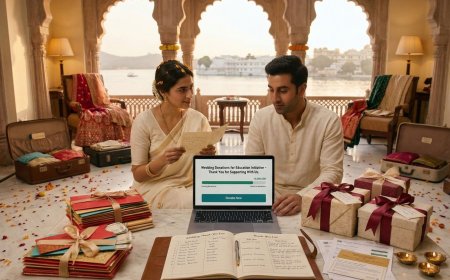
The paper was a deep burgundy with gold foil printing — the specific weight and texture of a card that communicates seriousness about the occasion before a single word has been read. The calligraphy was extraordinary. The box it arrived in was itself a small work of design, with a red ribbon and a small dried flower tucked beneath it, and the whole assembly communicated, correctly, that the wedding it was announcing was going to be an occasion of considerable beauty and care.
The wording confused almost everyone who received it.
Not the Indian guests — for them, the specific phrases were familiar, the sequence of events was legible from the structure, and the names and the relationships were immediately clear. But the forty international guests on the list — the colleagues, the university friends, the non-Indian family members — had a set of specific, common confusions that the couple discovered only when the RSVPs began to arrive with questions attached.
The first confusion was the names. The invitation listed the groom's name as the son of his father's name and his mother's name in the specific South Indian convention that places the father's name first, and the bride's name in the specific Gujarati convention of her father's name followed by her given name. Two of the international guests had addressed their RSVPs to the wrong person because they had not understood which name was the given name and which was the family name.
The second confusion was the events. The invitation listed four events across three days — the mehendi, the sangeet, the wedding, and the reception — without indicating which events all guests were invited to and which were family-only. Three international guests had booked their flights based on the assumption that the mehendi was the principal event and that they only needed to be present from the mehendi onward. The mehendi was family-only.
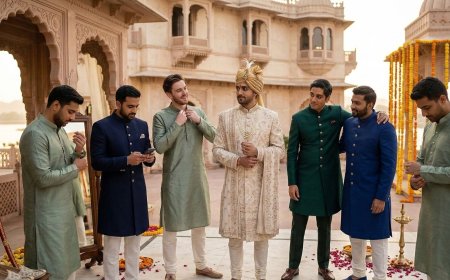
The third confusion was the dress code. The invitation said "traditional Indian attire or formal Western wear." One guest arrived at the mehendi in a three-piece suit because he had interpreted "formal Western wear" as the dress code for all events and had not brought Indian attire. He spent the evening looking magnificent and feeling conspicuous.
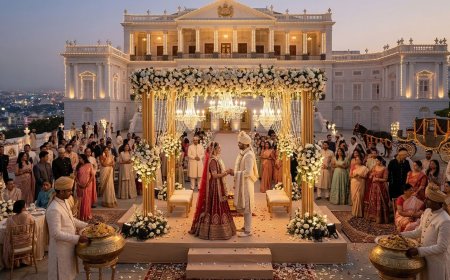
The fourth confusion was the venue. The wedding and the reception were at different venues — the ceremony at a heritage temple property outside the city and the reception at the hotel where most guests were staying. The invitation listed both addresses but did not indicate which event was at which address or how guests were expected to travel between them.
The couple was warm, organised, and genuinely thoughtful. The invitation was beautiful. The wording had not been written for the guests who would receive it.
This guide is about writing invitation wording that works for every person on a global guest list — the Indian family who understands the conventions and the international colleague who has never attended an Indian wedding and for whom every element of the wording is new information.
The Core Reality: What the Invitation Is Actually Doing
The Invitation's Multiple Functions
The wedding invitation performs several distinct functions simultaneously — and for a global guest list, each function carries different weight for different recipients.
The announcement function: The invitation announces that a wedding is happening, when, where, and who is getting married. This function is universal — every guest needs this information regardless of their cultural background.
The invitation function: The invitation communicates that the specific recipient is invited — that their presence is wanted and expected. This function is also universal, but the specific conventions by which it is communicated vary significantly between Indian and international invitation traditions.
The logistical function: The invitation provides the practical information the guest needs to attend — the dates, the venues, the events, the dress code. For international guests managing flight bookings and accommodation and the specific logistics of attending a destination wedding in India, this function is more demanding than for local guests.
The cultural function: The invitation communicates the cultural and religious context of the wedding — the tradition being celebrated, the specific conventions of the occasion, the values the couple is expressing in the way the invitation is worded. For international guests who are unfamiliar with the cultural context, this function either succeeds in giving them a sense of what they are being invited to or produces the specific confusion of the three-piece suit at the mehendi.
The tonal function: The invitation sets the emotional register of the occasion — the specific combination of formality and warmth, of celebration and solemnity, that the couple wants their guests to carry into the event itself. For a global guest list, the tonal function requires specific attention because the conventions of formal invitation language differ between cultures and what communicates warm formality in one cultural register communicates cold distance in another.
The Two Audiences Problem
The NRI wedding invitation written for a global guest list has two distinct audiences whose needs are different in specific and important ways.
The Indian audience: Familiar with the invitation conventions — the format in which names and relationships are listed, the significance of specific phrases and blessings, the implicit understanding of which events are for all guests and which are for family, the meaning of specific event names without requiring explanation. For this audience, the standard Indian wedding invitation wording is sufficient.
The international audience: Unfamiliar with the conventions — needing explicit explanation of what each event is, who is invited to which events, what the dress code means in practice, how the names work, what the specific phrases mean if they are drawn from the Indian tradition. For this audience, the standard Indian wedding invitation wording is insufficient.
The resolution: The invitation wording for a global guest list must serve both audiences simultaneously — preserving the specific cultural character and the specific warmth of the Indian invitation tradition while being sufficiently explicit and sufficiently clear that the international guest has all the information they need without requiring supplementary research or the specific embarrassment of arriving at the wrong event in the wrong outfit.
This is not a compromise between the two audiences. It is the specific craft of writing wording that is both culturally authentic and universally clear — more demanding than writing for either audience alone, and more rewarding when it succeeds.
The Names: The First Clarity Challenge
The Complexity of Indian Name Conventions
Indian name conventions vary significantly by region, community, and family — and the variation produces specific confusion for international guests who are accustomed to the Western convention of given name followed by family name as a universal standard.
The South Indian naming convention: In many South Indian families, the father's name comes first, followed by the child's given name — so a man named Rajan whose father is Krishnamurthy may be formally named Krishnamurthy Rajan. The family name as understood in the Western convention does not exist in the same form. International guests who receive an invitation listing the groom as "Krishnamurthy Rajan" may address communications to "Mr. Krishnamurthy" — using what is actually the father's name as the family name.
The Gujarati and Rajasthani naming convention: Many families use the father's given name as the child's middle name — Priya Ramesh Shah, where Priya is the given name, Ramesh is the father's name, and Shah is the family name. The international guest who is uncertain which of these three names is the "last name" for addressing purposes is in a specific and unnecessary confusion.
The hyphenated and combined family name: NRI couples who have adopted their country of residence's naming conventions — or who have combined their names after marriage — may have names that follow different conventions from the rest of the family members listed on the invitation.
The practical resolution for invitation wording:
Use the names in the form that is most legible to the international audience while remaining appropriate for the Indian audience. For Indian names whose structure may be unclear to international readers, a brief parenthetical clarification — (Rajan) following the full name to indicate the given name — is a small addition that removes a large confusion.
The couple's names, specifically, should be presented in the form they use in daily life in their country of residence — because the international guest who addresses correspondence to "Mr. Krishnamurthy" when the groom goes by "Rajan" in his London office has received wording that has prioritised tradition over practical clarity.
The Family Relationships
The standard Indian wedding invitation lists the families issuing the invitation — typically both sets of parents — with specific relationship designations that are meaningful within the Indian cultural context and may be unclear outside it.
The invitation issued by "Shri and Smt. Venkataraman Iyer" requires an international guest to know that Shri and Smt. are the Indian equivalents of Mr. and Mrs. — a piece of knowledge that is not universal. The invitation that uses "Mr. and Mrs. Venkataraman Iyer" makes this information immediately legible without removing any of the invitation's warmth or cultural character.
The guidance: Replace or supplement traditional Indian honorifics and family designation conventions with equivalents that are immediately legible to international guests. This is not a removal of cultural character — it is the recognition that the character communicates most effectively when it is understood.
The Events: The Second Clarity Challenge
The Multi-Event Structure
The NRI wedding's multi-event structure — the mehendi, the sangeet, the ceremony, the reception, and potentially additional events before and after — is the element of the invitation that most consistently confuses international guests for two specific reasons.
The first reason: International guests from cultures where a wedding is a single event on a single day do not automatically understand that each of the listed events is a separate occasion requiring separate preparation, separate travel, and separate outfit choices.
The second reason: The convention in many Indian wedding invitations of listing all events without indicating which are open to all guests and which are family-only creates the specific confusion of international guests who book flights based on an event they were not actually invited to.
The resolution for the multi-event structure:
List each event clearly with its name, date, time, and venue — in a format that makes it obvious that these are separate occasions rather than a programme for a single day.
For each event, explicitly indicate the invitation scope: "All guests are warmly invited" for events that are open to the full guest list. "Family and close friends" or "immediate family only" for events with a more limited invitation scope. This explicit indication removes the assumption that every event listed in the invitation is an invitation to every recipient.
Include a brief, one-sentence description of what each event is — not a detailed explanation but enough to give the international guest a sense of what they are attending. "The mehendi is an intimate gathering where the bride is adorned with henna in celebration of the wedding" gives the international guest the context they need without requiring them to research the term.
The Event Names
The specific event names used in Indian wedding invitations — mehendi, sangeet, baraat, vidai, and their various regional variants — are immediately legible to Indian guests and entirely opaque to international guests who have not researched the terminology.
The resolution:
Use the Indian event name followed by a brief English descriptor in parentheses or as a subtitle. "Mehendi (Henna Ceremony)" gives the Indian guest the familiar term and the international guest the immediate comprehension. "Sangeet (Music and Dance Celebration)" communicates both the cultural specificity and the general character of the event.
The parenthetical descriptor does not diminish the invitation's cultural authenticity — it extends the invitation's accessibility to the full range of its recipients.
The Venues: The Third Clarity Challenge
The Multiple Venue Problem
The NRI wedding's events are frequently spread across multiple venues — the hotel where guests are staying, the ceremony venue which may be at a different location, the reception venue which may be different again. The invitation that lists multiple addresses without clearly indicating which address corresponds to which event creates the specific possibility of guests arriving at the wrong location for the wrong event.
The resolution:
Match each event to its specific venue address explicitly — not as a general address list at the bottom of the invitation but as a specific field for each event. Every event in the invitation should have its own clearly associated venue name and address.
Include the Google Maps link or GPS coordinates for each venue in the digital version of the invitation or the wedding website — international guests navigating to unfamiliar addresses in Indian cities benefit enormously from a direct maps link rather than a street address that may not be findable through standard navigation apps.
Indicate the transport arrangement for each event — whether the couple is providing shuttle service from the accommodation, whether guests are expected to arrange their own transport, or whether a specific transport arrangement has been made.
The Destination and Duration
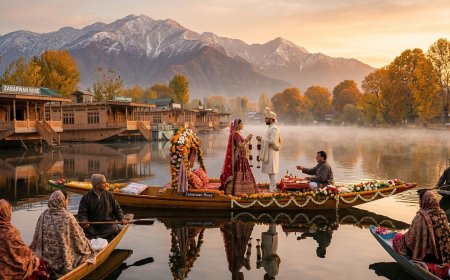
For destination weddings — the Rajasthan fort, the Goa beach venue, the Kerala backwater property — the invitation should make the destination character of the event explicit. International guests who do not understand that the wedding requires travel to a specific Indian city, that accommodation needs to be arranged at the destination, and that the events span multiple days require this information to be stated clearly rather than implied by the venue address.
The practical wording:
"The wedding will be held across four days in Jaipur, Rajasthan. Accommodation information and venue details are available at [wedding website]. We welcome guests from around the world and are here to help with any planning questions."
This explicit acknowledgment of the destination wedding's nature and the availability of planning support removes the specific confusion of the international guest who has received an invitation to an event in a city they have never visited and does not know what planning it requires.
The Dress Code: The Fourth Clarity Challenge
Why Standard Dress Code Wording Fails
"Traditional Indian attire or formal Western wear" is the dress code instruction that appears on most NRI wedding invitations and that consistently produces the three-piece suit at the mehendi.
The specific failures of this wording for an international audience:
It does not indicate whether the dress code applies to all events equally or whether different events have different dress codes. The mehendi's dress code is not the ceremony's dress code is not the reception's dress code — but the standard invitation wording implies a single dress code for all occasions.
It does not tell the international guest what "traditional Indian attire" means or where to find it. The instruction to wear something the guest has never worn and does not own, without any guidance on what it looks like or how to obtain it, is an instruction that produces anxiety rather than preparation.
"Formal Western wear" does not clarify whether a dark suit is appropriate or whether a tuxedo is required or whether a smart lounge suit is sufficient — different interpretations of "formal" produce different outcomes.
The resolution:
Provide event-specific dress codes rather than a single dress code for the whole wedding. Each event listing should have its own dress code indicator.
For the dress code itself, use language that is specific enough to be actionable:
"Traditional Indian attire is warmly encouraged — sarees, salwar kameez, or lehengas for women; kurta pyjamas, sherwanis, or bandhgala jackets for men. If you need guidance on where to find Indian attire, please see our wedding website. Smart formal Western attire is equally welcome."
This wording names specific garments, makes the encouragement rather than requirement clear, acknowledges the practical challenge for international guests by pointing to resources, and confirms that Western attire is acceptable — removing the specific anxiety of the guest who cannot find Indian attire and does not know whether attending without it is appropriate.
The RSVP: The Fifth Clarity Challenge
The RSVP Process for International Guests
The standard Indian wedding invitation RSVP mechanism — the phone call to the family, the WhatsApp message to the bride's mother — is natural for guests who have a direct family relationship with the hosts and who know which number to call and in which language to respond.
For international guests — particularly non-Indian guests who do not have a direct family relationship with the hosts and who may not know who to contact or how — the RSVP mechanism needs to be explicit.
The RSVP wording for a global guest list:
Provide a specific RSVP method — an email address, a wedding website RSVP form, or a WhatsApp number — that is clearly identified as the RSVP channel. "Please RSVP by [date] at [email address] or through our wedding website at [URL]."
Provide a specific RSVP deadline — not a vague "kindly respond at your earliest convenience" but a specific date by which the RSVP is needed and why. "Please RSVP by [date] so we can confirm your accommodation and catering arrangements."
Include a dietary and accessibility requirements field in the RSVP — either on the RSVP card itself or on the wedding website RSVP form. "Please let us know of any dietary requirements or accessibility needs so we can ensure your comfort."
The RSVP for Multiple Events
For invitations that list multiple events with different guest scopes, the RSVP should allow the guest to indicate which events they are attending — not assume that a single RSVP covers all events.
The wedding website RSVP form is the most practical mechanism for this — allowing guests to indicate their attendance at each specific event, their travel dates, and their accommodation requirements in a single form that gives the couple all the information they need.
The Language and Tone: The Sixth Clarity Challenge
The Formality Register
Indian wedding invitations are typically written in a formal register that reflects the seriousness and the cultural weight of the occasion. The specific phrases of the formal Indian invitation — "request the honour of your presence," "auspicious occasion," "seek your blessings" — are entirely appropriate for the Indian audience and may feel formal to the point of unfamiliarity for international guests accustomed to a warmer, more direct invitation style.
The resolution:
The formal register is appropriate and should be maintained — the NRI wedding invitation should not abandon its cultural character in the attempt to be accessible. But the specific phrases that are drawn from the Indian invitation tradition and that carry cultural meaning for the Indian audience can be supplemented with warmer, more direct language that serves the international audience.
The invitation that opens with a blessing or auspicious phrase — appropriate for the Indian tradition — and transitions to warmer, more personal language for the body of the invitation serves both audiences. "With the blessings of [deity or ancestors], we joyfully invite you to celebrate with us as [couple names] begin their journey together."
The Religious and Cultural Phrases
Many Indian wedding invitations include specific religious phrases — Sanskrit shlokas, Quranic verses, Sikh prayers, or other religious content — that are appropriate to the tradition being celebrated and that carry deep meaning for guests from that tradition.
For international guests who are not from the tradition, these phrases are beautiful but potentially opaque. A brief English translation or description immediately following the religious phrase — in parentheses or as a subtitle — makes the phrase's content accessible without diminishing its significance.
"Om Ganeshaya Namah (In reverence to Ganesha, the remover of obstacles, we begin this auspicious occasion)"
This addition takes three seconds to read and transforms the experience of the international guest from encountering unfamiliar script to being welcomed into the specific meaning of the tradition.
The Complete Invitation Structure: A Framework
The Elements in Sequence
A well-structured NRI wedding invitation for a global guest list moves through the following elements in a sequence that serves both the Indian and international audience:
The opening blessing or auspicious phrase — in the tradition's language with an English translation or description. Sets the cultural and religious register of the occasion.
The hosting family introduction — the names of the families issuing the invitation, in the form that is legible to international guests. "Mr. and Mrs. [Bride's parents' names] and Mr. and Mrs. [Groom's parents' names] joyfully invite you to celebrate the wedding of their children."
The couple's names — in the form the couple uses in daily life, clearly identified as bride and groom. For names whose structure may be unclear, a brief parenthetical with the given name or a line break that separates the elements.
The personal invitation — a warm, direct line that communicates the specific pleasure of the recipient's presence. "We would be honoured and delighted to have you with us to celebrate this occasion."
The event listings — each event with its name and descriptor, date, time, venue and address, dress code, invitation scope, and transport information. This section is the invitation's logistical core and should be formatted for maximum clarity rather than for aesthetic consistency with the rest of the invitation.
The practical information pointer — a clear reference to the wedding website and to the contact for questions. "Complete event details, accommodation information, and planning guidance are available at [wedding website]. Please contact [name] at [email/phone] with any questions."
The RSVP information — the specific method, the specific deadline, and the specific fields required.
The closing — a warm, brief expression of the couple's and families' anticipation of the occasion.
The Invitation Suite
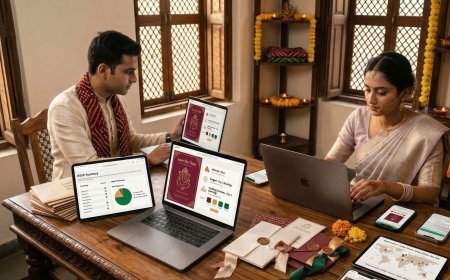
For NRI weddings with large international guest lists, the single invitation card may not be the right format. The invitation suite — a collection of components that together provide the complete information — allows the core invitation to maintain its aesthetic and tonal integrity while the supporting components deliver the practical information that international guests need.
The invitation suite components:
The main invitation card — the formal announcement of the wedding, the couple's names, and the hosting families. Cultural, beautiful, appropriately formal.
The events card — the complete listing of all events with the specific information each requires. More detailed and more practical in tone than the main card, formatted for clarity rather than aesthetics.
The accommodation and travel card — the destination information, the accommodation options, the travel guidance. Entirely practical.
The wedding website card — a single card that points to the wedding website where all detailed information lives, formatted with the URL prominently displayed and a QR code for immediate access.
The RSVP card — a simple, clear response mechanism that international guests can complete and return or that directs them to the online RSVP form.
The Digital Invitation: The International Guest's Natural Format
Why Digital Works Better for International Guests
The physical invitation — however beautiful — creates a specific logistical challenge for international guests: the information it contains is static, is in the guest's possession rather than readily accessible from their phone when they need it, and cannot be updated if any details change.
The digital invitation — or the digital supplement to the physical invitation — solves these problems. A digital invitation delivered via email or WhatsApp, with links to the wedding website for complete information and to the RSVP form for response, gives the international guest immediate access to all the information they need in the format they are most likely to consult when managing their travel logistics.
The practical approach:
Send the physical invitation to all guests as the formal announcement. Follow with a digital version — the PDF of the invitation with live links, or a brief email with the key information and the wedding website link — specifically to international guests who will be managing their travel logistics digitally.
The Wedding Website as Invitation Extension
The wedding website is the natural extension of the invitation for a global guest list — the place where the invitation's compressed information expands into the complete detail that international guests need.
The wedding website should contain everything that the physical invitation cannot contain without becoming a booklet: the complete event listings with full venue information and maps, the accommodation options and booking links, the dress code guidance with retailer recommendations, the cultural information brief, the visa and health preparation guidance, and the RSVP form.
The invitation's role in relation to the wedding website is to announce the occasion and direct the guest to the website for complete information — not to contain all the information itself.
Common Mistakes NRI Couples Make With Invitation Wording
The first mistake is writing the invitation for the Indian family audience and assuming the international guests will manage with it. The invitation wording that is clear for the Indian audience is not necessarily clear for the international audience — and the international guest who is confused by the invitation is less likely to ask for clarification than to make incorrect assumptions and act on them. Write for both audiences simultaneously.
The second mistake is not indicating which events are open to all guests. The invitation that lists all events without indicating which are family-only creates the specific problem of international guests booking flights based on events they were not actually invited to. Every event listing should explicitly indicate its guest scope.
The third mistake is providing a dress code that is not actionable. "Traditional Indian attire or formal Western wear" is a dress code instruction that requires the international guest to know what Indian attire is, where to find it, and what "formal Western" means in this specific context. Provide specific garment names, retailer guidance, and a clear indication that Western attire is acceptable if Indian attire is not possible.
The fourth mistake is using Indian honorifics and naming conventions without explanation. The international guest who does not know that Shri means Mr. or that the first name listed in a South Indian name is the father's name has received an invitation whose conventions require prior cultural knowledge to interpret. Make the names and honorifics legible to all recipients.
The fifth mistake is not providing a clear, simple RSVP mechanism. The invitation that asks guests to "kindly respond" without indicating how, to whom, by when, and with what information creates an RSVP process that is unclear for guests who do not have a direct family relationship with the hosts and who do not know the expected form of the response.
The Invitation That Works for Everyone
The beautiful invitation that confused everyone was not a failure of design or a failure of love. It was a failure of audience — the failure to write wording that served the full range of the people who would receive it.
The international guest who addressed the RSVP to the wrong person, who booked the flight for the wrong event, who arrived in a three-piece suit to the mehendi — each of these was a guest who had done their best with the information they had been given. The information they had been given was insufficient for their specific position as someone unfamiliar with the Indian wedding tradition, the Indian invitation convention, and the Indian city where the wedding would take place.
The invitation that works for everyone is not a simpler invitation. It is not a less beautiful invitation. It is not a less culturally authentic invitation. It is an invitation that has been written with the specific knowledge that it will be received by people with different degrees of familiarity with its conventions — and that has been crafted to serve all of them.
The Indian grandmother who receives it reads the blessing and recognises the tradition and understands every element without explanation. The Scottish colleague who receives it reads the English descriptor after each event name and understands immediately what he is being invited to and what to wear and how to RSVP.
Both of them feel invited. Both of them feel considered. Both of them arrive at the right event in the right outfit, having booked their travel correctly, having RSVP'd through the right channel by the right deadline.
The invitation that works for a global guest list is the invitation that every person on that list received.
Not the invitation that was designed for some of them and survived for the rest.
Published by NRIWedding.com — The Premium Global Platform for Non-Resident Indians Planning Indian Weddings From Abroad.
What's Your Reaction?
 Like
0
Like
0
 Dislike
0
Dislike
0
 Love
0
Love
0
 Funny
0
Funny
0
 Angry
0
Angry
0
 Sad
0
Sad
0
 Wow
0
Wow
0