














































































Parking Management for Large Indian Weddings: The Complete Guide for NRI Couples
"Parking chaos at a large Indian wedding creates a first impression that contaminates the entire guest experience before a single welcome drink has been served. This comprehensive guide gives NRI couples the complete framework for planning, staffing, and executing a professional parking management system for large outdoor Indian weddings. From realistic capacity assessment and zone system design to marshal staffing calculations, rideshare management, baraat integration, departure planning, and guest communication strategy, this is the most detailed parking management resource available for NRI couples planning large Indian weddings remotely from the UK, USA, Canada, UAE, or Australia. Your guests deserve a seamless arrival from the very first moment."

When the Wedding Starts in the Parking Lot
Consider this.
Your wedding day has arrived. Months of planning, thousands of decisions, an investment of resources and emotion that is difficult to fully articulate — all of it culminating in this single day. Your guests are arriving. The venue looks extraordinary. The décor team has delivered everything you asked for. The catering is ready. The lighting is perfect.
And then the calls start coming in.
Your uncle from Chicago, who flew fourteen hours to be here, is sitting in his hired car on a dusty road 400 meters from the venue entrance because there is no space to move. Your future in-laws' family, arriving in a convoy of eight vehicles, cannot find anyone directing them to the parking area. Three cars have already blocked the main entrance trying to drop off elderly guests, creating a bottleneck that has now backed up traffic for half a kilometer. A guest with mobility limitations cannot find the accessible drop-off point because nobody told the parking attendants it existed. The baraat procession is supposed to begin in twenty minutes and the road in front of the venue is completely gridlocked.
The wedding has not technically started yet. But the experience has. And right now, for a significant portion of your guest list, that experience is frustrating, undignified, and chaotic.
This is the parking management failure scenario that plays out at large Indian weddings with remarkable consistency. And like washroom planning, generator management, and other infrastructure-focused logistical disciplines, parking management receives minimal attention during the planning process and maximum attention when it collapses during the event itself.
For NRI couples planning large Indian weddings from abroad, parking represents a particularly complex challenge. You cannot drive the approach roads personally. You cannot assess the parking field capacity with your own eyes. You cannot observe how traffic flows at the venue during an event. You are making critical decisions about a physical, spatial, and human coordination challenge from thousands of kilometers away — based on venue descriptions, coordinator assurances, and satellite map images that give no sense of how 300 guests arriving in 120 vehicles across a 90-minute window will actually interact with the space available.
The consequences of getting this wrong extend far beyond the inconvenience of a long walk from a distant parking area. Parking chaos at a wedding creates a first impression that contaminates the entire guest experience before a single glass of welcome drink has been served. It causes delays that cascade through every element of the event timeline. It creates safety risks for elderly guests navigating unmanaged traffic. It generates a level of stress and frustration in arriving guests that takes significant time to dissipate — time that should have been spent in celebration.
This guide provides NRI couples with the complete framework for planning, managing, and executing a parking strategy for a large Indian wedding that ensures every guest — from the first arrival to the last departure — experiences the event beginning from the moment they turn onto the approach road.
The Core Reality: Why Parking Fails at Large Indian Weddings
The causes of parking failure at large Indian weddings are consistent and predictable. Understanding them transforms parking from an afterthought into a manageable planning discipline.
Venue capacity assessments are almost always optimistic. When venues quote parking capacity, they are typically counting the maximum number of vehicles that can be physically squeezed into the available space under ideal conditions — vehicles parked with perfect efficiency, no circulation space, no allowance for larger vehicles, and no consideration of the simultaneous arrival patterns that a wedding generates. Real-world parking capacity at events is consistently twenty to thirty percent lower than venue-quoted figures.
Indian wedding arrival patterns create extreme peak demand. Unlike Western wedding ceremonies where guests arrive within a narrow window and then stay for a predictable duration, large Indian weddings — particularly receptions — have a broad arrival window but with significant clustering. A significant percentage of guests will arrive within the same thirty-to-forty-five-minute window regardless of the stated start time, creating a peak demand moment that tests parking infrastructure at its absolute limits.
The vehicle mix at Indian weddings is more complex than at most events. A large Indian wedding generates a vehicle mix that includes private cars, hired taxis and rideshares, autorickshaws, luxury coaches for out-of-town guest groups, vendor vehicles, catering delivery trucks, and the baraat procession vehicle. Each category has different spatial requirements, different arrival and departure timing, and different management needs. Treating them as a single undifferentiated flow is the root cause of most parking chaos.
Staffing is consistently insufficient. A large outdoor venue with 120 vehicles arriving across a 90-minute window requires a minimum of eight to ten trained parking marshals with clear roles, communication equipment, and a coordinated management system. Most weddings deploy two or three untrained staff who stand near the parking area with no system, no communication, and no authority to manage the flow effectively.
Departure management is completely ignored. Every parking plan that exists at most Indian weddings is focused entirely on arrival. Nobody plans for departure — the simultaneous, vehicle-retrieval-required exit of hundreds of guests at the end of the evening, often in the dark, often after alcohol service, and always in a compressed timeframe. Departure chaos is frequently worse than arrival chaos and leaves guests with their final impression of the entire event.
The Strategic Framework: Building a Complete Parking Management System
Phase 1 — Conduct a Realistic Capacity Assessment
Before any other planning begins, you need an honest, independently verified assessment of the parking capacity actually available at your venue.
How to conduct a remote capacity assessment:
Request a detailed satellite or aerial map of the venue and surrounding area from your venue coordinator or local wedding planner. Using this map, identify all areas that can realistically be used for guest parking — the primary venue parking area, any overflow fields or adjacent lots, road verges that can safely accommodate parking, and any nearby public or private parking facilities that could be arranged through negotiation.
For each identified area, calculate realistic capacity using a standard parking space allocation of 2.5 meters by 5 meters per vehicle, with 6-meter-wide circulation lanes between rows. Do not use the venue's quoted capacity figure — calculate independently from the map dimensions.
Request a video walkthrough of all parking areas — conducted at the same time of day as your wedding functions, if possible — so you can assess surface conditions, lighting availability, gradient, and access route width.
The vehicle count calculation:
Estimate your vehicle count from your confirmed guest list. A useful rule of thumb for Indian wedding guest groups: divide your total guest count by 2.5 to 3 to estimate vehicle arrivals, accounting for family groups traveling together. For a 300-guest wedding, expect 100 to 120 vehicle arrivals. Add vendor and catering vehicles — typically 15 to 25 additional vehicles for a large wedding. Add a 20 percent buffer for taxis, rideshares, and additional vehicles not captured in your primary estimate. The total is your planning vehicle count.
Compare your planning vehicle count against your independently calculated realistic capacity. If the gap is significant, overflow planning becomes an immediate priority.
Phase 2 — Design the Parking Zone System
Effective parking management at a large Indian wedding requires a clearly defined zone system that separates different vehicle categories, manages arrival and departure flow, and ensures guest experience from the moment of arrival.
The core zones of a large wedding parking system:
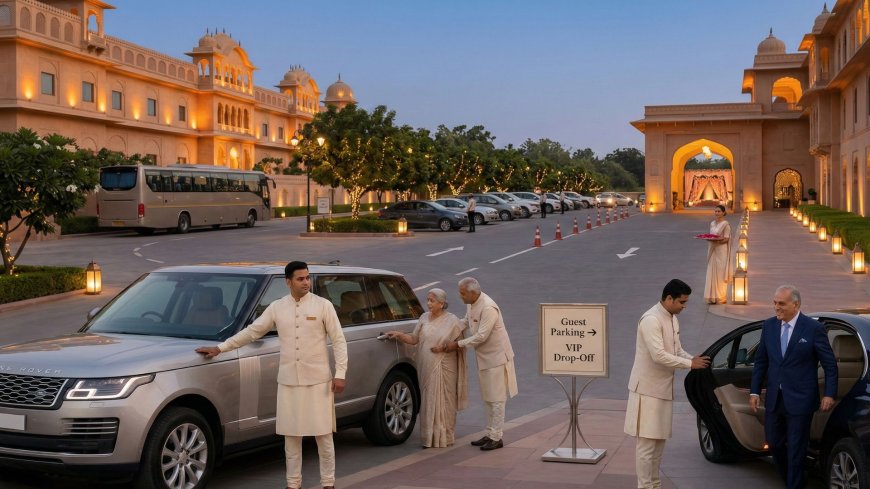
VIP and Family Drop-Off Zone — a clearly designated, attended drop-off area as close as possible to the main venue entrance. This zone is for drop-off only — no parking. Vehicles drop their passengers and immediately move to the general parking area. This zone must be wide enough to accommodate two vehicles simultaneously and have a clear exit route that does not conflict with the arrival lane. This is the zone where your elderly guests, your immediate family, and your VIP guests are greeted and transferred smoothly into the venue.
Accessible Parking Zone — a designated area of level, well-surfaced parking spaces immediately adjacent to the venue entrance, reserved exclusively for guests with mobility limitations. This zone requires clear signage, surface lighting, and an attendant whose specific responsibility is ensuring accessible parking guests receive the assistance they need from vehicle to venue entrance.
General Guest Parking Zone — the primary parking area for the majority of guests. This zone requires clear lane markings, logical row organization, adequate lighting for evening arrivals and nighttime departures, and sufficient attendant staffing to direct vehicles to spaces efficiently without creating internal circulation conflicts.
Vendor and Catering Vehicle Zone — a completely separate area, accessed via a service route distinct from the guest arrival route where possible, for all vendor vehicles, catering delivery trucks, and supplier access. Mixing vendor vehicle movements with guest arrivals is a primary cause of approach road gridlock. Separating them eliminates this conflict entirely.
Coach and Large Vehicle Zone — if you are arranging guest coaches from hotels or airports, these vehicles require dedicated staging areas that are sized appropriately for large vehicles and positioned so that their arrivals and departures do not conflict with the general parking flow.
Baraat Staging Area — if your wedding includes a baraat procession, the procession vehicles require a dedicated staging area away from the main arrival flow, with a planned route to the venue entrance that has been coordinated with your parking management team and communicated to the approach road traffic management plan.
Phase 3 — Design the Traffic Flow System
The parking zone system only functions if the traffic flow leading to and within those zones is managed intelligently. Traffic flow design for a large Indian wedding begins at the nearest main road junction — not at the venue gate.
Approach road management:
Identify the primary route guests will use to approach the venue. Walk or drive this route — or ask your local planner to video it — and identify every potential congestion point: narrow sections, unmarked junctions, road conditions that slow traffic, and any points where multiple arrival routes converge. Position traffic management marshals at every significant junction on the approach route — not just at the venue entrance. A marshal at the junction 800 meters from the venue who is directing vehicles confidently and clearly prevents the backlog that creates gridlock at the entrance.
Venue entrance management:
The venue entrance is the highest-pressure point in your entire traffic management system. It requires a minimum of two marshals — one managing inbound flow and one managing the internal circulation from the gate to the drop-off zone and parking areas. These marshals require communication equipment — walkie-talkies or mobile phones — and a clear protocol for managing flow when the parking area approaches capacity.
Internal circulation:
Design a one-way circulation system within the parking area wherever possible. Two-way circulation in a parking field creates head-on conflicts between arriving and departing vehicles that rapidly escalate into gridlock. One-way entry and one-way exit, clearly marked and actively managed, eliminates this entirely.
Phase 4 — Staff the System Correctly
Parking management staffing is where most wedding parking plans fail completely. The number of marshals required for a large Indian wedding is consistently higher than couples anticipate, and the quality of briefing those marshals receive determines whether the system functions or collapses under pressure.
Staffing calculation for a 300-guest, 120-vehicle wedding:
Two marshals on approach road junctions from one hour before the first guest arrival. Two marshals at the venue entrance managing inbound flow. Two marshals in the general parking zone directing vehicles to spaces. One marshal dedicated to VIP and family drop-off zone. One marshal dedicated to accessible parking. One marshal managing vendor and service vehicle access. One roving coordinator with overview responsibility and communication with all positions. Total: ten marshals minimum for a 300-guest wedding.
Marshal briefing requirements:
Every marshal must be briefed in writing and verbally before the event begins. The briefing must cover their specific position and role, the zone system and vehicle categories, the communication protocol and escalation procedure, the timeline of key events — baraat arrival, ceremony start, dinner service, event end — that will create demand surges, and the procedure for managing a full parking area including overflow direction.
Phase 5 — Plan the Departure
Departure management is the most neglected element of wedding parking planning and frequently the source of the worst guest experience of the entire event.
At the end of a large Indian wedding reception, you have a scenario where a large number of guests attempt to retrieve their vehicles and depart within a compressed timeframe, in the dark, after a long evening that may have included alcohol service, with varying levels of familiarity with the venue layout and parking area.
Without active management, this scenario produces gridlock, confusion, safety risks, and a final impression of chaos that undoes everything the carefully planned arrival experience created.
Departure management principles:
Maintain full marshal staffing through the entire departure period — do not stand down parking staff as the event winds down. Implement a staggered departure system for coach guests — communicate departure times to group coaches clearly and in advance so guest groups move to their coaches in an organized sequence rather than simultaneously. Position a marshal at the parking area exit to manage the exit flow onto the approach road. If exit traffic could conflict with approach road traffic, coordinate with local traffic management authorities for temporary traffic management support during the peak departure window. Ensure the parking area is fully lit throughout the departure period — do not allow venue lighting teams to begin breaking down event lighting while guests are still departing.
Common Mistakes NRI Couples Make in Parking Management
Delegating Entirely to the Venue Coordinator Venue coordinators manage the venue. Parking management for your specific guest count and vehicle mix is an event production responsibility that requires dedicated planning and dedicated staffing. Do not assume the venue has this covered.
Not Accounting for Rideshare and Taxi Volume The growth of Ola, Uber, and local taxi services means that a significant proportion of Indian wedding guests now arrive by rideshare rather than private vehicle. Rideshare vehicles require a dedicated drop-off and pickup zone — separate from private vehicle parking — because their high-frequency, short-duration arrivals and departures create significant circulation conflicts if mixed with general parking flow.
Ignoring the Baraat in the Traffic Plan The baraat is a joyful, spectacular, culturally essential procession. It is also a significant traffic management event that can completely block approach roads and venue entrances if it is not integrated into the overall traffic flow plan. Plan the baraat route, timing, and traffic management requirements explicitly and in coordination with your parking management team.
No Communication Plan for Guests The single most effective parking management tool available costs almost nothing — a clear, detailed parking and arrival instruction communicated to every guest before the wedding day. Include approach route directions, parking zone information, drop-off point location, accessible parking instructions, and coach pickup details in your pre-wedding guest communication. Guests who arrive knowing exactly where to go require significantly less active management than guests arriving without information.
Underestimating Rural Venue Approach Challenges Destination wedding venues in rural Rajasthan, rural Goa, or hill station locations often have approach roads that are narrow, poorly surfaced, inadequately lit, and not designed for the volume of traffic a large wedding generates. These venues require more extensive approach road management than urban or peri-urban venues and may require coordination with local authorities for temporary road management measures.
The Guest Communication Strategy: Your Most Powerful Parking Management Tool
A detailed, well-designed parking and arrival guide sent to all guests in the week before the wedding eliminates the majority of arrival confusion before it begins.
Your guest parking communication should include a clear map showing the venue location, approach routes, and parking area. It should specify the arrival route recommended for guests coming from different directions. It should identify the VIP and family drop-off zone and explain the drop-off procedure. It should provide specific instructions for guests with mobility limitations. It should give coach guests their departure point, timing, and boarding procedure. It should include a contact number for a member of your team who can provide real-time assistance to guests who become confused on the approach.
This communication can be distributed via WhatsApp — the dominant communication channel for Indian wedding guest groups — as a well-designed visual card or PDF that guests can reference on their phones during arrival. The investment of thirty minutes in creating this communication saves hours of parking management headaches on the wedding day.
Parking Management Checklist for NRI Couples
Capacity and Planning
- Conduct independent parking capacity assessment from venue maps
- Calculate planning vehicle count from confirmed guest list
- Identify overflow parking options and negotiate access in advance
- Design zone system covering all vehicle categories
- Plan one-way circulation system within parking area
Staffing and Briefing
- Calculate marshal requirement at minimum one per thirty vehicles plus coordination overhead
- Brief all marshals in writing and verbally before event
- Equip all marshals with communication devices
- Assign roving coordinator with overall parking oversight responsibility
- Maintain full staffing through complete departure period
Infrastructure
- Confirm adequate lighting across all parking areas and pathways
- Mark lanes and zones clearly with physical markers or painted lines
- Install clear directional signage from approach road to parking zones
- Confirm surface condition and drainage adequacy for expected vehicle volume
- Establish dedicated rideshare pickup and drop-off zone
Guest Communication
- Distribute parking and arrival guide to all guests one week before wedding
- Include approach map, zone information, drop-off instructions, and contact number
- Provide specific accessible parking instructions separately to relevant guests
- Communicate coach departure timing and boarding points to group guests
Departure Planning
- Plan staggered coach departure sequence
- Maintain marshal coverage through full departure period
- Ensure full lighting coverage during departure
- Establish exit flow management at venue gate
The Arrival That Sets the Tone for Everything
There is a principle in hospitality that the first impression and the last impression carry disproportionate weight in how an entire experience is remembered and evaluated. Everything in between matters — but the beginning and the end anchor the memory.
Your guests' first impression of your wedding begins not at the venue entrance, not at the welcome drink station, and not at the beautifully lit mandap. It begins the moment they turn onto the approach road and encounter the first signal of how this event has been organized.
A marshal standing confidently at the junction, waving them through with clear direction. A well-lit, clearly signed approach to the venue entrance. A smooth, attended drop-off experience. A short, clearly managed walk to a venue that appears exactly as beautiful as it was promised to be.
That sequence — seamless, dignified, and clearly the result of genuine planning — creates an immediate feeling in your guests that they are in the right place, that they are cared for, and that the wedding they are about to experience has been built with complete attention to their comfort and experience.
That feeling does not come from flowers or lighting or catering. It comes from parking management executed with the same seriousness and intelligence that every other element of your wedding has received.
Plan it properly. Staff it correctly. Communicate it clearly. And your guests will arrive at your wedding already feeling exactly the way you want them to feel — welcomed, comfortable, and ready to celebrate.
What's Your Reaction?
 Like
0
Like
0
 Dislike
0
Dislike
0
 Love
0
Love
0
 Funny
0
Funny
0
 Angry
0
Angry
0
 Sad
0
Sad
0
 Wow
0
Wow
0