





































































Suryagarh Palace, Jaisalmer — A Golden Desert Wedding at the Edge of the Thar: The NRI Couple's Complete Guide
The bride had not planned to cry at the camel. She had planned to cry at the pheras — the waterproof products in position, the tissues in the bridesmaid's clutch. Nobody had briefed for the camel at sunset. The camel turned its head and looked at her with the ancient, slightly disdainful expression of the creature entirely unbothered by the human occasion happening around it. And something about that look, and the sunset, and the two hundred and twelve people she loved, and the desert whose scale makes the human occasion feel simultaneously small and significant, produced the unplanned tears. This complete guide gives NRI couples everything needed to plan a wedding at Jaisalmer's most extraordinary palace — covering the Suryagarh's architecture and desert setting, every wedding space from the poolside to the sand dunes with full capacity details, two comprehensive tables with all venue costs, catering per-head prices, accommodation from ₹18,000 to ₹2,50,000 per night, complete budget breakdown from ₹3.34 crore to ₹6.13 crore, desert event logistics, the Rajasthani folk arts programme, the twenty-four month planning timeline, and the five mistakes that cost couples the most at this destination.


Suryagarh Palace, Jaisalmer — A Golden Desert Wedding at the Edge of the Thar: The NRI Couple's Complete Guide
The Camel at Sunset
The bride had not planned to cry at the camel.
She had planned to cry at the pheras — the specific, anticipated tears of the ceremony's emotional culmination, the moment when the ritual's meaning and the occasion's significance converge in the way that the pheras always produce in the person who is fully present to what is happening. She had prepared for those tears. She had briefed the makeup artist about those tears. She had the specific waterproof products in place for exactly those tears.
She had not prepared for the camel at sunset.
The camel was part of the welcome procession — the traditional Rajasthani arrival that the Suryagarh had arranged for the evening of the guests' welcome dinner, the procession that moved across the sand dunes outside the palace with the decorated camel at its head and the dhol players behind and the Jaisalmer sky above doing the thing that the Jaisalmer sky does at sunset, which is to turn every shade of orange and gold and ochre simultaneously until the desert and the sky become the single continuous warmth of the colour whose name in English is inadequate to describe what it actually looks like when you are standing in it.
She had been walking behind the procession. The groom was beside her. The guests were around them — the two hundred and twelve people whose presence in this specific place, on this specific evening, at the edge of the Thar Desert, had required eighteen months of planning and four international flights and the wedding planner's complete professional capability and the love of the two families whose combined effort had produced the occasion.
And then the camel had turned its head.
It had turned its head and looked at her with the specific expression that camels have — the expression that is simultaneously ancient and slightly disdainful and entirely unbothered by the human occasion happening around it — and something about the combination of that look, and the sunset, and the two hundred and twelve people she loved, and the desert whose scale makes the human occasion feel simultaneously small and significant, had produced in the bride the tears that she had not planned for and that the makeup artist's waterproof products were not in the right position to manage.
The groom had noticed. He had taken her hand. He had not asked what was wrong because nothing was wrong. He had simply held her hand in the Jaisalmer sunset while the camel looked at them both with its ancient, unbothered expression.
This is what the Suryagarh Palace, Jaisalmer does to the people who get married there. It produces the moments that were not planned — the unscripted, unrehearsed, specific emotional moments that the desert's scale and the palace's beauty and the Jaisalmer sky's specific generosity combine to create for the couple who has chosen this as the place.
This guide is for the NRI couple who wants to plan the occasion that makes the unplanned moments possible — and who needs the complete, specific, practical knowledge to do it.
The Palace: Understanding Suryagarh
What Suryagarh Is — And What It Is Not
The first thing the NRI couple needs to understand about the Suryagarh Palace is that it is not the converted heritage property whose age is its primary credential. The Suryagarh was built in the twenty-first century — completed in 2012 — and its claim to the palace experience is not the centuries of royal occupation but the specific architectural achievement of building a palace in the Jaisalmer tradition whose quality, whose authenticity, and whose specific beauty are the product of the deliberate, skilled, and expensive application of the traditional craft to the contemporary construction.
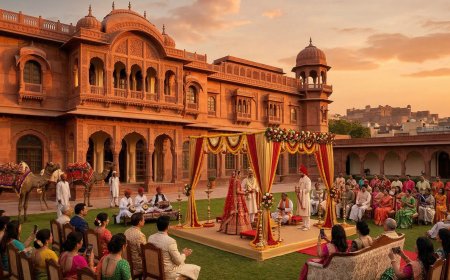
The Suryagarh was built by a team of craftspeople and architects who spent years sourcing the Jaisalmer yellow sandstone — the specific stone whose warm golden colour gives the Golden City its name — and applying to it the traditional Jaisalmer carving techniques, the jali screens, the ornamental facades, and the specific architectural vocabulary of the desert fort-palace tradition. The result is the building that looks, feels, and functions as the palace — not the pastiche or the themed resort but the genuine architectural achievement whose specific beauty has made it, in the dozen years since its opening, one of the most sought-after wedding destinations in India.
The honest assessment: the Suryagarh is the newest major palace wedding venue on this guide's list. For the couple whose requirement is the historical depth of the centuries-old palace, the Suryagarh is not the Jagmandir or the Umaid Bhawan. For the couple whose requirement is the most beautiful, the most operationally excellent, and the most specifically Jaisalmer wedding experience available — the Suryagarh is without competition.
The Jaisalmer Context: The Golden City
The Suryagarh's setting — the outskirts of Jaisalmer, where the city's golden sandstone architecture transitions into the Thar Desert's open expanse — is the context that no other Indian palace wedding venue can replicate. Jaisalmer is the westernmost of Rajasthan's major cities, the city that sits at the edge of the desert whose Pakistan border is sixty kilometres beyond, the city whose fort — the Sonar Quila, the Golden Fort — is the living fort whose residential and commercial occupation continues after eight centuries.
The Jaisalmer context gives the Suryagarh wedding its specific character — the character that is different from the Udaipur wedding's lake beauty and the Jodhpur wedding's blue city grandeur. The Jaisalmer wedding is the desert wedding — the wedding whose setting is the specific, austere, enormous beauty of the Thar, whose light is the specific golden light that the yellow sandstone and the desert atmosphere produce, and whose experience for the arriving guest is the experience of the genuinely remote, genuinely extraordinary destination.
For the NRI couple whose guests are arriving from London and Toronto and Sydney — whose daily life is the urban, the northern-hemisphere, the thoroughly familiar — the Jaisalmer destination is the specific gift of the genuinely unfamiliar. The guest who arrives in Jaisalmer for the Suryagarh wedding is the guest who has not been here before and who will not forget having been.
The Architecture and the Aesthetic
The Suryagarh's architecture is the specific achievement of the Jaisalmer palace tradition rendered in the contemporary construction — the yellow sandstone facade, the carved jali screens whose geometric patterns produce the specific play of light and shadow that is the Jaisalmer architectural tradition's most distinctive feature, the ornamental gates, the courtyard proportions, and the specific relationship between the built structure and the desert landscape that the palace's siting on the desert's edge creates.
The interiors continue the architectural commitment — the hand-carved stone details, the traditional Rajasthani craftsmanship applied to the furniture, the textiles, and the decorative elements, the specific palette of the desert's warm tones whose consistency through the interiors gives the Suryagarh its specific visual coherence.
The pool whose deck overlooks the desert. The rooftop whose view encompasses the Jaisalmer skyline and the Thar's expanse beyond. The courtyards whose proportions create the specific microclimate of the enclosed desert architecture — the shade and the air movement that the traditional design produces and that the Jaisalmer summer requires. These are the architectural achievements that the wedding's visual experience draws on and that the photographs capture as the specific beauty of this specific place.
The Wedding Spaces
The Poolside and the Desert Beyond
The Suryagarh's poolside — the infinity pool whose deck faces the desert, whose horizon is the Thar's open expanse, and whose specific position relative to the setting sun produces the golden hour photographs that have made this location the most reproduced image of the Suryagarh in the wedding photography world — is the wedding space that most completely captures the palace's specific offering.
The poolside ceremony — the mandap installed at the pool's edge with the desert as the horizon, the guests seated on the deck facing the couple and the expanse beyond — is the ceremony whose visual context is unique in the Indian wedding venue landscape. The desert is not the background. It is the ceremony's co-participant — the vast, ancient, golden presence that gives the human occasion its specific scale and its specific meaning.
The poolside capacity for the ceremony is up to one hundred and fifty guests seated — the intimate to moderate scale that the poolside's proportions accommodate. The poolside is the ceremony space rather than the large reception space — the couple who wants the poolside's visual context for the ceremony and the larger lawn spaces for the reception has understood the Suryagarh's spatial logic correctly.
The Courtyards
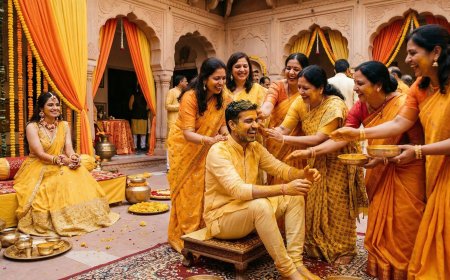
The Suryagarh's courtyards — the multiple enclosed outdoor spaces whose sandstone walls and carved details create the specific intimacy of the traditional haveli's organisation of space — are the wedding spaces for the pre-wedding functions, the mehendi, the haldi, the sangeet whose character requires the enclosed warmth of the courtyard rather than the open expanse of the desert-facing spaces.
The courtyards' capacity varies by the specific space — the primary courtyard accommodating up to two hundred guests for the standing reception and up to one hundred and fifty for the seated dinner. The courtyard wedding function has the specific quality of the contained celebration — the sound contained by the walls, the light directed by the enclosure, the intimacy of the space that knows where the party is and holds it warmly.
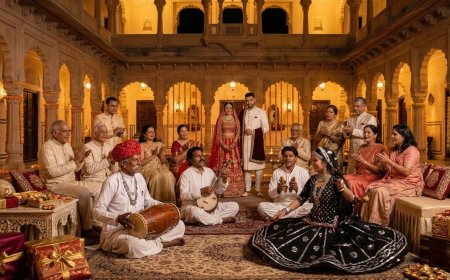
The courtyard sangeet — with the carved stone walls as the backdrop, the traditional Rajasthani musicians in the corner, the family performances on the improvised stage — is the sangeet whose setting amplifies the celebration's warmth in the way that the large open space cannot.
The Desert and the Dunes
The desert spaces beyond the palace — the sand dunes whose access from the Suryagarh is the specific logistical advantage of the palace's position at the city's edge — are the wedding spaces for the events that the desert itself provides: the sundowner cocktails on the dunes, the camel procession welcome dinner, the starlit desert dinner whose setting is the open Thar with the Milky Way above and the Jaisalmer fort's illuminated silhouette on the horizon.
The desert dinner — the occasion set on the dunes with the decorated tents, the carpet and the cushion seating, the traditional Rajasthani entertainment, and the desert sky whose star density in the absence of the light pollution is the specific, overwhelming visual experience that the city-dwelling guest has never encountered — is the event that the Suryagarh's desert position uniquely enables and that most consistently produces the unplanned emotional moments. The camel at sunset. The grandmother's silence at the dune's edge. The groom who looks up at the Milky Way and cannot speak for a moment.
The desert event's capacity is effectively unlimited by the venue's walls — the desert accommodates the size the couple needs. The practical limitation is the logistical management of the large group in the open desert — the transport, the lighting, the catering infrastructure, the safety considerations that the desert setting requires and that the experienced destination planner manages as the foundation of the desert event's planning.
The Rooftop
The Suryagarh's rooftop — the elevated space whose view encompasses the Jaisalmer fort to the east, the desert to the west, and the full Jaisalmer sky above — is the wedding space for the intimate occasion whose specific asset is the panoramic view rather than the capacity.
The rooftop accommodates up to one hundred guests for the cocktail reception and up to sixty for the seated dinner — the intimate scale that the rooftop's proportions set and that the view's quality justifies. The rooftop cocktail reception at the Suryagarh — with the Sonar Quila visible in the distance and the desert light doing what the desert light does at the specific hour of the evening — is the occasion whose setting is its own entertainment.
The Indoor Spaces
The Suryagarh's indoor spaces — the durbar hall, the dining room, the specific interior spaces whose carved stone ceilings and traditional detailing are the interior expression of the exterior's architectural quality — are the wedding spaces for the functions that the Jaisalmer climate makes the outdoor spaces unsuitable for: the summer function, the midday occasion, the event that requires the air conditioning's management of the Thar Desert's specific thermal demands.
The durbar hall's capacity is up to one hundred and twenty guests for the seated dinner. The indoor spaces are not the Suryagarh's primary wedding offering — the palace's specific gift is the outdoor spaces and the desert's proximity — but they are the quality indoor spaces whose character is consistent with the palace's overall standard and whose climate-controlled environment is the essential backup for the outdoor events whose weather management the Jaisalmer climate occasionally requires.
The Season: The Desert's Specific Demands
The Wedding Window
The Jaisalmer climate is the most extreme of the Rajasthan wedding destinations — the Thar Desert's specific climate whose summer temperatures reach forty-eight degrees and whose winter nights drop to single digits imposing the clearest wedding season boundary of any Indian destination.
October to November is the post-monsoon shoulder season whose temperatures have settled from the summer's extreme to the comfortable twenty-five to thirty-five degrees of the desert autumn. The October Jaisalmer days are warm — the outdoor daytime function requires the shade management — but the October evenings are the specific gift of the desert autumn, the temperatures dropping to twenty degrees as the sun sets and the desert releasing the day's warmth into the clear night sky. The October desert dinner, the October sundowner, the October ceremony in the late afternoon — these are the Suryagarh's events whose timing works with the climate rather than against it.
November to February is the peak season whose specific asset is the desert winter's specific quality — the cool days whose temperature requires the light wrap in the morning and whose afternoons are the perfect outdoor function temperature, and the cold nights whose temperature drops to eight to twelve degrees and whose sky is the clearest the Thar produces. The winter desert sky's star density — the specific astronomical gift of the clear desert atmosphere and the minimal light pollution of the remote location — is the sky that the desert dinner's guests look up at and cannot speak for a moment.
The December and January dates are the competition — the most desired and the most quickly taken. The NRI couple whose heart is set on the winter desert wedding should open the conversation with the Suryagarh at twenty-four months before the desired date.
February and March are the shoulder season's return — the temperatures rising toward the pre-summer warmth, the days comfortable and the evenings still usable for the outdoor function. The March Jaisalmer wedding is the wedding at the season's limit — possible and beautiful, but the couple should plan the outdoor events for the early evening and the late afternoon rather than the full day's outdoor programme.
The months to avoid: April through September without exception. The May Jaisalmer temperature reaches forty-eight degrees. The loo wind — the hot desert wind that blows across the Thar in the pre-monsoon months — is the outdoor event's adversary whose force and whose heat make the outdoor function genuinely unsafe. The monsoon, when it reaches Jaisalmer — typically later and less reliably than in the wetter parts of Rajasthan — is the brief but intense disruption to the outdoor programme. No responsible wedding should be planned for the Jaisalmer summer.
The NRI Couple's Specific Jaisalmer Planning
The Access Question
Jaisalmer is the most remote of the major Rajasthan wedding destinations — the specific remoteness that is the source of its beauty and the specific planning challenge that the NRI couple must address.
The Jaisalmer Airport — the civilian airport whose connectivity has improved in recent years — now receives the direct flights from Delhi and Mumbai whose journey time is approximately one hour fifteen minutes from Delhi and one hour forty-five minutes from Mumbai. The international guest arriving from abroad will connect through Delhi or Mumbai — the connection whose coordination is the first logistical planning element of the Jaisalmer wedding.
The train alternative — the overnight train from Delhi to Jaisalmer whose journey time is approximately seventeen hours and whose experience of crossing the Thar by rail is the specific adventure that some guests will choose — is the option whose romance the NRI couple can offer as the alternative to the flight without making it the primary guest transport.
The guest transport management:
The coordinated airport pickup — the fleet of vehicles that meets the arriving guests at the Jaisalmer Airport and transfers them to the Suryagarh — is the essential guest management infrastructure for the destination whose unfamiliarity to the international guest makes the independent navigation the source of the avoidable stress. Coordinate the arrivals. Know every guest's flight. Have the vehicle waiting.
The Vendor Ecosystem
The Jaisalmer vendor ecosystem is smaller than the Udaipur or the Jodhpur ecosystem — the specific consequence of the destination's remoteness and its smaller market. The decorator, the photographer, the entertainment company, and the caterer who operates in Jaisalmer at the Suryagarh's quality level is the vendor who is known to the experienced destination planner rather than the vendor who is discoverable through the general search.
The Suryagarh's own vendor relationships — the preferred suppliers whose experience with the palace's specific spaces and the desert's specific logistical demands is the product of the repeated work at this venue — are the starting point for the vendor selection. The couple whose destination planner has the Suryagarh relationship is the couple whose vendor selection begins with the experienced pool rather than the general market.
The equipment transport:
The decorator whose elaborate installation requires the equipment not available in Jaisalmer will transport it from Jodhpur or Jaipur — the additional cost of the transport that the Jaisalmer destination imposes on the vendor who is not locally based. The couple's budget should account for this transport premium — the cost that the destination's remoteness adds to every vendor whose equipment base is not in Jaisalmer.
The Desert Event Logistics
The desert events — the dune sundowner, the desert dinner, the camel procession — are the Suryagarh wedding's most distinctive offering and the events whose logistics require the most specific planning attention.
The generator and the lighting:
The desert has no power infrastructure. The desert event's lighting — the lanterns, the fairy lights, the specific illumination that converts the dune into the event space — runs on the generators whose transport to the dune location is the logistical planning element that the couple must confirm with the Suryagarh's events team and the destination planner. The generator whose fuel runs out at nine PM on the desert dinner night is the logistical failure whose consequence is the literal darkness. Confirm the power management specifically.
The safety management:
The open desert is the event space without the venue's safety infrastructure — without the fixed lighting, the clear pathways, the emergency access that the palace building provides. The desert event should be planned with the specific safety considerations: the clear route from the event to the transport, the medical support on-site, the communication plan for the emergency, and the specific management of the elderly guests and the children whose desert navigation in the dark requires the specific assistance.
The weather contingency:
The desert wind — the evening wind that the Thar produces even in the winter months — is the outdoor event's specific management challenge. The tent structures, the weighted decorations, the wind-resistant candle alternatives — the specific weather management of the desert event is the planning element that the experienced Jaisalmer destination planner knows and that the inexperienced planner discovers on the night.
The Complete Planning and Pricing Tables
Table One: Wedding Spaces, Events, and Costs
| Space / Event | Capacity (Seated) | Capacity (Standing) | Approx. Venue Cost (INR) | Approx. Venue Cost (USD) | Best For |
|---|---|---|---|---|---|
| Poolside Ceremony | Up to 150 | Up to 200 | ₹15,00,000 – ₹25,00,000 | $18,000 – $30,000 | Wedding pheras, desert backdrop |
| Poolside Cocktail Reception | Up to 120 | Up to 200 | ₹10,00,000 – ₹18,00,000 | $12,000 – $21,600 | Pre-dinner cocktails, sunset |
| Primary Courtyard – Seated Dinner | Up to 150 | Up to 200 | ₹20,00,000 – ₹40,00,000 | $24,000 – $48,000 | Reception dinner, sangeet dinner |
| Courtyard – Sangeet Function | Up to 200 | Up to 300 | ₹25,00,000 – ₹50,00,000 | $30,000 – $60,000 | Sangeet with performances, music |
| Rooftop – Cocktail Reception | Up to 60 | Up to 100 | ₹8,00,000 – ₹15,00,000 | $9,600 – $18,000 | Intimate cocktails, fort view |
| Rooftop – Seated Dinner | Up to 60 | — | ₹12,00,000 – ₹20,00,000 | $14,400 – $24,000 | Intimate family dinner |
| Durbar Hall – Indoor Dinner | Up to 120 | Up to 180 | ₹15,00,000 – ₹25,00,000 | $18,000 – $30,000 | Summer function, formal dinner |
| Desert Dunes – Sundowner | Up to 250 | Up to 400 | ₹20,00,000 – ₹40,00,000 | $24,000 – $48,000 | Welcome evening, cocktails |
| Desert Dunes – Dinner | Up to 250 | Up to 350 | ₹30,00,000 – ₹60,00,000 | $36,000 – $72,000 | Desert dinner under stars |
| Camel Procession – Welcome Event | Procession format | Up to 300 | ₹8,00,000 – ₹15,00,000 | $9,600 – $18,000 | Guest arrival, welcome evening |
| Mehendi – Courtyard Setting | Up to 100 | Up to 150 | ₹6,00,000 – ₹12,00,000 | $7,200 – $14,400 | Pre-wedding daytime function |
| Haldi – Garden or Courtyard | Up to 80 | Up to 120 | ₹5,00,000 – ₹10,00,000 | $6,000 – $12,000 | Morning pre-wedding ritual |
| Full Palace Exclusive Buyout (per day) | All spaces | All spaces | ₹1,00,00,000 – ₹1,80,00,000 | $1,20,000 – $2,16,000 | Complete exclusive use |
| Full 3-Day Wedding Package | 150–250 guests | — | ₹2,00,00,000 – ₹3,80,00,000 | $2,40,000 – $4,56,000 | All functions, coordination |
| Catering – Per Head (Cocktail Canapes) | — | — | ₹3,500 – ₹6,000 per head | $42 – $72 per head | Welcome drinks, canapes |
| Catering – Per Head (Buffet) | — | — | ₹8,000 – ₹14,000 per head | $96 – $168 per head | Sangeet, desert dinner buffet |
| Catering – Per Head (Seated Dinner) | — | — | ₹12,000 – ₹20,000 per head | $144 – $240 per head | Formal reception dinner |
| Catering – Desert Dinner Premium | — | — | Additional ₹2,000 – ₹4,000 per head | Additional $24 – $48 per head | Desert logistics surcharge |
All prices are indicative estimates. The Suryagarh provides the bespoke quotation based on the specific event programme, guest count, season, and agreed scope. The desert event premium reflects the additional logistics cost of the generator, the transport, and the setup in the open dune location. Prices exclude external vendors.
Table Two: Accommodation, Full Budget, and Planning Essentials
| Category | Detail | Approx. Cost (INR) | Approx. Cost (USD) | Notes |
|---|---|---|---|---|
| SURYAGARH ACCOMMODATION | ||||
| Deluxe Room | Palace wing, courtyard view | ₹18,000 – ₹28,000 per night | $216 – $336 per night | Entry-level luxury, traditional décor |
| Premium Room | Enhanced view, upgraded amenities | ₹28,000 – ₹40,000 per night | $336 – $480 per night | Desert or pool facing |
| Suite | Separate living area, premium appointments | ₹55,000 – ₹90,000 per night | $660 – $1,080 per night | Family suites, bridal party |
| Luxury Suite | Expanded suite, private terrace | ₹90,000 – ₹1,40,000 per night | $1,080 – $1,680 per night | Key family, VIP guests |
| Presidential Suite | Premier suite, panoramic views | ₹1,50,000 – ₹2,50,000 per night | $1,800 – $3,000 per night | Couple's suite, wedding night |
| Total Rooms Available | 65 rooms and suites | Room block negotiated | Rate varies by season | Book block 18 months minimum |
| OVERFLOW ACCOMMODATION | ||||
| Hotel Narayan Niwas Palace | Heritage property, Jaisalmer | ₹8,000 – ₹20,000 per night | $96 – $240 per night | Budget-conscious guests |
| Fort Rajwada | Four-star, city location | ₹12,000 – ₹25,000 per night | $144 – $300 per night | Mid-range quality option |
| Gorbandh Palace (Taj) | Five-star, city location | ₹20,000 – ₹50,000 per night | $240 – $600 per night | Premium overflow option |
| COMPREHENSIVE WEDDING BUDGET | ||||
| Venue hire – all functions (3 days) | All spaces, 3-day programme | ₹70,00,000 – ₹1,30,00,000 | $84,000 – $1,56,000 | Exclusive buyout recommended |
| Catering – all functions (200 guests) | All meals, three events | ₹70,00,000 – ₹1,40,00,000 | $84,000 – $1,68,000 | Including desert dinner premium |
| Desert event logistics | Generator, transport, dune setup | ₹15,00,000 – ₹30,00,000 | $18,000 – $36,000 | Per desert event |
| Decoration and florals | Full three-event installation | ₹50,00,000 – ₹1,00,00,000 | $60,000 – $1,20,000 | Transport premium from Jodhpur |
| Photography and videography | Destination wedding team | ₹15,00,000 – ₹35,00,000 | $18,000 – $42,000 | Desert and palace coverage |
| Entertainment | Sangeet performers, DJ, folk artists | ₹20,00,000 – ₹45,00,000 | $24,000 – $54,000 | Rajasthani folk essential |
| Destination wedding planner | Full service, Jaisalmer specialist | ₹10,00,000 – ₹22,00,000 | $12,000 – $26,400 | Essential for desert logistics |
| Bridal and groom's clothing | Full trousseau | ₹15,00,000 – ₹40,00,000 | $18,000 – $48,000 | Personal to couple |
| Hair and makeup | Bridal, bridal party | ₹3,00,000 – ₹8,00,000 | $3,600 – $9,600 | On-site at palace |
| Accommodation (all 65 rooms, 3 nights) | Full buyout accommodation | ₹35,00,000 – ₹75,00,000 | $42,000 – $90,000 | Wedding group rate negotiated |
| Guest transport | Airport transfers, inter-venue | ₹8,00,000 – ₹18,00,000 | $9,600 – $21,600 | Jaisalmer airport coordination |
| Camel procession and desert activities | Camels, horses, folk performers | ₹5,00,000 – ₹12,00,000 | $6,000 – $14,400 | Welcome evening essential |
| Invitations and stationery | Premium suite, desert theme | ₹2,00,000 – ₹5,00,000 | $2,400 – $6,000 | Sand and stone design language |
| Pandit and religious requirements | Ceremony officiant, materials | ₹1,00,000 – ₹3,00,000 | $1,200 – $3,600 | Confirm travel from Jaisalmer |
| Miscellaneous and contingency (10%) | Desert events increase variance | ₹15,00,000 – ₹30,00,000 | $18,000 – $36,000 | Higher than standard due to desert |
| TOTAL ESTIMATED RANGE | 200 guests, 3-day wedding | ₹3,34,00,000 – ₹6,13,00,000 | $4,01,000 – $7,36,000 | Full programme, desert events |
| PLANNING TIMELINE | ||||
| Initial inquiry | First contact with Suryagarh | 24 months before | 24 months before | Peak winter dates fill earliest |
| Contract and deposit | Date confirmed, deposit paid | 18–20 months before | 18–20 months before | Non-refundable deposit standard |
| Destination planner engaged | Jaisalmer specialist essential | 18 months before | 18 months before | Desert logistics require experience |
| Primary vendors confirmed | Decorator, photographer, caterer | 12–14 months before | 12–14 months before | Jaisalmer pool is smaller |
| Room block distributed to guests | Hotel information, booking guidance | 6 months before | 6 months before | 65 rooms fill quickly for large groups |
| Final guest count | Confirmed to Suryagarh team | 6–8 weeks before | 6–8 weeks before | Catering and seating planning |
| Desert event briefing | Generator, lighting, safety plan | 4 weeks before | 4 weeks before | Confirm contingency plan |
| Vendor transport from Jodhpur or Jaipur | Decorator equipment, specialist vendors | 2–3 days before | 2–3 days before | Coordinate with planner |
| Final payments | All vendors and venue | 4 weeks before | 4 weeks before | Confirm everything in writing |
All prices are indicative estimates for planning purposes. The Suryagarh provides the formal quotation. The contingency is set at the higher percentage — ten percent of the full budget — because the desert event's logistical variance is greater than the standard venue event and the Jaisalmer destination's remoteness increases the cost of the unexpected.
The Rajasthani Cultural Experience: What the Suryagarh Adds
The Folk Arts and the Living Tradition
The Suryagarh's specific geographic position in Jaisalmer — the city whose living cultural traditions of the Rajasthani folk arts are the most immediately accessible of any major wedding destination — is the asset that the wedding programme can draw on as the cultural dimension of the guest experience.
The Manganiyar musicians — the hereditary musician community of western Rajasthan whose music is the specific, ancient, extraordinarily beautiful tradition of the desert — are the entertainment whose engagement at the Suryagarh wedding is both the logistically easy and the culturally authentic choice. The Manganiyar performance at the desert dinner — the singer whose voice carries across the dunes as the Milky Way appears above — is the entertainment moment that the couple's international guests will describe for years.
The Kalbelia dancers — the snake charmer community whose specific dance tradition, recognised on the UNESCO Intangible Cultural Heritage list, is one of Rajasthan's most distinctive folk expressions — are the performance that the welcome evening's entertainment can include as the introduction to the destination's cultural depth.
The puppet masters, the fire dancers, the turban tying, the block printing demonstration — the specific craft and performance traditions of western Rajasthan are the cultural experiences that the Suryagarh's destination makes immediately available and that the thoughtfully planned wedding programme incorporates as the authentic cultural dimension of the guest experience rather than the tourist performance.
The Jaisalmer Fort and the Destination Experience
The Suryagarh wedding's guest programme — the activities organised for the guests across the multiple days of the wedding — has access to the Jaisalmer destination's specific cultural assets that no other Indian wedding destination can match.
The Sonar Quila visit — the living fort whose interior contains the residences, the temples, and the specific medieval urban fabric of the eight-century-old inhabited fort — is the excursion that gives the international guest the India that the contemporary Indian city no longer shows. The fort whose residents still live in the houses their ancestors built, whose temples are still in the daily ritual use, whose narrow lanes are the specific sensory experience of the historical city — this is the excursion whose experience remains with the international guest long after the wedding photographs have been organised into the album.
The desert safari — the jeep or camel journey into the Thar whose destination is the specific dune landscape beyond the city's edge — is the guest activity whose experience is available nowhere else in the Indian wedding destination landscape. The Sam Sand Dunes, forty-two kilometres from Jaisalmer, are the destination for the full desert safari experience — the dune landscape whose scale and whose specific beauty are the desert at its most complete.
Common Mistakes NRI Couples Make When Planning the Suryagarh Wedding
The first mistake is planning the desert events without the specific safety and logistics briefing. The desert dinner, the dune sundowner, the camel procession — these are the Suryagarh wedding's most distinctive offerings and the events whose logistics are most different from the standard palace event. The generator that has not been confirmed, the pathway lighting that has not been planned, the medical support that has not been arranged, the elderly guest whose desert navigation in the dark has not been specifically managed — these are the planning gaps that the desert event produces when the couple has not briefed the destination planner with the specific detail that the desert's open-air, off-grid character requires.
The second mistake is underestimating the vendor transport premium. The Jaisalmer destination's remoteness means that every vendor whose equipment base is not in Jaisalmer — the decorator bringing the installation from Jodhpur, the photographer flying in from Mumbai, the specialist entertainment company travelling from Delhi — is incurring the transport cost that the closer destination does not impose. The couple whose budget is built without the vendor transport premium will discover the cost in the final quotations rather than in the initial planning — the discovery that produces the budget revision at the point where the budget has the least flexibility.
The third mistake is not building the guest arrival coordination into the wedding programme with the same care as the wedding day itself. The international guest who arrives at the Jaisalmer Airport after the two-connection journey from London and who cannot find the transfer vehicle, who is uncertain of the route, who arrives at the Suryagarh without the welcome that the occasion deserves — this guest's first impression of the Suryagarh wedding has been set by the arrival's management failure. Coordinate every arrival. Know every flight. Have every vehicle confirmed.
The fourth mistake is booking the peak December or January dates without the twenty-four-month lead time. The Suryagarh has sixty-five rooms — the full house whose exclusive use by the wedding party is the experience that the destination wedding most completely provides but whose booking requires the early commitment that the peak season's competition demands. The couple who begins the conversation at twelve months before the desired December date will find the date taken or the accommodation partially committed to other bookings. Begin at twenty-four months.
The fifth mistake is not engaging the Rajasthani folk arts as the genuine cultural dimension of the wedding programme. The Suryagarh wedding whose entertainment is the DJ and the Bollywood performance — the standard Indian wedding entertainment that any Mumbai venue could also provide — has missed the specific cultural asset that the Jaisalmer destination offers and that the international guest has travelled so far to encounter. The Manganiyar musician at the desert dinner, the Kalbelia dancer at the welcome evening, the living cultural tradition of western Rajasthan — these are the entertainment choices that give the destination wedding its specific reason for being a destination wedding rather than a city wedding in a different location.
The Camel's Expression
The bride had not planned to cry at the camel.
The makeup artist had been prepared for the pheras — the waterproof products in position, the specific briefing delivered, the tissues in the bridesmaid's clutch at the ready. Nobody had briefed for the camel at sunset.
After the wedding — after the pheras and the reception and the desert dinner under the Milky Way and the final night when the last guests crossed the palace's threshold and the Suryagarh's courtyard was quiet — the bride had tried to explain to the groom why the camel had produced the tears that the pheras had not yet reached.
She had said: it was the combination. The camel and the sunset and the desert and the two hundred and twelve people. And the fact that we were actually here, actually doing this, actually getting married in the place we chose, which looked exactly the way we had hoped it would look and felt completely different from how we had imagined it would feel.
The groom had said: different how?
She had said: bigger. Everything was bigger than I expected. The desert is bigger. The sky is bigger. The feeling was bigger. The photographs will be beautiful but they won't be as big as it actually was.
This is the Suryagarh's specific gift to the couple who chooses it — the scale of the desert, the quality of the light, the specific beauty of the golden sandstone palace at the edge of the Thar, and the occasion's specific capacity to be bigger than the planning's imagination anticipated.
Begin the conversation at twenty-four months.
Engage the Jaisalmer destination planner before anything else is confirmed.
Brief the desert events with the specific safety and logistics detail they require.
Budget the vendor transport premium from the beginning.
And engage the Rajasthani folk arts as the cultural heart of the wedding programme.
The desert is bigger than the photographs.
The light is more golden than the mood board.
And the camel, when it turns its head and looks at you in the Jaisalmer sunset, has an expression that no wedding photographer has yet captured — the ancient, unbothered, slightly disdainful expression of the creature that has been in this desert for centuries and that is entirely unmoved by the human occasion happening around it.
Except that you will be moved.
Completely, unexpectedly, specifically moved.
That is what the Suryagarh does.
And it is worth every rupee and every month of the planning that makes it possible.
Published by NRIWedding.com — The Premium Global Platform for Non-Resident Indians Planning Indian Weddings From Abroad.
What's Your Reaction?
 Like
0
Like
0
 Dislike
0
Dislike
0
 Love
0
Love
0
 Funny
0
Funny
0
 Angry
0
Angry
0
 Sad
0
Sad
0
 Wow
0
Wow
0