


































































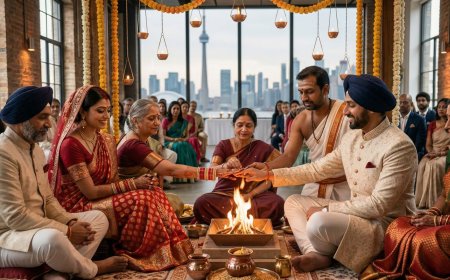



Two Weddings, Two Countries: How to Plan Both — The Complete NRI Wedding Planning Guide
Soon after their engagement, the bride created a spreadsheet with two tabs: “India” and “UK.” While both families assumed the wedding would happen in India, she realized she also needed a celebration in Manchester, where she had built her life and friendships over nine years. Many close friends could not travel to India, and she wanted them present for this milestone. The couple chose to plan two weddings, each serving a different community. This guide helps NRI couples plan weddings in two countries, covering legal considerations, planning timelines, venue options, guest communication, budgeting across currencies, and designing two distinct celebrations that each feel complete and meaningful.

Two Weddings, Two Countries: How to Plan Both
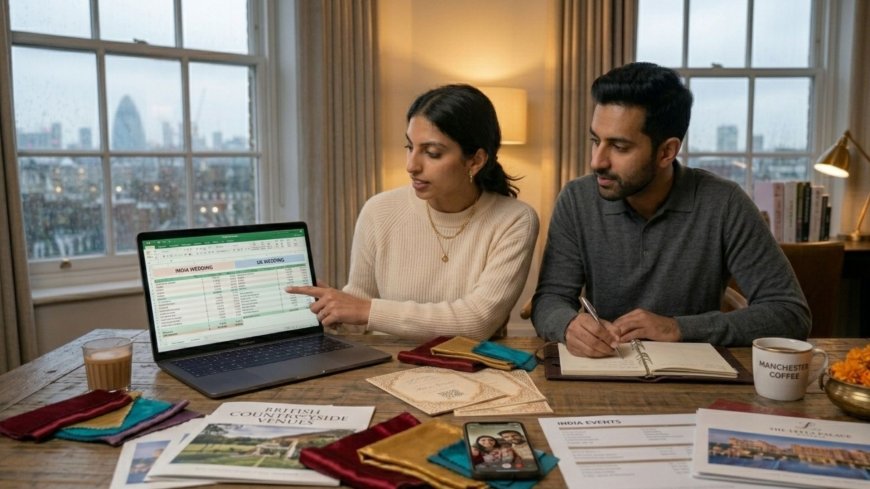
The Spreadsheet With Two Tabs
The bride had named them simply.
Tab One: India. Tab Two: UK.
She had created the spreadsheet six weeks after the engagement, on a Sunday afternoon in her flat in Manchester, while the groom was in Bangalore on a work trip and the two sets of parents were in the specific state of post-engagement anticipation that produces a high volume of WhatsApp messages containing suggestions, preferences, and opinions that are framed as suggestions and preferences.
The India wedding had been her mother's assumption from the beginning — the assumption of both families, really, stated and restated in various forms across the first weeks after the engagement. The groom's family was from Bangalore. Her family was from Chennai. The wedding would be in India. This was not a question.
The UK wedding had been the bride's own need, gradually articulated over the same weeks. She had lived in Manchester for nine years. Her closest friends — the people who had been present for the years that had shaped her into the person she was when she met the groom — were in the UK. Her colleagues, her flatmates from university, the friends she had made in the specific way that adults make friends when they move to a new country alone. They could not, most of them, take the leave and spend the money required to attend a wedding in India. And she could not be married without them present.
The spreadsheet with two tabs was the acknowledgment of both realities simultaneously.
Tab One: India. The families. The rituals. The four days of ceremony and celebration that the Tamil and Kannada traditions required. The hundred and eighty guests. The Bangalore venue. The December date.
Tab Two: UK. The friends. The colleagues. The celebration that her Manchester community deserved and that she wanted to give them. The forty guests. The countryside hotel in Cheshire. The following March.
Two weddings. Two countries. One couple. One spreadsheet with two tabs.
This guide is what goes in both of them.
The First Decision: Understanding What You Are Planning
The Two-Wedding Structure Is Not One Wedding Divided
The most important clarity for the couple planning two weddings in two countries is that they are planning two distinct occasions — not one wedding split across two geographies.
The India wedding and the UK wedding are different events with different purposes, different guest lists, different logistical frameworks, and different emotional characters. They share a couple and a marriage — but they serve different communities, reflect different cultural contexts, and require different planning approaches.
The couple who plans the two-wedding structure as one wedding extended across two countries — who tries to make the UK event feel like a continuation of the India event, who brings the same vendors, the same aesthetic, the same programme structure — produces two events that are each less than they could be. The couple who plans each wedding for the specific community and context it serves produces two events that are each complete.
The two-wedding planning framework begins with this clarity: Tab One and Tab Two are not the same document in two currencies. They are two different documents that happen to share some foundational decisions.
The Legal Marriage Question
Before the programme, the venues, the vendors, and the guest lists — the legal question must be answered clearly and early.
The legal marriage decision:
In the two-wedding structure, the couple must decide in which country the legal marriage takes place — the ceremony that produces the legally recognised marriage certificate. The options are: legal marriage in India only, legal marriage in the UK or country of residence only, or legal marriage in both countries.
Legal marriage in India:
A Hindu marriage registered under the Hindu Marriage Act, or a civil marriage registered under the Special Marriage Act, produces an Indian marriage certificate. This certificate must be apostilled and may need to be submitted to the couple's country of residence for the marriage to be recognised there — the specific requirements vary by country. In the UK, an Indian marriage certificate with apostille is generally recognised for immigration and legal purposes.
Legal marriage in the UK:
A civil ceremony conducted at a registered venue in England and Wales produces a UK marriage certificate immediately. The UK ceremony can be entirely civil — a twenty-minute ceremony with two witnesses and a registrar — or can be the primary celebration ceremony. For the couple who wants the legal certainty of a UK marriage certificate without the complexity of Indian marriage registration, the UK civil ceremony is the simpler legal route.
Legal marriage in both:
Some couples choose to legally marry in both countries — a civil ceremony in the UK and a registered ceremony in India — producing marriage certificates in both jurisdictions. This provides the maximum legal clarity across both countries but involves the most administrative complexity.
The recommendation:
Consult a solicitor or legal advisor familiar with cross-border marriage recognition before making the legal marriage decision. The specific requirements of the couple's country of residence, the specific visa and immigration implications, and the specific documentation requirements for the couple's circumstances are legal questions that require professional advice rather than general guidance.
Planning the India Wedding
The Foundations
The India wedding — the ceremony that serves the families, the traditions, and the Indian community — is typically the more complex of the two weddings to plan from abroad. Its planning requirements closely follow the full NRI wedding planning framework — venue, caterer, decorator, photographer, priest, accommodation block, guest logistics — with the additional layer of coordinating a large multi-day event from a different country.
The critical NRI-specific planning elements:
The wedding planner on the ground is not optional for the India wedding. The couple who is planning a large, multi-day Indian wedding from Manchester or Toronto or Sydney without a professional on the ground in Bangalore or Chennai or Udaipur is the couple whose planning is dependent on family members who have their own emotional investment in the occasion and their own competing priorities. The wedding planner is the professional whose sole focus is the execution of the wedding — and whose local relationships, local knowledge, and local presence are irreplaceable from a distance.
The site visit — the trip to India specifically to select and confirm the venue, meet the key vendors, and make the decisions that cannot be made remotely — is the investment that prevents the decisions of the India wedding from being made entirely on the basis of photographs and video calls. Schedule the site visit at least nine to twelve months before the India wedding date.
The India wedding's timeline must account for the international couple's travel schedule — the couple who is flying from the UK to India for the wedding needs to arrive with sufficient time to recover from the journey, to attend the pre-wedding events, and to be genuinely present for the four days of celebration rather than managing jet lag through the ceremony.
The India Wedding Programme
The India wedding programme for the NRI couple typically spans three to four days and includes the events that the relevant regional tradition requires — the mehndi, the sangeet, the ceremony, the reception — with the specific sequence and specific rituals determined by the couple's family traditions.
The programme design for a two-wedding couple:
The couple who is having a second wedding in the UK must be thoughtful about what the India wedding programme includes and excludes — specifically, whether there are elements of the programme that would be more meaningful to include in the UK wedding rather than the India wedding, or vice versa.
For example: the personal vows that the couple has written for each other may be more appropriate in the intimate UK wedding with the couple's closest friends than in the India wedding's larger, more traditional ceremony. The specific Western wedding traditions — the first dance, the speeches from friends, the cutting of a Western-style cake — may sit more naturally in the UK celebration than in the India wedding's programme.
The two-wedding structure gives the couple the specific gift of being able to place each element of the celebration in the context where it is most meaningful — the Indian traditions in the Indian celebration, the personal Western traditions in the UK celebration — rather than trying to accommodate all elements in a single occasion.
The India Wedding Guest List
The India wedding guest list is primarily the families' list — the extended family on both sides, the family friends, the community connections that the Indian wedding tradition encompasses. The couple's own close friends who are India-based are included. The international friends who cannot travel to India are not.
The communication to international guests:
The international friends and colleagues who are not attending the India wedding should be told about the India wedding explicitly — not to make them feel excluded but to give them the context that their exclusion is geographical rather than relational. "We are having our India celebration in December — we know this is not possible for most of you to attend, and that is exactly why we are also having our celebration here in March. The March event is the one we are planning specifically to celebrate with our UK community."
This communication — given early and personally to the significant relationships — prevents the India wedding from becoming a source of hurt feelings among the UK community who learn about it through social media without the context.
Planning the UK Wedding
The Different Character
The UK wedding — or the wedding in the couple's country of residence outside India — is a different occasion from the India wedding in character, scale, and purpose. It serves the couple's international community, operates within a different logistical framework, and has a different relationship to the couple's identity.
The UK wedding's specific character:
The UK wedding is typically smaller — the international community is smaller than the extended Indian family — and typically more personally curated. It is the occasion where the couple's own choices about aesthetic, programme, and experience have more room to express themselves, because the family traditions and family expectations that shape the India wedding are less present.
The UK wedding is also the occasion that most directly reflects the couple's life in the UK — their friends, their community, their professional world, the relationships that have been built in the years since they left India. It is the celebration of the person they have become in their international life as well as the person they were before they left.
The UK Wedding Format Options
The UK wedding does not need to replicate the India wedding's structure. The format should be chosen for what it serves best — the UK community, the couple's UK identity, and the intimate quality that a smaller guest list makes possible.
The reception-only format:
The most common UK wedding format for the couple who has had a full ceremony in India is the reception — a celebration event without a ceremony component. The couple is already married. The UK reception is the party that celebrates the marriage with the UK community. This format removes the legal and ceremonial complexity and focuses entirely on the celebration.
The reception can take any form that suits the couple and the UK context — a dinner and dancing event at a hotel or venue, an afternoon garden party, a seated dinner at a restaurant, an informal gathering at the couple's home. The absence of a ceremony removes the formal programme structure and gives the couple maximum flexibility in designing the celebration.
The ceremony and reception format:
Some couples choose to have a ceremony element at the UK wedding as well — a civil ceremony for the legal marriage, a blessing ceremony conducted by a priest or officiant, or a personal renewal of the vows and intentions that were made at the India ceremony. The ceremony element gives the UK community the experience of witnessing the couple's commitment rather than only celebrating it after the fact.
The cultural hybrid format:
The UK wedding that incorporates elements of both the Indian tradition and the Western celebration context — an Indian ceremony followed by a Western-style reception, or a Western civil ceremony followed by Indian celebration elements — is the format that most directly expresses the NRI couple's identity. The cultural hybrid format requires careful programme design to ensure that each element is presented with genuine understanding rather than as decoration, and that the UK guests who are unfamiliar with the Indian elements have the context to appreciate them.
The UK Wedding Venue
The UK wedding venue choice is shaped by the guest count, the format, and the aesthetic — and is not constrained by the requirement to accommodate the large Indian wedding's programme.
The venue options for a small UK wedding:
Private dining rooms at restaurants — for the couple whose UK celebration is primarily a dinner with close friends and family, the private dining room at a specific restaurant is the most personal and least production-intensive venue option.
Country house hotels — the traditional English country house hotel, available for full or partial buyout, provides the combination of accommodation, dining, and event space that works well for the UK wedding that includes overnight guests.
Non-traditional venues — the art gallery, the private member's club, the rooftop terrace, the converted warehouse — that reflect the couple's UK life and aesthetic rather than the conventional wedding venue format.
The family home — for the UK celebration that is most intimate and most personal, the couple's own home or the family's home in the UK.
The Indian wedding aesthetic in a UK venue:
The couple who wants to bring elements of the Indian wedding aesthetic into the UK venue — the florals, the colour, the specific decorative elements that connect the two occasions — should brief the UK decorator or venue stylist specifically on this intention. The Indian florals in a British country house are a specific aesthetic statement that works when it is intentional and curated, and that looks like an afterthought when it is not.
The UK Wedding Programme
The UK wedding programme has more flexibility than the India wedding's programme — because the traditional structure is less prescribed and because the smaller guest count makes more intimate programme formats possible.
The elements that work particularly well at the UK wedding:
Speeches from the couple's UK friends — the best man, the maid of honour, the specific friends who know the couple in the UK context — who can speak about the couple's life in the UK with the specific knowledge that comes from shared years and shared experiences.
The personal first dance — the couple's chosen song, in the UK venue, with the UK community watching. This moment, which may not have been part of the India wedding's programme, is a specific gift to the UK community.
The Indian wedding video — a brief, edited highlights film from the India wedding, shared at the UK reception, gives the UK community who were not present a window into the India celebration and creates the connection between the two occasions that makes the UK event feel like a continuation rather than a separate event entirely.
The photo display — photographs from the India wedding, displayed at the UK reception, create the visual connection between the two occasions and give the UK guests the experience of seeing the India wedding they were not able to attend.
The Coordination: Managing Both Weddings Simultaneously
The Timeline Relationship
The two weddings are planned simultaneously — the India wedding in December and the UK wedding in March require parallel planning tracks that must be coordinated without conflicting.
The timeline considerations:
The India wedding typically requires the longer planning lead time — twelve to eighteen months for a large multi-day wedding in India. The UK wedding, which is typically smaller and logistically simpler, can be planned in six to nine months. The parallel planning timeline should reflect this difference — the India wedding planning begins first and the UK wedding planning begins when the India wedding's major decisions are confirmed.
The budget for both weddings must be established simultaneously — the couple who has not set the UK wedding budget before the India wedding is fully planned may find that the India wedding has consumed the budget that was intended for both.
The vendor coordination:
Some vendors can serve both weddings — the photographer who shoots the India wedding and travels to the UK for the reception, the florist who designs elements for both occasions, the videographer whose India wedding film is edited and ready for showing at the UK reception. The opportunity to engage vendors across both weddings should be explored — it creates continuity between the two occasions and may produce cost efficiencies.
The Guest Overlap
Some guests will attend both weddings — the immediate family members who are based in both countries, the close friends who travel to India for the ceremony and attend the UK reception. The guest overlap requires specific coordination.
The overlap planning:
The guests who attend both weddings should receive communications that are specific to each wedding rather than combined communications that conflate the two occasions. The invitation to the India wedding and the invitation to the UK wedding are separate invitations for separate occasions.
The seating plan and the table management at the UK wedding should account for the guests who were at the India wedding — placing them in positions where their experience of the India wedding can be shared with the UK guests who were not there. The guest who attended both weddings is the specific connection between the two occasions and should be positioned to play that role.
The Financial Framework
The two-wedding budget requires a framework that treats the two occasions as separate financial commitments while managing the couple's total wedding expenditure.
The budget structure:
Establish the total wedding budget — the combined amount the couple has available for both weddings — before allocating it between the two occasions. The allocation between India and UK should reflect the relative scale and significance of each occasion rather than a default equal split.
The India wedding's fixed costs — the venue, the catering for a large guest list, the decoration of a large space, the accommodation block — typically require a larger absolute budget than the UK wedding. But the per-head cost of the UK wedding, particularly if it involves premium catering and a high-quality venue, may be higher.
The currency management:
The two-wedding budget involves two currencies — the India wedding's costs are primarily in Indian Rupees, the UK wedding's costs are primarily in Pounds Sterling. The exchange rate fluctuations across the twelve to eighteen month planning period can affect the real cost of the India wedding relative to the UK wedding's budget. Managing both currency exposures — potentially through a currency broker for the India wedding's significant transfers — is part of the two-wedding financial framework.
The Communication Strategy
The couple planning two weddings must manage two distinct communication streams — the India wedding communication to the India guest list and the UK wedding communication to the UK guest list — without allowing them to conflate or to create the impression with either community that their wedding is secondary to the other.
The communication principles:
Each wedding community should receive communications that treat their wedding as the primary occasion — because for their community, it is. The India wedding guests should not feel that they are attending the preliminary event before the real wedding in the UK. The UK wedding guests should not feel that they are attending the afterthought following the real wedding in India.
The language used in each community's communications should reflect this principle — the India wedding is "our wedding in Bangalore" and the UK wedding is "our wedding in Cheshire" — not "the Indian ceremony" and "the real wedding" or "the big wedding" and "the smaller celebration."
The Emotional Landscape: What Two Weddings Actually Feel Like
The Emotional Arc
The couple who has planned two weddings and attended both has a specific emotional experience that the single-wedding couple does not — the experience of being married in two different contexts, with two different communities, in two different cultural registers.
The India wedding:
The India wedding is typically the more emotionally intense occasion — the larger gathering, the longer programme, the weight of the family traditions and the multi-generational significance of the rituals. The couple at the India wedding is surrounded by the people who have known them longest and who carry the deepest investment in the marriage.
The India wedding is also, for many NRI couples, the occasion where the specific emotion of the diaspora experience is most present — the return to India for the most significant occasion of their lives, the gathering of the family that distance has separated, the performance of the rituals that connect them to a tradition that their daily life in the UK or US does not always make accessible.
The UK wedding:
The UK wedding is typically the more personally expressive occasion — the occasion where the couple's own choices about aesthetic and programme are most fully realised, where the friends who know the couple in their daily life are gathered, where the celebration reflects the life they are actually living rather than the tradition they are honouring.
The UK wedding often has a specific quality of ease — the smaller guest list, the more familiar context, the absence of the large family logistics — that allows the couple to be genuinely present in a way that the large India wedding's management demands sometimes preclude.
The time between:
The weeks or months between the India wedding and the UK wedding — the period in which the couple is legally married but has not yet celebrated with their UK community — have a specific character that couples often describe as unexpectedly significant. The marriage has happened. The daily life continues. The UK celebration is anticipated. The couple is in the specific state of being married before everyone who matters to them in their daily life knows it.
The Identity Expression
The two-wedding structure is, for many NRI couples, the most honest expression of their identity — the dual belonging that defines the NRI experience, honoured in two distinct occasions rather than compressed into a single event that tries to serve all communities simultaneously.
The couple who has two weddings is not being indecisive about their identity. They are acknowledging the specific reality of who they are — the person who left India and built a life elsewhere, who belongs genuinely to both places, who wants to celebrate the most significant occasion of their life with both communities in the contexts that serve each community best.
The two-wedding structure is the NRI couple's answer to the question that their identity poses: how do we honour where we come from and where we live, the family we were born into and the community we have chosen, the traditions we were raised in and the life we have built?
The answer, for many couples, is: two weddings, two countries, one marriage, and a spreadsheet with two tabs.
Common Mistakes NRI Couples Make With Two-Wedding Planning
The first mistake is not establishing the legal marriage decision before planning either wedding. The couple who is six months into planning two weddings and has not resolved which ceremony produces the legal marriage — or whether both do — is the couple who may discover, close to the wedding dates, that the legal requirements of one or both countries create constraints that affect the programme planning. Resolve the legal question first, with professional legal advice, before the programme planning begins.
The second mistake is planning both weddings to the same scale and format. The India wedding and the UK wedding are different occasions serving different communities — they should not be identical in scale, format, or programme. The couple who replicates the India wedding's four-day structure for the UK wedding, or who brings the full India wedding aesthetic wholesale into the UK celebration, has missed the specific opportunity of the two-wedding structure: the ability to calibrate each occasion for the community it serves.
The third mistake is allowing the communications to the two communities to imply that one wedding is more important than the other. The India community that hears the UK celebration described as "the real wedding" and the UK community that hears the India ceremony described as "just the family event" are both being disrespected. Both occasions are real weddings. Both communities deserve communications that treat their occasion as the significant event it is.
The fourth mistake is not budgeting for both weddings simultaneously before committing to the India wedding's costs. The couple who commits to the India wedding's full budget without establishing the UK wedding budget alongside it may find that the India wedding has consumed the total wedding budget and the UK celebration must be significantly scaled back or simplified. Establish both budgets before committing to either.
The fifth mistake is not managing the emotional demands of two weddings on the couple themselves. Two weddings is a significant logistical and emotional undertaking — the planning load is double, the family communication demands are double, and the couple must be genuinely present and emotionally engaged for two distinct occasions separated by weeks or months. The couple who does not plan for the emotional demands of the two-wedding structure — who does not build rest, recovery, and genuine support into the planning and execution — may find that the second wedding is being attended by two people who are exhausted from the first.
The Two Tabs That Became Two Days
The bride closed her laptop on the Sunday afternoon in Manchester when she had named the two tabs and accepted that this was what the planning was going to be.
Two venues. Two vendor teams. Two guest lists. Two communication streams. Two sets of family conversations. Two budgets. Two countries' worth of logistics.
In December, in Bangalore, she walked through the mandap and saw the groom's face and the faces of the two families who had waited for this moment and the specific faces of the people who had known them both since childhood and who were crying in the specific way that people cry when they have been waiting for something for a long time.
In March, in Cheshire, she walked into the country house hotel dining room and saw the faces of her Manchester friends and her university flatmates and her colleagues and the specific people who had been present for the nine years that had made her the person she was when she met the groom — and they were also crying, in the specific way that people cry when someone they love has found someone to love.
Two rooms. Two sets of tears. One marriage.
The spreadsheet had two tabs because the life had two homes. The wedding had two occasions because the marriage was being celebrated in both of them — not because the couple was indecisive about their identity but because their identity was genuinely dual and the two occasions were the honest expression of it.
Plan both weddings with full commitment.
Give each community the occasion it deserves.
Resolve the legal question first.
Budget for both before committing to either.
And be present — genuinely, completely present — for both days.
Because both days are the wedding.
Published by NRIWedding.com — The Premium Global Platform for Non-Resident Indians Planning Indian Weddings From Abroad.
What's Your Reaction?
 Like
0
Like
0
 Dislike
0
Dislike
0
 Love
0
Love
0
 Funny
0
Funny
0
 Angry
0
Angry
0
 Sad
0
Sad
0
 Wow
0
Wow
0