



















































Using AI Tools for Wedding Planning: ChatGPT Prompts for NRI Couples — The Complete Guide
Late one Wednesday night, a bride messaged an AI tool with a small but tricky question about her mehndi catering—whether to arrange special snacks for international guests unfamiliar with the event or rely on standard cocktail catering. Her planner was asleep and family were in different time zones, but the AI replied within seconds, helping her answer the caterer and sleep peacefully. AI in wedding planning doesn’t replace human expertise; it supports it when others aren’t available. This guide shows NRI couples how to use AI tools for research, writing, brainstorming, planning timelines, drafting messages, solving logistics issues, and preparing ideas while recognizing where human judgment and vendor relationships remain essential.


Using AI Tools for Wedding Planning: ChatGPT Prompts for NRI Couples
The Conversation That Started at Midnight
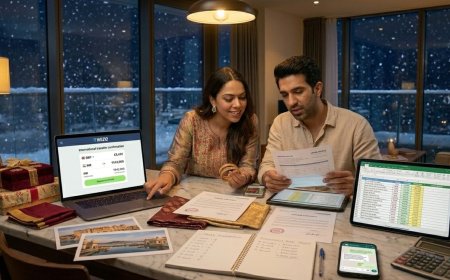
It was eleven fifty-eight on a Wednesday night when the bride typed her first message to the AI.
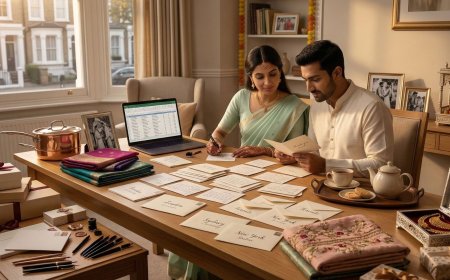
She had been awake for forty minutes longer than she had intended to be, having opened her laptop to check one thing about the venue contract and found herself, forty minutes later, in the specific spiral of the late-night wedding planning session — the one where one question leads to three more questions and the three more questions lead to a list of things that need to be done and the list of things that need to be done leads to the specific anxiety of a person who has just realised how much remains to be organised.
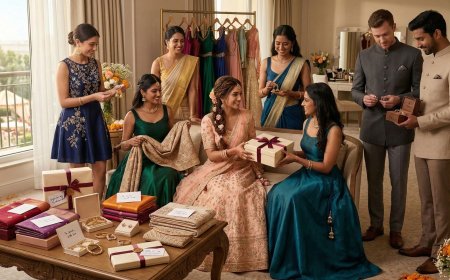
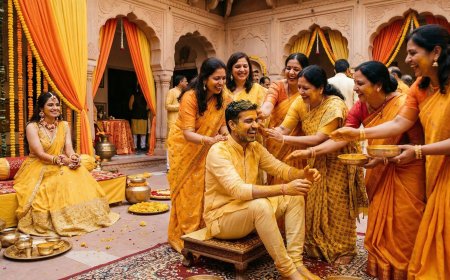
The specific trigger had been the caterer's question, received by email that afternoon and not yet answered: did the couple want a mehendi snack menu or would the standard cocktail catering cover the afternoon event? She had not known the answer. She had not known what a mehendi snack menu typically included, what the standard cocktail catering would or would not cover for a four-hour afternoon event, or what the relevant considerations were for a guest list that would include fifty international guests who had never attended a mehndi and a hundred Indian guests who had strong opinions about whether the food was appropriate.
She could have left the question for the morning. She could have messaged the wedding planner. She could have called her mother.
Instead, at eleven fifty-eight, she typed: I'm planning an NRI wedding in Udaipur in December. The caterer has asked whether I want a mehendi snack menu or whether standard cocktail catering will cover the afternoon event. I have fifty international guests who have never been to a mehndi and a hundred Indian guests. What are the relevant considerations and what would you recommend?
The response arrived in eleven seconds. It was specific, structured, and genuinely useful. It covered the considerations she had not thought of — the afternoon timing and the different food energy requirements of a standing, activity-based event versus a seated cocktail reception, the international guests' likely unfamiliarity with Indian afternoon snack traditions and the opportunity to use the food as a cultural introduction, the specific Indian snack categories that work for a mehndi and why, and a suggested hybrid approach that would serve both the cultural expectation and the international guest's experience.
She answered the caterer's email at twelve seventeen. She went to sleep at twelve twenty-three.
The AI assistant is not the wedding planner. It does not have relationships with vendors, cannot visit venues, cannot manage the logistics on the ground, and cannot provide the specific local knowledge that comes from years of planning weddings in a specific city. But at eleven fifty-eight on a Wednesday night, when the wedding planner is asleep and the mother is in a different time zone and the specific question is not urgent enough to warrant a phone call but specific enough to require a real answer, the AI assistant is the resource that is always available, always patient, and — when prompted well — genuinely useful.
This guide is the framework for prompting it well — the specific prompts, the specific strategies, and the specific use cases for ChatGPT and other AI tools that make them a genuinely valuable component of the NRI couple's wedding planning toolkit.
What AI Tools Actually Do Well (And What They Don't)
The Honest Assessment
The AI assistant is not uniformly useful across all wedding planning tasks. Understanding where it adds genuine value and where its limitations make it the wrong tool for the job is the foundation for using it effectively.
Where AI tools genuinely excel:
Research and synthesis: the AI can survey a broad topic — mehendi snack menus, Indian wedding invitation wording conventions, tipping customs at Indian hotels, the specific rituals of a Gujarati wedding ceremony — and synthesise the relevant considerations into a structured, useful response faster than any search engine result page.
Drafting and writing: the AI produces first drafts of written content — invitation wording, wedding website copy, thank you card language, vendor inquiry emails, WhatsApp broadcast messages, speech drafts — that are significantly better than the blank page the couple would otherwise be staring at, and that can be refined through conversation until they reach the quality the couple wants.
Brainstorming: the AI is a patient and inexhaustible brainstorming partner — generating options, alternatives, and considerations that the couple may not have thought of, without the social dynamics of asking a person for ideas and feeling obligated to use them.
Structuring and organising: the AI is excellent at producing structured frameworks — checklists, timelines, budget allocation templates, vendor briefing structures — that organise complex information into actionable formats.
Explaining and educating: for the NRI couple whose connection to the Indian wedding tradition is real but whose knowledge of specific regional customs, rituals, or vendor categories is incomplete, the AI is a patient and non-judgmental teacher.
Translation and cultural bridging: the AI can help craft content that bridges cultural contexts — the invitation wording that serves both the Indian and the international guest, the ceremony programme that explains Sanskrit rituals in English that illuminates rather than reduces.
Where AI tools have genuine limitations:
Current and local information: the AI's knowledge has a training cutoff — it does not know the current market rates for wedding vendors in Jaipur in the current season, the specific reputation of a specific caterer in Udaipur, or whether a specific venue has recently changed its policies. For current, local, specific information, the AI should always be supplemented with direct research and professional advice.
Personal knowledge: the AI does not know the couple — their specific relationship, their families' specific dynamics, their personal aesthetic preferences, the specific people they are writing thank you cards to. Every output the AI produces that requires personal knowledge must be personalised by the couple before it is used.
Professional judgment: the AI cannot replace the professional judgment of an experienced wedding planner, a legal advisor reviewing a vendor contract, or a financial advisor assessing the wedding budget's impact on the couple's financial plan. The AI's output in these domains should be treated as a starting point for professional conversation rather than a professional conclusion.
Vendor relationships: the AI cannot negotiate with vendors, build the trust relationships that produce the best service, or navigate the specific interpersonal dynamics that determine how smoothly the wedding is executed. The human relationships are irreplaceable.
The Prompting Framework: How to Get Useful Responses
The Four Elements of a Good Prompt
The quality of the AI's response is directly determined by the quality of the prompt. The couple who types "help me with my wedding" will receive a different response than the couple who types a prompt that contains the four elements of a good AI prompt.
Element One — Context:
Who you are and what the relevant background is. The AI does not know you — provide the context it needs to give you a useful response rather than a generic one.
Example: "I am planning a three-day NRI wedding in Udaipur in December for two hundred and thirty guests. My family is from Tamil Nadu and my partner's family is from Gujarat. We have approximately sixty international guests from the UK, USA, and Australia."
Element Two — The Specific Task:
What specifically you want the AI to do. Research, draft, brainstorm, review, explain, structure, translate — the more specifically you describe the task, the more specifically the AI can execute it.
Example: "I need you to draft a WhatsApp broadcast message to our international guests explaining the dress code for the sangeet event."
Element Three — The Parameters:
The constraints and requirements the output must meet. Length, tone, language, format, specific elements that must be included or excluded.
Example: "The message should be warm but informative, approximately one hundred and fifty words, written in English, and should include specific guidance on what kurta pyjama means and where to buy one in the UK."
Element Four — The Purpose:
Why the output is needed and how it will be used — the context that allows the AI to calibrate its response for the actual situation rather than an imagined one.
Example: "This message will be sent to guests who have confirmed attendance but have asked us what to wear — they are enthusiastic but culturally unfamiliar with the tradition."
The assembled prompt:
"I am planning a three-day NRI wedding in Udaipur in December for two hundred and thirty guests. My family is from Tamil Nadu and my partner's family is from Gujarat. We have approximately sixty international guests from the UK, USA, and Australia. I need you to draft a WhatsApp broadcast message to our international guests explaining the dress code for the sangeet event. The message should be warm but informative, approximately one hundred and fifty words, written in English, and should include specific guidance on what kurta pyjama means and where to buy one in the UK. This message will be sent to guests who have confirmed attendance but have asked us what to wear — they are enthusiastic but culturally unfamiliar with the tradition."
This prompt will produce a response that is specific, calibrated, and usable with minimal refinement. The generic prompt will produce a response that requires significant additional work to become useful.
The Prompts: A Complete Library for NRI Wedding Planning
Category One: Planning and Organisation Prompts
The master timeline prompt:
"I am planning an NRI wedding in [city] on [date]. The wedding programme spans [number] days and includes [list of events — mehndi, sangeet, ceremony, reception]. I am based in [country] and will be planning remotely for the first [number] months before traveling to India [number] weeks before the wedding. Create a month-by-month planning timeline from [current month] to the wedding date that covers all the major planning milestones I need to hit, organised by category: venue, catering, photography, outfits, entertainment, guest logistics, and travel and accommodation. Flag the decisions that must be made earliest due to vendor availability and lead time requirements."
The budget allocation prompt:
"I have a total wedding budget of [amount] in [currency] for an NRI wedding in India with [number] guests across [number] days and [number] events. My family is from [region] and my partner's family is from [region]. Suggest a budget allocation across the major wedding expenditure categories — venue, catering, decor, photography and videography, entertainment, outfits and jewellery, accommodation for hosted guests, transportation, invitations and stationery, beauty and grooming, priest and ceremony — with a brief explanation of why you are suggesting each allocation. Note the categories where NRI weddings typically overspend against initial estimates and why."
The vendor briefing template prompt:
"Create a vendor briefing template for a [vendor type — photographer / caterer / decorator / DJ] at an NRI wedding in [city] with [number] guests. The brief should include all the information the vendor needs to understand the scope of work, the couple's vision, the specific requirements of the NRI wedding context, the payment and contract terms to be confirmed, and the key questions the couple should ask the vendor at the initial meeting. Format it as a document I can customise and send to multiple vendors."
The checklist prompt:
"Create a comprehensive checklist for [specific task — packing for the wedding week in India / the final week before the wedding / the morning of the ceremony / the day after the wedding before flying home]. The checklist should be specifically calibrated for an NRI couple based in [country] whose wedding is in [city] India, and should include the NRI-specific items that a domestic Indian wedding checklist would not contain."
Category Two: Communication Drafting Prompts
The invitation wording prompt:
"Draft the wording for an Indian wedding invitation that serves two different audiences simultaneously: traditional Indian guests familiar with Indian wedding conventions, and international guests who are not. The wedding is a [Hindu / Muslim / Sikh / Jain] ceremony between [Bride's name], daughter of [Parents' names], and [Groom's name], son of [Parents' names], on [date] at [venue name] in [city]. The events included in the invitation are [list of events]. The tone should be formal but warm. Include a version for the main invitation card and a version for the events details insert. Flag the specific elements of Indian invitation wording that need to be explained or modified for international guests."
The wedding website copy prompt:
"Write the 'Our Story' section of a wedding website for an NRI couple. The couple met [how they met], dated for [how long], and got engaged [where and how]. The bride is from [background] and is based in [city]. The groom is from [background] and is based in [city]. The wedding is in [location]. The tone should be warm, personal, and specific — not the generic wedding website language that sounds like it was written by a template. Approximately three hundred words. I will personalise the specific details but I need the structure and the language to be distinctive."
The vendor inquiry email prompt:
"Draft an initial inquiry email to a wedding photographer in [city] India for an NRI wedding on [date] with [number] guests across [number] days. The email should introduce the couple, describe the scope of work, ask the specific questions that will determine whether this photographer is right for the wedding, and establish the couple's seriousness as a client. Include the NRI-specific context — remote planning from [country], destination wedding in India — so the photographer understands the logistics. Approximately two hundred and fifty words. Professional but warm in tone."
The thank you card prompt:
"Help me write a specific, personal thank you card for [describe the guest — the groom's aunt from London who gave a specific gift and traveled from the UK for the wedding]. The gift was [specific description]. The specific thing about this guest's attendance that was meaningful was [specific detail]. The thank you card should be warm and personal — not generic — and should reference the specific gift and the specific gesture of attendance. Approximately one hundred words. I will add any additional personal details."
The cultural explanation prompt:
"Write a warm, accessible explanation of [specific Indian wedding ritual — the saptapadi / the sindoor ceremony / the nikah / the anand karaj] for inclusion in a wedding ceremony programme that will be read by international guests who have no prior knowledge of the tradition. The explanation should be approximately one hundred and fifty words, should treat the tradition with genuine respect and specificity, and should give the reader enough context to understand what they are witnessing without reducing the ritual to a tourist exhibit. The tone should be the voice of a person sharing something they love, not a textbook definition."
The WhatsApp broadcast prompt:
"Draft a WhatsApp broadcast message to [describe the recipient group — all wedding guests / international guests only / India-based guests / the bridal party] about [specific topic — the shuttle schedule / the dress code reminder / the sangeet programme / the final logistics confirmation]. The message should be [warm and conversational / concise and informational / urgent and clear]. It should be [approximate word count] words and should be formatted for WhatsApp — with line breaks where appropriate and without the overly formal language of an email. Include [specific information that must be in the message]."
Category Three: Research and Education Prompts
The regional tradition research prompt:
"I am planning a wedding that brings together a Tamil Brahmin family and a Gujarati family. Neither family is fully familiar with the other's wedding traditions. Give me a comprehensive overview of the key ritual differences between a Tamil Brahmin wedding and a Gujarati wedding — the specific ceremonies that are unique to each tradition, the moments where the two traditions might approach the same event differently, and the specific considerations for a couple who wants to honour both traditions in a single wedding programme. This is for my own education and for a conversation with both families and the priest."
The destination research prompt:
"I am considering [Udaipur / Jaipur / Goa / Rishikesh / Coorg] as the destination for an NRI wedding with [number] guests, [number] of whom are international. For each destination, give me: the specific advantages and disadvantages for an NRI wedding of this scale, the best months for the wedding, the approximate venue cost range, the international travel accessibility, the specific logistical challenges that are unique to this destination, and the type of wedding aesthetic it most naturally supports. Format as a comparative table followed by a brief recommendation based on the profile I have described."
The vendor category education prompt:
"I am about to start the process of finding and briefing a wedding decorator in India for the first time. I have no prior experience with Indian wedding decor vendors. Explain to me: how the Indian wedding decor vendor market is structured, the difference between a decorator and a florist in this context, what a mood board is and how to create one, the key questions I should ask a decorator in an initial meeting, the red flags that suggest a decorator is not right for my wedding, the approximate price range for different levels of decor quality in [city], and how the payment and contract structure typically works. I want to approach the first decorator meeting informed rather than naive."
The etiquette research prompt:
"I need to understand the etiquette around [specific topic — gifting money at an Indian wedding / tipping wedding vendors in India / the role of the baraat in a wedding where not everyone shares the tradition / the appropriate way to handle dietary requirements at an Indian wedding catering for international guests]. Explain the tradition, the cultural significance, the range of practices within the tradition, and the specific considerations for an NRI couple navigating the tradition across cultural lines."
Category Four: Creative and Content Prompts
The sangeet performance concept prompt:
"Help me develop a concept for a sangeet performance by the bride's side of the family — approximately eight performers ranging in age from twenty-two to sixty-five, based in four different countries. The performance should last approximately four minutes, should tell a story about the bride rather than being a generic Bollywood medley, and should be accessible to a mixed audience of Indian family and international guests. Suggest three different concept directions — one primarily Bollywood, one that incorporates the bride's regional Tamil background, and one hybrid concept — with a brief description of each, the approximate song choices, and the performance structure."
The wedding speech prompt:
"Help me draft a speech for [the father of the bride / the maid of honour / the best man / the groom] at an NRI wedding reception. The speech should be approximately three to four minutes when delivered at a natural pace. Key information to include: [specific details about the relationship to the couple, specific stories or memories to include, the tone — humorous / emotional / a combination, any specific elements that must be included such as acknowledgments of specific family members]. The speech should work for an audience that includes both Indian family members and international guests — avoiding cultural references that would exclude one group without explanation."
The wedding hashtag prompt:
"Generate twenty wedding hashtag options for [couple's names] getting married on [date]. The hashtags should be: witty and specific to this couple rather than generic wedding hashtags, easy to spell and remember, appropriate for use across Instagram and other social media platforms, and a mix of formats — some combining the names, some referencing the location or date, some using a wordplay or reference specific to the couple's story. After generating the twenty options, recommend the three strongest and explain why."
The vow writing prompt:
"Help me write personal wedding vows for a [Hindu / civil / interfaith] ceremony. I want the vows to be personal and specific to my relationship, approximately two to three minutes when spoken, and to acknowledge both the cultural tradition of our wedding and the contemporary, equal partnership we are entering into. Key elements I want to include: [specific memories, specific promises, specific acknowledgments of family]. The tone should be [deeply emotional / warmly humorous / a combination]. Please give me a first draft that I can personalise — I don't want to read something generic at my wedding."
Category Five: Problem-Solving Prompts
The family conflict navigation prompt:
"I am dealing with a specific situation in my wedding planning that requires careful navigation. [Describe the situation specifically — for example: my mother wants a traditional Tamil ceremony element that my partner's Gujarati family is not familiar with and has expressed concern about, or two family members who cannot be seated near each other due to a longstanding conflict, or a budget disagreement between the two families about the appropriate scale of the wedding]. Give me: the key considerations from each perspective, the range of approaches I could take from most to least accommodating of all parties, the specific language I might use in conversations with each party, and your recommendation for the approach that is most likely to produce a good outcome."
The logistics problem prompt:
"I have a specific logistics problem with my NRI wedding that I need help thinking through. [Describe the specific problem — for example: forty international guests arriving from six countries whose flights all land at different times across a twelve-hour window on the first day of the wedding programme, or a ceremony venue and reception venue that are thirty kilometres apart in a city with significant traffic congestion, or a wedding date that coincides with a major local festival that will affect hotel availability and road access]. Give me: a clear analysis of the problem's components, three to five possible solutions ranging from simple to complex, the practical implications of each solution, and a recommendation."
The vendor dispute prompt:
"I am in a dispute with a wedding vendor about [specific issue — a deposit that the vendor is refusing to refund despite a cancellation clause in the contract, a service that was significantly different from what was agreed and what was delivered, a vendor who has become unresponsive after receiving a significant payment]. Help me: understand my position clearly, draft a formal written communication to the vendor that is firm but professional, understand what escalation options I have if the direct communication does not resolve the situation, and identify what I should do to protect myself going forward."
Category Six: The Iterative Refinement Prompts
One of the AI's most underused capabilities in the wedding planning context is the iterative refinement conversation — the back-and-forth that takes a first draft from adequate to excellent.
The refinement prompt structure:
After receiving any AI output, the couple can refine it through conversation rather than starting again. Effective refinement prompts:
"This is good but the tone is too formal — can you make it warmer and more conversational while keeping the same structure?"
"The third paragraph doesn't feel like me — can you rewrite it with [specific characteristic — more humour / more emotion / a specific reference to something personal I can fill in]?"
"Can you give me three alternative versions of the opening line — I want to choose the one that sounds most like the way I actually speak?"
"This is almost right but it's too long — can you cut it to approximately [number] words while keeping the most important elements?"
"The cultural explanation in the third section feels like it was written for a tourist brochure — can you make it feel like a friend explaining something they love rather than a guide book?"
The iterative refinement conversation is the specific workflow that produces the AI output that is genuinely personal and genuinely excellent — not the first draft, but the fourth or fifth version that has been shaped through the specific feedback of the person who will actually use it.
Building the AI Workflow Into the Planning Process
The AI as the First Draft Resource
The most practical integration of AI tools into the NRI wedding planning process is as the first draft resource — the tool that produces the initial version of any written content, any structured framework, or any research synthesis, which the couple then refines with their personal knowledge and judgment.
The couple who uses AI as the first draft resource never stares at a blank page. The invitation wording, the vendor email, the cultural explanation, the wedding website copy, the thank you card — each begins as a specific AI prompt rather than as the anxiety of an empty document, and each ends as a personalised, excellent version of the initial draft that the couple has shaped through conversation and revision.
The AI as the Midnight Resource
As demonstrated in the guide's opening — the AI is specifically valuable at the moments when the human resources are unavailable. The wedding planner is asleep. The mother is in a different time zone. The question is not urgent enough for a phone call but specific enough to require a real answer.
The AI at these moments is the patient, knowledgeable, always-available resource that provides the answer that allows the planning to continue rather than the anxiety to accumulate. The couple who uses AI in this way does not replace their professional advisors — they supplement them with the specific resource that serves the eleven fifty-eight question that would otherwise wait until morning.
The AI as the Preparation Tool
Before any significant meeting — with the wedding planner, with a vendor, with a family member about a difficult planning decision — the AI can help the couple prepare. The prompts that generate the questions to ask the photographer, the considerations to raise with the caterer, the language to use in the conversation with the family member about the budget — these preparation prompts produce the confidence that comes from entering a significant conversation already organised.
Common Mistakes NRI Couples Make When Using AI for Wedding Planning
The first mistake is treating AI output as final rather than as a first draft. The invitation wording produced by the AI is a starting point — it requires the couple's personal details, their personal voice, and their specific knowledge of the guests who will receive it before it is ready to use. The couple who copies the AI's output directly onto their invitation without personalisation has sent a wedding invitation that does not sound like them.
The second mistake is not providing enough context in the prompt. The AI's response is only as specific as the prompt — the generic prompt produces the generic response that requires significant additional work. Every prompt should include the couple's specific context: the region, the guest count, the cultural backgrounds, the specific situation being addressed. The additional thirty seconds of context in the prompt produces a significantly more useful response.
The third mistake is using AI for decisions that require professional judgment. The AI's analysis of a vendor contract is not a legal opinion. The AI's budget allocation suggestion is not financial advice. The AI's assessment of a family conflict situation is not the judgment of someone who knows the specific people involved. AI output in these domains should prompt a conversation with a professional, not replace one.
The fourth mistake is not iterating. The couple who reads the AI's first response and accepts it or rejects it without the refinement conversation is not using the tool's most powerful capability. The iterative conversation — the back-and-forth that shapes the draft through specific feedback — is the workflow that produces genuinely excellent output rather than adequate first drafts.
The fifth mistake is using AI at the expense of the human relationships that the wedding depends on. The wedding planner, the vendor, the family member — the human relationships that produce the best wedding are built through genuine, personal engagement. The couple who delegates the vendor email to AI without reading and personalising it, who uses the AI's cultural explanation without the personal voice that makes it genuine, who manages the family conflict through AI-generated language without the authentic conversation — this couple is using efficiency to avoid the specific human engagement that the wedding's relationships require.
The Tool That Is Available at Midnight
The bride who typed her first message at eleven fifty-eight went to sleep at twelve twenty-three having answered the caterer's question, understood the relevant considerations, and made a specific, informed decision about the mehendi snack menu.
She had not replaced her wedding planner. She had not made the decision that the wedding planner would have made — she had made her own decision, informed by the AI's synthesis of the relevant considerations, personalised with her own knowledge of her specific guests and her specific vision for the mehndi, and communicated to the caterer in her own voice.
The AI tool in the NRI wedding planning process is not a replacement for the human expertise, the human relationships, and the human judgment that the wedding requires. It is the specific resource that is available when the human resources are not — that provides the first draft when the page is blank, the research synthesis when the question needs answering, the structured framework when the information needs organising, and the patient brainstorming partner when the thinking needs an interlocutor.
It is the tool that is available at midnight.
For the NRI couple planning a complex, multi-day, multi-culture, international wedding across significant distances and time zones — managing vendor relationships in a country they are not currently in, navigating cultural traditions they are both deeply connected to and partially distant from, communicating with guests in multiple languages across multiple countries — the midnight availability is not a minor convenience.
It is a specific and significant resource.
Learn to prompt it well.
Use it as the first draft and the preparation tool and the research synthesiser.
Iterate until the output is genuinely yours.
And let it answer the eleven fifty-eight question that would otherwise wait until morning.
Published by NRIWedding.com — The Premium Global Platform for Non-Resident Indians Planning Indian Weddings From Abroad.
What's Your Reaction?
 Like
0
Like
0
 Dislike
0
Dislike
0
 Love
0
Love
0
 Funny
0
Funny
0
 Angry
0
Angry
0
 Sad
0
Sad
0
 Wow
0
Wow
0