





































































The Wedding That Was in the Mountains: The NRI Couple's Complete Guide to Adventure Weddings in India in Unique Locations
Seventeen conventional venues looked at and none of them quite right, and then a meadow at four thousand metres in the valley where the groom had spent his childhood summers. The adventure wedding is the wedding whose location is itself part of the meaning — the ceremony in the landscape rather than the banquet hall, the celebration in a place that requires specific effort to reach and that communicates something about the couple that no conventional venue can. This guide delivers a complete framework covering the Himalayan settings from Spiti Valley to Ladakh to Chopta, the Thar Desert and Rann of Kutch, the Andaman Islands, the Kerala backwaters, the Western Ghats plantations, the permission landscape from forest permits to coastal regulations to ASI approvals, the infrastructure gap across power and sanitation and weather contingency, the guest management including physical capability considerations and travel briefing, the outdoor ceremony's sound and light challenges, and the photography approach that makes the landscape the occasion's greatest asset.


Adventure Weddings in India: Getting Married in Unique Locations
The NRI couple's complete guide to the wedding that refuses the conventional venue — the ceremony in the landscape rather than the banquet hall, the celebration whose location is itself part of the meaning
The Wedding That Was in the Mountains
The couple had looked at seventeen venues. Hotel ballrooms in Mumbai. Heritage havelis in Jaipur. Luxury resort properties in Udaipur. Each one was beautiful. Each one was, in a specific way that the couple could not immediately articulate, not quite right.
The groom had grown up in Himachal Pradesh before his family moved to Delhi and then to London. The mountains were the landscape of his earliest memories — the specific quality of the light at altitude, the cold that arrived in the evenings, the specific smell of the pine forests that he had not found anywhere else in thirty-eight years of living on other terrain.
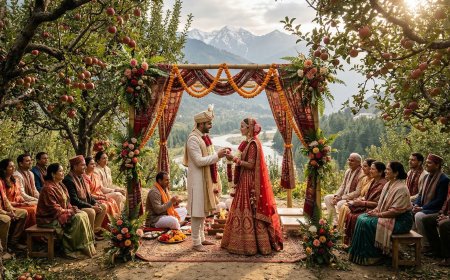
The bride had grown up in Chennai and had never been to the Himalayas. On their third trip to India together, he had taken her to the valley where he had spent his childhood summers. She had stood at the edge of a meadow at four thousand metres and said: this is where we should get married.
He had said: you know this will be complicated.
She had said: I know. I want it anyway.
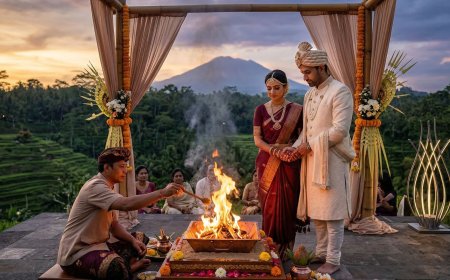
The planning that followed was the most complex wedding planning either of them had encountered in their combined experience of attending forty-three Indian weddings. It was also the most meaningful. The wedding they had — in a meadow at four thousand metres, with twenty-two guests who had all made the specific effort that the location required, in the landscape that was the source of some of the most important things about who the groom was — was the wedding that was exactly right in the way that none of the seventeen conventional venues had been.
This guide is for the couple who has found their meadow.
What the Adventure Wedding Actually Is
The Definition
The adventure wedding, for the purposes of this guide, is the wedding whose location is itself a significant element of the occasion's meaning — the ceremony in a landscape rather than a venue, the celebration in a place that requires specific effort to reach or specific preparation to conduct safely, the wedding whose setting communicates something about the couple that the conventional venue cannot.
The adventure wedding is not the destination wedding — the wedding in a beautiful place that happens to be different from where the couple lives. The destination wedding can be conducted in a conventional venue in an unconventional city. The adventure wedding's unconventionality is in the location itself — the mountain meadow, the beach at sunrise, the forest clearing, the houseboat on the backwaters, the cave temple, the desert under the stars.
The adventure wedding is not defined by physical difficulty — the beach wedding is an adventure wedding in this sense even though it requires no mountaineering. It is defined by the intentionality of the location choice — the wedding in the place that has been specifically chosen because the place itself matters, because the landscape is part of what the occasion is saying.
The Indian Landscape as Wedding Setting
India's geographic and cultural diversity produces a range of adventure wedding settings whose variety is extraordinary — from the Himalayan peaks of the north to the tropical backwaters of the south, from the Thar Desert's dunes to the Western Ghats' forests, from the Andaman archipelago's coral beaches to the Spiti Valley's high-altitude monasteries.
The adventure wedding in India is not the adaptation of a Western concept to an Indian context. India's own traditions contain deeply embedded connections between sacred landscape and ceremony — the rivers, the mountains, the forests, the specific places whose sacred significance has been acknowledged for thousands of years. The wedding in the landscape is, in many ways, a return to something older than the banquet hall rather than an innovation upon it.
The Settings: Where in India
The Himalayas and the Mountain North
The Himalayan region — spanning Himachal Pradesh, Uttarakhand, Ladakh, Sikkim, and the northeastern states — offers the most dramatically distinctive landscape available in India for the adventure wedding.
Spiti Valley, Himachal Pradesh:
Spiti is among the most remote inhabited valleys in India — a high-altitude cold desert at an average elevation of four thousand metres, accessible by road for only a portion of the year, whose landscape is the specific combination of barren grandeur and intimate human settlement that produces the sensation of being at the edge of the world.
The wedding in Spiti — at a monastery, in a village courtyard, in the open landscape with the peaks behind — is a wedding whose setting is unrepeatable. The logistics are genuinely demanding: the road to Spiti is one of the most challenging in India, the altitude requires acclimatization, the guest list is naturally limited by the travel's difficulty, and the vendor infrastructure is minimal rather than developed.
The couple who chooses Spiti is choosing an experience whose difficulty is part of its meaning — the guests who make it have made a specific sacrifice that communicates their love for the couple, and the ceremony in the specific landscape is not reproducible anywhere else.
Chopta, Uttarakhand:
Chopta — the high-altitude meadow in Uttarakhand at approximately twenty-five hundred metres, accessible by road and reasonably within reach of Delhi — is the adventure wedding location whose accessibility makes it more practical than Spiti without significantly diminishing the landscape's drama.
The meadow setting, the backdrop of the Tungnath range, the forest of rhododendron and oak that surrounds the open ground — these are the elements that make Chopta a genuinely extraordinary setting for a small ceremony.
Ladakh:
Ladakh's specific landscape — the high-altitude desert, the Buddhist monasteries, the turquoise lakes at elevation, the specific quality of the sky at thirty-five hundred metres — is among the most photographically extraordinary in the world and among the most logistically demanding for a wedding.
The permits required for certain areas of Ladakh, the altitude acclimatization that is genuinely necessary rather than advisory, the seasonal accessibility, and the limited infrastructure all make the Ladakh wedding a commitment whose logistics require specific professional support.
The rewards: the Pangong Lake setting, the Nubra Valley, the monastery courtyard — these are settings whose visual grandeur is not available anywhere else in India.
Rajasthan: Beyond the Haveli
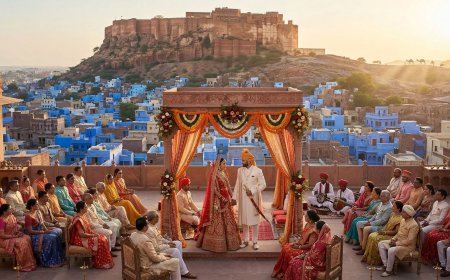
Rajasthan is the most popular destination wedding location in India — and for the adventure wedding couple, the appeal is in Rajasthan's landscapes beyond the heritage properties.
The Thar Desert:
The Thar Desert — specifically the sand dunes near Jaisalmer and in the Sam Sand Dunes area — is the Indian landscape most associated with the specific drama of the desert wedding. The ceremony at sunset on the dunes, the dinner under the stars with the sand extending to the horizon, the morning light on the golden city in the distance — these are the specific sensory experiences that the desert wedding offers and that no other setting replicates.
The practical considerations: the Thar's heat is extreme outside the October to February window. The sand requires specific management for catering, for florals, for the couple's attire. The logistics of transporting guests and setting up a functional celebration in a desert setting require specific vendor experience and specific planning.
The Rann of Kutch:
The Great Rann of Kutch — the salt desert of Gujarat whose specific landscape is the vast white expanse of the salt flat, extending to the horizon in every direction under an enormous sky — is the adventure wedding setting that is less frequently used than the Thar Desert and whose visual drama is entirely different.
The Rann Utsav season — October to February — coincides with the period when the Rann is accessible and visually extraordinary. The full moon night on the Rann, with the white salt flat reflecting the moonlight, is among the most distinctive settings available for a night ceremony in India.
The Coastal and Island Settings
The Andaman Islands:
The Andaman Islands — the archipelago in the Bay of Bengal whose beaches are among the most pristine in India, whose coral reefs are largely intact, and whose geographic isolation produces a specific quality of remoteness — are the Indian adventure wedding setting whose combination of tropical beauty and genuine remoteness is most distinctive.
The beach wedding in the Andamans — at Radhanagar Beach on Havelock Island, at one of the less-visited beaches on Neil Island, or at a specifically scouted private beach — is the Indian setting that most closely approximates the Maldivian or Seychellois wedding in its visual quality.
The logistics: the Andamans require either a flight or a long ferry journey from the mainland, which naturally limits the guest list and concentrates it on the guests who are genuinely committed to the experience. The permit requirements for certain islands and areas need to be investigated specifically.
Goa's Beaches:
Goa's beaches — the most accessible coastal setting in India for an adventure wedding — range from the developed and heavily trafficked to the specific pockets of genuinely remote beauty that are accessible to those who look for them.
The Goa beach wedding at a private stretch of beach, at sunrise or sunset, with the Arabian Sea behind the couple — this is the setting that balances accessibility with genuine beauty. The challenge: the beaches that are genuinely beautiful in Goa are often the beaches that require specific permission to use privately, specific management of the tide timing, and specific attention to the monsoon season's impact on the coastal setting.
The Kerala Backwaters:
The Kerala backwaters — the network of lagoons, lakes, canals, and rivers that runs parallel to the Kerala coast — are the Indian landscape whose specific quality of green water, coconut palms, and the specific light of the tropical south produces a wedding setting of extraordinary intimacy and beauty.
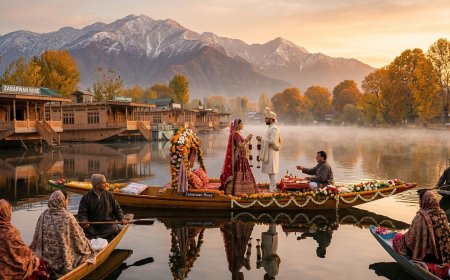
The houseboat wedding — the ceremony conducted on a traditional Kerala kettuvallam, moored in a backwater location — is the adventure wedding format that is most specifically Indian in its cultural resonance. The houseboat, the backwater, the ceremony conducted on the water with the landscape of the Kuttanad or the Alappuzha canals surrounding the celebration — this is the wedding whose setting is inseparable from its cultural meaning.
The Forest and Wildlife Settings
Jim Corbett and the Forest Lodges:
The forest lodges adjacent to India's wildlife reserves — the properties at the edges of Jim Corbett, Kanha, Pench, and Bandhavgarh — offer the adventure wedding setting whose ambient wildlife adds a specific dimension unavailable in any other category of location.
The wedding at a forest lodge — the ceremony in a clearing surrounded by the sounds of the forest, the dinner by firelight with the forest's edge visible in the darkness — is the setting whose sensory richness is entirely specific to the Indian jungle.
The permission requirements for any ceremony within the reserve itself, as distinct from the adjacent properties, need to be investigated specifically — the regulations governing use of protected areas are strict and specific.
The Western Ghats:
The Western Ghats' specific landscape — the dense forest, the spice plantations, the tea and coffee estates of Coorg and Wayanad and the Nilgiris — offers the adventure wedding setting whose intimacy and fragrance are entirely specific to this landscape.
The plantation wedding — the ceremony in a coffee or spice estate, surrounded by the specific smells of the Western Ghats — is the setting that carries the cultural memory of the landscape in its sensory character.
The Logistics: What the Adventure Wedding Requires
The Permission Landscape
The adventure wedding's first logistical challenge is permission — the specific permits, approvals, and authorizations that the unconventional location requires.
Forest and protected area permits:
Any ceremony within or adjacent to a protected forest area, a wildlife reserve, or a national park requires specific permission from the relevant forest authority. The application process, the lead time, the specific restrictions on what is permitted — these vary by state and by specific location and require investigation well in advance of the wedding date.
Beach permits:
Private use of a public beach in India — the exclusive use that a wedding ceremony requires — typically requires permission from the local panchayat, the coastal zone management authority, and in some cases the state's tourism department. The regulations under the Coastal Regulation Zone notification add specific complexity to any structure or installation on the beach.
Heritage and monument sites:
The ceremony at an ASI-protected monument, at a specific heritage site, or within the boundaries of a historically significant location requires specific ASI permission and is subject to the restrictions that apply to use of the protected heritage.
High-altitude areas:
Certain high-altitude areas — in Ladakh, in the northeastern states, in specific border regions — require inner line permits for Indian citizens from certain states and separate permits for foreign nationals. The permit requirements for the guests, in addition to those for the event itself, add a specific logistics layer.
The permit timeline:
The permit applications for adventure wedding locations should begin at minimum six months before the wedding date — and for the most complex locations, a year in advance is not excessive. The permit that cannot be obtained means the location cannot be used, and the couple who has invested significantly in planning for a specific location before confirming its availability has taken a specific risk that the permit timeline makes avoidable.
The Infrastructure Gap
The adventure wedding location's defining characteristic — its remoteness, its unconventionality, its distance from the wedding industry's standard infrastructure — is the same characteristic that creates the logistics challenge.
The vendor reach:
The florist, the caterer, the photographer, the decorator — the vendors whose services the wedding requires — must be willing and able to travel to the location. The vendor network that serves the Jaipur heritage hotel does not necessarily serve the Spiti Valley meadow. The adventure wedding couple must either find vendors who specifically serve their location or plan for the significant logistics of bringing vendors from a distance.
The generator and power:
The remote location that lacks reliable grid power requires a generator — and the generator that powers the lighting, the sound, the catering equipment, and the communications for a wedding is a significant logistical provision. The generator's fuel supply, its noise management — the generator that can be heard during the ceremony is the generator that has been placed without adequate consideration — and its backup provision need specific planning.
The water and sanitation:
The remote location's water and sanitation infrastructure — or lack of it — is the planning element that is most frequently underestimated and most immediately consequential for the guests' comfort. The provision of adequate sanitation for the wedding's duration, in a location that does not have permanent facilities, requires specific planning that the conventional venue does not.
The weather contingency:
The outdoor adventure wedding is entirely dependent on weather in a way that the covered venue is not. The contingency plan for adverse weather — the structure that can be erected quickly, the alternative indoor space, the specific decision framework for when the plan changes — is the planning element that the adventure wedding requires and that the conventional wedding does not.
The monsoon's specific impact on coastal and forested locations. The mountain's specific unpredictability, where weather changes can be rapid and dramatic. The desert's specific temperature range, where the evening that begins at a comfortable temperature can become very cold after midnight. Each location's specific weather characteristics need to be understood before the wedding date is set and the contingency planned before the event.
The Guest Management
The adventure wedding's location imposes specific requirements on the guests that the conventional venue does not — and the couple's responsibility to their guests includes the specific management of these requirements.
The physical capability consideration:
The wedding at high altitude, the wedding accessed by a difficult road, the wedding on a beach requiring a walk across sand — each of these locations has specific physical requirements that not all guests can meet. The grandmother with limited mobility, the guest with a respiratory condition, the family elder whose physical capacity is limited — the adventure wedding's location may be genuinely inaccessible to specific guests whose presence matters to the couple.
The couple must decide honestly: is the location more important than these guests' ability to attend? There is no wrong answer — but it is a decision that should be made explicitly rather than allowed to be resolved by default.
The travel briefing:
Every guest at an adventure wedding needs a more detailed travel briefing than the conventional wedding guest requires. The road conditions. The altitude and its effects. The weather at the time of year. The appropriate clothing. The physical preparation. The permit requirements if applicable. The emergency medical provision at the location.
The briefing should be comprehensive, honest, and provided early enough that guests can make informed decisions about their attendance rather than discovering the requirements after they have committed.
The accommodation:
The accommodation available at or near the adventure wedding location is typically more limited — in quantity, in standard, and in the specific comfort infrastructure that guests from abroad may expect — than the accommodation available at conventional wedding destinations.
The management of guests' accommodation expectations — the honest communication about what is available, the assistance with booking, the specific preparation for the gap between expectation and reality — is the guest management challenge most specific to the adventure wedding.
The Ceremony Design: What Changes Outdoors
The Sound
The outdoor ceremony's sound management is the technical challenge most frequently underestimated. The voice that carries beautifully in an enclosed space is the voice that is lost to the ambient sound of the landscape — the wind, the water, the wildlife, the specific sounds of the outdoor environment.
The wireless microphone system — specifically calibrated for outdoor use, with the specific wind protection that prevents the wind noise that renders the ceremony inaudible — is not optional at the outdoor adventure wedding. The ceremony whose words cannot be heard by the guests seated ten metres from the couple has failed its most basic communicative function.
The sound engineer who has specific experience with outdoor events, who understands the specific acoustic challenges of the landscape, and who has tested the equipment in outdoor conditions rather than in a studio is the professional the adventure wedding requires.
The Light
The outdoor ceremony's light is the element that most directly determines the ceremony's visual quality — and the outdoor light's behavior is entirely different from the controlled indoor light that the conventional venue provides.
The ceremony at the golden hour — the specific light of the hour before sunset — is the outdoor ceremony at its most visually extraordinary. The logistics of the golden hour ceremony: the timing must be precisely planned, the ceremony must start and end within the window of the best light, and the photographer must be positioned to use the light rather than fight it.
The ceremony in full midday sun — the outdoor ceremony at the time of day when the Indian sun is most intense — is the ceremony that is most challenging for the guests and the least visually interesting photographically. The timing of the outdoor ceremony should be planned around the light as much as around the programme.
The Florals and Decor
The outdoor ceremony's florals and decor are subject to the specific challenges of the outdoor environment — the wind that displaces arrangements, the humidity that wilts blooms, the specific insects whose engagement with the florals the couple had not anticipated.
The florals for the outdoor setting should be chosen by a florist who has specific experience with outdoor events — who knows which blooms hold in the specific ambient conditions, which arrangements are stable in wind, and which design approaches use the landscape rather than competing with it.
The decor that uses the landscape as its primary material — the flowers that are the wildflowers of the actual setting, the fabrics that are the colors of the landscape, the lighting that enhances rather than replaces the ambient light — is the decor approach most appropriate to the adventure wedding setting. The decor that brings the banquet hall into the outdoors — the heavy arrangements, the formal tablecloths, the chandelier — is the decor that is fighting the setting rather than working with it.
The Photography: The Adventure Wedding's Greatest Asset
The adventure wedding's greatest gift to the photographic record is the setting — the landscape that is not available to the conventional wedding and that makes every photograph specific to this occasion and this place.
The photographer who is selected for the adventure wedding should be selected specifically for their outdoor and landscape photography capability — the photographer whose portfolio includes outdoor work in challenging and remote settings, who has experience with the specific technical challenges of high altitude, changing light, and unconventional backgrounds.
The adventure wedding's photography should be planned as a specific creative project in collaboration with the photographer — the specific shots that use the landscape, the specific moments that the setting makes possible and that no other setting would produce. The photograph of the couple at the edge of the meadow with the Himalayan peaks behind them. The ceremony image with the backwater's green water surrounding the houseboat. The dinner under the desert stars with the Milky Way above the table.
These are the images whose existence justifies the planning complexity.
The Adventure Wedding as a Statement of Values
The couple who chooses the meadow at four thousand metres over the hotel ballroom is making a specific statement — about what they value, about the kind of occasion they want to create, about the place and the landscape that carry meaning for them.
The statement is not for the guests or for the social media archive. It is for themselves — the specific honesty of an occasion designed around what the couple actually finds beautiful and meaningful rather than around the convention of what a wedding is supposed to look like.
The guests who make the journey to the specific, difficult, extraordinary location are the guests who are saying something specific in return — that the couple is worth the effort, that the experience is worth the inconvenience, that they want to be present at the occasion in its full, specific, unrepeatable form.
The twenty-two guests who stood in the meadow at four thousand metres were the twenty-two people who had specifically decided that this was the wedding they wanted to attend — not out of obligation but out of genuine desire to be part of the specific thing the couple was creating.
The groom, standing in the landscape of his childhood at the moment of his marriage, said afterward that he had not fully understood until that moment why it had mattered so much to be there.
The bride, who had grown up far from the mountains and who had stood in that meadow for the first time three years before the wedding, said that she understood.
That understanding — between two people, in a specific landscape, at the moment of their wedding — is the thing that the adventure wedding is for.
It is not available at a hotel ballroom.
NRIWedding.com — Expert guidance for Indian weddings planned across borders.
What's Your Reaction?
 Like
0
Like
0
 Dislike
0
Dislike
0
 Love
0
Love
0
 Funny
0
Funny
0
 Angry
0
Angry
0
 Sad
0
Sad
0
 Wow
0
Wow
0