










































































Four Days, Four Hundred Guests: The NRI Couple's Strategic Guide to Evaluating Wedding Caterers During a Short India Visit
Most NRI couples have a narrow window in India to make one of their most consequential wedding decisions — choosing the caterer who will feed hundreds of guests across multiple events. This guide delivers a complete evaluation framework built specifically for couples working against the clock, covering remote shortlisting, pre-screening calls, tasting strategy, team assessment, reference checks, and post-booking communication from abroad. Stop making catering decisions under time pressure without a system and start arriving in India already prepared to evaluate, compare, and book with genuine confidence.


You Have Four Days. The Wedding Feeds Four Hundred People. Choose Wisely.
The itinerary looks optimistic on paper. You land on Thursday evening. Friday is earmarked for venue visits. Saturday has three caterer meetings scheduled. Sunday is for family time and loose ends. Monday morning you fly back to Sydney or Seattle or Stuttgart, and by the time you board that flight, you need to have made a decision about who is going to feed four hundred guests across four events at the most significant celebration of your life.
Four days. Four hundred people. One decision that affects every guest's experience of your wedding more directly than almost anything else you will plan.
This is the reality of NRI wedding planning logistics. You are not based in the city where your wedding is happening. You do not have the luxury of multiple leisurely vendor meetings spread across several months. You cannot pop back for a follow-up tasting when a caterer's proposal comes through three weeks after your visit. You have a narrow window, a complex decision, and the added pressure of knowing that every meeting you have in India is competing with family obligations, jet lag, and the seventeen other planning conversations that need to happen on the same trip.
The couples who make excellent catering decisions in this context are not the ones with more time. They are the ones with better preparation. They arrive in India having already done the work that most couples try to do in person — the research, the shortlisting, the criteria definition, the question preparation — so that the limited in-person time is used exclusively for the things that can only be assessed face to face.
This guide gives you the preparation framework and the in-person evaluation strategy to make a confident, well-informed catering decision in the time you actually have.
Why Catering Is the Decision That Demands the Most Rigor
Before the evaluation framework, a clear-eyed acknowledgment of why this particular decision carries disproportionate weight in the overall wedding planning process.
Food is the most universally experienced element of any wedding. Every guest — regardless of their relationship to the couple, their cultural background, their level of engagement with the ceremony, or how much they danced at the reception — eats the food. It is the one experience that is genuinely shared across the entire guest list. And unlike the flowers or the lighting or the venue styling, which guests may admire but quickly forget, the food is remembered. Specifically, viscerally, and for years.
Indian wedding guests are also, as a demographic, deeply informed and deeply opinionated about food quality. A guest who might generously overlook a floral arrangement that did not quite match the brief will not overlook biryani that was clearly made in bulk with insufficient attention, or a paneer dish that arrived at room temperature, or a dessert table that ran out an hour before the reception ended. Food failure at an Indian wedding is not a minor inconvenience. It is the thing people remember and discuss and, in the merciless dynamic of extended family WhatsApp groups, compare unfavorably to the wedding two years ago.
For NRI couples specifically, the catering decision carries an additional dimension. You are not present in the months between booking and wedding day to check in informally, to taste a new dish the caterer wants to add, to flag concerns early. You are managing this relationship from abroad, which means the quality of your initial evaluation and the clarity of your brief have to do work that ongoing in-person oversight would otherwise handle.
Get this decision right, and the food at your wedding will be one of its defining pleasures. Get it wrong, and no amount of beautiful flowers and excellent photography will fully compensate.
The Pre-Visit Preparation: The Work That Happens Before You Land
The most valuable thing you can do to maximize your limited India time is to complete as much of the evaluation process as possible before your visit begins. By the time you sit across from a caterer in person, you should already know their reputation, their price positioning, their capacity, and their suitability for your event scale and cuisine requirements. The in-person meeting is for the things that cannot be assessed remotely — the food itself, the team's responsiveness, the quality of the interpersonal dynamic.
Building Your Shortlist Remotely
Begin your caterer shortlist at least eight to twelve weeks before your India visit. The shortlist should not be built from Instagram aesthetics alone — beautiful food photography is a marketing exercise, not a quality indicator. Build it from three sources that carry more weight.
Personal recommendations from people whose weddings you respect and whose taste aligns with yours. Not generic "they were good" recommendations but specific accounts: what they liked about the food, what the service was like, whether the caterer was responsive and easy to work with, whether there were any issues on the day and how they were handled.
Your wedding planner's assessment, if you are working with one. A planner who operates regularly in your wedding city has direct experience with multiple caterers and can steer you away from operators whose on-paper presentation does not match their on-day execution — a distinction that is impossible to make without that insider knowledge.
Reviews and references from venues you are considering. Venue managers see caterers in action repeatedly and have strong opinions, which they will usually share if asked directly. A venue that has worked with a caterer multiple times and speaks about them enthusiastically is meaningful endorsement. A venue that is neutral or vague about a caterer they have hosted is worth noting.
Aim for a shortlist of three to five caterers before you arrive in India. More than five and your limited meeting time becomes diluted. Fewer than three and you do not have the comparison basis to evaluate confidently.
The Remote Pre-Screening Call
Before scheduling in-person meetings, conduct a twenty-minute pre-screening call with each shortlisted caterer. This call has two purposes: to confirm basic suitability and to assess responsiveness and communication quality.
Basic suitability questions for the call: What is your capacity for an event of our scale? Are you available on our wedding dates? What is your experience with events of similar guest count and multi-event structure? Do you have experience catering for mixed Indian and international guest lists? What is your pricing range for this scale of event?
Any caterer who cannot answer these questions clearly on a twenty-minute call, or who takes more than forty-eight hours to schedule the call in the first place, has already told you something important about how they will communicate with you from abroad in the months between booking and wedding day.
After the pre-screening calls, narrow your shortlist to three caterers for in-person meetings and tastings.
The In-Person Meeting: What to Assess and How
The Tasting: The Most Important Hour of Your India Visit
If you have limited time in India and something must be prioritized above all else in the catering evaluation process, it is the tasting. Not the meeting. Not the proposal review. The tasting.
A caterer's proposal tells you what they intend to serve. The tasting tells you whether they can actually cook it to the standard your wedding requires.
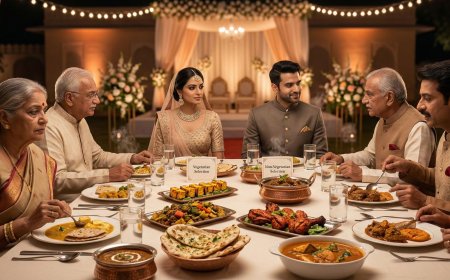
Arrive at the tasting with specific dishes you want to evaluate — not an open brief that allows the caterer to show only their strongest preparations. Request a selection that spans the menu you are considering: at least one rice dish, one or two meat preparations, one or two vegetarian mains, a bread selection, a dessert selection, and the live station item if you are planning one. If your wedding involves specific regional cuisine requirements — Gujarati thali, Punjabi dhaba style, South Indian spread — the tasting must include these specifically rather than a generic North Indian showcase.
Assess the food on the following dimensions.
Flavor authenticity Does this taste like genuinely well-made Indian food, or does it taste like scaled catering — food that has been standardized for volume production at the expense of the layered, complex flavors that distinguish excellent Indian cooking from adequate Indian cooking?
Temperature management. How are dishes presented and maintained during the tasting? Temperature management at scale is one of the most challenging aspects of wedding catering. Food that arrives at the tasting at the correct temperature tells you the caterer understands heat management. Food that is lukewarm or inconsistently heated signals a problem that will be worse at a four-hundred-person event.
Consistency across the spread. A caterer who produces one exceptional dish surrounded by adequate preparations is a caterer whose team has uneven strengths. You need consistent quality across the entire menu, not a showcase dish that masks mediocrity elsewhere.
Presentation quality. At a wedding, food presentation contributes to the overall visual experience of the event. The plating, garnishing, and buffet presentation at the tasting — even in a meeting room setting — gives you an indication of the care and attention the team brings to the visual dimension of their work.
Portion sizing and richness. Indian wedding food has specific cultural expectations around generosity — the sense that there is abundance, that no guest is eating small portions, that the table is genuinely full. A tasting that produces small, restaurant-style portions indicates either a catering culture misaligned with wedding food expectations or a caterer who is showing you less than they will deliver.
Take notes during the tasting. Not mental notes — written notes, specific to each dish, about what worked, what was missing, and what questions the food raised. This discipline prevents the natural human tendency to remember only the strongest and weakest elements while forgetting the nuanced observations that distinguish a good caterer from the right caterer for your specific wedding.
The Team Assessment
Beyond the food, the in-person meeting gives you an opportunity to assess the people who will be responsible for executing your wedding catering. This dimension is frequently overlooked in favor of the food evaluation, and it is a serious oversight.
The catering team lead — the person you are meeting with and who will be the point of contact throughout the planning process — should demonstrate specific qualities that matter for an NRI couple managing from abroad.
Responsiveness and communication clarity. How quickly and clearly do they answer your questions in the meeting? A team lead who is direct, specific, and confident in their answers is a team lead who will be direct, specific, and confident in their written communication over the following months. One who is vague, evasive, or frequently defers to follow-up communication for basic questions is one who will be difficult to manage remotely.
Operational specificity. Can they speak precisely about how they handle specific operational challenges — late-running timelines, unexpected guest count changes, temperature management across a long buffet service? A caterer who has been doing this successfully at scale has specific answers to these questions. One whose answers are generic or reassuring without being specific has not thought carefully about these scenarios.
Cultural and culinary literacy. For NRI couples with specific regional food traditions, the caterer's genuine knowledge of and respect for those traditions is essential. A team lead who speaks specifically about the distinctions between different regional cuisines — who can tell you why a particular dish needs a specific technique to be authentic — is one who will execute your specific vision rather than a generic version of it.
The Questions That Reveal the Most
These are the specific questions that consistently separate excellent wedding caterers from adequate ones. Ask every caterer on your shortlist the same questions and compare the answers.
How many events are you catering on our wedding date, and what is your capacity allocation across them? A caterer who will be managing three weddings simultaneously on your date with a single kitchen team is a different operational reality from one for whom your event is their sole focus. There is no universally right answer — large catering operations routinely manage multiple events — but you need to understand the structure and satisfy yourself that your event receives appropriate resource allocation.
Who specifically will be the on-site catering manager for our wedding, and can we meet them? The person you are meeting with during the sales process is not always the person who will be present on your wedding day. The on-site manager is the person whose competence and judgment directly affects the execution. If possible, meet them before booking. If not, ask for their specific experience with events of your scale.
How do you handle dietary requirements at scale, and what is your protocol for preventing cross-contamination? The answer to this question reveals operational rigor in a way that no portfolio or reference check can. A caterer with genuinely robust dietary requirement management will have a specific, detailed answer. One who gives reassuring generalities is a caterer for whom dietary management is an afterthought.
What is your contingency plan if a key preparation — the biryani, the main curry — is not meeting quality standards on the morning of the event? This question is designed to assess problem-solving culture. An excellent caterer will have a specific answer about quality checks, alternative sourcing, and escalation protocols. One who seems surprised by the question has not built contingency thinking into their operational approach.
Can you provide three references from weddings of similar scale that we can contact? References are standard practice and any reputable caterer should provide them without hesitation. Follow up on at least two. Ask specifically about food quality consistency throughout the service, how the team handled any issues that arose, whether the caterer was responsive in the planning period, and whether the event guest count and scale was genuinely comparable to yours.
The Menu Discussion: Going Deeper Than the Proposal
A caterer's initial proposal is a starting point for a menu conversation, not a finished document for approval. The couples who get the most from this conversation are the ones who arrive knowing what they want and are willing to push back on generic suggestions.
Come to the menu discussion with your regional cuisine priorities clearly defined. If your family is from Rajasthan, the dal baati churma matters. If your family is from Kerala, the fish preparations need to be authentic to that culinary tradition. If your family spans multiple regional backgrounds, the menu needs to honor that complexity. Do not accept a generic North Indian wedding menu if your family's food identity is more specific than that.
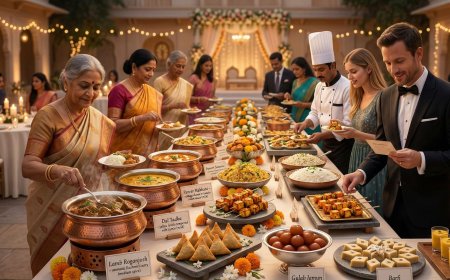
Push on the live stations specifically. Live stations — whether a chaat counter, a kebab grill, a dosa station, or a regional specialty — are among the highest-impact elements of Indian wedding catering and the ones where caterers can most meaningfully differentiate. A caterer who has strong live station execution and is genuinely enthusiastic about designing one for your wedding is offering something meaningfully different from one who includes a live station as a checkbox.
Discuss the dessert table specifically and separately from the main course. Mithai quality at Indian weddings is highly variable — the difference between fresh, properly made sweets from a specialist mithai supplier versus mass-produced alternatives is immediately apparent to any Indian guest. Ask specifically where the mithai is sourced, whether it is made in-house or purchased from a specialist, and whether you can taste the specific items that will appear on your dessert table.
Managing the Decision From Abroad After the Visit
You have done the tastings, had the meetings, asked the questions. You are back on the plane to Sydney or Seattle or Stuttgart. Now you need to make a final decision and manage the relationship from thousands of kilometers away until the wedding day.
The decision itself should be made within one week of your return while the impressions are fresh and the comparative assessment is clear. A decision matrix — assigning scores across food quality, team quality, communication responsiveness, price positioning, and reference quality — removes the paralysis that can set in when gut feel and rational analysis point in different directions.
Once the decision is made, the booking confirmation and contract review should happen within two weeks. Read the contract carefully — specifically the cancellation and postponement terms, the payment schedule, the specification of what is included and what is billed additionally, and the headcount adjustment protocol closer to the event date.
The communication rhythm with your chosen caterer from this point should be structured rather than reactive. A detailed brief sent within four weeks of booking that covers your menu priorities, your regional cuisine requirements, your guest demographic and dietary breakdown, your event schedule with timings, and your specific expectations for service style. A check-in at the three-month mark to confirm menu finalization and address any questions. A finalization call at the six-week mark to confirm headcount, event timings, and logistics. A written summary sent after every call so there is a record of every commitment made.
The couples who have the most confidence in their catering decision as the wedding approaches are not the ones who check in most frequently — they are the ones whose initial brief was thorough enough that there is little ambiguity to manage in the months that follow.
At a Glance: The NRI Caterer Evaluation Framework
| Evaluation Stage | When | What to Assess | Red Flags |
|---|---|---|---|
| Remote shortlisting | 8–12 weeks before India visit | Reputation, recommendations, capacity, price range, cuisine specialization | No verifiable references, Instagram-only presence, vague capacity answers |
| Pre-screening call | 4–6 weeks before India visit | Availability, communication quality, basic suitability, responsiveness | Slow to schedule, evasive on basic questions, unavailable on wedding dates |
| In-person tasting | During India visit | Food quality, temperature management, flavor authenticity, consistency, presentation | Inconsistent quality across dishes, lukewarm service, reluctance to show full menu range |
| Team assessment | During India visit | Communication clarity, operational specificity, cultural knowledge, on-site manager quality | Vague operational answers, unfamiliarity with your regional cuisine, no clear on-site manager |
| Reference checks | After India visit, before booking | Execution quality, issue management, planning communication, scale accuracy | Reluctance to provide references, references who are vague or unenthusiastic |
| Contract review | Before booking confirmation | Payment terms, cancellation policy, headcount protocol, inclusions and exclusions | Unclear inclusions, unfavorable cancellation terms, no headcount adjustment provision |
| Post-booking brief | Within 4 weeks of booking | Menu specification, dietary requirements, event schedule, service expectations | Slow to acknowledge brief, generic responses that do not reflect your specific requirements |
| Finalization call | 6 weeks before wedding | Headcount confirmation, event timing, logistics, final menu confirmation | Significant changes from original proposal, communication difficulties, unresolved dietary concerns |
The Confidence That Comes From Preparation
There is a specific quality of confidence available to the NRI couple who has done this work properly — who arrives in India prepared, uses their limited time with precision, makes a decision grounded in real evaluation rather than time pressure, and manages the relationship from abroad with structural clarity rather than anxious check-ins.
It is the confidence of knowing that the most universally experienced element of your wedding — the food that every guest will eat, the flavors that will define how people remember the day, the generosity and care that the catering expresses on your behalf — is in the hands of a team you evaluated thoroughly and briefed completely.
That confidence does not come from the tasting alone, as important as that is. It comes from the months of preparation that made the tasting possible, the questions that revealed what the food alone could not show you, and the follow-through that ensured the caterer you chose on that Thursday in Mumbai or Delhi or Jaipur understood exactly what you needed from them before you boarded the flight home.
The food at your wedding will be experienced by every person you love. It deserves exactly this level of care.
NRIWedding.com — Expert guidance for Indian weddings planned across borders.
What's Your Reaction?
 Like
0
Like
0
 Dislike
0
Dislike
0
 Love
0
Love
0
 Funny
0
Funny
0
 Angry
0
Angry
0
 Sad
0
Sad
0
 Wow
0
Wow
0