































































Vegetarian or Non-Vegetarian? The NRI Couple's Honest Guide to Navigating the Most Politically Charged Menu Decision of Your Wedding
No wedding planning decision generates more family tension for NRI couples than choosing between a vegetarian and non-vegetarian menu. This guide cuts through the noise with an honest breakdown of every position at the table — from sincere religious observance to cultural hospitality traditions to international guest considerations. Learn the four structural menu approaches, the family conversations that actually need to happen, and how to design a vegetarian menu that genuinely impresses everyone. Make the decision that honors your families and your guests without sacrificing your own clarity or conviction in the process.

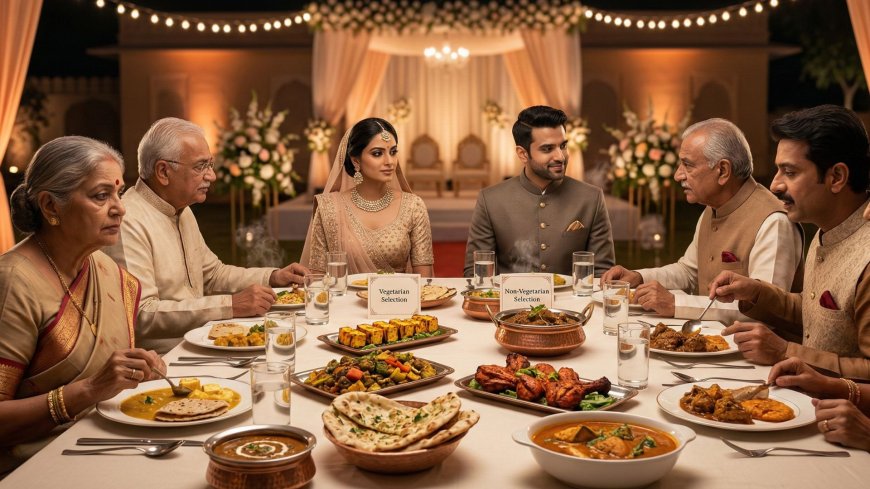
Nobody Told You the Menu Would Cause More Drama Than the Guest List
You handled the seating chart without a major incident. You navigated the outfit color coordination across three families with relative diplomacy. You even managed the invitation wording debate between your mother and your mother-in-law without anyone going silent for more than forty-eight hours.
And then someone asked whether the wedding would be vegetarian or non-vegetarian.
The WhatsApp group went quiet in a way that felt specifically loaded. Your father sent a voice note. Your future in-laws called separately, within the same hour. Your cousin who has been vegan for three years sent a long message that began with "I just want to make sure I understand the situation correctly."
Welcome to the single most reliably contentious food decision in Indian wedding planning. The vegetarian versus non-vegetarian menu debate is not really about food. It is about family identity, religious observance, cultural hierarchy, hospitality values, and the deeply held belief — present on both sides of the debate — that the other side's preference represents a form of disrespect toward people who matter.
Understanding what is actually at stake in this conversation, and building a menu strategy that addresses the real concerns rather than just the surface preferences, is the difference between a decision that lands well and one that becomes the story people tell about your wedding for the wrong reasons.
Why This Decision Is Harder for NRI Couples
For couples planning and living in India, the vegetarian versus non-vegetarian conversation unfolds within a shared cultural context. Families generally know each other's dietary practices. Regional and community norms provide a framework. The decision, while sometimes contentious, happens within a landscape of shared reference points.
NRI couples navigate this without the same shared context. You may come from a family with strict vegetarian observance — Jain, Brahmin, or simply a family for whom vegetarianism is a deeply held practice across generations — marrying into a family for whom non-vegetarian food is a central expression of celebration and hospitality. Or the reverse. Or both families are vegetarian but your international guest list includes colleagues and friends for whom a fully vegetarian wedding feels unexpectedly restrictive.
Add to this the reality that NRI communities often span multiple generations with different degrees of religious observance, different relationships to traditional dietary practices, and different experiences of food culture through years of living abroad. A second-generation NRI who grew up in London eating everything may have a very different relationship to vegetarianism than their grandparents who have kept strict vegetarian households for sixty years.
The decision you make is not just a menu decision. It is a statement about whose cultural practices your wedding prioritizes and how you are navigating the complexity of two families whose food identities may sit in genuine tension.
The Real Positions at the Table
Before building a solution, a clear understanding of the positions that actually exist in this conversation and what each one is genuinely about.
The Strictly Vegetarian Position
For many Indian families — particularly Brahmin, Jain, Vaishnavite, and Gujarati communities — vegetarianism at religious and ceremonial occasions is not a preference. It is a practice rooted in spiritual observance, ritual purity, and a framework in which the presence of meat at a sacred event is genuinely, meaningfully problematic.
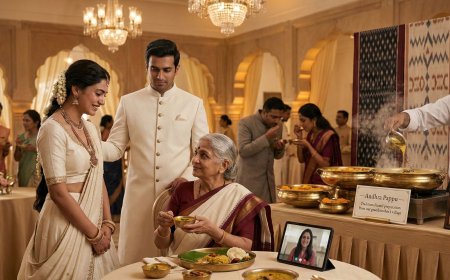
This is not squeamishness or food prejudice. It is a sincere religious and cultural position that deserves to be understood as such rather than dismissed as unreasonable restriction. For an elderly grandmother who has maintained a pure vegetarian household for seven decades, the question of whether meat will be served at her grandchild's wedding ceremony is not a catering preference — it is a matter of whether she can be fully, spiritually present at the event.
The Non-Vegetarian Position
For many other Indian families and communities — Punjabi, Bengali, Maharashtrian, South Indian, and Muslim communities, among others — non-vegetarian food is not merely permitted at celebrations. It is central to them. A wedding without meat is, in this framework, a wedding that is not fully celebrating. The lamb, the chicken, the fish — these are expressions of abundance and generosity, markers of a family's commitment to genuine hospitality, and in some cases, specific dishes that carry the weight of family tradition across generations.
For these families, a strictly vegetarian wedding is not neutral accommodation — it is an experience of their dietary identity being overridden by the other family's preferences.
The International Guest Position
For NRI couples with significant international guest lists, a strictly vegetarian menu creates a different challenge. Not a religious or cultural one — a practical one. International guests who are not vegetarian and who are unfamiliar with the full richness of Indian vegetarian cuisine may find a vegetarian-only menu unexpectedly limited if it is not designed with genuine intention and variety. This concern is legitimate but also solvable — it depends far more on the quality and range of the vegetarian menu than on the presence or absence of meat.
The Younger Generation Position
The younger NRI generation frequently occupies a more flexible position — comfortable with vegetarian food, comfortable with non-vegetarian food, more focused on quality and taste than on the ideological dimension of the choice. But this flexibility can make it tempting to defer the decision or try to please everyone simultaneously, which often results in a menu that satisfies nobody completely.
The Options and Their Real Implications
There are four structural approaches to this decision, each with distinct implications for family dynamics, guest experience, and operational complexity.
Option One: Fully Vegetarian Menu
A fully vegetarian wedding menu is the approach that honors the most restrictive dietary position in the room. If one family has sincere religious or cultural reasons for requiring a vegetarian event, and those reasons are respected rather than merely accommodated, a well-designed fully vegetarian menu is not a compromise — it is a positive choice.
The critical word here is well-designed. A fully vegetarian Indian wedding menu that is designed with genuine ambition — that showcases the full range of Indian vegetarian cuisine with its regional diversity, its textural complexity, its capacity for richness and celebration — is not a lesser menu. It is a different menu, and in the hands of an excellent caterer, it is a menu that impresses non-vegetarian guests precisely because it challenges their assumption that vegetarian food cannot be the center of a genuinely abundant celebration.
The practical implication is that your caterer selection must prioritize vegetarian cuisine expertise. Not every wedding caterer has equal mastery of vegetarian cooking — some operate primarily in the non-vegetarian space and their vegetarian options are clearly secondary. For a fully vegetarian wedding, you need a caterer whose vegetarian preparations are their signature rather than their accommodation.
The family dynamic implication is that this choice communicates a clear prioritization. Non-vegetarian family members who understand the religious or cultural reasoning behind it will generally accept it graciously, particularly if the food itself is genuinely excellent. Those who receive it as an imposition rather than a principled decision will find it harder to accommodate — which is why the communication around this choice matters as much as the choice itself.
Option Two: Fully Non-Vegetarian Menu With Vegetarian Options
This is functionally the default at many Indian weddings — a non-vegetarian spread as the centerpiece, with substantial vegetarian options available throughout. In practice, this approach often serves neither group optimally. The vegetarian options can feel secondary and less carefully prepared than the main non-vegetarian dishes. Strictly vegetarian guests who observe religious dietary practices may not be comfortable sharing a buffet with meat preparations even if their own plate is vegetarian.
For NRI couples navigating family tension between vegetarian and non-vegetarian preferences, this approach resolves the surface question — there is meat available — without resolving the underlying tension. A Jain grandmother who is present at a wedding where meat is being served in the same space as the ceremony rituals has not been accommodated in any meaningful spiritual sense regardless of the vegetarian dishes on offer.
Option Three: Separated Vegetarian and Non-Vegetarian Service
The most commonly recommended solution in wedding planning guides — and the one that sounds logical until you try to execute it — is running a separated service with a clearly distinct vegetarian section and a clearly distinct non-vegetarian section, sometimes in different parts of the venue.
This approach has genuine merit in specific contexts. For very large receptions where the scale allows meaningful physical separation, or for events where the vegetarian guests are a smaller subgroup with specific needs that can be catered to in a dedicated space, separation can work well.
The operational reality for most Indian weddings is messier. A buffet that is theoretically separated becomes practically integrated as serving utensils migrate, guests move across sections, and the kitchen manages both from the same catering infrastructure. For guests with strict religious dietary requirements — Jains who observe the principle of non-contamination rigorously, for example — surface separation without genuine kitchen separation does not address the actual concern.
The family dynamic implication is also worth examining honestly. Physical separation of vegetarian and non-vegetarian guests at a wedding creates a visible statement about dietary difference that can feel alienating rather than accommodating — a literal segregation of the guest community along food identity lines.
Option Four: Tiered Event Approach
The approach that NRI couples with genuinely divergent family dietary positions increasingly find workable is a tiered structure that makes different menu decisions for different events within the wedding weekend.
The religious ceremonies — the actual wedding rituals, the morning functions, any events conducted with pandit or religious observance — are vegetarian in accordance with the spiritual requirements of those events. The reception and evening celebrations, which are less ritually charged and more purely celebratory, may include non-vegetarian options. This is not a compromise that satisfies nobody — it is a principled distinction that honors the ritual sanctity of the ceremonial events while creating space for the non-vegetarian family's hospitality culture at the celebration events.
For many families, particularly those with religious vegetarian requirements on one side and cultural non-vegetarian traditions on the other, this tiered approach represents a genuinely respectful navigation of the tension rather than a forced resolution of it.
The Family Conversation That Actually Needs to Happen
Most couples who struggle with this decision are struggling because the conversation with their families has happened around the decision rather than about it.
The around version sounds like this: requests are communicated through intermediaries, preferences are expressed as requirements, and the couple finds themselves managing two competing sets of expectations without ever having a direct conversation with the family members whose position is most strongly held.
The about version is a direct, respectful, genuinely curious conversation with the family members most invested in the outcome. Not a negotiation — a conversation that starts from genuine interest in understanding what is at stake for each family before any solution is proposed.
With the vegetarian family: What specifically is important to you about the menu being vegetarian? Is it about the ceremony events specifically, or all events across the weekend? Is your concern about the food itself, or about sharing a space where meat is being prepared? Understanding the specific nature of the concern prevents the mistake of offering a solution that addresses the surface preference without addressing the underlying one.
With the non-vegetarian family: What does having non-vegetarian food at the wedding mean to you? Is it about the food experience specifically, or about the expression of your family's hospitality culture? Are there specific dishes that carry family significance? Understanding this allows you to design a response that honors the genuine value rather than simply reinstating meat as a default.
These conversations require courage and genuine curiosity. They also, in the experience of most couples who have them, produce far more workable solutions than any amount of menu planning conducted without them.
Designing the Vegetarian Menu That Impresses Everyone
If the decision lands on a fully vegetarian or primarily vegetarian menu, the quality and ambition of that menu is the most important investment you can make in ensuring the decision is received well.
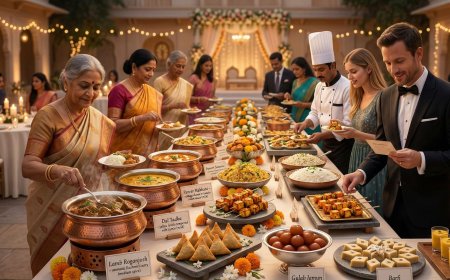
A vegetarian Indian wedding menu designed without compromise should span regional traditions rather than defaulting to a generic North Indian vegetarian selection. Paneer preparations in three or four distinct styles — not paneer makhani, palak paneer, and shahi paneer simultaneously, which creates a monotonous protein base, but a spread that showcases paneer alongside dal preparations, vegetable-centered dishes, and live station items that create texture and variety.
Dal preparations deserve specific attention. A wedding-quality dal makhani — slow-cooked overnight, rich with butter and cream, carrying the depth that only extended cooking produces — is a dish that non-vegetarian guests consistently identify as one of the best things they ate at a vegetarian wedding. A well-made dal is not a consolation for the absence of meat. It is a dish of genuine substance and satisfaction.
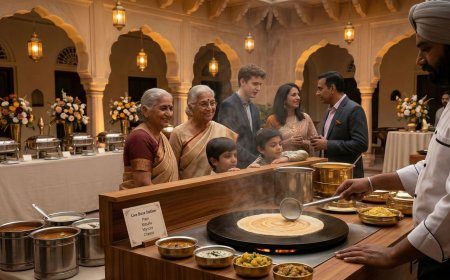
Regional vegetarian specialties are underused at most Indian weddings and represent the clearest opportunity to create a menu that feels specific and considered rather than generic. A Rajasthani dal baati churma for a family from Rajasthan. A Tamil Nadu-style sambar and rasam progression as a palate element in a South Indian spread. A Gujarati undhiyu that showcases winter vegetables in a preparation that bears no resemblance to anything a non-Indian guest has encountered before. These dishes tell a specific culinary story rather than a generic one, and they create the sense of genuine hospitality — of a family sharing their specific food culture — that elevates a good wedding meal into a memorable one.
What to Tell Your International Guests
For NRI couples with significant international guest lists choosing a vegetarian menu, managing expectations in advance prevents the experience of international guests arriving underprepared for what they will find.
A brief note in your wedding communications — on your wedding website, in your pre-wedding information pack, or as a personal message to guests you know well — that explains the menu choice warmly and specifically prepares non-vegetarian guests for the experience rather than surprising them. Something as simple as "our wedding menu celebrates the Indian vegetarian tradition in its full richness — we think you will be surprised and delighted by what vegetarian Indian cooking at its best can offer" reframes the experience from a restriction to an invitation.
You are not apologizing for your menu. You are welcoming your guests into an experience they may not have encountered before and giving them the context to approach it with curiosity rather than disappointment.
The Decisions That Belong to You
There is a version of this decision that belongs to your families. And there is a version that belongs to you.
The family version includes the sincere religious requirements, the cultural traditions that carry genuine meaning, the hospitality values that reflect something real about who your families are. These deserve respect and careful consideration.
The version that belongs to you is the decision itself — the final call, made with full information and genuine respect for everyone involved, about what your wedding will look and taste like. That decision is not subject to veto by whoever applies the most pressure or makes the loudest claim. It is informed by the conversations you have had, the values you hold as a couple, and your honest assessment of what serves your guests and honors your families most completely.
The couples who navigate this most gracefully are the ones who make the decision consciously and communicate it with warmth rather than defensiveness — who can say, in whatever form is appropriate for their family: we thought about this carefully, we understand what it means to each of you, and here is what we decided and why.
That communication — delivered with genuine care and genuine conviction — does more to land a difficult menu decision well than any amount of compromise in the menu design itself.
The food will be eaten once. The family relationships will last the rest of your life. Design the menu that serves both with the seriousness they each deserve.
NRIWedding.com — Expert guidance for Indian weddings planned across borders.
What's Your Reaction?
 Like
0
Like
0
 Dislike
0
Dislike
0
 Love
0
Love
0
 Funny
0
Funny
0
 Angry
0
Angry
0
 Sad
0
Sad
0
 Wow
0
Wow
0