



































































Feeding Two Worlds at One Table: The NRI Couple's Complete Guide to Designing a Wedding Menu for Indian and International Guests
Designing a wedding menu for both Indian and international guests is one of the most nuanced catering challenges NRI couples face — and the most consequential for overall guest experience. This guide delivers a complete framework for building a single, thoughtfully designed menu that honors Indian culinary tradition without leaving international guests uncomfortable or unfed. From appetizer strategy and spice spectrum management to dietary requirements, live stations, and caterer briefing, learn exactly how to design a menu that makes every guest feel genuinely considered from the first welcome drink to the last late night bite.


Somebody Is Always Going to Ask if There Is Anything Plain
You have seen it happen at other Indian weddings. The beautifully arranged buffet — the dal makhani, the paneer tikka, the biryani that took the caterer three days to prepare — and somewhere near the end of the line, a non-Indian guest holding a plate with a small portion of plain rice and a bread roll, looking politely uncertain about everything else on offer.
On the other side of the equation: the Indian relatives who have flown from Delhi and Chennai and Ahmedabad, who have been looking forward to proper home-style food for months, confronted with a fusion menu that tries so hard to accommodate everyone that it ends up feeling authentic to nobody.
This is the menu design challenge that defines NRI weddings more specifically than almost any other planning decision. You are not just choosing food. You are making a statement about whose comfort matters, whose palate is being centered, and how seriously you have thought about the experience of every person in the room.
The couples who get this right are not the ones who split the difference and serve mediocre versions of everything. They are the ones who approach the menu as a genuine creative and logistical challenge — and who work with their caterer to produce something that honors the Indian food traditions at the heart of the celebration while ensuring that every guest, regardless of background, finds something genuinely wonderful to eat.
This guide is how you do that.
Understanding Who Is Actually in the Room
Before a single dish is selected, a clear-eyed assessment of your guest demographic is the most important thing you can do.
NRI weddings draw a specific kind of international gathering. The Indian contingent typically spans multiple generations — grandparents and elderly relatives for whom authenticity in the food is deeply meaningful, middle-generation family members with established palates and strong opinions, and younger Indian guests who may have grown up abroad and approach both Indian and international food with equal comfort.
The international contingent is equally varied. Western guests who have limited exposure to Indian food and will need gentle entry points. International guests of other cultural backgrounds — East Asian, Middle Eastern, African, Latin American — whose own food cultures may create different preference profiles than a simple Indian versus Western binary suggests. Children who are reliable only in their preference for the familiar and the mild.
Your caterer cannot design intelligently for this room unless you give them an honest breakdown. Approximate guest count by broad category — how many guests are from India, how many are Western, how many are from other backgrounds, what proportion are children, how many have specific dietary requirements — is the information that turns a generic wedding menu into one designed for your specific gathering.
The Strategic Foundation: One Great Menu, Not Two Mediocre Ones
The most common mistake in multi-cultural wedding menu design is the attempt to run two parallel menus — a full Indian spread and a full Western spread — simultaneously. The logic seems sound: give everyone what they are comfortable with. In practice, this approach creates several problems.
It dilutes quality. A catering team that is managing two complete cuisines simultaneously is managing complexity that affects execution. The Indian food is less carefully prepared because half the kitchen attention is on the Western alternatives. The Western food is less confidently produced because the kitchen's core competency is Indian cuisine. Both suffer.
It segregates rather than connects. A buffet that physically separates Indian food from Western food creates two distinct food cultures in the same room, which mirrors the social dynamic you are trying to bridge. Guests self-select toward their comfort zone rather than exploring across it.
It underestimates your international guests. The assumption that Western guests cannot engage with Indian food is frequently wrong — particularly among the internationally minded, well-traveled guests that NRI weddings typically draw. Given proper guidance, genuinely excellent Indian food is appealing to almost everyone. The guests who struggle are usually struggling with the unfamiliarity of the format, not the food itself.
The better approach is a single, thoughtfully designed menu with intelligent structural choices — entry points for less experienced guests, clear labeling, and specific accommodations for dietary requirements — that centers the Indian culinary tradition while ensuring nobody goes hungry or uncomfortable.
The Architecture of an Inclusive Indian Wedding Menu
The Appetizer and Welcome Food Strategy
Appetizers are your most powerful tool for guest acclimatization. For international guests who are encountering Indian food in its full form for the first time, the pre-dinner nibbles are the moment when comfort is established or anxiety is created.
Design your appetizer selection with this in mind. Include familiar textures and formats alongside more distinctly Indian options. Vegetable samosas — universally approachable and almost universally loved — alongside more sophisticated chaat options for guests who are comfortable with them. Paneer tikka in small, manageable pieces with a mild yogurt dip creates a format that any guest can engage with. Mini naan with multiple dip options — a mild raita, a gentle tamarind chutney, a straightforward hummus if the broader spread warrants it — gives guests control over their spice engagement.
The key principle at the appetizer stage is not to dilute — do not serve bland versions of Indian food to accommodate perceived sensitivity. Serve well-prepared, genuinely flavored Indian food in formats that are physically and texturally accessible. Most guests who claim they cannot eat spicy food can eat a beautifully made paneer tikka with appropriate accompaniment. The barrier is usually format and unfamiliarity, not heat tolerance.
The Main Course: Where the Real Work Happens
The main course buffet is where menu design decisions have the most visible impact on guest experience. A well-structured Indian wedding buffet for a mixed international guest list should address five considerations simultaneously.
Spice spectrum management. Include dishes across the spice range rather than defaulting to either uniformly mild or uniformly hot. Label the spice level clearly — not with generic warnings but with specific information: a mild dal tadka, a medium-spiced lamb roganjosh, a hotter green chili preparation. Guests who want to self-regulate their spice intake can do so if they have accurate information.
Protein variety. For a mixed Indian and international gathering, protein diversity is more important than it would be for a purely Indian guest list. Chicken, lamb, fish, and paneer across the Indian preparation list, alongside clearly labeled vegetarian and vegan options, ensures that dietary preferences and restrictions across different cultural backgrounds are addressed.
Structural accessibility. International guests who are less familiar with Indian food benefit from buffet design that makes portion logic clear. Clearly separated rice dishes, bread options, and accompanying condiments reduce the uncertainty that can make a complex Indian buffet intimidating. A brief label that says "best with naan" or "serve alongside the raita" provides guidance without condescension.
Genuine quality over range. Eight excellently prepared dishes are superior to fourteen dishes produced with divided attention. Work with your caterer to identify their core strengths and build the menu around those rather than requesting an encyclopedic spread that stretches their execution.
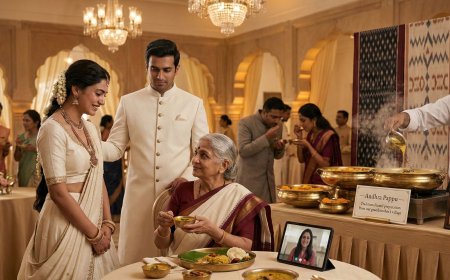
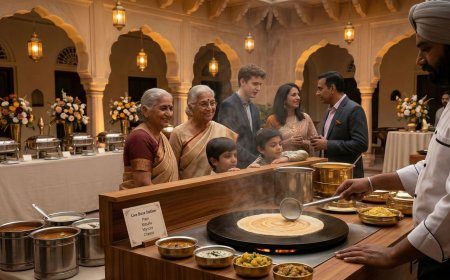
A live station. A live chaat station, a live kebab grill, or a live dosa counter does three things simultaneously: it provides the highest-quality version of those dishes, it creates visual engagement and a natural social gathering point, and it gives an experienced attendant the opportunity to guide less familiar guests through the food in a personal, unhurried way. This is one of the single most effective tools for managing international guest comfort at Indian weddings.
The Dessert Strategy
Indian sweets are a category unto themselves — intensely flavored, unfamiliar in texture to many Western guests, and deeply meaningful to Indian guests for whom a wedding without proper mithai is genuinely incomplete.
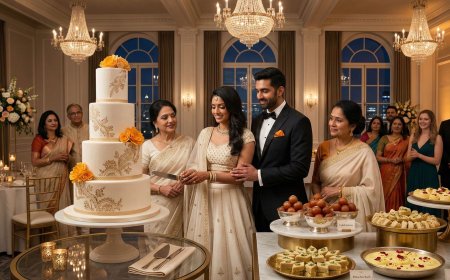
The dessert table should not require compromise in either direction. A full traditional mithai selection — gulab jamun, rasgulla, kheer, barfi, ladoo, whatever your family traditions call for — is non-negotiable for the Indian guests and should be present in abundance. Alongside this, a selection of desserts that bridge the palate — a cardamom panna cotta, a pistachio and rose semifreddo, a mango kulfi that reads as ice cream to Western guests while being genuinely Indian in flavor — provides entry points without replacing or reducing the traditional offerings.
The presentation of the dessert table also matters for cross-cultural engagement. Small tasting portions with clear labels and flavor descriptions — "cardamom-scented milk pudding" tells an international guest more about what they are about to eat than "kheer" does — invite exploration rather than uncertain avoidance.
Dietary Requirements: The Non-Negotiables
Managing dietary requirements at a large Indian wedding for a mixed international guest list is genuinely complex and requires more advance planning than most couples allocate to it.
Vegetarian and Vegan
Indian wedding menus are naturally well-suited to vegetarian guests — many of the most beloved dishes are vegetarian by tradition. The challenge is ensuring that vegetarian options receive the same attention and quality as non-vegetarian offerings, rather than being an afterthought to the main meat-centered dishes.
Vegan accommodation requires specific attention, as many Indian dishes that appear vegetarian include ghee, dairy-based sauces, or yogurt marinades. Work with your caterer to identify which dishes on your menu are genuinely vegan and ensure these are clearly labeled. For guests with vegan requirements, knowing in advance that the daal is made with ghee versus oil makes a significant practical difference.
Gluten-Free
Many traditional Indian dishes are naturally gluten-free — rice-based dishes, lentil preparations, most curries. The challenge is cross-contamination in a busy catering kitchen and the atta-based preparations that are central to Indian bread culture. For guests with celiac disease or serious gluten intolerance, advance communication with your caterer about preparation protocols is essential rather than relying on menu labeling alone.
Halal and Kosher
For NRI weddings with Muslim or Jewish guests, halal and kosher requirements affect the sourcing and preparation of meat dishes specifically. Confirming your caterer's halal certification — or arranging halal-certified alternatives for affected guests — should happen at the menu planning stage, not as a last-minute consideration. Kosher requirements are more complex and typically require specialist catering rather than a standard caterer's accommodation.
Nut Allergies
Indian cuisine uses nuts extensively — in curries, in rice dishes, in sweets, in garnishes. For guests with nut allergies, which can be life-threatening in severe cases, identifying and clearly labeling every dish containing nuts is a safety requirement, not a preference. This should be a specific, non-negotiable conversation with your caterer.
The Labeling System That Makes Everything Work
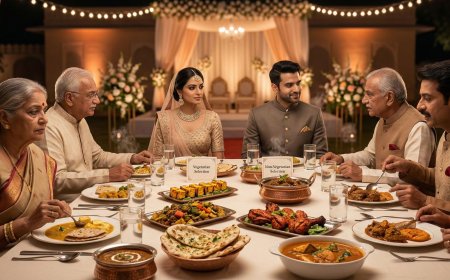
A buffet is only as accessible as its labeling. For a mixed Indian and international guest list, generic labels — "Paneer Makhani," "Dal Tadka," "Murgh Korma" — serve Indian guests well and international guests poorly.
A dual-language labeling system that includes both the dish name and a brief English description solves this without sacrificing cultural identity. "Paneer Makhani — cottage cheese in a rich tomato and cream sauce" tells the international guest what they are looking at while preserving the dish's proper name for Indian guests who know and love it.
Add a simple visual indicator for spice level — a mild, medium, and hot classification that uses consistent symbols rather than numbers, which carry different associations across cultures — and a clear vegetarian, vegan, and contains-nuts indicator, and you have a labeling system that serves every guest at the buffet independently without requiring intervention from the catering staff.
At a Glance: Menu Design Decisions by Guest Category
| Menu Element | Indian Guests Priority | International Guests Priority | Recommended Approach |
|---|---|---|---|
| Appetizers | Chaat, kebabs, samosas, pakoras | Approachable formats, familiar textures | Full Indian selection with accessible portion sizes and mild dip options |
| Main course spice level | Full authentic flavor range | Mild to medium entry points | Clear spice labeling across a full spectrum — do not dilute, do label |
| Bread selection | Naan, roti, paratha, puri | Familiar bread format as comfort anchor | Full Indian bread range with brief serving guidance at the station |
| Rice dishes | Biryani, pulao, jeera rice | Plain rice as a safety option | Biryani as feature dish, jeera rice as approachable alternative |
| Vegetarian options | Substantial and authentic | Clear identification and variety | Feature-quality vegetarian dishes, not afterthoughts |
| Protein range | Lamb, chicken, fish per regional tradition | Chicken as most universally comfortable | Full regional protein selection with clear labeling |
| Desserts | Full traditional mithai selection | Entry-point desserts alongside Indian sweets | Traditional mithai in full plus two or three bridge desserts with flavor descriptions |
| Live stations | Chaat, dosa, kebab grill | Personal guidance opportunity | At least one live station — highest engagement tool for mixed guest lists |
| Labeling | Dish names in recognized format | English descriptions alongside names | Dual-language labels plus spice and dietary indicators throughout |
| Children's options | Mild versions of familiar dishes | Plain carbohydrates and mild protein | Dedicated children's section with mild, simple, universally familiar options |
Working With Your Caterer: The Conversations That Matter
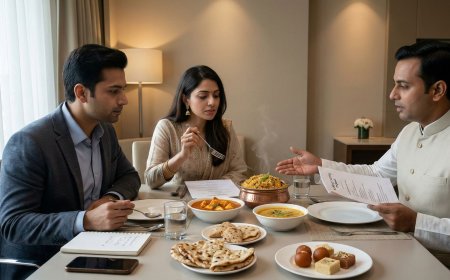
The quality of your wedding menu is a direct function of the quality of your caterer briefing. A caterer who understands your guest demographic, your priorities, and your specific family food traditions will produce something genuinely extraordinary. One who is given only a generic brief will produce a generic menu.
Tell your caterer specifically about your international guest proportion and their likely food background. A caterer who knows that forty percent of your guests are from the United Kingdom or Australia or the United States will make different decisions than one who assumes a predominantly Indian guest list.
Share your family's regional food traditions. Indian cuisine is not monolithic — a Gujarati family's wedding food is a completely different culinary conversation from a Punjabi or Tamil or Bengali family's celebration menu. Your caterer should understand your regional roots and build the menu around them, because authenticity to your specific tradition is what makes the food meaningful to your family rather than generically South Asian.
Discuss presentation alongside menu selection. The way food is presented at a buffet — the vessels used, the arrangement, the garnishing, the serving tools — affects how guests engage with it. For an NRI wedding with international guests, elevated presentation that signals quality and care makes international guests more willing to engage with unfamiliar dishes than a functional but visually uninspiring arrangement.
Request a tasting before finalizing the menu. This is standard practice for couples based locally and should be arranged via a trusted representative — a family member, your on-ground coordinator — for NRI couples who cannot attend in person. Do not finalize a wedding menu for three hundred guests without someone you trust having eaten it and reported back.
The Welcome Drink: Your First Impression
Before a single plate is served, the welcome drink sets the tone for how guests experience the food culture of your wedding.
A well-designed welcome drink selection — fresh coconut water for those who want it, a signature mocktail that incorporates Indian flavors without being challenging, fresh nimbu paani, perhaps a regional specialty relevant to your family background — immediately signals that this is a thoughtful, considered food experience rather than a default catering exercise.
For international guests, the welcome drink is often the first direct engagement with Indian culinary flavors. A beautiful, cold, slightly sweetened rose and lychee drink, offered with genuine hospitality by the welcome team, creates an immediate positive association with the flavors that will follow throughout the meal. It is a small decision with a disproportionate impact on first impressions.
The Late Night Food Moment
The late night food station — the point in the reception when dancing has been underway for an hour and the initial dinner energy has dissipated — is one of the most strategically underused elements of Indian wedding catering.
For a mixed Indian and international guest list, this is the moment when the food can be most playful and cross-cultural. Pav bhaji sliders. Mini frankies. Chaat cones. Street food formats that read as familiar and fun to international guests while being genuinely Indian in flavor and character. A chai and coffee station alongside mithai for the older guests who have moved away from the dance floor.
The late night station also serves a practical function — it keeps the energy of the reception going by giving guests a reason to linger, a new activity, and a second round of food that feels different in format from the main dinner service.
Food Is How You Tell People They Belong Here
The menu you design for your wedding is not just a catering decision. It is a statement about the community you are gathering and the care you have brought to their experience. Every guest who finds something genuinely wonderful to eat — the Indian relatives who taste the biryani and recognize their grandmother's tradition in it, the international colleague who discovers that paneer tikka is one of the best things they have ever eaten — carries that experience out of your wedding as part of how they remember the day.
Food at its best does what great hospitality always does. It makes people feel considered, welcomed, and genuinely nourished — not just physically, but in the deeper sense of feeling that someone thought about them before they arrived.
Your guests flew from multiple continents to be in the same room. They came from different food cultures, different comfort zones, and different relationships with the Indian culinary tradition that is at the heart of your celebration.
Design the menu that tells all of them, in the most direct and generous language available, that they were thought about before they arrived. That their presence mattered enough to deserve real consideration. That this is a table worth sitting at.
That is what the right wedding menu does. And it is worth every conversation, every tasting, and every carefully chosen dish it takes to get there.
NRIWedding.com — Expert guidance for Indian weddings planned across borders.
What's Your Reaction?
 Like
0
Like
0
 Dislike
0
Dislike
0
 Love
0
Love
0
 Funny
0
Funny
0
 Angry
0
Angry
0
 Sad
0
Sad
0
 Wow
0
Wow
0