







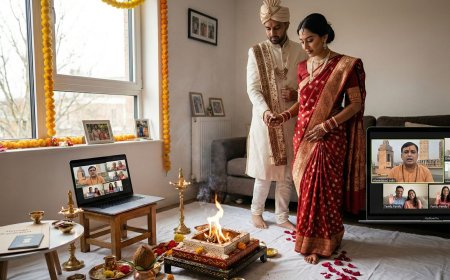







































































Financial Crisis Mid-Planning: How to Scale Down Gracefully — The Complete NRI Wedding Planning Guide
The groom had asked for the conversation on a Sunday. They were getting married in September. Five months away. The planning was at the stage where the major vendors were contracted, the deposits paid, the guest list finalised at two hundred and thirty-one people. He said: I need to tell you about the money. The company had restructured in February. His role made redundant in March. Six weeks of not telling the bride. The new position paid less. The gap between the original budget and what the budget could now be was not small. He said: the wedding we planned costs more than we can spend. The bride was quiet. Then she said: okay, tell me what we're keeping and what we're cutting. This guide gives NRI couples the complete framework for scaling down gracefully mid-planning — covering the honest budget audit, the non-negotiable identification, the guest list reduction, venue renegotiation, catering simplification, décor concentration, photography protection, the family conversation, the guest list communication, and how to allow the scaled-down wedding to become the wedding rather than the compromise.


Financial Crisis Mid-Planning: How to Scale Down Gracefully
The Conversation on a Sunday in April
The groom had asked for the conversation on a Sunday.
Not the planning conversation — they had those on Thursdays, the scheduled weekly call that had been the rhythm of the nine months since the engagement. The Sunday conversation was the different kind — the kind whose request, delivered on the Friday evening with the specific quietness of the person who has been carrying something for several days and who has decided the carrying cannot continue, told the bride before the Sunday arrived that the conversation was going to be about something that mattered.
They were getting married in September. Five months away. The planning was at the stage where the major vendors were contracted, the deposits paid, the guest list finalised at two hundred and thirty-one people, the budget set at the number that had seemed, nine months ago when the engagement was new and the planning was the exciting project rather than the sustained responsibility, achievable.
The groom sat across the kitchen table and said: "I need to tell you about the money."
The money was not what it had been nine months ago. The company he worked for had restructured in February. His role had been made redundant in March. He had spent six weeks not telling the bride — managing the job search, managing the anxiety, managing the specific calculation of how long the savings would last against the wedding budget and the ordinary life's costs and the mortgage that did not pause for the restructuring. He had found a new position four weeks ago. The new position paid less. The gap between the original wedding budget and what the budget could now be was not small.
He said: "The wedding we planned costs more than we can spend."
The bride was quiet for a moment.
She said: "How much less?"
He told her.
She was quiet again — longer this time.
Then she said: "Okay. Tell me what we're keeping and what we're cutting."
This was not the response the groom had feared. He had feared the specific distress of the person whose vision for the occasion is challenged by the financial reality — the grief of the lehenga that cannot now be afforded, the venue that must be reconsidered, the guest list that must be reduced. The bride felt these things. She felt them later, in the specific privacy of the feelings that the practical conversation cannot accommodate. But at the kitchen table on the Sunday in April she felt something else first — the specific clarity of the person who has been given the honest picture and who is capable of working with what is true rather than what was planned.
The conversation on the Sunday in April was the beginning of the scaling down that this guide is the framework for.
Understanding the Financial Crisis Mid-Planning
Why It Happens
The financial crisis that arrives mid-planning — after the deposits have been paid, the vendors contracted, the guest list built, the vision established — is the crisis that the planning's initial optimism most poorly prepares the couple for.
The job loss. The business failure. The investment that did not perform. The family financial emergency — the parent's health crisis, the sibling's situation, the specific family circumstance that redirects the financial resource that the wedding was drawing on. The currency movement that has made the India-based wedding significantly more expensive in the NRI couple's home currency than the exchange rate at the booking time allowed for. The cost escalation across the planning period — the inflation that has made the original vendor quotes insufficient and the actual costs meaningfully higher.
These are the genuine financial crises — not the overspending that the budget management could have prevented, not the planning that exceeded the realistic means from the beginning, but the specific, external circumstances that changed the financial reality after the planning was underway.
The distinction matters because the response to the genuine financial crisis is the response to the changed circumstances rather than the correction of the planning error. The couple whose financial crisis is the genuine circumstance change is the couple whose scaling down is the adaptation to the new reality rather than the consequence of the planning failure.
The Emotional Landscape
The financial crisis mid-planning produces a specific emotional landscape that the practical response must navigate rather than bypass.
The shame:
The specific shame of the person who feels they have failed to provide the wedding that was planned — the groom who feels the specific weight of the financial responsibility that the restructuring has disrupted, the bride whose family has been told the wedding will be one thing and must now be told it will be another. The shame is real. It is also not useful to the practical management of the situation and must be acknowledged without being allowed to govern the decisions.
The grief:
The genuine grief for the wedding that was planned and that is no longer possible — the venue that was the anchor of the vision, the guest list that included everyone, the specific elements of the occasion that the new budget cannot accommodate. The grief is the appropriate response to the genuine loss. It deserves the space of the private acknowledgment before the public management.
The relief:
The specific relief of the person who has been carrying the financial anxiety alone and who has now told the partner — the groom who feared the Sunday conversation and who discovered that the telling was the beginning of the management rather than the end of the planning. The relief that the honest picture, however difficult, is better than the anxiety of the concealed reality.
The couple's response to each other:
The financial crisis is the test of the partnership whose passing or failing determines not only the wedding's management but the couple's experience of the marriage's beginning. The partner who receives the financial news with the bride's response — okay, tell me what we're keeping and what we're cutting — is the partner who has made the crisis the shared problem rather than the individual failure. The partnership that the Sunday conversation required is the partnership the marriage will also require.
The Assessment: Understanding the New Reality
The Honest Budget Audit
Before any decision about the scaling down, the couple must conduct the honest budget audit — the specific assessment of the current financial position that produces the accurate picture of what the new budget is and what the gap between the original budget and the new budget requires.
The audit's components:
The total amount already spent — the deposits paid, the partial payments made, the non-recoverable costs that the scaling down cannot recoup. These costs are the sunk costs whose recovery the scaling down cannot prioritise — they are spent, and the decision about the remaining budget should not be distorted by the attempt to justify the sunk costs through the decisions that follow.
The total amount committed but not yet paid — the balance payments due on the contracted vendors, the payments that the contracts require before the wedding date. These are the costs that the scaling down must address — the payments that are committed but whose commitment may be renegotiable.
The total amount unspent and uncommitted — the budget allocation for the elements whose vendors have not been contracted, whose deposits have not been paid, whose costs remain entirely within the couple's control. These are the areas where the scaling down produces the most direct saving.
The new total budget — the specific number that the changed financial circumstances allow for the wedding in its entirety. The honest number, not the aspirational number.
The gap — the difference between the total committed costs and the new total budget. The gap is the number that the scaling down must close.
The Recovery Assessment
Before the scaling down's decisions, the couple should assess the recovery possibilities — the specific amounts that can be recovered from the already-contracted vendors through renegotiation or cancellation.
The renegotiation potential:
The vendor whose contract is signed but whose service has not yet been delivered is the vendor who may be willing to renegotiate the scope or the price in exchange for the guaranteed continuation of the booking. The caterer whose menu can be simplified. The decorator whose design can be scaled back. The venue whose package can be reduced. The renegotiation that reduces the committed cost without cancelling the vendor relationship is the recovery that preserves the planning's continuity while closing the gap.
The cancellation recovery:
The vendor whose cancellation is possible within the contract's terms — whose cancellation clause allows the exit at a cost that is less than the full contract value — is the vendor whose cancellation should be assessed as the recovery option. The photographer whose cancellation at five months costs the deposit only — if the deposit is less than the saving that the replacement at a lower price produces — is the cancellation worth assessing.
The deposit recovery reality:
The honest assessment of the deposit recovery is the specific assessment that the scaling down's emotional difficulty most distorts. The deposit that was paid with the excitement of the booking is the deposit whose loss feels, in the financial crisis, like the additional wound. The practical reality: the deposit that is non-recoverable is the sunk cost whose loss has already occurred. The decision about the vendor relationship going forward should be made on the basis of the future cost rather than the past deposit.
The Scaling Down Framework: What to Cut, What to Keep
The Principle of the Non-Negotiable
The scaling down requires the explicit identification of the non-negotiables — the elements of the wedding whose inclusion is essential to the couple's experience of the occasion and that the scaling down will not touch.
The non-negotiables are different for every couple. The photographer who has been in the planning since the beginning, whose relationship with the couple is the product of nine months of engagement, and whose documentation of the occasion is the thing the couple most values — this photographer may be the non-negotiable around which the rest of the scaling down is designed. The ceremony's religious elements whose conduct is the tradition's requirement — these are the non-negotiables whose integrity the financial crisis cannot compromise.
The identification process:
The couple should each independently identify their non-negotiables before the joint conversation — the elements that, if absent from the wedding, would make the occasion feel genuinely incomplete rather than simply reduced. The independent identification prevents the negotiation from beginning with the compromise and allows the genuine priorities to surface before the rationalisation of the shared position begins.
The non-negotiables that both partners identify are the clear non-negotiables. The non-negotiables that only one partner identifies are the priorities that the partnership must negotiate — the specific conversation about what matters most that the financial crisis makes necessary and that the planning's ordinary management had deferred.
The Guest List: The Most Significant Variable
The guest list is the wedding budget's most powerful lever — the single variable whose reduction produces the greatest saving across the largest number of budget categories simultaneously.
The guest list reduction saves: the per-head catering cost, the per-head venue cost in the per-person package structures, the invitation and stationery cost, the favour cost, the transport and accommodation support cost, the table decoration cost per table. The guest whose invitation is withdrawn produces the saving across every cost category that their presence was drawing on.
The guest list reduction's difficulty:
The guest list reduction is the most financially effective scaling down intervention and the most emotionally and socially difficult. The family who has been told the wedding will have two hundred and thirty-one guests and who must now be told it will have one hundred and fifty is the family whose management of the reduction requires the specific conversation that the financial crisis's shame makes most difficult.
The guest list reduction's approach:
The concentric circle method — the assessment of the guest list from the centre outward, starting with the people whose presence is unconditional and working outward to the people whose invitation was the obligation rather than the genuine desire. The inner circle — the immediate family, the closest friends, the people whose absence would be genuinely felt — is the circle that the reduction does not touch. The outer circle — the extended network, the colleagues, the family friends whose invitation was the social obligation — is the circle where the reduction produces the saving without the genuine loss.
The honest assessment: every name removed from the guest list is the saving across every cost category. The financial crisis's pressure makes the honest assessment of the genuine versus the obligatory invitation more possible than the planning's ordinary social pressure allows.
The Venue: Renegotiation Before Replacement
The venue is typically the wedding budget's largest single cost and the vendor whose renegotiation or replacement produces the greatest single saving.
The renegotiation first:
Before the venue replacement — before the conversation with the venue about the cancellation and the financial penalty — the couple should attempt the renegotiation. The venue whose package can be reduced — the five-star ballroom package renegotiated to the garden ceremony with the sit-down dinner for the reduced guest count — is the venue whose cooperation in the scaling down produces the saving without the cancellation cost.
The specific renegotiation conversation with the venue: the financial circumstances have changed and the guest count will be reduced from two hundred and thirty-one to one hundred and fifty. What are the options for adjusting the package and the price to reflect the reduced guest count and the reduced service scope?
The venue that is inflexible — whose contract's terms do not allow the package reduction — is the venue whose cancellation should be assessed against the cancellation cost and the replacement venue's cost.
The venue replacement:
The venue replacement in the mid-planning financial crisis is the significant decision whose specific cost — the cancellation cost at the original venue, the new deposit at the replacement venue — must be assessed against the saving that the replacement produces. The venue replacement that saves twenty lakh rupees but costs eight lakh rupees in cancellation fees and new deposits is the saving of twelve lakh rupees — the net saving that the decision is actually producing.
The Catering: The Menu That Serves the Occasion
The catering cost is the budget category most directly linked to the guest count and the menu's complexity. The scaling down of the catering produces the saving through the guest count reduction, the menu simplification, and the service format change.
The menu simplification:
The menu whose complexity — the twelve-course sit-down dinner, the live cooking stations, the elaborate sweet counter — was designed for the original budget is the menu whose simplification produces the meaningful saving without the fundamental change to the catering's quality. The eight-course dinner whose courses are the eight best courses of the original twelve. The two live cooking stations rather than the four. The sweet counter that represents both families' traditions in the specific sweets rather than the comprehensive display.
The service format:
The sit-down dinner whose service cost — the waiting staff, the table service, the formal presentation — is the significant component of the catering budget is the format whose replacement with the buffet service produces the specific saving. The buffet that is well-designed, well-presented, and well-managed is the occasion whose guest experience is not diminished by the format change — the guests who are eating the same food at a well-managed buffet have the same culinary experience as the guests at the sit-down table.
The Décor: The Thoughtful Reduction
The décor budget is the category where the thoughtful reduction produces the greatest visual impact per rupee saved — where the concentration of the reduced budget in the specific, high-visibility moments produces the occasion that looks considered rather than scaled back.
The concentration principle:
The décor budget that is spread evenly across the full venue produces a moderate level of decoration everywhere. The décor budget that is concentrated in the specific high-visibility locations — the ceremony mandap, the entrance, the couple's table — produces the specific visual impact that the photographs capture and that the guests remember, with the less-decorated areas of the venue communicating the intentional restraint rather than the financial limitation.
The flowers:
The floral budget is the décor category whose reduction most benefits from the thoughtful concentration — the full floral installation at the mandap and the entrance, the simpler greenery arrangements at the guest tables, the specific statement pieces at the photographs' natural focal points. The full floral wedding and the concentrated floral wedding produce different aesthetics, both of which can be beautiful; the concentrated version is the version that the reduced budget can produce without the appearance of the inadequate attempt at the full version.
The Photography and Videography
The photography and videography are the budget categories whose scaling down most directly affects the permanent record of the occasion — the documentation that will exist long after the wedding day's experience has passed.
The recommendation:
The photography and the videography are the last budget categories to scale down and the categories whose reduction should be most carefully considered. The photographs are the wedding's permanent record. The saving achieved by the photography downgrade is the saving that is felt every time the album is opened.
The possible reductions:
The videography reduction before the photography reduction — the video is the less permanent record in the sense that it is less frequently revisited, and the saving from the videography downgrade is the less costly permanent compromise. The second photographer's removal before the primary photographer's downgrade — the second shooter whose absence reduces the coverage without eliminating the primary documentation. The pre-wedding shoot's cancellation — the saving of the pre-wedding shoot's cost without the reduction of the wedding day's documentation.
The Clothing and Jewellery
The bridal and groom's clothing is the budget category whose personal significance — the specific garments that the couple will be photographed in, that will be preserved, that represent the occasion's most personal visual dimension — makes the reduction most emotionally difficult.
The distinction:
The distinction between the garment whose price reflects the designer's name and the garment whose price reflects the craftsmanship — the specific hand embroidery, the specific fabric quality, the specific construction — is the distinction that the scaling down most benefits from making. The designer lehenga at the premium price and the equally beautiful lehenga from the non-branded craftsperson at a fraction of the price are, in the photographs, the same garment. The saving is in the label, not the beauty.
The rental option:
The rental of the bridal lehenga — a market that has grown significantly in India's major cities — is the option that the financial crisis makes relevant if it was not considered in the original planning. The rental lehenga at a fraction of the purchase price preserves the visual standard of the occasion without the full purchase cost.
The Family Conversation: Telling the Families
The Conversation That Must Happen
The families who have been told the wedding will have two hundred and thirty-one guests, who have been building their own expectations around the occasion that was planned, must be told that the occasion is being scaled down. The telling is the conversation that the financial crisis's shame makes most difficult and that the planning's integrity requires.
The timing:
As soon as the scaling down decisions have been made — not before, because the communication of the financial difficulty without the specific plan produces the anxiety without the resolution, and not after, because the delay gives the families less time to adjust their own preparations and communications.
The framing:
The honest framing that does not require the complete disclosure of the financial details. The couple is not obligated to share the specific financial situation with the families — the job loss, the specific amount of the gap. The couple is obligated to share the specific changes to the wedding that the families need to know in order to manage their own expectations and their own communications.
"We have made the decision to scale the wedding down. The guest list will be reduced to one hundred and fifty. The occasion will be more intimate than we originally planned. We want to tell you before we communicate the changes more broadly."
The framing that presents the scaling down as the couple's decision — not the financial crisis's imposition — is the framing that gives the couple the most agency in the communication. It is also, from a certain angle, the honest framing: the decision to scale down is the couple's decision, whatever has produced the necessity of making it.
The Guest List Communication
The communication of the guest list reduction to the guests who will no longer be invited is the most difficult practical task the financial crisis produces.
The principle:
The guests who are being removed from the list deserve the personal communication — not the form letter, not the social media announcement, not the information passed through the family network. The personal communication that acknowledges the specific relationship and the specific regret of the omission is the communication that respects the relationship even in the reduction.
The specific message: "We have had to make the very difficult decision to reduce our wedding to an intimate ceremony. We want you to know that this decision was made with great sadness and that your presence would have meant so much to us. We hope to celebrate with you in another form."
The alternative celebration — the post-wedding party, the reception at a later date, the gathering that includes the guests who were not at the intimate ceremony — is the specific offering that the communication can include and that most effectively manages the guest's experience of the omission.
The Reframe: The Intimate Wedding
The Wedding That the Reduction Makes Possible
The scaling down of the wedding from two hundred and thirty-one guests to one hundred and fifty — or to eighty, or to fifty — is the reduction that changes the occasion's character in ways that are not only the loss of the original vision. The smaller wedding is the different wedding, and the different wedding has the specific qualities that the larger wedding cannot provide.
The presence:
The wedding of one hundred and fifty guests is the wedding where the couple can speak to every person in the room. The wedding of two hundred and thirty-one is the wedding where the couple manages the room rather than inhabiting it. The intimate wedding's presence — the specific quality of the occasion that is small enough to be genuinely personal — is the quality that the scaling down makes possible.
The quality:
The budget that was spread across two hundred and thirty-one guests, concentrated on one hundred and fifty, produces a meaningfully better per-head experience — the food, the wine, the specific attention to each table, the details that the larger guest count dilutes. The smaller wedding whose per-head budget is higher is the wedding whose quality can be genuinely excellent rather than adequately managed.
The photography:
The photographs of the intimate wedding — the photographs where every face in the frame is the face of someone the couple genuinely loves, where the room's atmosphere is the warmth of the specifically chosen rather than the accommodation of the obligatory — are the photographs that tell a different story from the photographs of the large occasion. Not a lesser story. A different one, and in some ways a more honest one.
Common Mistakes Couples Make in the Financial Crisis Mid-Planning
The first mistake is not telling the partner immediately when the financial situation changes. The groom who carried the job loss for six weeks before the Sunday conversation is the groom whose six weeks of solo carrying produced the specific anxiety that the Sunday's telling resolved. Tell the partner. The financial crisis is the shared problem. The concealment makes it the individual burden.
The second mistake is cutting the photography before the décor. The décor exists for the wedding day. The photography exists for the rest of the life. The permanent record of the occasion is the budget category that the scaling down should protect most fiercely and reduce most reluctantly.
The third mistake is communicating the guest list reduction through the family network rather than personally. The guest who learns they have been removed from the list through the family WhatsApp group has been given a specific message about how their relationship is valued. The personal communication — brief, warm, honest — is the respect that the relationship requires even when the relationship is being managed rather than celebrated.
The fourth mistake is presenting the scaling down to the families as the financial crisis rather than as the couple's decision. The family whose sympathy is engaged by the financial disclosure is the family whose involvement in the scaling down's management exceeds the appropriate. The family who is told the couple has decided on an intimate wedding is the family whose response is to the decision rather than to the circumstance.
The fifth mistake is grieving the original wedding throughout the planning of the scaled-down wedding rather than allowing the scaled-down wedding to become the wedding the couple is planning. The grief for the original vision is appropriate in its moment. The grief that persists into the planning of the new version is the grief that prevents the new version from being genuinely embraced and that produces the wedding that is experienced as the compromise rather than the occasion.
The September Wedding
The wedding was in September. One hundred and forty-three guests.
Not the two hundred and thirty-one of the original planning. Not the heritage ballroom. The smaller venue — a boutique property whose garden the couple had walked on a site visit in May and whose specific intimacy had produced, in the bride, the specific recognition of the occasion that she had expected to feel in the heritage ballroom fourteen months ago and had not.
The caterer had renegotiated the menu. The decorator had concentrated the flowers at the mandap and the entrance. The photographer had remained — the non-negotiable, the thing the bride had named first when the Sunday conversation asked what they were keeping.
The groom had told the bride that the scaling down felt like the failure and she had said: look at the room.
He had looked at the room.
One hundred and forty-three people who were specifically there — not the two hundred and thirty-one whose list had included the obligation alongside the love, but the one hundred and forty-three whose presence in the room was the specific, chosen presence of the people the couple most wanted.
The groom looked at the room and felt something he had not expected to feel given the Sunday conversation in April and the five months between it and the September evening.
He felt that the wedding was exactly right.
Not the wedding that had been planned. The wedding that had happened — the wedding that the financial crisis had produced by removing from the occasion everything that was not essential and leaving only what was.
Tell the partner when the money changes.
Identify the non-negotiables before the cutting begins.
Protect the photography.
Reduce the guest list from the outside in.
Concentrate the décor in the high-visibility moments.
And allow the scaled-down wedding to become the wedding — not the compromise, not the reduced version of what was planned, but the specific occasion that the new reality has made possible.
The room with one hundred and forty-three people who are specifically there.
That is the wedding.
It was always the wedding.
Published by NRIWedding.com — The Premium Global Platform for Non-Resident Indians Planning Indian Weddings From Abroad.
What's Your Reaction?
 Like
0
Like
0
 Dislike
0
Dislike
0
 Love
0
Love
0
 Funny
0
Funny
0
 Angry
0
Angry
0
 Sad
0
Sad
0
 Wow
0
Wow
0