




















































The Moment a Father Places His Daughter's Hand in Another's — and Lets Go
Kanyadaan — the sacred Hindu ritual of a father offering his daughter in marriage — is considered the highest act of devotion a parent can perform in a lifetime. For NRI families planning weddings across London, Toronto, Dubai, Sydney, and Houston, this ritual carries extraordinary emotional weight: it is the moment two worlds meet in a single pair of joined hands. This guide covers the spiritual origins of Kanyadaan, regional variations across ten Indian communities, and complete practical guidance for performing it authentically abroad or as a destination wedding in India.


Kanyadaan is not merely a wedding ritual — it is considered the greatest act of devotion a Hindu parent can perform in an entire lifetime. For NRI families separated from their roots by oceans and decades, this single moment — a father's trembling hands placing his daughter's into a stranger's — carries the full weight of everything they carried across the water. This is the ritual that breaks every father in the room, and puts every family back together.
You have watched your father hold it together through everything. Through the visa queues and the new country and the jobs that were beneath him and the winters that were nothing like home. Through your school plays and your graduations and every moment he stood at the back of a room in a foreign city, proud and slightly out of place, holding the culture inside him like something he refused to put down.
He will not hold it together for Kanyadaan. Nobody does.
You are planning a Hindu wedding — in Toronto, in Birmingham, in Melbourne, in Dubai — and somewhere in the middle of the venue shortlists and the catering negotiations and the lehenga fittings, you have arrived at this ritual. The one your mother cannot discuss without her voice changing. The one your father has not mentioned at all, which tells you everything. You need to understand what it is, what it asks of everyone in the room, and how to do it with the full weight of its meaning intact — wherever in the world you happen to be standing when the moment arrives.
This article will take you through every part of it.
🌟 DID YOU KNOW?
Kanyadaan is classified in ancient Hindu scriptures as the highest of all daans [acts of charitable giving] — ranked above the gifting of land, gold, food, or knowledge. The Dharmashastra texts describe it as a deed so meritorious that it liberates not just the parents performing it, but seven generations of ancestors on both sides of the family.
The ritual's structure is referenced in the Rigveda, making it one of the oldest continuously practised wedding customs in human history — observed in some form for over 3,500 years across the Indian subcontinent, surviving invasions, empires, colonial rule, and now, the particular challenge of the diaspora.
A 2023 survey of NRI Hindu families in the UK and Canada found that Kanyadaan is the single wedding ritual most frequently cited as the moment families felt most connected to their Indian identity — surpassing even the saat phere [seven circumambulations of the sacred fire] — because of its intensely personal, irreversible, human quality.
What Is Kanyadaan?
Kanyadaan [from Sanskrit: kanya meaning virgin daughter, and daan meaning the act of giving as sacred offering] is the moment in a Hindu wedding ceremony when the bride's father — or, in his absence, her mother, maternal uncle, or a designated elder — formally places the bride's right hand into the groom's right hand and offers her in marriage. It is not a transaction. It is a yajna [sacred sacrifice] — the offering of what is most precious, most beloved, most irreplaceable.
The ritual occurs at the heart of the main wedding ceremony, typically after the Ganesh Puja [invocation of Ganesha] and the Var Puja [welcoming of the groom] but before or concurrent with the saat phere [seven sacred circumambulations of the havan fire]. The precise placement varies by regional tradition, but its centrality does not.
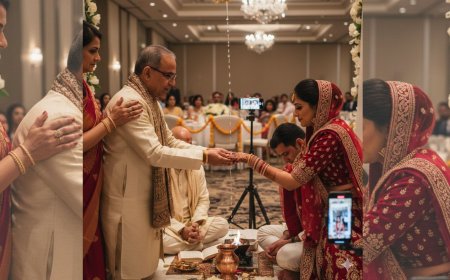
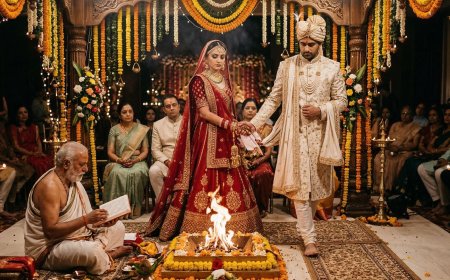
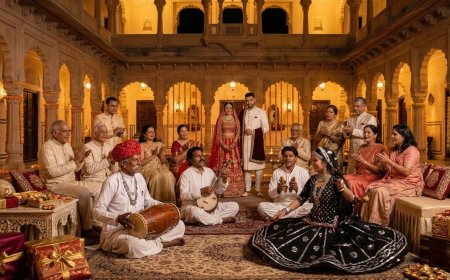
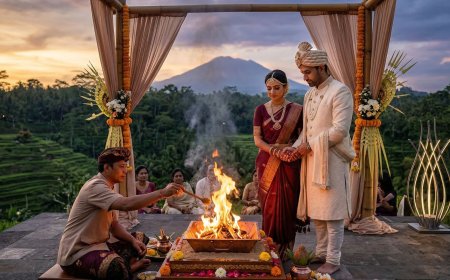
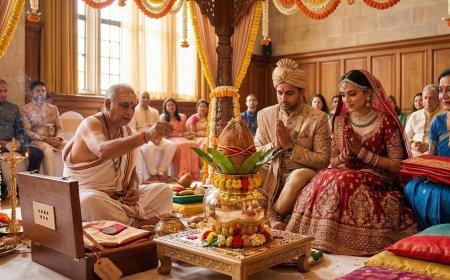
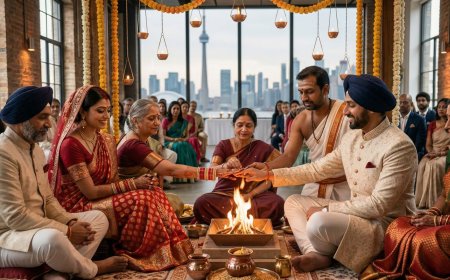
The physical sequence unfolds as follows: the bride's father approaches with his daughter, both seated or standing before the sacred fire. The pandit [priest] recites specific Kanyadaan mantras from the Grihyasutras [ancient householder ritual texts], invoking the names of the families' gotra [ancestral lineage] and calling upon the Saptarishi [seven celestial sages] as witnesses. The father then takes his daughter's right hand — her hasta [hand, symbolic of her capacity to give and receive love] — and places it into the groom's open palm. Over their joined hands, the pandit pours a slow stream of water mixed with tulsi leaves [holy basil, sacred to Vishnu], akshat [unbroken rice grains with turmeric], and sometimes flower petals or panchamrit [the five sacred substances]. The mother of the bride often places her hand over both, completing the circle. The groom accepts the bride with a formal Sanskrit vow of protection, provision, and partnership.
The water poured over the joined hands is called Godaan jal in some traditions — a purifying stream that seals the offering, witnessed by fire, by lineage, and by every person in the room who has ever loved either of them.
What makes this moment spiritually devastating in the most beautiful sense is its completeness. The father does not give his daughter away as property. He performs an act of tyaag [renunciation] — releasing his claim, his protection, his role — and in doing so, performs the highest spiritual act available to a householder. He becomes, in this moment, something close to a saint.
Community Comparison: Kanyadaan Across Indian Traditions
| Community / State | Local Name | Key Tradition | How NRIs Abroad Adapt It |
|---|---|---|---|
| Himachali | Kanyadaan | Father performs ritual with both hands covering daughter's; specific Pahari mantras recited; nati[folk dance] precedes the ceremony | Pahari pandit sourced through Himachali community associations; nati performed by family before the ritual begins |
| Garhwali | Kanyadaan | Maternal uncle [mama] plays an equally important role alongside the father; both place hands on the bride's | Mama travels specifically for this moment or joins via video call with a local elder performing the physical gesture |
| Kumaoni | Kanyadaan | Accompanied by mangal geet [auspicious songs] sung exclusively by women of the bride's family throughout the ritual | Recorded mangal geet played if live singers unavailable; female family elders sing softly as accompaniment |
| Ladakhi | Adapted Kanyadaan | Ladakhi Buddhist families observe a parallel gifting ritual; Hindu Ladakhi families follow standard Kanyadaan with regional mantra variations | Community elder clarifies which tradition the family follows; hybrid rituals increasingly common in diaspora |
| Kashmiri Pandit | Kanyadaan / Lagan | Performed with specific Kashmiri Shaivite mantras; the bride's pheran [traditional Kashmiri robe] is held by the father as he makes the offering | Pheran sourced from Kashmiri community networks in London and Toronto; Kashmiri pandit specifically sought |
| Punjabi | Kanyadaan | Father places daughter's hand in groom's hand; Anand Karaj [Sikh wedding ceremony] has a parallel called Lavaan where the father leads the bride; combined in mixed families | Both traditions honoured where relevant; gurudwara provides support for the Sikh elements alongside Hindu pandit |
| Marathi | Kanyadaan | Performed beneath an antarpat [silk cloth held between bride and groom]; the cloth is dropped at the moment of Kanyadaan, symbolising the veil lifting | Antarpat sourced from Marathi community stores; the cloth-dropping moment is among the most photographed in Marathi weddings abroad |
| Tamil | Kanya Sampradanam | Kanya Sampradanam [gift of the daughter] is the Tamil equivalent; performed with the bride's father pouring water over joined hands; mango leaves used | Tamil Brahmin pandits in London, Sydney, and Toronto are relatively accessible; mango leaves sourced from Indian grocers |
| Bengali | Sampradaan | The Bengali equivalent places the bride between two shankha [conch shells]; her face is covered with betel leaves which she holds up as the father gives her away | Shankha and betel leaves sourced from Bengali grocery suppliers; the betel leaf reveal is a signature photographic moment |
| Rajasthani | Kanyadaan | Father performs ritual in full dhoti [traditional cloth]; bride seated in a doli [decorated palanquin] beforehand; elaborate mantra sequence | Dhoti worn by father regardless of venue; doli recreated symbolically with decorated chair; Rajasthani pandits available in major UK and Canadian cities |
The Meaning Behind the Ritual
To give away what you love most, freely and with open hands, is the highest expression of love that exists in Hindu philosophical thought. Kanyadaan is not about ownership transferring — it is about dharma [sacred duty and righteous living] completing its cycle. A father's dharma toward his daughter has been to protect, nourish, educate, and prepare her. Kanyadaan is the moment that dharma reaches its fullest expression and simultaneously releases itself. He has done everything he was meant to do. Now he lets go.
The water poured over the joined hands carries specific symbolism rooted in Vedic cosmology. Water is jeevan [life itself] in Indian philosophical tradition — the first element, the purifier, the sustainer. To pour it over the joined hands of two people is to say: may your life together flow as water flows — finding its path, nourishing everything it touches, never truly stopped by any obstacle it meets.
The groom's acceptance carries equal weight. He does not merely receive — he takes a vow before fire, before lineage, before the entire assembled community of people who have loved this woman. The Sanskrit he speaks in this moment translates roughly as: I receive you. I will protect you. I will not fail you.
The ritual encodes the Indian understanding that love is not a feeling but a practice — something you agree to perform every day, witnessed and accountable.
For a non-Indian partner or family member: this is the moment we acknowledge, formally and in front of everyone, that loving someone means eventually releasing them toward their own life — and that this release, done with grace and ceremony, is one of the most sacred things a human being can do.
Doing Kanyadaan Abroad: The Practical Reality
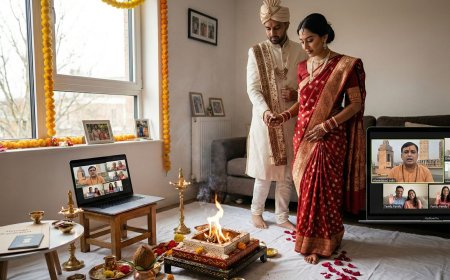
Of all the Hindu wedding rituals that NRI couples navigate from abroad, Kanyadaan is the one that requires the least physical infrastructure and the most emotional preparation. The ritual itself needs very little — a pandit, a fire or lamp, water, tulsi leaves, akshat, and the people. What it demands is that the right people are in the room, that the pandit knows your family's specific mantra tradition, and that the moment is protected from the noise and distraction that Western venue settings can generate.
Finding the Right Pandit: Kanyadaan mantras are recited from the Grihyasutras — ancient household ritual texts that vary by regional shakha [school of Vedic study]. A pandit trained in the Rigvedic tradition will recite differently from one trained in the Yajurvedic school. For most NRI families, the priority is finding a pandit who knows your gotra and your regional tradition and who speaks enough English to guide non-Indian family members through what they are witnessing. In London, the temples at Neasden, Wembley, and Tooting are the most reliable starting points. In Toronto, the temple networks along Dixie Road in Mississauga and the Hindu Sabha Mandir in Brampton maintain pandit directories. In Sydney, the Hindu Council of Australia and the Parramatta temple community are your best resources. In Dubai, the Hindu Temple in Bur Dubai coordinates pandits for NRI weddings throughout the UAE. In Houston, the Shiva Vishnu Temple and the BAPS Mandir both maintain contacts. Begin this search four to six months before the wedding — not two.
Sourcing Ritual Items: The physical items required for Kanyadaan are available across all major diaspora cities. Tulsi plants and dried tulsi leaves are stocked at Indian grocery stores — on Southall Broadway in London, on Gerrard Street and the Dixie Road corridor in Toronto, at Harris Park in Parramatta in Sydney, and along Hillcroft Avenue in Houston. Fresh tulsi is preferable; a small potted plant kept in the venue on the wedding day is a beautiful and practical solution. Akshat is simply whole unbroken rice mixed with turmeric — prepared at home the night before. The water vessel — ideally a kalash [copper pot] — is available at any Indian puja supply store in these same areas.
The Fire Question: Kanyadaan ideally occurs in the presence of Agni [the sacred fire], lit within a havan kund [fire pit]. Western venues with smoke detectors present a real challenge here. The practical solution used by most NRI couples is to notify the venue in writing that a small ceremonial fire will be lit, request that the nearest detector be temporarily covered during the ceremony, and confirm this arrangement with venue management at least two weeks in advance. Many experienced NRI wedding venues have done this dozens of times and have a standard procedure. If fire is completely prohibited, a deepak [oil lamp] placed at the centre of the ceremony space is a spiritually valid substitute — the pandit can confirm this.
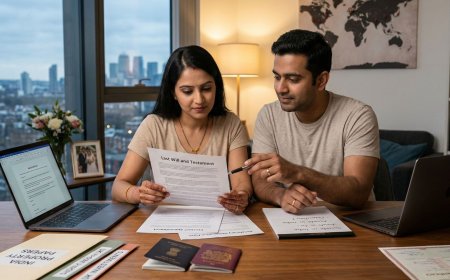
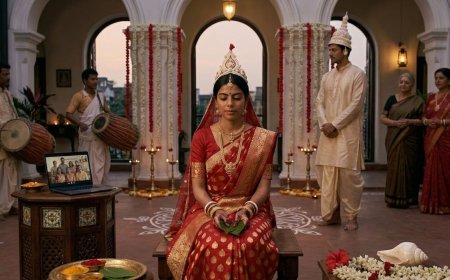
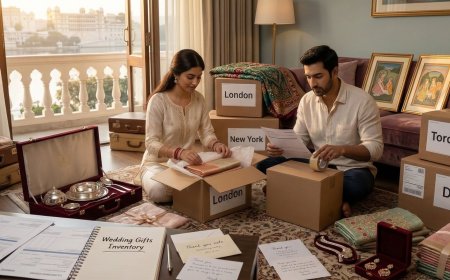
Coordinating with India: For elderly grandparents or relatives who cannot travel, Kanyadaan is the one moment above all others that must be shared live. Set up a stable video connection — a tablet on a tripod, not a handheld phone — and position it so that the relative in India can see the bride's father's face as well as the joined hands. Test this connection the morning of the ceremony. Assign a dedicated person on each side to manage the call. For families joining from India, a 3:00pm IST ceremony time works across almost every NRI diaspora city — it corresponds to 10:30am in the UK, 9:30am in Dubai, 7:30pm in Sydney, and 4:30am on the US East Coast — the one timezone that will require some sacrifice. That sacrifice, for this moment, is worth making.
Doing Kanyadaan as a Destination Wedding in India
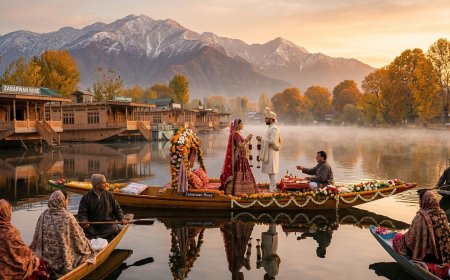
If you are bringing your wedding back to India, Kanyadaan takes on yet another dimension — performed in the landscape that produced the ritual itself, surrounded by the extended family that has been waiting years for this day.
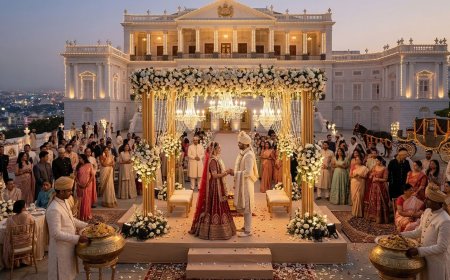
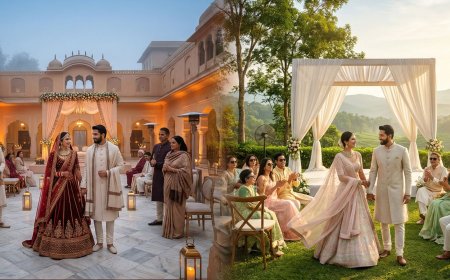
Varanasi is the most spiritually charged location for any Hindu wedding ritual, and a Kanyadaan performed on the ghats of the Ganges carries a weight that is genuinely indescribable. Rishikesh, at the foothills of the Himalayas with the Ganges running fast and cold, is increasingly popular for NRI destination weddings seeking both spiritual authenticity and natural beauty. Jaipur and Udaipur offer the palace and haveli settings that photograph magnificently while supporting traditional pandits. For South Indian families, Madurai and Tirupati carry deep ritual authority.
When briefing a local pandit on your specific regional tradition, provide a written document — in Hindi or your regional language — specifying your gotra, your shakha, any family-specific mantra variations, and the names of the couple's fathers for inclusion in the ritual invocations. Experienced destination wedding pandits in all of these cities are accustomed to NRI families arriving with specific requirements and will adapt accordingly.
For non-Indian guests, a single beautifully printed card explaining what Kanyadaan means — placed on their seats before the ceremony — transforms passive observation into genuine witnessing.
What You Need: Kanyadaan Ritual Checklist
Ritual Items A kalash filled with clean water; fresh or dried tulsi leaves; akshat prepared the night before; red and yellow flower petals; a deepak with ghee; a havan kund and firewood if permitted, or a deepak substitute if not; a silk cloth or dupatta for the bride's father to hold during the offering; a clean white cloth for the couple to sit upon; panchamrit if the full ritual is observed; and a printed copy of the gotra and family lineage details for the pandit.
People Required The pandit, the bride's father [or designated elder — mother, maternal uncle, or both parents together if the family chooses], the couple, and the mother of the bride for the completion of the three-handed gesture. A dedicated family member to manage the video call for India-based relatives, and a photographer specifically briefed that the Kanyadaan moment is the single most important frame of the entire wedding.
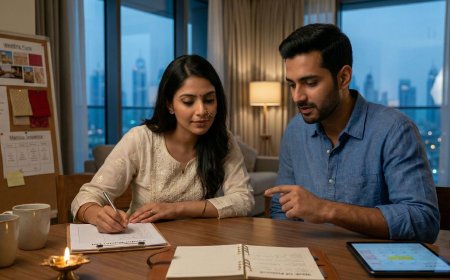
Preparation Steps Source your pandit four to six months ahead and confirm they know your regional mantra tradition. Prepare written gotra and family lineage details to give the pandit one week before. Source ritual items two weeks before. Brief your photographer on the Kanyadaan sequence one week before the wedding. Set up and test the video call connection on the morning of the ceremony. Brief non-Indian guests the evening before with a short explanation of what they will witness.
NRI.Wedding's verified pandit network and vendor directory exist to take the searching off your plate. Let us connect you to the right people — so that when the moment comes, you are present for it completely.
5 Questions NRI Couples Always Ask
Can Kanyadaan be performed by the bride's mother if the father is not present or has passed away?
Yes — and this is explicitly supported by ancient Hindu scriptural tradition. The Dharmashastra texts provide for the mother, the maternal uncle [mama], the paternal grandfather, or any respected elder to perform Kanyadaan when the father is unable to. Many NRI families in which the father has passed away choose to have both the mother and the maternal uncle perform the ritual together — one on each side of the bride — which is not only scripturally valid but deeply moving. Discuss this specifically with your pandit in advance so the mantras are adjusted accordingly.
My partner is not Hindu. Does Kanyadaan still apply, and how do we frame it for their family?
Kanyadaan applies fully regardless of the groom's religious background — it is a ritual of the bride's family, performed by the bride's father, and its meaning is entirely internal to the Hindu wedding tradition. For the non-Hindu partner's family observing it, the most helpful framing is this: this is the moment the bride's father formally entrusts his daughter to your family, and your family's role is simply to witness and receive that trust with respect. Most non-Indian families, when the ritual is explained to them in plain language, find it genuinely moving rather than alienating.
How do I find a pandit in London or Sydney who knows my specific gotra and regional mantra tradition?
The most effective approach is to contact community-specific cultural organisations rather than general temple directories. Kashmiri Pandit Sabhas, Tamil Brahmin associations, Marathi Mandals, and Gujarati Samaj chapters all maintain networks of priests who know region-specific wedding traditions. NRI.Wedding's pandit directory is filtered by regional tradition and gotra familiarity — it is the fastest route to the right person without a dozen phone calls that go nowhere.
We want to include the Kanyadaan in a civil ceremony setting. Is that possible?
Kanyadaan is a specifically religious ritual and belongs within the Hindu wedding ceremony — it cannot be fully transplanted into a civil ceremony context without losing its meaning. However, many NRI couples create a beautiful solution: they hold a small, private Kanyadaan at home or in a temple setting on the morning of the civil ceremony, attended only by immediate family, before the public celebration begins. This preserves the intimacy and sanctity of the ritual while keeping the civil event entirely separate. The pandit attends the home setting; no venue permissions are required.
How long does Kanyadaan take, and where exactly does it sit in the ceremony running order?
The Kanyadaan itself — the moment of the joined hands, the water, the mantras specific to the offering — takes between ten and twenty minutes when performed properly. It typically follows the Var Puja and occurs immediately before or concurrent with the beginning of the saat phere. In total, from the start of the havan lighting to the completion of Kanyadaan and the first phera, plan for approximately forty-five minutes to one hour. Share this running order with your venue coordinator and photographer in advance — both need to know that this sequence cannot be rushed.
The Emotional Angle
There is something your father has been carrying since the day you were born that he has never found the words for. Not in this language, not in his own language, not in any language. It is the specific weight of loving a daughter — of watching someone grow from something entirely dependent on you into someone entirely capable without you, and feeling simultaneously proud beyond expression and quietly, privately terrified of the moment you will have to demonstrate that you know this.
Kanyadaan is that moment. Formalised. Witnessed. Inescapable.
NRI fathers carry an additional layer that their counterparts in India sometimes do not. They raised their daughters in translation — in schools that did not know their names, in cities that mispronounced their surnames, in cultures that did not share their values. They watched their daughters navigate two worlds without a map, and they could not always help because they were navigating them too. They held on, perhaps, a little tighter than fathers who had the comfort of familiarity surrounding them. The letting go, therefore, asks a little more.
When the pandit begins the mantra and the water is poured and the hands are joined — the father's hands are shaking not with weakness but with the full force of everything he chose to carry, and everything he is now choosing to release.
This is not loss. This is the completion of the longest love story in the room.
A Moment to Smile
At a wedding in Melbourne's western suburbs three years ago, the bride's father — a retired engineer from Lucknow who had lived in Australia for twenty-six years and prided himself on never crying in public — had privately told his wife the week before the wedding that he was absolutely fine and that Kanyadaan was simply a ritual and that he was not going to make a scene.
He lasted approximately four seconds after the pandit began the mantra before he was weeping so completely that his glasses fogged. His wife had to remove them, clean them, and return them to his face mid-ritual while the pandit continued without comment, as though this happened every single week, which, to be fair, it probably did.
The photograph of that moment — glasses slightly askew, daughter laughing through her own tears, mother of the bride holding tissues in each hand — became the family's most printed, most shared, most beloved image of the entire wedding.
He has since stopped claiming he was fine.
Quotes from the Diaspora
"My father practised what he was going to say during Kanyadaan for two weeks. He had written notes. He referenced the notes zero times during the actual ritual because he couldn't see them. He told me afterward that he understood, for the first time, why his own father had never spoken much at important moments. Some things are too big for words and you only learn that when you're standing inside them." — Shreya Agarwal, UP Brahmin community, Toronto
"My daughter-in-law's father is a quiet man. Very contained. Very British-Indian in the way he holds himself together in public. When he placed her hand in my son's hand and the pandit poured the water, he made a sound I have never heard from a human being before — not a cry exactly, but something underneath crying. Every single person in the room felt it. I think about it still." — Kamala Venkataraman, Tamil Brahmin community, Leicester
"We did Kanyadaan at 7am in my parents' living room in Houston before anyone else arrived. Just my parents, his parents, and the pandit. No guests, no photographer, no pressure. My father held my hand for a long time before he gave it. I let him. I knew he needed that. I needed it too." — Nisha Mehta, Gujarati community, Houston
Your Roots Travel With You
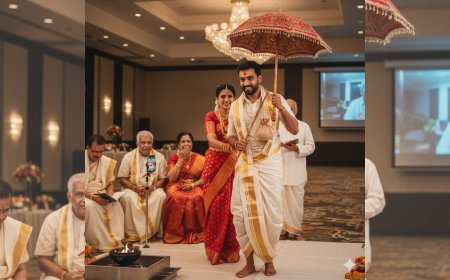
Somewhere right now, a father is standing in a hired room in a city far from where he was born, wearing a dhoti he ironed three times because it had to be right, waiting for the pandit to reach the part of the ceremony he has been dreading and longing for in equal measure for thirty years. His daughter is beside him, dressed in colours he chose with her mother six months ago on a video call at midnight. The pandit begins. The water is poured. The hands are joined.
This is what NRI.Wedding exists to protect — not just the ceremony, but the meaning inside it. Our verified pandits know your regional tradition. Our vendors source your ritual items. Our photographers know which moment to wait for. Our planning checklists ensure that when this moment arrives, nothing is missing.
Carry it across every ocean. Perform it in every city. Let no distance be large enough to diminish it.
Your daughter deserves the full weight of this moment. Give it to her.
This article covers Kanyadaan — the sacred Hindu bride-giving ritual — across Punjabi, Tamil, Bengali, Rajasthani, Marathi, Kashmiri Pandit, Garhwali, and Kumaoni communities, with complete practical guidance for NRI couples and families in London, Toronto, Melbourne, Houston, Dubai, and Sydney planning authentic Hindu wedding ceremonies abroad or as destination weddings in India.
What's Your Reaction?
 Like
0
Like
0
 Dislike
0
Dislike
0
 Love
0
Love
0
 Funny
0
Funny
0
 Angry
0
Angry
0
 Sad
0
Sad
0
 Wow
0
Wow
0