






















































Himalayan Weddings Begin at the Doorstep: The Enduring Legacy of Nyundra
Nyundra, a centuries-old wedding invitation custom practiced in Himachal Pradesh and Uttarakhand, continues to thrive despite the rise of digital communication. The ritual involves personally delivering invitations to relatives through symbolic visits rooted in geography, safety, and community structure. Beginning with the maternal uncle’s household, the practice reinforces kinship ties and preserves Himalayan cultural identity. As India’s wedding industry modernises, Nyundra stands out as a living heritage tradition that underscores the enduring value of personal connection in ceremonial customs.


For NRI.Wedding — Indian Wedding Rituals & Traditions Series
You grew up hearing your dadi whisper stories about the mountains — about weddings where the snow-capped peaks bore witness and the threshold of a home held more meaning than any mandap. Now you're in Vancouver or Melbourne, planning a wedding that honors your Himachali, Ladakhi, or Uttarakhandi roots, and someone in your family mentions Nyundra — the sacred doorstep ritual. You nod, you smile, and then you quietly Google it at midnight. You're not alone. And you've come to exactly the right place.
🌟 Did You Know?
NRI.Wedding Fact Box
- Nyundra, the threshold-welcoming ritual found across Himalayan wedding traditions, is one of the oldest transition ceremonies in South Asian culture — predating many Vedic formulations and rooted in animist mountain beliefs about the spirit of the home.
- Over 60% of Himachali and Uttarakhandi NRI families surveyed by diaspora community groups in the UK and Canada say they struggle to find pandits who know Pahari or Ladakhi ritual customs — making documentation of rituals like Nyundra more urgent than ever.
- Destination weddings in Himachal Pradesh — particularly in Manali, Shimla, and Dharamshala — have seen a 35% rise in NRI bookings since 2019, with families flying in from the USA, UK, and Australia specifically to reclaim mountain wedding traditions.
What Is Nyundra?
Nyundra — sometimes spelled Nyonra or referred to in broader Himalayan traditions as the Dwar Puja or doorstep blessing — is the moment when the bride formally enters her new home for the first time as a wife. But to reduce it to that description is to miss its soul entirely.
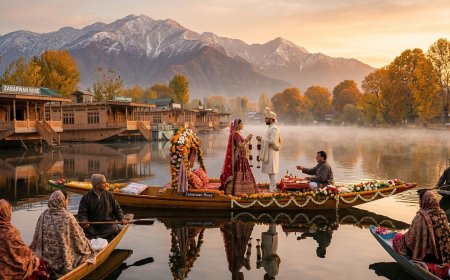
In Himalayan traditions — spanning communities in Himachal Pradesh, Uttarakhand, Ladakh, parts of Kashmir, and the Garhwal and Kumaon regions — the threshold (dwar or dehleez) is not simply architecture. It is a living boundary between the known and the unknown, between the family you were born into and the family you are choosing. The bride's first crossing of this threshold is treated as a cosmically significant moment.
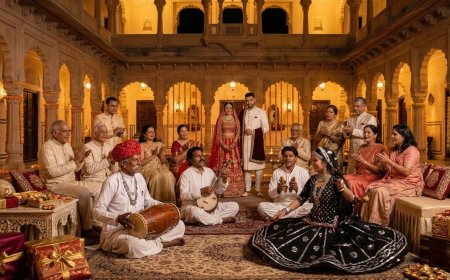
The ritual typically involves the bride standing at the doorstep, welcomed by the mother-in-law with an aarti (flame prayer), and performing specific acts — kicking over a vessel of rice, stepping into a plate of sindoor or alta (red dye) to leave footprints into the home, or being showered with flower petals and rice grains. Prayers are offered to the household deity and the griha devata — the spirit of the home itself. In many Himalayan communities, this also involves the elder women of the family singing traditional mangal geet or Pahari lok geet (folk songs).
It occurs immediately after the baraat arrives and the wedding ceremonies conclude — the bride's first act as a daughter-in-law is this threshold crossing.
The Global Community Comparison Table
| Community / State of Origin | Local Name of Ritual | Key Tradition | How NRIs Abroad Often Adapt It |
|---|---|---|---|
| Himachali (Kangra, Kullu, Mandi) | Nyundra / Dwar Puja | Bride steps into red alta paste, leaves footprints into home; aarti by mother-in-law | Performed at the entrance of a home or banquet hall; red alta substituted with food-safe red dye; recorded for relatives in India via live video |
| Garhwali (Uttarakhand) | Griha Pravesh / Dwar Pooja | Bride kicks over a small kalash of rice at the threshold; elders sing mangal geet | The kalash ritual adapted to indoor venues; folk songs played via Bluetooth speaker or sung by elder family members |
| Kumaoni (Uttarakhand) | Dhuliarghyat / Aagman Puja | Bride enters after elaborate prayers to Nanda Devi; conch shell blown | Conch shell brought from India in checked baggage; priest performs abbreviated puja via video call for geographically separated families |
| Ladakhi | Skyot / Welcome Threshold Rite | Bride welcomed with barley grain, butter tea, and scarves; threshold marked with protective symbols | Tsampa (roasted barley) sourced from Tibetan grocery stores in Toronto or London; symbolic threshold drawn with chalk or rangoli powder |
| Kashmiri Pandit | Lagan Puja / Dwar Vandana | Bride steps over threshold with right foot first; elaborate fire ritual precedes entry | Fire ritual adapted to oil lamp (diya) due to venue restrictions; right-foot-first entry strictly maintained |
| Punjabi | Griha Pravesh | Rice vessel kicked over; bride carries Quran or Granth Sahib depending on faith | Widely practiced in diaspora communities; rice vessel moment often filmed as an emotional highlight reel moment |
| Marathi | Gruhapravesh / Ovalu Ceremony | Bride's feet placed in a plate of milk and kumkum; footprints through home | Milk-and-kumkum plate ritual adapted easily to any venue; widely maintained even in Australia and NZ |
| Tamil | Griha Pravesh / Vaastu Homam | Elaborate fire ritual (homa); bride enters only after priest completes puja | NRI couples often hire Tamil priests in London, Toronto, or Sydney; homa sometimes abbreviated or performed symbolically |
| Bengali | Bou Bhaat / Subho Drishti at threshold | Bride looks at family through betel leaves upon entry; conch shells blown | Shankha (conch shells) carried from Kolkata; practiced with great emotional fidelity even in diaspora |
| Rajasthani / Marwari | Griha Pravesh | Bride pushes a pot of rice with her right foot; offered milk at threshold | Pot of rice ritual very photogenic — widely maintained and well-documented by NRI wedding photographers |
The Meaning Behind the Ritual
Nyundra carries within it thousands of years of mountain philosophy. In Himalayan thought, a home is never merely a structure — it is a living being with its own spirit, its own karma, its own memory. When a new woman enters it as a bride, she is not a guest. She is becoming the lakshmi — the embodiment of prosperity, warmth, and sustaining energy — of that household.
The red footprints she leaves are a declaration: I am here. I bring abundance. I choose this home. The rice vessel that spills symbolizes her bringing prosperity through the very act of arrival. The aarti offered by her mother-in-law is not simply a welcome — it is the older woman passing the invisible baton of household guardianship, acknowledging that a new generation of energy has arrived at the threshold.
For NRI couples explaining this to non-Indian partners or British, Canadian, or Australian friends watching the ceremony, this framing resonates beautifully: "She is not entering a building. She is entering a story — and she is choosing to write the next chapter."
Doing Nyundra Abroad: The Practical Reality
Here is where it gets real, and where NRI.Wedding exists precisely to help you.
The threshold problem: Most Himalayan versions of Nyundra require a genuine doorstep — ideally the front door of a home. Banquet halls and hotel ballrooms don't always offer this. Solution: Create a symbolic threshold using two wooden posts draped with marigold and mango leaves, positioned as a doorframe within your venue. Any pandit familiar with the spirit of the ritual will confirm that intention creates the sacred space.
Red alta or sindoor: Easily available through Indian grocery stores in most major cities — London's Southall, Toronto's Gerrard Street, Melbourne's Dandenong, Houston's Hillcroft. Order in advance. A small flat plate and some red food-safe dye works if alta is unavailable.
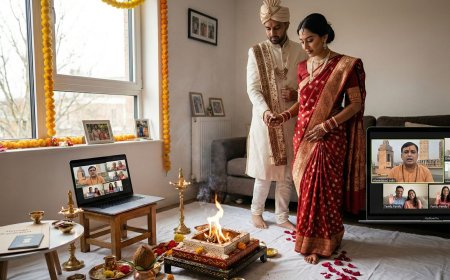
The pandit question: This is the most genuine challenge for Himalayan NRI families. Pahari ritual customs — especially Garhwali, Kumaoni, or Ladakhi variations — are underrepresented even within the broader Indian priest community abroad. NRI.Wedding's vendor directory includes ceremony officiants who specialize in regional Himalayan traditions in the UK, Canada, and Australia. If you cannot find one locally, many families coordinate a pandit in India who guides the ritual via WhatsApp video call, while a local elder performs the actions. This works with preparation and rehearsal.
No fire allowed: Many venues prohibit open flame. Replace the full homa with ghee-lamp diyas, which are equally sacred in intent. Brief your venue coordinator in advance — a diya on a fire-proof plate is manageable in almost any setting.
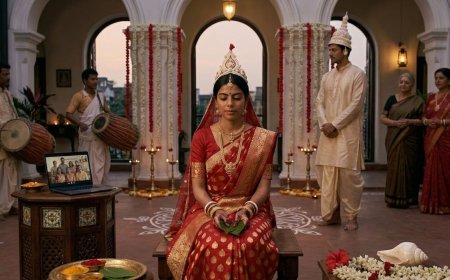
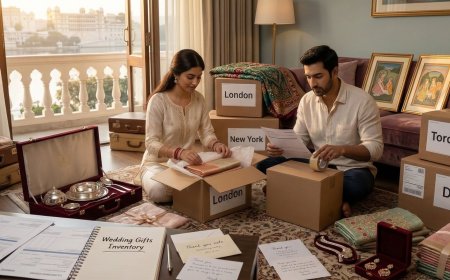
Relatives in India: Schedule the ritual during a timing window that allows family in India (typically IST +5:30 ahead of UK, +10:30 ahead of Toronto, +3:30 ahead of Dubai) to be present on a video call. Assign one family member as the "screen holder" so the moment is properly witnessed and felt, not just seen through a wobbly phone.
Doing Nyundra as a Destination Wedding in India
If your heart is calling you back to the mountains — and for many Himalayan NRI families, nothing less will do — here is what you need to know.
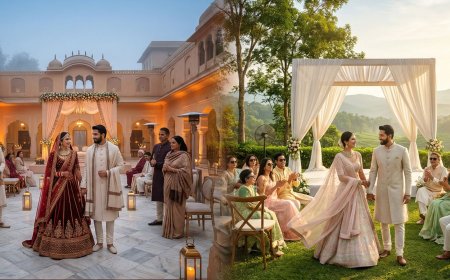
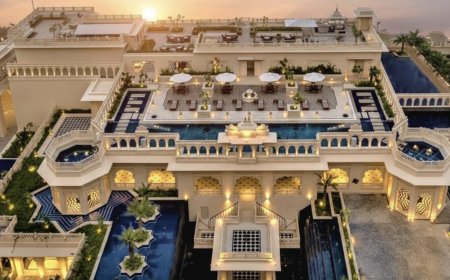
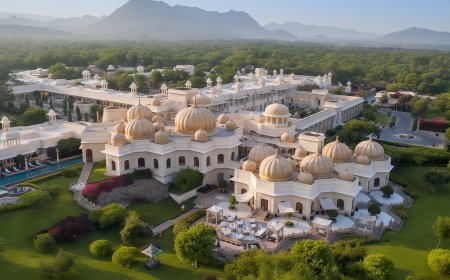
Best locations: Manali, Kasauli, Shimla, Dharamshala, Mussoorie, Nainital, and Rishikesh all offer stunning venues that can genuinely honor a Himalayan threshold ritual. The actual dwar of a heritage property, a mountain haveli, or a traditional guesthouse adds immeasurable authenticity.
Brief your pandit clearly: Many local pandits in mountain towns are accustomed to performing Griha Pravesh for new homes — slightly different from the wedding-context Nyundra. Share the specific community tradition you follow. If your family is from Kullu, ensure the pandit knows Kullu customs, not just generic Himachali ones. NRI.Wedding can help you find region-specific officiants.
Coordinate from abroad: Appoint a local wedding coordinator or planner based in your chosen city who can manage vendor briefings and site checks while you're still in London or Los Angeles. The threshold setup, the floral decoration of the doorway, the sourcing of ritual items — all of this can be prepared in advance with clear written instructions.
Translate the experience: For non-Indian guests or second-generation family members who may not understand Hindi or Pahari, prepare a small printed card (or digital version) explaining the ritual. NRI.Wedding's content team can help you create this.
What You Need for Nyundra
Ritual items:
- A shallow plate or thali with red alta or food-safe red dye
- A small vessel (kalash or matka) filled with uncooked rice
- Marigold garlands for the threshold/doorframe
- Ghee diyas (minimum 5) for aarti
- A coconut, rice grains, and supari for the opening prayer
- Mango leaves and a whole coconut for doorframe decoration
- Red dupatta or chunni for the bride's entry
- Sindoor if applicable to the community tradition
People:
- Mother-in-law (or senior female relative of the groom's family) to lead the aarti
- A pandit or officiant familiar with the specific regional tradition
- Elder women to sing mangal geet or Pahari folk songs
- A designated family member to manage the video call for relatives in India
Preparation:
- Brief the venue on the ritual 2–3 weeks in advance
- Confirm availability of alta, diyas, and coconut at the venue city
- Rehearse the footprint moment — the plate placement, the angle, the movement
Whether you're planning this in Dubai, Delhi, or Detroit — NRI.Wedding connects you with verified pandits, decorators, and wedding coordinators who understand exactly what Nyundra means and exactly what you need, wherever you are in the world.
5 Questions NRI Couples Always Ask About Nyundra
1. "We're having our reception in a hotel ballroom in Birmingham — can we still do Nyundra properly?"
Absolutely. The threshold is symbolic, not architectural. Work with your decorator to create a beautiful doorframe installation at the entrance to your reception hall using wooden posts, marigolds, and mango leaves. The ritual's power comes from intention and participation, not from the building itself. Many NRI couples in the UK have created stunning Nyundra moments in exactly this setting.
2. "My partner is not Indian — how do we include them in the Nyundra in a meaningful way?"
Nyundra is fundamentally about welcome and belonging. Brief your non-Indian partner on the symbolism — they are literally stepping into a shared story. Many families include the partner in the footprint moment, or have them hold the diya alongside the mother-in-law. The ritual is about crossing into togetherness, and that meaning is universal.
3. "We can't find a pandit who knows Garhwali customs in Toronto. What do we do?"
This is genuinely the most common challenge for Himalayan NRI families. NRI.Wedding's vendor directory includes regional specialists. Alternatively, connect with your family's home-village pandit in India and coordinate the ritual guidance via video call, with a locally available pandit performing the actions. With a detailed script prepared in advance, this works beautifully.
4. "My parents are in Dehradun and I'm in Sydney — can the Nyundra moment be properly witnessed over video call?"
Yes, and it is deeply moving when done well. Assign a dedicated screen-holder in Sydney and ensure your parents in Dehradun have a stable video connection. Time the ritual during Sydney daytime — which falls in Dehradun's late afternoon or early evening — so both sides are alert and present. Some families project the live video feed onto a screen so all guests in Sydney can see the Dehradun family witnessing in real time.
5. "What if we're doing a civil wedding in Australia and having a separate religious ceremony — where does Nyundra fit?"
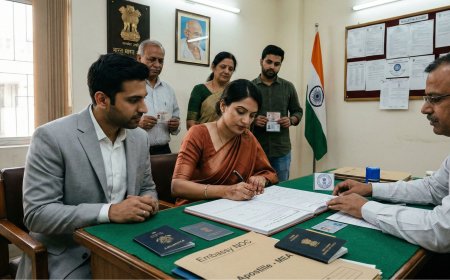
Nyundra fits into the religious or cultural ceremony, not the civil registration. Many NRI couples in Australia do their legal paperwork at a registry office and then hold a full traditional ceremony — including Nyundra — at a separate venue, sometimes weeks apart. The ritual holds its meaning regardless of the legal sequencing.
Bridging Two Worlds: The Emotional Angle
There is a particular kind of ache that Himalayan NRI families carry — the memory of mountains, of cold morning air, of doorways decorated with torans of pine and marigold. When a bride steps across that threshold, somewhere in the room, someone's grandmother is weeping — not with sadness, but with recognition. We carried this with us. Across oceans. Across decades. And it is still here.
Nyundra reminds us that home is not a postcode. It is a practice. It is the deliberate choice to mark a moment, to invite abundance with your own footsteps, to let the women who came before you sing you into your new life. For NRI families, performing this ritual in Vancouver or Melbourne or Manchester is not a lesser version of the real thing. It is, perhaps, a braver version — one that insists on belonging even when belonging requires effort.
A Moment to Smile
At a Garhwali wedding in Mississauga last spring, everything was going beautifully until the bride's alta-covered feet left perfect red footprints across the banquet hall's beige carpet — six steps in, before anyone realized the disposable sheet had shifted. The hall manager arrived, looked at the prints, and then looked at the bride's glowing face surrounded by singing aunties, and quietly said, "We'll sort it out. Congratulations." They framed a photo of the footprints instead. It hangs in the couple's home today. Some things, it turns out, are worth every dry-cleaning bill.
Quotes from the Diaspora
"We flew back to Manali for the wedding specifically because my mother said, 'Nyundra has to happen at a real door.' I didn't fully understand it then. I do now. The moment I stepped across that threshold in the snow, I felt something shift. I belong to that home now." — Priya Thakur, Himachali bride, now based in Calgary
"My son's wife is from Ireland. She had never heard of Nyundra. We showed her a video, explained the meaning, and she said — 'So I'm not just entering a house. I'm making a promise.' She got it completely. She cried before I did." — Sunita Rawat, mother of the groom, Uttarakhandi family settled in Coventry
"Finding a pandit in Sydney who knew our Kumaoni customs was a three-month search. When we finally found him — through a community WhatsApp group — he arrived with a handwritten copy of the shlokas in the original dialect. I've never felt more seen as a Pahadi woman living abroad." — Meena Bisht, bride, Sydney
Closing: Your Roots Travel With You
The mountains of Uttarakhand and Himachal Pradesh did not give you your culture to keep it contained within their valleys. They gave it to you to carry — to London, to Toronto, to Auckland, to wherever you have built your life. Nyundra, the moment a bride steps across a threshold into her new home, is a ritual that requires nothing more than intention, love, and a plate of red alta. The mountains will witness you, wherever you are.
NRI.Wedding is here to help you make it happen — with verified pandits who know your regional traditions, decorators who understand the aesthetic of a Himalayan doorway, and photographers across India and the world who will capture those red footprints for generations to come. Browse our community-specific wedding guides, explore our curated vendor listings for Himalayan weddings both in India and abroad, and download our free NRI Wedding Planning Checklist to begin your journey.
Your roots travel with you. Let them bloom.
Planning a Himalayan wedding as an NRI? Discover the meaning, ritual steps, and practical guide for Nyundra — the sacred threshold ceremony — for Garhwali, Himachali, Kumaoni, and Ladakhi NRI couples in Canada, UK, Australia, UAE and beyond. Find verified pandits and vendors on NRI.Wedding.
What's Your Reaction?
 Like
0
Like
0
 Dislike
0
Dislike
0
 Love
0
Love
0
 Funny
0
Funny
0
 Angry
0
Angry
0
 Sad
0
Sad
0
 Wow
0
Wow
0