


























































QR Codes at Indian Weddings: Creative Uses for Tech-Savvy Couples — The Complete NRI Wedding Planning Guide
At a sangeet, a table card displayed a simple QR code with the words “Scan me.” When a guest from Amsterdam scanned it, a webpage opened with the story of the couple’s engagement, including a short video from the rooftop where the proposal happened. He shared it with a guest from Chennai beside him, and the two began a conversation that lasted forty minutes. The QR code didn’t create the connection—it created the opening. This guide helps NRI couples use QR codes as hospitality tools across their wedding, from invitations and ceremony programs to table stories, menus, interactive maps, playlists, photo sharing, and post-wedding memories, enhancing guest experience meaningfully.

QR Codes at Indian Weddings: Creative Uses for Tech-Savvy Couples
The Small Square That Changed the Guest Experience
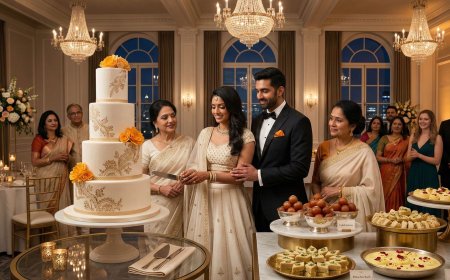
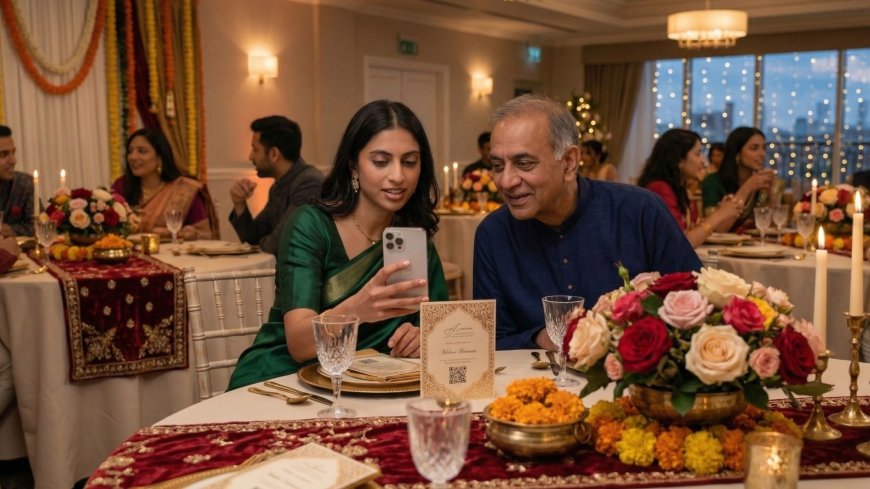
The table card at the sangeet had a QR code on it.
Not instead of the guest's name — the name was there, calligraphed in the same gold ink as the rest of the stationery suite. The QR code was smaller, positioned in the lower right corner of the card, printed in the same deep burgundy as the table number. There was no instruction text beside it — just the code and, beneath it, a single line: Scan me.
The groom's colleague from Amsterdam — a man who described himself as professionally curious and personally nosy, which was not inaccurate — scanned it during the welcome drinks, while the rest of his table was still finding their seats. His phone opened to a short webpage. The page had a photograph of the table's name at the top — the table was named after Jaipur, where the couple had gotten engaged — and below the photograph, three things: a paragraph about why Jaipur was significant to the couple, a curated list of three things to do in Jaipur if the guest had time before or after the wedding, and a short video — thirty seconds — of the couple at the specific rooftop where the proposal had happened, filmed during the planning visit six weeks before the wedding.
He watched the video twice. He showed it to the woman sitting next to him — the bride's aunt from Chennai, who had not yet spoken to him because she had not yet found a conversational opening with a person she had never met and with whom she shared, apparently, no common language beyond a mutual connection to the bride.
"That's where she got engaged," he said, showing her the phone.
"I know," the aunt said, in English that was accented but entirely clear. "I was there when she called to tell her mother."
They spoke for forty minutes.
The QR code on the table card had not produced the conversation. The curiosity, the warmth, the specific fact of two people at the same table with a shared connection to the same person — these had produced the conversation. The QR code had produced the opening. The small square in the lower right corner of the table card had given the curious colleague a reason to do something with his hands during the first three minutes of the sangeet, and had given him something to share with the stranger beside him, and had given the stranger beside him a reason to speak in English to a person she might otherwise not have addressed until the meal service began.
The QR code at the Indian wedding is not a technology feature. It is a hospitality tool — a specific mechanism for delivering information, creating connections, building anticipation, and deepening the guest experience at the precise moment and in the precise context where the information, connection, or anticipation is most valuable.
This guide is the complete framework for how the tech-savvy NRI couple uses QR codes across the full wedding programme — not as a gimmick but as a thoughtfully deployed tool that serves the guest at every moment it appears.
The QR Code Principle: Useful, Not Impressive
The Distinction That Matters
The QR code at a wedding can be impressive or it can be useful. The impressive QR code is the one that demonstrates the couple's technical sophistication and produces the specific response of "oh, how clever" from the guests who encounter it. The useful QR code is the one that gives the guest something they genuinely need at the moment they need it and that they would have been worse off without.
The impressive QR code is forgotten within hours. The useful QR code is remembered because of what it delivered — the video that explained the ceremony, the map that got the guest to the venue without confusion, the playlist that the guest downloaded and listened to on the flight home.
Every QR code in the wedding programme should be evaluated against the useful test before it is included — does this code give the guest something they genuinely need, want, or would be delighted by, at the moment and in the context in which they are scanning it? The QR code that passes this test belongs. The QR code that exists to demonstrate the couple's technical sophistication should be reconsidered.
The Technical Foundation
Before the creative applications, the technical foundation — the specific decisions about how QR codes are created and managed — determines whether the codes work reliably and whether their content can be updated without reprinting the physical materials that carry them.
Dynamic vs static QR codes:
A static QR code encodes the destination URL directly into the code itself — the code and the URL are permanently linked, and if the URL changes or the content at the URL needs to be updated, the code must be regenerated and the physical material reprinted.
A dynamic QR code encodes a redirect URL — the code points to a short URL that redirects to the actual destination. The destination can be changed at any time without changing the code itself. For wedding QR codes on printed stationery — invitations, table cards, programmes, signage — dynamic codes are strongly recommended because they allow the content to be updated if circumstances change without requiring the stationery to be reprinted.
The QR code generator:
Dynamic QR codes require a QR code management service — QR Tiger, Beaconstac, Flowcode, or any of the established QR code management platforms — that manages the redirect and provides scanning analytics. Most services offer free tiers that are adequate for wedding use.
The design consideration:
QR codes can be designed — with custom colours, with a logo or monogram in the centre, with shapes that are round rather than square — within the constraints of the error correction capacity that makes the code scannable. A QR code in the wedding's deep burgundy with the couple's monogram at the centre is both functional and aesthetically integrated with the stationery. The generic black-and-white QR code on premium paper stock creates a visual dissonance that the designed code avoids.
The testing requirement:
Every QR code on printed material must be tested — scanned from the printed version, not from the screen — before the material is finalised for printing. The code that scans perfectly on screen may not scan from the specific paper stock, finish, or size at which it is printed. Test at the actual size and on the actual material before printing runs.
The Applications: Where and How QR Codes Work at Indian Weddings
Application One: The Invitation Suite
The wedding website QR code:
The most common and most straightforward application — a QR code on the invitation that links directly to the wedding website. The guest who receives the invitation scans the code and is taken immediately to the full information resource: the schedule, the accommodation guide, the cultural information, the RSVP form, the dress code, the venue maps.
The wedding website QR code on the invitation replaces the typed URL — which is both more convenient for the guest (no typing required) and more visually elegant on the invitation card (a designed QR code occupies less space than a long URL and integrates more naturally with the invitation's design).
The RSVP QR code:
A separate QR code on the RSVP card or insert that links directly to the RSVP form — bypassing the wedding website's main page and taking the guest immediately to the action they are being asked to take. The direct RSVP QR code reduces the friction between receiving the invitation and completing the RSVP — which, for the international guest managing a complex logistics exercise, is a specific service.
The multi-language invitation:
For NRI weddings with significant multilingual guest representation — where the invitation suite serves guests who read in Tamil, Gujarati, Punjabi, or other regional languages — a QR code on the English invitation that links to translations of the key information is the practical solution to the multilingual invitation challenge. Rather than printing multiple language versions of the full suite, the English invitation with a translation QR code gives every guest access to the information in their preferred language without the production complexity of a multi-language print run.
Application Two: The Wedding Programme
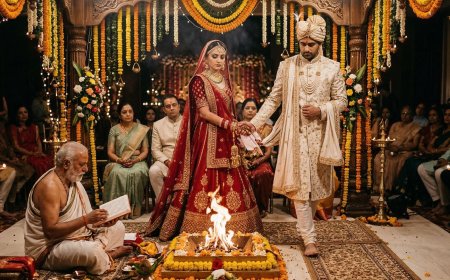
The ceremony programme — the document given to guests at the ceremony that explains the sequence of rituals — is one of the most impactful QR code applications at the NRI wedding because it directly addresses the international guest's most pressing experience gap: the absence of cultural context for what they are witnessing.
The deep cultural explanation QR code:
The ceremony programme can explain the sequence of rituals in the space available on a printed card — but cannot, in that space, provide the depth of cultural and historical context that transforms watching into understanding. A QR code at the top of the programme page — "Scan for the full story of each ritual" — links to a dedicated webpage that provides the complete cultural explanation: the Sanskrit or Arabic or Gurmukhi text of each ritual, its translation, its historical origin, its emotional significance, and its specific place in the marriage tradition.
The guest who scans the code before the ceremony begins arrives at the first ritual with the full context. The guest who scans it during a pause between rituals finds the explanation of what they have just witnessed. The guest who scans it after the ceremony satisfies the curiosity that the ceremony produced.
The music QR code:
The ceremony programme with a QR code linking to a Spotify playlist of the ceremony's music — the specific compositions being played, the classical pieces being sung, the specific ragas or hymns or qawwalis that form the ceremony's musical backdrop — gives the guest a connection to the music that extends beyond the ceremony itself. The guest who discovers a specific composition at the ceremony and wants to listen to it again finds it immediately through the programme's QR code.
Application Three: The Table Cards and Seating
The table card QR code application is the one with the widest creative range — the small card at each place setting is the guest's first personal interaction with the wedding's detail, and the QR code that adds depth to that interaction is the one whose content is most specifically designed for the individual or the table.
The table story code:
As described in the opening of this guide — the QR code that links to the story of the table's name. For weddings where tables are named after significant places, songs, films, or experiences in the couple's relationship, the QR code that tells the story behind the name transforms the table naming from a decorative choice into a narrative experience.
The personalised guest code:
The most technically ambitious table card application — a unique QR code for each guest that links to a personalised webpage created specifically for them. The page contains a personal message from the couple, a photograph of the couple with the guest, and perhaps a shared memory or an inside reference that only this guest would appreciate.
The personalised guest code requires the most preparation — a unique page for each guest at a large wedding is a significant content production exercise — but produces the most specifically personal guest experience. It is most practically achieved for the closest guests, the international guests who have traveled furthest, and the family members whose presence is most significant, rather than for the full guest list.
The table activity code:
For tables where the guest mix requires a social lubricant — the mixed table where guests do not know each other, the table with significant cross-cultural representation — a QR code that links to a table-specific activity: a set of conversation questions designed for the specific mix of guests at that table, a short quiz about the couple whose answers the table must agree on, a shared prediction task about the couple's future.
Application Four: The Mehndi and Pre-Wedding Events
The mehndi design gallery:
A QR code at the mehndi venue that links to a curated gallery of mehndi designs — traditional patterns, contemporary styles, regional variations, the specific motifs that carry significance in the couple's tradition — that guests can browse and discuss with the mehndi artists. The gallery serves two functions: it gives guests who want henna applied a reference for the designs they might choose, and it gives all guests a cultural education in the mehndi tradition's visual vocabulary.
The music request code:
A QR code at the sangeet that links to a music request form — a simple form where guests submit song requests that the DJ receives in real time. The music request code is the digital replacement of the guest who physically approaches the DJ booth — a replacement that is more organised, more equal (every guest can submit a request, not just the ones who are comfortable approaching the DJ), and more manageable for the DJ who receives requests in a organised queue rather than as a series of shouted conversations.
The photo sharing code:
A QR code at each event that links to a shared photo album — a Google Photos shared album, a Dropbox folder, or a dedicated wedding photo platform — where guests can upload the photographs they take during the event. The shared photo album aggregates the guest photography from all events into a single accessible collection that the couple can access after the wedding.
The photo sharing QR code is one of the most consistently valuable wedding QR applications because it captures the photographs that the professional photographer does not take — the candid moments, the private conversations, the specific expressions that the professional camera missed because it was pointing at something else at the same moment.
Application Five: The Venue Signage
The venue map QR code:
Large wedding venues — particularly destination wedding venues in Rajasthan or Kerala whose property spans multiple buildings, gardens, and event spaces — are frequently confusing for guests who are navigating between events for the first time. A QR code on the venue's welcome signage that links to an interactive map of the property — with each event space labelled, the walking routes indicated, and the accessibility routes marked — is the practical navigation tool that the printed venue map cannot fully replace.
The vendor credit code:
For guests who want to know who designed the florals, who made the bridal outfit, who did the mehndi — a QR code on the welcome signage or the programme that links to a vendor credit page. The vendor credit page is simultaneously a service to guests who want to know more about the specific vendors and a gesture of appreciation to the vendors whose work has contributed to the wedding's aesthetic.
The house rules and logistics code:
For outdoor venues where specific logistics apply — no flash photography during the ceremony, specific shoe removal protocols, the location of the nearest medical support — a QR code on the entrance signage that links to the concise list of house rules and practical logistics information.
Application Six: The Reception
The menu QR code:
The QR code on the reception dinner table that links to the full menu — with ingredient lists, allergen information, regional origin descriptions, and the specific story of why certain dishes were chosen. The menu QR code is particularly valuable for the NRI wedding's international guests who may be encountering specific dishes for the first time and who benefit from the ingredient information both for dietary reasons and for the simple pleasure of knowing what they are eating.
The speech and toast cue:
For weddings with multiple speeches and toasts from family members and friends — the QR code on a discreet card at each table that links to a page where guests can submit a toast or add a note to the couple. The toast collection page — accessible during the dinner — produces a collection of written toasts from the full guest list that complements the spoken toasts from the selected speakers. The couple receives not four toasts from selected speakers but two hundred brief notes from the full gathering.
The charity donation code:
For couples who have designated a charity in lieu of wedding favours or as an additional gift option — the QR code on the table card or the favour item that links directly to the charity's donation page. The charity QR code is the specific mechanism that makes the charitable giving option genuinely accessible — a guest who would not otherwise navigate to the charity website on their own will scan a code at the table during dinner.
Application Seven: The Wedding Favours
The wedding favour with a QR code — a QR code on the favour's packaging that adds a digital dimension to the physical gift — is one of the most creative applications of the technology in the wedding context.
The recipe code:
A favour of a locally sourced food item — the ghevar from Jaipur, the coconut sweets from Kerala, the pickle from the bride's grandmother's recipe — with a QR code on the packaging that links to the recipe. The guest who takes the favour home has both the physical experience of the food item and the recipe that allows them to recreate it — a gift that extends well beyond the wedding day.
The music playlist code:
A favour whose packaging carries a QR code linking to the couple's curated playlist — the songs that defined their relationship, the music of their respective cultural backgrounds, the specific tracks that they want the guest to take home from the wedding as a sonic memory. The playlist code is the digital equivalent of the mix CD — the personalised musical gift that takes no physical space and travels home with every guest regardless of their luggage situation.
The memory letter code:
A favour with a QR code that links to a video message from the couple — a personal thank you, a specific wish for the guest, a brief expression of what the guest's presence at the wedding has meant. The memory letter code on a beautifully designed favour produces a moment of private, personal connection in the context of a large public celebration — the guest who scans the code in their hotel room after the reception receives something specifically for them.
Application Eight: The Post-Wedding
The photograph delivery code:
A thank you card sent after the wedding that includes a QR code linking to the couple's selected professional photographs — the gallery of images that the photographer has delivered and that the couple wants to share with the guests who attended. The photograph delivery code is the post-wedding gift — the invitation to experience the wedding again through the professional lens.
The video highlights code:
A thank you communication that includes a QR code linking to the wedding highlight video — the short film that the videographer has produced from the footage of the full wedding programme. The video highlights code is the most personally valued post-wedding digital content for the guests who attended and the most powerful surrogate experience for the guests who could not.
The Design Integration: Making QR Codes Beautiful
The Aesthetic Challenge
The standard QR code — black squares on a white background — is visually incompatible with the premium aesthetic of most NRI wedding stationery. The solution is not to accept the visual dissonance but to design the QR code as an integral element of the stationery.
The design options:
Colour integration: QR codes can be produced in any colour, as long as the contrast between the code and its background meets the minimum contrast ratio for reliable scanning. A QR code in the wedding's deep burgundy on a cream background is visually integrated with the stationery and functionally reliable.
Monogram centre: the centre of a QR code can accommodate a small logo or monogram — typically up to thirty percent of the code's area — without compromising scannability. The couple's monogram at the centre of the QR code is both visually elegant and personally branded.
Shape customisation: the square modules of the standard QR code can be replaced with rounded or custom shapes that are more visually sympathetic to curved and decorative design styles. Custom-shaped QR codes require more careful testing for scannability but produce a significantly more refined visual result.
Frame and label integration: adding a simple frame and a brief instruction — "Scan for the story" or "Open on your phone" — contextualises the code without requiring explanation from a person and integrates the call to action with the design.
Common Mistakes NRI Couples Make With Wedding QR Codes
The first mistake is deploying QR codes without testing them on the actual printed material. The code that works perfectly when scanned from a screen may fail to scan from the specific paper stock, finish, or reduced size at which it is printed. Every QR code on printed material must be tested — at the actual print size, on the actual paper — before the final print run.
The second mistake is using static QR codes for time-sensitive or potentially changeable content. The shuttle schedule, the ceremony timing, the venue map — this content may need to be updated after the stationery is printed. Static codes whose destination content is fixed cannot be updated without reprinting. Use dynamic QR codes for all time-sensitive content.
The third mistake is not providing context for the code. The QR code that appears without instruction — without the "Scan me" or the brief label that tells the guest what to expect — is the code that many guests, particularly older guests less familiar with QR technology, will not scan. A one-line label that describes what scanning will deliver — "Scan for the story of our engagement" — both contextualises the code and creates the specific curiosity that drives scanning.
The fourth mistake is linking to content that does not work on a mobile device. The QR code links to a webpage — which will be opened on the guest's smartphone. The webpage must be mobile-optimised — responsive design, fast loading, no Flash elements, no content that requires a desktop browser to access. A QR code that links to a page that displays incorrectly on mobile has created a worse guest experience than no QR code at all.
The fifth mistake is overdeploying QR codes to the point where they lose their specific function. The wedding stationery suite that has a QR code on every element — the invitation main card, the RSVP card, the schedule insert, the accommodation card, the table card, the menu card, the programme, the favour packaging — produces the specific fatigue of a communication channel that has been used so frequently that each individual code no longer carries the specific invitation of a discovery waiting to be made. Deploy QR codes where they deliver specific value — not on every surface where they can be placed.
The Small Square With the Large Function
The Amsterdam colleague and the aunt from Chennai spoke for forty minutes because a QR code had given them a reason to begin.
Not the QR code itself — the QR code was a square of burgundy pixels on a cream card. What it had given them was the video of the rooftop in Jaipur, and the video had given the colleague something to show, and the showing had given the aunt something to respond to, and the response had given them both the opening that the seating plan had created but that neither of them would have found on their own in the first three minutes of a sangeet.
The QR code did not create the connection. The connection was already there, waiting — two people who loved the same person, who had traveled significant distances to be at the same celebration, who had more in common than the absence of a conversation had allowed them to discover.
The QR code created the opening.
That is the correct and complete job description of the wedding QR code. Not to impress. Not to demonstrate technical sophistication. Not to replace the human warmth of a beautifully printed invitation or a personally written message or the genuine hospitality of a well-planned event. But to create the opening — the specific moment where information becomes connection, where the guest's curiosity is met with exactly the right content at exactly the right moment, where the small square in the lower right corner of the table card delivers something that the table card alone could not.
Design them with intention.
Link them to content that genuinely serves the guest.
Place them where the opening is needed.
Test them before you print.
And let the small square do its large and specific job.
Published by NRIWedding.com — The Premium Global Platform for Non-Resident Indians Planning Indian Weddings From Abroad.
What's Your Reaction?
 Like
0
Like
0
 Dislike
0
Dislike
0
 Love
0
Love
0
 Funny
0
Funny
0
 Angry
0
Angry
0
 Sad
0
Sad
0
 Wow
0
Wow
0